Our Favorite Book Covers of 2010

We know you’re not supposed to judge a book by its cover and blah blah blah, but really, c’mon, aesthetic sensibilities go a long way. Here are a some of our favorite covers for books published in 2010.

Has Melville House made a book that’s not really really good looking? This NY indie not only put out some of our favorite reading of 2010, they also put out some of the best designed books of the year. Books like Jean-Christophe Valtat’s Aurorarama and Mahendra Singh and Lewis Carroll’s The Hunting Carroll evince a diverse aesthetic range unified by simple and attractive designs. We absolutely love the cover for Tao Lin’s Richard Yates; the visual non sequitur dovetails nicely with the book’s arbitrary name.

In fact, it’s a trio of forthcoming books from Melville House that prompted this post. In January, they’ll release the first in a series of books by Nobel winning German author Heinrich Böll. The first three books, which arrived at Biblioklept World Headquarters yesterday, are beautiful, simple, and elegant.

We’ve started The Clown; a review of the book’s guts forthcoming. Another book with a cool cover that we haven’t read yet is Adam Ross’s Mr. Peanut. We know someone on Twitter pointed out that skulls are the smiley faces of this decade but we can’t remember who gets credit, so let’s just pretend you heard that witticism here first.


We haven’t read Adam Levin’s mammoth début The Instructions yet, but a copy arrived today, and man is it beautiful. McSweeney’s knows how to do a hardback right–why encumber a book with a dusty dust jacket that’s going to get in the reader’s way when some gold embossing will do much nicer? Our copy is white but we couldn’t find an image of a white one on the internet, so here’s a blue one because Jesus Christ we’re not about to start photographing books now, are we?

We like both covers for Tom McCarthy’s C, but maybe we’re biased here because we loved the book so much.

We also love the cover of Charles Burns’s X’ed Out.

Picador’s British edition of Roberto Bolaño’s Nazi Literature in the Americas is somehow playful and deadly serious at the same time (just like the book).

Another one on the posthumous tip: We’re not big into tattoos but we can’t help digging this cover for David Foster Wallace’s The Broom of the System.

Amy Hempel on Gordon Lish and Barry Hannah

Amy Hempel talks Gordon Lish and Barry Hannah (among other things) in a new interview with Vice. A taste–

Do you think about readers when you’re writing? Do you personify them?
I do. I always have, and it’s always been a handful of other writers. Sometimes it has changed, but yes, I really do think of a few actual people. It makes it a little bit easier since I know them, and I know that, well, if this person will find it funny, then I’ve succeeded, or some such thing. It makes it more like trading confidences. I think it’s daunting to think of writing for one’s readers, whoever they may be, so I bring it down to something manageable—a few people whose standards I know and whose work I very much admire—and that makes it more like, almost, a letter to the person. That helps me set the course.

So do you think like, “I’m going to change this here. I’m sure Gordon Lish would love it”?
[laughs] Well, I often have in mind Barry Hannah, and in fact when you phoned me just now, I was working on some remarks I’m going to make at a sort of memorial tribute to Barry, who died last March. This is something that will be held just outside Boston, two nights from now. A bunch of writers who adored him, just paying tribute to him. Barry Hannah was always on my list of people I knew, writers I admired immensely, and just thinking, you know, Barry Hannah might read this, it seemed to focus me when I was writing.

Writing is an extremely solitary activity, but at the same time it’s also very intense. One analogy that I always think of is swimming—it’s something that you do on your own, and the only standard of success you have is your last lap.
I agree 100 percent. And yet there are writers who hold themselves up and compare themselves to other writers. I think that’s useless. As you say, you’re only trying to beat your own best time. That’s the only relevant competition as far as I’m concerned.

Is your past with Lish something that still has an influence on you?
You know, it was a long time ago. I was a student of his at Columbia and then privately and then his author back in the early 80s. I did two books with him. Working with him was a crucial formative experience, but it was a long time ago. There are other writers who have sort of stepped in. Interestingly, Barry Hannah was one and Mary Robison is another, and they are both his authors, too, and were at the time that I was being published by him. So, yes, [Lish] had a terrific impact on my writing very early on. I don’t think he’s writing any more, but he’s still present among writers who really do care about writing at the sentence level. His impact there has certainly endured.

What about the so-called golden age of American short stories? I don’t really know if it’s accurate, or even intelligent, to define it that way.
Well, I think it was a phenomenon in publishing, with a lot of critics rightly going to Raymond Carver—who was also Gordon’s author—and people like Mary Robison. You know—some of the story writers who really, really opened things up again for stories as a commercially viable kind of writing as well as something that was important to a lot of readers.

“Christmas Trees” — Robert Frost

“Christmas Trees” by Robert Frost–

A Christmas Circular Letter

The city had withdrawn into itself
And left at last the country to the country;
When between whirls of snow not come to lie
And whirls of foliage not yet laid, there drove
A stranger to our yard, who looked the city,
Yet did in country fashion in that there
He sat and waited till he drew us out
A-buttoning coats to ask him who he was.
He proved to be the city come again
To look for something it had left behind
And could not do without and keep its Christmas.
He asked if I would sell my Christmas trees;
My woods—the young fir balsams like a place
Where houses all are churches and have spires.
I hadn’t thought of them as Christmas Trees.
I doubt if I was tempted for a moment
To sell them off their feet to go in cars
And leave the slope behind the house all bare,
Where the sun shines now no warmer than the moon.
I’d hate to have them know it if I was.
Yet more I’d hate to hold my trees except
As others hold theirs or refuse for them,
Beyond the time of profitable growth,
The trial by market everything must come to.
I dallied so much with the thought of selling.
Then whether from mistaken courtesy
And fear of seeming short of speech, or whether
From hope of hearing good of what was mine,
I said, “There aren’t enough to be worth while.”
“I could soon tell how many they would cut,
You let me look them over.”

“You could look.
But don’t expect I’m going to let you have them.”
Pasture they spring in, some in clumps too close
That lop each other of boughs, but not a few
Quite solitary and having equal boughs
All round and round. The latter he nodded “Yes” to,
Or paused to say beneath some lovelier one,
With a buyer’s moderation, “That would do.”
I thought so too, but wasn’t there to say so.
We climbed the pasture on the south, crossed over,
And came down on the north.
He said, “A thousand.”

“A thousand Christmas trees!—at what apiece?”

He felt some need of softening that to me:
“A thousand trees would come to thirty dollars.”

Then I was certain I had never meant
To let him have them. Never show surprise!
But thirty dollars seemed so small beside
The extent of pasture I should strip, three cents
(For that was all they figured out apiece),
Three cents so small beside the dollar friends
I should be writing to within the hour
Would pay in cities for good trees like those,
Regular vestry-trees whole Sunday Schools
Could hang enough on to pick off enough.
A thousand Christmas trees I didn’t know I had!
Worth three cents more to give away than sell,
As may be shown by a simple calculation.
Too bad I couldn’t lay one in a letter.
I can’t help wishing I could send you one,
In wishing you herewith a Merry Christmas.


Heroes of 2010 — David Mitchell

Vice Interviews Sam Lipsyte

Vice interviews Sam Lipsyte–good stuff. From the interview, here’s Lipsyte on writing comedy–

The page is very different than what a stand-up comic does. A comedian has a physical body—gestures, vocal intonations, double takes—whatever they’re going to do to bring across the comedy. They can make a phrase funny just by the way they say it. Authors don’t have any of those tools at our disposal, so we have to find lingual ways to do it. So much of it is how you build to something, how wide you make a loop of description before you veer off and land somewhere totally unrelated. You have to learn how that rhythm works in prose. It has to be something you feel.

I don’t want it to be too jokey, I don’t want it to be making claims for itself as funny, but then you must laugh because it is a funny moment. I pursue… something strange, usually, in every paragraph. It may be funny, or it may be something I don’t think is that funny. I’ve had people come up to me and say, “That was so funny!” and I think, “Dude, that’s the most devastating moment in the book.” I’ve realized that it’s both. In my work the funniest thing is usually the most devastating thing, and that’s where they play with each other.

“The Savior must have been a docile Gentleman” — Emily Dickinson

Emily Dickinson’s nativity poem, “The Savior must have been a docile Gentleman”–

The Savior must have been
A docile Gentleman—
To come so far so cold a Day
For little Fellowmen—

The Road to Bethlehem
Since He and I were Boys
Was leveled, but for that ‘twould be
A rugged Billion Miles—

James Joyce’s Death Mask

Charles Burns Talks to Vice; Discusses Subconscious Tintin Influences

At Vice, Sammy Markham (Crickets) interviews one of our heroes of Charles Burns. Read our review of Burns’s latest, X’ed Out. From the interview with Markham, Burns discusses subconscious influences–

There’s work that I grew up with and looked at and internalized. It is still in my subconscious, and I pay attention to that part of myself, and those images come through. For example, I looked at Tintin books when I was really, really young—before I could even read—and so there were elements of the stories that I didn’t understand the relevance of. In The Secret of the Unicorn there’s one scene where Tintin is down in this basement. He’s been kidnapped. He wakes up and there’s this intercom that’s stuck on the wall. And in my mind, I had no idea what an intercom was, but I could tell that there was a voice balloon coming from this little hole in the wall.

In a weird and felicitous coincidence, I happened to have read The Secret of the Unicorn just last week and then read a comic by Burns in the May or June 2010 issue of The Believer where he riffs on the very scene he’s described above, a comic I only understood after reading Unicorn. Here’s the comic–

“A Christmas Greeting” — Walt Whitman

“A Christmas Greeting” by Walt Whitman

Welcome, Brazilian brother–thy ample place is ready;
A loving hand–a smile from the north–a sunny instant hall!
(Let the future care for itself, where it reveals its troubles,
impedimentas,
Ours, ours the present throe, the democratic aim, the acceptance and
the faith;)
To thee to-day our reaching arm, our turning neck–to thee from us
the expectant eye,
Thou cluster free! thou brilliant lustrous one! thou, learning well,
The true lesson of a nation’s light in the sky,
(More shining than the Cross, more than the Crown,)
The height to be superb humanity.

“Welcome” — Deb Olin Unferth

“Welcome,” a short story by Deb Olin Unferth, published in Vice’s annual fiction issue. A sample–

I finally figured it out and I said it: You want me to leave?

I said this because I did have small evidences. The day before they had gotten a little meaner, one of them especially, the bigger one, the one who had earlier been my champion. But I didn’t understand. I had been having such a nice time. I was bewildered. Why did they suddenly not love me?

And then the next morning it happened again. The big one had a mean look on his face. The other figured she didn’t need to have an ugly look on her face because the big one was taking care of it, so she could just stand to the side and look on, bemused. But I was so stupid, I still didn’t understand. I looked at the littler one as if to say, Why is he acting this way?

A Gordon Lish Sentence That Cracked Me Up

Today, I listened to Iambik’s audiobook version of Collected Fictions, a selection of stories written and read by the inimitable Gordon Lish. Lish reads a few choice stories from four of his volumes in a wry, gruff tone; he’s got a wonderful rhythmic style, and he pauses to reflect on some of the selections before and after reading them. I’ll give the volume a proper review down the line, but I wanted to share a passage–a long sentence, really—that made me laugh out loud from the story “Mr. Goldbaum,” from the 1988 collection Mourner at the Door. I actually own Mourner at the Door, and had read “Mr. Goldbaum” sometime earlier this year or last year, but I don’t remember it being nearly as funny or touching. Must be Lish’s delivery. Anyway, the Lishness, which can be appreciated entirely out of context–

What if your father was the kind of father who was dying and he called you to him and you were his son and he said for you to come lie down on the bed with him so that he could hold you and so that you could hold him so that you both could be like that hugging with each other like that to say goodbye before you had to actually go leave each other and did it, you did it, you god down on the bed with your father and you got up close to your father and you got your arms around your father and your father was hugging you and you were hugging your father and there was one of you who could not stop it, who could not help it, but who just got a hard-on?

Or both did?

Picture that.

Not that I or my father ever hugged like that.

“Santa” — Kate Beaton

Kate Beaton’s “Santa,” from her site Hark, a Vagrant!

The AV Club Interviews Lynda Barry

The AV Club’s Tasha Robinson interviews comix legend Lynda Barry. In the (rather lengthy) interview, Barry discusses teaching her craft–

It’s a really hard thing to teach students. The two things I always try to teach them is, one, you have to stay in motion. It doesn’t mean that you have to just write blah, blah, blah, blah, blah. Write the alphabet. You have to stay in motion. And the other thing is, when you get stuck, don’t read over what you just wrote. Especially if you have a computer. Maybe by hand is not so bad, but with a computer, what happens is… My experience has always been that there is a point when the story just stops. Always. You know, it’s just like when you’re dancing. There’s a time when you’re fake-dancing, because the groove has stopped. Then you’re back in the groove. So if people understood that that’s a natural part of making something, and they knew what to do during that time… But what people will do if they’re writing on a computer is, when that time comes and it’s quiet for a minute, they panic and go back and start fixing stuff above it that was not even broken. You can’t start to fix something until you know what it’s for, you know? So I always try to get my students to just sustain the state of mind for a certain amount of time. Even though I use 24 panels for my students, they’ll have seven minutes to just sustain this open state of mind while they’re writing, keep their hand in motion. But it’s really tough to get them to believe me, to just to even give it a try. And then once they do, it’s really fun.

A Blood Meridian Christmas

Cormac McCarthy’s seminal anti-Western Blood Meridian isn’t exactly known for visions of peace on earth and good will to man. Still, there’s a strange scene in the book’s final third that subtly recalls (and somehow inverts) the Christmas story. The scene takes place at the end of Chapter 15. The Kid, erstwhile protagonist of Blood Meridian, has just reunited with the rampaging Glanton gang after getting lost in the desert and, in a vision-quest of sorts, has witnessed “a lone tree burning on the desert” (a scene I argued earlier this year was the novel’s moral core).

Glanton’s marauders, tired and hungry, find temporary refuge from the winter cold in the town of Santa Cruz where they are fed by Mexicans and then permitted to stay the night in a barn. McCarthy offers a date at the beginning of the chapter — December 5th — and it’s reasonable to assume, based on the narrative action, that the night the gang spends in the manger is probably Christmas Eve. Here is the scene, which picks up as the gang — “they” — are led into the manger by a boy–

The shed held a mare with a suckling colt and the boy would would have put her out but they called to him to leave her. They carried straw from a stall and pitched it down and he held the lamp for them while they spread their bedding. The barn smelled of clay and straw and manure and in the soiled yellow light of the lamp their breath rolled smoking through the cold. When they had arranged their blankets the boy lowered the lamp and stepped into the yard and pulled the door shut behind, leaving them in profound and absolute darkness.

No one moved. In that cold stable the shutting of the door may have evoked in some hearts other hostels and not of their choosing. The mare sniffed uneasily and the young colt stepped about. Then one by one they began to divest themselves of their outer clothes, the hide slickers and raw wool serapes and vests, and one by one they propagated about themselves a great crackling of sparks and each man was seen to wear a shroud of palest fire. Their arms aloft pulling at their clothes were luminous and each obscure soul was enveloped in audible shapes of light as if it had always been so. The mare at the far end of the stable snorted and shied at this luminosity in beings so endarkened and the little horse turned and hid his face in the web of his dam’s flank.

The “shroud of palest fire” made of sparks is a strange image that seems almost supernatural upon first reading. The phenomena that McCarthy is describing is simply visible static electricity, which is not uncommon in a cold, dry atmosphere–particularly if one is removing wool clothing. Still, the imagery invests the men with a kind of profound, bizarre significance that is not easily explainable. It is almost as if these savage men, naked in the dark, are forced to wear something of their soul on the outside. Tellingly, this spectacle upsets both the mare and her colt, substitutions for Mary and Christ child, which makes sense. After all, these brutes are not wise men.

Santa Claus Rape in Ellison’s Invisible Man

I’m finishing up Ralph Ellison’s Invisible Man, and I came to this shocking, weird, gross, Christmasy reference near the end of the book. The context is that, in 1950s America, Sibyl, a white woman, wants the narrator, a black man, to fulfill her rape fantasy. Page 522 of my edition–

George Orwell’s Recipes for Plum Cake and Christmas Pudding

(Via).

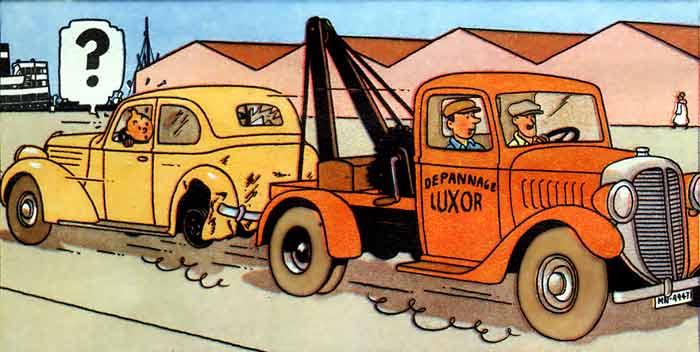
Every Car in Hergé’s Tintin Comics

Every car in Hergé’s Tintin comics.