Unidentified participant: Mr. Faulkner, you may have touched on this previously, but could you give some advice to young writers? What advice would you give to young writers?
William Faulkner: At one time I thought the most important thing was talent. I think now that—that the young man or the young woman must possess or teach himself, train himself, in infinite patience, which is to—to try and to try and to try until it comes right. He must train himself in ruthless intolerance. That is, to throw away anything that is false no matter how much he might love that page or that paragraph. The most important thing is insight, that is, to be—to curiosity—to—to wonder, to mull, and to—to—to muse why it is that man does what he does. And if you have that, then I don’t think the talent makes much difference, whether you’ve got that or not.
Unidentified participant: How would you suggest that he get this insight? Through experience?
William Faulkner: Yes, and then the greatest part of experience is in the books, to read. To read and to read and to read and to read. To watch people, to have—to never judge people. To watch people, what they do, with—with—without intolerance. Simply to—to learn why it is they did what they did.
Unidentified participant: This is a question about writing in general. I think maybe you just answered it, but they say until Hawthorne came along that there were two ways to construct a story: either start with the characters and then a plot, or start with a plot and make up your characters, and they say that Hawthorne started with the idea and invented both. And I wonder, I know there’s no one formula to producing a story, but I just wonder where you start most often and what you feel is most important, what pattern you [have worked out] to use?
William Faulkner: Three methods you just stated, all will work but—but none—neither or none are more important than the others, and no one can say just what method the story demands. Apparently there’s something inside the man or the woman that must be—be told, must be written. It could be an anecdote. It could be a character. It could be an idea, but I don’t think you could say which system to—or which pattern to assume in order to—to create a story or a book.
Unidentified participant: You have no favorite pattern? It just depends on the individual—?
William Faulkner: That’s right, that’s right. It could be an anecdote. The Sound and the Fury came out of an anecdote, a picture of a—a little girl, the muddy seat of her drawers when she climbed the tree to look in a parlor window, and that’s—the book came from that.
Unidentified participant: Mr. Faulkner
William Faulkner: Sir.
Unidentified participant: In The Sound and the Fury, the first three sections of that book are narrated by one of the—of the four Compson children, and in view of the fact that Caddy figures so prominently, is there any particular reason why you didn’t have a section with—giving her views or impressions of what went on?
William Faulkner: That’s a good question. That—the explanation of that whole book is in that. It began with the—the picture of the—the little girl’s muddy drawers, climbing that tree to look in the parlor window with her brothers that didn’t have the courage to climb the tree waiting to see what she saw. and I tried first to tell it with one brother, and that wasn’t enough. That was Section One. I tried with another brother, and that wasn’t enough. That was Section Two. I tried the third brother, because Caddy was still to me too beautiful and too moving to—to reduce her to telling what was going on, that it would be more—more passionate to see her through somebody else’s eyes, I thought. And that failed, and I tried myself, the fourth section, to tell what happened, and I still failed. [audience laughter] So—
Unidentified participant: Mr. Faulkner, when you wrote this, did you have it thought out beforehand, the whole sequences, or did they sort of evolve as you wrote it?
William Faulkner: It evolved as I wrote it. It began with the picture, as I said, of—of the little girl climbing the tree to tell her brothers what was going on in the room where the grandmother’s funeral was taking place, and the rest grew from that.
Unidentified participant: Sir, when you are reading for your own pleasure, which authors do you consistently return to?
William Faulkner: The ones I came to love when I was eighteen, nineteen, twenty years old. Moby-Dick, the Old Testament, Shakespeare, a lot of Conrad, Dickens. I read Don Quixote every year.
Today is Black Friday in America. I don’t think it’s necessary to remark at length on the bizarre disjunction between this exercise in consumerism-as-culture and the intended spirit of the Thanksgiving holiday that precedes it. Indeed, I think that the cognitive dissonance that underwrites Black Friday—the compulsion to suffer (and cause suffering), both physically and mentally, to “save” money on “consumer goods” (sorry for all the scare quotes, but these terms are euphemisms and must be placed under suspicion)—I think that this cognitive dissonance is nakedly apparent to all who choose to (or are forced to) actively engage in Black Friday. The name itself is dark, ominous, wonderfully satanic.
Rereading “The Subliminal Man,” I was struck by how presciently J.G. Ballard anticipated not only the contours of consumerist culture—urban sprawl, a debt-based economy, the mechanization of leisure, the illusion of freedom of choice—but also how closely he intuited the human, psychological responses to the consumerist society he saw on the horizon. Half a century after its publication, “The Subliminal Man” seems more relevant than ever.
The premise of the tale is fairly straightforward and fits neatly with the schema of many other early Ballard stories: Franklin, an overworked doctor, is approached by Hathaway, a “crazy beatnik,” who refuses to take part in the non-stop consumerism of contemporary society. Hathaway can “see” the subliminal messages sent through advertising. He asks for Franklin’s help in stopping the spread of these messages. Hathaway reasons that the messages are intended to enforce consumerist society:
Ultimately we’ll all be working and spending twenty–four hours a day, seven days a week. No one will dare refuse. Think what a slump would mean – millions of lay–offs, people with time on their hands and nothing to spend it on. Real leisure, not just time spent buying things . . .
The fear of a slump. You know the new economic dogmas. Unless output rises by a steady inflationary five per cent the economy is stagnating. Ten years ago increased efficiency alone would raise output, but the advantages there are minimal now and only one thing is left. More work. Subliminal advertising will provide the spur.
Franklin is unconvinced, even though he is already working Saturdays and Sunday mornings to payoff TVs, radios, and other electronic goods that he and his wife replace every few months. Soon, however, he realizes that something is wrong:
He began his inventory after hearing the newscast, and discovered that in the previous fortnight he and Judith had traded in their Car (previous model 2 months old) 2 TV sets (4 months) Power mower (7 months) Electric cooker (5 months) Hair dryer (4 months) Refrigerator (3 months) 2 radios (7 months) Record player (5 months) Cocktail bar (8 months)
Franklin finally sees the truth, but only after Hathaway takes to blowing up signs’ switch boxes (the word “terrorism” is of course not used in the text, although it surely would be today):
Then the flicker of lights cleared and steadied, blazing out continuously, and together the crowd looked up at the decks of brilliant letters. The phrases, and every combination of them possible, were entirely familiar, and Franklin knew that he had been reading them for weeks as he passed up and down the expressway.
BUY NOW BUY NOW BUY NOW BUY NOW BUY NEW CAR NOW NEW CAR NOW NEW CAR NOW
YES YES YES YES YES YES YES YES YES YES
Like many Ballard stories, “The Subliminal Man” ends on a pessimistic note, with Franklin choosing to ignore his brief enlightenment and give in. Ballard drives his criticism home in the final image of the story, with Franklin and his wife heading out to shop:
They walked out into the trim drive, the shadows of the signs swinging across the quiet neighbourhood as the day progressed, sweeping over the heads of the people on their way to the supermarket like the blades of enormous scythes.
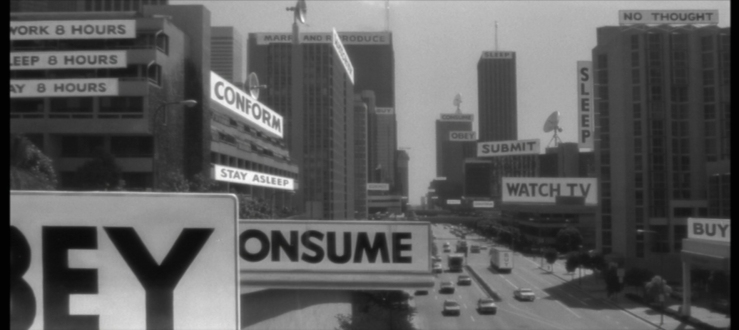
“The Subliminal Man” offers a critique of consumerism that John Carpenter would make with more humor, violence, and force in his 1988 film They Live. In Carpenter’s film, the hero John Nada (played by Roddy Piper) finds a pair of sunglasses that allow him to see through the ads, billboards, and other commercials he’s exposed. What’s underneath? Naked consumerism:
The images here recall the opening lines of “The Subliminal Man”: ‘The signs, Doctor! Have you seen the signs?’ Like Ballard’s story, Carpenter’s film is about waking up, to seeing the controlling messages under the surface.
In his film The Pervert’s Guide to Ideology, Slavoj Žižek offers a compelling critique of just how painfulit is to wake up to these messages:
It’s worth pointing out that Carpenter offers a far more optimistic vision than Ballard. Ballard’s hero gives in—goes back to sleep, shuts his eyes. Carpenter’s hero Nada resists the subliminal messages—he actually takes up arms against them. This active resistance is possible because Carpenter allows his narrative an existential escape hatch: In They Live, there are real, genuine bad guys, body-snatching ugly-assed aliens—others that have imposed consumerism on humanity to enslave them. That’s the big trick to They Live: It’s not us, it’s them.
Ballard understands that there is no them; indeed, even as the story skirts around the idea of a conspiracy to dupe consumers into cycles of nonstop buying, working, and disposing, it never pins that conspiracy on any individual or group. There’s no attack on corporations or government—there’s not even a nebulous “them” or “they” that appears to have controlling agency in “The Subliminal Man.” Rather, Ballard’s story posits ideology as the controlling force, with the only escape a kind of forced suicide.
I don’t think that those who engage in consumerism-as-sport, in shopping-as-a-feeling are as blind as Ballard or Carpenter represent. I think they are aware. Hell, they enjoy it. What I think Ballard and Carpenter (and others, of course) really point to is the deep dissatisfaction that many of us feel with this dominant mode of life. For Ballard, we have resistance in the form of the beatnik Hathaway, an artist, a creator, a person who can perceive what real leisure would mean. For Carpenter, Nada is the resister—an outsider, a loner, a weirdo too. It’s somehow far more satisfying to believe that those who engage in spectacle consumerism are brainwashed by aliens than it is to have to come to terms with the notion that these people are acting through their own agency, of their own will and volition. Happy shopping everyone!
Ed. note: Biblioklept published a version of this post last year. It is offered again now in the spirit of Thanksgiving leftovers.
I know of two kinds of writers: those whose central preoccupation is a verbal technique, and those for whom it is human acts and passions. The former tend to be dismissed as “Byzantine” or praised as “pure artists.” The latter, more fortunately, receive the laudatory epithets “profound,” “human,” or “profoundly human,” and the flattering vituperative “savage.” The former is Swinburne or Mallarme; the latter, Celine or Theodore Dreiser. Certain exceptional cases display the virtues and joys of both categories. Victor Hugo remarked that Shakespeare contained Gongora; we might also observe that he contained Dostoevsky…Among the great novelists, Joseph Conrad was perhaps the last who was interested both in the techniques of the novel and in the fates and personalities of his characters. The last that is until the tremendous appearance of Faulkner.
From Borges’ 1937 review of William Faulkner’s Absalom! Absalom!. Originally published in the Argentine magazine El Hogar, part of Borges’ “The Literary Life” column. Republished in Selected Non-Fictions.
Denis Johnson’s new novel The Laughing Monsters is excellent.
Okay: Too short a review? Well. Look, I read it over the weekend, and got a copy of the audiobook version to listen to this week, and then I’ll write a proper review, but here’s publisher FS&G’s blurb, followed by a few quick impressions:
Denis Johnson’s The Laughing Monsters is a high-suspense tale of kaleidoscoping loyalties in the post-9/11 world that shows one of our great novelists at the top of his game.
Roland Nair calls himself Scandinavian but travels on a U.S. passport. After ten years’ absence, he returns to Freetown, Sierra Leone, to reunite with his friend Michael Adriko. They once made a lot of money here during the country’s civil war, and, curious to see whether good luck will strike twice in the same place, Nair has allowed himself to be drawn back to a region he considers hopeless.
Adriko is an African who styles himself a soldier of fortune and who claims to have served, at various times, the Ghanaian army, the Kuwaiti Emiri Guard, and the American Green Berets. He’s probably broke now, but he remains, at thirty-six, as stirred by his own doubtful schemes as he was a decade ago.
Although Nair believes some kind of money-making plan lies at the back of it all, Adriko’s stated reason for inviting his friend to Freetown is for Nair to meet Adriko’s fiancée, a grad student from Colorado named Davidia. Together the three set out to visit Adriko’s clan in the Uganda-Congo borderland—but each of these travelers is keeping secrets from the others. Their journey through a land abandoned by the future leads Nair, Adriko, and Davidia to meet themselves not in a new light, but rather in a new darkness.
The Laughing Monsters is not the plot-driven spy novel it pretends to be. The novel’s plot is a shaggy dog story, an excuse for Johnson to riff on how adventure tips into madness, how conflicting identities jam up against loyalties.
Johnson is clearly following Conrad’s Heart of Darkness, sure, but there are also heavy hints of Moby-Dick here, and even Blood Meridian (McCarthy clearly is the descendant of Melville and Conrad, of course). But mostly Denis Johnson is following Denis Johnson in The Laughing Monsters.
The Laughing Monsters is also very-much about writing itself: Nair is a writer, and much of the novel takes the form of emails he sends (or writes without sending), notes he scratches on lined paper in dull pencil, and half-mad confessions. Ultimately, the voice that narrates the novel is Nair’s internal composer. The driving force of the story though is Michael Adriko, the charismatic trickster who seems to be creating the plot as he goes along.
More to come, but again, short version: Great stuff.
I should probably start with a confession: I’m not a big Haruki Murakami fan.
I’ve tried.
I’ve probably abandoned The Wind-Up Bird Chronicle more than any other book (save maybe Proust). I lost interest somewhere in the first 100 pages of Kafka on the Shore, despite finding the premise intriguing. I’ve enjoyed a few of Murakami’s short stories over the years—or maybe found them technically impressive—but none more than the first one I read back in 2001 or 2002 in an issue of Harper’s (I was living in Tokyo at the time, and the main character took the same train I did everyday, the Marunouchi Line).
I want—or rather at one point I really tried—to like Murakami’s fiction, but I just don’t. It leaves me cold.
Which is odd, I think, because the themes and tones—dark ambiguity, strange disappearances, unresolved mysteries, etc.—these are the themes I enjoy most in fiction.
When the kind folks at Audible offered me a review opportunity, I thought I’d take another shot at Murakami. His new novel Colorless Tsukuru Tazaki and His Years of Pilgrimage is short enough, I reasoned, for me to, y’know, not abandon it. So I listened to Random House Audio’s production (10 hours, unabridged), reading sections against a copy of the book I checked out from the library. (English translation is by frequent Muarkami translator Philip Gabriel).
There were some fine, creepy moments, but on the whole, I was left cold. The novel is technically impressive (did I already use that term?—What I mean is that Murakami is masterful at activating the sensuous strokes that make the words real for the reader—the book is stuffed with the tiny details that are, y’know, mimetic, and these mimetic details bring vitality to Murakami’s frequent metaphysical digressions—when Tsukuru feels a pain in his back, for instance, this physical sensation is not merely a placeholder for a psychological or spiritual hurt, but the very locus of metaphysical disjunction that Murakami wants to explore in the novel—but hang on, I seem to be riffing unfocused in a parenthetical aside, before I have even addressed that basic question review readers want satisfied up front: What is the book about?).
What is the book about?
Before I get to that, I have to address the performance in the audiobook by Bruce Locke, who reads the dialogue (and Tsukuru’s inner-monologues) with a mild Japanese accent. This accent clashes with the affectless intonation that Locke uses to read the exposition. It makes no logical sense at all why Japanese characters would speak to each other in this way. The audience is smart enough to realize that they are reading a book in translation—why make the characters speak to each other in stereotypical accents? The choice is unfortunate, problematic and distracting.
Okay, but:
What is the book about?
Reader, in the acme of laziness—a laziness I will attribute to my lack of enthusiasm to the novel—here is a synopsis of Colorless Tsukuru that I jacked from Wikipedia:
In this Bildungsroman of the realist kind (hints of the author’s magical realism are left to dreams and tales), the third-person narrative follows the past and present of Tsukuru Tazaki, a man who wants to understand why his life was derailed sixteen years ago.
In the early 1990s in his home town of Nagoya, the young Tsukuru was a fan of train stations. In high school, the two boys and two girls that were his four best friends all had a color as part of their surnames, leaving him the “colorless” one of their “orderly, harmonious community”. But one day in 1995, during his second year in college, his friends abruptly cut all relationships with him. That never-explained, Kafkaesque ostracism left him feeling suicidal then guilty “as an empty person, lacking in color and identity”; and when his only college friend vanished the next semester, he felt “fated to always be alone”.
Now in 2011’s Tokyo, the 36-year-old engineer Tazaki works for a railroad company and builds stations. His new girlfriend Sara spurs him “to come face-to-face with the past, not as some naive, easily wounded boy, but as a grown-up” and seek his former friends to mend the relationships and find out why they rejected him, because she won’t commit to him unless he can move past that issue. And so he will visit them one by one, first back in Nagoya, then in rural Finland, on a quest for truth and a pilgrimage for happiness.
That’s actually a pretty nice little summary—hey, there’s even some analytic commentary! Kafkaesque indeed!
What’s missing from the summary—besides the seemingly-endless metaphorically-overdetermined scenes of Tsukuru swimming that Murakami insists on inserting—what’s missing from the summary is what I take to be a key scene, a story-within-a-story that Tsukuru’s college friend tells him about a pianist who travels around with a bag (which may or may not contain human fingers). The pianist explains to his audience-of-one (Tsukuru’s college friend’s father, if that matters) that he has chosen to die in the place of another person. This metaphysical conceit haunts the rest of the novel, but remains unresolved. (The theme of death and the specter of severed fingers returns again in the novel’s most compelling passage, an extended grotesque vignette featuring fingers floating in formaldehyde).
Much of Colorless Tsukuru remains unresolved. I’d be fine with that if it worked, but I don’t think it does here. (I’m reminded of a joke I read on Twitter years ago: That we know it’s literary fiction if at the end the character is waiting for something). The prose, while brilliant at times in its mimesis, is often clunky and almost always repetitive. This is a repetitive novel. This novel repeats its scenes repetitively. There’s a lot of repetition here.
But you just don’t get Murakami, man, you may reply, dear reader, and that may be true. (Although I do have a penchant for ambiguous, morbid, sinister fiction in translation). I try to assess a novel on what the writer is trying to do, and Murakami—here and elsewhere—feels like a writer supremely adept at creating what Jonathan Lethem called the “furniture” of the novel, the mimetic space in which the characters can come to life. And yet the life force of the characters—their spirit, if I may—seems tepid, clichéd—boring. In the end, I just don’t care. I guess I just don’t get Murakami, man.




 When the kind folks at Audible offered me a review opportunity, I thought I’d take another shot at Murakami. His new novel Colorless Tsukuru Tazaki and His Years of Pilgrimage is short enough, I reasoned, for me to, y’know, not abandon it.
  Biblioklept