“Willie & Wade” — Donald Barthelme

“Willie & Wade” by Donald Barthelme

Well we all had our Willie & Wade records ‘cept this one guy who was called Spare Some Change? ’cause that’s all he ever said and you don’t have no Willie & Wade records if the best you can do is Spare Some Change?

So we all took our Willie & Wade records down to the Willie & Wade Park and played all the great and sad Willie & Wade songs on portable players for the beasts of the city, the jumpy black squirrels and burnt-looking dogs and filthy, sick pigeons.

And I thought probably one day Willie or Wade would show up in person at the Willie & Wade Park to check things out, see who was there and what record this person was playing and what record that person was playing.

And probably Willie (or Wade) would just ease around checking things out, saying “Howdy” to this one and that one, and he’d see the crazy black guy in Army clothes who stands in the Willie & Wade Park and every ten minutes screams like a chicken, and Willie (or Wade) would just say to that guy, “How ya doin’ good buddy?” and smile, ’cause strange things don’t bother Willie, or Wade, one bit.

And I thought I’d probably go up to Willie then, if it was Willie, and tell him ’bout my friend that died, and how I felt about it at the time, and how I feel about it now. And Willie would say, “I know.”

And I would maybe ask him did he remember Galveston, and did he ever when he was a kid play in the old concrete forts along the sea wall with the giant cannon in them that the government didn’t want any more, and he’d say, “Sure I did.” And I’d say, “You ever work the Blue lay in San Antone?” and he’d say, “Sure I have.”

And I’d say, “Willie, don’t them microphones scare you, the ones with the little fuzzy sweaters on them?” And he’d say to me, “They scare me bad, potner, but I don’t let on.”

And then he (one or the other, Willie or Wade) would say, “Take care, good buddy,” and leave the Willie & Wade Park in his black limousine that the driver of had been waiting patiently in all this time, and I would never see him again, but continue to treasure, my life long, his great contributions.

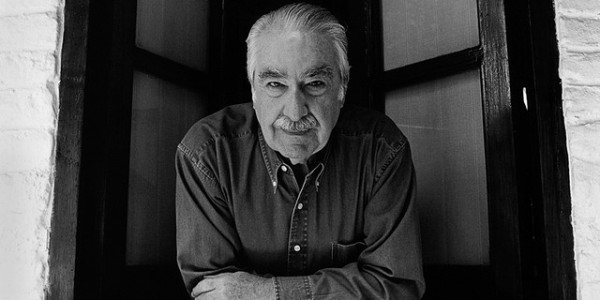
RIP Álvaro Mutis

Alvaro-Mutis-600x300

RIP Álvaro Mutis, 1923 – 2013

Colombian writer Álvaro Mutis died in Mexico City today. He was ninety.

Mutis is likely most famous in the English-speaking world for his excellent series of picaresque novellas focusing on the Gaviero, which have been collected as The Adventures and Misadventures of Maqroll. I first learned of the book through a friend who reviewed it on this blog; his review made me pick it up and read and riff on it myself. I don’t know if I can overstate how wonderful these novellas are. I’ve mixed them into my readings over the past year, breaking up the space between new novels by taking a trip with the Gaviero. They are something beyond palate-cleansers; they are the kind of adventure narratives that made me fall in love with reading in the first place. I feel strangely fortunate that there are two more I have yet to read.

Here’s John Updike’s thorough, excellent review of The Adventures and Misadventures of Maqroll.

And: a 2001 interview with Mutis by Francisco Goldman. From that interview:

FG: If you could travel with Maqroll to any period, which would it be?

AM: The 18th century. Casanova and I would have been friends. I would have been friends with the Prince de Ligne and I would have lived in Paris and Venice. I’d take the elegant life, the brilliant prose, like Voltaire—each time you read him you realize that he’s the real thing. And that is where my interest in the 18th century ends; once they get to the French Revolution and the horror and saving of mankind, that’s where I exit.

And a few last scraps from Un Bel Morir:

All the stories and lies about his past accumulating until they formed another being, always present and naturally more deeply loved than his own pale, useless existence composed of nausea and dreams.

A crack of wood waking him in the humble hotel on the Rue de Rempart and, in the middle of the night, leaving him on that shore where only God is aware of other people.

The eyelid twitching with the autonomous speed of one who knows he is in the hands of death. The eyelid of the man he had to kill, with repugnance, with no anger, to save the life of a woman whom he now found unbearable. 

All his waiting. All the emptiness of that nameless time used up in the foolishness of negotiations, proceedings, journeys, blank days, mistaken itineraries. All that life, from which he now begs, as he slips through the wounded dark toward death, some of the leftover scraps he thinks he has a right to. 

Barthelme’s Influences

INTERVIEWER

Your own influences—whom would you like to cite as your spiritual ancestors?

BARTHELME

They come in assorted pairs. Perelman and Hemingway. Kierkegaard and Sabatini. Kafka and Kleist. Kleist was clearly one of Kafka’s fathers. Rabelais and Zane Grey. The Dostoyevsky of Notes from Underground. A dozen Englishmen. The surrealists, both painters and poets. A great many film people, Buñuel in particular. It’s always a stew, isn’t it? Errol Flynn ought to be in there somewhere, and so should Big Sid Catlett, the drummer.

—From Donald Barthelme’s interview with The Paris Review.

“Beckett’s Theory of Comedy” — Anne Carson

btc

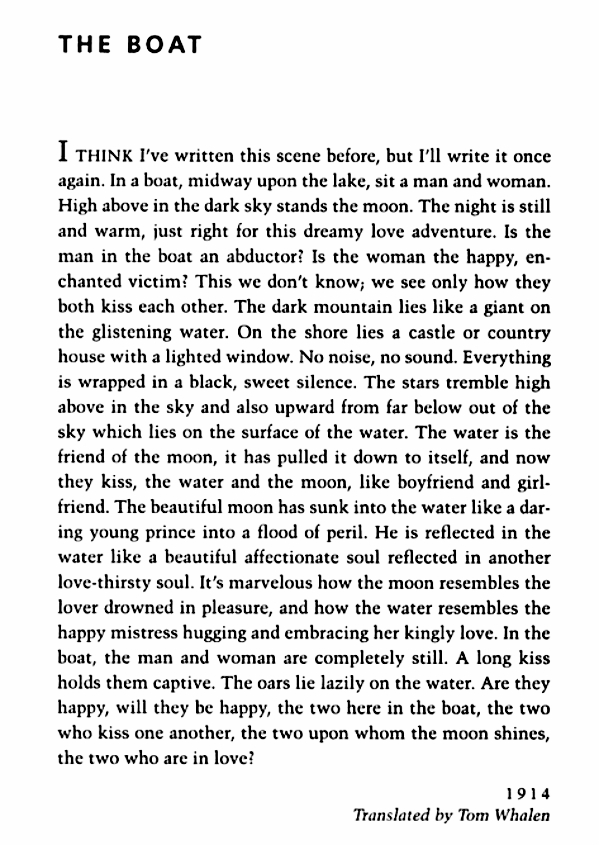
“The Boat” — Robert Walser

tb

Illustration for Kafka’s Metamorphosis — Jean-Michel Folon

folon-kafka-2

(More/via/about; then even more).

Read “The House of the Beehives” by Italo Calvino

“The House of the Beehives” by Italo Calvino

It is difficult to see from far away, and even if someone had already been here once he could not remember the way back; there was a path here at one time, but I made brambles grow over it and wiped out every trace. It’s well chosen, this home of mine, lost in this bank of broom, with a single story that can’t be seen from the valley, and covered in a chalky whitewash with windows picked out in red.

There’s some land around I could have worked and haven’t; a patch for vegetables where snails munch the lettuce is enough for me, and a bit of terraced earth to dig up with a pitchfork and grow potatoes, all purple and budding. I only need to work to feed myself, for I’ve got nothing to share with anyone.

And I don’t cut back the brambles, either the ones now clambering over the roof of the house or those already creeping like a slow avalanche over the cultivated ground; I should like them to bury everything, myself included. Lizards have made their nests in the cracks of the walls, ants have scooped out porous cities under the bricks of the floor; I look forward every day to seeing if a new crack has opened, and think of the cities of the human race being smothered and swallowed up by weeds.

Above my home are a few strips of rough meadow where I let my goats roam. At dawn, dogs sometimes pass by, on the scent of hares; I chase them off with stones. I hate dogs, with their servile fidelity to man; I hate all domestic animals, their pretense of having sympathy with human beings just so they can lick the remains off greasy plates. Goats are the only animals I can stand, for they don’t expect intimacy or give any.

I don’t need chained dogs to guard me. Or even hedges or padlocks, those horrible contraptions of humans. My field is studded with beehives, and a flight of bees is like a thorny hedge that only I can cross. At night the bees sleep in the bean husks, but no man ever comes near my house; people are afraid of me and they are right; not because certain tales they tell about me are true—lies, I say, just the sort of thing they would tell—but they are right to be afraid of me, I want them to be.

When I go over the crest in the morning, I can see the valley dropping away beneath and the sea high all around me and the world. And I see the houses of the human race perched on the edge of the sea, shipwrecked in their false neighborliness; I see the tawny, chalky city, the glittering of its windows, and the smoke of its fires. One day brambles and grass will cover its squares, and the sea will come up and mold the ruins into rocks.

Only the bees are with me now; they buzz around my hands without stinging me when I take the honey from the hives, and settle on me like a living beard; friendly bees, ancient race without a history. For years I’ve been living on this bank of broom with goats and bees; once I used to make a mark on the wall at the passing of each year; now the brambles choke everything. Why should I live with men and work for them? I loathe their sweaty hands, their savage rites, their dances and churches, their women’s acid saliva. But those stories aren’t true, believe me; they’ve always told stories about me,; the lying swine.

I don’t give anything and I don’t owe anything; if it rains at night I cook and eat the big snails slithering down the banks in the morning; the earth in the woods is scattered with soft, damp toadstools. The woods give me everything else I need: sticks and pine cones to burn, and chestnuts; and I snare hares and thrushes, too, for don’t think I love wild animals or have an idyllic adoration of nature—one of man’s absurd hypocrisies. I know that in this world we must devour one another and that the survival of the fittest holds; I kill only the animals I want to eat, with traps, not with guns, so as not to need dogs or other men to fetch them.

Sometimes I meet men in the woods, if I’m not warned in time by the dull thuds of their axes cutting down trees one by one. I pretend not to see them. On Sundays the poor come to gather fuel in the woods, which they strip like the speckled heads of aloes; the trunks are hauled away on ropes and form rough tracks, which gather the rain during storms and provoke landfalls. May everything go to similar ruin in the cities of the human race; may I, as I walk along one day, see chimney tops emerging from the earth, meet parts of streets falling off into ravines, and stumble on strips of railroad track in the middle of the forest.

But you must wonder if I don’t ever feel this solitude of mine weighing on me, if some evening, one of those long twilights, I haven’t gone down, without any definite idea in my head, toward the houses of the human race. I did go, one warm twilight, toward those walls surrounding the gardens below, and climbed down over the medlar trees; but when I heard women laughing and a distant child calling, back I came up here. That was the last time; now I’m up here alone. Well, I get frightened of making a mistake every now and again, as you do. And so, like you, I go on as I was before.

You’re afraid of me, of course, and you’re right. Not because of that affair, though. That, whether it ever happened or not, was so many years ago it doesn’t matter now, anyway.

That woman, that dark woman who came up here to scythe —I had only been up here a short time then and was still full of human emotions—well, I saw her working high on the slope and she hailed me and I didn’t reply and passed by. Yes, I was still full of human emotions then, and of an old resentment, too; and because of that old resentment—not against her, I don’t even remember her face—I went up behind her without her hearing me.

Now, the tale as people tell it is obviously false, for it was late and there wasn’t a soul in the valley and when I put my hands around her throat no one heard her. But I would have to tell you my story from the beginning for you to understand.

Ah, well, let’s not mention that evening any more. Here I live, sharing my lettuce with snails that perforate the leaves, and I know all the places where toadstools grow and can tell the good ones from the poisonous; about women and their poisons I don’t think any more. Being chaste is nothing but a habit, after all.

She was the last one, that dark woman with the scythe. The sky was full of clouds, I remember, dark clouds scudding along. It must have been under a hurrying sky like that, on slopes cropped by goats, that the first human marriage took place. In contact between human beings there can only, I know, be mutual terror and shame. That’s what I wanted, to see the terror and shame, just the terror and shame, in her eyes; that’s the only reason I did it to her, believe me.

No one has said a word about it to me, ever; there isn’t a word they can say, since the valley was deserted that evening. But every night, when the hills are lost in the dark and I can’t follow the meaning of an old book by the light of the lantern, and I sense the town with its human beings and its lights and music down below, I feel the voices of you all accusing me.

But there was no one to see me there in the valley; they say those things because the woman never returned home.

And if dogs passing by always stop to sniff at a certain spot, and bay and scratch the ground with their paws, it’s because there’s an old moles’ lair there—I swear it, just an old moles’ lair.

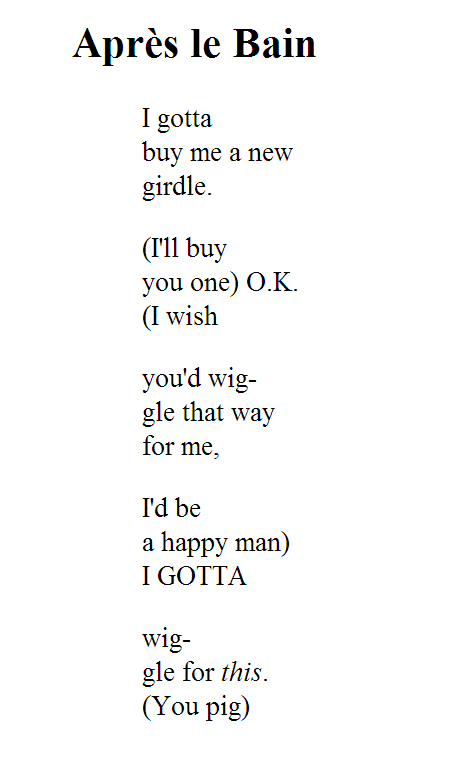
“Après le Bain” — William Carlos Williams

wcw

“Florida,” a Short Story by Mavis Gallant

Marie Carette spent eight Christmases of her life in Florida, where her son was establishing a future in the motel industry. Every time Marie went down she found Raymond starting over in a new place: his motels seemed to die on his hands. She used to come back to Montreal riddled with static electricity. Her sister Berthe couldn’t hand her a teaspoon without receiving a shock, like a small silver bullet. Berthe believed the current was generated by a chemical change that occurred as she flew out of Fort Lauderdale toward a wet, dark, snowy city.

Marie had been living with Berthe ever since 1969, the year her husband died. She still expected what Berthe thought of as husband service: flights met, cabs hailed, doors held, tips attended to. Berthe had to take the bus out to Dorval Airport, with Marie’s second-best fur coat over her arm and her high-heeled boots in a plastic bag.

‘Don’t tell me it’s still winter,’ Marie would wail, kissing Berthe as if she had been away for months rather than just a few days. Guiding Marie’s arms into the second-best-mink sleeves (paws and piecework), Berthe would get the first of the silvery shocks.


Thomas Bernhard’s Atzbacher on State-Sanctioned Corpses

Irrsigler has that irritating stare which museum attendants employ in order to intimidate the visitors who, as is well known, are endowed with all kinds of bad behaviour; his manner of abruptly and utterly soundlessly appearing round the corner of whatever room in order to inspect it is indeed repulsive to anyone who does not know him; in his grey uniform, badly cut and yet intended for eternity, held together by large black buttons and hanging on his meagre body as if from a coat rack, and with his peaked cap tailored from the same grey cloth, he is more reminiscent of a warder in one of our penal institutions than of a state-employed guardian of works of art. Ever since I have known him Irrsigler has always been as pale as he now is, even though he is not sick, and Reger has for decades described him as a state corpse on duty at the Kunsthistorisches Museum for over thirty-six years.

–Thomas Bernhard, Old Masters, trans. Ewald Osers. Chicago: University of Chicago Press, 1989.
 

“Concerning the Bodyguard” — Donald Barthelme

“Concerning the Bodyguard” by Donald Bartheleme

Does the bodyguard scream at the woman who irons his shirts? Who has inflicted a brown burn on his yellow shirt purchased expensively from Yves St. Laurent? A great brown burn just over the heart?

Does the bodyguard’s principal make conversation with the bodyguard, as they wait for the light to change, in the dull gray Citroën? With the second bodyguard, who is driving? What is the tone? Does the bodyguard’s principal comment on the brown young women who flock along the boulevard? On the young men? On the traffic? Has the bodyguard ever enjoyed a serious political discussion with his principal?

Is the bodyguard frightened by the initials D.I.T.?

Is the bodyguard frightened by the initials C.N.D.?

Will the bodyguard be relieved, today, in time to see the film he has in mind – Emmanuelle Around the World? If the bodyguard is relieved in time to see Emmanuelle Around the World, will there be a queue for tickets? Will there be students in the queue?

Is the bodyguard frightened by the slogan Remember 17 June? Is the bodyguard frightened by black spray paint, tall letters ghostly at the edges, on this wall, on this wall? At what level of education did the bodyguard leave school?

Is the bodyguard sufficiently well-paid? Is he paid as well as a machinist? As well as a foreman? As well as an army sergeant? As well as a lieutenant? Is the Citroën armored? Is the Mercedes armored? What is the best speed of the Mercedes? Can it equal that of a BMW? A BMW motorcycle? Several BMW motorcycles?

Does the bodyguard gauge the importance of his principal in terms of the number of bodyguards he requires? Should there not be other cars leading and following his principals car, these also filled with bodyguards? Are there sometimes such additional precautions, and does the bodyguard, at these times, feel himself part of an ocean of bodyguards? Is he exalted at these times? Does he wish for even more bodyguards, possibly flanking cars to the right and left and a point car far, far ahead?

After leaving technical school, in what sort of enterprises did the bodyguard engage before accepting his present post? Has he ever been in jail? For what sort of offense? Has the bodyguard acquired a fondness for his principal? Is there mutual respect? Is there mutual contempt? When his principal takes tea, is the bodyguard offered tea? Beer? Who pays?

Can the bodyguard adduce instances of professional success?

Had he a previous client?

Is there a new bodyguard in the group of bodyguards? Why? Continue reading ““Concerning the Bodyguard” — Donald Barthelme”

“Many ideas turn into lifelong disfigurements” (Thomas Bernhard)

“Many ideas turn into lifelong disfigurements,” he said. The ideas often surprised one years later, but sooner or later they would always make the one who had had them look ridiculous. The ideas came from a place they never left. They would always remain there, in that place: it was the place of dreams. “The idea doesn’t exist that can be expunged or expunge itself. The idea is actual, and remains so.” Last night, he had been thinking about pain. “Pain doesn’t exist. A necessary illusion,” he said. Pain wasn’t pain, not in the way a cow was a cow. “The word ‘pain’ directs the attention of a feeling toward a feeling. Pain is overplus. But the illusion of it is real.” Accordingly, pain both was and was not. “But there is no pain,” he said. “Just as there is no happiness. Found an architecture on pain.” All thoughts and images were as involuntary as the concepts: chemistry, physics, geometry. “You have to understand these concepts to know something. To know everything.” Philosophy didn’t take you a single step nearer. “Nothing is progressive, but nothing is less progressive than philosophy. Progress is tripe. Impossible.” The observations of mathematics were foundational. “Oh, yes,” he said, “in mathematics everything’s child’s play.” And just like so-called child’s play, mathematics could finish you. “If you’ve crossed the border, and you suddenly no longer get the joke, and see what the world’s about, don’t see what anything’s about anymore. Everything’s just the imagining of pain. A dog has as much gravity as a human being, but he hasn’t lived, do you understand!” One day I would cross a threshold into an enormous park, an endless and beautiful park; in this park one ingenious invention would succeed another. Plants and music would follow in lovely mathematical alternation, delightful to the ear and answering to the utmost notions of delicacy; but this park was not there to be used, or wandered about in, because it consisted of a thousand and one small and minuscule square and rectilinear and circular islets, pieces of lawn, each of them so individual that I would be unable to leave the one on which I was standing. “In each case, there is a breadth and depth of water that prevents one from hopping from one island to another. In my imagining. On the piece of grass which one has reached, how is a mystery, on which one has woken up, and where one is compelled to stay,” one would finally perish of hunger and thirst. “One’s longing to be able to walk through the whole park is finally deadly.”

—From Thomas Bernhard’s novel Frost.


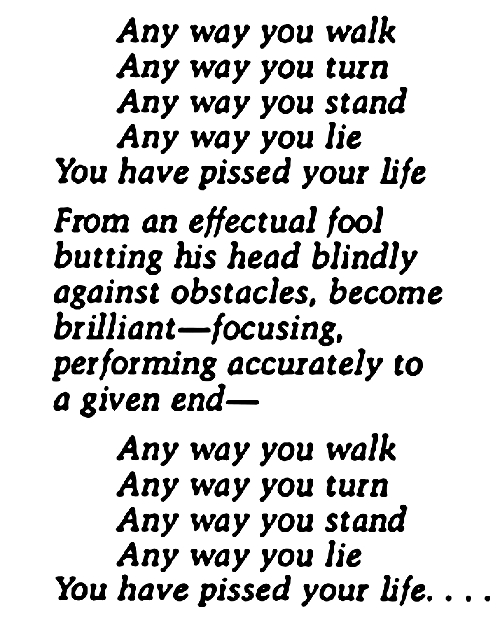
“You Have Pissed Your Life” — William Carlos Williams

capture1

Eight Images and Ideas from Anton Chekhov’s Note-Books

A schoolboy treats a lady to dinner in a restaurant. He has only one rouble, twenty kopecks. The bill comes to four roubles thirty kopecks. He has no money and begins to cry. The proprietor boxes his ears. He was talking to the lady about Abyssinia.

* * * * *

A man, who, to judge from his appearance, loves nothing but sausages and sauerkraut.

* * * * *

Terrible poverty, desperate situation. The mother a widow, her daughter a very ugly girl. At last the mother takes courage and advises the daughter to go on the streets. She herself when young went on the streets without her husband’s knowledge in order to get money for her dresses; she has some experience. She instructs her daughter. The latter goes out, walks all night; not a single man takes her; she is ugly. A couple of days later, three young rascals on the boulevard take her. She brought home a note which turned out to be a lottery ticket no longer valid.

* * * * *

Two wives: one in Petersburg, the other in Kertch. Constant rows, threats, telegrams. They nearly reduce him to suicide. At last he finds a way: he settles them both in the same house. They are perplexed, petrified; they grow silent and quiet down.

* * * * *

An officer and his wife went to the baths together, and both were bathed by the orderly, whom they evidently did not consider a man.

* * * * *

A government clerk gave his son a thrashing because he had only obtained five marks in all his subjects at school. It seemed to him not good enough. When he was told that he was in the wrong, that five is the highest mark obtainable, he thrashed his son again—out of vexation with himself.

* * * * *

A very good man has such a face that people take him for a detective; he is suspected of having stolen shirt-studs.

* * * * *

A serious phlegmatic doctor fell in love with a girl who danced very well, and, to please her, he started to learn a mazurka.

* * * * *

—From Anton Chekhov’s Note-Books.

W.G. Sebald Reads from His Novel Austerlitz at the 92nd Street Y (Video)

W. G. Sebald reading from his novel Austerlitz at 92nd Street Y. October 15, 2001, just two months before his death.

He later takes questions (beginning at the 28 minute mark), including a discussion of how he uses photography in his work. Susan Sontag then takes a question in which she addresses “cowboy rhetoric” after 9/11. They then discuss which of their books might be their “favorite.”

(Via prefer-not-to on Twitter).

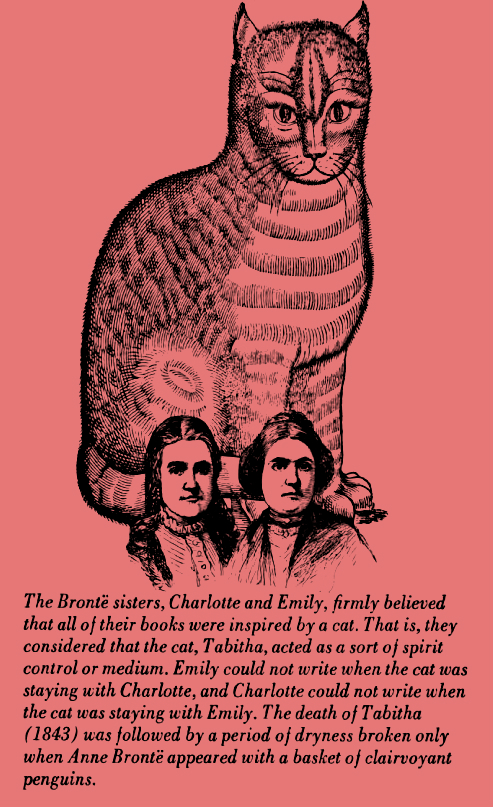
The Brontë Sisters, Inspired by a Cat (Donald Barthelme)

db

(From “Natural History” by Donald Barthelme, published in the August 1971 issue of Harper’s).

“A picture has no meaning but its beauty, no message but its joy” (Oscar Wilde)

We never know what an artist is going to do.  Of course not.  The artist is not a specialist.  All such divisions as animal painters, landscape painters, painters of Scotch cattle in an English mist, painters of English cattle in a Scotch mist, racehorse painters, bull-terrier painters, all are shallow.  If a man is an artist he can paint everything.

The object of art is to stir the most divine and remote of the chords which make music in our soul; and colour is indeed, of itself a mystical presence on things, and tone a kind of sentinel.

Am I pleading, then, for mere technique?  No.  As long as there are any signs of technique at all, the picture is unfinished.  What is finish?  A picture is finished when all traces of work, and of the means employed to bring about the result, have disappeared.

In the case of handicraftsmen—the weaver, the potter, the smith—on their work are the traces of their hand.  But it is not so with the painter; it is not so with the artist.

Art should have no sentiment about it but its beauty, no technique except what you cannot observe.  One should be able to say of a picture not that it is ‘well painted,’ but that it is ‘not painted.’

What is the difference between absolutely decorative art and a painting?  Decorative art emphasises its material: imaginative art annihilates it.  Tapestry shows its threads as part of its beauty: a picture annihilates its canvas: it shows nothing of it.  Porcelain emphasises its glaze: water-colours reject the paper.

A picture has no meaning but its beauty, no message but its joy.  That is the first truth about art that you must never lose sight of.  A picture is a purely decorative thing.

From Oscar Wilde’s “Lecture to Art Students,” 1883.