The greatest weight.— What, if some day or night a demon were to steal after you into your loneliest loneliness and say to you: “This life as you now live it and have lived it, you will have to live once more and innumerable times more; and there will be nothing new in it, but every pain and every joy and every thought and sigh and everything unutterably small or great in your life will have to return to you, all in the same succession and sequence – even this spider and this moonlight between the trees, and even this moment and I myself. The eternal hourglass of existence is turned upside down again and again, and you with it, speck of dust!”
Would you not throw yourself down and gnash your teeth and curse the demon who spoke thus?… Or how well disposed would you have to become to yourself and to life to crave nothing more fervently than this ultimate eternal confirmation and seal?
Although it was so brilliantly fine—the blue sky powdered with gold and great spots of light like white wine splashed over the Jardins Publiques—Miss Brill was glad that she had decided on her fur. The air was motionless, but when you opened your mouth there was just a faint chill, like a chill from a glass of iced water before you sip, and now and again a leaf came drifting—from nowhere, from the sky. Miss Brill put up her hand and touched her fur. Dear little thing! It was nice to feel it again. She had taken it out of its box that afternoon, shaken out the moth-powder, given it a good brush, and rubbed the life back into the dim little eyes. “What has been happening to me?” said the sad little eyes. Oh, how sweet it was to see them snap at her again from the red eiderdown!… But the nose, which was of some black composition, wasn’t at all firm. It must have had a knock, somehow. Never mind—a little dab of black sealing-wax when the time came—when it was absolutely necessary… Little rogue! Yes, she really felt like that about it. Little rogue biting its tail just by her left ear. She could have taken it off and laid it on her lap and stroked it. She felt a tingling in her hands and arms, but that came from walking, she supposed. And when she breathed, something light and sad—no, not sad, exactly—something gentle seemed to move in her bosom.
There were a number of people out this afternoon, far more than last Sunday. And the band sounded louder and gayer. That was because the Season had begun. For although the band played all the year round on Sundays, out of season it was never the same. It was like some one playing with only the family to listen; it didn’t care how it played if there weren’t any strangers present. Wasn’t the conductor wearing a new coat, too? She was sure it was new. He scraped with his foot and flapped his arms like a rooster about to crow, and the bandsmen sitting in the green rotunda blew out their cheeks and glared at the music. Now there came a little “flutey” bit—very pretty!—a little chain of bright drops. She was sure it would be repeated. It was; she lifted her head and smiled.
Only two people shared her “special” seat: a fine old man in a velvet coat, his hands clasped over a huge carved walking-stick, and a big old woman, sitting upright, with a roll of knitting on her embroidered apron. They did not speak. This was disappointing, for Miss Brill always looked forward to the conversation. She had become really quite expert, she thought, at listening as though she didn’t listen, at sitting in other people’s lives just for a minute while they talked round her.
She glanced, sideways, at the old couple. Perhaps they would go soon. Last Sunday, too, hadn’t been as interesting as usual. An Englishman and his wife, he wearing a dreadful Panama hat and she button boots. And she’d gone on the whole time about how she ought to wear spectacles; she knew she needed them; but that it was no good getting any; they’d be sure to break and they’d never keep on. And he’d been so patient. He’d suggested everything—gold rims, the kind that curved round your ears, little pads inside the bridge. No, nothing would please her. “They’ll always be sliding down my nose!” Miss Brill had wanted to shake her.
The old people sat on the bench, still as statues. Never mind, there was always the crowd to watch. To and fro, in front of the flower-beds and the band rotunda, the couples and groups paraded, stopped to talk, to greet, to buy a handful of flowers from the old beggar who had his tray fixed to the railings. Little children ran among them, swooping and laughing; little boys with big white silk bows under their chins, little girls, little French dolls, dressed up in velvet and lace. And sometimes a tiny staggerer came suddenly rocking into the open from under the trees, stopped, stared, as suddenly sat down “flop,” until its small high-stepping mother, like a young hen, rushed scolding to its rescue. Other people sat on the benches and green chairs, but they were nearly always the same, Sunday after Sunday, and—Miss Brill had often noticed—there was something funny about nearly all of them. They were odd, silent, nearly all old, and from the way they stared they looked as though they’d just come from dark little rooms or even—even cupboards!
Behind the rotunda the slender trees with yellow leaves down drooping, and through them just a line of sea, and beyond the blue sky with gold-veined clouds.
Tum-tum-tum tiddle-um! tiddle-um! tum tiddley-um tum ta! blew the band.
Two young girls in red came by and two young soldiers in blue met them, and they laughed and paired and went off arm-in-arm. Two peasant women with funny straw hats passed, gravely, leading beautiful smoke-coloured donkeys. A cold, pale nun hurried by. A beautiful woman came along and dropped her bunch of violets, and a little boy ran after to hand them to her, and she took them and threw them away as if they’d been poisoned. Dear me! Miss Brill didn’t know whether to admire that or not! And now an ermine toque and a gentleman in grey met just in front of her. He was tall, stiff, dignified, and she was wearing the ermine toque she’d bought when her hair was yellow. Now everything, her hair, her face, even her eyes, was the same colour as the shabby ermine, and her hand, in its cleaned glove, lifted to dab her lips, was a tiny yellowish paw. Oh, she was so pleased to see him—delighted! She rather thought they were going to meet that afternoon. She described where she’d been—everywhere, here, there, along by the sea. The day was so charming—didn’t he agree? And wouldn’t he, perhaps?… But he shook his head, lighted a cigarette, slowly breathed a great deep puff into her face, and even while she was still talking and laughing, flicked the match away and walked on. The ermine toque was alone; she smiled more brightly than ever. But even the band seemed to know what she was feeling and played more softly, played tenderly, and the drum beat, “The Brute! The Brute!” over and over. What would she do? What was going to happen now? But as Miss Brill wondered, the ermine toque turned, raised her hand as though she’d seen some one else, much nicer, just over there, and pattered away. And the band changed again and played more quickly, more gayly than ever, and the old couple on Miss Brill’s seat got up and marched away, and such a funny old man with long whiskers hobbled along in time to the music and was nearly knocked over by four girls walking abreast.
Oh, how fascinating it was! How she enjoyed it! How she loved sitting here, watching it all! It was like a play. It was exactly like a play. Who could believe the sky at the back wasn’t painted? But it wasn’t till a little brown dog trotted on solemn and then slowly trotted off, like a little “theatre” dog, a little dog that had been drugged, that Miss Brill discovered what it was that made it so exciting. They were all on the stage. They weren’t only the audience, not only looking on; they were acting. Even she had a part and came every Sunday. No doubt somebody would have noticed if she hadn’t been there; she was part of the performance after all. How strange she’d never thought of it like that before! And yet it explained why she made such a point of starting from home at just the same time each week—so as not to be late for the performance—and it also explained why she had quite a queer, shy feeling at telling her English pupils how she spent her Sunday afternoons. No wonder! Miss Brill nearly laughed out loud. She was on the stage. She thought of the old invalid gentleman to whom she read the newspaper four afternoons a week while he slept in the garden. She had got quite used to the frail head on the cotton pillow, the hollowed eyes, the open mouth and the high pinched nose. If he’d been dead she mightn’t have noticed for weeks; she wouldn’t have minded. But suddenly he knew he was having the paper read to him by an actress! “An actress!” The old head lifted; two points of light quivered in the old eyes. “An actress—are ye?” And Miss Brill smoothed the newspaper as though it were the manuscript of her part and said gently; “Yes, I have been an actress for a long time.”
The band had been having a rest. Now they started again. And what they played was warm, sunny, yet there was just a faint chill—a something, what was it?—not sadness—no, not sadness—a something that made you want to sing. The tune lifted, lifted, the light shone; and it seemed to Miss Brill that in another moment all of them, all the whole company, would begin singing. The young ones, the laughing ones who were moving together, they would begin, and the men’s voices, very resolute and brave, would join them. And then she too, she too, and the others on the benches—they would come in with a kind of accompaniment—something low, that scarcely rose or fell, something so beautiful—moving… And Miss Brill’s eyes filled with tears and she looked smiling at all the other members of the company. Yes, we understand, we understand, she thought—though what they understood she didn’t know.
Just at that moment a boy and girl came and sat down where the old couple had been. They were beautifully dressed; they were in love. The hero and heroine, of course, just arrived from his father’s yacht. And still soundlessly singing, still with that trembling smile, Miss Brill prepared to listen.
“No, not now,” said the girl. “Not here, I can’t.”
“But why? Because of that stupid old thing at the end there?” asked the boy. “Why does she come here at all—who wants her? Why doesn’t she keep her silly old mug at home?”
“It’s her fu-ur which is so funny,” giggled the girl. “It’s exactly like a fried whiting.”
“Ah, be off with you!” said the boy in an angry whisper. Then: “Tell me, ma petite chere—”
“No, not here,” said the girl. “Not yet.”
On her way home she usually bought a slice of honey-cake at the baker’s. It was her Sunday treat. Sometimes there was an almond in her slice, sometimes not. It made a great difference. If there was an almond it was like carrying home a tiny present—a surprise—something that might very well not have been there. She hurried on the almond Sundays and struck the match for the kettle in quite a dashing way.
But to-day she passed the baker’s by, climbed the stairs, went into the little dark room—her room like a cupboard—and sat down on the red eiderdown. She sat there for a long time. The box that the fur came out of was on the bed. She unclasped the necklet quickly; quickly, without looking, laid it inside. But when she put the lid on she thought she heard something crying.
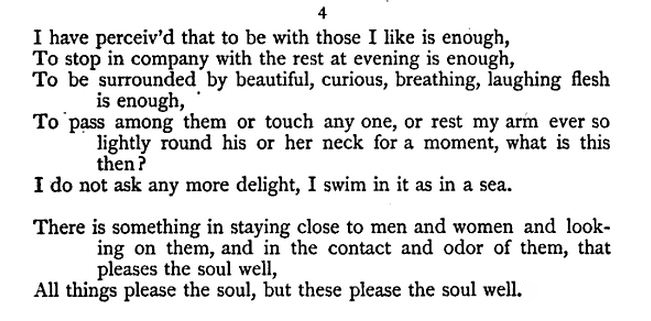
Speaking of monuments reminds one that there is more talk about a monument to Walt Whitman, “the good, gray poet.” Just why the adjective good is always applied to Whitman it is difficult to discover, probably because people who could not understand him at all took it for granted that he meant well. If ever there was a poet who had no literary ethics at all beyond those of nature, it was he. He was neither good nor bad, any more than are the animals he continually admired and envied. He was a poet without an exclusive sense of the poetic, a man without the finer discriminations, enjoying everything with the unreasoning enthusiasm of a boy. He was the poet of the dung hill as well as of the mountains, which is admirable in theory but excruciating in verse. In the same paragraph he informs you that, “The pure contralto sings in the organ loft,” and that “The malformed limbs are tied to the table, what is removed drop horribly into a pail.” No branch of surgery is poetic, and that hopelessly prosaic word “pail” would kill a whole volume of sonnets. Whitman’s poems are reckless rhapsodies over creation in general, some times sublime, some times ridiculous. He declares that the ocean with its “imperious waves, commanding” is beautiful, and that the fly-specks on the walls are also beautiful. Such catholic taste may go in science, but in poetry their results are sad. The poet’s task is usually to select the poetic. Whitman never bothers to do that, he takes everything in the universe from fly-specks to the fixed stars. His “Leaves of Grass” is a sort of dictionary of the English language, and in it is the name of everything in creation set down with great reverence but without any particular connection.
But however ridiculous Whitman may be there is a primitive elemental force about him. He is so full of hardiness and of the joy of life. He looks at all nature in the delighted, admiring way in which the old Greeks and the primitive poets did. He exults so in the red blood in his body and the strength in his arms. He has such a passion for the warmth and dignity of all that is natural. He has no code but to be natural, a code that this complex world has so long outgrown. He is sensual, not after the manner of Swinbourne and Gautier, who are always seeking for perverted and bizarre effects on the senses, but in the frank fashion of the old barbarians who ate and slept and married and smacked their lips over the mead horn. He is rigidly limited to the physical, things that quicken his pulses, please his eyes or delight his nostrils. There is an element of poetry in all this, but it is by no means the highest. If a joyous elephant should break forth into song, his lay would probably be very much like Whitman’s famous “song of myself.” It would have just about as much delicacy and deftness and discriminations. He says:
“I think I could turn and live with the animals. They are so placid and self-contained, I stand and look at them long and long. They do not sweat and whine about their condition. They do not lie awake in the dark and weep for their sins. They do not make me sick discussing their duty to God. Not one is dissatisfied nor not one is demented with the mania of many things. Not one kneels to another nor to his kind that lived thousands of years ago. Not one is respectable or unhappy, over the whole earth.” And that is not irony on nature, he means just that, life meant no more to him. He accepted the world just as it is and glorified it, the seemly and unseemly, the good and the bad. He had no conception of a difference in people or in things. All men had bodies and were alike to him, one about as good as another. To live was to fulfil all natural laws and impulses. To be comfortable was to be happy. To be happy was the ultimatum. He did not realize the existence of a conscience or a responsibility. He had no more thought of good or evil than the folks in Kipling’s Jungle book.
And yet there is an undeniable charm about this optimistic vagabond who is made so happy by the warm sunshine and the smell of spring fields. A sort of good fellowship and whole-heartedness in every line he wrote. His veneration for things physical and material, for all that is in water or air or land, is so real that as you read him you think for the moment that you would rather like to live so if you could. For the time you half believe that a sound body and a strong arm are the greatest things in the world. Perhaps no book shows so much as “Leaves of Grass” that keen senses do not make a poet. When you read it you realize how spirited a thing poetry really is and how great a part spiritual perceptions play in apparently sensuous verse, if only to select the beautiful from the gross.
MEN fear death, as children fear to go in the dark; and as that natural fear in children, is increased with tales, so is the other. Certainly, the contemplation of death, as the wages of sin, and passage to another world, is holy and religious; but the fear of it, as a tribute due unto nature, is weak. Yet in religious meditations, there is sometimes mixture of vanity, and of superstition. You shall read, in some of the friars’ books of mortification, that a man should think with himself, what the pain is, if he have but his finger’s end pressed, or tortured, and thereby imagine, what the pains of death are, when the whole body is corrupted, and dissolved; when many times death passeth, with less pain than the torture of a limb; for the most vital parts, are not the quickest of sense. And by him that spake only as a philosopher, and natural man, it was well said, Pompa mortis magis terret, quam mors ipsa. Groans, and convulsions, and a discolored face, and friends weeping, and blacks, and obsequies, and the like, show death terrible. It is worthy the observing, that there is no passion in the mind of man, so weak, but it mates, and masters, the fear of death; and therefore, death is no such terrible enemy, when a man hath so many attendants about him, that can win the combat of him. Revenge triumphs over death; love slights it; honor aspireth to it; grief flieth to it; fear preoccupateth it; nay, we read, after Otho the emperor had slain himself, pity (which is the tenderest of affections) provoked many to die, out of mere compassion to their sovereign, and as the truest sort of followers. Nay, Seneca adds niceness and satiety: Cogita quamdiu eadem feceris; mori velle, non tantum fortis aut miser, sed etiam fastidiosus potest. A man would die, though he were neither valiant, nor miserable, only upon a weariness to do the same thing so oft, over and over. It is no less worthy, to observe, how little alteration in good spirits, the approaches of death make; for they appear to be the same men, till the last instant. Augustus Caesar died in a compliment; Livia, conjugii nostri memor, vive et vale. Tiberius in dissimulation; as Tacitus saith of him, Jam Tiberium vires et corpus, non dissimulatio, deserebant. Vespasian in a jest, sitting upon the stool; Ut puto deus fio. Galba with a sentence; Feri, si ex re sit populi Romani; holding forth his neck. Septimius Severus in despatch; Adeste si quid mihi restat agendum. And the like. Certainly the Stoics bestowed too much cost upon death, and by their great preparations, made it appear more fearful. Better saith he, qui finem vitae extremum inter munera ponat naturae. It is as natural to die, as to be born; and to a little infant, perhaps, the one is as painful, as the other. He that dies in an earnest pursuit, is like one that is wounded in hot blood; who, for the time, scarce feels the hurt; and therefore a mind fixed, and bent upon somewhat that is good, doth avert the dolors of death. But, above all, believe it, the sweetest canticle is’, Nunc dimittis; when a man hath obtained worthy ends, and expectations. Death hath this also; that it openeth the gate to good fame, and extinguisheth envy.—Extinctus amabitur idem.
EIGHT years before he had seen his friend off at the North Wall and wished him godspeed. Gallaher had got on. You could tell that at once by his travelled air, his well-cut tweed suit, and fearless accent. Few fellows had talents like his and fewer still could remain unspoiled by such success. Gallaher’s heart was in the right place and he had deserved to win. It was something to have a friend like that.
Little Chandler’s thoughts ever since lunch-time had been of his meeting with Gallaher, of Gallaher’s invitation and of the great city London where Gallaher lived. He was called Little Chandler because, though he was but slightly under the average stature, he gave one the idea of being a little man. His hands were white and small, his frame was fragile, his voice was quiet and his manners were refined. He took the greatest care of his fair silken hair and moustache and used perfume discreetly on his handkerchief. The half-moons of his nails were perfect and when he smiled you caught a glimpse of a row of childish white teeth.
As he sat at his desk in the King’s Inns he thought what changes those eight years had brought. The friend whom he had known under a shabby and necessitous guise had become a brilliant figure on the London Press. He turned often from his tiresome writing to gaze out of the office window. The glow of a late autumn sunset covered the grass plots and walks. It cast a shower of kindly golden dust on the untidy nurses and decrepit old men who drowsed on the benches; it flickered upon all the moving figures—on the children who ran screaming along the gravel paths and on everyone who passed through the gardens. He watched the scene and thought of life; and (as always happened when he thought of life) he became sad. A gentle melancholy took possession of him. He felt how useless it was to struggle against fortune, this being the burden of wisdom which the ages had bequeathed to him. Continue reading ““A Little Cloud” — James Joyce”→
Purged the books pictured in the lower right-hand corner and picked up a few: Curzio Malaparte’s Kaputt, which has intrigued me for awhile now, Denis Johnson’s Fiskadoro—in the Vintage Contemporaries edition no less!—and Lydia Davis’s novel The End of the Story, which I somehow haven’t read yet. Hypothesis: Lydia Davis and Denis Johnson may be America’s greatest living novelists (?).
All great literary men are shy. I am myself, though I am told it is hardly noticeable.
I am glad it is not. It used to be extremely prominent at one time, and was the cause of much misery to myself and discomfort to every one about me—my lady friends especially complained most bitterly about it.
A shy man’s lot is not a happy one. The men dislike him, the women despise him, and he dislikes and despises himself. Use brings him no relief, and there is no cure for him except time; though I once came across a delicious recipe for overcoming the misfortune. It appeared among the “answers to correspondents” in a small weekly journal and ran as follows—I have never forgotten it: “Adopt an easy and pleasing manner, especially toward ladies.”
Poor wretch! I can imagine the grin with which he must have read that advice. “Adopt an easy and pleasing manner, especially toward ladies,” forsooth! Don’t you adopt anything of the kind, my dear young shy friend. Your attempt to put on any other disposition than your own will infallibly result in your becoming ridiculously gushing and offensively familiar. Be your own natural self, and then you will only be thought to be surly and stupid.
The shy man does have some slight revenge upon society for the torture it inflicts upon him. He is able, to a certain extent, to communicate his misery. He frightens other people as much as they frighten him. He acts like a damper upon the whole room, and the most jovial spirits become in his presence depressed and nervous.
This is a good deal brought about by misunderstanding. Many people mistake the shy man’s timidity for overbearing arrogance and are awed and insulted by it. His awkwardness is resented as insolent carelessness, and when, terror-stricken at the first word addressed to him, the blood rushes to his head and the power of speech completely fails him, he is regarded as an awful example of the evil effects of giving way to passion.
But, indeed, to be misunderstood is the shy man’s fate on every occasion; and whatever impression he endeavors to create, he is sure to convey its opposite. When he makes a joke, it is looked upon as a pretended relation of fact and his want of veracity much condemned. His sarcasm is accepted as his literal opinion and gains for him the reputation of being an ass, while if, on the other hand, wishing to ingratiate himself, he ventures upon a little bit of flattery, it is taken for satire and he is hated ever afterward. Continue reading ““On Being Shy” — Jerome K. Jerome”→
“For me, the litmus test is always language,” George Saunders told Charlie Rose in a recent interview. “If the sentences are kind of jangly and interesting, then I know how to proceed.”
Saunders composes stories syntactically: his themes and plots and characters emerge from the right jangle, the right discordant note that simultaneously pleases and disturbs. This technique shows in his latest collection Tenth of December, a showcase for Saunders’s estimable verbal prowess and a reminder that he is one of America’s preeminent satirists.
Tenth of December also reveals some of Saunders’s limitations, the biggest of which is that he seems to write the same few stories again and again. Granted, these stories are sharp, funny, puncturing criticisms of American life—satires of corpocracy and the ways commerce infests language (and hence thought); satires of how late capitalism engenders cycles of manufactured desire and very-real despair; satires, ultimately, of how we see ourselves seeing others seeing us in ways that we don’t wish to be seen. Perhaps Saunders writes the same plots repeatedly because he thinks we need to read them repeatedly—and there’s certainly pleasure and humor and pathos in Tenth of December—but there isn’t any territory explored here that would be unfamiliar to anyone who read CivilWarLand in Bad Decline or Pastoralia.
Take “Escape from Spiderhead,” one of the stronger entries in December. This is pure Saundersville, a story nudging weirdly into a skewed future that might come too-true too soon. Said spiderhead is a prison command center where wardens subject their inmates to language and desire experiments, using drugs like “Verbaluce™, VeriTalk™, ChatEase™” (lord does Saunders love incaps) to manipulate the prisoners’ minds and bodies alike (all with consent, of course).
The story is a biting and often painful exploration of how our desires and actions might be constrained and controlled by others. It’s also an excellent excuse for Saunders to flex some of those verbal muscles of his:
He added some Verbaluce™ to the drip, and soon I was feeling the same things but saying them better. The garden still looked nice. It was like the bushes were so tight-seeming and the sun made everything stand out? It was like any moment you expected some Victorians to wander in with their cups of tea. It was as if the garden had become a sort of embodiment of the domestic dreams forever intrinsic to human consciousness. It was as if I could suddenly discern, in this contemporary vignette, the ancient corollary through which Plato and some of his contemporaries might have strolled; to wit, I was sensing the eternal in the ephemeral.
“Escape from Spiderhead” is one of several tales in Decemberthat ultimately posit selflessness and empathy as a metaphysical escape hatch, an out to all the post-postmodern awful. It’s a near-perfect little story, which is why it’s too bad when Saunders essentially repeats it (right down to the Verbaluce™/amplified language conceit) in “My Chivalric Fiasco.” (Perhaps “My Chivalric Fiasco” was necessary though; it provides the sole “weird theme park” story requisite to any Saunders collection).
An equal to “Spiderhead” is “The Semplica Girl Diaries,” the collection’s strongest condemnation of how capitalism engenders bizarre ethical positions within families, between neighbors—and even countries. The longest story in the collection, “The Semplica Girl Diaries” purports to be a harried middle class father’s diary, a conceit which gives Saunders plenty of space to jangle.
Our poor narrator just wants to keep up with the Joneses, a serious character flaw that often results in hilarious hyperbole. He takes his family to the birthday party of his daughter’s classmate. This classmate’s family is wealthy, perfect, glowing, healthy, innovative, happy:
Just then father (Emmett) appears, holding freshly painted leg from merry-go-round horse, says time for dinner, hopes we like sailfish flown in fresh from Guatemala, prepared with a rare spice found only in one tiny region of Burma, which had to be bribed out, and also he had to design and build a special freshness-ensuring container for the sailfish.
Set against such a pristine backdrop our hapless narrator’s own life seems stressful and shabby:
Household in freefall, future reader. Everything chaotic. Kids, feeling tension, fighting all day. After dinner, Pam caught kids watching “I, Gropius,” (forbidden) = show where guy decides which girl to date based on feeling girls’ breasts through screen with two holes. (Do not actually show breasts. Just guy’s expressions as he feels them and girl’s expression as he feels them and girl’s expression as guy announces his rating. Still: bad show.) Pam blew up at kids: We are in most difficult period ever for family, this how they behave?
I love how Saunders works I, Gropius in there—his dystopian touches work best when they are simultaneously over-the-top (idea) and graceful (delivery of idea). These moments of humor don’t deflate the extreme anxieties that “The Semplica Girl Diaries” produces; rather, the humorous, hyperbolic eruptions add to what turns out to be a horror story.
Like the narrator of “The Semplica Girl Diaries,” the eponymous would-be hero of “Al Roosten” is painfully attuned to how others might/do see him. “Al Roosten” is one of several of December’s exercises in how we see others seeing us (set against the backdrop of how we desire others to see us, etc.). The story starts at a charity auction where local businessmen are being auctioned off (including Roosten’s rival Donfrey—an echo of Emmett) and then heads precisely nowhere (or rather, remains entirely in poor Roosten’s skull). First paragraph:
Al Roosten stood waiting behind the paper screen. Was he nervous? Well, he was a little nervous. Although probably a lot less nervous than most people would be. Most people would probably be pissing themselves by now. Was he pissing himself? Not yet. Although, wow, he could understand how someone might actually—
That sentence-interrupting final dash precedes the intrusion of the “real,” phenomenological world into Roosten’s consciousness. There’s much of James Thurber’s “Walter Mitty” in “Al Roosten”—and, indeed, much of Mitty in Saunders generally—perhaps because Saunders’s jangles lead him to explore the strange gaps between thought and action, reality and imagination. It’s worth sharing a few paragraphs of Saunders’s technique:
Frozen in the harsh spotlight, he looked so crazy and old and forlorn and yet residually arrogant that an intense discomfort settled on the room, a discomfort that, in a non-charity situation, might have led to shouted insults or thrown objects but in this case drew a kind of pity whoop from near the salad bar.
Roosten brightened and sent a relieved half wave in the direction of the whoop, and the awkwardness of this gesture—the way it inadvertently revealed how terrified he was—endeared him to the crowd that seconds before had been ready to mock him, and someone else pity-whooped, and Roosten smiled a big loopy grin, which caused a wave of mercy cheers.
Roosten was deaf to the charity in this. What a super level of whoops and cheers. He should do a flex. He would. He did. This caused an increase in the level of whoops and cheers, which, to his ear, were now at least equal in volume to Donfrey’s whoops/cheers. Plus Donfrey had been basically naked. Which meant that technically he’d beaten Donfrey, since Donfrey had needed to get naked just to manage a tie with him, Al Roosten. Ha ha, poor Donfrey! Running around in his skivvies to no avail.
We can note here the transitions between what the world sees (in those first two paragraphs) to how Roosten sees the world seeing him. This is Saunders at perhaps his finest, showcasing a meticulous control of free indirect style; Roosten is simultaneously pathetically endearing and loathsome. He is attractive and repellent precisely because we understand him—what it is to see him, but also what it is to be seen in the way he is being seen.
The titular story, which closes the collection, also offers a Walter Mittyish figure, a “pale boy with unfortunate Prince Valiant bangs and cublike mannerisms” who sneaks off into the woods to fantasize about the Lilliputian “Nethers” who might try to kidnap his crush Suzanne (whom he’s never addressed, of course). “Somewhere there is a man who likes to play and hug, Suzanne said,” the poor boy imagines. Again, this is Saundersville, where we laugh out loud and then reprimand ourselves for our cruelty and then engage, empathize, say, Hey kid, I’ve been there too…
“Tenth of December” is a sort of rewrite of two stories from Pastoralia, “The End of FIRPO in the World” and “The Falls.” I suppose I don’t mind, but I wish that Saunders’s jangles might lead him to new plots. Despite its rehashing of these earlier stories, “Tenth of December” delivers possibly the strongest case for empathy-as-transcendence in the collection. Our boy gets a shot at actually living up to his haircut—he’ll valiantly help a suicidal terminally ill man, who will, in turn, help him. What the story illustrates best though is how impulse precedes action and action precedes thought, how action can be shot through with memory:
He was on his way down before he knew he’d started. Kid in the pond, kid in the pond, ran repetitively through his head as he minced. Progress was tree to tree. Standing there panting, you got to know a tree well. This one had three knots: eye, eye, nose. This started out as one tree and became two.
Suddenly he was not purely the dying guy who woke nights in the med bed thinking, Make this not true make this not true, but again, partly, the guy who used to put bananas in the freezer, then crack them on the counter and pour chocolate over the broken chunks, the guy who’d once stood outside a classroom window in a rainstorm to see how Jodi was faring with that little red-headed shit who wouldn’t give her a chance at the book table, the guy who used to hand-paint birdfeeders in college and sell them on weekends in Boulder, wearing a jester hat and doing a little juggling routine he’d—
There’s that dash again. Dare I liken it to the dashes of Poe, of Dickinson? Maybe, maybe not.
I’ve shared some highlights of December, which I believe outweigh its weaker spots, unremarkable pieces like “Puppy,” a transparent exercise in how class in America inheres through a system of seeing/not-seeing others, or “Exhortation,” an amusing but forgettable memorandum that reads like Saunders-doing-Saunders.
“Home” is really the only story I would’ve left out of December. It’s the story of a war veteran trying to reintegrate into a society that flatly reiterates “Thank you for your service” while doing precisely nothing to actually thank the vet. Saunders’s sentiments are clearly in the right place, but the story rings false and hollow, its authorial anger overriding the humanity of its characters. At its worst moments, “Home” gives us a world of shuffling grotesques whose quirks preëmpt any possibility for genuine pathos. Saunders, usually in command of language, seems strained here. And it’s not a strain of venturing into new territory; no, all of Saunders’s tricks and traps are on display here (including an unexplained/unexplored substance called MiiVOXmax). Perhaps that’s the problem. Perhaps there’s too much of the author in the story.
And maybe that’s why I like the short, visceral two-paragraph perfection of “Sticks” so much–it seems freer, sharper. At fewer than four hundred words it’s easily the shortest piece in the collection (and the shortest thing I’ve read by Saunders). “Sticks” condenses the harried middle class hero of almost every Saunders tale into one ur-Dad, stunning, sad, majestic. It’s also the oldest story in the collection, originally published by Harper’s in 1995, which means it predates the publication of all his other collections. I don’t know why Saunders included it in December but I’m glad he did. It breaks up some of his rut.
That rut, by the way, is a pleasure to roll through—a fast, funny pleasure, but a pleasure nonetheless. Saunders is very good at highlighting our culture’s ugly absurdities, and he usually does so with moving pathos. And if his jangly sentences are their own raison d’être, then so be it. They are harmonious and sour, soaring and searing. Recommended.
“Ye have heard that it hath been said, an eye for an eye and a tooth for a tooth: but I say unto you, That ye resist not evil.”—ST. MATTHEW V. 38, 39.
It was in the time of serfdom—many years before Alexander II.’s liberation of the sixty million serfs in 1862. In those days the people were ruled by different kinds of lords. There were not a few who, remembering God, treated their slaves in a humane manner, and not as beasts of burden, while there were others who were seldom known to perform a kind or generous action; but the most barbarous and tyrannical of all were those former serfs who arose from the dirt and became princes.
It was this latter class who made life literally a burden to those who were unfortunate enough to come under their rule. Many of them had arisen from the ranks of the peasantry to become superintendents of noblemen’s estates.
The peasants were obliged to work for their master a certain number of days each week. There was plenty of land and water and the soil was rich and fertile, while the meadows and forests were sufficient to supply the needs of both the peasants and their lord.
There was a certain nobleman who had chosen a superintendent from the peasantry on one of his other estates. No sooner had the power to govern been vested in this newly-made official than he began to practice the most outrageous cruelties upon the poor serfs who had been placed under his control. Although this man had a wife and two married daughters, and was making so much money that he could have lived happily without transgressing in any way against either God or man, yet he was filled with envy and jealousy and deeply sunk in sin.
Michael Simeonovitch began his persecutions by compelling the peasants to perform more days of service on the estate every week than the laws obliged them to work. He established a brick-yard, in which he forced the men and women to do excessive labor, selling the bricks for his own profit.
On one occasion the overworked serfs sent a delegation to Moscow to complain of their treatment to their lord, but they obtained no satisfaction. When the poor peasants returned disconsolate from the nobleman their superintendent determined to have revenge for their boldness in going above him for redress, and their life and that of their fellow-victims became worse than before. Continue reading ““The Candle” — Leo Tolstoy”→
In the department of—but it is better not to mention the department. There is nothing more irritable than departments, regiments, courts of justice, and, in a word, every branch of public service. Each individual attached to them nowadays thinks all society insulted in his person. Quite recently a complaint was received from a justice of the peace, in which he plainly demonstrated that all the imperial institutions were going to the dogs, and that the Czar’s sacred name was being taken in vain; and in proof he appended to the complaint a romance in which the justice of the peace is made to appear about once every ten lines, and sometimes in a drunken condition. Therefore, in order to avoid all unpleasantness, it will be better to describe the department in question only as a certain department.
So, in a certain department there was a certain official—not a very high one, it must be allowed—short of stature, somewhat pock-marked, red-haired, and short-sighted, with a bald forehead, wrinkled cheeks, and a complexion of the kind known as sanguine. The St. Petersburg climate was responsible for this. As for his official status, he was what is called a perpetual titular councillor, over which, as is well known, some writers make merry, and crack their jokes, obeying the praiseworthy custom of attacking those who cannot bite back.
His family name was Bashmatchkin. This name is evidently derived from “bashmak” (shoe); but when, at what time, and in what manner, is not known. His father and grandfather, and all the Bashmatchkins, always wore boots, which only had new heels two or three times a year. His name was Akakiy Akakievitch. It may strike the reader as rather singular and far-fetched, but he may rest assured that it was by no means far-fetched, and that the circumstances were such that it would have been impossible to give him any other.
This is how it came about.
Akakiy Akakievitch was born, if my memory fails me not, in the evening of the 23rd of March. His mother, the wife of a Government official and a very fine woman, made all due arrangements for having the child baptised. She was lying on the bed opposite the door; on her right stood the godfather, Ivan Ivanovitch Eroshkin, a most estimable man, who served as presiding officer of the senate, while the godmother, Anna Semenovna Byelobrushkova, the wife of an officer of the quarter, and a woman of rare virtues. They offered the mother her choice of three names, Mokiya, Sossiya, or that the child should be called after the martyr Khozdazat. “No,” said the good woman, “all those names are poor.” In order to please her they opened the calendar to another place; three more names appeared, Triphiliy, Dula, and Varakhasiy. “This is a judgment,” said the old woman. “What names! I truly never heard the like. Varada or Varukh might have been borne, but not Triphiliy and Varakhasiy!” They turned to another page and found Pavsikakhiy and Vakhtisiy. “Now I see,” said the old woman, “that it is plainly fate. And since such is the case, it will be better to name him after his father. His father’s name was Akakiy, so let his son’s be Akakiy too.” In this manner he became Akakiy Akakievitch. They christened the child, whereat he wept and made a grimace, as though he foresaw that he was to be a titular councillor. Continue reading ““The Cloak” — Nikolai Gogol”→





 Biblioklept