For David Berman

Screenshot 2019-05-17 at 3.48.03 PM.png

I wish David Berman were still alive.

That’s the thing that I want to say.

I’m sitting here on a black leather couch with scratched arms—the couch’s arms are scratched not mine, scratched by a cat named Remy who ran away years ago—I’m sitting here typing these dumb words while my daughter is a few feet off at the kitchen table working on a summer reading essay she should have started ages ago. The essay is on The Outsiders. She’s letting me help her, for once, but she’s complaining about the help, which is mostly in the form of questions by me—Why does it matter that they hide in a church? What does Frost’s poem mean? How does Johnny interpret the poem? What does it mean to save someone at great cost to yourself? She’d rather have answers.

I have a lot of tabs open on my browser, too. I’m looking through recent posts on Menthol Mountains, the blog of the late David Berman, who died yesterday way too young at 52, David Berman the singer-songwriter, the poet, the author of six Silver Jews albums and the slim poetry collection Actual Air and most recently an album called Purple Mountains by a band called Purple Mountains; David Berman, who died yesterday way too young at 52, was a voice in my ear and in my head from the time I was 15.

The last post on Menthol Mountains is a bunch of quotes from the Austrian writer Thomas Bernhard. The first quote is:

Q: Why are you so allergic to interviews?

A: Try to picture yourself being shackled hand and foot to a tree, and someone firing a machine gun at you. Don’t you think that would make you a bit tense?

Was Berman allergic to interviews himself? He did a surprising number for the release of the Purple Mountains record. (John Lingan’s profile in The Ringer is particularly outstanding.) Most of the interviews and profiles told a sad story, a man living in a one-room apartment in the back of his record label Drag City’s offices, trying to stay sober. A man whose wife and ally and bandmate Cassie had left him; a man whose mother, an anchor in his life, had died in 2016. A man still estranged from his evil father.

These sad details are expressed in every lyric and chord of the Purple Mountains record. It opens with “That’s Just the Way That I Feel,” an unusually plain and plaintive title for Berman. The song begins thus:

Well, I don’t like talkin’ to myself
But someone’s gotta say it, hell
I mean, things have not been going well
This time I think I finally fucked myself

(The opener “Well, I don’t” echoes the opening of “How to Rent a Room,” the first track of my favorite Silver Jews record, The Natural Bridge: “No I don’t really want to die
/ I only want to die in your eyes.”)

“This time I think I finally fucked myself.” Purple Mountains returns to this idea of fucking oneself in the last song, “Maybe I’m the Only One for Me”:

If no one’s fond of fucking me
Maybe no one’s fucking fond of me
Yeah, maybe I’m the only one for me

I could pick through the record more, pull line after line out—I’ve been listening to the thing almost every day for a month—but the titles alone signal Berman’s deep pain: “She’s Making Friends, I’m Turning Stranger”; “Darkness and Cold”; “Nights that Won’t Happen”; the song “I Loved Being My Mother’s Son” is heartbreaking and I’ve found myself getting up to skip it because it’s too painful. Berman channeled all that pain into something beautiful; Purple Mountains is probably his best, most sincere, cohesive record. I hate that it was his last one, and I hate that its opening lines seemed to warn us—here’s the next set of lines from “That’s Just the Way That I Feel”:

You see, the life I live is sickening
I spent a decade playing chicken with oblivion
Day to day, I’m neck and neck with giving in
I’m the same old wreck I’ve always been

I’m not sure if I can listen to the record any time soon.

I was thrilled when Berman made new music. I wrote about hearing “All My Happiness Is Gone” for the first time, although I was really writing about myself, like I am here, and a friend, the friend who texted me three months ago to tell me that there was new music by David Berman and the friend who texted me last night to tell me that David Berman died. I was making dinner and my nephew and niece were over for the night and I was cooking angel hair pasta and I cried and I overcooked the angel hair pasta.

I wish David Berman were still alive.

(I’ve gotten up from the black leather cat-scratched couch a few times to look in on my daughter’s essay, which seems to be focusing on saving people and trying to stay golden and all that jazz.)

Back on Menthol Mountains, Berman’s blog, scrolling through more Thomas Bernhard quotes, and I see this one, from my favorite Bernhard novel Gargoyles:

Everyone, he went on, speaks a language he does not understand, but which now and then is understood by others. That is enough to permit one to exist and at least to be misunderstood.

Did Berman understand his own language? I felt like I understood him, even at his most cryptic, in the poems of Actual Air or the lyrics of some of the weirder Silver Jews songs. Again, I felt like this was someone talking to me. I took “Advice to the Graduate” personally:

Sleep on your back and ash in your shoes
And always use the old sense of the words
Your third drink will lead you astray
Wandering down the backstreets of the world

I’m thinking now of the lines after those, too

On the last day of your life, don’t forget to die
The things that you do will always make your mama cry

It’s a little past noon now and my daughter is still writing, and I’m still writing, and I know she’s managed to say more than I have—that’s she’s over there spelling out what it means to sacrifice for others, what it means to stay gold and care about sunsets, and etc. But I think she might need me to make her a sandwich now.

I wish David Berman had forgotten to die.

Screenshot 2019-05-17 at 3.51.11 PM

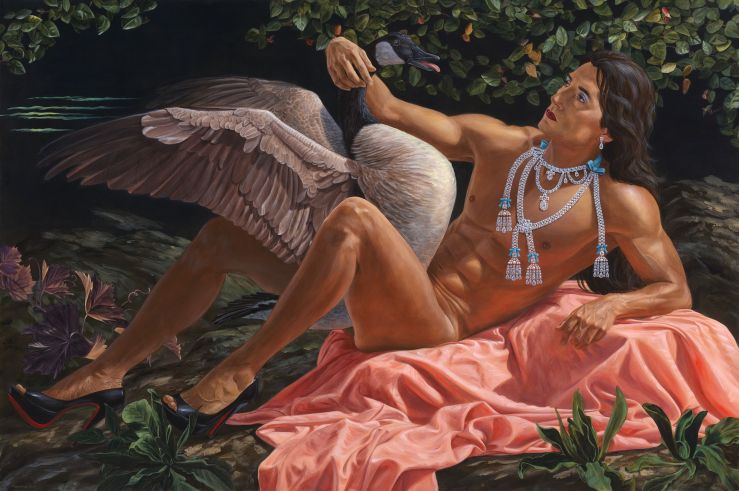
The Affair — Kent Monkman

9aa7d5a288f32deda47b1aee11b455f0

The Affair, 2018 by Kent Monkman (b. 1965)

Woman Power — Maria Lassnig

f4bc0f82fa091499082e9ae15cf9d138

Woman Power, 1979 by Maria Lassnig (1919-2014)

May as well be a rainbow (Toni Morrison)

You think dark is just one color, but it ain’t. There’re five or six kinds of black. Some silky, some woolly. Some just empty. Some like fingers. And it don’t stay still, it moves and changes from one kind of black to another. Saying something is pitch black is like saying something is green. What kind of green? Green like my bottles? Green like a grasshopper? Green like a cucumber, lettuce, or green like the sky is just before it breaks loose to storm? Well, night black is the same way. May as well be a rainbow.

From Toni Morrison’s novel Song of Solomon.

RIP Toni Morrison

bdkyvyujr2crj4r4q8gm

RIP Toni Morrison, 1931-2019

The great American writer Toni Morrison died yesterday at the age of 88. Morrsion was a writer, academic, teacher, and playwright (among many other things), but will likely be best remembered for her eleven novels, which include Beloved (1987), The Bluest Eye (1970), and most recently God Help the Child (2015). Morrison’s slim essay collection Playing in the Dark (1992) remains a standard in college classrooms.

Playing in the Dark was probably the first thing I read by Morrison. I read it more than 20 years ago in a college classroom, and it was one of the first works of cultural criticism I’d read. I think I was probably too young to fully appreciate its scope, but I’ve since used elements of it (as well as Morrison’s essay on Adventures of Huckleberry Finn) in my own classes many times. Beloved, which I read around the same time, also as an undergraduate, had a more profound, visceral effect on me.

While Beloved, a mature exercise published when the author was in her fifties, is likely to be the book most people associate with Morrison, her early novels are especially compelling. The Bluest Eye is a study in abjection, painful, rich, fertile. The follow up, Sula (1973), centers on a black township in Ohio in the thirties. It’s also a painful and beautifully-written novel. Song of Solomon (1977) is maybe my favorite Morrison novel. Its protagonist Milkman Dead remains one of her most complex and memorable figures. I tend to think of these three early novels as a fecund trilogy, the rich base from which Morrison’s themes of race, memory, location, family, identity, and love continued to grow. These themes continued throughout her works, notably Beloved, of course, as well as Jazz (1992) and Paradise (1997). Morrison’s later works are perhaps underread or understudied compared to her early and middle period, but her 2008 novel A Mercy is a particularly focused and strong exploration of the myth of early America. It remains one of my favorites by Morrison. Morrison published two novels after: Home (2012) and God Help the Child. She also wrote the libretto for the opera Margaret Garner (2005), who was the historical inspiration for Beloved. Days after the 2016 election, Morrison published “Making America White Again” in The New Yorker.

A documentary film about her life, Toni Morrison: The Pieces I Am is in theaters now.

“Heat” — Denis Johnson

“Heat”

by

Denis Johnson


Here in the electric dusk your naked lover
tips the glass high and the ice cubes fall against her teeth.
It’s beautiful Susan, her hair sticky with gin,
Our Lady of Wet Glass-Rings on the Album Cover,
streaming with hatred in the heat
as the record falls and the snake-band chords begin
to break like terrible news from the Rolling Stones,
and such a last light—full of spheres and zones.

August,
you’re just an erotic hallucination,
just so much feverishly produced kazoo music,
are you serious?—this large oven impersonating night,
this exhaustion mutilated to resemble passion,
the bogus moon of tenderness and magic
you hold out to each prisoner like a cup of light?

Blog about some books acquired

img_3745

My family and I spent a wonderful week in Oregon at the end of July. We visited friends who live in Portland, where we based our stay, and we drove to the coast, to Mount Hood, and to all kinds of beautiful places. It was really fucking lovely.

Among all the gardens and forests and breweries and record shops, we managed to fit in some bookstores too, of course.

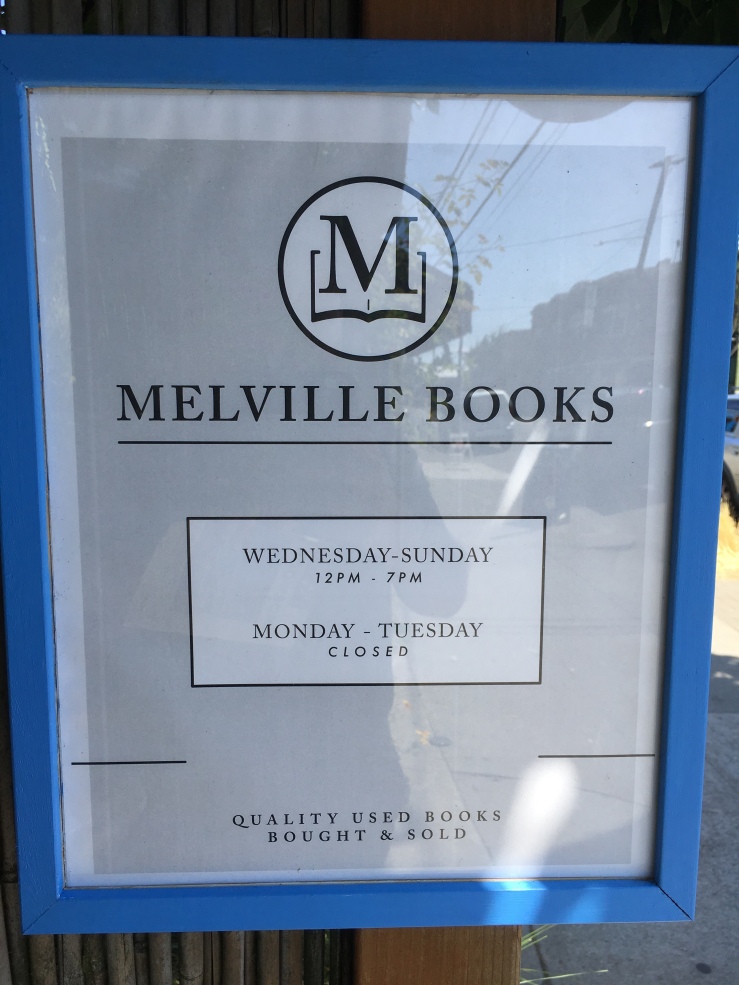
The first was Melville Books, right off of Alberta Street, tucked away just a bit. Our rental house was a block from Alberta, and we got there early in the afternoon and took a stroll. Melville Books is pretty new. The owner-proprietor was making a wooden “Open” sign while he chatted with me about his stock and his experiences scouting and buying used books. He was really friendly, and the small store was very well curated.

img_3259

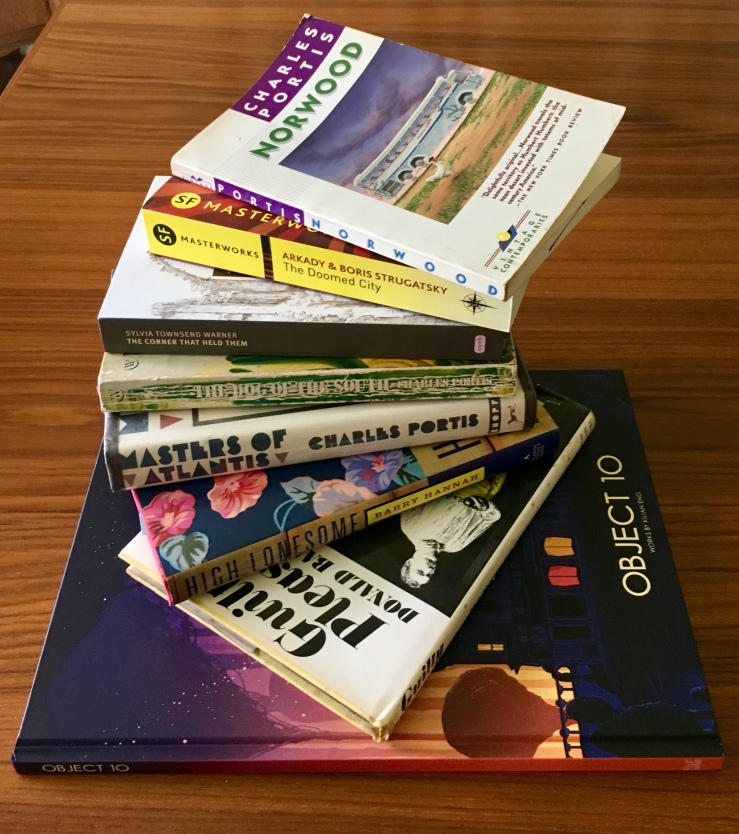
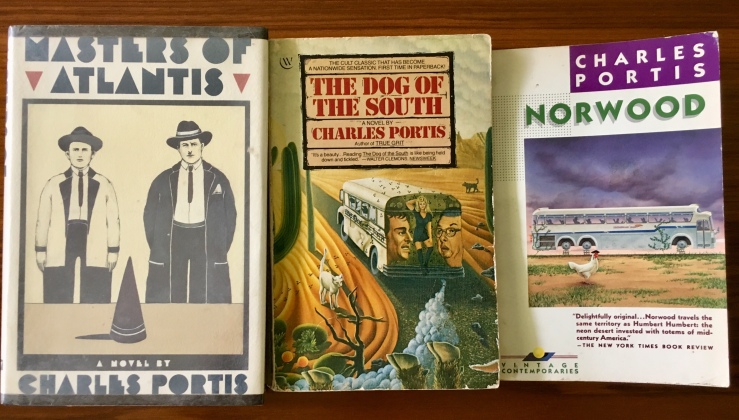
I picked up Charles Portis’s first novel Norwood there on something of a whim. I’ve never read Portis, but I know his fans love his stuff, and I couldn’t pass up the Vintage Contemporaries cover. There was also a hardback copy of True Grit in stock at Melville that I now regret not having picked up. Norwood is hilarious, and has evoked in me a need to read more Portis.

I actually went to my local used book store today to get some stuff for my kids (and maybe just to get out of the house), but the only copy of True Grit they had in stock was a Coen Brothers film adaptation tie in. I did pick up copies of Masters of Atlantis (in hardback) and The Dog of the South though.

img_3733

We also visited Powell’s, of course. I wasn’t expecting it to be as big as it was. Powell’s is a very well-stocked general bookstore, but I was a little disappointed that I couldn’t find more weird or rare stuff there (I think my local place, Chamblin Bookmine, has spoiled me).

img_3558

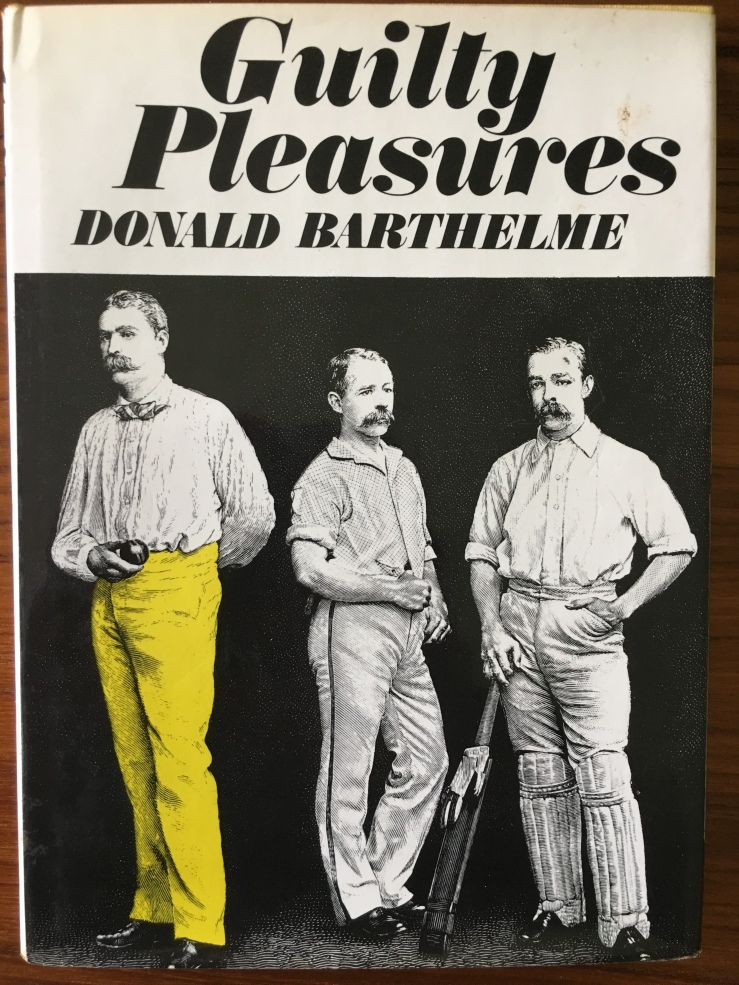
I picked up a first-edition hardback of Donald Barthelme’s “nonfiction” collection Guilty Pleasures for just a few bucks.

img_3734

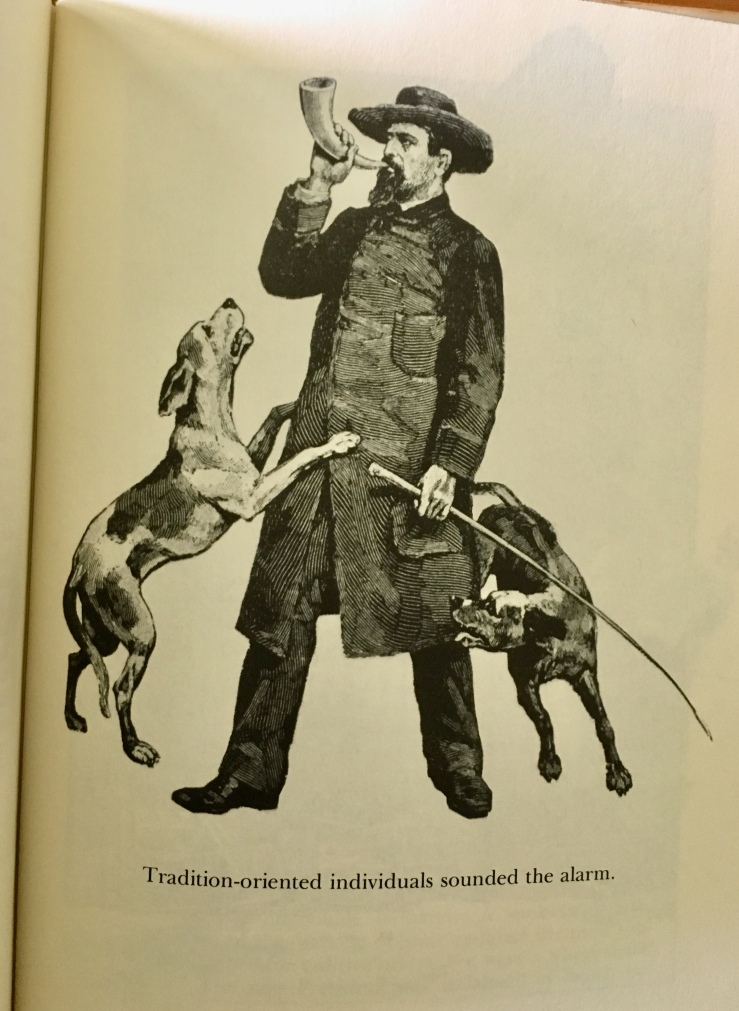
It includes one of my favorite Barthelme pieces, “Eugenie Grandet.” It also includes quite a bit of his collage work.

img_3735

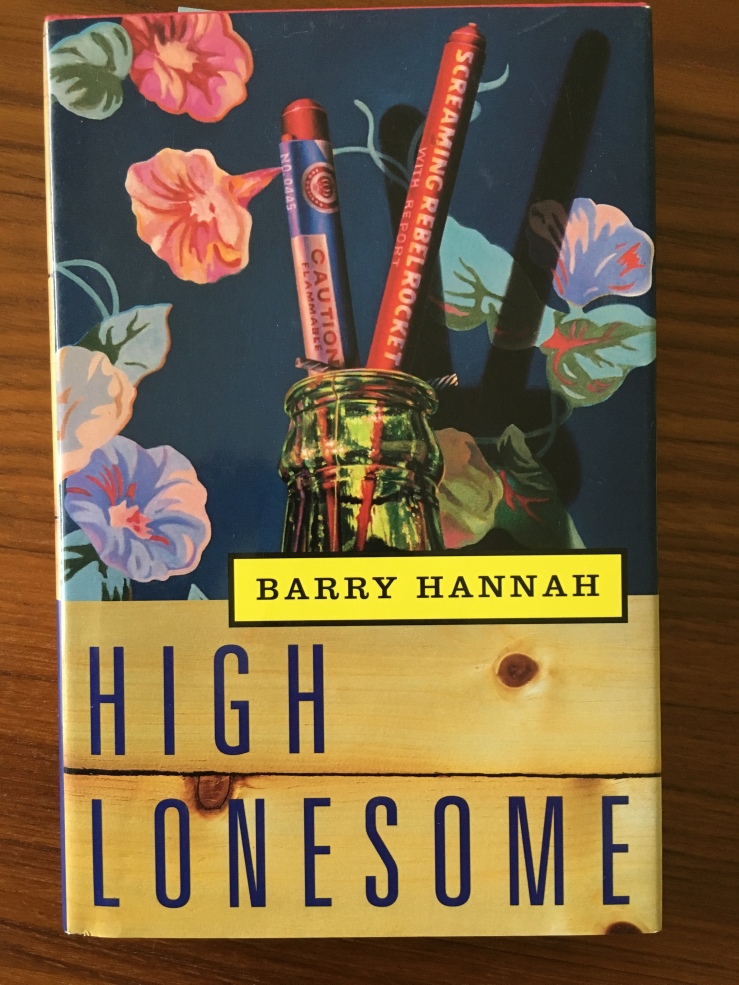
I also picked up a hardback copy of Barry Hannah’s High Lonesome. I’ve read a lot of the stories in here (collected in Long Lost Happy), but some are unfamiliar. Also, the cover is by the photorealist painter Glennray Tutor, a Southern contemporary of Hannah’s. Tutor did the covers for several other Hannah volumes.

img_3736

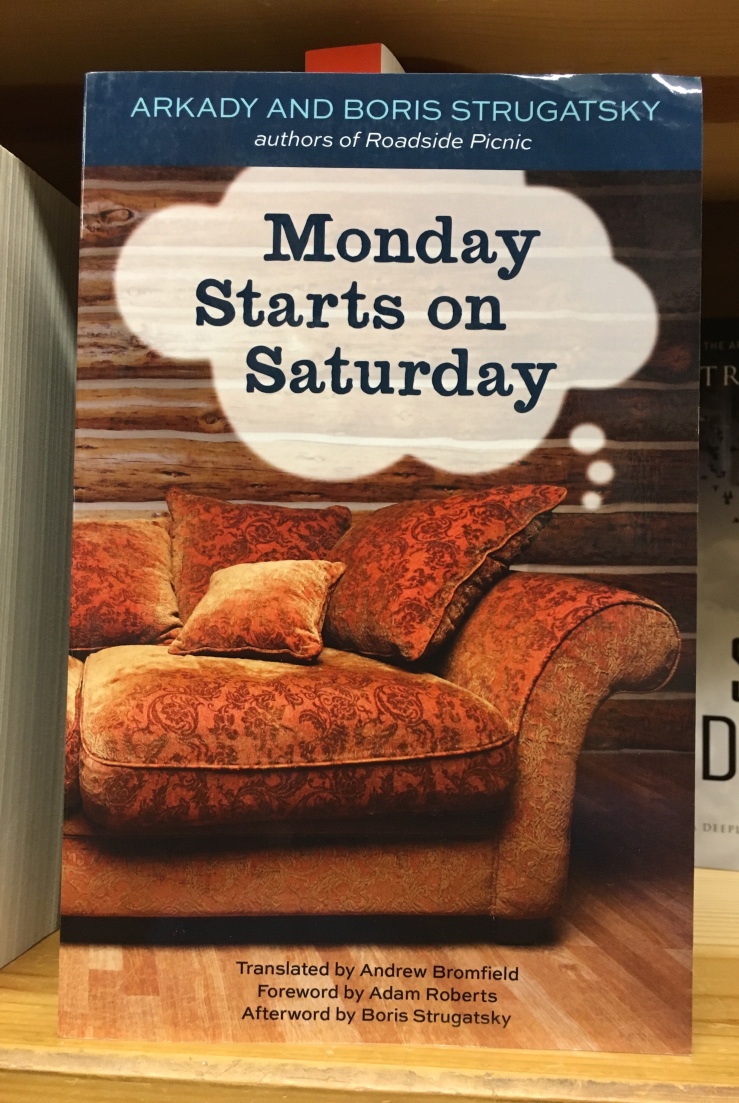
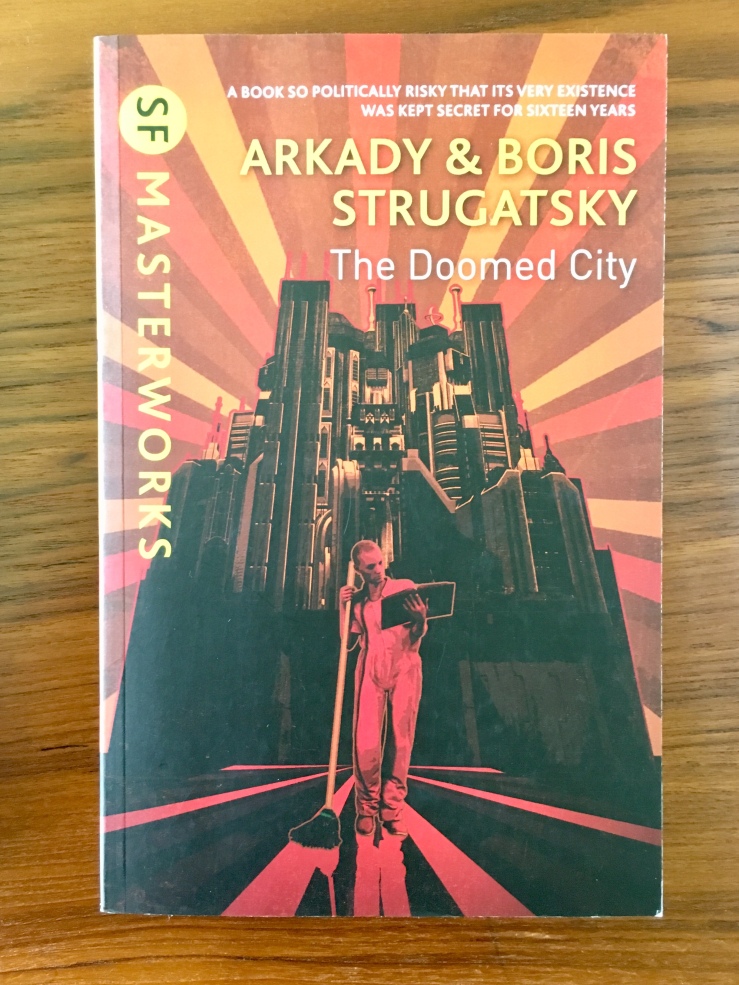
Over in the sci-fi section of Powell’s I found some books by the Strugatsky brothers, which I’ve been into lately. I’ve heard Monday Starts on Saturday is good, but the cover for this edition is so godawful bad that I couldn’t go for it. That’s what library e-books are for, I guess. (Really though, a blank white cover would have been better.)

img_3553

I ended up picking up The Doomed City instead, which I might try to squeeze in before the end of summer.

img_3737

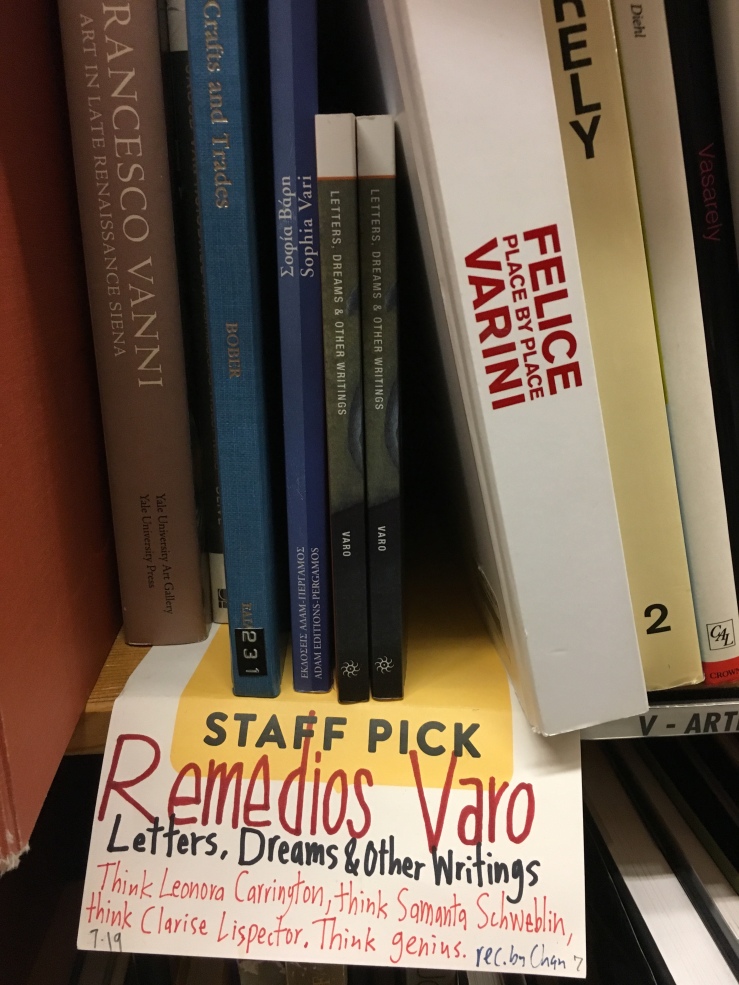
I was impressed with the art books collection at Powell’s but also disappointed not to find anything by Remedios Varo or Leonora Carrington, other than recent editions of their fiction—no real art books though. I was happy though to see a shelf recommendation for Margaret Carson’s recent translation of Varo’s Letters, Dreams & Other Writings though. I sent a pic to Margaret, who was really generous to me with her time in recent interview about her translation.

img_3555

I visited a few other bookshops, not so much as destinations, but rather in happy accidents in the neighborhoods we visited—but I restrained myself from picking anything else up. (And no, I didn’t make it to Mother Foucault’s, unfortunately, although many folks told me to. Next time.)

We visited Floating World Comics the same day as Powell’s, where I picked up a copy of Kilian Eng’s Object 10. I’ve been a fan of Eng’s for years, sharing his images on the blog and following him on Instagram. I hadn’t realized though that Floating World was his publisher. Object 10 is lovely.

img_3740

img_3743img_3744img_3742

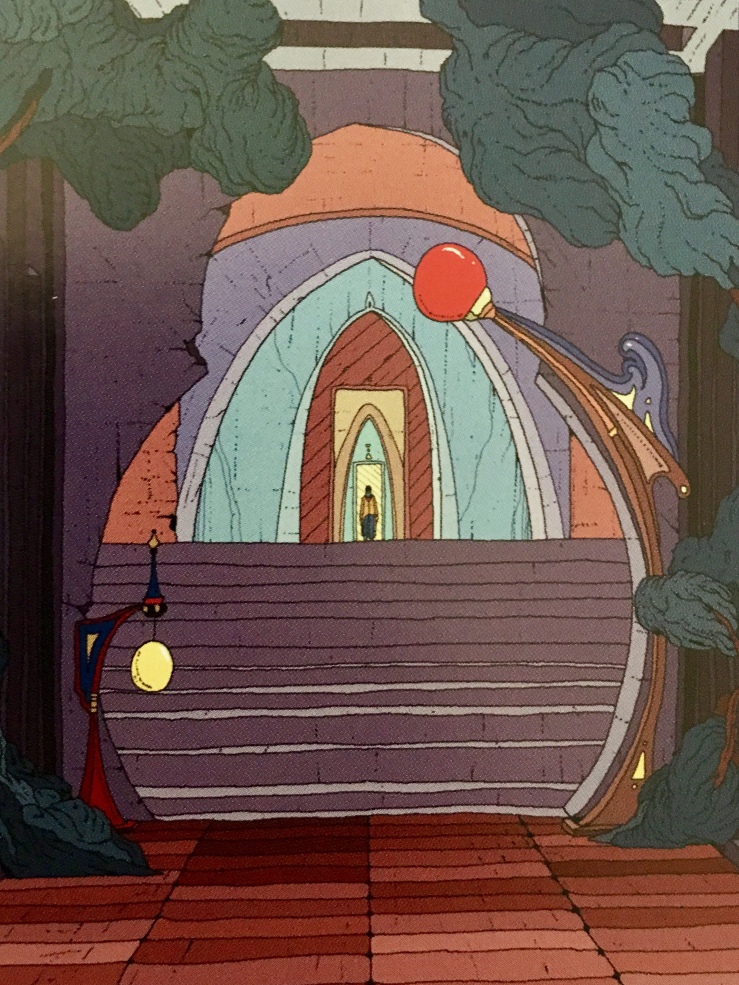
I also picked up a pack of 1993 Moebius trading cards there for a dollar. I haven’t opened them yet though. Saving it for a treat later. It was neat to see copies of Anders Nilsen’s Tongues in the wild, too. I had reviewed the title awhile back for The Comics Journal, but I hadn’t realized that Nilsen lived in Portland. We also checked out Bridge City Comics on Mississippi, which had a nice selection of dollar comics that I indulged my kids in.

Portland was fantastic in general. The only real disappointment came when we visited the Portland Art Museum expecting to see a major Frida Kahlo exhibit. Unfortunately, we misread the dates—the show starts next summer. The museum has a nice collection though. Just a few pics of some pieces I liked:

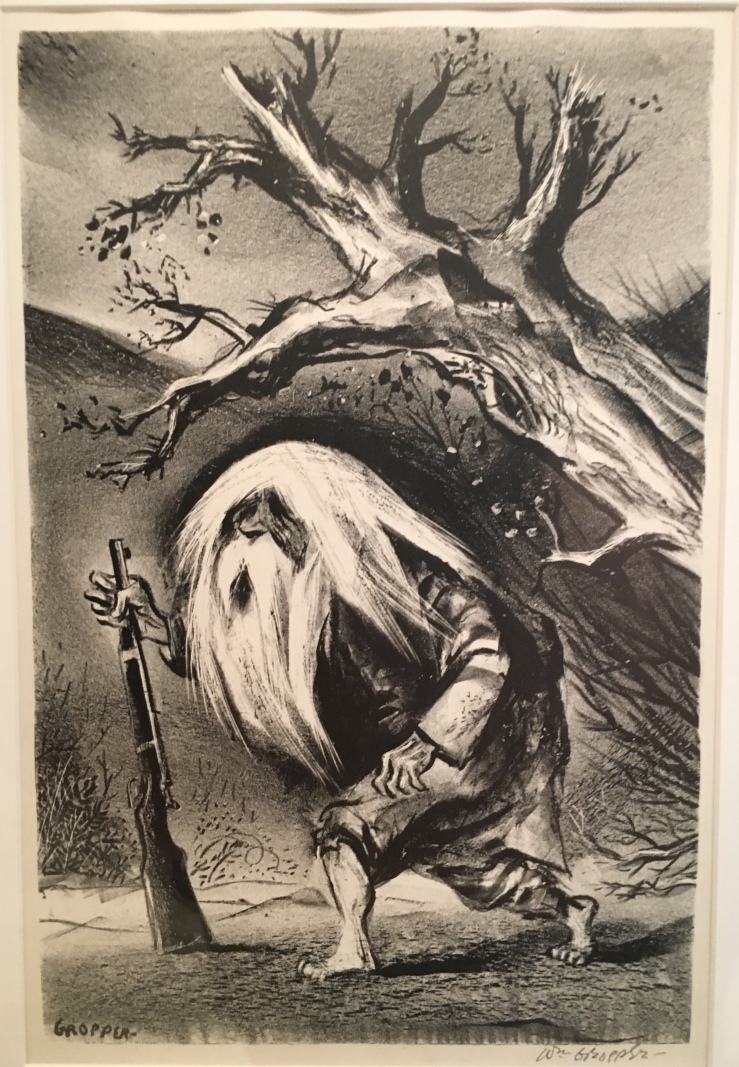
Rip Van Winkle (1945) by William Gropper:

img_3291

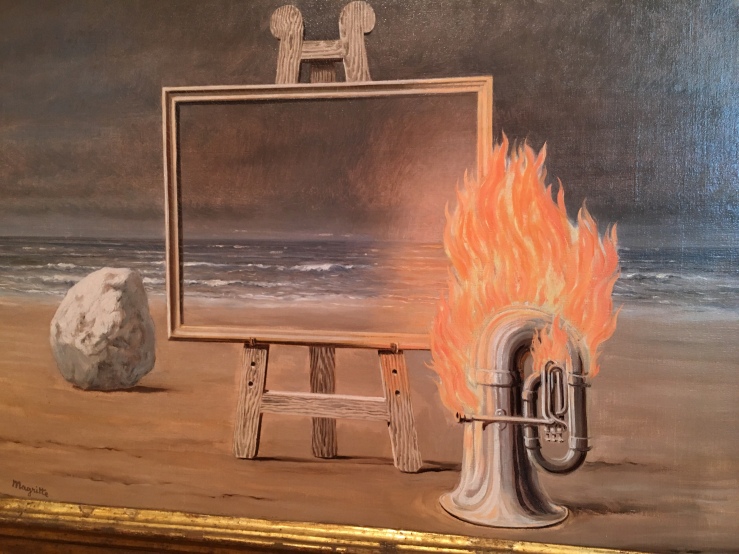
The Fair Captive (1948) by Rene Magritte

img_3339

and The Femminiello (1740-60) by Giuseppe Bonito.

img_3302

Here’s the museum’s description of this unusual painting:

Owing to widespread social prejudice, cross-dressing was rarely depicted in European art until the modern era. This recently discovered painting from the mid-eighteenth century is a testament to the exceptional and long-standing acceptance of cross-dressers known as femminielli in the great Italian city of Naples. The term, which might be translated “little female-men,” is not derogatory, but rather an expression of endearment. Femminielli come from impoverished neighborhoods, as is evidenced by this individual’s missing tooth and goiter, a common condition among the poor in the Neapolitan region. Although femminiellicross-dress from an early age, they do not try to conceal their birth sex completely. Rather than being stigmatized, they are deemed special and are accepted as a “third sex” that combines the strengths of both males and females. In particular, femminielli are thought to bring good luck, so Neapolitans often take newborn babies to them to hold. Femminielli are also popular companions for an evening of gambling. This association is represented by the necklace of red coral, which is similarly thought to bring good fortune. Neapolitan genre paintings (images of everyday life) frequently feature a grinning figure to engage the viewer. Here, we are invited to consider the artist’s playful inversion of traditional views of gender, which contrasts the pretty young male with the more masculine femminiello.

Maybe we’ll get back to the Pacific Northwest next summer and see the Kahlo then.

Anyway so well—

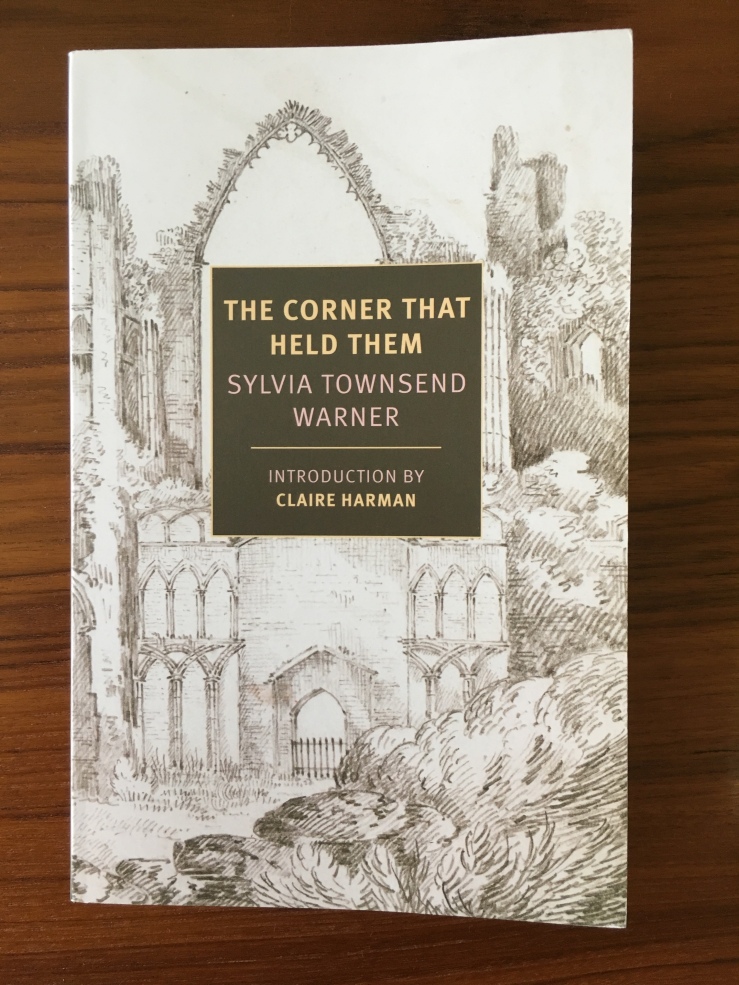
Like I said, I went to the bookstore today, not looking for myself (promise!) except that I did stop and browse Portis briefly, picking up the aforementioned copies. When I got home, I had a package from NYRB containing The Corner That Held Them by Sylvia Townsend Warner. It immediately interested me when I flicked through it—seems like a weird one. NYRB’s blurb below; more to come.

img_3738

Sylvia Townsend Warner’s The Corner That Held Them is a historical novel like no other, one that immerses the reader in the dailiness of history, rather than history as the given sequence of events that, in time, it comes to seem. Time ebbs and flows and characters come and go in this novel, set in the era of the Black Death, about a Benedictine convent of no great note. The nuns do their chores, and seek to maintain and improve the fabric of their house and chapel, and struggle with each other and with themselves. The book that emerges is a picture of a world run by women but also a story—stirring, disturbing, witty, utterly entrancing—of a community. What is the life of a community and how does it support, or constrain, a real humanity? How do we live through it and it through us? These are among the deep questions that lie behind this rare triumph of the novelist’s art.


Last Dance — Clive Smith

716653_cs-3154v1

Last Dance, 2018 by Clive Smith (b. 1967)

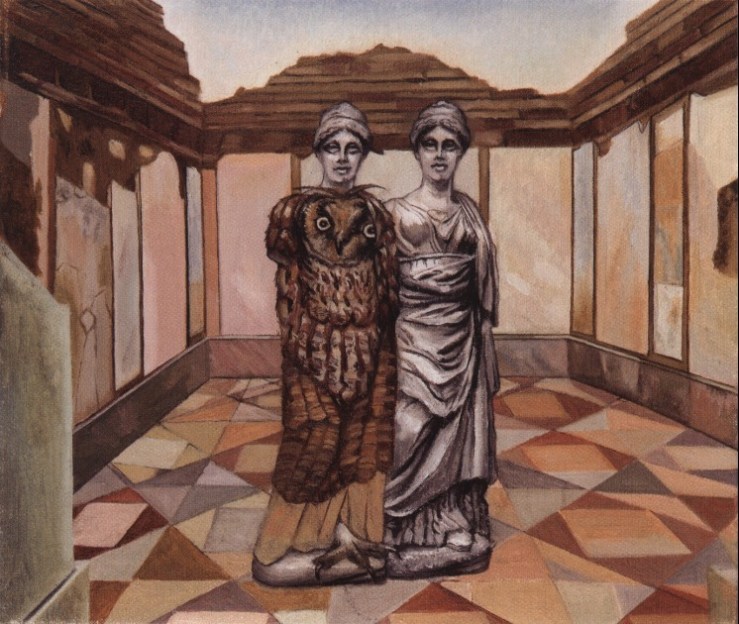
Sisters of Anarchy — Edith Rimmington

1940-4120sisters20of20anarchy

Sisters of Anarchy, 1941 by Edith Rimmington (1902-1986)

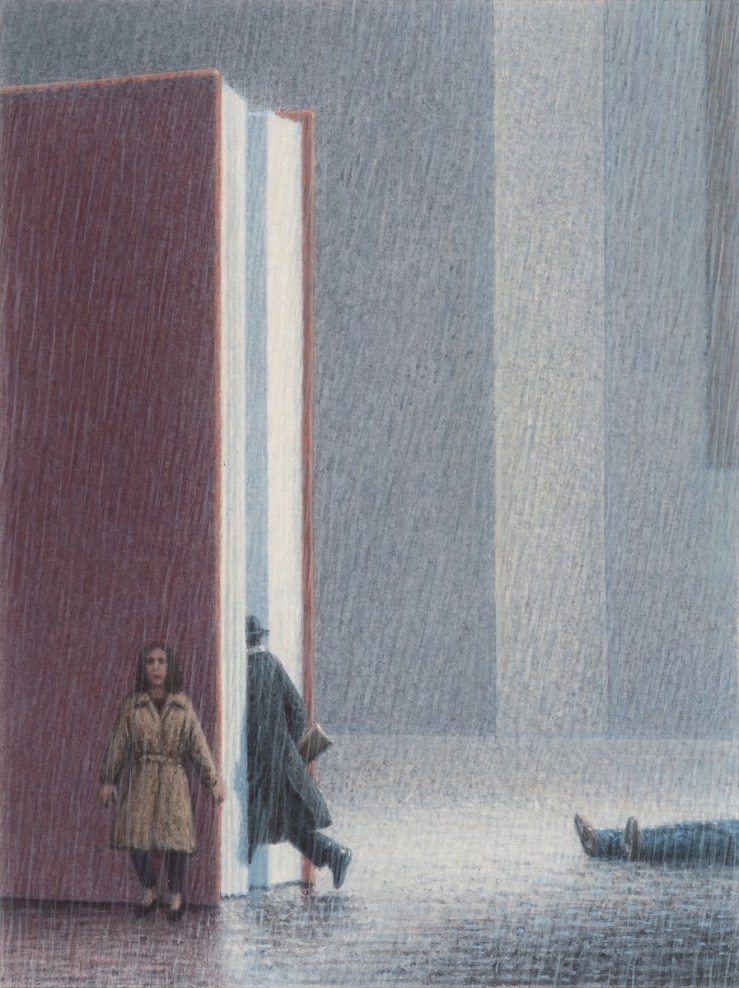
Narrative in the Rain — Quint Buchholz 

quint-buchholz-narrative-in-the-rain-2013

Narrative in the Rain, 2013 by Quint Buchholz (b. 1957)

Island Library — Jamie Wyeth

island-library-1977

Island Library, 1977 by Jamie Wyeth (b. 1946)

Sic Transit — George Frederic Watts

Sic Transit 1891-2 by George Frederic Watts 1817-1904

Sic Transit, 1892 by George Frederic Watts (1817–1904)

“A Rabbit as King of the Ghosts” — Wallace Stevens

“A Rabbit as King of the Ghosts”

by

Wallace Stevens


The difficulty to think at the end of day,
When the shapeless shadow covers the sun
And nothing is left except light on your fur—

There was the cat slopping its milk all day,
Fat cat, red tongue, green mind, white milk
And August the most peaceful month.

To be, in the grass, in the peacefullest time,
Without that monument of cat,
The cat forgotten in the moon;

And to feel that the light is a rabbit-light,
In which everything is meant for you
And nothing need be explained;

Then there is nothing to think of. It comes of itself;
And east rushes west and west rushes down,
No matter. The grass is full

And full of yourself. The trees around are for you,
The whole of the wideness of night is for you,
A self that touches all edges,

You become a self that fills the four corners of night.
The red cat hides away in the fur-light
And there you are humped high, humped up,

You are humped higher and higher, black as stone—
You sit with your head like a carving in space
And the little green cat is a bug in the grass.

“Bartleby” is the first great epic of modern Sloth (Thomas Pynchon)

By the time of “Bartleby the Scrivener: A Story of Wall-Street” (1853), acedia had lost the last of its religious reverberations and was now an offense against the economy. Right in the heart of robber-baron capitalism, the title character develops what proves to be terminal acedia. It is like one of those western tales where the desperado keeps making choices that only herd him closer to the one disagreeable finale. Bartleby just sits there in an office on Wall Street repeating, “I would prefer not to.” While his options go rapidly narrowing, his employer, a man of affairs and substance, is actually brought to question the assumptions of his own life by this miserable scrivener — this writer! — who, though among the lowest of the low in the bilges of capitalism, nevertheless refuses to go on interacting anymore with the daily order, thus bringing up the interesting question: who is more guilty of Sloth, a person who collaborates with the root of all evil, accepting things-as-they-are in return for a paycheck and a hassle-free life, or one who does nothing, finally, but persist in sorrow? “Bartleby” is the first great epic of modern Sloth, presently to be followed by work from the likes of Kafka, Hemingway, Proust, Sartre, Musil and others — take your own favorite list of writers after Melville and you’re bound sooner or later to run into a character bearing a sorrow recognizable as peculiarly of our own time.

From Thomas Pynchon’s 1993 essay “Sloth; Nearer, My Couch, to Thee.”

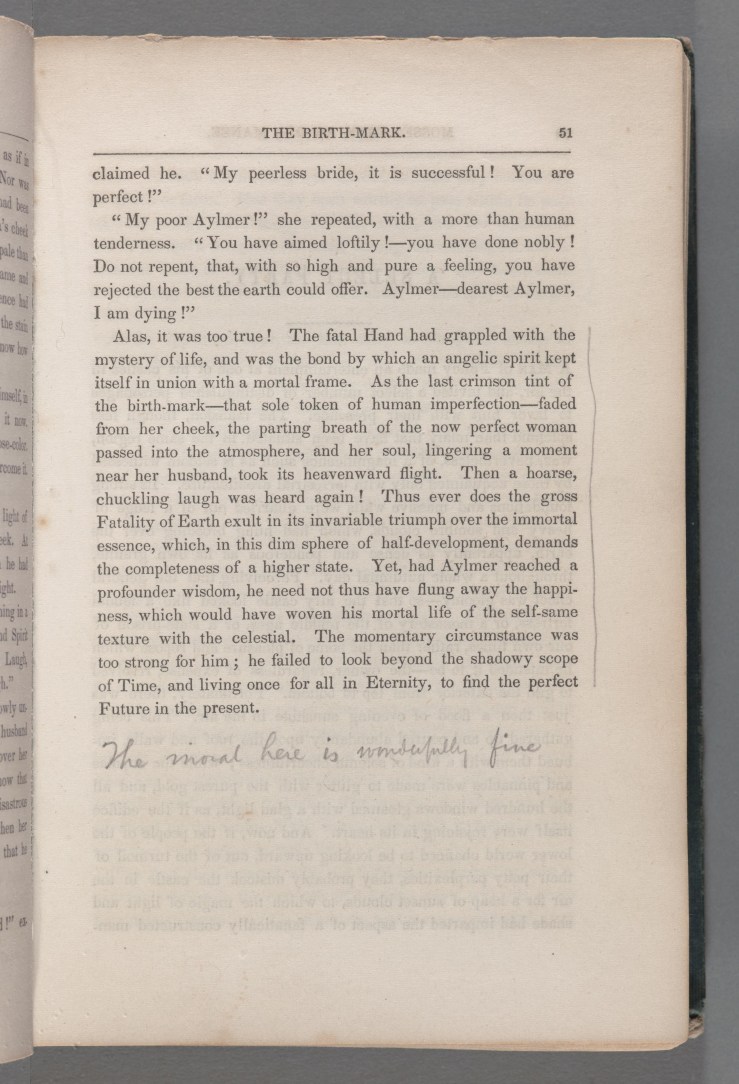
The moral here is wonderfully fine | Melville annotates Hawthorne

Herman Melville’s markings and annotations on the last page of Nathaniel Hawthorne’s short story “The Birth-mark.” From Melville’s Marginalia Online.

The problems of Bartleby

What are the problems of Herman Melville’s story “Bartleby, the Scrivener: A Story of Wall Street”?

This question seems like a bad starting place.

Let me share an anecdote instead.

—I was in the tenth grade the first time I read “Bartleby.”

At the time, I thought I was a teacher’s dream—a sharp reader, someone who loved English class, someone with opinions about the texts we read. Lots and lots of opinions. In retrospect, I realize that I was a nightmare for poor Ms. Hall, a wonderful teacher who I’m sure dreaded our meetings (there were like 15 guys in the class, all unruly).

Simply put, I didn’t want to do things her way.

So she gave me a copy of Billy Budd, Sailor and Other Stories and told me to read “Bartleby,” suggesting that there was something I might learn from it.

I don’t know if backfired is exactly the right term for the results of this experiment. I do know that “Bartleby” offered me a brilliant retort—a literary allusion!—to refuse any task I didn’t feel like undertaking in 10th grade English:

“I would prefer not to.”

—While we’re here—

“I would prefer not to”

So, this is clearly one of the problems of “Bartleby,” if not the core problem condensed into one utterance: Why would? Why the conditional?

Consider, vs. I prefer not to, a constative (or maybe even performative) utterance.

But Bartleby “would prefer not to.”

Contrast this with the imperative must that the narrator employs:

At the expiration of that period, I peeped behind the screen, and lo!
Bartleby was there.

I buttoned up my coat, balanced myself; advanced slowly towards him, touched his shoulder, and said, “The time has come; you must quit this place; I am sorry for you; here is money; but you must go.”

“I would prefer not,” he replied, with his back still towards me.

“You must.”

He remained silent.

Now I had an unbounded confidence in this man’s common honesty. He had frequently restored to me sixpences and shillings carelessly dropped upon the floor, for I am apt to be very reckless in such shirt-button affairs. The proceeding then which followed will not be deemed extraordinary.

“Bartleby,” said I, “I owe you twelve dollars on account; here are thirty-two; the odd twenty are yours.—Will you take it?” and I handed the bills towards him.

These brief lines perhaps serve to summarize Melville’s tale.

We see here the basic plot—our titular scrivener will not leave the lawyer’s office after weeks of refusing (although refusing is not quite the right word) to work.

We also see here what I take to be the theme of “Bartleby,” the strange ethical position Bartleby’s (conditional) would prefer not to places the narrator’s (imperative) must set against the moral backdrop of do unto others: namely, an impossible ethical position for a Wall Street lawyer especially and most of us in general.

And “Bartleby,” as you’ll no doubt recall, is in some ways Melville trying to work out the problems of Matthew 25:35-39—

For I was an hungred, and ye gave me meat: I was thirsty, and ye gave me drink: I was a stranger, and ye took me in:

Naked, and ye clothed me: I was sick, and ye visited me: I was in prison, and ye came unto me.

Then shall the righteous answer him, saying, Lord, when saw we thee an hungred, and fed thee? or thirsty, and gave thee drink?

When saw we thee a stranger, and took thee in? or naked, and clothed thee?

Or when saw we thee sick, or in prison, and came unto thee?

Perhaps our narrator tries to do these things—tries to feed and clothe and help this stranger Bartleby—but he can’t. Because Bartleby won’t give him an agency to relate to.

Because Bartleby’s utterance “I would prefer not to” denies the performative or constantive or declarative—indeed, it suspends or disrupts its own conditionality, the relation of the subject to its predicate verb.

Or consider one of Bartleby’s only other lines: “What is wanted?” His grammar again suspends agency, disrupts the notion of a stable I (let alone objective case me) that the narrator can interface with, dictate to, interrogate, see his own narcissistic reflection in).

—Hang on though, I was telling an anecdote. It was about the first time I read “Bartleby,” when I was fourteen or fifteen. This is the book:

20121112-150751.jpg

I stole it of course, or never returned it. Yes, that’s duct tape on its side. It is more or less falling apart. Here’s the back, barcode and all.

20121112-150740.jpg

Over the years, like many readers, I returned many times to “Bartleby,” reading it again in high school, then in college, then in grad school. I read it unassigned too, of course—when I read Kafka and it recalled itself to me, and when I read Moby-Dick for the first time. I read it when compelled. And then I read it with my own students. (I read most of the other stuff in the collection too, of course — Billy Budd and then later (why so much later?!) Benito Cereno).

I scrawled through so much of the book that my annotations are basically worthless, virtually everything underlined or circled:

20121112-151659.jpg

So we butt up against the problems of “Bartleby”—the problems of interpretation. How to figure an eponymous “hero” who is no more than a phantom, a trace, a lack? How to hash out a narrator who presents himself in relatively admirable terms and yet is so clearly an ethical failure? Why oh why would Bartleby prefer not to? Is the story a tragedy or a comedy? Does it present a world with rules, codes, ethics, or is all absurd here—nihilistic even? Is Bartleby a Christ figure? An ascetic monk? A ghost? Is the story just about Melville’s own anger over the poor reception of Pierre? How much of contemporary transcendentalist thought can we find in the story?

—Slight shift:

The kind people of Melville House were sporting enough to send a copy of “Bartleby” my way. The book is part of their HybridBooks project; these books offer “digital illuminations” along with traditional (uh, paper) books.

I’d requested a HybridBook—any one of them, really—because I now read about half the time on a Kindle Fire—so I was particularly interested in what a “hybrid” had to offer. What is the reading experience like?

First, the book itself is part of Melville House’s Art of the Novella series—beautiful, minimal design with French flaps. I read it on my porch the afternoon it arrived, enjoying its pristine, white, unmarked pages. Then, I checked out the “Digital Illuminations.”

The illuminations are available in several device-specific options, all easy to download with the QRC that comes with the book. I read most of the illuminations on my Kindle, but I also put them on my iPhone and my laptop. I had originally intended this post to be specifically about the digital illuminations, but hell, “Bartleby” is just too damn freighted a read for me at this point. Anyway, there’s a lot of good stuff in there, including “The Transcendentalist” by Ralph Waldo Emerson, selections from Jonathan Edwards and Joseph Priestly, Thoreau’s “Civil Disobedience,” and several excerpts from Melville himself, including letters, other books, and reviews. What I found must, uh, illuminating was “Of Some of the Sources of Poetry Amongst Democratic Nations” from Democracy in America by Alexis de Tocqueville. There are also illustrations, including a map; there’s even a recipe for ginger nuts. I wish that MH had included a digital copy of the book though. From a practical, concrete standpoint, I found it easier to switch between the free public domain version of “Bartleby” on my Kindle and MH’s illuminations than it would have been to pick up the physical book.

Now, to shift back (perhaps):

Do the digital illuminations help to answer or solve or address some of the problems of “Bartleby,” some of the issues posed above?

Should they?

—I suppose the hedging answer is yes and no.

The additional material illuminates some of the philosophical, political, historical, and even personal context for “Bartleby.” The material is edited with minimal intrusion, but with enough explication to clearly connect the various selections to Melville’s story. If I’m reading with my teacher hat on (this is a metaphor; there is no literal hat), I’d say you probably couldn’t do better than what Melville House has put together here. The digital illuminations provide a strong foundation for an informed reading, a range of texts that speak (obliquely or otherwise) to “Bartleby.”

Does it all add up to a deeper or richer understanding of “Bartleby”?

Should it?

—Well. No. And then no.

I mean, would we want a series of essays that would provide the missing pieces that would allow us to puzzle out “Bartleby”? Could we even trust such pieces, let alone trust ourselves to trust such pieces? Isn’t this strange uncertainty why “Bartleby” endures—and endures apart from Moby-Dick or Billy Budd, strange texts themselves, but also not nearly as confounding?

“Bartleby” simultaneously wriggles and plays dead; it burns with apparent wit but then reminds us that we might not be in on the joke. It is Kafkaesque thirty years before Kafka was even born. It shakes off its allegorical idiom the minute we think we might limn its contours. It makes us read it again because we cannot pin it down.

—But maybe you want to pin it down, tickle it, torture it, make it solve its problems (or at least respond, damn it!).

And maybe I claimed that “Bartleby” was about something—that it was about ethical relations, about duty to one’s fellows—especially when a fellow isn’t a fellow but rather the trace of a fellowthe idea of a fellowa ghost.

So, look, here’s a take on it:

The narrator—let’s call him Lawyer—Lawyer, see he’s a dick, in the parlance of our times. He’s a dick because he doesn’t know that he’s a dick, which is one of the constituting factors of the ontological state of being a dick. He also does not want to see himself as being a dick (this is another factor in the ontological state of being a dick). He wants to see himself as a good guy, this Wall Street dickhead, but Bartleby won’t let him do that. Bartleby won’t even let him see himself at all: Bartleby doesn’t reflect back. He prefers not to.

Our Lawyer, see, he’s all buttoned up, he’s snug (these are his words). He tells us upfront that he possesses “a profound conviction that the easiest way of life is the best”; he repeatedly points out the way that people are “useful” to him (or to others). He sees no possibility of an ethics outside of usefulness; on top of that, he cannot see that he cannot see any possibility of an ethics based on anything but “usefulness” (or the negative economy of obstruction figured in Bartleby).

And ah Bartleby, ah humanity: One time model employee, once apparently free from the eccentricities that plague the Lawyer’s other scriveners, Turkey and Nippers. Machinelike.

Bartleby mechanically completes large quantities of copies without comment or complaint.  But when asked to simply read in unison with Lawyer and his scriveners, Bartleby replies: “I would prefer not to.” Bartleby will not read with others—he is literally not on the same page as his colleagues.

Lawyer confronts Bartleby with his noncompliance; Bartleby repeats his mantra. Fuck mantra though because it’s not a mantra. It’s only repeated for Lawyer, to Lawyer, really, who can’t schematize/name/pin down Bartleby’s response. In fact, I would prefer not to so startles Lawyer that he says he’s  “unmanned” by the words. So he rationalizes Bartleby’s odd response, internalizes it, paraphrases it, if you like.

And then Bartleby ceases to even do his copying work. Oh the anarchy! But wait, there’s not even anarchy. There’s not even protest. There’s just big nothing. But not even big nothing—instead the smallest nothing (which proves that big nothing is possible).

So Lawyer attempts to “help” Bartleby. Lawyer believes doing so is his “Christian duty.” And to know that this duty has been met, Lawyer needs Bartleby to be his echo. But Bartleby’s I prefer not to denies this narcissistic exchange. He empties his I of ego (shades of Emerson’s Transparent Eyeball).

Confused, Lawyer tries to pay off Bartleby. When that doesn’t work, Lawyer actually packs up and moves to a new office. But even here he can’t cut off Bartleby. The office’s landlord comes to Lawyer to remove Bartleby.

And when Bartleby refuses to leave the office he is taken to “the Tombs”—prison.

Here, Lawyer tries to provide comfort for Bartleby (hearken ye back to Matthew 25:35-39). He arranges for Bartleby to receive good food in the prison. Bartleby prefers not to eat though, and dies curled up in the fetal position during a visit by Lawyer.

Lawyer is the first reader of Bartleby. But like many readers of “Bartleby,” he is confused.

Lawyer’s confusion results from his need for safety—for ease, for comfort, for a snug, buttoned-upness—and that safety is bought through an affirmation of first-person experience: namely, in the affirmation of the self in the other. That security is bought through assimilating another person’s first-person perspective. But Bartleby is empty of I, of self, of ego.

Bartleby would prefer not to: He will not be ventriloquized: He will not echo: He will not read from the same script: He will not be “of use,” as Lawyer puts it.

So Bartleby dissipates and dissolves: He goes down in the Tombs: a ghost, and impossibility, presence coupled with absence.

— And the epilogue:

We all recall the epilogue, yes?

Lawyer offers up “one little item of rumor,” a morsel, a “vague report . . . that Bartleby had been a subordinate clerk in the Dead Letter Office at Washington.” The idea tears the narrator up inside: “Dead letters! does it not sound like dead men?”

For Lawyer, Bartleby is a dead letter, a failed letter.

Did Melville worry that “Bartleby” would be a failed letter? That it would not find an audience? That his work would not be delivered? If he did, it seems too then that Bartleby’s negations foreclose or reject this concern. Not sure of how to wrap up this riff, I’ll retreat to the safety of my title.

We find the final problems (in basic narrative chronology, that is) of “Bartleby” in its final line. Has Lawyer learned from his experience? Can he empathize, finally feel something for Bartleby beyond the confines of a perceived ethical duty? Is Bartleby a place holder for all humanity? Or is Bartleby in opposition to humanity? What does it mean—-

Ah Bartleby! Ah humanity!

?

[Ed. note–Biblioklept originally posted this riff in November of 2012. I’m running it again for Herman Melville’s 200th birthday.]