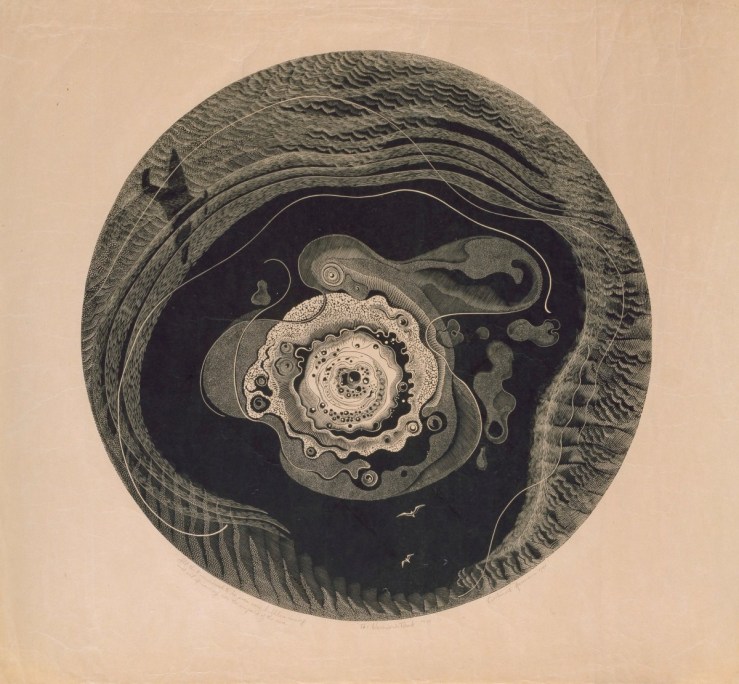
The Warrior’s Tomb — Gertrude Hermes

George Grady Press; Hermes, Gertrude; The Warrior's Tomb

The Warrior’s Tomb1941 by Gertrude Hermes (1901–1983)

“A Postcard from the Volcano” — Wallace Stevens

“A Postcard from the Volcano”

by

Wallace Stevens


Children picking up our bones
Will never know that these were once
As quick as foxes on the hill;

And that in autumn, when the grapes
Made sharp air sharper by their smell
These had a being, breathing frost;

And least will guess that with our bones
We left much more, left what still is
The look of things, left what we felt

At what we saw. The spring clouds blow
Above the shuttered mansion-house,
Beyond our gate and the windy sky

Cries out a literate despair.
We knew for long the mansion’s look
And what we said of it became

A part of what it is … Children,
Still weaving budded aureoles,
Will speak our speech and never know,

Will say of the mansion that it seems
As if he that lived there left behind
A spirit storming in blank walls,

A dirty house in a gutted world,
A tatter of shadows peaked to white,
Smeared with the gold of the opulent sun.

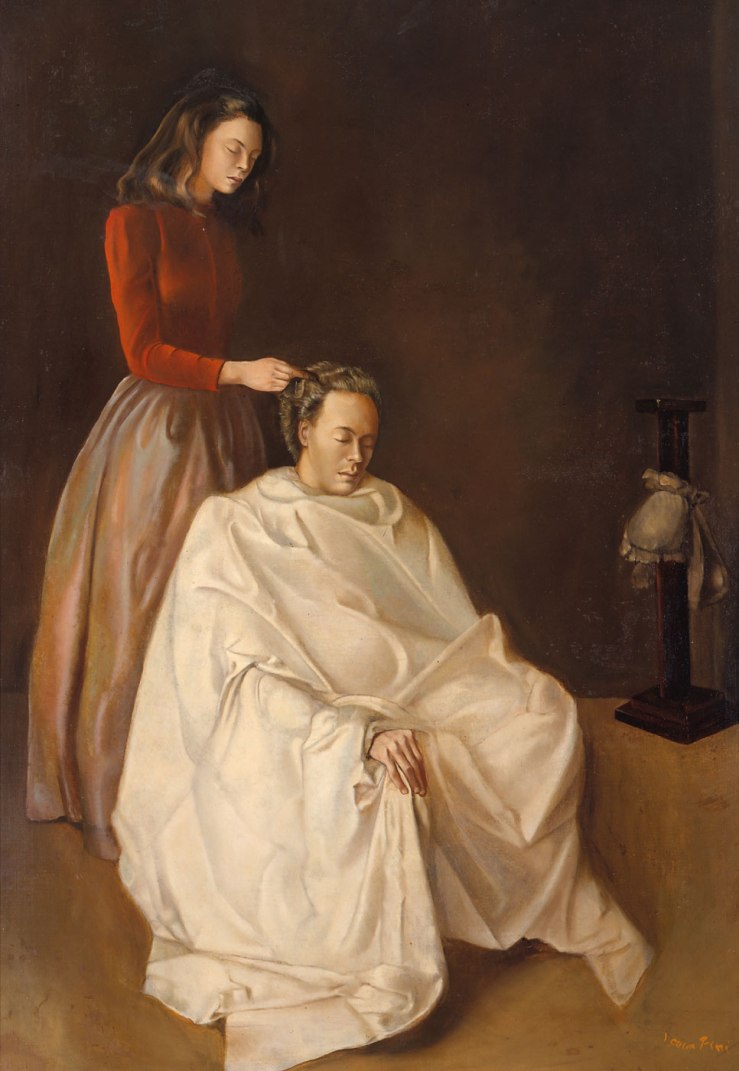
Operation I — Leonor Fini

operation-i-hi

Operation I, 1939 by Leonor Fini (1908-1996)

Uncertainty of the real | Blog about the first third of Anna Kavan’s novel Ice

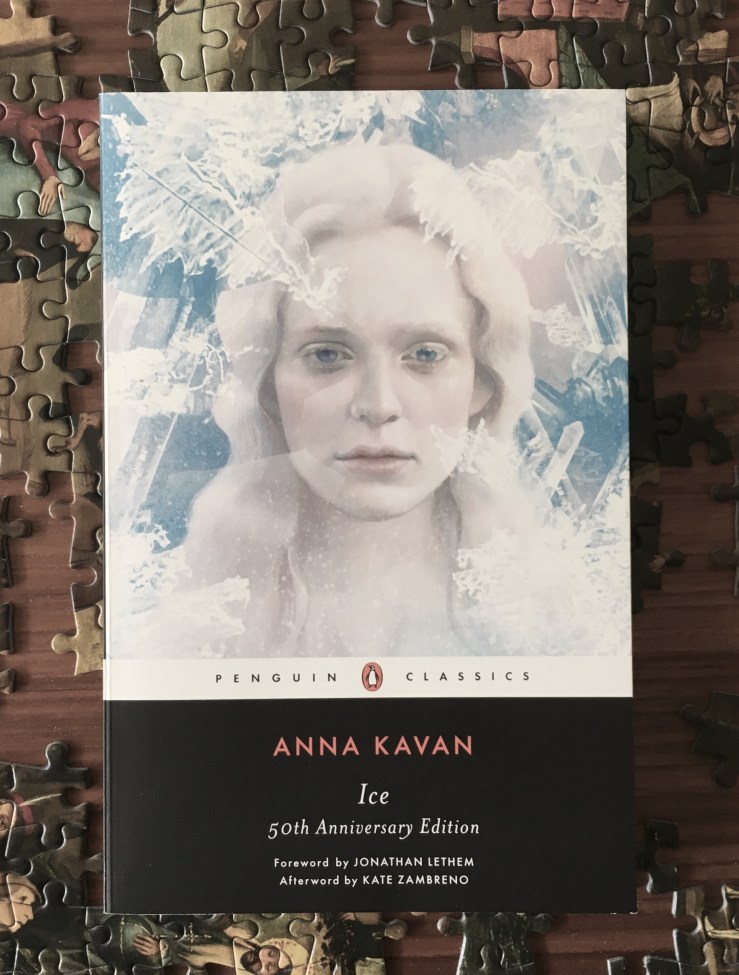
The first three words of Anna Kavan’s 1967 novel Ice are “I was lost,” a simple declaration that seems to serve as a mission statement for the next 60 odd pages. I read these 60 odd pages (63, to be precise, in my Penguin Classics 50th Anniversary Edition of the novel) today, often feeling lost, and glad of it. I like it when I don’t really know what a book is doing, and Ice is such a book.

Ice is told in first-person by an as-yet-unnamed narrator who strikes me as more than a little unreliable. “Reality had always been something of an unknown quantity to me,” he tells us early in the first chapter, admitting that, “At times this could be disturbing.”

Kavan crafts a disturbing, dreamlike tone from the novel’s opening pages, a sinister menace that intensified over the five chapters that I read today. The novel’s settings are detailed but also indistinct, not tethered to any specific time or place, yet nevertheless vaguely familiar. Ice starts in a place like England, and our narrator soon travels to what seems like a Scandinavian country—more on that in a minute—and it’s unclear when exactly the story is taking place: the past? The future? A twisted version of now?

What is clear is that Ice is set in a world that has fallen or is falling into ruin. The word ruins repeats throughout the book; there’s a sense of a post-war world that never recovered—crumbling walls, abandoned buildings, and a reliance on ancient fortresses as symbols of civilization. It’s simultaneously real and unreal, uncanny, disquieting. “The situation was alarming, the atmosphere tense, the emergency imminent,” our narrator tells us, pointing to the vague horror that writhes under the novel’s surface.

Our unnamed narrator repeatedly underscores Ice’s central unreality, an unreality that it is possible he, as the narrator, actually is creating through his witnessing and telling:

I was aware of an uncertainty of the real, in my surroundings and in myself. What I saw had no solidity, it was all made of mist and nylon, with nothing behind.”

Our narrator, who claims to have been at times a soldier and at times an explorer, admits that his medication might contribute to his sense of unreality, to his getting lost. Reading Ice is to get lost from paragraph to paragraph, which I mean in the most complimentary sense. I often had to backtrack, especially in the early chapters, to make sure I hadn’t somehow missed a sentence or stray line of connective tissue that might explain why we had suddenly ended up in, say, a Boschian-nightmare battle, or in the inside of a mesmerist’s chamber in a high tower.

The first swerve into unreality (if it is indeed unreality) happens in the opening paragraphs. Our narrator is lost, driving icy hills, looking for the home of a woman (“the girl”) he claims is his former betrothed, now married to another. It’s not quite clear why he needs to see her, but he’s looking for her, and he’s lost. (I have just describe the plot of the first several chapters.) Here is how we first meet the girl:

An unearthly whiteness began to bloom on the hedges. I passed a gap and glanced through. For a moment, my lights picked out like searchlights the girl’s naked body, slight as a child’s, ivory white against the dead white of the snow, her hair bright as spun glass. She did not look in my direction. Motionless, she kept her eyes fixed on the walls moving slowly towards her, a glassy, glittering circle of solid ice, of which she was the centre. Dazzling flashes came from the ice-cliffs far over her head; below, the outermost fringes of ice had already reached her, immobilized her, set hard as concrete over her feet and ankles. I watched the ice climb higher, covering knees and thighs, saw her mouth open, a black hole in the white face, heard her thin, agonized scream. I felt no pity for her. On the contrary, I derived an indescribable pleasure from seeing her suffer. I disapproved of my own callousness, but there it was.

Kavan’s narrator never fully explains that what he might have just communicated to the readers was an hallucination or other species of unreality. He concedes that his medication (for “trauma” inflicted by the girl’s desertion of him) leads him to have nightmares and visions, always of the girl becoming a “victim” of some kind (the word victim repeats throughout Ice).

He finally arrives at the house of the girl and her husband. Kavan layers this visit with his memories (or fantasies?) of at least one other visit to their home. Kavan condenses these scenes with surreal fabulsim. Our narrator, like Vonnegut’s hero Billy Pilgrim, seems unstuck in time, yet also seems unable, or unwilling, to provide his audience any guideposts. We get lost together.

Our narrator can also see sights that seem impossible to a first-person perspective—he seems able to see the girl in rooms we understand to be closed, in spaces we understand to be private, from distances we understand to be impossible. In one such instance, he even seems to peer through the girl’s own consciousness:

Instead of the darkness, she faced a stupendous sky-conflagration, an incredible glacial dream-scene. Cold coruscations of rainbow fire pulsed overhead, shot through by shafts of pure incandescence thrown out by mountains of solid ice towering all around. Closer, the trees round the house, sheathed in ice, dripped and sparkled with weird prismatic jewels, reflecting the vivid changing cascades above. Instead of the familiar night sky, the aurora borealis formed a blazing, vibrating roof of intense cold and colour, beneath which the earth was trapped with all its inhabitants, walled in by those impassable glittering ice-cliffs. The world had become an arctic prison from which no escape was possible, all its creatures trapped as securely as were the trees, already lifeless inside their deadly resplendent armour.

This apocalyptic vision is a foretaste of images to come later in the novel, although Kavan (or her narrator, I should write) is more interested, for now anyway, in the dream-like psychological apocalypse of the girl over the ecological apocalypse vaguely hinted at in initial chapters (“a steep rise in radioactive pollution, pointing to the explosion of a nuclear device,” “substantial climatic change,” impending secret wars).

The girl moves closer to the “arctic prison” of her vision after running away from home and husband (or is she kidnapped?)—and our narrator follows her, trusting his intuition, which somehow gets him on a ship headed to a Scandinavianish country in a town that pulses with mythical dread. Here, the girl seems to be imprisoned by a man called only “the warden” in a fortress called the High House. Our narrator, as before, is able to access this private space, which he describes for us in horrific, archetypal terms:

She was in bed, not asleep, waiting. A faint pinkish glow came from a lamp beside her. The wide bed stood on a platform, bed and platform alike covered in sheepskin, facing a great mirror nearly as long as the wall. Alone here, where nobody could hear her, where nobody was meant to hear, she was cut off from all contact, totally vulnerable, at the mercy of the man who came in without knocking, without a word, his cold, very bright blue eyes pouncing on hers in the glass. She crouched motionless, staring silently into the mirror, as if mesmerized. The hypnotic power of his eyes could destroy her will, already weakened by the mother who for years had persistently crushed it into submission. Forced since childhood into a victim’s pattern of thought and behaviour, she was defenceless against his aggressive will, which was able to take complete possession of her. I saw it happen

“I saw it happen”: How?

Our narrator poses as a researcher of ruins in the town; the warden allows it (or at least seems to allow it) in the hopes that the narrator will convince his countrymen to help the warden’s country with the coming apocalypse. Meanwhile, the girl seems subject to multiple instances of becoming a victim, sacrificial and otherwise. (There are cliffs, there are dragons, there are battles, there are phosphorescent skeletons). How real these instances are is impossible to say. They are real enough to the narrator in any case, even if he seems able to walk away from them after a paragraph or two. “I had a curious feeling that I was living on several planes simultaneously,” he tells us, adding that “the overlapping of these planes was confusing.”

Confusing is one word, although Kafkaesque would do as well. I have tried to avoid using the word Kafkaesque to describe literature of late—it’s overused, and a bit of a crutch. Ice is reminiscent of The Castle, sure, but that’s not why I use the term here. Kavan’s writing achieves what Kafka’s writing achieves: It evokes the image and psychology of apocalypse while at the same time negating, displacing, suspending, delaying, or otherwise withholding the revelation that apocalypse promises. It is apocalypse without explanation, without understanding, without wisdom. It is being lost.

Kavan’s novel’s fable-like quality also calls to mind Angela Carter’s stories and novels, and the psychological dynamics recall J.G. Ballard (whose blurb appears on my copy). There are other notes of course—Charlotte Perkins Gilman, Robin Hardy’s 1973 film The Wicker Man, Piercy’s Woman on the Edge of Time—but Ice strikes me as its own flavor and idiom of strange, a flavor and idiom I am digging very much right now. More thoughts to come.

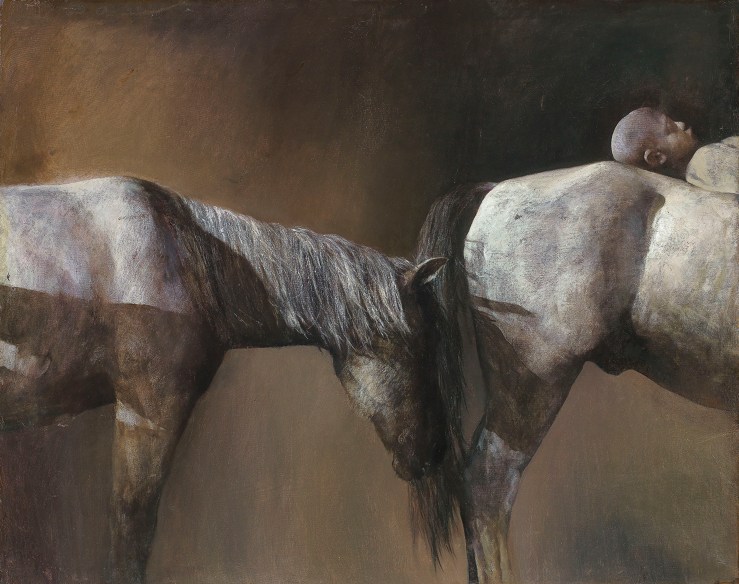
Life — He Duoling

2014_hgk_03307_0024_000he_duoling

Life, 1988 by He Duoling (b. 1948)

Blog about some recently acquired books

img_3038

I have acquired a goodly amount of books in the last two weeks and failed to do any of these silly “books acquired” posts about them, having been busy with summer classes and occupying summer-bound children (and, admittedly spending too many free hours rewatching Deadwood so that I can watch the Deadwood film and doing a Brueghel puzzle, and not really writing).

I ordered Pierre Senges’ strange little book Geometry in the Dust. It’s new in English translation by Jacob Siefring from publisher Inside the Castle. (Siefring also translated Senges’ novel The Major Refutation, which I read a few years ago.) Geometry in the Dust is a rectangular novella that includes black and white illustrations by Patrice Killoffer. The text is set in two columns, with occasional inset notes set in a smaller font.

img_3040

I mention the size/shape, the inset notes, and the illustrations because, for whatever reason, these things make the reading experience even odder (although I can’t articulate why, and to be clear, I find the oddness compelling).

img_3041

Told in the articulate, observant, and often-funny first-person voice of the “sole faithful minister…advisor, chamberlain and…scapegoat” of a certain monarch—a “you” this minister addresses—like, you, the reader—told in this funny and strange voice, Geometry in the Dust is “about” (a term that we’d have to place under suspicion here) the planning, the mental construction of a great city. A sort of extended thought experiment, Senges’ novella captivated me for two quick afternoon reads, and I hope to go through it again in preparation for a proper review. For now, I’ll lazily compare it to Borges, Calvino, Perec, and Antoine Volodine—writers that Senges does not imitate, but seems to drink from the same imaginative well as.

img_3031

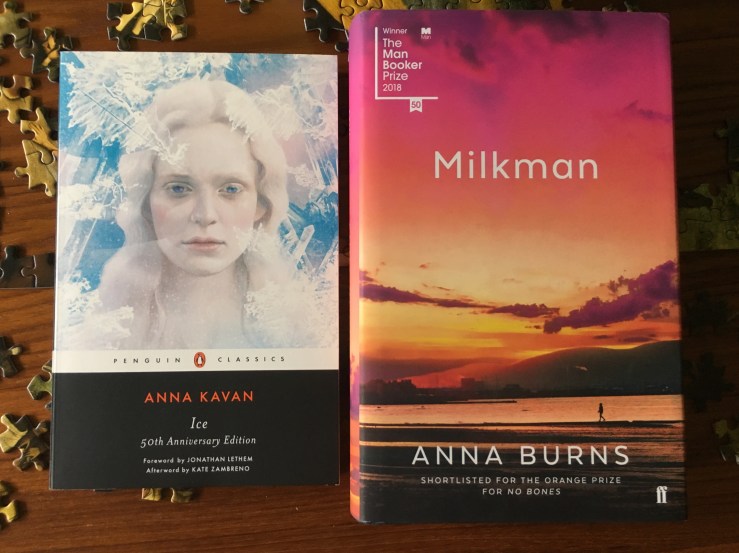
I went to my beloved used bookstore last Friday to browse, as is often my habit, and while I didn’t find any of the Joy Williams Vintage Contemporaries I was hoping to find, I did find a copy of Anna Kavan’s 1967 novel Ice. I’ll admit I hadn’t heard of Kavan until I read Ann Quin’s fantastic novel Berg (which I reviewed recently on this blog). I subsequently read/heard Kavan’s name brought up in conversations concerning Quin. Ice is my next read.

I also spied a new copy of Anna Burns’ Milkman at half price and picked it up. I’d heard good things about the novel—that it’s weird, challenging; that a lot of folks hated it. And, like, look—Ann, Anna, Anna. Why not? Milkman after Ice?

I got home to three separate review copies in the mail, a bit of an overwhelming shock, really, as one is NYRB’s new edition of Gregor von Rezzori’s The Death of my Brother Abel (translated by Joachim Neugroschel and revised by Marshall Yarbrough) b/w Cain: The Last Text (translated by David Dollenmayer). (The novel and its sequel have been published as Abel and Cain.) At nearly 900 pages it is a brick, or maybe a nice big hole to fall into soon.

I was also pleasantly surprised to see that Contra Mundum Press has published Iceberg Slim’s novel Night Train to Sugar Hill, which was never published in Slim’s (aka Robert Beck’s) lifetime. I’m not sure if this is the first publication of this late novel, but I think it is.

I had read some of Greg Gerke’s essays at LARB and 3:AM before getting See What I See (which is out later this year), and am generally impressed with what I’ve read so far. I admit that I skipped around almost immediately, reading (or rereading, in one case) pieces on William Gass and William Gaddis, before turning through pieces on Paul Thomas Anderson and Ingmar Bergman. An essay ostensibly on Mike Leigh’s film Mr. Turner is really about criticism itself, and contains this paragraph:

Critics have a job incompatible with their raw materials. They are to respond promptly and pithily to a work of art—the very life of which changes by different viewings, listenings, and readings, and at different times in one’s life. It is like being a bull rider—one being is not made to situate itself onto the other. Yet, our culture still respects some views and honors the guidance offered. In conjunction, it is no exaggeration to say we live in an era that disposes of language, including the etiolation of the sentence, punctuation, spelling, and grammar by the rush to judgment, and by the ego not caring what it’s form of thought is like, only that it’s owner’s name is lit up. Our species is changing—words, because they are not respected, boil more easily over into lies and exaggeration, disregarding the best humanistic advice possible, courtesy of Shakespeare: “Speak what we feel, not what we ought to say.” Where once words were imbricated and limned to grasp at wisdom, we now have the sweet satisfactions of irony, the insulting tweet, and the ham-handed “article” on why this or that does or doesn’t meet one’s satisfaction.

Gerke’s essay reminded me that I had wanted to see Mr. Turner (admiring both Leigh and his subject). (And if Gerke is a namegoogler—I loved Boyhood.)

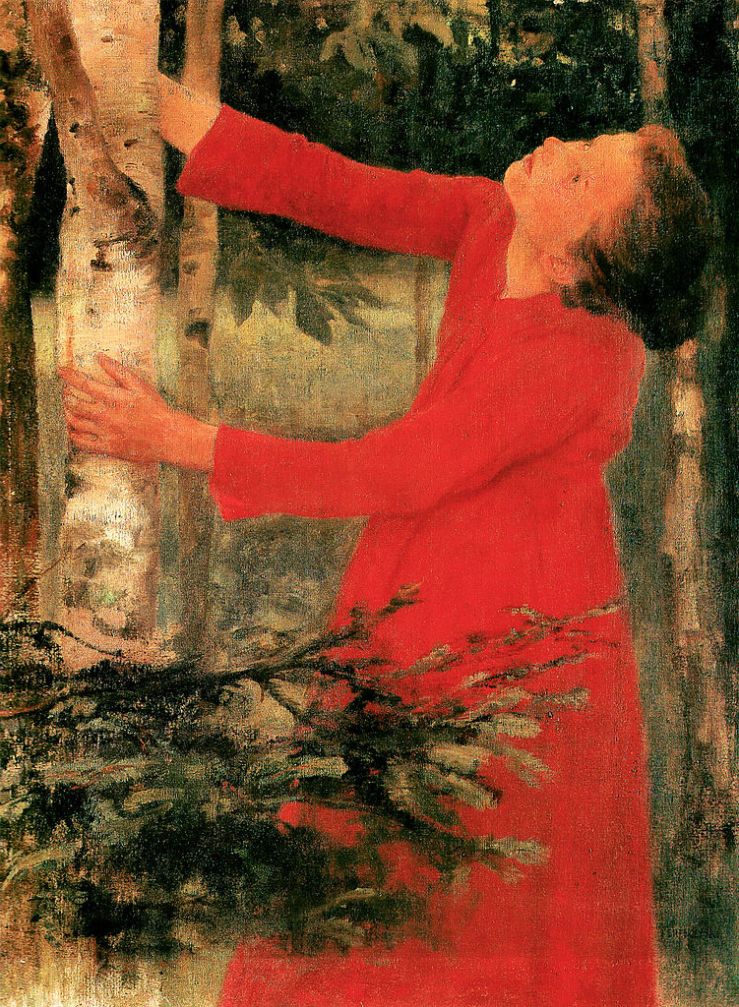
Birdsong — Karoly Ferenczy

birdsong-1893

Birdsong, 1893 by Karoly Ferenczy (1862-1917)

Grace Sholto Douglas 1940 — Leslie Hurry

Grace Sholto Douglas 1940 by Leslie Hurry 1909-1978

Grace Sholto Douglas, 1940 by Leslie Hurry (1909–1978)

Film poster for The Man Who Fell to Earth — Tomer Hanuka

mwfte_72

Film poster for The Man Who Fell to Earth by Tomer Hanuka.

It is summer, and not winter, that steals away mortal life | Nathaniel Hawthorne’s journal entry for June 23, 1843

June 23d.–Summer has come at last,–the longest days, with blazing sunshine, and fervid heat. Yesterday glowed like molten brass. Last night was the most uncomfortably and unsleepably sultry that we have experienced since our residence in Concord; and to-day it scorches again. I have a sort of enjoyment in these seven-times-heated furnaces of midsummer, even though they make me droop like a thirsty plant. The sunshine can scarcely be too burning for my taste; but I am no enemy to summer showers. Could I only have the freedom to be perfectly idle now,–no duty to fulfil, no mental or physical labor to perform,–I should be as happy as a squash, and much in the same mode; but the necessity of keeping my brain at work eats into my comfort, as the squash-bugs do into the heart of the vines. I keep myself uneasy and produce little, and almost nothing that is worth producing.

The garden looks well now: the potatoes flourish; the early corn waves in the wind; the squashes, both for summer and winter use, are more forward, I suspect, than those of any of my neighbors. I am forced, however, to carry on a continual warfare with the squash-bugs, who, were I to let them alone for a day, would perhaps quite destroy the prospects of the whole summer. It is impossible not to feel angry with these unconscionable insects, who scruple not to do such excessive mischief to me, with only the profit of a meal or two to themselves. For their own sakes they ought at least to wait till the squashes are better grown. Why is it, I wonder, that Nature has provided such a host of enemies for every useful esculent, while the weeds are suffered to grow unmolested, and are provided with such tenacity of life, and such methods of propagation, that the gardener must maintain a continual struggle or they will hopelessly overwhelm him? What hidden virtue is in these things, that it is granted them to sow themselves with the wind, and to grapple the earth with this immitigable stubbornness, and to flourish in spite of obstacles, and never to suffer blight beneath any sun or shade, but always to mock their enemies with the same wicked luxuriance? It is truly a mystery, and also a symbol. There is a sort of sacredness about them. Perhaps, if we could penetrate Nature’s secrets, we should find that what we call weeds are more essential to the well-being of the world than the most precious fruit or grain. This may be doubted, however, for there is an unmistakable analogy between these wicked weeds and the bad habits and sinful propensities which have overrun the moral world; and we may as well imagine that there is good in one as in the other.

Our peas are in such forwardness that I should not wonder if we had some of them on the table within a week. The beans have come up ill, and I planted a fresh supply only the day before yesterday. We have watermelons in good advancement, and muskmelons also within three or four days. I set out some tomatoes last night, also some capers. It is my purpose to plant some more corn at the end of the month, or sooner. There ought to be a record of the flower-garden, and of the procession of the wild-flowers, as minute, at least, as of the kitchen vegetables and pot-herbs. Above all, the noting of the appearance of the first roses should not be omitted; nor of the Arethusa, one of the delicatest, gracefullest, and in every manner sweetest, of the whole race of flowers. For a fortnight past I have found it in the swampy meadows, growing up to its chin in heaps of wet moss. Its hue is a delicate pink, of various depths of shade, and somewhat in the form of a Grecian helmet. To describe it is a feat beyond my power. Also the visit of two friends, who may fitly enough be mentioned among flowers, ought to have been described. Mrs. F. S—- and Miss A. S—-. Also I have neglected to mention the birth of a little white dove.

I never observed, until the present season, how long and late the twilight lingers in these longest days. The orange hue of the western horizon remains till ten o’clock, at least, and how much later I am unable to say. The night before last, I could distinguish letters by this lingering gleam between nine and ten o’clock. The dawn, I suppose, shows itself as early as two o’clock, so that the absolute dominion of night has dwindled to almost nothing. There seems to be also a diminished necessity, or, at all events, a much less possibility, of sleep than at other periods of the year. I get scarcely any sound repose just now. It is summer, and not winter, that steals away mortal life. Well, we get the value of what is taken from us.

Nathaniel Hawthorne’s journal entry for June 23, 1843. From Passages from the American Note-Books.

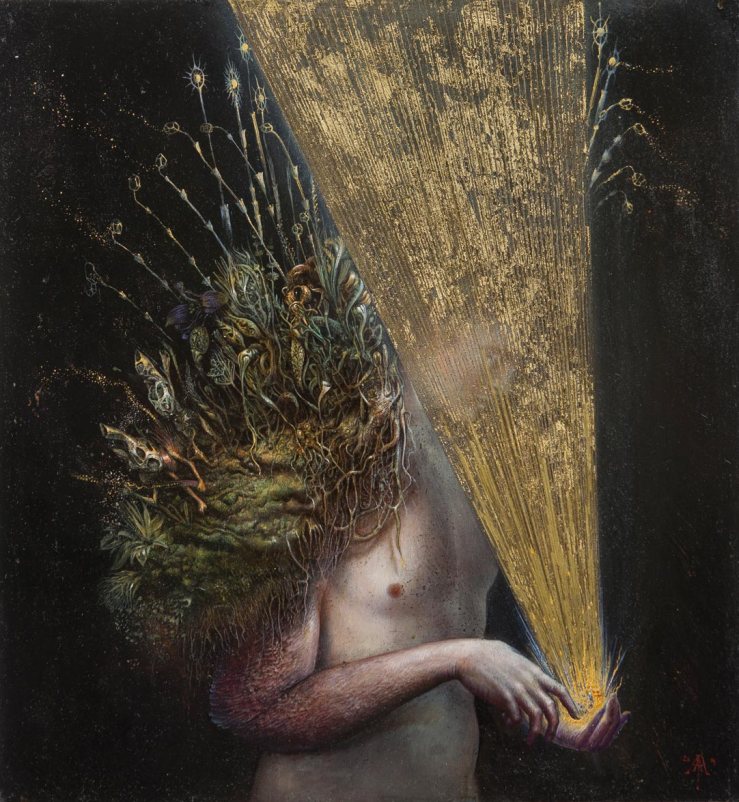
The Philosopher’s Stone — Agostino Arrivabene

la-pietra-del-filosofo-.-oil-on-gold-leaf-on-brass-cm-437x405

La pietra del filosofo (The Philosopher’s Stone), 2014 by Agostino Arrivabene (b. 1967)

Halfboy and Half Sister —  Stuart Pearson Wright

halfboy20and20halfsister20by20stuart20pearson20wright

Halfboy and Half Sister, 2018 by Stuart Pearson Wright (b. 1975)

The Thousand and One Nights — Jane Graverol

195420the20thousand20and20one20nights

The Thousand and One Nights, 1954 by Jane Graverol (1905–1984),

The Oneiroscopist — Edith Rimmington

194720the20oneiroscopist20

The Oneiroscopist, 1947  by Edith Rimmington (1902-1986)

“Tree and Sky” — William Carlos Williams

Screenshot 2019-06-19 at 3.06.06 PM

Pilgrim on Cathedral Steps — Paul Fenniak

opt_paul_fenniak-pilgrim_on_cathedral_steps_2018

Pilgrim on Cathedral Steps, 2018 by Paul Fenniak (b. 1965)

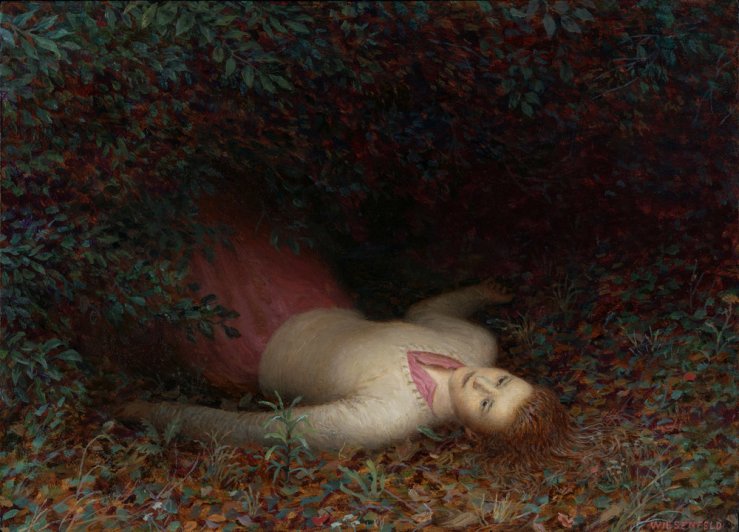
Heather — Aron Wiesenfeld

heatherss

Heather, 2016 by Aron Wiesenfeld (b. 1972)