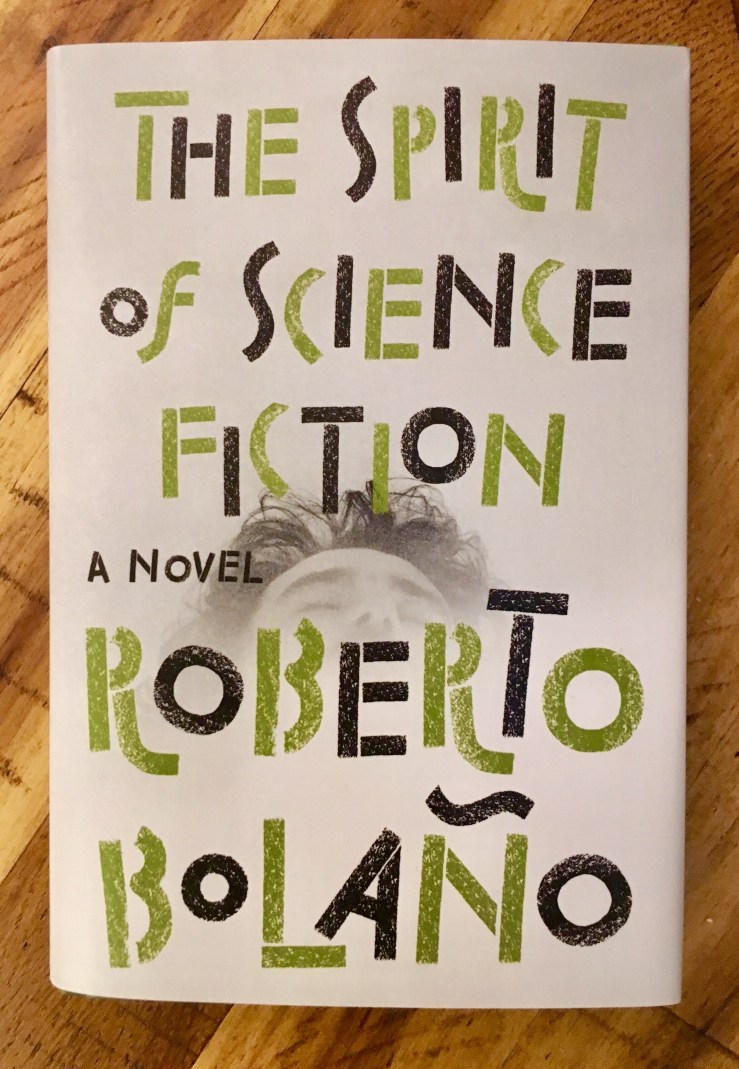
More Bolaño: A review of Roberto Bolaño’s novel The Spirit of Science Fiction

img_2270

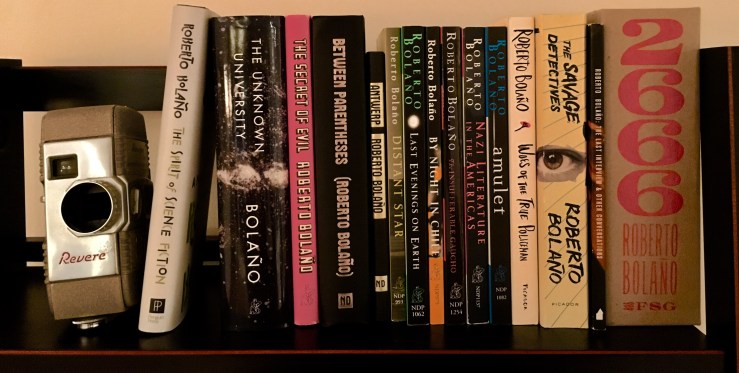
Roberto Bolaño died at the young age of 50 in 2003, just as his work was beginning to gain a wider audience and broader critical acclaim. It wasn’t until after his death that his work was published in English. Just a few months after Bolaño died, New Directions published By Night in Chile in translation by Chris Andrews. A year later, they published Andrews’ translation of Distant Star, and completed the loose trilogy of these short novels with the publication of Amulet in early 2007. A few months after the publication of Amulet, FS&G published Natasha Wimmer’s translation of The Savage Detectives, which had been originally published in Spain a decade earlier. By the time Wimmer’s translation of 2666 hit the shelves in 2008, Bolaño had become a literary sensation in the U.S., only half a decade after his death.

2666 is arguably Bolaño’s masterpiece, and certainly one of the defining books of the first decade of the 21st century. I read the book in a fevered rush, and then read it again, and then again. As far as I can tell, there are more essays and reviews about 2666 on Biblioklept than any other book. It was the second book I read by Bolaño—admittedly, a first reading of The Savage Detectives left me a perplexed and cold, but I’ve since returned to that novel with a broader understanding and appreciation of Bolaño’s project, a project that seemed to expand yearly after Bolaño’s demise.

Indeed, it became something of a joke in literary circles, What, another Bolaño? He drops books from beyond the grave like Tupac drops albums! There are the short story collections (translated by Andrews) that trickled out between 2007 and 2012, along with harder to classify collections, like The Secret of Evil (Andrews, 2012) and Nazi Literature in the Americas (Andrews, 2008), a jangling set of keys to the Bolañoverse. Another set of keys came in the wonderful collection The Unknown University, a compendium of Bolaño’s poetry in translation by Laura Healy published by New Directions in 2013.
img_2273

Then there are the novels that seemed to arrive every year or so: The Skating Rink (Andrews, 2009), Monsieur Pain (Andrews, 2010), Antwerp (Wimmer, 2010), The Third Reich (Wimmer, 2011), A Little Lumpen Novelita (Wimmer, 2014). Bolaño composed these pieces primarily in the 1980s, when he still thought of himself as a poet. These novels lack the vitality and vibrancy of his later work—the short story collections, the trilogy of short novels that began with Distant Star, and his big books, The Savage Detectives and 2666.

Indeed, for many Bolaño fans, reading these early novels feels like its own project—winnowing for seeds, pulling at the threads that will cohere into something grander in the Bolaño’s future (which, from a readerly perspective, is the past). So when FS&G published Wimmer’s translation of Woes of the True Policeman in 2012, it was hard for many readers to see the novel as anything but ancillary materials for 2666—it was hard to read the novel as a discrete work, on its own. Instead, the question Woes asked Bolaño fans was, Where does this fit in the Bolañoverse?

The same question is in play for the latest posthumous Bolaño release, The Spirit of Science Fiction (Penguin, Wimmer). A simple read, and one that is not incorrect, is that The Spirit of Science Fiction feels like a trial run at The Savage Detectives. In particular, Spirit blueprints the first and third sections of The Savage Detectives, sections that revolve around the immature adventures of two would-be poets in Mexico City in the 1970s. Instead of Arturo Belano and Ulisses Lima though, we get Jan Schrella (“alias Roberto Bolaño”) and Remo. These two heroes divide Bolaño’s literary ambitions into poetry and prose, posterity and potboiler pulp fiction. In The Savage Detectives, Arturo Belano and Ulisses Lima will synthesize these ambitions more grandly in their literary quest.

Jan and Remo’s questing in Spirit isn’t quite as grand. Remo wants to figure out why there are so many literary magazines in Mexico City; Jan spends his days writing to American science fiction writers. They manage to get mixed up with a set of sisters and their friend—poets of course. (Everyone in the novel is a poet, even—especially—a skinny motorcycle mechanic). The sisters prefigure the Font sisters of The Savage Detectives, and much of their plot feels like a sketch for that richer work.

Their friend Laura is a more interesting figure—a bit sinister, a cipher really, an iteration of the Lisas and Lupes that we find elsewhere in Bolaño’s fiction—in particular in some of the poetry collected in The Unknown Univeristy. Indeed, the final section of The Spirit of Science Fiction, “Mexican Manifesto,” was originally published in a different form in that collection. Some of the best parts of Spirit feel like failed poems, poems that want to be prose, unpoetical, mad, howling, jolly poems. Like 2666 or The Savage Detectives, the plot of Spirit careens, splinters, dares the reader to put the fragments together.

There is structure though: The main of the novel is told in first-person perspective by Remo. He’s seventeen, and has come from Chile to Mexico City with his friend Jan to live destitute in a garret and write bad articles under a pseudonym while he pursues his poetry. He gets sidetrack by love and other matters.

Running counter to this narrative are the letters that Jan writes to American sci-fi authors like Ursula K. Le Guin and Alice Sheldon. In a metatextual nod, Jan (“alias Roberto Bolaño”) also writes to Sheldon’s alias James Tiptree, Jr. Jan’s letters are a highlight of the novel, setting youthful arrogance and romantic idealism against a kind of quasi-tragic pathos. In a letter to Philip José Farmer, Jan (alias Roberto) suggests that a literary sci-fi anthology called American Orgasms in Space be published as a means to end war and cultivate brotherhood between Latin Americans and North Americans. The punchline to the letter is hilarious. Before signing off (“Warmly”), Jan informs the author of the Riverworld series that, “A week ago, I lost my virginity.”

A third strand runs throughout Spirit. In a series of segments set in some presumable future, a female journalist interviews Jan in the middle of a bizarre drunken party somewhere in the dark woods. Jan has won a prize for a sci-fi novel that he summarizes for the journalist who listens, downing vodka after vodka. Jan’s prize-winning sci-fi novel meshes elements that will be familiar to Bolaño’s readers—apocalyptic desolation, failed communication, esoteric histories of Latin America, mystery authors. Etc. It’s even partially set in the Unknown University. The interview segments seem perched on the edge of their own sinister apocalypse, a typically-Bolañoesque move, as if a seemingly-normal situation might topple over into malevolence at any moment. Unfortunately though, these sections seem to have been abandoned.

Indeed, much of Spirit reads like a patchwork of abandoned drafts, riddled with material and ideas that will pop up in later novels—the tabletop gaming of The Third Reich, the fascination of Nazi iconography we see in Nazi Literature in the Americas, the reckoning of post-colonialism which belongs to The Savage Detectives in particular, as well as the Bolañoverse as a whole. Too, Spirit shares the ominous swells and sinister reverberations that we identify with both Bolaño’s prose and poetry—the book shows the joyful optimism of youth poised on the cusp of unnameable disaster.

And there are plenty of great sections in The Spirit of Science Fiction: Jan desribing the entirety of a Gene Wolfe space novella to his friend, but mashing it into a vision of the screenwriter Thea von Harbou and her Nazi sympathies; the story of a Belgian-occupied village in the Congo that falls into a madness of woodworking, a madness that leads to general slaughter; a nervous late-night ride on a stolen motorcycle named the Aztec Princess; “the story of how Georges Perec, as a boy, prevented a duel to the death between Isidore Isou and Altagor in an old neighborhood in Paris”; a grotesque and enthralling final sequence in a semi-legal Mexico City bathhouse that channels the dark ghost of William S. Burroughs.

In short, there’s a lot of great writing in The Spirit of Science Fiction—plenty of moments that satisfy, if only temporarily, our cravings for more Bolaño. And yet the novel is clearly unfinished, which, if you’ve read Bolaño—and I’m assuming if you’ve hung out this far into this review, you’ve read Bolaño, and like, if you haven’t read Bolaño, I think he’s great, and a great starting point for reading him would be Distant Star or the short story collection Last Evenings on Earth—and, where was I? Okay: The Spirit of Science Fiction is clearly an unfinished piece, which, if you’ve read Bolaño, may seem like a Bolañoesque feature—his works point to an indeterminancy, an oblique, inconclusive, resolutely unfinishedness. (Think of the final lines/images of The Savage Detectives, for example).

And yet Spirit’s unfinishedness is not of a piece with the general aporia that belongs to Bolaño’s finished unfinished works—it seems, rather, an abandoned project, a draft to be repurposed later. Which, of course, it was—we already got the material that Spirit helped inspirit—in The Savage Detectives, in Nazi Literature, in 2666—in Bolaño’s best materials.

Paradoxically then, The Spirit of Science Fiction leaves the reader—by which I mean the Bolaño fan—by which I mean, let’s be honest, this Bolaño fan—Spirit leaves this reader hungry for more, for the pages to gallop on and on, to careen into more dread and manic joy and bad poetry and good poetry and pilfered stories and excessive metaphors. More: More Bolaño.

And then how could this review be a complaint? Well it isn’t. I enjoyed The Spirit of Science Fiction, was hungry for it before I even touched it, and then left hungry, wanting more: More Bolaño.
Read “The Lover,” a short story by Joy Williams

“The Lover”

by

Joy Williams


THE girl is twenty-five. It has not been very long since her divorce but she cannot remember the man who used to be her husband. He was probably nice. She will tell the child this, at any rate. Once he lost a fifty-dollar pair of sunglasses while surf casting off Gay Head and felt badly about it for days. He did like kidneys, that was one thing. He loved kidneys for weekend lunch. She would voyage through the supermarkets, her stomach sweetly sloped, her hair in a twist, searching for fresh kidneys for this young man, her husband. When he kissed her, his kisses, or so she imagined, would have the faint odor of urine. Understandably, she did not want to think about this. It hardly seemed that the same problem would arise again, that is, with another man. Nothing could possibly be gained from such an experience! The child cannot remember him, this man, this daddy, and she cannot remember him. He had been with her when she gave birth to the child. Not beside her, but close by, in the corridor. He had left his work and come to the hospital. As they wheeled her by, he said, “Now you are going to have to learn how to love something, you wicked woman.” It is difficult for her to believe he said such a thing.

The girl does not sleep well and recently has acquired the habit of listening all night to the radio. It is a weak, not very good radio and at night she can only get one station. From midnight until four she listens to Action Line. People call the station and make comments on the world and their community and they ask questions. Music is played and a brand of beef and beans is advertised. A woman calls up and says, “Could you tell me why the filling in my lemon meringue pie is runny?” These people have obscene materials in their mailboxes. They want to know where they can purchase small flags suitable for waving on Armed Forces Day. There is a man on the air who answers these questions right away. Another woman calls. She says, “Can you get us a report on the progress of the collection of Betty Crocker coupons for the lung machine?” The man can and does. He answers the woman’s question. Astonishingly, he complies with her request. The girl thinks such a talent is bleak and wonderful. She thinks this man can help her.

The girl wants to be in love. Her face is thin with the thinness of a failed lover. It is so difficult! Love is concentration, she feels, but she can remember nothing. She tries to recollect two things a day. In the morning with her coffee, she tries to remember and in the evening, with her first bourbon and water, she tries to remember as well. She has been trying to remember the birth of her child now for several days. Nothing returns to her. Life is so intrusive! Everyone was talking. There was too much conversation! The doctor was above her, waiting for the pains. “No, I still can’t play tennis,” the doctor said. “I haven’t been able to play for two months. I have spurs on both heels and it’s just about wrecked our marriage. Air conditioning and concrete floors is what does it. Murder on your feet.” A few minutes later, the nurse had said, “Isn’t it wonderful to work with Teflon? I mean for those arterial repairs? I just love it.” The girl wished that they would stop talking. She wished that they would turn the radio on instead and be still. The baby inside her was hard and glossy as an ear of corn. She wanted to say something witty or charming so that they would know she was fine and would stop talking. While she was thinking of something perfectly balanced and amusing to say, the baby was born. They fastened a plastic identification bracelet around her wrist and the baby’s wrist. Three days later, after they had come home, her husband sawed off the bracelets with a grapefruit knife. The girl had wanted to make it an occasion. She yelled, “I have a lovely pair of tiny silver scissors that belonged to my grandmother and you have used a grapefruit knife!” Her husband was flushed and nervous but he smiled at her as he always did. “You are insecure,” she said tearfully. “You are insecure because you had mumps when you were eight.” Their divorce was one year and two months away. “It was not mumps,” he said carefully. “Once I broke my arm while swimming is all.” Continue reading “Read “The Lover,” a short story by Joy Williams”

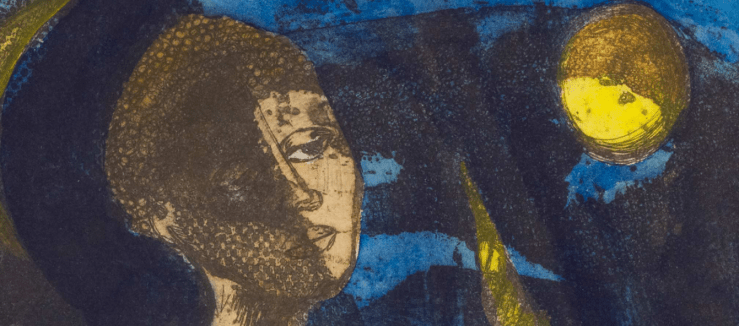
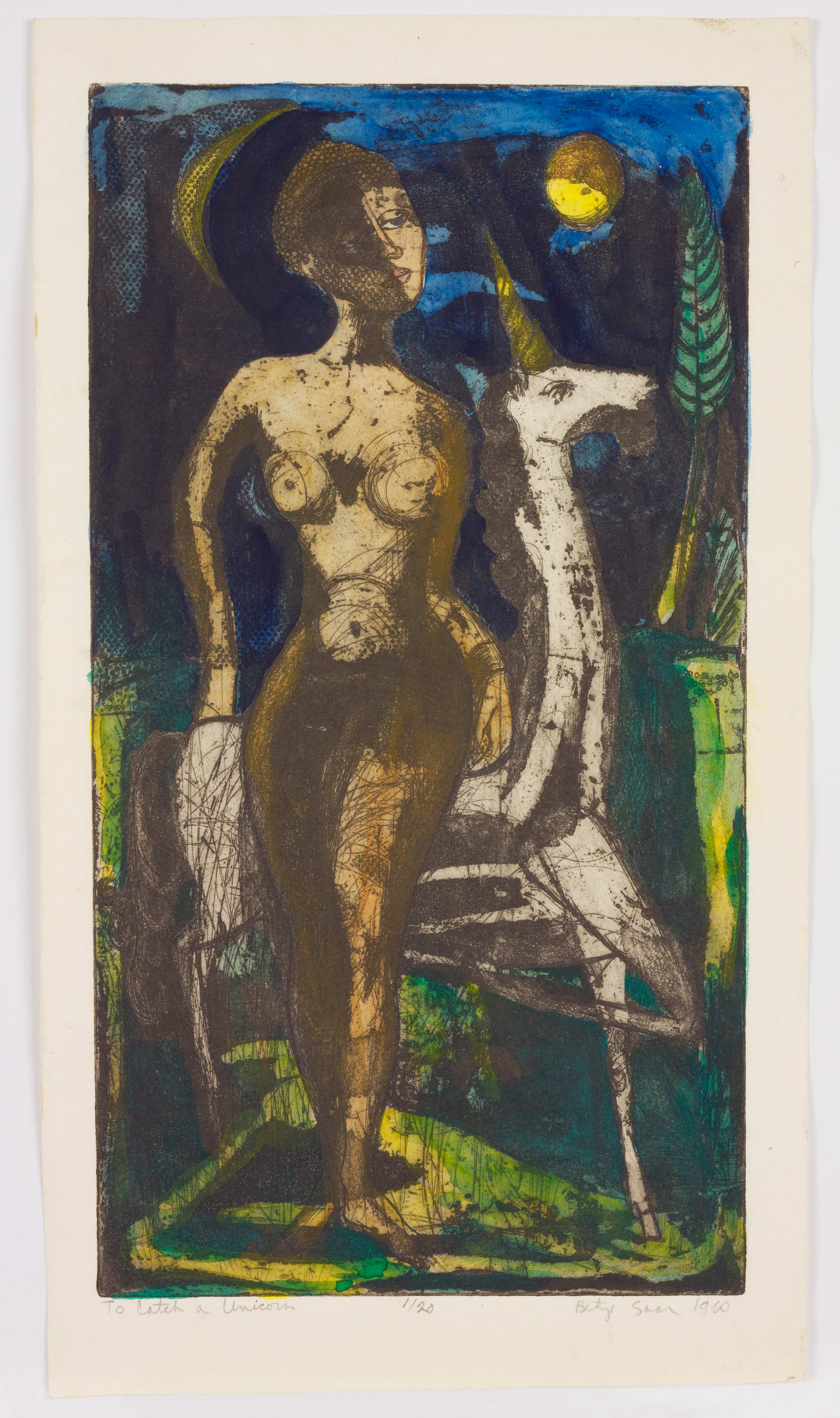
To Catch a Unicorn — Betye Saar

dig.37Screenshot 2019-02-17 at 9.56.13 AMScreenshot 2019-02-17 at 9.55.47 AM

To Catch a Unicorn, 1960 by Betye Saar (b. 1926)

American Orgasms in Space | Warmly, Jan Schrella, alias Roberto Bolaño

Dear Philip José Farmer:

Wars can be ended with sex or religion. Everything seems to indicate that there are no other citizen alternatives; these are dark days, heaven knows. We can set aside religion for now. That leaves sex. Let’s try to put it to good use. First question: what can you in particular and American science fiction writers in general do about it? I propose the immediate creation of a committee to centralize and coordinate all efforts. As a first step—call it preparing the terrain—the committee must select ten or twenty authors for inclusion in an anthology, choosing those who have written most radically and enthusiastically about carnal relations and the future. (The committee should be free to select who they like, but I would presume to suggest the indispensable inclusion of entries by Joanna Russ and Anne McCaffrey; maybe later I’ll explain why, in another letter.) This anthology, to be titled something like American Orgasms in Space or A Radiant Future, should focus the reader’s attention on pleasure and make frequent use of flashbacks—to our times, I mean—to chart the path of hard work and peace that it has been necessary to travel to reach this no-man’s-land of love. In each story, there should be at least one sexual act (or, lacking that, one episode of ardent and devoted camaraderie) between Latin Americans and North Americans. For example: legendary space pilot Jack Higgins, commander of the Fidel Castro, participates in interesting physical and spiritual encounters with Gloria Díaz, a navigation engineer from Colombia. Or: shipwrecked on Asteroid BM101, Demetrio Aguilar and Jennifer Brown spend ten years practicing the Kama Sutra. Stories with a happy ending. Desperate socialist realism in the service of alluring, mind-blowing happiness. Every ship with a mixed crew and every ship with its requisite overdose of amatory activity! At the same time, the committee should establish contact with the rest of American science fiction writers, those who’re left cold by sex or who won’t touch it for reasons of style, ethics, market appeal, personal preference, plot, aesthetics, philosophy, etc. They must be taught to see the importance of writing about the orgies that future citizens of Latin America and the U.S. can take part in if we take action now. If they flatly refuse, they must be convinced, at the very least, to write to the White House to ask for a cease in hostilities. Or to pray along with the bishops of Washington. To pray for peace. But that’s our backup plan, and we’ll keep it in under wraps for now. In closing, let me tell you how much I admire your work. I don’t read your novels; I devour them. I’m seventeen, and maybe someday I’ll write decent science fiction stories. A week ago, I lost my virginity.

Warmly,

Jan Schrella, alias Roberto Bolaño

From Roberto Bolaño’s novel The Spirit of Science Fiction. English translation by Natasha Wimmer.

“Cross” — Langston Hughes

“Cross”

by

Langston Hughes

My old man’s a white old man
And my old mother’s black.
If ever I cursed my white old man
I take my curses back.
If ever I cursed my black old mother
And wished she were in hell,
I’m sorry for that evil wish
And now I wish her well
My old man died in a fine big house.
My ma died in a shack.
I wonder where I’m going to die,
Being neither white nor black?

A map of Rohan, Gondor and Mordor with plot notes for The Lord of the Rings — J.R.R. Tolkien

merlin_150013257_d9be5100-5415-4284-bfbc-2005a9fb7d2a-superjumbo

A map of Rohan, Gondor and Mordor with plot notes for The Lord of the Rings, Book V, 1944, by J.R.R. Tolkien (1892–1973).

From The Morgan Library & Museum’s exhibition “Tolkien: Maker of Middle-earth.”

Kiss with Honda — Alex Colville

colville6

Kiss with Honda, 1989 by Alex Colville (1920-2013)

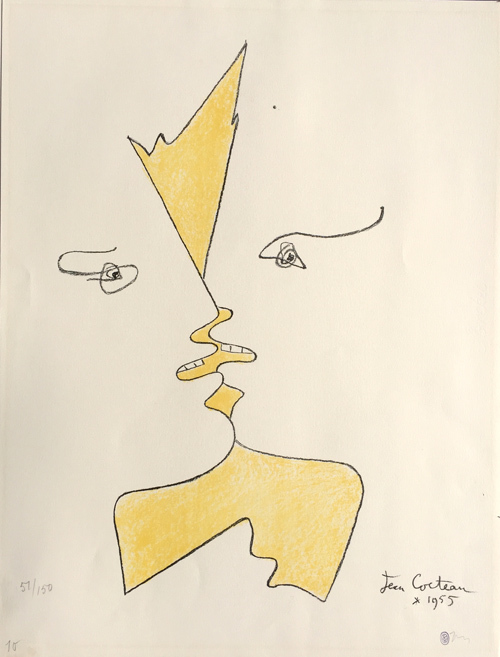
The Kiss — Jean Cocteau

larger

The Kiss, 1955 by Jean Cocteau (1889-1963)

The Kiss — Richard Lindner

ob_44e4f0_kiss

The Kiss, 1971 by Richard Lindner (1901-1978)

The Kiss — Clarence White

the_kiss

The Kiss, 1904 by Clarence White (1871-1925)

The Kiss — Odd Nerdrum

odd-nerdrum-the-kiss

The Kiss, 2002 by Odd Nerdrum (b. 1944)

Barad-dûr: The Fortress of Sauron — J.R.R. Tolkien

merlin_150013245_3ec3294a-7d7c-4721-8836-9d6b6c723299-superjumbo

Barad-dûr: The Fortress of Sauron, c. 1944 by J.R.R. Tolkien (1892–1973).

From The Morgan Library & Museum’s exhibition “Tolkien: Maker of Middle-earth.”

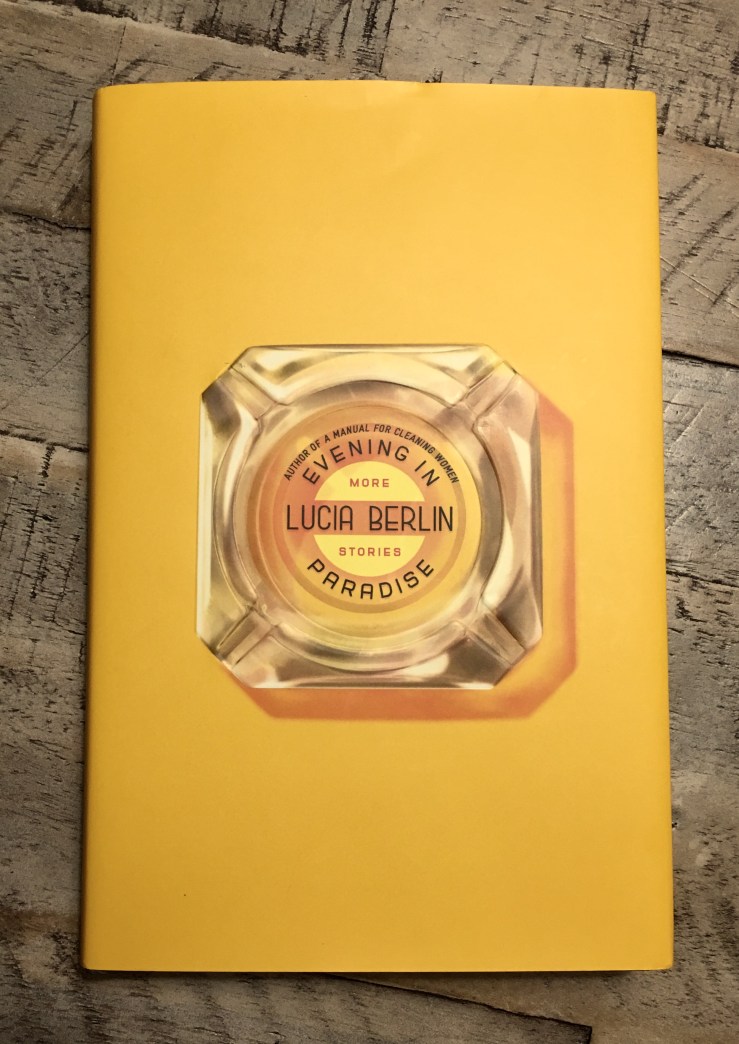
A review of Lucia Berlin’s short story collection Evening in Paradise

img_2216

Evening in Paradise is the second posthumously-published collection of short stories by the American writer Lucia Berlin. The book collects twenty-two stories originally published between 1981 and 1999. Most of the stories center around a semi-autobiographical version of Berlin herself. Like the excellent compendium A Manual for Cleaning Women which preceded it, Evening in Paradise is crammed with life. These stories teem with electric energy—even when their immediate subject matters might seem banal on the surface. Evening in Paradise shows an artist shaping the events of her life, big and small, wild and tragic, sharp and dull, into an impressionistic and urgent patchwork of tales that add up to a fictional memoir of sorts. As Berlin’s eldest son Mark Berlin noted in a 2005 essay on his mother (which serves as an introduction to Evening in Paradise),

Ma wrote true stories; not necessarily autobiographical, but close enough for horseshoes. Our family stories and memories have been slowly reshaped, embellished and edited to the extent that I’m not sure what really happened all the time. Lucia said this didn’t matter: the story is the thing.

The first stories in the collection feel sharply autobiographical. Both “The Musical Vanity Boxes” and “Sometimes in the Summer” are told by a first-person narrator named “Lucia” who details the small adventures of her childhood early 1940s in El Paso, Texas. Lucia and her friend slip over borders of all sorts, passing not only into Juarez, but also into a more complicated version of themselves as they mature. There’s a subtle menace rumbling under these stories. A mature Berlin looks back, knows what her girl protagonist does not yet know about the world and its dark joys and sinister terrors. The writer shows us a narrator gazing on life’s bright lights, even as she—the writer—draws our attention to the edge of those lights, to the threatening shadows on the margin.

Like A Manual for Cleaning Women, the stories in Evening in Paradise follow an arc of maturation—they are organized not chronologically by dates of composition or publication, but organized rather around the age of the central protagonist, the Berlin stand-in.

We find this protagonist simultaneously struggling and thriving in her teenage years. “Anando: A Gothic Romance” lives up to its subtitle. Set in Chile in an ex-pat community, “Andado” features a version of Berlin’s own teenage family—the father, a somewhat-absent mining engineer; the mother a depressed alcoholic. It’s no wonder then that our hero “Laura” is so easily seduced — “ruined” — by an older man. In one telling aside, the third-person narrator assesses a subtle moment of the seduction from the distance of time:

She was simply enveloped.

This would never happen to her again. When she grew older she would always be in control, even when being submissive. This would be the first and the last time anyone took over herself.

In “Itinerary,” another fictionalized-version of Berlin departs Chile for college in New Mexico. She leaves on her own, taking a series of planes and being greeted by a series of hosts, each of which reveals, inadvertently, something about her family which she had not previously seen, something that would be obvious though to any mature eyes settling on the family with objective distance. Berlin’s first-person narrator never quite names what is revealed to her; instead, she takes us up to the moment where we see her seeing what she has previously been blind to, yet still does not quite have the language to name. The final lines of “Itinerary” are a sort of negative epiphany:

It was sunset as we circled Albuquerque. The Sandias and the miles of rocky desert were a deep coral pink. I felt old. Not grown up, but the way I do now. That there was so much I did not see or understand, and now it is too late. The air was cold in New Mexico. No one met me.

The middle section of Evening in Paradise gives way to a series of stories focusing on young wives and young mothers different iterations of Berlin in the fifties. “Lead Street, Albuquerque” is particularly fascinating. Here, Berlin splits the material of her life into two different characters—the narrator, a somewhat hapless housewife who’s relegated to washing the dishes while her artist-husband and his artist-friends chat about hepcat stuff—and “Maria” — “seventeen, American, but grew up in South America, acts foreign, shy. English major.” A mature narrator looks back, half-mockingly and half-lovingly, at an ingénue-muse version of herself, the pair framed in the same tale. And our narrator turns toward her own life in the same attitude in turn:

Is there a word opposite of déjà vu? Or a word to describe how I saw my whole future flash before my eyes? I saw that I’d stay at the Albuquerque National Bank and Bernie would get his doctorate and keep on painting bad paintings and making muddy pottery and would get tenure. We would have two daughters and one would a dentist and the other a cocaine addict. Well, of course I didn’t know all that, but I saw how things would be hard. And I knew that years and years from then Bernie would probably leave me for one of his students and I’d be devastated but then would go back to school and when I was fifty I’d finally do things I wanted to do, but I would be tired.

The push-pull of artistic ambition against domestic life’s constraints ripple through these middle stories, where women raise kids and clean houses while men pursue their muses—writing, jazz, painting. There are small resentments and sordid affairs, banal routines and burgeoning substance abuse problems. Threaded through these stories is a common theme though, summed up in the last line of “Cherry Blossom Time,” when the hero Cassandra addresses her husband: “David. Please talk to me.”

The collection’s title story marks a shift in the trajectory of the Berlinverse, and stands out as a bit of an oddity. “Evening in Paradise” is the only piece here that doesn’t feature a straightforward Berlin stand-in; indeed, the story doesn’t have a strong central persona at all. Rather, “Evening” plays like a series of elegiac vignettes centered around the Oceano hotel–notably its bar—in Puerto Vallarta, Mexico. It’s 1963 and cast and crew of The Night of the Iguana are causing a ruckus in the small fishing town, drinking heavily, taking up with beach gigolos, smoking reefers—and even shooting heroin and snorting coke. Richard Burton and Elizabeth Taylor burst in and out; Ava Gardner looms larger than life. Director John Huston sits in the bar’s corner, drinking homemade mescal from a mayonnaise jar. There’s scheming and screaming, and generally famous times—but, like the title declares, the scene announces the end of an era.

“Evening in Paradise,” without a Berlin-protagonist, resets the stage, moving us to Mexico for a while, and introducing heroin as a major trope. In the next tale, “La Barca de la Ilusion,” Maya and her husband Buzz move to Yelapa (in Jalisco, Mexico) so that Buzz can kick heroin. “La Barca” is a standout in the collection, a slow burn of a tale, but one packed with lifetimes of storytelling. Buzz, born to a wealthy Boston family, drops out of Harvard to play saxophone in jazz clubs. He marries an heiress named Circe (I know, right?), starts a Volkswagen franchise, becomes a millionaire, has an affair with Maya, divorces Circe, etc. The problem remains though: “Heroin is easy to hide if you are rich, because you always have it.” That problem transgresses the paradise of Yalapa in the form of Victor, a menacing drug dealer who’s had his hooks in Buzz for years. Victor is a creature from the shadows, the sinister specter that haunted the background of the earlier tales of Evening in Paradise finally made manifest. I won’t spoil the rest of the story, but it swells to a startling, cinematic climax.

Characters like Victor and Buzz and Circe show up in different iterations in successive stories, like “My Life Is an Open Book” and “The Wives,” before Evening in Paradise gives over to Berlin’s Oakland years. Stories like “Noël, 1974” feature Berlin’s sons—excuse me, Berlin’s stand-in’s sons. These stories also feature her alter-ego’s high-functioning alcoholism. (Again, features that will be familiar to fans of the stories in A Manual for Cleaning Women).

The one-pager “The Pony Bar, Oakland” serves as something of a summary of the material that preceded it, delivered in Berlin’s economical prose. “There are certain perfect particular sounds. A tennis ball, a golf ball hit just right….Pool is erotic any way you look at it” the narrator begins, perched on a bar stool, as the sounds of billiards take her back in time to a cricket match in Chile:

Cricket in Santiago. Red parasols, green grass, white Andes. Red and white striped canvas chairs at the Prince of Wales Country Club. I signed chits for lemonade, tipped the tuxedoed waiters, applauded John Wells. Perfect crack of the cricket bat. I wore white, was careful of the grass stains, flirted with the boys who wore Grange school gray flannels, blue blazers in summertime. Cucumber sandwiches with tea, plans for Sunday at Viña del Mar.

The narrator remarks that she felt like an alien in that privileged childhood, just as she feels like an alien here at the Pony Bar in Oakland, sitting next to a tattooed biker. Berlin—or hey, sorry, Berlin’s stand-in—is never at home, but also at home every where. The tale ends as she glances at the hinges tattooed on the biker’s wrists, elbows, knees. The story ends in a wry punchline:

“You need a hinge on your neck,” I said.

“You need a screw up your ass.”

The smoky bar reverberating with the erotic sounds of pool transmutes into expatriate pastimes and then lands back into unglamorous Oakland, to culminate in a dirty joke. “Pony Bar, Oakland” condenses Evening in Paradise’s themes of memory, sensation, and life into a spare but evocative tale.

Later stories, like “Our Brother’s Keeper,” “Lost in the Louvre,” and “Luna Nueva” work in much the same way, filling a few slim pages with full fat life. These late stories are reflective and fully mature—still questioning and questing, but also shining with a strange peace, a strange reconciling to the sinister forces that vibrate under life’s vivid contours of family, work, culture, persona. I’ll confess that there’s something in these stories that I don’t fully appreciate—something beyond my forty years, something that their narrators see that I don’t maybe—maybe not yet, maybe not ever. But I’ll be happy to revisit them—and Berlin’s work in general—in years to come. Highly recommended.


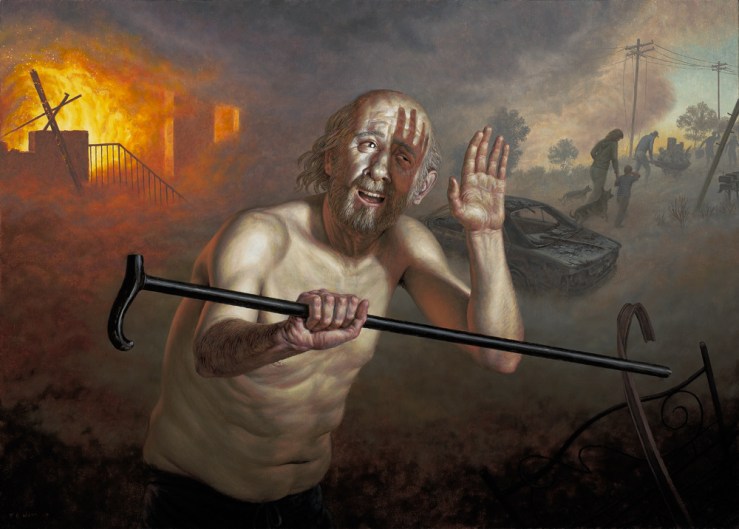
Anchises Lost — F. Scott Hess

tumblr_nlbe8jkCs71tg83cfo1_1280

Anchises Lost, 2009 by F. Scott Hess (b. 1955)


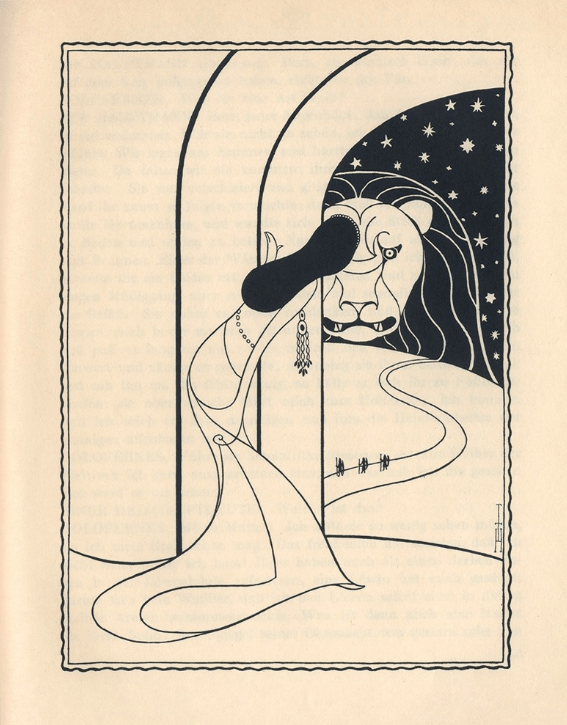
Judith sees the Head of the Lion — Thomas Theodor Heine

Screenshot 2019-02-12 at 9.47.52 PM

Judith sees the Head of the Lion, 1908 by Thomas Theodor Heine (1867-1948)

I got this seeker running along a lonely line

Birmingham Totem — Charles White

dig.57

Birmingham Totem, 1964 by Charles White (1918-1979)