Blog about Denis Johnson’s story “The Starlight on Idaho”

“The Starlight on Idaho” is the second of five stories in Denis Johnson’s collection The Largesse of the Sea Maiden. Apart from the collection’s title story (which I wrote about here), “The Starlight on Idaho” is the only piece in Largesse to have been previously published (in a different form in a 2007 issue Playboy). You can read the story online in full here, and watch/hear Johnson read excerpts from it in this video:

My impression after reading Largesse the first time was that “Starlight” was a good story, but also perhaps the weakest in the collection. Reading it again this afternoon, I see its inclusion in Largesse as vital. “Starlight” engages with the book’s overall themes of repentance, regret, and forgiveness—as well as the act of writing itself—more overtly than the other four stories in Largesse. In a sense, the story bridges Johnson’s earlier work (like Angels and Jesus’ Son) more directly to the late (and more complex) narratives in Largesse, like “Doppelgänger, Poltergeist” and “Triumph Over the Grave.”

The title of the story refers not to the literal starlight on the literal state of Idaho (where Johnson lived for some years), but rather to the “Starlight Addiction Recovery Center on Idaho Avenue, in its glory days better known as the Starlight Motel.” The story’s narrator is Cass—Mark Cassandra—and he is in this California rehab “because the last four years have really kicked [his] ass.” Cass summarizes those four years a few times in “Starlight,” including this charming list:

Just to sketch out the last four years – broke, lost, detox, homeless in Texas, shot in the ribs by a thirty-eight, mooching off the charity of Dad in Ukiah, detox again, run over (I think, I’m pretty sure, I can’t remember) shot again, detox right now one more time again.

Our hero has hit rock bottom and now writes to family members, friends, the devil, and other folks. As he puts it, Cass is “writing letters to each one of you lucky winners who has a hook in my heart.” The epistolary form allows Johnson to explore issues of regret and religion through the lens of a defiant but wrecked soul, who at one point tells his reader that “I’m not about to get on my knees.”

Cass’s detox is a metaphorical descent into hell. He writes to Pope John Paul; he writes to Satan. At one point in the middle of a letter to his brother, he sneaks in a letter to God:

Excuse me, I have to burn this page and write a letter to God while it’s on fire. Question is, God, where are you?  What the fuck on earth do you think you’re doing, man?  We are in HELL down here, HELL down here, HELL. You know?  Where’s Superman?

“The Starlight on Idaho” ultimately reads like one long letter to God. We learn much about Cass’s family (fractured, foul, awful), but Cass never uses them as an excuse for his behavior. He knows that his alcoholism and drug abuse “was a button [he] could push to destroy the known world.” Letter writing is part of restoring Cass to the world again. He has to find a way to tell his story.

Similarly, listening to other people’s stories is part of Cass’s recovery. Key scenes in “Starlight” feature Cass attending to other people’s tales and empathizing with them. “Starlight” climaxes not with Cass’s own story, but with the story of a man named Howard, a former undercover narc who has royally fucked up his own life. “My story is the amazing truth,” Howard declares, and that story ends with God squeezing Howard’s soul, intensely, always. This squeezing brings Howard closer to God.

Cass tells Howard’s story to his brother “John the Strangest Of All us Cassandras” in the final letter in “Starlight.” In the letter previous—addressed to Satan—Cass signs off as “Mark Cassandra, a more or less Christian.” In the final letter to John, Cass signs off “Your Brother In Christ, Cass.” Is the conversion complete and true? I think so. Johnson loves his characters and often drives them to a place of salvation.

For some readers, this insistence on redemption—and here a specifically Christian redemption—might be a bit too much, even a bit too on the nose. Cass certainly has a Jesus Christ complex. In the depths of detox, he despairs:

Why do I think I might be Jesus Christ and I’m supposed to come here and suffer, really suffer, suffer past your most excruciating fantasies of torment and why do I think everybody’s looking at me because they know this about me?

Johnson lets it drop more than once that our narrator is about to turn 33, as if to underline the point. However, he’s a disciple, not a messiah. He’s Mark Cassandra; his brother’s names are Luke and John. Those guys wrote a few letters, right? And then of course there’s that pagan last name, Cassandra. Is Mark a prophet? And will his prophecies be ignored? Who are they for? Who reads his words? Well, us of course.

“The Starlight on Idaho” may end on a note of religious redemption, but a subtler motif lies under the narrative’s surface. Johnson’s work has never struck me as overtly metafictional, but “Starlight” is clearly about writing itself, and foregrounds writing as vital to Cass’s recovery. Cass and the other “inmates” of the Starlight Addiction Recovery Center are like participants in a writer’s workshop, only one with much higher stakes. These recovering addicts are making their fractured lives cohere through narrative power. The trick of “The Starlight on Idaho” is to withhold the product—the life narrative—and give us instead the process, the pieces, the fragments themselves. Mark Cassandra’s letters may not be addressed to us, but of course we are his readers and his witnesses.

Girl Reading — Richard Diebenkorn

Screenshot 2018-07-20 at 9.36.07 AM

Girl Reading, 1961 by Richard Diebenkorn (1922 – 1993)

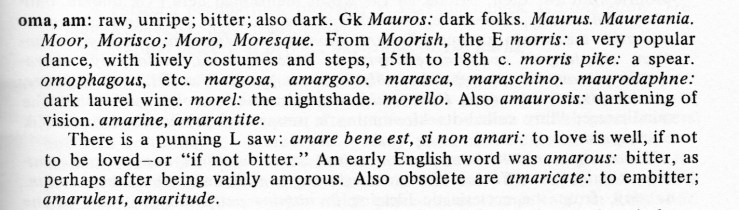
oma, am: raw, unripe; bitter; also dark.

img_9946

From Joseph T. Shipley’s The Origin of English Words: A Discursive Dictionary of Indo-European Roots.

My story is the amazing truth | Denis Johnson

This one speaker Howard had us all frozen up, we listened to him stock-still for forty-five minutes. He started out simple, comes out of high-school, tries the infantry, finds the service kind of boring without a war. Drinking on leave and weekends. Gets his discharge, goes to Santa Rosa Community College. Going for a business degree. Drinking on weekends.  Itchy and discontented. One night, he has this friend who’s a cop in SR, guy says, ride along with us and get a taste. He says two hours into the ride I’m feeling like I never felt. These guys tell a citizen what to do, he better do it. They give orders and they’re obeyed and I never knew how bad I wanted that. Zip into the Santa Rosa police training program, then I’m a cop, got three girlfriends, one black, one Asian, one white, cruising in a squad car all night long, kicking ass, busting heads, top of the world, man.  One year in I’ve got a sweet little wife and a six-week baby daughter. Two years in they put me on Narcotics and Vice, undercover. My job is to hang out in bars and party like Nero. Can I do that?  Hell, what do they think I’ve been doing every free minute anyhow?  And will I buy drugs?  Gee, okay, I’ll give it a shot. And Howard, they say, listen, sometimes in the course of your duties you will have a line of coke laid out before you and in the course of your duties you’ll just have to put your head down there and suck it up. It’s part of the ride, okay Howard?  Yeah, I say, part of the ride, and inside of six months I’m the biggest coke-head, the biggest dealer, and the crookedest cop in Northern California. I did armed robberies on dealers and drugstores up and down Highway 101. I had seven girlfriends and I was pimping every one.  My sweet little wife divorced me and took my daughter and I never even noticed. The force gave me a thousand a month to buy coke in little bags and turn them in, and I had thirty thousand under my bed in a shoebox next to three or four kilos of coke the force would never see. I’d wake up in the afternoon and fare forth and wreak havoc. I murdered three guys I still claim the world is better off without, but I’m not the judge though, am I?  But I sure thought I was. I took the lives of other human beings. I thought I was God. I looked in the mirror and said so — looked in the mirror and said, You are God. When God decided to prove me wrong, it all came down like a mountain of dogshit on my head. They rolled me up and socked me with so many charges, including at one point second degree murder, that if they stacked them up and ran me through I’d be doing time a hundred years past my natural death. I’m lying in jail and that cell is sucking the drugs and the fight and the soul right out me and giving it to God and God is squeezing it in his fingers, man, every last fiber of my soul in the almighty grip of the truth. And the truth is that everything I’ve done, every thought I’ve thought, every moment I’ve lived, is shit turned to dust and dust blown away. God, I said, fuck it, I’m not even gonna pray. Squeeze my guts till you get tired, that’s all I want now, because at least it’s real, it’s true, it’s got something to do with you. So then I think I died. I think I died in jail. My life itself just left me, and who you see before you now is someone else. So I wandered like a ghost through the court system and came out with a sentence of ten years. Did seven, one day at a time. Prayed every day and every night, but only one prayer:  Squeeze till you get tired, Lord. Kill me, Lord, I don’t care, as long as it’s you who kills me. Just got out eight days ago, and rehab is part of my parole. And nothing to show for thirty-six years on this earth.  Except that God is closer to me than my next breath. And that’s all I’ll ever need or want. If you think I’m bullshitting, kiss my ass. My story is the amazing truth.

From Denis Johnson’s short story “The Starlight on Idaho.”

Gleaming Connection — Wiley Wallace

wallace2

Triptych of Saints — Sergio Padovani

trittico-delle-sante

Triptych of Saints by Sergio Padovani (b. 1972)

Blog about Denis Johnson’s story “The Largesse of the Sea Maiden”

img_0381

I finished reading Denis Johnson’s posthumous collection of short stories The Largesse of the Sea Maiden a few weeks ago. I felt a bit stunned by the time I got to the fourth story in the collection, “Triumph Over the Grave,” which ends with these words: “It’s plain to you that at the time I wrote this, I’m not dead. But maybe by the time you read it.”

Denis Johnson died just over a year ago, of course, a fact that haunts any reading of Sea Maiden (at least for fans, and I am a fan). The collection was released just half a year after his death, and I managed to avoid reading any reviews of it. I held out on picking it up for reasons I don’t really know how to explain, but I when I finally read it, I consumed it in a greedy rush.

Anyway, since I finished the book I’ve tried a few times to put together a “review,” but each time I get some words down I find myself sprawling out all over the place, rereading bits of the stories, picking out new motifs, new questions, new parallels between Johnson’s life and the lives of his narrators. Very short review: The Largesse of the Sea Maiden is one of Johnson’s best books, a perfect gift to his readers—his own tragicomic obituary in fictional form. It’s a book about death and writing and art and commerce and regret and salvation, and each time I go back to it I find more in there than I saw the first time–more order, more threads, more design. So instead of a full long review, I’ll offer instead a series of blogs about each of the five stories in the collection. (Perhaps this form is simply an excuse to reread The Largesse of the Sea Maiden).

The first story is the title track, “The Largesse of the Sea Maiden.” First published in The New Yorker back in 2014, this long short story (it runs to not-quite 40 pages) introduces the major themes and tones of the entire collection. “Largesse” is told by a first-person narrator in ten titled vignettes. Some of the titles, like “Widow,” “Orphan,” “Farewell,” and “Memorial,” directly name the themes of both the story and the book.

The narrator of “The Largesse of the Sea Maiden” is a writer—but not a writer of literature or fiction—of art—but of commercials. Although “Largesse” shows him somewhat comfortable in his life in San Diego with his third wife, the narrator nevertheless is melancholy, even dour at times. In the beginning of the vignette “Ad Man,” he declares:

This morning I was assailed by such sadness at the velocity of life—the distance I’ve traveled from my own youth, the persistence of the old regrets, the new regrets, the ability of failure to freshen itself in novel forms—that I almost crashed the car.

(Is there a subtle nod there to one of Johnson’s most well-known stories, “Car-Crash While Hitchhiking”? I think so. If not, I find a thread).

“Ad Man” initiates the major plot trajectory of “Largesse”: Our narrator has won an award for an advertisement he wrote and directed decades ago, and he will have to return to New York City to be given the award at a special dinner. Floating through the vignettes is the ad man’s anxiety about his own legacy of work against the backdrop of the finer arts. We learn in “Accomplices” that he cares enough about the arts to object that his host has hung a Mardsen Hartley oil landscape above a lit fireplace—but he doesn’t prevent the man from burning the painting—his “property”—in a moment where Johnson subtly critiques the relationship between art and commerce. The narrator turns the burning of the painting into a new art though—storytelling.

The narrator later tells us that “looking at art for an hour or so always changes the way I see things afterward,” and “Largesse” is riddled with encounters with art and artists, like the outsider painter Tony Fido, whom the narrator meets at a gallery. The artist offers, unprompted, a scathing critique of a Edward Hopper’s painting Gas:

“You’re a painter yourself.”

“A better painter than this guy,” he said of Edward Hopper.

“Well, whose work would you say is any good?”

“The only painter I admire is God. He’s my biggest influence.”

That attribution — “he said of Edward Hopper” — is a lovely example of Johnson’s sharply-controlled wit.

Tony Fido plays a major minor role in “Largesse.” Fido tells the narrator the story of his encounter with a widow—one of several widows in both “Largesse” and Largesse, and his own suicide—Fido’s—becomes a strange moment for the narrator to realize how little he actually knows about his friend. And of course, all of these plot points give Johnson a chance to riff on the themes of death, loss and regret.

“Largesse” is loaded with thoughts on regret and forgiveness. Talking with a friend, the narrator muses that “we wandered into a discussion of the difference between repentance and regret. You repent the things you’ve done, and regret the chances you let get away.” The vignette “Farewell” stages a chance for the narrator to repent his past sins; his ex-wife, dying of cancer, calls him up to (possibly) forgive him:

In the middle of this I began wondering, most uncomfortably, in fact with a dizzy, sweating anxiety, if I’d made a mistake—if this wasn’t my first wife Ginny, no, but rather my second wife, Jennifer, often called Jenny. Because of the weakness of her voice and my own humming shock at the news, also the situation around her as she tried to speak to me on this very important occasion—folks coming and going, and the sounds of a respirator, I supposed—now, fifteen minutes into this call, I couldn’t remember if she’d actually said her name when I picked up the phone and I suddenly didn’t know which set of crimes I was regretting, wasn’t sure if this dying farewell clobbering me to my knees in true repentance beside the kitchen table was Virginia’s, or Jennifer’s.

I’ve quoted at such length because the moment is an example of Johnson’s tragicomic genius—a sick punchline that disconnects crime from punishment and punishment from forgiveness. The narrator ends up making the connections himself in the end: “after all, both sets of crimes had been the same.” And yet Johnson keeps pushing his character past reconciliation into a midnight walk to clear his conscience:

I wonder if you’re like me, if you collect and squirrel away in your soul certain odd moments when the Mystery winks at you, when you walk in your bathrobe and tasseled loafers, for instance, well out of your neighborhood and among a lot of closed shops, and you approach your very faint reflection in a window with words above it. The sign said “Sky and Celery.”

Closer, it read “Ski and Cyclery.”

“Farewell” ends on this note of a winking Mystery—on the profound insight that we are always susceptible to misreading the signs in front of us.

“The Largesse of the Sea Maiden” is very much a story about trying to put together a cohesive narrative from the strands and fragments around us. Indeed, its very form points to this—the fractured vignettes have to be pieced together by the reader. Johnson fractures not just form but tone. The deadpan, tragicomic, pathos-laden humor that’s run throughout Johnson’s oeuvre dominates in “Largesse,” yes, but there are strange eruptions of sentimental fantasy, particularly in “Mermaid,” a vignette that reads like the narrator’s own imaginative construction, and not the (often banal) reality that most of the narrative is grounded in. After receiving his award in New York, the narrator makes his way to a bar, and here conjures a scene like something from a film noir:

I couldn’t see the musician at all. In front of the piano a big tenor saxophone rested upright on a stand. With no one around to play it, it seemed like just another of the personalities here: the invisible pianist, the disenchanted old bartender, the big glamorous blonde, the shipwrecked, solitary saxophone…And the man who’d walked here through the snow…And as soon as the name of the song popped into my head I thought I heard a voice say, “Her name is Maria Elena.” The scene had a moonlit, black-and-white quality. Ten feet away at her table the blond woman waited, her shoulders back, her face raised. She lifted one hand and beckoned me with her fingers. She was weeping. The lines of her tears sparkled on her cheeks. “I am a prisoner here,” she said. I took the chair across from her and watched her cry. I sat upright, one hand on the table’s surface and the other around my drink. I felt the ecstasy of a dancer, but I kept still.”

The ecstasy here—internalized and “still”—is the ecstasy of storytelling, imagination, art. This is the gift of the mermaid, the largesse of the sea maiden. The minor moment is the real award for our ad man hero, who finds no real transcendence in commercial writing.

I’ve been using “the narrator” in this riff, but our hero has a name, which he reveals to us in the final vignette, “Whit.” It’s here that he describes the ad he’s (not exactly) famous for, an “animated 30-second spot [where] you see a brown bear chasing a gray rabbit.” The chase ends when the rabbit gives the bear a dollar bill.” Narrator Whit explains that this ad for a bank “referred, really, to nothing at all, and yet it was actually very moving.” He goes on:

I think it pointed to orderly financial exchange as the basis of harmony. Money tames the beast. Money is peace. Money is civilization. The end of the story is money.

And yet our ad man, despite his commercial interpretation of his own writing, recognizes too that this work “was better than cryptic—mysterious, untranslatable.” The word “untranslatable” is one of several clues that link the final section of “Largesse” to the final section of Walt Whitman’s long poem, Song of Myself. Whitman’s narrator (“Walt Whitman, a kosmos”) claims that he is, like the spotted hawk who swoops to disturb his reverie, “untranslatable.” Bequeathing himself to us—a gift for our good graces—he reminds us that “You will hardly know who I am,” a line that Johnson echoes in the beginning of “Whit”: “My name would mean nothing to you, but there’s a very good chance you’re familiar with my work.” And then of course, there’s the big tell—Johnson’s narrator is Bill Whitman, a pun that works on several levels. Walt Whitman’s language has seeped into the language of advertising—in a way it is the genesis of a new commercial American idiom—and here Johnson slyly pushes it back into the realm of art.

Just as the conclusion of Song of Myself builds to a self-penned elegy for its self-subject, “The Largesse of the Sea Maiden” reads like Johnson’s elegy for an alter-ego. We learn in the final paragraphs that Bill Whitman is “just shy of sixty-three” — roughly the same age as Johnson would’ve been when the story was published. (We learn that the narrator of “Doppelgänger, Poltergeist,” the final story in The Largesse of the Sea Maiden, is also the same age as Johnson. That narrator was born on “July 20, 1949.” Johnson’s birthday was July 1, 1949).

Narrator Whit reflects on his life in the story’s melancholy penultimate paragraph:

I note that I’ve lived longer in the past, now, than I can expect to live in the future. I have more to remember than I have to look forward to. Memory fades, not much of the past stays, and I wouldn’t mind forgetting a lot more of it.

However, there’s still a restlessness to his spirit, a questing desire to answer the final lines of Song of Myself, perhaps, where Whitman writes:

Failing to fetch me at first keep encouraged,
Missing me one place search another,
I stop somewhere waiting for you

The last paragraph of “The Largesse of the Sea Maiden” is Johnson’s narrator’s implicit response to these lines, and as I cannot improve upon his prose, they will be my last lines as well:

Once in a while, I lie there as the television runs, and I read something wild and ancient from one of several collections of folktales I own. Apples that summon sea maidens, eggs that fulfill any wish, and pears that make people grow long noses that fall off again. Then sometimes I get up and don my robe and go out into our quiet neighborhood looking for a magic thread, a magic sword, a magic horse.

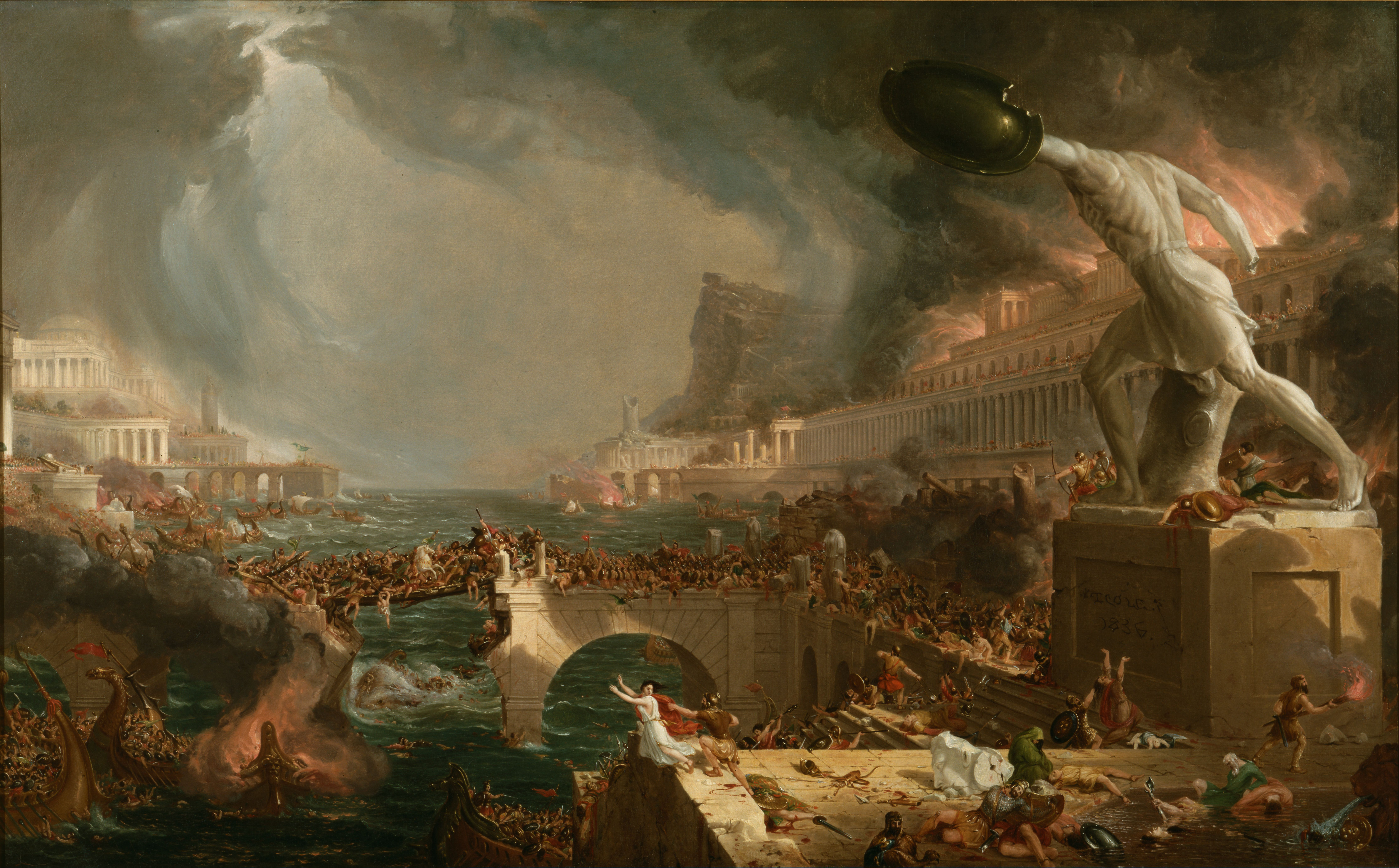
Destruction — Thomas Cole

Cole_Thomas_The_Course_of_Empire_Destruction_1836

Destruction (From The Course of Empire series), 1836 by Thomas Cole (1801-1848)

The Singers — Odd Nerdrum

the-singers

The Singers, 1984 by Odd Nerdrum (b. 1944)

The Elephant Man (Summer Film Log)

5059

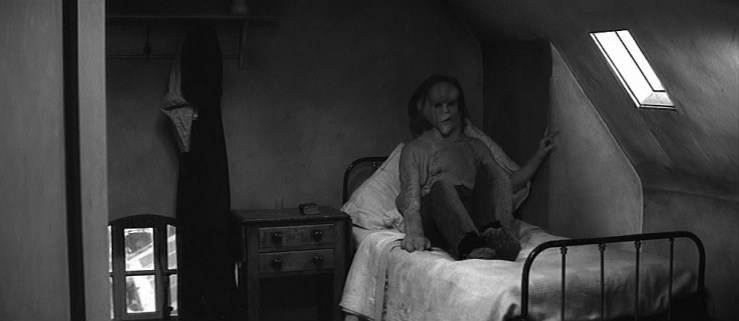
I watched David Lynch’s film The Elephant Man (1980) last night for the first time in at least a decade (likely more than a decade). The Elephant Man is not my favorite Lynch film to rewatch, perhaps because it is his most realistic film despite its fantastic touches.

The Elephant Man is emotionally devastating, propelled by naturalistic performances unusual in Lynch’s oeuvre. Lynch teases the titular elephant man’s hideous countenance for the first fifteen or so minutes of the film, but when we finally see John Merrick (played by an unrecognizable John Hurt), we feel only pity for his circumstance and contempt for a world that can’t accept him.

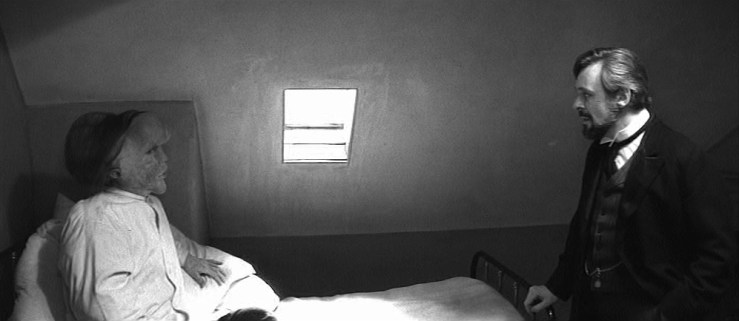
Dr. Treves (Anthony Hopkins) shares that mix of pity and contempt. Treves is the surgeon who moves Merrick from his freakshow prison to a respectable London hospital, where the young man can finally find some measure of comfort in his own skin. Away from his former handler, the sadistic Mr. Bytes (Freddie Jones), young Merrick quickly becomes an aesthete, the toast of London society.

2159

Merrick’s hospital suite becomes an artiste’s garret, where he builds a model of a nearby cathedral and takes tea with a famous actress. However, a cruel night porter named Jim (Michael Elphick) intrudes into this peace, selling tipsy gawkers tickets to see the elephant man in his new minor paradise. While Jim’s invasions are horrifying, more subtly terrible is the notion that Dr. Treves himself is simply recapitulating the freakshow, only this time to a “higher society” — a sin that Ms. Mothershead, the ward’s head nurse, warns Treves against. She serves as the moral anchor of the film, proclaiming that care and attention—bathing, feeding, cleaning—are the truest forms of “love.”

Despite its subject matter, The Elephant Man is possibly Lynch’s most straightforward, even traditional film (this estimation includes The Straight Story (1999)). The plot is ultimately a character study of a lonely man who craves not wholesale acceptance or dramatic love but simple friendship. The emotional crux of The Elephant Man rests in Treves’ reticence to truly befriend his patient, a reticence Lynch refuses to resolve.

2659

We feel pity for Merrick, but as his social status swells into a surreal ironic infamy, we feel a second pity—the fame goes to his head. Hurt portrays these strange emotional swings through thick layers of makeup, aided by Lynch’s impeccable framing and Freddie Francis’ dreamy black and white cinematography. (Francis served as cinematographer on Lynch’s next film, 1984’s Dune, as well as the aforementioned The Straight Story). Lynch’s sound design is haunting, but not as proficient as later efforts—too reliant on flange and echo, the sound design often subtracts through addition.

3859

Visually, The Elephant Man plants seeds for any number of Lynchian set pieces to come. The nightworld Lynch creates for poor Merrick to endure repeats throughout his oeuvre, notably in Blue Velvet (1986), Lost Highway (1997) and Twin Peaks (1990-2017). Michael Elphick’s night porter Jim is particularly sinister, a proto-Frank Booth. Freddie Jones’ Mr. Bytes is a loathsome first copy of Baron Harkonnen from Dune. It’s all quite horrifying.

Lynch always tempers the dark with the light. The subtle supernatural touches in The Elephant Man—halos and orbs, night spectacles, bewitched paintings—are motifs that repeat throughout his work. So much of The Elephant Man’s DNA is in Twin Peaks, and perhaps my favorite thing about watching it—aside from the rich blacks and grays and lights—was how much it evoked for me Part 8 of Twin Peaks: The Return—the best thing I saw on a screen last year.

6059

Lynch finds light in life’s grotesque pageant, and this strange light is what colors The Elephant Man as such an intensely meaningful film. Merrick is more than a freak, but also more than a human—Lynch refuses to show his title character’s humanity as a series of banal platitudes. Such a representation would not be true to human nature. And in the end, The Elephant Man is about human nature, or, more importantly, one real fantastic unreal human.


How I watched it: On a big TV via a streaming service, very late at night. I am indebted to the archive Film Grab as the source of the images used in this post.

“Breughel” — Aldous Huxley

Screenshot 2018-07-16 at 7.52.38 PM

“Breughel”

by

Aldous Huxley

from Along the Road, 1925


Most of our mistakes are fundamentally grammatical. We create our own difficulties by employing an inadequate language to describe facts. Thus, to take one example, we are constantly giving the same name to more than one thing, and more than one name to the same thing. The results, when we come to argue, are deplorable. For we are using a language which does not adequately describe the things about which we are arguing.

The word “painter” is one of those names whose indiscriminate application has led to the worst results. All those who, for whatever reason and with whatever intentions, put brushes to canvas and make pictures, are called without distinction, painters. Deceived by the uniqueness of the name, aestheticians have tried to make us believe that there is a single painter-psychology, a single function of painting, a single standard of criticism. Fashion changes and the views of art critics with it. At the present time it is fashionable to believe in form to the exclusion of subject. Young people almost swoon away with excess of aesthetic emotion before a Matisse. Two generations ago they would have been wiping their eyes before the latest Landseer. (Ah, those more than human, those positively Christ-like dogs—how they moved, what lessons they taught! There had been no religious painting like Landseer’s since Carlo Dolci died.)

These historical considerations should make us chary of believing too exclusively in any single theory of art. One kind of painting, one set of ideas are fashionable at any given moment. They are made the basis of a theory which condemns all other kinds of painting and all preceding critical theories. The process constantly repeats itself. Continue reading ““Breughel” — Aldous Huxley”

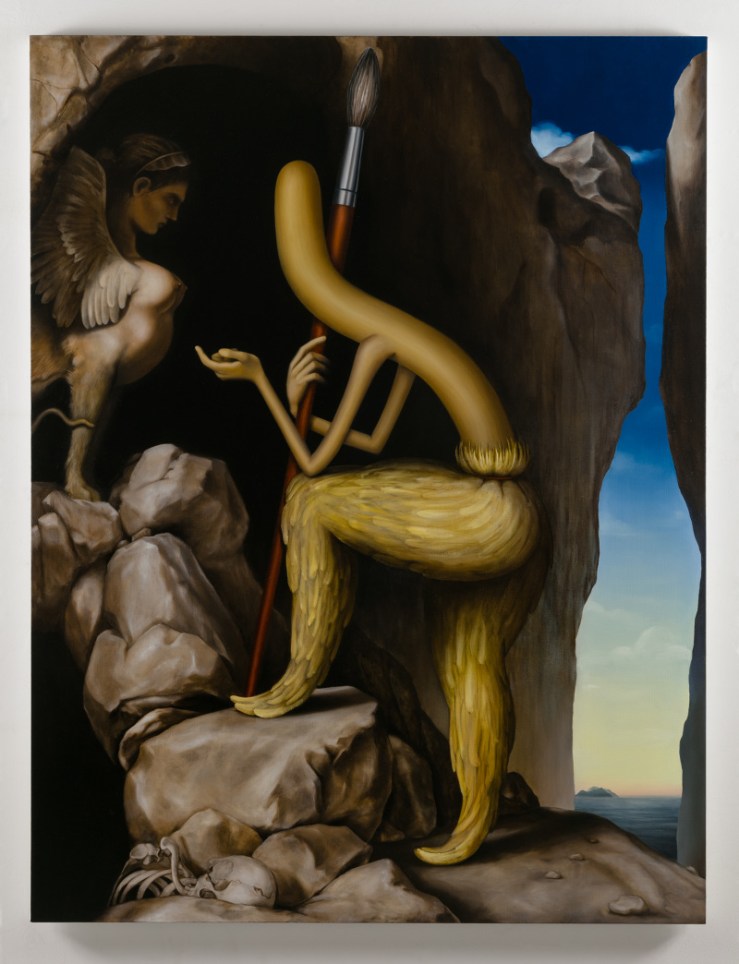
The Riddle — Emily Mae Smith

emsmith_2017_070_021_theriddle_800

The Riddle, 2017 by Emily Mae Smith (b. 1979)

LAWN — Joe Houston

houston_lawn_website

LAWN, 1989 by Joe Houston (b. 1962)

The Misfortunes of Silenus (Detail) — Pierro di Cosimo

Screenshot 2018-07-05 at 8.48.35 PM

The Misfortunes of Silenus (detail), c. 1500 by Pierro di Cosimo (1462-1522)

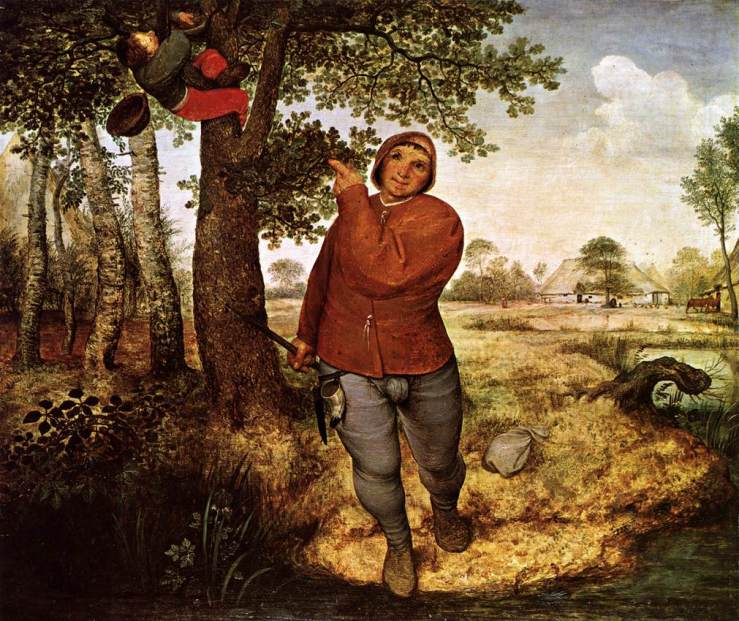
The Peasant and the Birdnester — Pieter Bruegel the Elder

the-peasant-and-the-birdnester

The Peasant and the Birdnester, 1568 by Pieter Bruegel the Elder (c. 1525-1569)

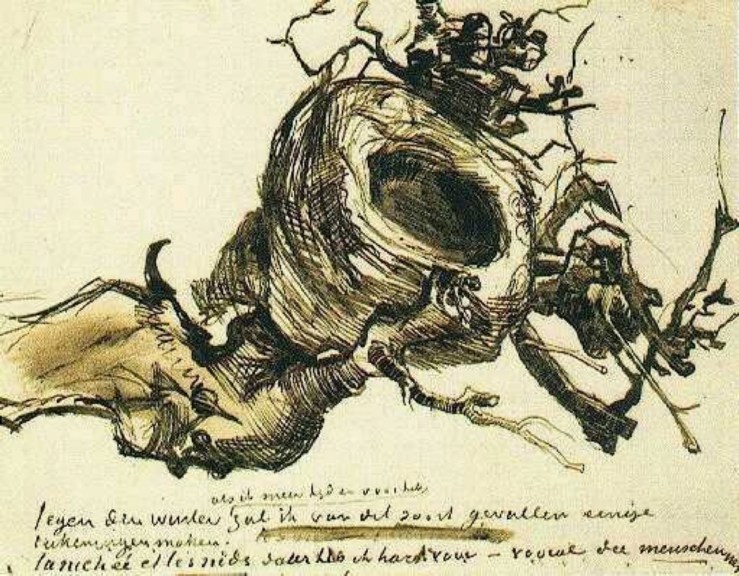
Bird’s Nest — Vincent van Gogh

bird-s-nest-18851

Bird’s Nest, 1885 by Vincent van Gogh (1843-1890)

Sometimes not so adequate | Nathaniel Hawthorne’s journal entry for July 14th, 1850

Lenox, July 14th.–The tops of the chestnut-trees have a whitish appearance, they being, I suppose, in bloom. Red raspberries are just through the season.

Language,–human language,–after all, is but little better than the croak and cackle of fowls and other utterances of brute nature,–sometimes not so adequate.

Nathaniel Hawthorne’s journal entry for July 14th, 1850. From Passages from the American Note-Books.