The cawing of the crow resounds among the woods | Nathaniel Hawthorne’s journal entry for October 12th, 1841

October 12th.–The cawing of the crow resounds among the woods. A sentinel is aware of your approach a great way off, and gives the alarm to his comrades loudly and eagerly,–Caw, caw, caw! Immediately the whole conclave replies, and you behold them rising above the trees, flapping darkly, and winging their way to deeper solitudes. Sometimes, however, they remain till you come near enough to discern their sable gravity of aspect, each occupying a separate bough, or perhaps the blasted tip-top of a pine. As you approach, one after another, with loud cawing, flaps his wings and throws himself upon the air.

There is hardly a more striking feature in the landscape nowadays than the red patches of blueberry and whortleberry bushes, as seen on a sloping hill-side, like islands among the grass, with trees growing in them; or crowning the summit of a bare, brown hill with their somewhat russet liveliness; or circling round the base of an earth-imbedded rock. At a distance, this hue, clothing spots and patches of the earth, looks more like a picture than anything else,–yet such a picture as I never saw painted.

The oaks are now beginning to look sere, and their leaves have withered borders. It is pleasant to notice the wide circle of greener grass beneath the circumference of an overshadowing oak. Passing an orchard, one hears an uneasy rustling in the trees, and not as if they were struggling with the wind. Scattered about are barrels to contain the gathered apples; and perhaps a great heap of golden or scarlet apples is collected in one place.

Nathaniel Hawthorne’s journal entry for October 12th, 1841. Collected in Passages from the American Note-Books.

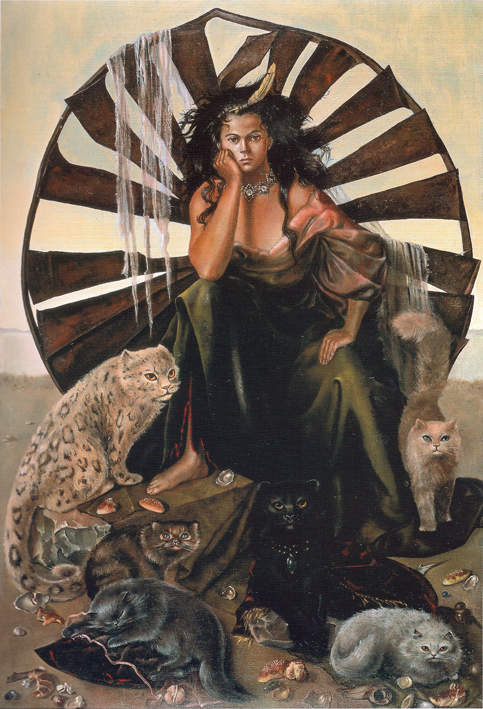
Ideal Life — Leonor Fini

ob_59a9e6_la-vie-ideale-vue-par-leonor-fini

Ideal Life, 1950 by Leonor Fini (1908-1996)

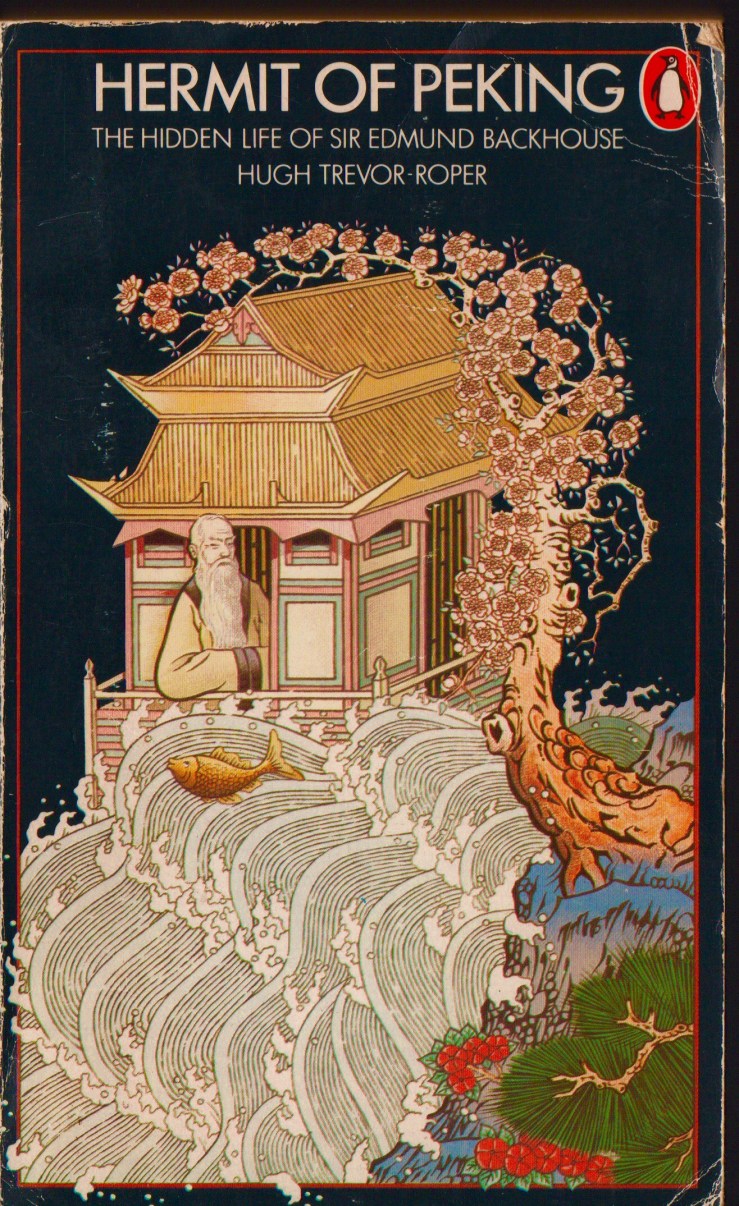
Hermit of Peking (Book acquired 28 Sept. 2017)

img_8122

My daughter asked to go to our favorite used bookstore a few weeks ago, and while she was milling around the children’s section, I dipped through the adjacent biographies area, an area I admit I seldom visit. Hugh Trevor-Roper’s Hermit of Peking was literally lying on the floor. The Arcimboldosque cover (by Peter Brookes—the political cartoonist?) caught my eye. The blurb, which notes that Sir Edmund Backhouse was “one of the most outrageous forgers, confidence trickster and eccentrics of the century” intrigued me; I posted the pic on Twitter and a good source vouched for Hermit. I picked it up. Read more about Backhouse’s frauds and schemes here.


Big Bad Wolves: Chapter 6 — Mu Pan

wolve5_fb

Big Bad Wolves, 2017 by Mu Pan (b. 1976)


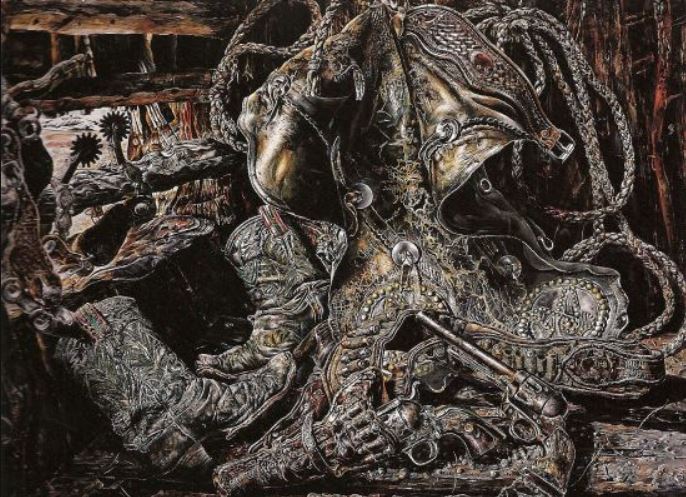
The Wild Bunch (Hole in the Wall Gang) — Ivan Albright

029

The Wild Bunch (Hole in the Wall Gang), 1951 by Ivan Albright (1897-1983)

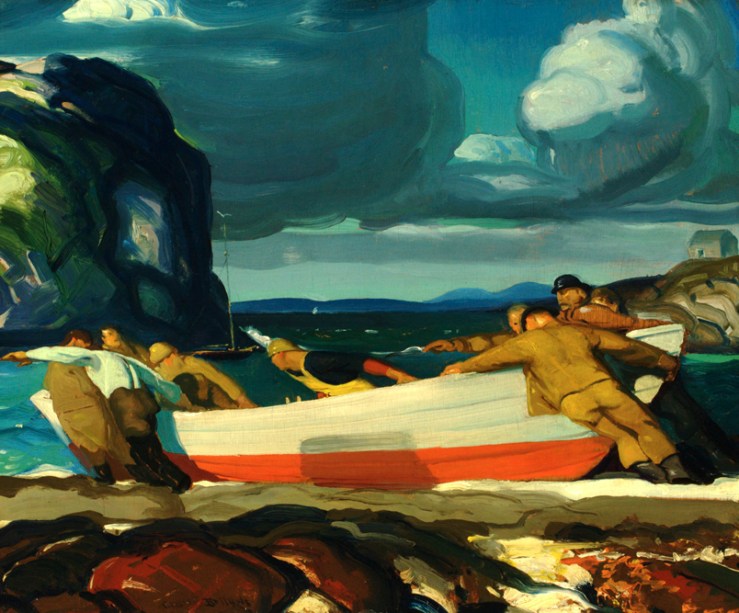
The Big Dory — George Bellows

the-big-dory-1913

The Big Dory, 1913 by George Bellows (1882-1925)

“Roog,” a short story by Philip K. Dick

“Roog”

by

Philip K. Dick


“Roog!” the dog said. He rested his paws on the top of the fence and looked around him.

The Roog came running into the yard.

It was early morning, and the sun had not really come up yet. The air was cold and gray, and the walls of the house were damp with moisture. The dog opened his jaws a little as he watched, his big black paws clutching the wood of the fence.

The Roog stood by the open gate, looking into the yard. He was a small Roog, thin and white, on wobbly legs. The Roog blinked at the dog, and the dog showed his teeth.

“Roog!” he said again. The sound echoed into the silent half darkness. Nothing moved nor stirred. The dog dropped down and walked back across the yard to the porch steps. He sat down on the bottom step and watched the Roog. The Roog glanced at him. Then he stretched his neck up to the window of the house, just above him. He sniffed at the window.

The dog came flashing across the yard. He hit the fence, and the gate shuddered and groaned. The Roog was walking quickly up the path, hurrying with funny little steps, mincing along. The dog lay down against the slats of the gate, breathing heavily, his red tongue hanging. He watched the Roog disappear.

The dog lay silently, his eyes bright and black. The day was beginning to come. The sky turned a little whiter, and from all around the sounds of people echoed through the morning air. Lights popped on behind shades. In the chilly dawn a window was opened.

The dog did not move. He watched the path.

In the kitchen Mrs. Cardossi poured water into the coffee pot. Steam rose from the water, blinding her. She set the pot down on the edge of the stove and went into the pantry. When she came back Alf was standing at the door of the kitchen. He put his glasses on.

“You bring the paper?” he said.

“It’s outside.”

Alf Cardossi walked across the kitchen. He threw the bolt on the back door and stepped out onto the porch. He looked into the gray, damp morning. At the fence Boris lay, black and furry, his tongue out.

“Put the tongue in,” Alf said. The dog looked quickly up. His tail beat against the ground. “The tongue,” Alf said. “Put the tongue in.”

The dog and the man looked at one another. The dog whined. His eyes were bright and feverish.

“Roog!” he said softly.

“What?” Alf looked around. “Someone coming? The paperboy come?”

The dog stared at him, his mouth open.

“You certainly upset these days,” Alf said. “You better take it easy. We both getting too old for excitement.”

He went inside the house.

The sun came up. The street became bright and alive with color. The postman went along the sidewalk with his letters and magazines. Some children hurried by, laughing and talking.

About 11:00, Mrs. Cardossi swept the front porch. She sniffed the air, pausing for a moment.

“It smells good today,” she said. “That means it’s going to be warm.” In the heat of the noonday sun the black dog lay stretched out full length, under the porch. His chest rose and fell. In the cherry tree the birds were playing, squawking and chattering to each other. Once in a while Boris raised his head and looked at them. Presently he got to his feet and trotted down under the tree.

He was standing under the tree when he saw the two Roogs sitting on the fence, watching him.

“He’s big,” the first Roog said. “Most Guardians aren’t as big as this.”

The other Roog nodded, his head wobbling on his neck. Boris watched them without moving, his body stiff and hard. The Roogs were silent, now, looking at the big dog with his shaggy ruff of white around his neck.

“How is the offering urn?” the first Roog said. “Is it almost full?”

“Yes.” The other nodded. “Almost ready.”

“You, there!” the first Roog said, raising his voice. “Do you hear me? We’ve decided to accept the offering, this time. So you remember to let us in. No nonsense, now.”

“Don’t forget,” the other added. “It won’t be long.”

Boris said nothing.

The two Roogs leaped off the fence and went over together just beyond the walk. One of them brought out a map and they studied it.

“This area really is none too good for a first trial,” the first Roog said. “Too many Guardians… Now, the northside area—”

“They  decided,” the other Roog said. “There are so many factors—”

“Of course.” They glanced at Boris and moved back farther from the fence. He could not hear the rest of what they were saying.

Presently the Roogs put their map away and went off down the path.

Boris walked over to the fence and sniffed at the boards. He smelled the sickly, rotten odor of Roogs and the hair stood up on his back.

That night when Alf Cardossi came home the dog was standing at the gate, looking up the walk. Alf opened the gate and went into the yard.

“How are you?” he said, thumping the dog’s side. “You stopped worrying? Seems like you been nervous of late. You didn’t used to be that way.”

Boris whined, looking intently up into the man’s face.

“You a good dog, Boris,” Alf said. “You pretty big, too, for a dog. You don’t remember long ago how you used to be only a little bit of a puppy.”

Boris leaned against the man’s leg.

“You a good dog,” Alf murmured. “I sure wish I knew what is on your mind.”

He went inside the house. Mrs. Cardossi was setting the table for dinner. Alf went into the living room and took his coat and hat off. He set his lunch pail down on the sideboard and came back into the kitchen.

“What’s the matter?” Mrs. Cardossi said.

“That dog got to stop making all that noise, barking. The neighbors going to complain to the police again.”

“I hope we don’t have to give him to your brother,” Mrs. Cardossi said, folding her arms. “But he sure goes crazy, especially on Friday morning, when the garbage men come.”

“Maybe he’ll calm down,” Alf said. He lit his pipe and smoked solemnly. “He didn’t used to be that way. Maybe he’ll get better, like he was.”

“We’ll see,” Mrs. Cardossi said.

The sun rose up, cold and ominous. Mist hung over all the trees and in the low places.

It was Friday morning.

The black dog lay under the porch, listening, his eyes wide and staring. His coat was stiff with hoarfrost and the breath from his nostrils made clouds of steam in the thin air. Suddenly he turned his head and leaped up.

From far off, a long way away, a faint sound came, a kind of crashing sound.

“Roog!” Boris cried, looking around. He hurried to the gate and stood up, his paws on top of the fence.

In the distance the sound came again, louder now, not as far away as before. It was a crashing, clanging sound, as if something were being rolled back, as if a great door were being opened

“Roog!” Boris cried. He stared up anxiously at the darkened windows above him. Nothing stirred, nothing.

And along the street the Roogs came. The Roogs and their truck moved along bouncing against the rough stones, crashing and whirring.

“Roog!” Boris cried, and he leaped, his eyes blazing. Then he became more calm. He settled himself down on the ground and waited, listening.

Out in front the Roogs stopped their truck. He could hear them opening the doors stepping down onto the sidewalk. Boris ran around in a little circle. He whined and his muzzle turned once again toward the house.

Inside the warm, dark bedroom, Mr. Cardossi sat up a little in bed and squinted at the clock.

“That damn dog,” he muttered. “That damn dog.” He turned his face toward the pillow and closed his eyes.

The Roogs were coming down the path, now. The first Roog pushed against the gate and the gate opened. The Roogs came into the yard. The dog backed away from them.

“Roog! Roog!” he cried. The horrid, bitter smell of Roogs came to his nose, and he turned away.

“The offering urn,” the first Roog said. “It is full, I think.” He smiled at the rigid, angry dog. “How very good of you,” he said

The Roogs came toward the metal can, and one of them took the lid from it.

“Roog! Roog!” Boris cried, huddled against the bottom of the porch steps. His body shook with horror. The Roogs were lifting up the big metal can, turning it on its side. The contents poured out onto the ground, and the Roogs scooped the sacks of bulging, splitting paper together, catching at the orange peels and fragments, the bits of toast and egg shells.

One of the Roogs popped an egg shell into his mouth. His teeth crunched the egg shell.

“Roog!” Boris cried hopelessly, almost to himself. The Roogs were almost finished with their work of gathering up the offering. They stopped for a moment, looking at Boris.

Then, slowly, silently, the Roogs looked up, up the side of the house, along the stucco, to the window, with its brown shade pulled tightly down.

“ROOG!” Boris screamed, and he came toward them, dancing with fury and dismay. Reluctantly, the Roogs turned away from the window. They went out through the gate, closing it behind them.

“Look at him,” the last Roog said with contempt, pulling his corner of the blanket up on his shoulder. Boris strained against the fence, his mouth open, snapping wddly. The biggest Roog began to wave his arms furiously and Boris retreated. He settled down at the bottom of the porch steps, his mouth still open, and from the depths of him an unhappy, terrible moan issued forth, a wail of misery and despair.

“Come on,” the other Roog said to the lingering Roog at the fence.

They walked up the path.

“Well, except for these little places around the Guardians, this area is well cleared,” the biggest Roog said. “I’ll be glad when this particular Guardian is done. He certainly causes us a lot of trouble.”

“Don’t be impatient,” one of the Roogs said. He grinned. “Our truck is full enough as it is. Let’s leave something for next week.”

All the Roogs laughed.

They went on up the path, carrying the offering in the dirty, sagging blanket.
I took a solitary walk to Walden Pond | Nathaniel Hawthorne’s journal entry for Friday, October 6th, 1843

Friday, October 6th.–Yesterday afternoon I took a solitary walk to Walden Pond. It was a cool, windy day, with heavy clouds rolling and tumbling about the sky, but still a prevalence of genial autumn sunshine. The fields are still green, and the great masses of the woods have not yet assumed their many-colored garments; but here and there are solitary oaks of deep, substantial red, or maples of a more brilliant hue, or chestnuts either yellow or of a tenderer green than in summer. Some trees seem to return to their hue of May or early June before they put on the brighter autumnal tints. In some places, along the borders of low and moist land, a whole range of trees were clothed in the perfect gorgeousness of autumn, of all shades of brilliant color, looking like the palette on which Nature was arranging the tints wherewith to paint a picture. These hues appeared to be thrown together without design; and yet there was perfect harmony among them, and a softness and a delicacy made up of a thousand different brightnesses. There is not, I think, so much contrast among these colors as might at first appear. The more you consider them, the more they seem to have one element among them all, which is the reason that the most brilliant display of them soothes the observer, instead of exciting him. And I know not whether it be more a moral effect or a physical one, operating merely on the eye; but it is a pensive gayety, which causes a sigh often, and never a smile. We never fancy, for instance, that these gayly clad trees might be changed into young damsels in holiday attire, and betake themselves to dancing on the plain. If they were to undergo such a transformation, they would surely arrange themselves in funeral procession, and go sadly along, with their purple and scarlet and golden garments trailing over the withering grass. When the sunshine falls upon them, they seem to smile; but it is as if they were heartbroken. But it is in vain for me to attempt to describe these autumnal brilliancies, or to convey the impression which they make on me. I have tried a thousand times, and always without the slightest self-satisfaction. Fortunately there is no need of such a record, for Nature renews the picture year after year; and even when we shall have passed away from the world, we can spiritually create these scenes, so that we may dispense with all efforts to put them into words.

Walden Pond was clear and beautiful as usual. It tempted me to bathe; and, though the water was thrillingly cold, it was like the thrill of a happy death. Never was there such transparent water as this. I threw sticks into it, and saw them float suspended on an almost invisible medium. It seemed as if the pure air were beneath them, as well as above. It is fit for baptisms; but one would not wish it to be polluted by having sins washed into it. None but angels should bathe in it; but blessed babies might be dipped into its bosom.

In a small and secluded dell that opens upon the most beautiful cove of the whole lake, there is a little hamlet of huts or shanties inhabited by the Irish people who are at work upon the railroad. There are three or four of these habitations, the very rudest, I should imagine, that civilized men ever made for themselves,–constructed of rough boards, with the protruding ends. Against some of them the earth is heaped up to the roof, or nearly so; and when the grass has had time to sprout upon them, they will look like small natural hillocks, or a species of ant-hills,–something in which Nature has a larger share than man. These huts are placed beneath the trees, oaks, walnuts, and white-pines, wherever the trunks give them space to stand; and by thus adapting themselves to natural interstices, instead of making new ones, they do not break or disturb the solitude and seclusion of the place. Voices are heard, and the shouts and laughter of children, who play about like the sunbeams that come down through the branches. Women are washing in open spaces, and long lines of whitened clothes are extended from tree to tree, fluttering and gambolling in the breeze. A pig, in a sty even more extemporary than the shanties, is grunting and poking his snout through the clefts of his habitation. The household pots and kettles are seen at the doors; and a glance within shows the rough benches that serve for chairs, and the bed upon the floor. The visitor’s nose takes note of the fragrance of a pipe. And yet, with all these homely items, the repose and sanctity of the old wood do not seem to be destroyed or profaned. It overshadows these poor people, and assimilates them somehow or other to the character of its natural inhabitants. Their presence did not shock me any more than if I had merely discovered a squirrel’s nest in a tree. To be sure, it is a torment to see the great, high, ugly embankment of the railroad, which is here thrusting itself into the lake, or along its margin, in close vicinity to this picturesque little hamlet. I have seldom seen anything more beautiful than the cove on the border of which the huts are situated; and the more I looked, the lovelier it grew. The trees overshadowed it deeply; but on one side there was some brilliant shrubbery which seemed to light up the whole picture with the effect of a sweet and melancholy smile. I felt as if spirits were there,–or as if these shrubs had a spiritual life. In short, the impression was indefinable; and, after gazing and musing a good while, I retraced my steps through the Irish hamlet, and plodded on along a wood-path.

According to my invariable custom, I mistook my way, and, emerging upon the road, I turned my back instead of my face towards Concord, and walked on very diligently till a guide-board informed me of my mistake. I then turned about, and was shortly overtaken by an old yeoman in a chaise, who kindly offered me a drive, and soon set me down in the village.

Nathaniel Hawthorne’s journal entry for Friday, October 6th, 1843. Collected in Passages from the American Note-Books.

Hollow People — Morteza Katouzian

dfw8qn56_2655s6gwtsgw_b

Hollow People, 1976 by Morteza Katouzian (b. 1943)

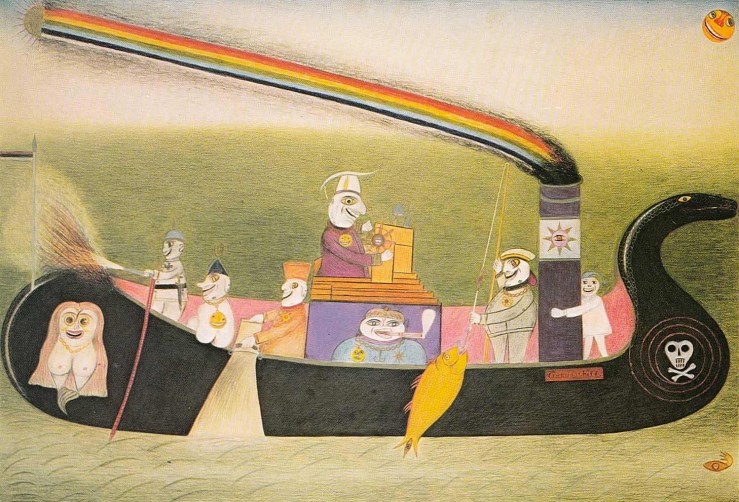
The State Magic Ship to the Moon Spirit Driving — Friedrich Schroder-Sonnenstern

15097120034_2329b21303_o

The State Magic Ship to the Moon Spirit Driving, 1956 by Friedrich Schroder-Sonnenstern (1892-1982)

Almost no memory | A review of Kazuo Ishiguro’s The Buried Giant

In Kazuo Ishiguro’s 2015 novel The Buried Giant, a metaphysical mist engulfs sixth-century Britain, clouding the memories of all who inhabit the land. Saxons and Britons alike cannot recall their bellicose past. Against this mist, elderly Britons Axl and Beatrice seek their long-lost son. They meet a Saxon warrior who hunts an ancient she-dragon he’s vowed to slay. He’s aided by a youth, Edwin, who’s been exiled from his village after being bitten by a mythic creature. King Arthur’s aged nephew Sir Gawain lingers as a courtly protector, a figure from an already-bygone era; the mist seems to slowly rot his brain and his conscience, pushing him into paranoia and madness. There are Charonic ferrymen and awful ogres; there are mad monks and terrible pixies. A hellhound, a dragon, a poisoned goat. Rivers and mountains and crypts and villages. But most of all that mist.

Charon, Joachim Patinir

Ishiguro makes the reader experience that mist. He obscures. The action that occurs—and yes, there’s action here, measured action (often measured in a literal sense)—the action that occurs in The Buried Giant is almost always oblique, shadowed, indistinct, but also very mechanical. The memory-mist renders the world treacherous, immediate, a dark, vague place that offers its travelers no purchase of reference. Deceptive.

Forgive me for quoting at such length, but I think a longish passage here shows how and what Ishiguro is doing. Almost all of our principals are here, underground—note their procession, their movement—a constant motif in the novel, movement, single file or side by side—and the presence of a light, illumination—also a motif. Note the variety of interpretations of not knowingnot seeing, note the simple horror:

They went on into the tunnel, Sir Gawain leading, Axl following with the flame, Beatrice holding his arm from behind, and Edwin now at the rear. There was no option but to go in single file, the passage remaining narrow, and the ceiling of dangling moss and sinewy roots grew lower and lower until even Beatrice had to stoop. Axl did his best to hold the candle high, but the breeze in the tunnel was now stronger, and he was often obliged to lower it and cover the flame with his other hand. Sir Gawain though never complained, and his shape going before them, sword raised over his shoulder, seemed never to vary. Then Beatrice let out an exclamation and tugged Axl’s arm.

“What is it, princess?”

“Oh, Axl, stop! My foot touched something then, but your candle moved too quickly.”

“What of it, princess? We have to move on.”

“Axl, I thought it a child! My foot touched it and I saw it before your light passed. Oh, I believe it’s a small child long dead!”

“There, princess, don’t distress yourself. Where was it you saw it?”

“Come, come, friends,” Sir Gawain said from the dark. “Many things in this place are best left unseen.”

Beatrice seemed not to hear the knight. “It was over here, Axl. Bring the flame this way. Down there, Axl, shine it down there, though I dread to see its poor face again!”

Despite his counsel, Sir Gawain had doubled back, and Edwin too was now at Beatrice’s side. Axl crouched forward and moved the candle here and there, revealing damp earth, tree roots and stones. Then the flame illuminated a large bat lying on its back as though peacefully asleep, wings stretched right out. Its fur looked wet and sticky. The pig-like face was hairless, and little puddles had formed in the cavities of the outspread wings. The creature might indeed have been sleeping but for what was on the front of its torso. As Axl brought the flame even closer, they all stared at the circular hole extending from just below the bat’s breast down to its belly, taking in parts of the ribcage to either side. The wound was peculiarly clean, as though someone had taken a bite from a crisp apple.

“What could have done work like this?” Axl asked.

He must have moved the candle too swiftly, for at that moment the flame guttered and went out.

Ishiguro gives us mystery, interpretation, and then an incomplete, ambiguous revelation. (This is the basic structure of the novel). Beatrice never relents in her belief that she’s stumbled over a dead child. Brimming with lost children and lost parents and orphans, The Buried Giant is a novel of erasures. But an erasure leaves a trace, a violent, visceral marking into the page’s blankness. Revelation through absence.

We would have no plot, not really, without some overcoming of blankness, and Axl in particular overcomes the mist in his quest. A backstory fleshes out, in watery strokes albeit. The Buried Giant, as far as fantasy epics go, is awfully indistinct. Or rather, Ishiguro offers only mechanical and immediate glimpses into this world, a Britain on the cusp of the Middle Ages. Through Axl’s consciousness (and conscience), we see the vital precision in hand-to-hand combat, for example. Its patience, its slowness, its dependence on muscle memory. Or perhaps (dare I say) more boringly, we feel the very real peril involved in walking in the wild dark as an elderly person. The thrills in The Buried Giant come not from its sword and sorcery costumes, but from its Kafkaesque edges and gaps. This is a novel about not knowing.

And it’s here that The Buried Giant is most successful—as an evocation of not knowing. Axl and Beatrice’s quest unfolds as a series of choices and consequences severed, for the most part, from the anchor of memory. There’s an episodic vibe to the novel, a sense that it’s making itself up as it goes along. (It’s not). The novel strongly reminded me of some of the old RPGs I’d play on a Commodore 64 as a kid. The graphics weren’t great and I had to use my imagination a lot. The games were sometimes frustrating and slow. But perhaps you want a more, uh, literary comparison? Something more recent too? The Buried Giant recalls Ishiguro’s short story “A Village after Dark” a lot more than, say, A Game of Thrones or The Lord of the Rings. It’s a fantasy novel, but one that feels etiolated, its vivid colors drained. More Gustave Doré than Gustave Moreau.

While a precise indistinctness (forgive the oxymoron) is part of The Buried Giant’s program, there’s nothing indistinct about its heroes’ love for each other. Axl and Beatrice, A & B—can I say I came to love them? Or if I didn’t quite love them, I was rooting for them, say? Rooting for their survival, but specifically their survival as a they, a shared survival. Ishiguro successfully communicates their intimacy, their romance, their love, a love threatened by both the natural world and the supernatural return of lost memory. Their relationship is the heart of the novel upon which Ishiguro fixes his themes of memory, justice, vengeance, and love. Ishiguro’s commentary on those themes ultimately may feel pessimistic to many readers, particularly in the novel’s conclusion.

Excepting the ones that we love and return to and obsess over, we retain little of the novels that we read. What memories remain are kernels—the outline of a plot, a strange lingering phrase or detail, a bright or bold character, a theme, an idea, an image. It’s the love between Axl and Beatrice that I’ll likely recall most strongly from the shadows of The Buried Giant. If we can’t remember, we can at least experience.

[Editorial note: Biblioklept originally published this review in October, 2015],

Kazuo Ishiguro’s subtle and unsettling short story, “A Village After Dark”

There was a time when I could travel England for weeks on end and remain at my sharpest—when, if anything, the travelling gave me an edge. But now that I am older I become disoriented more easily. So it was that on arriving at the village just after dark I failed to find my bearings at all. I could hardly believe I was in the same village in which not so long ago I had lived and come to exercise such influence.

There was nothing I recognized, and I found myself walking forever around twisting, badly lit streets hemmed in on both sides by the little stone cottages characteristic of the area. The streets often became so narrow I could make no progress without my bag or my elbow scraping one rough wall or another. I persevered nevertheless, stumbling around in the darkness in the hope of coming upon the village square—where I could at least orient myself—or else of encountering one of the villagers. When after a while I had done neither, a weariness came over me, and I decided my best course was just to choose a cottage at random, knock on the door, and hope it would be opened by someone who remembered me.

I stopped by a particularly rickety-looking door, whose upper beam was so low that I could see I would have to crouch right down to enter. A dim light was leaking out around the door’s edges, and I could hear voices and laughter. I knocked loudly to insure that the occupants would hear me over their talk. But just then someone behind me said, “Hello.”

Read the rest of Kazuo Ishiguro’s story “A Village After Dark” at The New Yorker; you can also hear Ben Marcus read and discuss the story on The New Yorker’s fiction podcast.


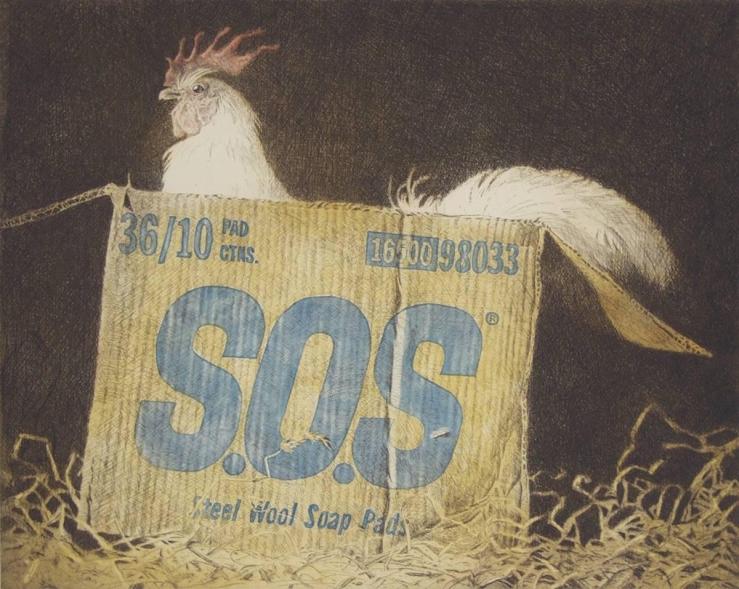
S.O.S. — Jamie Wyeth

wyeth_sos_ded_proof_3_5_z

S.O.S, 1981 by Jamie Wyeth (b. 1946)

The Empress of Sorrow — Eric Fischl

the-empress-of-sorrow

The Empress of Sorrow, 1992 by Eric Fischl (b. 1948)

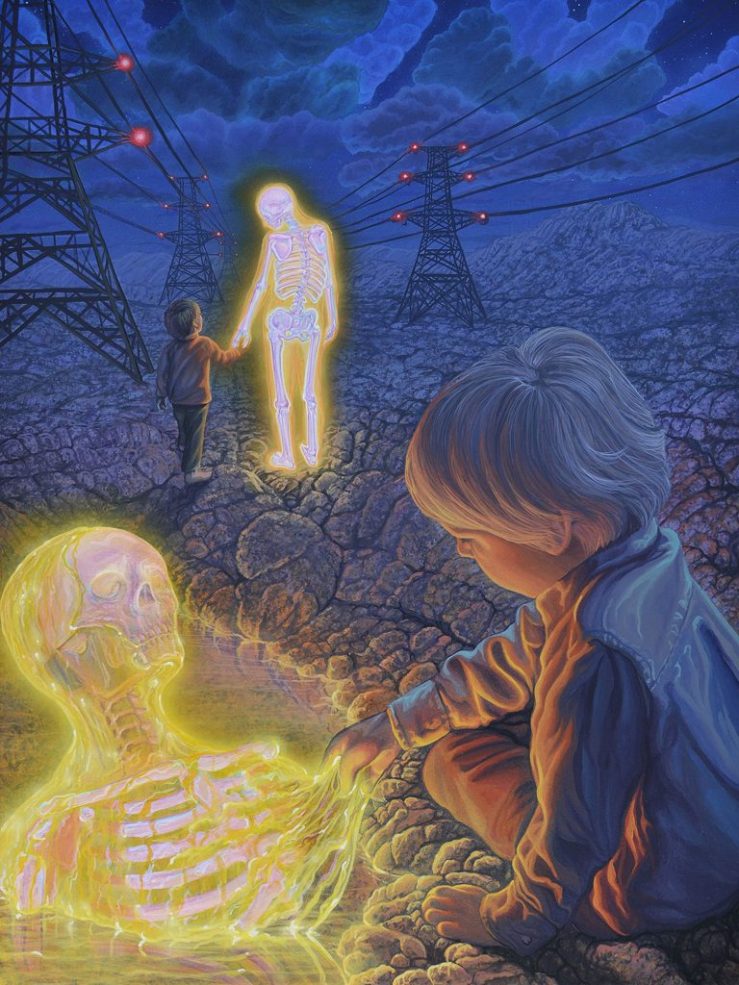
Growing Together — Wiley Wallace

wileywallace03_3-grow-together-wiley-wallace-small-768x1024

Grow Together, 2016 by Wiley Wallace

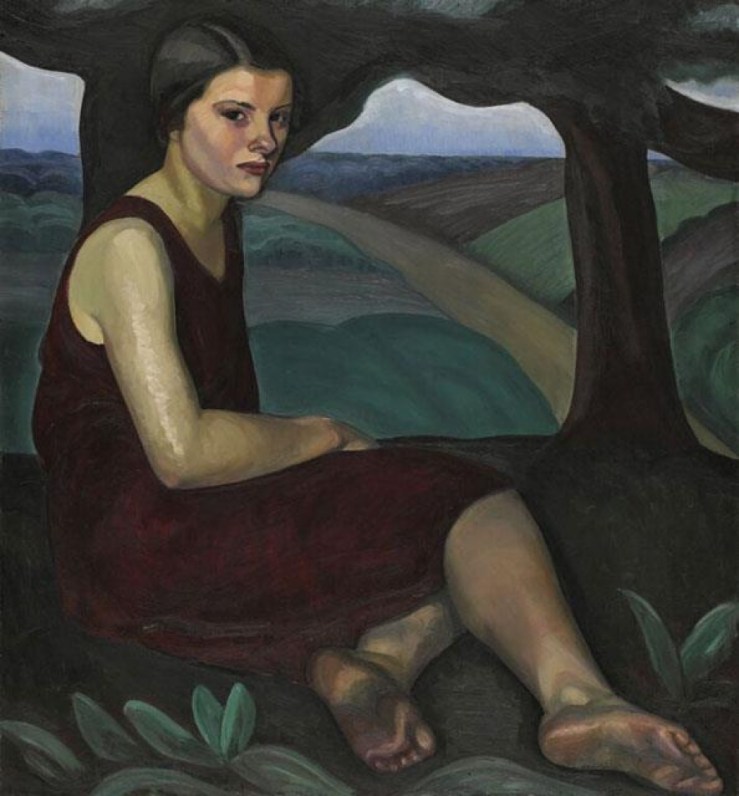
Girl on a Hill — Prudence Heward

6fa382ab0bdc5857c238d4ea96ad972d

Girl on a Hill, 1928 by Prudence Heward (1896-1947)