I’ve had a hard time reading much (let alone writing anything) since November 8th.
A Klimt puzzle has been soothing though.
And I’ve found audiobooks, which I’ve always loved, particularly wonderful lately. They have provided a kind of anti-noise, antidote, anti-?—against the NPR news and punditry I might normally adhere to in the car (and especially potent against my own thoughts at night before I fall asleep).
My pattern with audiobooks has long been to reread at night the chapters or passages I audited that day, or to audit after I had read—or to mix it all up, going back and forth. I like this method because it allows me, essentially, to reread.
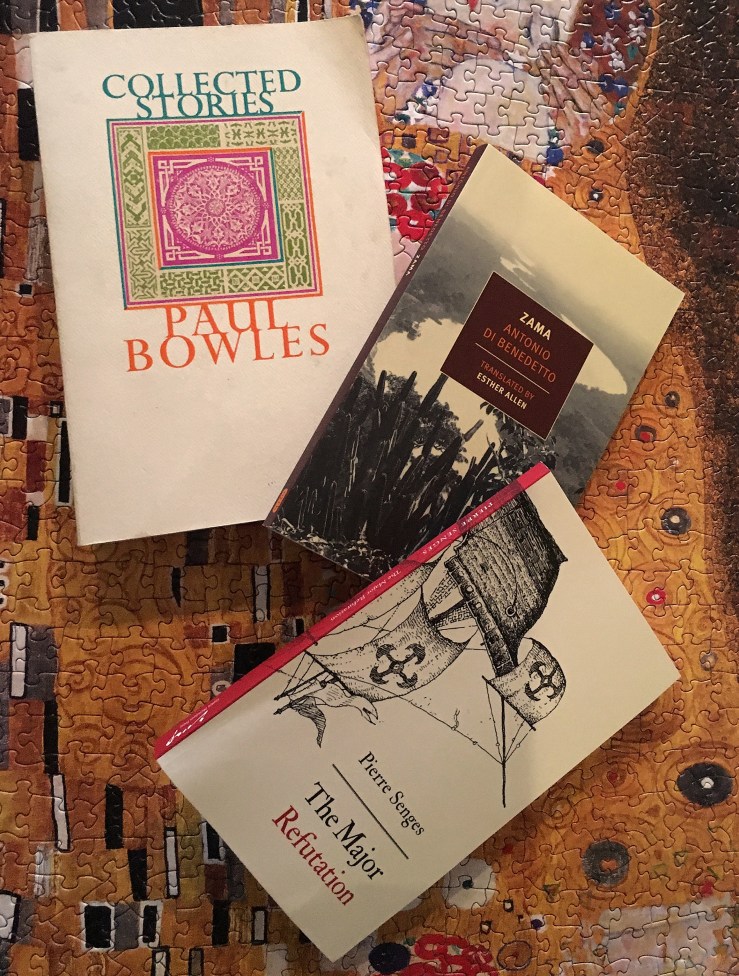
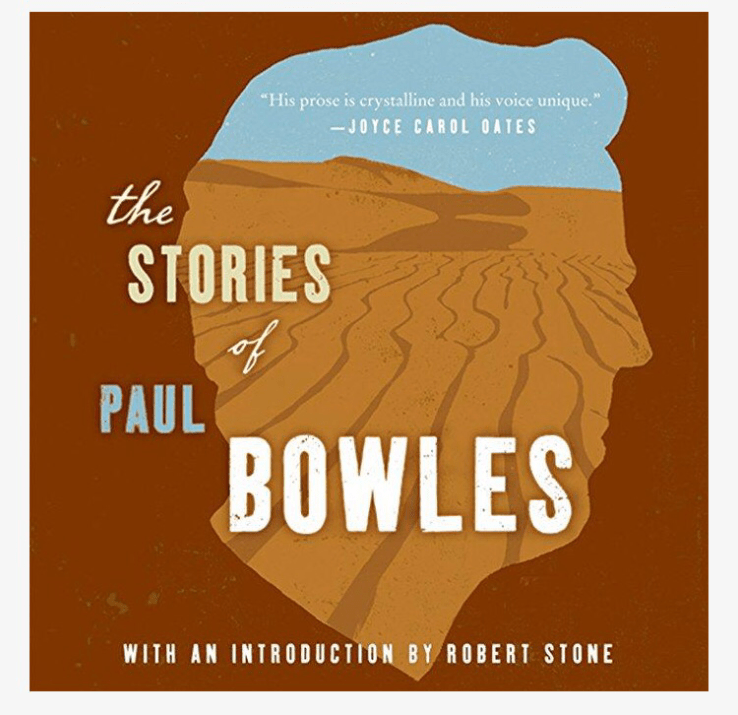
I’ve been listening to The Stories of Paul Bowles, read by like a dozen different performers (not a full-cast group read, but rather different voices for different tales). Then (mostly at night but occasionally very early in the morning), I’ve been rereading some of the stories that are collected in Collected Stories. (My local bookshop had copies of the more-complete The Stories of, but hell, who can pass up a Black Sparrow Press edition? Plus—parenthetically—the BSP edition collects the more essential stories).
Anyway, I’m coming to the end of The Stories of Paul Bowles and I’m almost a bit sad about it. The sadness come partially from the fact that the stories are presented chronologically, and, simply put, the later tales are sadder than the earlier ones. Not in content, but in tone—Bowles’s later stuff grows more bitter, more resentful. The earlier tales are strange, sharp, and driven by weird nightmare alienation and sinister surrealism. But they also open into possibility, exploration, and radical newness. The later tales, composed in the 1980s, seem to me a closing off, not just in themes and tone, but also stylistically. They retreat into formalist modernism. There’s a palpable resistance to postmodernism in the later stories, an elegiac tone that romanticizes (even through multiple ironies) the post-War colonial past.
But my sadness is also the feeling of Oh I want more. (Plus like, the aforereferenced general post-election malaise). This is all easily remedied by my plan to listen to the first two-thirds of these stories again—but probably after I take a crack at his novels.
I was too young the first time I took a crack at The Sheltering Sky—16 I think. I was reading a lot of Hemingway, Vonnegut, William Burroughs, et al. But I couldn’t click with Bowles, which makes sense to me two decades later. His stories are spare but sharp, wild but obscure. His fables refuse to square with our expectations. They are menacing, awful, loaded with strangers and travelers and outcasts. The characters do not know what is happening to them; they do not even know that they do not know what is happening to them. Often, the story’s narrator does not seem to know what is happening, and if the narrator does know what is happening, he’s not going to throw anything but the barest bones to the reader to piece together. Anyway, I’ll trek through again, for sure.
A late Bowles story, the epistolary “Unwelcome Words” (many of the later stories are epistolary affairs), offers me a neat transition to the audiobook I’ve been drifting off into unconsciousness the past few evenings with. Here’s Bowles’s narrator (a version of Bowles his-goddamn-self):
I’ve often wished that someone would rewrite the end of Huckleberry Finn, delivering it from the farcical closing scenes which Twain, probably embarrassed by the lyrical sweep of the nearly completed book, decided were necessary if the work were to be appreciated by American readers. It’s the great American novel, damaged beyond repair by its author’s senseless sabotage. I’d be interested to have your opinion, or do you feel that the book isn’t worth having an opinion about, since a botched masterpiece isn’t a masterpiece at all? Yet to counterfeit the style successfully, so that the break would be seamless and the prose following it a convincing continuation of what came before—that seems an impossible task. So I shan’t try it, myself.
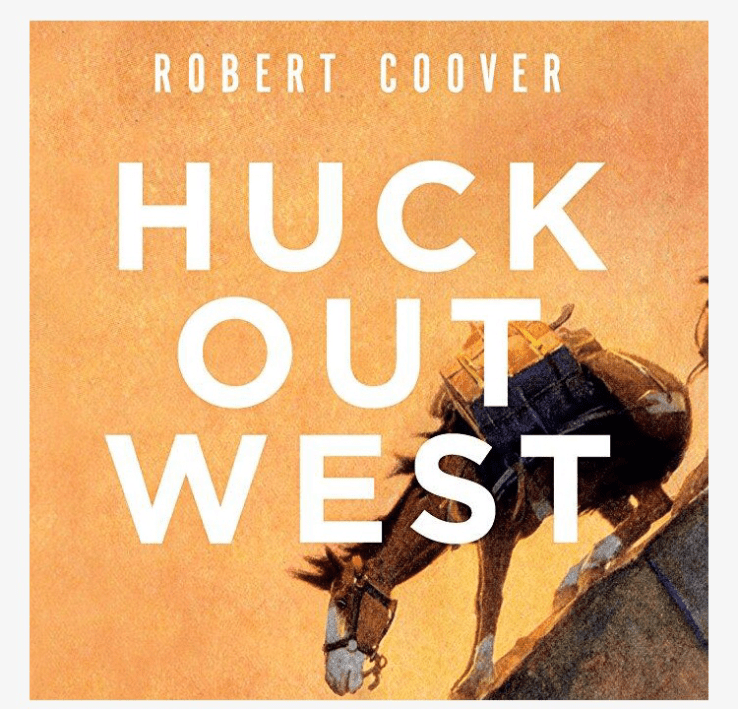
Bowles here licenses my transition to Robert Coover’s latest, Huck Out West, a sorta-sequel to Twain’s problematic American masterpiece. Sure, Coover’s not rewriting the end of Huck Finn so much as he’s carrying out the mission of the novel’s final lines: “…I got to light out for the Territory ahead of the rest, because Aunt Sally she’s going to adopt me and sivilize me, and I can’t stand it. I been there before.” So Coover sets Huck out in the Territory, away from the maternal bodies that would otherwise sivilize him. I’ve gotten maybe two hours into the audiobook (it’s short, fewer than ten hours), but I keep launching in to different points, and only auditing late at night. I need a physical copy.
Physical copies report:
I’m crawling through Pierre Senges’s The Major Refutation (Eng. trans. by Jacob Siefring), mostly because I have to look up names, look for images, get lost in early depictions of “The New World” (and, uh, the refutation of the New World). . So far, it reminds me of the kind of fantasy-based literary criticism that I love: Eco, Borges, Calvino. Excerpt here.
A friend loaned me his copy of Antonio di Benedetto’s first novel Zama (Eng. translation by Esther Allen) last week, insisting I read it, and informing me that Bolaño based the titular figure of his story “Sensini” on di Benedetto. I read the first four chapters this afternoon; they were very short and I want to keep reading. Short chapters are working for me right now.


 Biblioklept