Three Dishes of Sweetmeats and Chestnuts with Three Glasses on a Table — Osias Beert

So, How Is Your Appetite, Troll Mother Continued — John Bauer

Read “Mr. Spaceship,” an early Philip K. Dick story

illo1

“Mr. Spaceship”

by

Philip K. Dick


Kramer leaned back. “You can see the situation. How can we deal with a factor like this? The perfect variable.”

“Perfect? Prediction should still be possible. A living thing still acts from necessity, the same as inanimate material. But the cause-effect chain is more subtle; there are more factors to be considered. The difference is quantitative, I think. The reaction of the living organism parallels natural causation, but with greater complexity.”

Gross and Kramer looked up at the board plates, suspended on the wall, still dripping, the images hardening into place. Kramer traced a line with his pencil.

“See that? It’s a pseudopodium. They’re alive, and so far, a weapon we can’t beat. No mechanical system can compete with that, simple or intricate. We’ll have to scrap the Johnson Control and find something else.”

“Meanwhile the war continues as it is. Stalemate. Checkmate. They can’t get to us, and we can’t get through their living minefield.”

Kramer nodded. “It’s a perfect defense, for them. But there still might be one answer.”

“What’s that?”

“Wait a minute.” Kramer turned to his rocket expert, sitting with the charts and files. “The heavy cruiser that returned this week. It didn’t actually touch, did it? It came close but there was no contact.”

“Correct.” The expert nodded. “The mine was twenty miles off. The cruiser was in space-drive, moving directly toward Proxima, line-straight, using the Johnson Control, of course. It had deflected a quarter of an hour earlier for reasons unknown. Later it resumed its  course. That was when they got it.”

“It shifted,” Kramer said. “But not enough. The mine was coming along after it, trailing it. It’s the same old story, but I wonder about the contact.” Continue reading “Read “Mr. Spaceship,” an early Philip K. Dick story”

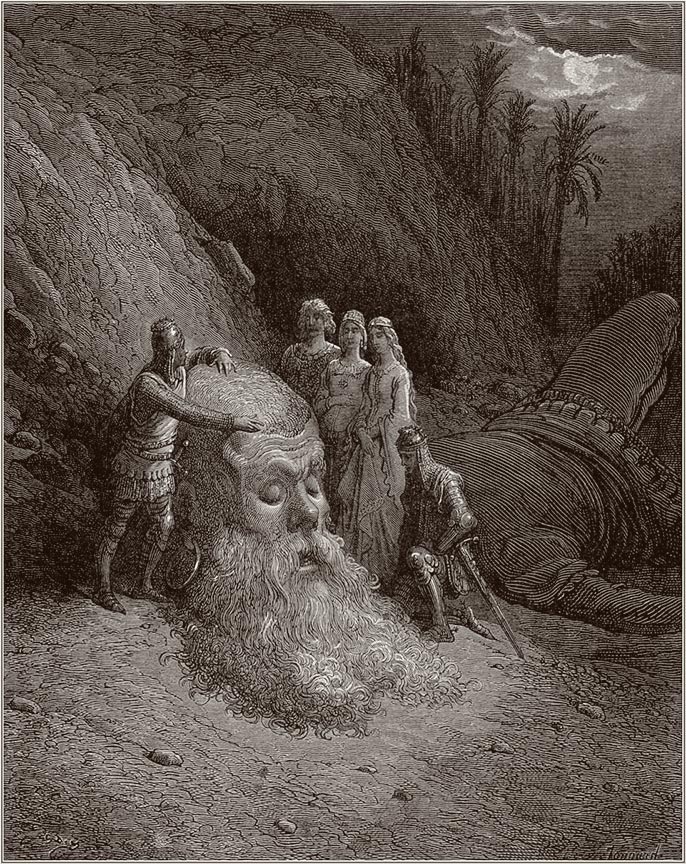
Illustration for Orlando Furioso — Gustave Doré

dore-orlando-furioso-864

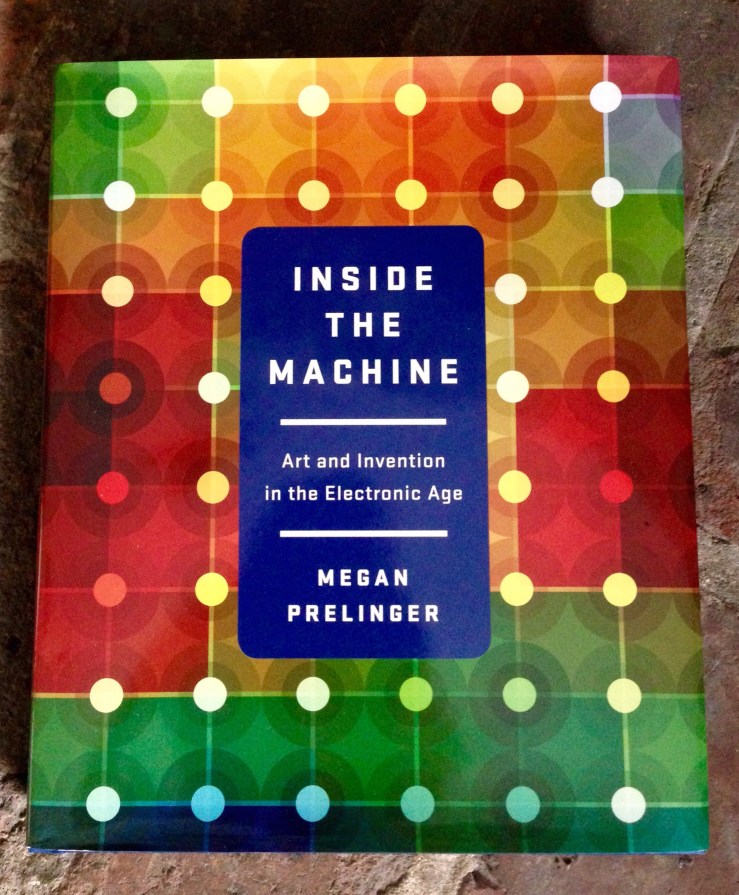
Inside the Machine (Book acquired 6.25.2015)

IMG_7686

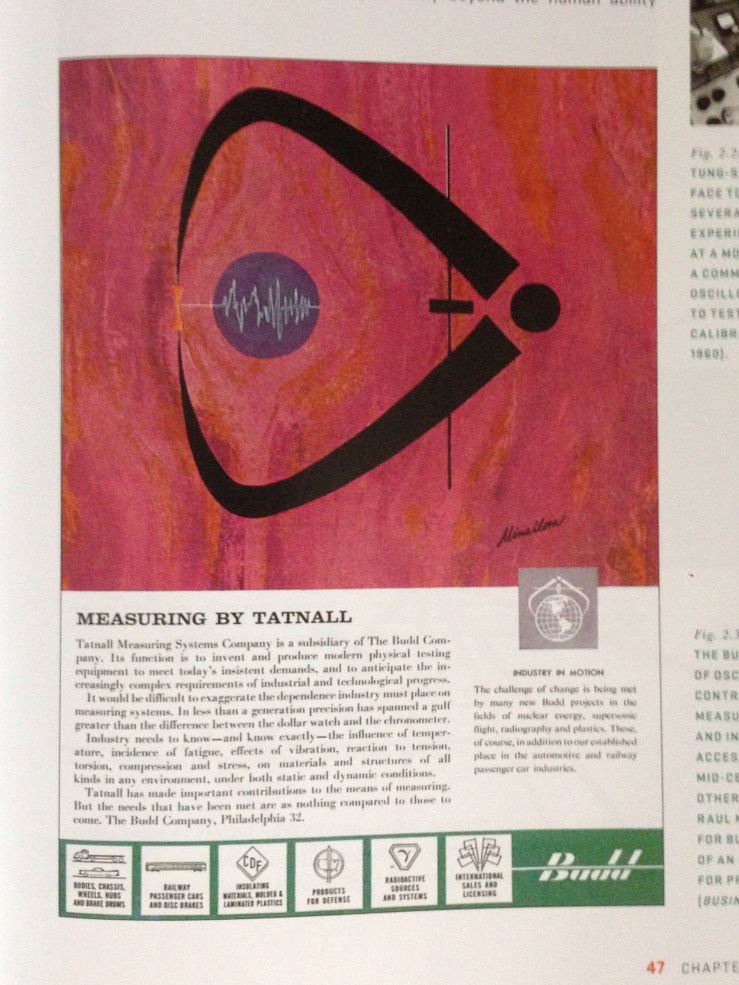
My crappy iPhone pics aren’t doing justice to these images from Megan Prelinger’s Inside the Machine (glossy pages are hard to photograph). Book is out in August from W.W. Norton—their blurb:

A visual history of the electronic age captures the collision of technology and art—and our collective visions of the future.

A hidden history of the twentieth century’s brilliant innovations—as seen through art and images of electronics that fed the dreams of millions.

A rich historical account of electronic technology in the twentieth century, Inside the Machine journeys from the very origins of electronics, vacuum tubes, through the invention of cathode-ray tubes and transistors to the bold frontier of digital computing in the 1960s.

But, as cultural historian Megan Prelinger explores here, the history of electronics in the twentieth century is not only a history of scientific discoveries carried out in laboratories across America. It is also a story shaped by a generation of artists, designers, and creative thinkers who gave imaginative form to the most elusive matter of all: electrons and their revolutionary powers.

As inventors learned to channel the flow of electrons, starting revolutions in automation, bionics, and cybernetics, generations of commercial artists moved through the traditions of Futurism, Bauhaus, modernism, and conceptual art, finding ways to link art and technology as never before.

A visual tour of this dynamic era, Inside the Machine traces advances and practical revolutions in automation, bionics, computer language, and even cybernetics. Nestled alongside are surprising glimpses into the inner workings of corporations that shaped the modern world: AT&T, General Electric, Lockheed Martin.

While electronics may have indelibly changed our age, Inside the Machinereveals a little-known explosion of creativity in the history of electronics and the minds behind it.

IMG_7687

Continue reading “Inside the Machine (Book acquired 6.25.2015)”

Read “Crow Mountain,” a new short story by Can Xue

“Crow Mountain” is a new short story by Can Xue in the July issue of Asymptote. Translation by Karen Gernant and Chen Zeping. The first few paragraphs:

I’d been waiting for a long time for Qinglian, who lived on the fifth floor, to take me to a place called “Crow Mountain.” It was a vacant five-story building on the brink of collapse. It used to be the municipal office. I had passed by it only once—the year I was four. I remembered Mama pointing at the large, tightly closed windows and saying to me, “This is ‘Crow Mountain’!” All kinds of questions occurred to me right away. “What do you mean, it’s a mountain?” I asked. “It’s obviously a building. Where are the crows? Are these windows shut so tightly because they’re afraid the crows inside will fly away?” Dad was standing beside me. I wanted to ask still more questions, but he cut me off: “Come on, let’s go!”

Later we moved to another part of the city. It was Qinglian who told me more about that building. Qinglian was only fourteen but already a beauty, and I envied her. She always frowned as she said to me, “Juhua, Juhua, how can you be so ugly? I’m embarrassed to be seen with you.” I knew she was kidding, so I didn’t get mad. We had been talking about “Crow Mountain” for a long time. Everything I knew about it came from Qinglian. Though I could still vaguely remember that large building outside the city, I hadn’t been back a single time. The city was too big. But Qinglian went every year because her uncle was a gatekeeper there.

“They’re always saying it’s going to collapse, but actually it isn’t. It’ll be fine for decades. It’s so much fun inside!” she said.

The Willy Grasser — Sidney Sime

Title/s: 'Bogus Beast, The Wily Grasser' Maker/s: Sime, Sidney Herbert (draughtsman) [ULAN info: British artist, 1867] Technique Description: pen and Indian ink with grey wash on paper, stuck down on card Dimensions: height: 227 mm, width: 168 mm

List with No Name #53

  1. Agapē Agape
  2. Amerika
  3. Billy Budd
  4. The Castle
  5. The Garden of Eden
  6. Hadji Murat
  7. Islands in the Stream
  8. Juneteenth
  9. The Leopard
  10. The Master and Margarita
  11. The Metamorphosis
  12. The Mysterious Stranger
  13. October Ferry to Gabriola
  14. The Pale King
  15. Persuasion
  16. Stephen Hero
  17. The Third Policeman
  18. The Third Reich
  19. Three Days Before the Shooting…

Minamoto no Yorimitsu Preparing to Kill the Earth Spider — Tsukioka Yoshitoshi

5050161212810010

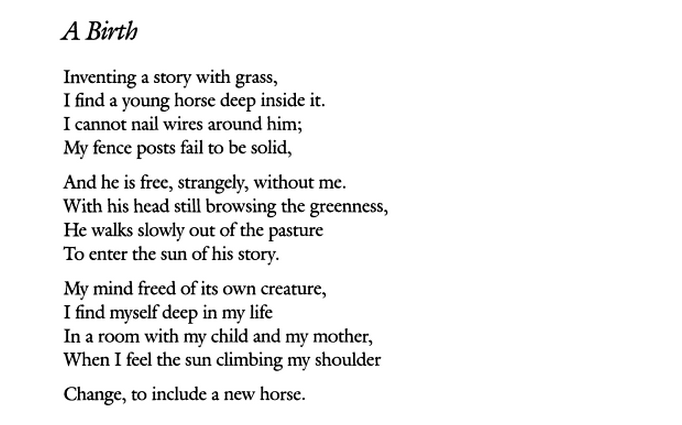
“Situation” — Langston Hughes

Screenshot 2015-07-15 at 10

Fête nationale — Theophile Steinlen

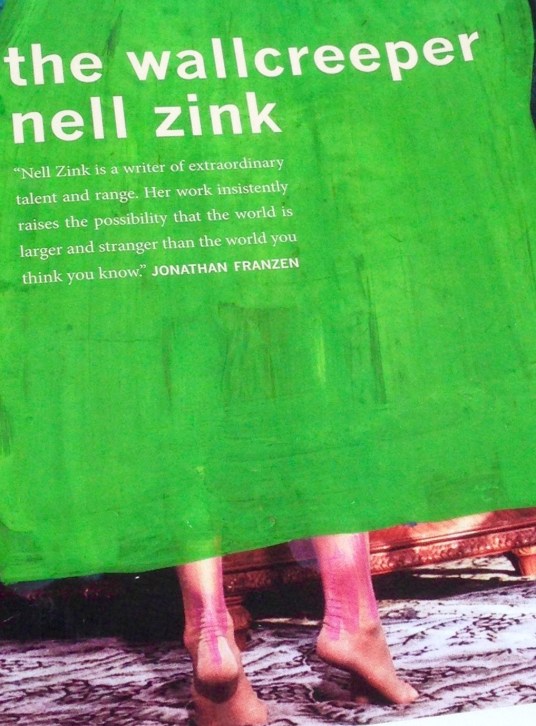
A review of Nell Zink’s extraordinary novel The Wallcreeper

image

The short review is, “Nell Zink’s début novel The Wallcreeper is extraordinary.”

But this argument is insufficient, unsupported, you, dear reader, may protest. Why should you spend your hard-earned time reading The Wallcreeper, eh? (I read the book in four sittings. I was late to Sunday dinner for finishing the thing). To invert one of the better book short book reviews I’ve ever read: Every sentence made me want to read the next sentence. Is that not a good enough reason to read The Wallcreeper? Maybe you want to read some of those sentences. Here’s the first one:

I was looking at the map when Stephen swerved, hit the rock, and occasioned the miscarriage.

Or a page or two later when our heroine/narrator Tiffany describes how she met Stephen:

Our first meeting prevented a crime. He saw me standing in front of the open gate of the vault.

(Don’t worry about that crime). Oh, and, on that first meeting with Stephen:

It was one of those moments where you think: We will definitely fuck. It might take a while, though, because Stephen looked as respectable as I did.

And here’s a simile from Tiffany, just because I love the line and can wedge it in here:

After the cranes had landed, the geese passed overhead in so many Vs that they merged into Xs and covered the entire sky like a fishnet stocking.

It occurs to me now that I’m probably doing this wrong, right? I should be summarizing the book a bit, no? I’m not particularly interested in that—the plot is the sentences—I mean, yeah, there’s a plot, about Tiffany and Stephen in Berne and later Berlin—and some other places too—and the different lovers they take and the various projects they undertake—music, language acquisition, ecoterrorism—and lots of birdwatching.

Maybe I should lazily just reblurb Keith Gessen’s blurb:

Who is Nell Zink? She claims to be an expatriate living in northeast Germany. Maybe she is; maybe she isn’t. I don’t know. I do know that this first novel arrives with a voice that is fully formed: mature, hilarious, terrifyingly intelligent, and wicked. The novel is about a bird-loving American couple that moves to Europe and becomes, basically, eco-terrorists. This is strange, and interesting, but in between is some writing about marriage, love, fidelity, Europe, and saving the earth that is as funny and as grown-up as anything I’ve read in years. And there are some jokes in here that a young Don DeLillo would kill to have written. I hope he doesn’t kill Nell Zink

The DeLillo comparison is apt, but Zink’s novel is funnier than anything DeLillo’s done in ages. Maybe that’s not fair. “Funny” seems like a weak word, really, for Zink and her narrator Tiffany (and Stephen)—all the words I would use to describe what Zink’s doing here seem pale and imprecise. I mean wittysmartintelligent, devastatingconfounding. Extraordinary, right, that was the word I used above, yes? (He looks the word up in an online dictionary, somehow at 36 and a lifelong native English speaker unsure what it actually means). A placeholder like strange would work, except some of y’all take that word as a pejorative. Eccentric or quirky imply, I think, a rhetorical imprecision wholly absent from the novel. The Wallcreeper is a precise book. The book is very good. It is an interesting book. (What awful sentences those were! But true).

Can you know a book through the words the reviewer uses to describe it though? (No). Can you really know a character through the words she launches your way, anyway? In The Wallcreeper, Tiffany doesn’t really know herself, or Stephen, and the narrative is in some ways her kinda sorta finding out about herself (and Stephen, and other stuff), in a non-urgent manner. Or maybe very urgent, I don’t know—she and Stephen are in a constant state of crisis, sort of, or epiphany-making—

Our marriage had begun in the most daunting way imaginable. We had barely known each other, and then we had those accidents and that jarring disconnect between causes (empty-headed young people liking each other, wallcreepers) and effects (pain, death).

A wallcreeper is a small bird with crimson wings, by the way.

The titular wallcreeper, also by the way, is the thing that makes Stephen swerve in that opening sentence I shared for you above. The book is full of swerves, dips, dives, turns—each sentence swerves into the next, artfully, gracefully, precisely. Tiffany’s consciousness, or the language that Zink uses to represent Tiffany’s consciousness, swerves:

We walked down into the lower garden and sat on a bench. He looked into the pond and remarked favorably on the lack of goldfish. I thought of all the spawn-guzzling carp I had admired in the past and felt abashed. I shrank at the vulgarity of raptures over beauty, nature’s most irrelevant and unnecessary quality.

Beautiful!

But where was I? I think swerves was the metaphor I was batting about a bit—well, I suppose I could go on, suggest that all that swerving swerves up to Something More, that the novel swerves (swells? no, not swells) to an ending shot-through with mythical undertones (which our narrator punctures)—I mean to say that, yes, okay, the novel is a wonderful witty aesthetic read—each sentence made me want to read the next sentence—but readers who require More Than That will also get it. Or maybe not. The Wallcreeper, like all extraordinary novels, is Not For Everyone. The Wallcreeper was/is for me though, and I hope it will also be for you too.

The Wallcreeper is available directly from publisher The Dorothy Project and finer bookshops.

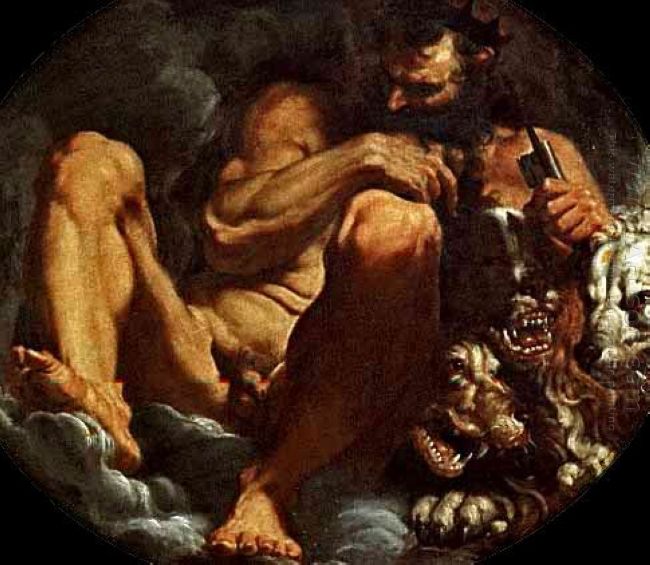
Pluto — Agostino Carracci

ARTS601676

The Fourteenth of July at Etretat — Felix Vallotton

Leocadia — Francisco Goya