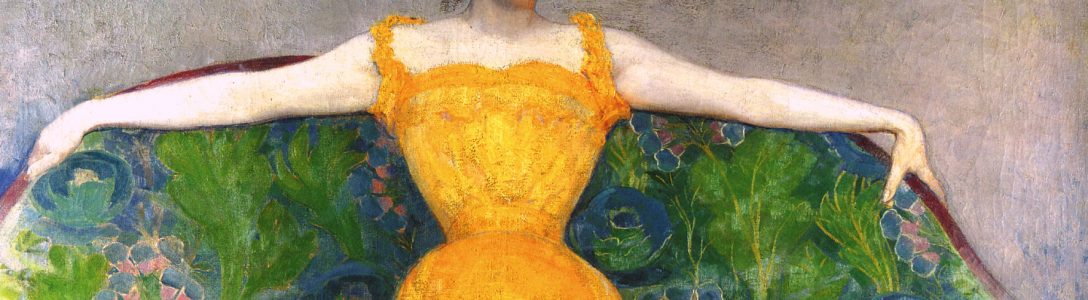
Reclining Nude Reading — Felice Casorati

tumblr_n6sq23lmJo1qb4lg8o1_1280

Reclining Nude Reading, 1943 by Felice Casorati (1883–1963)

“Nervous,” a very short story by Robert Walser

“Nervous”

by

Robert Walser

translated by Christopher Middleton


I am a little worn out, raddled, squashed, downtrodden, shot full of holes. Mortars have mortared me to bits. I am a little crumbly, decaying, yes, yes. I am sinking and drying up a little. I am a bit scalded and scorched, yes, yes. That’s what it does to you. That’s life. I am not old, not in the least, certainly I am not eighty, by no means, but I am not sixteen any more either. Quite definitely I am a bit old and used up. That’s what it does to you. I am decaying a little, and I am crumbling, peeling a little. That’s life. Am I a little bit over the hill? Hmm! Maybe. But that doesn’t make me eighty, not by a long way. I am very tough, I can vouch for that. I am no longer young, but I am not old yet, definitely not. I am aging, fading a little, but that doesn’t matter; I am not yet altogether old, though I am probably a little nervous and over the hill. It’s natural that one should crumble a bit with the passage of time, but that doesn’t matter. I am not very nervous, to be sure, I just have a few grouches. Sometimes I am a bit weird and grouchy, but that doesn’t mean I am altogether lost, I hope. I don’t propose to hope that I am lost, for I repeat, I am uncommonly hard and tough. I am holding out and holding on. I am fairly fearless. But nervous I am, a little, undoubtedly I am, very probably I am, possibly I am a little nervous. I hope that I am a little nervous. No, I don’t hope so, one doesn’t hope for such things, but I am afraid so, yes, afraid so. Fear is more appropriate here than hope, no doubt about it. But I certainly am not fear-stricken, that I might be nervous, quite definitely not. I have grouches, but I am not afraid of the grouches. They inspire me with no fear at all. “You are nervous,” someone might tell me, and I would reply cold-bloodedly, “My dear sir, I know that quite well, I know that I am a little worn out and nervous.” And I would smile, very nobly and coolly, while saying this, which would perhaps annoy the other person a little. A person who refrains from getting annoyed is not yet lost. If I do not get annoyed about my nerves, then undoubtedly I still have good nerves, it’s clear as daylight, and illuminating. It dawns on me that I have grouches, that I am a little nervous, but it dawns on me in equal measure that I am cold-blooded, which makes me uncommonly glad, and that I am blithe in spirit, although I am aging a little, crumbling and fading, which is quite natural and something I therefore understand very well. “You are nervous,” someone might come up to me and say. “Yes, I am uncommonly nervous,” would be my reply, and secretly I would laugh at the big lie. “We are all a little nervous,” I would perhaps say, and laugh at the big truth. If a person can still laugh, he is not yet entirely nervous; if a person can accept a truth, he is not yet entirely nervous; anyone who can keep calm when he hears of some distress is not yet entirely nervous. Or if someone came up to me and said: “Oh, you are totally nervous,” then quite simply I would reply in nice polite terms: “Oh, I am totally nervous, I know I am.” And the matter would be closed. Grouches, grouches, one must have them, and one must have the courage to live with them. That’s the nicest way to live. Nobody should be afraid of his little bit of weirdness. Fear is altogether foolish. “You are very nervous!” “Yes, come by all means and calmly tell me so! Thank you!”

That, or something like it, is what I’d say, having my gentle and courteous bit of fun. Let man be courteous, warm, and kind, and if someone tells him he’s totally nervous, still there’s no need at all for him to believe it.

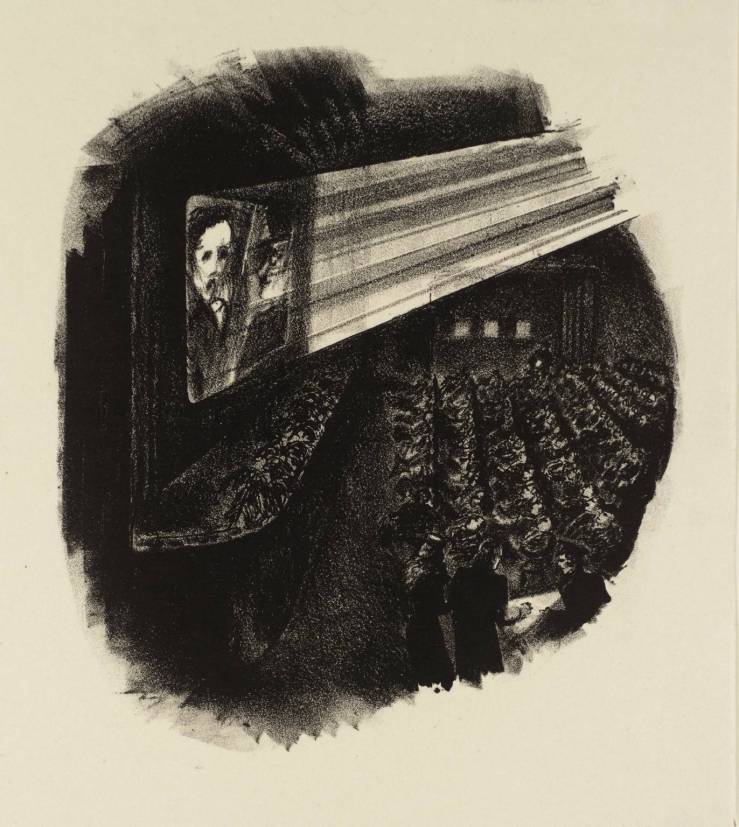
The Cinema — James Boswell

The Cinema, 1939 by James Boswell (1906-1971)

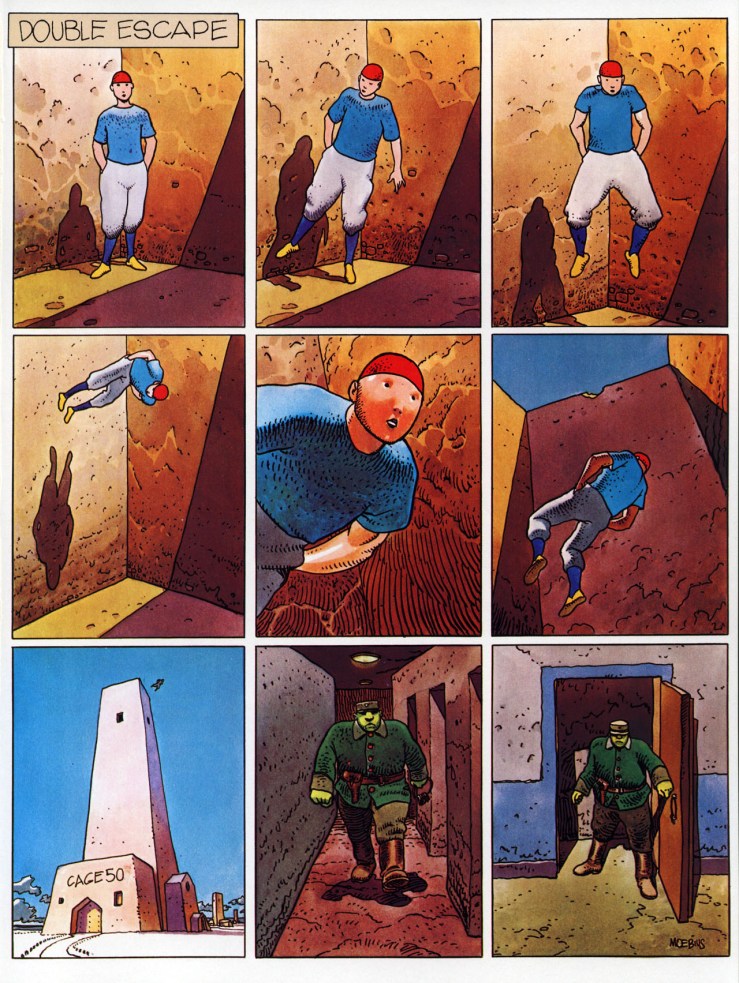
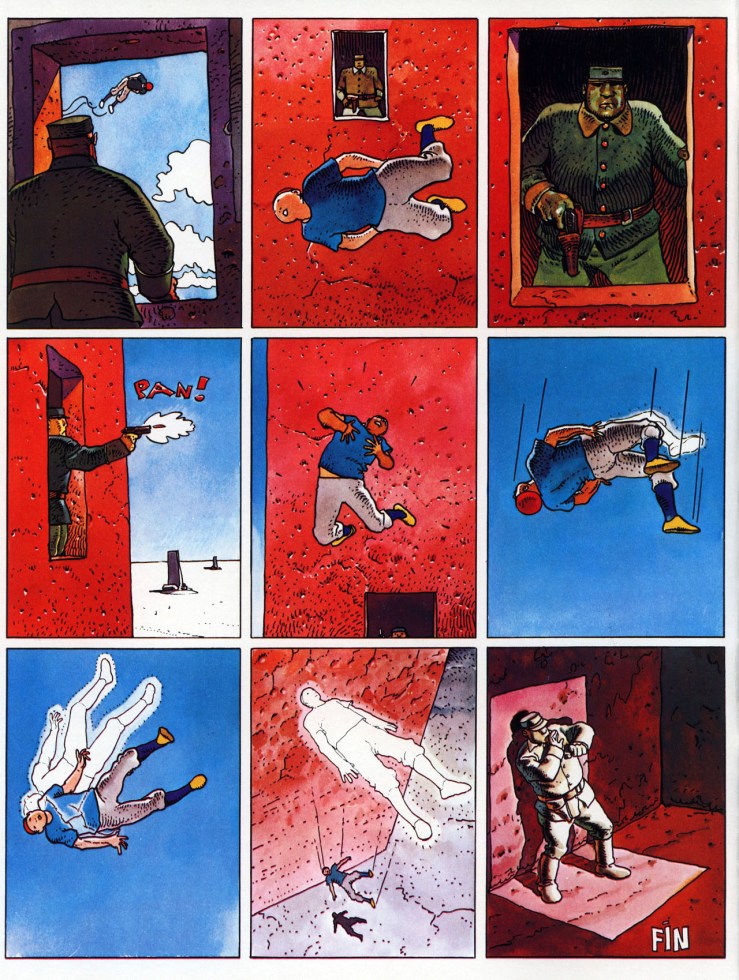
“Double Escape” — Moebius

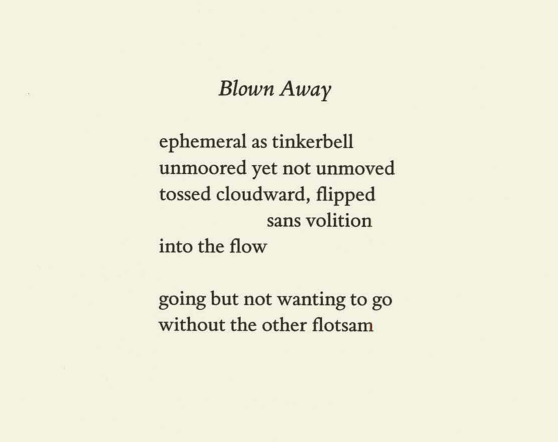
“Blown Away” — Tom Clark

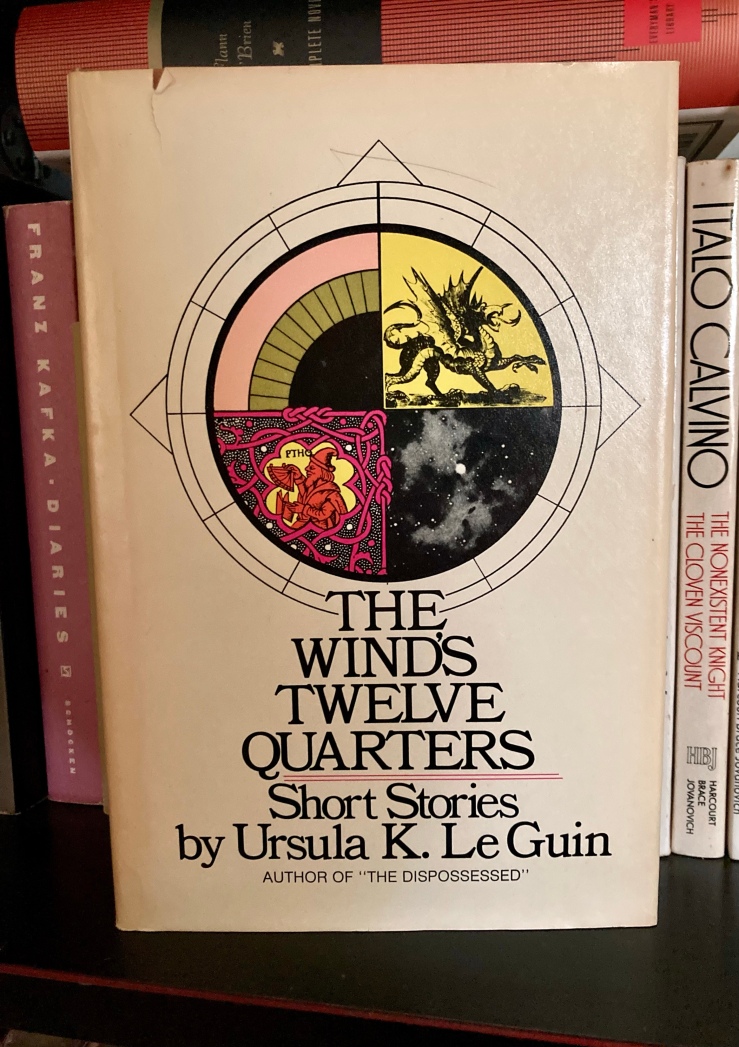
Riff on Ursula K. Le Guin’s collection The Wind’s Twelve Quarters

Ursula K. Le Guin’s 1975 volume The Wind’s Twelve Quarters collects seventeen short stories, offering, as the author puts it in her foreword, “a retrospective” of her career to date: “a roughly chronological survey of my short stories during the first ten years after I broke into print.” Le Guin adds that The Wind’s Twelve Quarters is “by no means a complete collection” of her short stories to date, and that the book does not include “fiction which doesn’t fit under the headings Fantasy or Science Fiction.” In addition to her foreword, Le Guin offers brief introductory notes to each of the seventeen tales.

For me, these introductions were often as interesting as the stories themselves. In her introduction to “Semley’s Necklace,” for example, Le Guin declares that the “candor and simplicity” of this early story exemplifies the “romanticism” characteristic of her early work — a mode that has “gradually become something harder, stronger, and more complex” as her career developed. In her introduction to “The Good Trip,” she tells us that her “only strong opinion about drugs (pot, hallucinogens, alcohol) is anti-prohibition and pro-education” but also admits that “people who expand their consciousness by living instead of by taking chemicals usually come back with much more interesting reports of where they’ve been.” In her intro to “Nine Lives,” which was originally published in Playboy in 1968, Le Guin laments that it appeared “under the only pen name I have ever used: U. K. Le Guin,” and that it is “surprising to me to realize how thoughtlessly I went along with them. It was the first (and is the only) time I met with anything I understood as sexual prejudice, prejudice against me as a woman writer, from any editor or publisher; and it seemed so silly, so grotesque, that I failed to see that it was also important.” In her introduction for “A Trip to the Head,” Le Guin describes a dark bout of writers block she experienced over a period of two years living in England. Giving herself permission to write “A Trip to the Head” released the block:

There is a kind of story which I would describe as a Bung Puller. The writer for one reason or another has been stuck, can’t work; and gets started again suddenly, with a pop, and a lot of beer comes leaping out of the keg and foaming all over the floor. This story was definitely a Bung Puller.

“A Trip to the Head” is one of the very few examples in the collection where the introductory material outweighs the tale it introduces. The story starts promisingly enough:

“Yes, this is Earth,” said the one beside him, “nor are you out of it. In Zambia men are rolling down hills inside barrels as training for space flight. Israel and Egypt have defoliated each other’s deserts. The Reader’s Digest has bought a controlling interest in the United States of America/General Mills combine. The population of the Earth is increasing by thirty billion every Thursday. Mrs Jacqueline Kennedy Onassis will marry Mao Tse-Tung on Saturday, in search of security; and Russia has contaminated Mars with bread mold.”

“Why then,” said he, “nothing has changed.”

—but then Le Guin makes good on that “nothing has changed” idea, even as, paradoxically, her story’s undefined protagonist transforms through a series of identities. “A Trip to the Head” is a postmodern experiment that doesn’t really succeed, unless, of course, you count that its creation unblocked our author.

And it’s a good thing Le Guin broke her block: some of her strongest work came after “A Trip to the Head,” including The Lathe of Heaven, The Dispossessed, and the first two Earthsea novels. Most of the stories in The Wind’s Twelve Quarters that came after “A Trip to the Head” are quite strong. 1971’s “Vaster Than Empires and More Slow,” part of Le Guin’s Hainish universe, tells the story of SPACE MADNESS! and a murderous empathic jungle. “The Ones Who Walk Away from Omelas” (1973) is a successful morality experiment (or “psychomyth,” to use Le Guin’s term). “Omelas” proposes a utopia where “millions [are] kept permanently happy on the one simple condition that a certain lost soul on the far-off edge of things should lead a life of lonely torment.” In her introduction, Le Guin attributes this riff on the scapegoat to William James’s essay “The Moral Philosopher and the Moral Life” (although she concedes that she first read the scenario in Dostoyevsky’s Brothers Karamazov). “Omelas” is a highlight of The Wind’s Twelve Quarters, as is 1974’s “The Day Before the Revolution,” which details a day in the life of the aged anarchist revolutionary Odo. “The Day Before the Revolution” serves as a kind of prologue to The Dispossessed, a move that appears elsewhere in the collection.

The opening story, “Semly’s Necklace,” is quite literally the prologue to Le Guin’s first novel Rocannon’s World (1966). “Winter’s King” (1969) was the spark that led to what many consider Le Guin’s finest novel The Left Hand of Darkness (published later the same year). 1964’s “The Word of Unbinding” and “The Rule of Names” preceded the Earthsea novels that Le Guin would begin in the late sixties. While these germinal tales are intriguing, its clear the Le Guin, ever the anthropologist, would like to do more than her limited canvas can hold. These tales are most notable as ancillary material to be situated in the worlds that Le Guin would go on to conjure in a much wider scope.

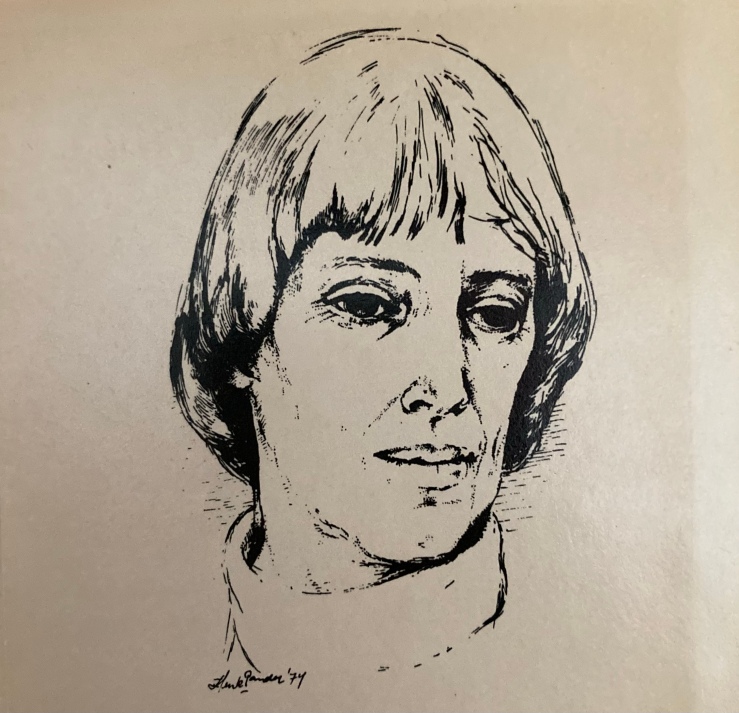
Ursula K. Le Guin portrait by Henk Pander.

Some of the best stories in the collection are self-contained, even as they point to Le Guin’s developing larger themes and goals as a writer. “The Masters” (1963) is a lovely dystopian riff on power, control, and knowledge (“The theme of this story is one I returned to later, with considerably better equipment,” Le Guin remarks in her intro, adding, “It has a good sentence in it, though: ‘He had been trying to measure the distance between the earth and God'” — that is a good sentence!) 1970’s “Things” imagines the paranoia of a promised apocalypse, with a brickmaker turned boatbuilder and a widowed weaver providing their own imaginative resistance to the coming onslaught. 1962’s “April in Paris” is a lovely oddity—a romantic time traveling tale with a sentimental happy ending:

The alchemist and the interstellar archaeologist went first, speaking French; the Gaulish slave and the professor from Indiana followed, speaking Latin, and holding hands. The narrow streets were crowded, bright with sunshine. Above them Notre Dame reared its two square towers against the sky. Beside them the Seine rippled softly. It was April in Paris, and on the banks of the river the chestnuts were in bloom

The Wind’s Twelve Quarters is not a great starting place for anyone interested in Le Guin’s worlds. Interested parties would do better to start with The DispossessedThe Lathe of Heaven, or The Left Hand of Darkness—but interested parties are probably aware of that. The book is better suited for folks like me—folks who tore through the Hainish cycle and the Earthsea books and collections, and still wanted a little moreThe Wind’s Twelve Quarters is ultimately most interesting as a document of a writer coming into the prime of her powers, and, as such, is indispensable for hardcore Le Guin fans.

Double Door — Lois Dodd

Double Door, 1976 by Lois Dodd (b. 1927)

Moby-Dick, but just the punctuation

. ( . ) — — , , , ; . , , . ; . ” , – , , , , , . ” — — . ” . * * * . . . ; . . ” — — ‘ . ” . * * * . . ; . . – , , . ” — — ‘ . , . , . , . , – . , . , . , . , . , . , . , . – – , . – – , . . ( – – ) . – – – , , . , , – , , , . . , , , ‘ , , , , , . , – , . , ; – ; , – , ; ; , , — — , – ! , ! ! – ; – , – , , , . — — , ! . ” . ” — — . ” ; . ” — — . ” . ” — — . ” ; . ” — — . ” , , , , , ; . ” — — . ” ‘ , , , , , . ” — — ‘ ‘ . ” : , . ” — — ‘ . ” , , . , . . . . , – , , . ” — — ‘ . ” . ” ” – , , . . . . , – , . . ” — — ‘ , . . . ” , , ‘ ( ‘ ) , , – , . ” — — . — — . ” , ! . ” — — . ” ‘ . ” — — ‘ . ” . ” — — ‘ . ” . , . ” — — . ” . ” ” . ” — — . ” . ” — — . ” , ‘ , ‘ , , , , ‘ . ” — — . ” , . ” — — . . ” , , , , . ” — — . . . . . ” ‘ . . . . ‘ , . ” — — ‘ . ” , — — ( , ) . ” — — ‘ . ” , . ” — — ‘ . ” , . ” — — . — — ” , , , ; , . ” — — . ” , . ” — — ‘ . ” , , , . ” — — ‘ . ” , , ; . ” — — ‘ , . ” , , . ” — — . ‘ . . ” , . ” — — ‘ . ” , . . – – – . . . . ‘ , . . . . , . . . . , . . . . . ” — — , . . . . ” ( ) , – , ( ) , , . . ” — — ‘ . ” – , , . ” — — ‘ . . . . . . ” ‘ . ” — — . . . ” , , , ; . ” — — ‘ , . . . ” . . . , . ” — — ‘ . ” , , . – , ‘ . ” — — . ” , , . . ” — — , . . ” , . ” — — . ” , , , . , . ” — — ‘ . ” , . , , , – , – , , . ” — — ‘ ‘ ‘ . ” , , , . ” — — ‘ . ” , , ? ” — — ‘ – . ” — — . ” — — . ( . ) ” ‘ , , , . , , . ” — — . ” : ‘ , . ” — — ‘ . ” , , , , . ” , , – , . ” — — , ‘ . ” , . ” — — ‘ . ( . ) ” – , ‘ . ” — — ‘ . ” . ” — — . ” , , , . ” — — ‘ . ” , , , , , , , ; , ; : ‘ , , , , , , , ‘ , , , , . ” — — ‘ . ” ! ! ! . ‘ . ; , . ” — — ‘ . ” , : — — — — ‘ – . ” — — ‘ . ” , ‘ . ” — — ‘ . ” , , . ” — — . ” , , ‘ , ” ; ” ; . ‘ – , ! ” — — ‘ . ” , . ” — — ‘ . ” ! . , ? ” , ” . ” — — ” , . ” , . , . ” , ; , , , , . ” — — . ” , , . . . . ” , , , . ” — — . ” , ; , ; ; , . . . . , , , ( ) , , , , . ” — — ‘ , . ” ” ( ) ” ” ( ) ” , , , , . ” — — ‘ , . . ” , ” – . ” ? ” . ” , . ” ” . ! ” ” , . ” ” – ! ? ” ” , ! ! ! ! ” ” ! ! ” ” , ! ! — — — — — — — — – – ! ” ” ? ” ” . ” ” ! ! . ” — — . ‘ . . ” – , , . ” — — ” , ” . . . . , ; ; . ” — — . ” , ” . , ” . , . ” — — ‘ . . , . . ” , . ” — — ” , ‘ ‘ , . ” . . . ” , ” , ” . ” — — ( ) , , . – . ” , , , , , – . ” — — ‘ . ” ; , ; , – . ” — — ” ” . ” – . , – – , , . ” — — . . . . . ” , , , . ” — — . ” , . ” — — – . ” ( ) . ” — — . ” , . . ” — — . ” ; , , . ” — — . ” ( ) , , , ‘ ” ( ) , ” . ” — — ‘ . ” ‘ ! ‘ , , , ; — — ‘ , ! ‘ ” — — . ” , , , ! ” — — . ” , , , , . ” — — . . . . — — — — , , . . ; , ; , ; , , ‘ — — , . . ; . . , , , . , — — . , . , , , . – . . , , , . ? — — , . ; – ; ; , . ; — — , , . ? ? ? ! , , . ! ; . . . — — — — . , , — — , , , . . , ? . ; . , , . . – — — , – , , . , , . , , . . , , , . ? , , ; , ; . , – . , – ‘ , , ‘ . , – – — — ? — — — — ! , ? , , , , ? , ? , , ? ? , ? . , , , . , . ; . , , , . , . , – — — — — ‘ — — , ; — — , ; , , Continue reading “Moby-Dick, but just the punctuation”

Impossible Body 2 — Adrian Ghenie

Impossible Body 2, 2022 by Adrian Ghenie (b. 1977)

“Space” — Mark Strand

“Space”

by

Mark Strand


A beautiful woman stood at the roof-edge of one of New York’s tall midtown apartment houses. She was on the verge of jumping when a man, coming out on the roof to sunbathe, saw her. Surprised, the woman stepped back from the ledge. The man was about thirty or thirty-five and blond. He was lean, with a long upper body and short, thin legs. His black bathing suit shone like satin in the sun. He was no more than ten steps from the woman. She stared at him. The wind blew strands of her long dark hair across her face. She pulled them back and held them in place with one hand. Her white blouse and pale blue skirt kept billowing, but she paid no attention. He saw that she was barefoot and that two high-heeled shoes were placed side by side on the gravel near where she stood. She had turned away from him. The wind flattened her skirt against the front of her long thighs. He wished he could reach out and pull her toward him. The air shifted and drew her skirt tightly across her small, round buttocks; the lines of her bikini underpants showed. “I’ll take you to dinner,” he yelled. The woman turned to look at him again. Her gaze was point-blank. Her teeth were clenched. The man looked at her hands which were now crossed in front of her, holding her skirt in place. She wore no wedding band. “Let’s go someplace and talk,” he said. She took a deep breath and turned away. She lifted her arms as if she were preparing to dive. “Look,” he said, “if it’s me you’re worried about, you have nothing to fear.” He took the towel he was carrying over his shoulders and made it into a sarong. “I know it’s depressing,” he said. He was not sure what he had meant. He wondered if the woman felt anything. He liked the way her back curved into her buttocks. It struck him as simple and expressive; it suggested an appetite or potential for sex. He wished he could touch her. As if to give him some hope, the woman lowered her arms to her sides and shifted her weight. “I’ll tell you what,” the man said, “I’ll marry you.” The wind once again pulled the woman’s skirt tightly across her buttocks. “We’ll do it immediately,” he said, “and then go to Italy. We’ll go to Bologna, we’ll eat great food. We’ll walk around all day and drink grappa at night. We’ll observe the world and we’ll read the books we never had time for.” The woman had not turned around or backed off from the ledge. Beyond her lay the industrial buildings of Long Island City, the endless row houses of Queens. A few clouds moved in the distance. The man shut his eyes and tried to think of how else to change her mind. When he opened them, he saw that between her feet and the ledge was a space, a space that would always exist now between herself and the world. In the long moment when she existed before him for the last time, he thought, How lovely. Then she was gone.

Kafka diary entry, 19 July 1910

Sunday, 19 July, slept, awoke, slept, awoke, miserable life.

From Diaries, Franz Kafka; trans. by Joseph Kresh.

Bunch’s Moderan/Ginzburg’s Dry Heart (Books acquired, 14 July 2023)

Picked up two on Friday—

I’ve been wanting to read Natalia Ginzburg for a while, and when I saw a used copy of her novella The Dry Heart (translated by Frances Frenaye), it seemed like a good entry point. It was really the description on the back that grabbed me:

The Dry Heart begins and ends with the matter-of-fact pronouncement: “I shot him between the eyes.” As the tale—a plunge into the chilly waters of loneliness, desperation, and bitterness—proceeds, the narrator’s murder of her flighty husband takes on a certain logical inevitability. Stripped of any preciousness or sentimentality, Natalia Ginzburg’s writing here is white-hot, tempered by rage. She transforms the unhappy tale of an ordinary dull marriage into a rich psychological thriller that seems to beg the question: why don’t more wives kill their husbands?

I read NYRB’s collected Moderan a few years ago, but I couldn’t pass up this Avon Bard mass market paperback.

Opening track:

“THINKING BACK (OUR GOD IS A HELPING GOD!)”

by

David R. Bunch


FLESH seemed doomed that year; death’s harpies were riding down. The once-beautiful, sweet and life-sustaining air was tinged with poison now, and man drank at his peril from the streams that had once been pure. He prayed to a God that was said to be in all things good, true and beautiful, but especially was thought to be all sternness and goodness, justice and loving-care, in some milk-white place far away, “On High.” And those prayers if answered were answered very obliquely indeed. For the air got deeper in poison from the tinkering with lethal things the flesh-man indulged in when not praying, and the water got fuller with danger as each new explosion pounded the bomb-fevered air. There was talk of the End; great discussions were handled in great halls across the land. Treaties were signed among statesmen to help the air get better, to allow the streams to recover and run pure once again. But even as the flesh-hands grasped the pens to scrawl the marks of good faith in some countries, fear lashed at capitals in other countries. Arsenals were tested anew. Things done were undone. The air got sicker; the streams ran not pure but pure danger—There seemed no chance for flesh-man, and his God seemed entirely silent wherever He was, wherever His white throne was. The HOPELESS signs were out everywhere. Little children asked that they be allowed to go quickly and not grow up hurting and maimed. Adults in what should have been the full flower of brave manhood and fair womanhood quaked, looked heavenward for some hopeful sign and, finding none, fell down and cried bitterly. The aged ones, quavering and whining now, finally decided that yes, truly they were most glad that they were so very old. The flesh billions courted at the Palace of Danger so ardently had turned against them and the mass wedding of Death and Destruction seemed now all but assured.

And then—and then this chance! Offered to all. It came first as small hope, the rumor of it, a faint faint breath of a chance seeping through the flesh-fouled metropolises. And then it was confirmed as glowing fact when the tour went round that year, year of the Greatest Darkness. And yet—and yet they scoffed, scoffed by the billions at this man working his hinges and braces, would not believe his heart was an ever-last one, had no credulity for his new wonderful lungs that could breathe him a forever-life even in bomb-tainted air. When they saw that his hands were steel they yelled robot! robot! When they saw that his eyes were wide-range, mechanism-helped, and that he’d a phfluggee-phflaggee button on his talker that he pressed from time to time to aid in his speech expression they laughed and yelled . . . Continue reading “Bunch’s Moderan/Ginzburg’s Dry Heart (Books acquired, 14 July 2023)”

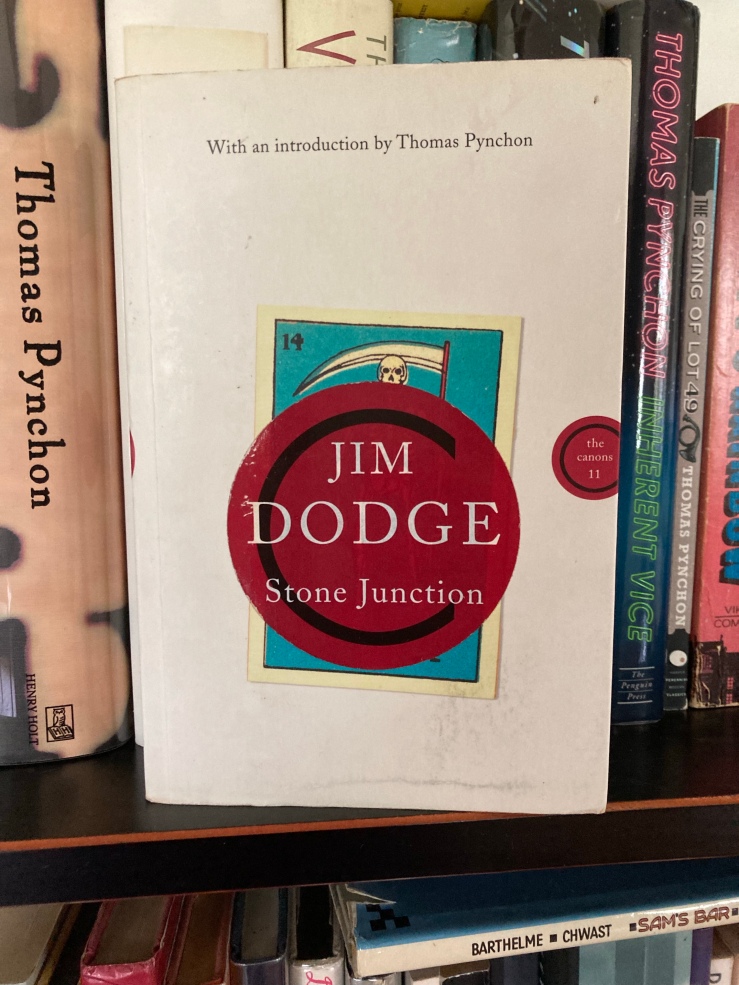
A review of Stone Junction, Jim Dodge’s alchemical pot-boiler

Jim Dodge’s 1990 novel Stone Junction tells the life story of Daniel Pearse, a young man of preternatural talents and sharp intelligence who trains under various tutors in a secret society, steals an enormous diamond, and eventually attains enlightened apotheosis. A lot of other stuff happens too.

Dodge subtitled his novel An Alchemical Pot-Boiler, a description that punctures any premature accusations of pretension, yet also calls attention to the novel’s arcane subject matter. The subtitle’s also a joke, of course—Dodge invites us to read his 500-pager as a kind of alchemist’s cauldron, a kitchen sink overloaded with spies and thieves, gamblers and quick change artists, holy fools and madmen. 

And Dodge, as promised, keeps his pot boiling. Stone Junction is a propulsive and engaging read largely because of the world he imagines for Daniel to grow up in. Stone Junction isn’t a magical realism act, but magic exists here. From a very young age, Daniel is initiated into a clandestine organization called AMO. Said aloud, as a young Daniel points out, the name “AMO” is suggestive of both “ammo” and the Latin verb amo, it’s really an acronym:

AMO is the acronym for Alliance of Magicians and Outlaws – or, as some members claim, Alchemists, Magicians, and Outlaws, which they contend was the original name. Another faction, small but vocal, insists AMO has always stood for Artists, Myth-singers, and Outriders. As you might sense, there is constant and long-standing contention about AMO’s origins and development

…AMO is a secret society – though more on the order of an open secret, in fact. Basically, AMO is a historical alliance of the mildly felonious, misfits, anarchists, shamans, earth mystics, gypsies, magicians, mad scientists, dreamers, and other socially marginal souls.

After the violent and mysterious death of his mother (and his own near-death), Daniel comes under the tutelage of those dreamers and socially-marginal souls. Extended episodes of Daniel’s working and growing under a new teacher make up the bulk of Stone Junction; these inventive and enjoyable sections are the finest parts of the book. Thomas Pynchon offers a nice catalog of Daniel’s various mentors in his introduction to the 1997 reprint of Stone Junction:

Wild Bill Weber teaches meditation, fishing, waiting. Mott Stocker teaches Dope, its production and enjoyment. Ace safecracker Willie Clinton (yep) instructs the boy in how to get past all kinds of locks and alarms, rendering him thus semi-permeable to certain protected parts of the world, setting him on his path to total dematerialization. For a while Daniel teams up with poker wizard Bad Bobby Sloane, roving the American highways in search of opportunities to risk capital in ways that cannot be officially controlled… The shape-shifting genius Jean Bluer teaches Daniel the arts of disguise… At last Daniel comes circling back to Volta…who teaches him the final secret of Invisibility. None of your secular Wellsian tricks with refractive indices and blood pigmentation here, but rather the time-honored arts of ceasing to be material.

It makes sense that Pynchon (who praises Stone Junction as “an outlaw epic for our own late era of corrupted romance and defective honor”) would stick on that big “I” Invisibility, always a byword in his own novels.

Dodge’s byword in Stone Junction is another i-word: imagination. Especially in its final third, Dodge’s novel, and its characters, repeat the importance of imaginative possibility, of imagining new realities, new states of being.

Volta is the dark sage magician guiding Daniel on his quest toward imagination. Or, rather, his quest to steal an enormous, perfectly-circular diamond from the U.S. government. He might throw Daniel into a den of lions, but our boy’s an escape artist. His last name, Pearse, among other transmutations (pierce, purse, pairs), suggests Percival, one of Arthur’s Knights of the Round Table. (Like Percival, Daniel is raised alone in hermetic seclusion by his solo mother.) The diamond is Daniel’s grail.

In her contemporary New York Times review of Stone Junction, Michele Slung pointed out the novel’s debt to Arthurian legends, among other sources, calling it “a post-psychedelic coming-of-age fable that’s part Thomas Pynchon, part Tolkien, part Richard Brautigan, a story that owes as much to The Once and Future King as it does to Huckleberry Finn.” Like Huck FinnStone Junction has a ramshackle, picaresque energy, but it nevertheless adheres to a plot, with the mystical diamond a MacGuffin for Daniel (among other thieves and spies) to quest after—once he’s matured and advanced in his outlaw skills, of course.

As I stated above, the strongest elements of Stone Junction revolve around Daniel’s adventures and training. (His time on the poker circuit with Bad Bobby Sloane is a particular highlight.) Dodge transmogrifies the raw material of American Weirdo Mythos into new inventions, zany recapitulations of occult outlaw fables.

Dodge’s prose style, while effective in its descriptions of characters, cannot quite approach the register of his imaginative inventory. The novel relies heavily on exposition, and while major characters like Volta and Bad Bobby Sloane speak with authentic and differentiated voices, a monolingual sameiness pervades too much of the prose. In its strongest moments, Stone Junction reads like a YA Pynchon novel; in its weakest moments, it reminded me of Tom Robbins.

The stronger moments prevail, however—Stone Junction is a fun, flighty, and at times unexpectedly heavy summer read. The novel might also be read in (stoned) conjunction with Pynchon’s 1990 twin Vineland. Both novels diagnose the fallout of the 1960s counterculture wave crashing against the Reagan eighties; both seem attempts to, at least in the world of letters, check the burgeoning nostalgic romanticization of that turbulent decade. Pynchon’s is the more flawed, sillier, and better-written effort; Dodge’s is likely his magnum opus.

If I’ve namechecked Pynchon too much in my review, forgive me: His name is on the cover of Jim Dodge’s novel, and his own (far more-detailed, far better-written) review precedes Jim Dodge’s novel, and his endorsement is frankly the reason I sought it out to begin with. I called Stone Junction “YA Pynchon” above, but I didn’t mean it as an insult—it’s YA in an older sense, in the sense of the novels handed me when I was young, hardly adult, novels that etched their own versions of reality onto our own banal reality; realities more real: Adventures of Huckleberry FinnThe OutsidersThe Once and Future KingThe Lord of the RingsHatchet… Stone Junction is about youth, but it’s also about maturation, and the ache and melancholy of aging out of the game, personified in the semi-tragic figure of Daniel’s would-be mentor, Volta.

I don’t think I would’ve appreciated the depth of Volta’s melancholy as a much younger person, which is the time I wished I had first read Stone Junction. I should’ve found the novel almost 30 years ago—let’s say the summer I stayed in my cousin’s old bedroom. I was fifteen or sixteen, and he, a decade older than me, was doing Adult Things. I listened to the tapes and records he had left in his high school bedroom, taking a few with me at the end of the summer. (Tripp, if you’re reading, I still have your cassette of New Order’s Low-Life in a box somewhere. Drive up sometime and we can search it out together.) I read almost all of his cheap paperbacks, and took as many as I thought I could reasonably get away with with me: Fear and Loathing, Cat’s CradleEven Cowgirls Get the Blues, both Miller Tropic novels, The Electric Kool-Aid Acid TestThe Dharma BumsDelta of VenusThe Beautiful and the Damned. That would’ve been the perfect summer for me to first read Stone Junction, but I didn’t read it then. I read it now. Let a younger person in your life steal it from you, sooner rather than later.

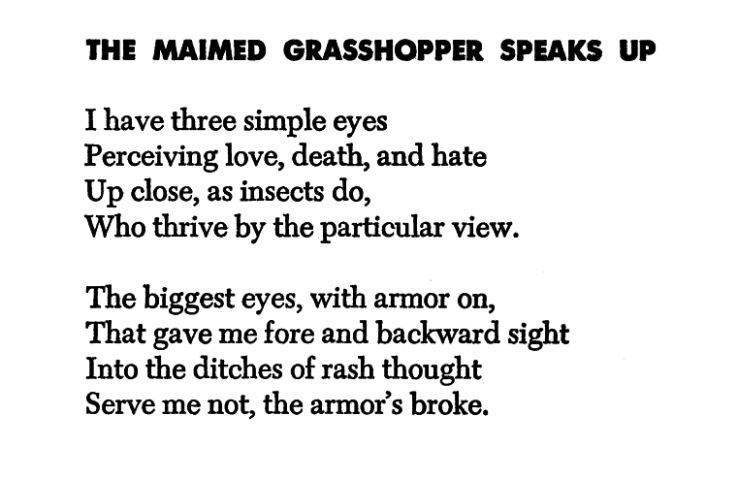
“The Maimed Grasshopper Speaks Up” — Jean Garrigue

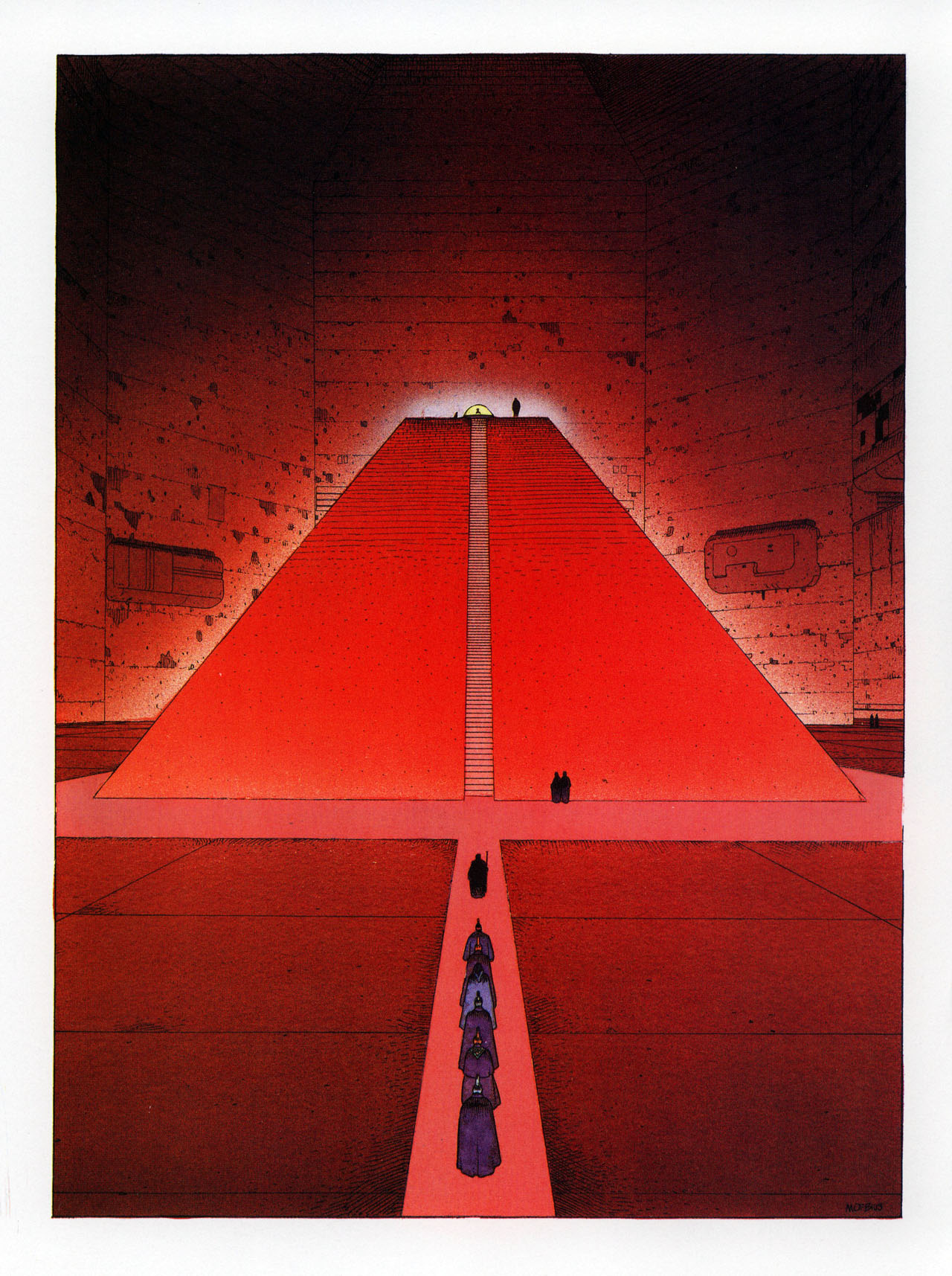
Untitled (Approaching the Paternum) — Moebius

Page from The Goddess, 1990 by Moebius (Jean Giraud, 1938–2012)

“The Wayfarer” — Robert Coover

“The Wayfarer”

by

Robert Coover


I came upon him on the road. I pulled over, stepped out, walked directly over to him where he sat. On an old milestone. His long tangled beard was a yellowish gray, his eyes dull with the dust of the road. His clothes were all of a color and smelled of mildew. He was not a sympathetic figure, but what could I do?

I stood for a while in front of him, hands on hips, but he paid me no heed. I thought: at least he will stand. He did not. I scuffed up a little dust between us with the toe of my boot. The dust settled or disappeared into his collection of it. But still, he stared obliviously. Vacantly. Perhaps (I thought): mindlessly. Yet I could be sure he was alive, for he sighed deeply from time to time, He is afraid to acknowledge me, I reasoned. It may or may not have been the case, but it served, for the time being, as a useful premise. The sun was hot, the air dry. It was silent, except for the traffic.

I cleared my throat, shifted my feet, made a large business of extracting my memo-book from my breast pocket, tapped my pencil on it loudly. I was determined to perform my function in the matter, without regard to how disagreeable it might prove to be. Others passed on the road. They proffered smiles of commiseration, which I returned with a pleasant nod. The wayfarer wore a floppy black hat. Tufts of yellow-gray hair poked out of the holes in it like dead wheat. No doubt, it swarmed. Still, he would not look at me.

Finally, I squatted and interposed my face in the path of his stare. Slowly—painfully, it would seem—his eyes focused on mine. They seemed to brighten momentarily, but I am not sure why. It could have been joy as easily as rage, or it could have been fear. Only that: his eyes brightened; his face remained slack and inexpressive. And it was not a glow, nothing that could be graphed, it was just a briefest spark, a glimmer. Then dull again. Filmy as though with a kind of mucus smeared over. And he lost the focus. I don’t know whether or not in that instant of perception he noticed my badge. I wished at the time that he would, then there could be no further ambiguities. But I frankly doubted that he did. He has traveled far, I thought. Continue reading ““The Wayfarer” — Robert Coover”

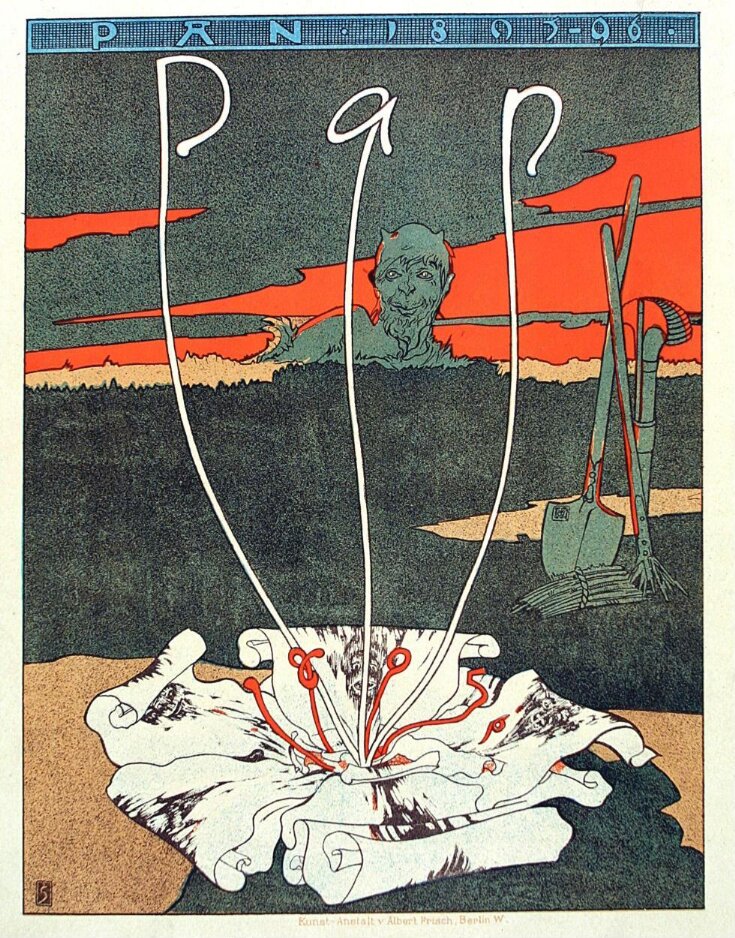
Pan — Joseph Sattler

Pan, 1895 by Joseph Sattler (1867-1931)