
From New Directions and translated by Laura Healy. A poetic (contra)concordance to the Bolañoverse? We shall see.
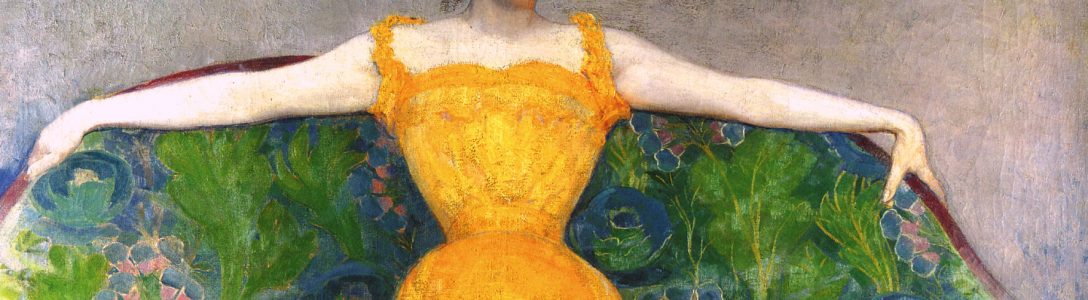
From New Directions and translated by Laura Healy. A poetic (contra)concordance to the Bolañoverse? We shall see.
“The Maypole of Merry Mount” by Nathaniel Hawthorne
There is an admirable foundation for a philosophic romance in the curious history of the early settlement of Mount Wollaston, or Merry Mount. In the slight sketch here attempted the facts recorded on the grave pages of our New England annalists have wrought themselves almost spontaneously into a sort of allegory. The masques, mummeries and festive customs described inthe text are in accordance with the manners of the age. Authority on these points may be found in Strutt’s Book of English Sports and Pastimes.
Bright were the days at Merry Mount when the Maypole was the banner-staff of that gay colony. They who reared it, should their banner be triumphant, were to pour sunshine over New England’s rugged hills and scatter flower-seeds throughout the soil. Jollity and gloom were contending for an empire. Midsummer eve had come, bringing deep verdure to the forest, and roses in her lap of a more vivid hue than the tender buds of spring. But May, or her mirthful spirit, dwelt all the year round at Merry Mount, sporting with the summer months and revelling with autumn and basking in the glow of winter’s fireside. Through a world of toil and care she flitted with a dream-like smile, and came hither to find a home among the lightsome hearts of Merry Mount.
Never had the Maypole been so gayly decked as at sunset on Midsummer eve. This venerated emblem was a pine tree which had preserved the slender grace of youth, while it equalled the loftiest height of the old wood-monarchs. From its top streamed a silken banner colored like the rainbow. Down nearly to the ground the pole was dressed with birchen boughs, and others of the liveliest green, and some with silvery leaves fastened by ribbons that fluttered in fantastic knots of twenty different colors, but no sad ones. Garden-flowers and blossoms of the wilderness laughed gladly forth amid the verdure, so fresh and dewy that they must have grown by magic on that happy pine tree. Where this green and flowery splendor terminated the shaft of the Maypole was stained with the seven brilliant hues of the banner at its top. On the lowest green bough hung an abundant wreath of roses—some that had been gathered in the sunniest spots of the forest, and others, of still richer blush, which the colonists had reared from English seed. O people of the Golden Age, the chief of your husbandry was to raise flowers! Continue reading ““The Maypole of Merry Mount” — Nathaniel Hawthorne”

“May-Day” by Ralph Waldo Emerson
Daughter of Heaven and Earth, coy Spring,
With sudden passion languishing,
Maketh all things softly smile,
Painteth pictures mile on mile,
Holds a cup with cowslip-wreaths,
Whence a smokeless incense breathes.
Girls are peeling the sweet willow,
Poplar white, and Gilead-tree,
And troops of boys
Shouting with whoop and hilloa,
And hip, hip three times three.
The air is full of whistlings bland;
What was that I heard
Out of the hazy land?
Harp of the wind, or song of bird,
Or clapping of shepherd’s hands,
Or vagrant booming of the air,
Voice of a meteor lost in day?
Such tidings of the starry sphere
Can this elastic air convey.
Or haply ‘t was the cannonade
Of the pent and darkened lake,
Cooled by the pendent mountain’s shade,
Whose deeps, till beams of noonday break,
Afflicted moan, and latest hold
Even unto May the iceberg cold.
Was it a squirrel’s pettish bark,
Or clarionet of jay? or hark,
Where yon wedged line the Nestor leads,
Steering north with raucous cry
Through tracts and provinces of sky,
Every night alighting down
In new landscapes of romance,
Where darkling feed the clamorous clans
By lonely lakes to men unknown.
Come the tumult whence it will,
Voice of sport, or rush of wings,
It is a sound, it is a token
That the marble sleep is broken,
And a change has passed on things.
Continue reading ““May-Day” — Ralph Waldo Emerson”

I thought I’d jump in on the Books Acquired feature on the blog, so below is a picture and some words about the books I got this past April. Significantly fewer than average as I’m *trying* to read the books I already have but, you know, it doesn’t really ever stop.
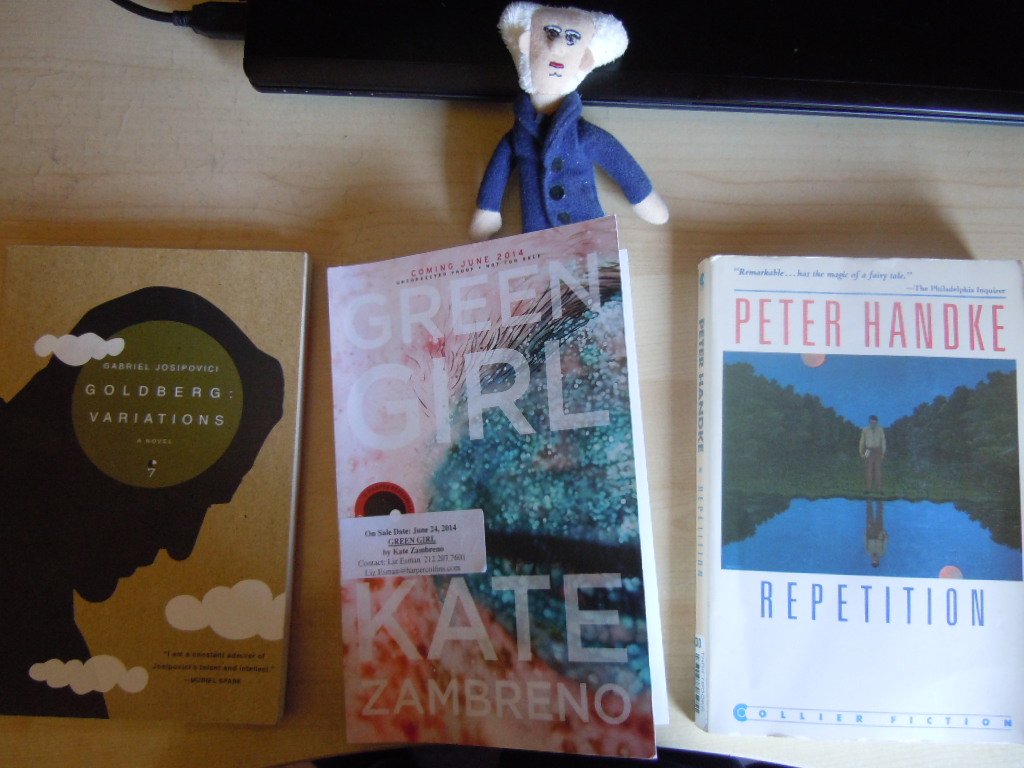
It was in this interview on the blog that I heard about Gabriel Josipovici’s philosophical novel. I’ve been on the hunt for more books like this in the past couple of years, and if it’s anyone’s recommendation about novels that wax philosophical, it’d be a philosopher’s. Goldberg: Variations also promises to slake an obsessive thirst for books about composers and their madness (or illness). I also seem unable to shake an attraction for books that tell stories about other stories, with the latter being the “actual story” of the book. From the back: “At the turn of the eighteenth century, a writer–a Jew–enters an English country manor, where he has been invited to read through the night to his host until the gentleman falls asleep. What unfolds then are seemingly unconnected stories covering a vast array of topics–from incest to madness to a poetic competition in the court of George III. And what emerges by the end is a breathtaking tapestry in which past and present, imagination and truth, are intricately woven together into one remarkable whole.”
I saw Kate Zambreno read from this book back in 2011 when it was originally published by Emergency Press. Since then she’s written a “critical memoir” titled Heroines, which explores the writer’s relationship with the “wives and mistresses” of the 20th-Century modernist greats. It’s my understanding that Zambreno has also reworked through Green Girl for this republish. Which I can’t imagine doing. Seems terrifying and harrowing. Only about 20 pages in so far, but it definitely has, for desperate lack of a better term, a European feel to it that’s rare for American writers. The sentences vibrate along the same manic, anxious and panicky frequencies of favorites like Bernhard, Rhys and Woolf. From the back: “Ruth is a young American in London, trying desperately to navigate a world in which she attracts the unwanted gaze of others while grappling with the uncertainty of her own self-regard. Haunted equally by self-doubt and by a morbid fascination with the beautiful, cruel, and empty people around her, Ruth darts quietly through the rainy sidewalks of her present, trying to escape her future.”
I know Steve Mitchelmore, blogger of This Space, is a big Peter Handke fan. I tweeted him a couple of months ago and he recommended that I start with this one. I’m looking forward to reading an Austrian (or Austro-Hungarian and descendants of) that isn’t cantankerous and odorous a la Bernhard. But, as expected, this book seems like it’s going to be really fucked up. The back: “In the summer of 1960, Filip Kobal leaves his home in search of his missing brother, Gregor. Not quite twenty, he is armed only with two of his brother’s books; a copybook and a dictionary in which Gregor has, revealingly, marked certain words. Filip’s investigations of language–of the laws of naming objects, and of the roots of alienation in the discrepancy between objects’ names and our experience of them–becomes, finally, an investigation of himself and the world around him.”



- On being transported to strange scenes, we feel as if all were unreal. This is but the perception of the true unreality of earthly things, made evident by the want of congruity between ourselves and them. By and by we become mutually adapted, and the perception is lost.
- An old looking-glass. Somebody finds out the secret of making all the images that have been reflected in it pass back again across its surface.
- Our Indian races having reared no monuments, like the Greeks, Romans, and Egyptians, when they have disappeared from the earth their history will appear a fable, and they misty phantoms.
- A woman to sympathize with all emotions, but to have none of her own.
- A portrait of a person in New England to be recognized as of the same person represented by a portrait in Old England. Having distinguished himself there, he had suddenly vanished, and had never been heard of till he was thus discovered to be identical with a distinguished man in New England.
- Men of cold passions have quick eyes.
- A virtuous but giddy girl to attempt to play a trick on a man. He sees what she is about, and contrives matters so that she throws herself completely into his power, and is ruined,–all in jest.
From Nathaniel Hawthorne’s American Note-Books.


 Biblioklept