I call this my literary archive, there are ten drawers, and each of them contains all of the material that went into the making of one or other of my books. But at the back you will find untidy hand written pages, at the front you will find a file copy of the finished book and even all the reviews and comments. … This is part of what I call my chronological archive, um, we just have happened to have opened one of nineteen drawers that we could have opened. And then, I have been a great writer of letters to people, and people write letters to me. In there must be… I couldn’t count them; there must be many thousands of letters in those cabinets. The equivalent for me of emails is the little box of envelopes up there.
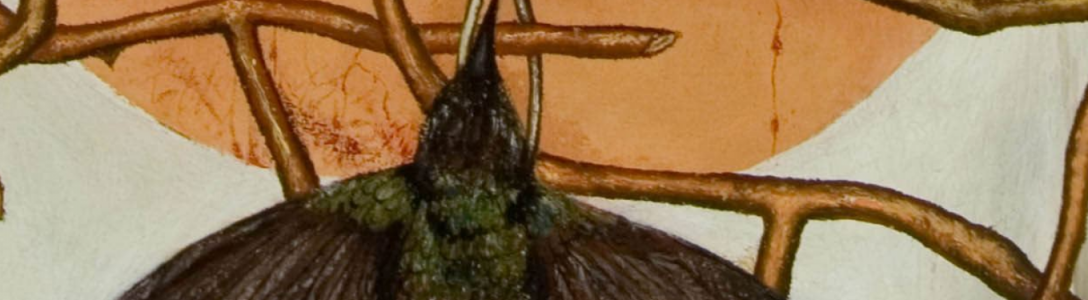
Illustration (Reader) — Flannery O’Connor

Cemetery secret (Kafka)
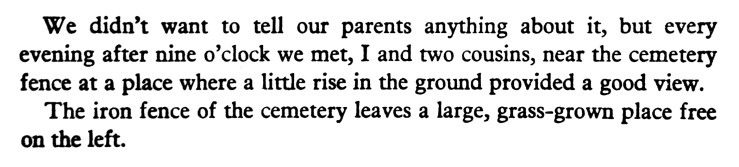
Illustration from Thorheiten — Thomas Theodor Heine

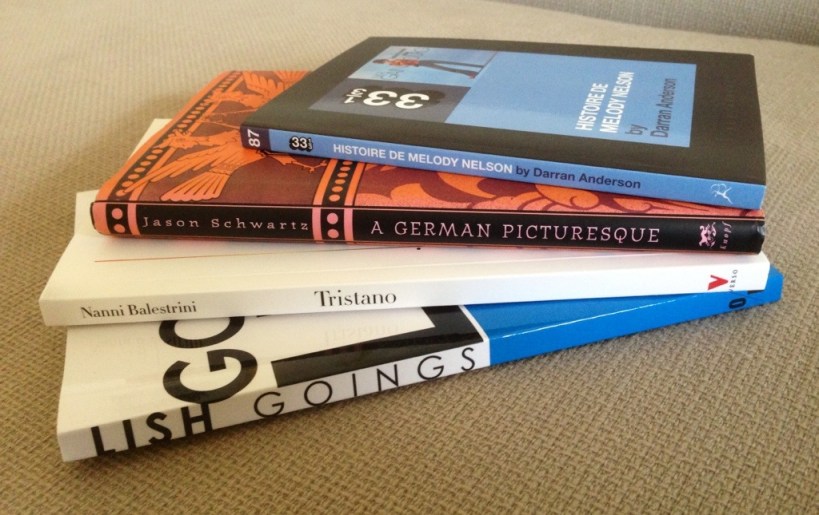
Some books I wish I’d written about this week (or last week, or the week before)
Horse Studies — Leonardo da Vinci


Sancho and the Don Indulge in Philosophical Reflections — Gustave Dore

Horses — Huang Yongyu

Please Unplease Me: A Review of Laura Frost’s The Problem With Pleasure
First, I want to get a bad joke out of the way: it seems cruelly apt to review a scholarly text titled The Problem With Pleasure: Modernism and Its Discontents (Columbia UP 2013), especially one, while passionate and provocative, that may preclude pleasure for the casual reader. To be expected from a scholarly text, hence the bad joke, but Frost’s study of the vicissitudes of modernist unpleasure performs its argument quite well — The arrays of Unpleasure found in this book do delight and prod the reader in its investigations of everything from stalwart modernist topoi to perfume and farts. Frost’s mission, in her own words, is to “present the interwar debate about pleasure and the rise of unpleasure … as a new way of defining literary modernism more capaciously” (14). Frost wants to collapse the schism between the two divergent interwar poles of “high” and “low” culture and their shared mission to re-stabilize the shocked and distended interwar subject. Frost’s contribution to her field isn’t quite revolutionary, but the methods in which she ties the affect of text and media on the body is pressing and important, and carries weight outside the academy. For it is not simply that the “high” modernists wanted its world to repudiate fast & easy entertainment to engage with the post-World War One space. Rather, they wanted their readers to engage with pleasure in a different key — unpleasure. Seeing the beginnings of literary modernism with the more inclusive Unpleasure rather than Eliotian disdain or Poundian militancy allows us to see how literary modernists not only critiqued vernacular entertainment, but how Jean Rhys, James Joyce and Aldous Huxley were themselves subject to mass cultural motifs in their own texts. “High” and “low” culture were not as mutually exclusive as previously thought, Frost asserts, and the interwar period set the stage for our current moment of pleasure, cultural division, and technological innovation considerably more than we think.
Continue reading “Please Unplease Me: A Review of Laura Frost’s The Problem With Pleasure”
Leo Tolstoy in the Forest — Ilya Repin

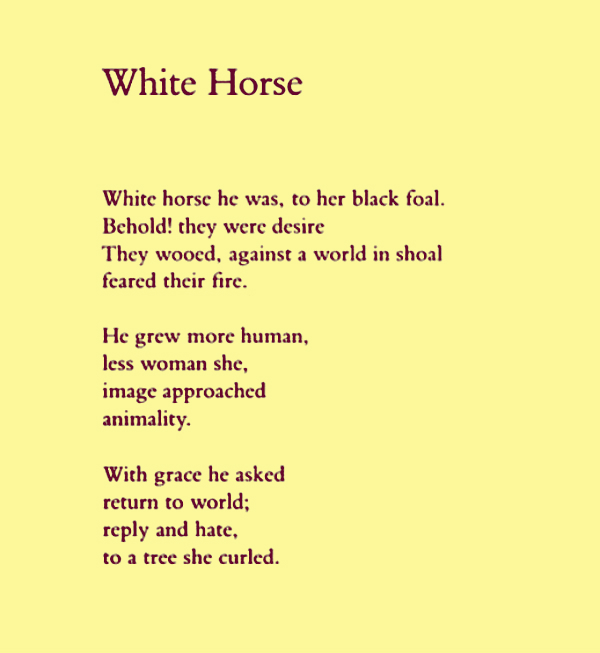
“White Horse” — Charles Olson
The Scornful Woman — Egon Schiele

Ben Marcus Riffs on Ovid’s Metamorphoses
Manuscript Diary Entry — Charlotte Brontë

An Affenpinscher — Hans Hoffmann

“The Captured Woman” — Donald Barthelme
“The Captured Woman” by Donald Barthelme
The captured woman asks if I will take her picture.
I shoot four rolls of 35 mm. and then go off very happily to the darkroom. . .
I bring back the contacts and we go over them together. She circles half a dozen with a grease pencil — pictures of herself staring. She does not circle pictures of herself smiling, although there are several very good ones. When I bring her back prints (still wet) she says they are not big enough.
“Not big enough?”
“Can you make enlargements?”
“How big?”
“How big can you make them?”
“The largest paper I have is twenty-four by thirty-six.”
“Good!”
The very large prints are hung around her room with pushpins.
“Make more.”
“For what?”
“I want them in the other rooms too.”
“The staring ones?”
“Whichever ones you wish.”
I make more prints using the smiling negatives. (I also shoot another half dozen rolls.)
Soon the house is full of her portraits, she is everywhere.
A State Secret — Jehan Georges Vibert

 Biblioklept