“Masks” — Ezra Pound

masks

Jupiter and Semele — Gustave Moreau

If a man wants to read good books, he must make a point of avoiding bad ones (Schopenhauer)

As regards reading, to require that a man shall retain everything he has ever read, is like asking him to carry about with him all he has ever eaten. The one kind of food has given him bodily, and the other mental, nourishment; and it is through these two means that he has grown to be what he is. The body assimilates only that which is like it; and so a man retains in his mind only that which interests him, in other words, that which suits his system of thought or his purposes in life.

If a man wants to read good books, he must make a point of avoiding bad ones; for life is short, and time and energy limited.

Repetitio est mater studiorum. Any book that is at all important ought to be at once read through twice; partly because, on a second reading, the connection of the different portions of the book will be better understood, and the beginning comprehended only when the end is known; and partly because we are not in the same temper and disposition on both readings. On the second perusal we get a new view of every passage and a different impression of the whole book, which then appears in another light.

A man’s works are the quintessence of his mind, and even though he may possess very great capacity, they will always be incomparably more valuable than his conversation. Nay, in all essential matters his works will not only make up for the lack of personal intercourse with him, but they will far surpass it in solid advantages. The writings even of a man of moderate genius may be edifying, worth reading and instructive, because they are his quintessence—the result and fruit of all his thought and study; whilst conversation with him may be unsatisfactory.

So it is that we can read books by men in whose company we find nothing to please, and that a high degree of culture leads us to seek entertainment almost wholly from books and not from men.

From The Art of Literature by Arthur Schopenhauer.
Manuscript Page from Alice in Wonderland — Lewis Carroll

Add. 46700  f.15v

(More/via).

Lisbeth Reading — Carl Larsson

The Blank Signature — René Magritte

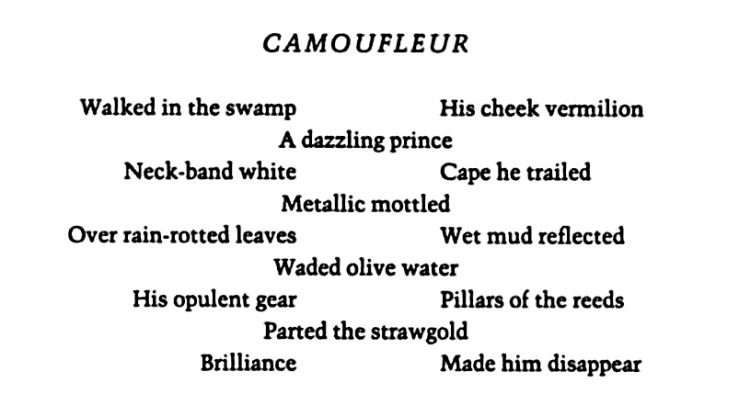
“Camoufleur” — May Swenson

camofleur

Some Really Lovely Books Acquired, 1.21.2014 (Thanks Ryan!)

20140124-140145.jpg

I was pleasantly surprised to get a box of great stuff in the mail from Ryan Mihaly, a frequent contributor to this blog (check out the second part of his interview with translator Ilan Stavans). Inside the handsome Penguin Classics Goethe was this little card:

20140124-140153.jpg

20140124-140201.jpg

I had never even heard of The Thoughtbook, Fitzgerald’s boyhood diary. Sample:

20140124-140208.jpg

20140124-140218.jpg

Tom Clark is The Best.

20140124-140225.jpg

20140124-140235.jpg

And always Hell.

20140124-140241.jpg

Thanks again, Ryan!

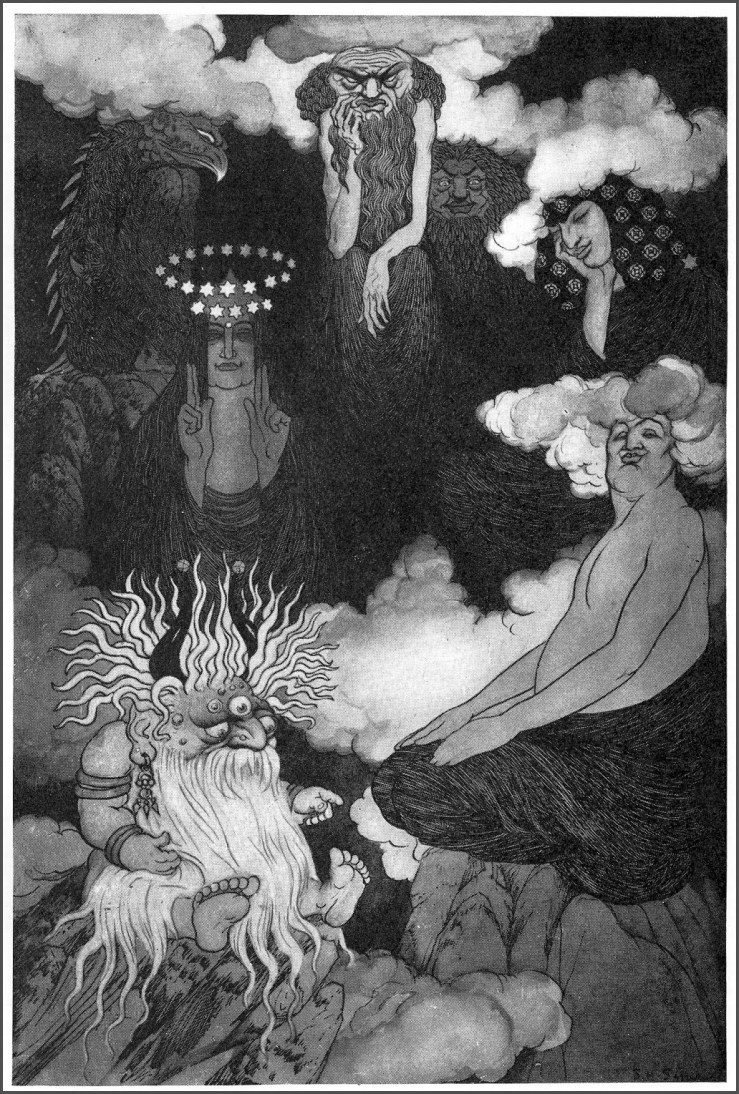
Lo! The Gods! — Sidney H. Sime

sidney sime time and gods Lo! The Gods!

Metaphors and similes (Schopenhauer)

Metaphors and similes are of great value, in so far as they explain an unknown relation by a known one. Even the more detailed simile which grows into a parable or an allegory, is nothing more than the exhibition of some relation in its simplest, most visible and palpable form. The growth of ideas rests, at bottom, upon similes; because ideas arise by a process of combining the similarities and neglecting the differences between things. Further, intelligence, in the strict sense of the word, ultimately consists in a seizing of relations; and a clear and pure grasp of relations is all the more often attained when the comparison is made between cases that lie wide apart from one another, and between things of quite different nature. As long as a relation is known to me as existing only in a single case, I have but an individual idea of it—in other words, only an intuitive knowledge of it; but as soon as I see the same relation in two different cases, I have a general idea of its whole nature, and this is a deeper and more perfect knowledge.

Since, then, similes and metaphors are such a powerful engine of knowledge, it is a sign of great intelligence in a writer if his similes are unusual and, at the same time, to the point. Aristotle also observes that by far the most important thing to a writer is to have this power of metaphor; for it is a gift which cannot be acquired, and it is a mark of genius.

From The Art of Literature by Arthur Schopenhauer.

The Convalescent — Gwen John

“One Bird” — Tom Clark

tom clark

The Nocturnal Travelers — Honore Daumier

Quentin Tarantino and Steve Buscemi Rehearsing Scenes for Reservoir Dogs (NSFW)

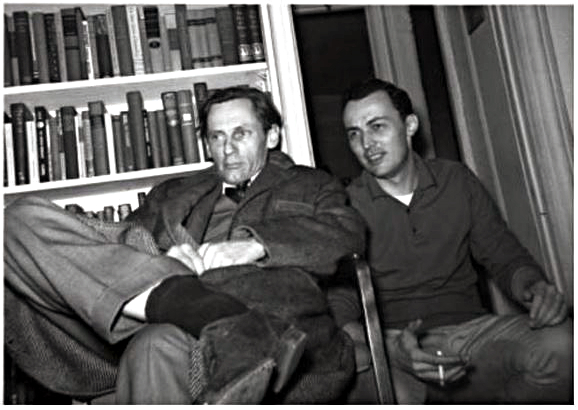
William Gaddis and David Markson, New York, 1964

wgdm

(From The Letters of William Gaddis, Dalkey Archive).

Macrocercus Aracanga — Edward Lear