“In drear-nighted December” — John Keats

“In drear-nighted December” by  John Keats

In drear-nighted December,
Too happy, happy tree,
Thy branches ne’er remember
Their green felicity:
The north cannot undo them
With a sleety whistle through them;
Nor frozen thawings glue them
From budding at the prime.

In drear-nighted December,
Too happy, happy brook,
Thy bubblings ne’er remember
Apollo’s summer look;
But with a sweet forgetting,
They stay their crystal fretting,
Never, never petting
About the frozen time.

Ah! would ’twere so with many
A gentle girl and boy!
But were there ever any
Writhed not at passed joy?
The feel of not to feel it,
When there is none to heal it
Nor numbed sense to steel it,
Was never said in rhyme.

Illustration to Paradise Lost — William Blake

“Christmas Night with Satan” — John Fox, Jr.

“Christmas Night with Satan” by John Fox, Jr.

No night was this in Hades with solemn-eyed Dante, for Satan was only a woolly little black dog, and surely no dog was ever more absurdly misnamed. When Uncle Carey first heard that name, he asked gravely:

“Why, Dinnie, where in h—-,” Uncle Carey gulped slightly, “did you get him?” And Dinnie laughed merrily, for she saw the fun of the question, and shook her black curls. “He didn’t come f’um THAT PLACE.”

Distinctly Satan had not come from that place. On the contrary, he might by a miracle have dropped straight from some Happy Hunting- Ground, for all the signs he gave of having touched pitch in this or another sphere. Nothing human was ever born that was gentler, merrier, more trusting or more lovable than Satan. That was why Uncle Carey said again gravely that he could hardly tell Satan and his little mistress apart. He rarely saw them apart, and as both had black tangled hair and bright black eyes; as one awoke every morning with a happy smile and the other with a jolly bark; as they played all day like wind-shaken shadows and each won every heart at first sight—the likeness was really rather curious. I have always believed that Satan made the spirit of Dinnie’s house, orthodox and severe though it was, almost kindly toward his great namesake. I know I have never been able, since I knew little Satan, to think old Satan as bad as I once painted him, though I am sure the little dog had many pretty tricks that the “old boy” doubtless has never used in order to amuse his friends.

“Shut the door, Saty, please,” Dinnie would say, precisely as she would say it to Uncle Billy, the butler, and straightway Satan would launch himself at it—bang! He never would learn to close it softly, for Satan liked that—bang!

If you kept tossing a coin or marble in the air, Satan would keep catching it and putting it back in your hand for another throw, till you got tired. Then he would drop it on a piece of rag carpet, snatch the carpet with his teeth, throw the coin across the room, and rush for it like mad, until he got tired. If you put a penny on his nose, he would wait until you counted, one—two— THREE! Then he would toss it up himself and catch it. Thus, perhaps, Satan grew to love Mammon right well, but for another and better reason than that he liked simply to throw it around—as shall now be made plain. Continue reading ““Christmas Night with Satan” — John Fox, Jr.”

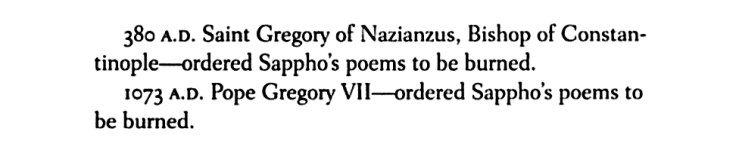
Sappho on the Rocks — Gustave Moreau

Burning Sappho (David Markson)

dm

Escape — Glen Baxter

baxter

Batman vs. Santa — Bill Sienkiewicz

batman vs santa

The Chimera — Gustave Moreau

Surveillance (Calvin and Hobbes)

surveillance

“Patricide: Patricide is a bad idea” (Donald Barthelme)

Patricide: Patricide is a bad idea, first because it is contrary to law and custom and second because it proves, beyond a doubt, that the father’s every fluted accusation against you was correct: you are a thoroughly bad individual, a patricide! — member of a class of persons universally ill-regarded. It is all right to feel this hot emotion, but not to act upon it. And it is not necessary. It is not necessary to slay your father, time will slay him, that is a virtual certainty. Your true task lies elsewhere. Your true task, as a son, is to reproduce every one of the enormities touched upon in this manual, but in attenuated form. You must become your father, but a paler, weaker version of him. The enormities go with the job, but close study will allow you to perform the job less well than it has previously been done, thus moving toward a golden age of decency, quiet, and calmed fevers. Your contribution will not be a small one, but “small” is one of the concepts that you should shoot for. If your father was a captain in Battery D, then content yourself with a corporalship in the same battery. Do not attend the annual reunions. Do not drink beer or sing songs at the reunions. Begin by whispering, in front of a mirror, for thirty minutes a day. Then tie your hands behind your back for thirty minutes a day, or get someone else to do this for you. Then, choose one of your most deeply held beliefs, such as the belief that your honors and awards have something to do with you, and abjure it. Friends will help you abjure it, and can be telephoned if you begin to backslide. You see the pattern, put it into practice. Fatherhood can be, if not conquered, at least “turned down” in this generation — by the combined efforts of all of us together.

From Donald Barthelme’s novel The Dead Father.

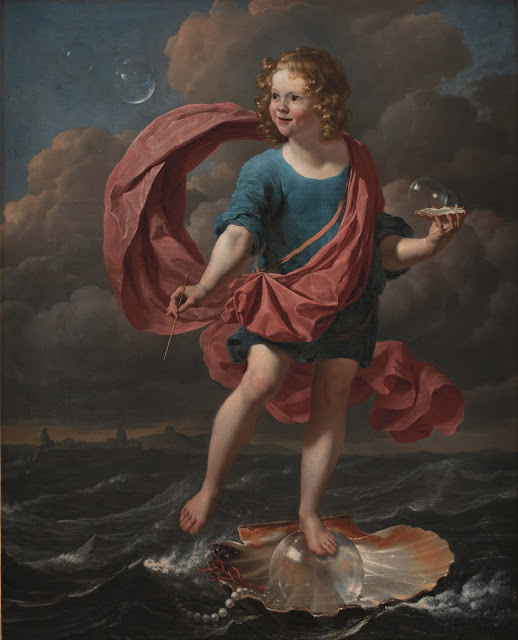
Boy Blowing Soap Bubbles — Karel Dujardin

Karel Dujardin ~ Boy Blowing Soap Bubbles; Allegory on the Transitoriness and the Brevity of Life, 1663

Portrait of Katie Lewis — Edward Burne-Jones

Granddad’s Eggnog

Hopefully everyone is happy and with loved ones and friends during these holidays–and what better way to show love and fellowship than sharing a draught of delicious eggnog (alternately, the sad and solitary can drown their lonely sorrows in this high-alcohol, high-calorie treat). This is an old recipe; I remember my cousin and I stealing sips of this nog during my grandparents’ Christmas parties.

You will need:

A bottle of fine bourbon

A bottle of fine rum

A liqueur of your choice (this is optional; coffee, cream, or amaretto all add a nice touch)

A gallon of vanilla ice cream (substitute frozen yoghurt if you’re concerned about calories)

A carton of store-bought eggnog (alternately, you can make your own eggnog from eggs, milk, and sugar, although it’s a genuine pain in the ass and no one will ever know the difference, unless you go around pointing it out to them, which will make you look like an asshole, and you don’t want to look like an asshole, do you?)

Nutmeg, cinnamon, mace, clove (Use whole spices! Any of your favorite holiday spices will do, but I consider these four essential)

To make a one gallon pitcher of eggnog:

Put about 6 cups of ice cream in the pitcher.

Add some cinnamon sticks and cloves; grate some nutmeg and mace into the pitcher.

Add 4 cups of the store-bought eggnog; stir mixture.

Add about 3 and 1/2 cups of bourbon, 1 1/2 cups of rum, and liqueur (about 1/2 a cup will do) to taste; add more spices.

Stir vigorously; cover and allow to set in the freezer for at least 12 hours before serving. Stir vigorously before serving.

To make your guests happy, I suggest serving the nog with both liquor and ice cream at hand; this way those inclined may add either as their taste dictates. (Note for heavy drinkers: if your intention is to get smashed, stop drinking the eggnog after two cups and begin drinking the bourbon straight! The high levels of cream and sugar in this nog will guarantee a hangover–don’t overdo it!).

“Blue Christmas” — Lou Reed

The Christmas Tree — Fairfield Porter

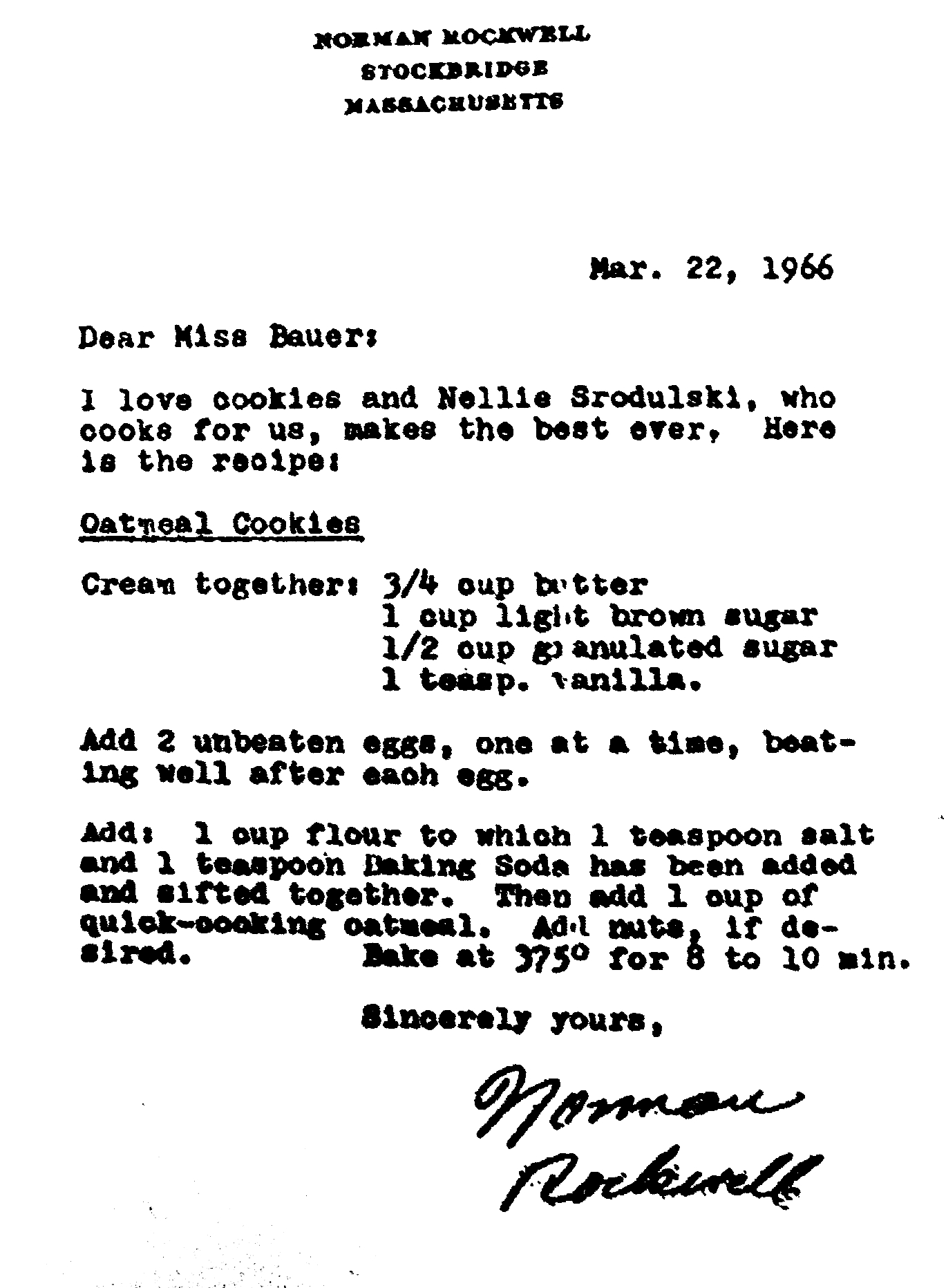
Norman Rockwell’s Oatmeal Cookies (Recipe)

norman