From Thomas Bernhard’s Novel Gargoyles, The Story of the Deceased Teacher

While we ate, my father also told me the following story about the deceased teacher. Once when he was a boy, his grandmother had taken him along into the deep woods to pick blackberries. They lost their way completely, wandered for hours, and could not find the way out of the woods. Darkness fell, and still they had not found the path. They kept going in the wrong direction all the time. Finally grandmother and grandson curled up in a hollow, and lying pressed close together, survived the night. They were lost all the next day and spent a second night in another refuge. Not until the afternoon of the second day did they suddenly emerge from the woods, only to find they had all along gone in a direction opposite from that of their home. Totally exhausted, they had struggled on to the nearest farmhouse.

This ordeal had quickly brought about the grandmother’s death. And her grandson, not yet six, had had his entire future ruined by it, my father said.

You could always conclude that the disasters in a man’s life derived from earlier, usually very early, injuries to his body and his psyche, my father averred. Modern medicine was aware of this, but still made far too little use of such knowledge.

“Even today most doctors do not look into causes,” my father said. “They concern themselves only with the most elementary patterns of treatment. They’re hypocrites who do nothing but prescribe medicines and close their eyes to the psyches of people who because of their helplessness and a disastrous tradition entrust themselves completely to their doctors. And most doctors are lazy and cowardly.”

Putting yourself at their mercy meant putting yourself at the mercy of chance and total unfeelingness, trusting to a pseudo-science, my father said. “Most doctors nowadays are unskilled workers in medicine. And the greatest mystifiers. I never feel more insecure than when I’m among my colleagues. Nothing is more sinister than medicine.”

In the last months of his life the teacher had developed an astonishing gift for pen drawing, my father said. The demonic elements that more and more came to light in his drawings shocked his parents. In delicate lines he drew a world “intent upon self-destruction” that terrified them: birds torn to pieces, human tongues ripped out by the roots, eight-fingered hands, smashed heads, extremities torn from bodies not shown, feet, hands, genitals, people suffocated as they walked, and so on. In those last months the bony structure of the young man’s skull became more and more prominent. And he drew his own portrait frequently, hundreds, thousands of times. When the young teacher talked, the disastrous way his mind was set became apparent. My father had considered taking some of the drawings and showing them to a gallery owner he knew in Graz. “They would make a good exhibition,” he said. “I don’t know anyone who draws the way the teacher did.” The teacher’s surrealism was something completely original, for there was nothing surreal in his drawings; what they showed was reality itself. “The world is surrealistic through and through,” my father said. “Nature is surrealistic, everything is surrealistic.” But he felt that art one exhibited was destroyed by the very act of being exhibited, and so he dropped the idea of doing anything with the teacher’s drawings. On the other hand, he was afraid the schoolmaster’s parents would throw away the drawings or burn them—thousands of them!—from ignorance of how good they were and because they were still frightened, anxious, and wrought up about these drawings. So he had decided to take them. “I’ll simply take them all with me,” he said. He had no doubt they would be handed over to him.

The teacher’s parents must have kept thinking of their sick son’s unfortunate bent whenever they looked at him during his last illness, my father said. “What a terrible thing it is that when you know of some deviation, some unnaturalness, or some crime in connection with a person, as long as he lives you can never look at him without thinking about that deviation, unnaturalness, or crime.”

From his bed the teacher had a view of the peak of the Bundscheck on one side and the rounded top of the Wölkerkogel on the other side. “You can feel this whole stark landscape in his drawings,” my father said.

The teacher’s parents said, however, that during his last days he had not spoken at all, only looked at the landscape outside his window. But the landscape he saw was entirely different from theirs, my father said, and different from the landscape we see when we look at it. What he depicted was an entirely different landscape, “everything totally different.”

—From Thomas Bernhard’s novel Gargoyles.
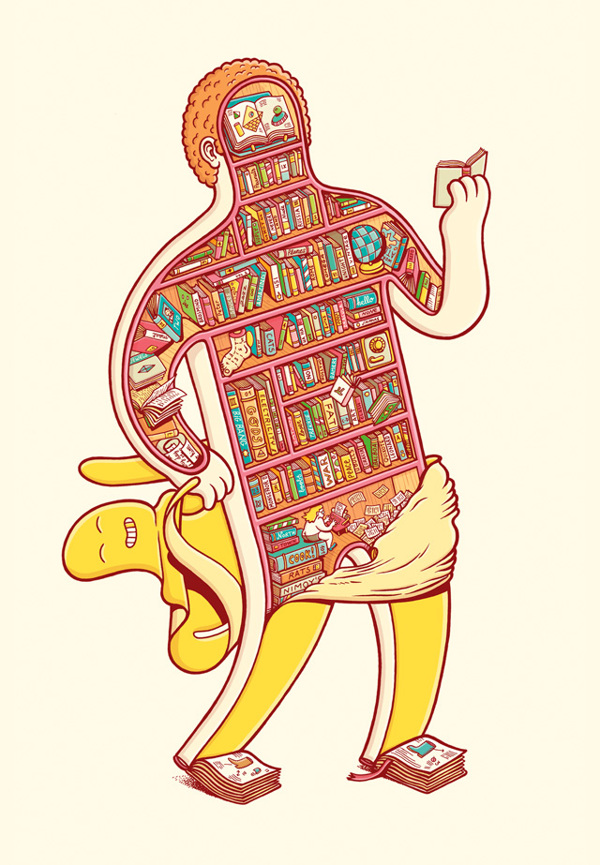
 

What’s Inside? #18 (Library Man) — Brosmind

whats-inside-18

(More).

List with No Name #36

  1. Fargo
  2. A Serious Man
  3. The Big Lebowski
  4. Miller’s Crossing
  5. Barton Fink
  6. Blood Simple
  7. No Country for Old Men
  8. O Brother, Where Art Thou?
  9. The Man Who Wasn’t There
  10. Raising Arizona
  11. Burn After Reading
  12. True Grit
  13. The Hudsucker Proxy
  14. The Ladykillers
  15. Intolerable Cruelty

Untitled (Cubism and Abstract Art) — Steve Wolfe

theNewerYork, a Worthy Alternative to Your iPhone

20130709-154848.jpg

Like many (maybe most) Americans, my first impulse when I have to wait somewhere is to pull out my smart phone and dick around. I like to dick around on Twitter, which often leads me to stuff that I scan or gaze or graze through, with a kind of distracted, even half-hearted, attention. Because I’m also attending to something else—the waiting.

I had to wait, or be patient, or be a patient, or what have you several times last month, and each time I brought with me the newest or forthcomingest issue of theNewerYork—issue 3 (or III, depending on press materials). It fits neatly in my pocket and most of the pieces are a page at most—a perfect alternative to my iPhone, with none of the eye-deadening numbness that so often happens with long binges on a tiny screen.

theNewerYork describes itself as

a weird sort of literary mag. Our rule: no short stories, no poetry, no essays. We want to play around with literary form and narration, we want to screw with your mind! There will be personal letters, flash-fictions, glossaries, aphorisms, manuals, lists and other absurdities. We received over 600 submissions from all over the world. We’ve got flash fictions of sex and drugs, teenage romances, philosophical treatises, pretentious definitions, web forums, silly, sappy, scary stuff.

That’s a pretty apt description. To hijack and cannibalize my write-up of the last issue, theNewerYork’s “willingness to showcase experimentation in what goes on paper for people to look at and read is both a strength and a weakness.” This third issue sees an all-around increase in quality, from the production design, to the art, to the writing.

Highlights include Panayotis Pakos’s “Les Innumerables (A Binary Tale),” a Calvinoesque flash that imagines the dream-life of numbers, and Shane Jesse Christmass’s “My Delicate Response to a Child’s Writing Prompt Website” (quick sample: “If there were no television I’d beach my television set down within the dunes…”). Zach Davidson’s “Unstandardized Testing” claims (truthfully?) to present a set of scrambled questions from a trash bin; the testtaker is tasked with creating proper order (sample: “too lazy to do lazy something you are if you are still?”)

The most affecting piece in the collection is Anton Nimblett’s “Show & Tell: An American Game,” an analysis posing as a chronology. I’ll share only the nineteenth century portion, and, at the risk of spoiling, let you know that the story ends with the line “Show birth certificate (again, again, again).”

20130807-130214.jpg

The list-form, along with (or combined with) the second-person POV seems a favorite for “experimental” fiction, which can occasionally be grating (but only when it doesn’t work)—but most of the pieces here work. And if they don’t, there’s something coming up that does.

Despite the disparate tones, approaches, and geographies of its contributors, theNewerYork coheres—the little magazine has a clear (if discursive vision). Good stuff. Check out their website for more. 

“Indifference” — Edna St. Vincent Millay

ind

Son of a Gun (Book Acquired, 8.5.2013)

20130806-162848.jpg

Son of a Gun, Justin St. Germain’s memoir, explores the life and death of his mother, who was killed by her fifth husband. Here’s publisher Random House’s blurb:

Tombstone, Arizona, September 2001. Debbie St. Germain’s death in her remote trailer, apparently at the hands of her fifth husband, is a passing curiosity. “A real-life old West murder mystery,” the local TV announcers intone before the commercial break, while barroom gossips snicker cruelly. But for her twenty-year-old son, Justin St. Germain, the tragedy marks the line that separates his world into before and after.

Justin decides to confront people from his past and delve into the police records in an attempt to make sense of his mother’s life and death. All the while he tries to be the type of man she would have wanted him to be. Brutally honest and beautifully written, Son of a Gun is a brave, unexpected and unforgettable memoir.

Here’s Publishers Weekly’s write-up:

A young man wrestles with his heartache over his mother’s murder in this lacerating memoir of family dysfunction. St. Germain was a 20-year-old college student when his mother Debbie was shot to death in 2001 by her fifth husband in a desolate trailer in the Arizona desert, a disaster that threw into sharp relief the chaos of his working-class background. St. Germain revisits Debbie’s unstable life as an Army paratrooper and businesswoman, the string of men she took up with (some physically abusive), and his own boyhood resentment at their presence and at incessant domestic upheaval. Intertwined is a jaundiced, somewhat self-conscious meditation on St. Germain’s claustrophobic hometown of Tombstone—all sun-bleached ennui, arid hardpan, and tourist kitsch—and its presiding spirit, Wyatt Earp, archetype of the violent, trigger-happy machismo that he blames for killing his mother, yet feels drawn to as a touchstone of manhood. St. Germain makes harsh judgments of the men in his past (as well as of his sullen, callous adolescent self), but as he seeks them out later, he arrives, almost against his will, at a subtler appreciation of their complexities. At times his trauma feels more dutiful than deeply felt, but his memoir vividly conveys the journey from youthful victimization toward mature understanding.


Eight Notes from Nathaniel Hawthorne’s Note-Books

  1. Would it not be wiser for people to rejoice at all that they now sorrow for, and vice versa? To put on bridal garments at funerals, and mourning at weddings? For their friends to condole with them when they attained riches and honor, as only so much care added?
  2. If in a village it were a custom to hang a funeral garland or other token of death on a house where some one had died, and there to let it remain till a death occurred elsewhere, and then to hang that same garland over the other house, it would have, methinks, a strong effect.
  3. No fountain so small but that Heaven may be imaged in its bosom.
  4. Fame! Some very humble persons in a town may be said to possess it,–as, the penny-post, the town-crier, the constable,–and they are known to everybody; while many richer, more intellectual, worthier persons are unknown by the majority of their fellow-citizens. Something analogous in the world at large.
  5. The ideas of people in general are not raised higher than the roofs of the houses. All their interests extend over the earth’s surface in a layer of that thickness. The meeting-house steeple reaches out of their sphere.
  6. Nobody will use other people’s experience, nor have any of his own till it is too late to use it.
  7. Two lovers to plan the building of a pleasure-house on a certain spot of ground, but various seeming accidents prevent it. Once they find a group of miserable children there; once it is the scene where crime is plotted; at last the dead body of one of the lovers or of a dear friend is found there; and, instead of a pleasure-house, they build a marble tomb. The moral,–that there is no place on earth fit for the site of a pleasure-house, because there is no spot that may not have been saddened by human grief, stained by crime, or hallowed by death. It might be three friends who plan it, instead of two lovers; and the dearest one dies.
  8. Comfort for childless people. A married couple with ten children have been the means of bringing about ten funerals.

Notations from Nathaniel Hawthorne’s American Note-Books.

Arranged — Jim Hodges

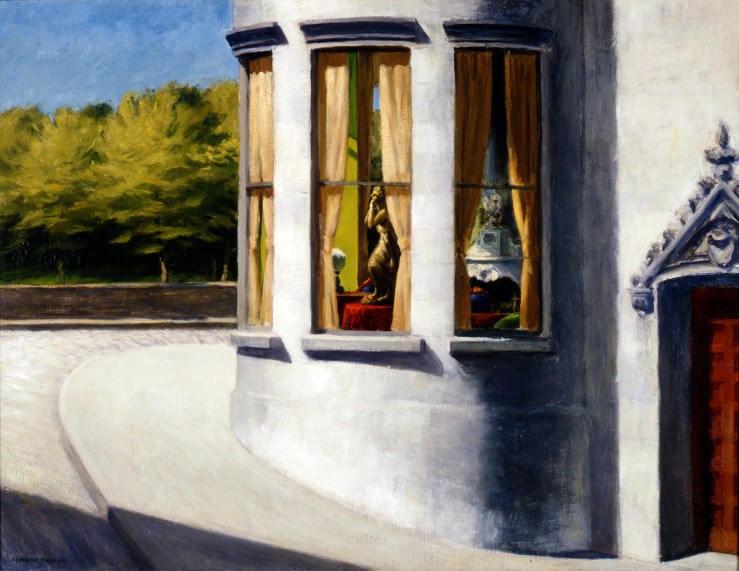
August in the City — Edward Hopper

hopper

List with No Name #35

  1. Achebe
  2. Bolaño
  3. Carter
  4. DeLillo
  5. Ellison
  6. Fitzgerald
  7. Gaddis
  8. Houellebecq
  9. Ishiguro
  10. James
  11. Kertész
  12. Lispector
  13. McCarthy
  14. Nabokov
  15. O’Connor
  16. Pullman
  17. Quincey, de
  18. Rousseau
  19. Shakespeare
  20. Tolkien
  21. Uris
  22. Vollmann
  23. Wallace
  24. X, Malcolm
  25. Yates
  26. Zweig

Heretic/Hanging (Books Acquired, Sometime Last Week)

20130806-162835.jpg

I was out of town when these showed up last week.

First, Susan Ronald’s Heretic Queen: Publisher St. Martin’s Griffin’s blurb:

Acclaimed biographer Susan Ronald delivers a stunning account of Elizabeth I that focuses on her role in the Wars on Religion—the battle between Protestantism and Catholicisim that tore apart Europe in the 16th Century

Elizabeth’s 1558 coronation procession was met with an extravagant outpouring of love. Only twenty-five years old, the young queen saw herself as their Protestant savior, aiming to provide the nation with new hope, prosperity, and independence from the foreign influence that had plagued her sister Mary’s reign. Given the scars of the Reformation, Elizabeth would need all of the powers of diplomacy and tact she could summon.

Extravagant, witty, and hot-tempered, Elizabeth was the ultimate tyrant. Yet at the outset, in religious matters, she was unfathomably tolerant for her day. “There is only one Christ, Jesus, one faith,” Elizabeth once proclaimed. “All else is a dispute over trifles.” Heretic Queen is the highly personal, untold story of how Queen Elizabeth I secured the future of England as a world power. Susan Ronald paints the queen as a complex character whose apparent indecision was really a political tool that she wielded with great aplomb.

And: The Hanging of Samuel Ash by Sheldon Russell, from Minotaur. Publishers Weekly blurb:

A compelling lead compensates only in part for the relatively weak plot of Russell’s fourth mystery featuring one-armed Santa Fe railroad bull Hook Runyon (after 2012’s Dead Man’s Tunnel), set during WWII against a backdrop of labor unrest. When Runyon checks out a nonworking signal on a remote stretch of track, he discovers a man’s corpse hanging from the signal’s cantilever. The only clue to the dead man’s identity is a Bronze Star inscribed with the name Samuel Ash. Not wanting the war hero to be buried in a pauper’s grave, Runyon takes custody of the body and embarks on a quest to find Ash’s relatives and the truth about his death. A dose of humor lightens the gloom—pickpockets steal Runyon’s wallet and badge while he’s hunting pickpockets—but the mystery itself never picks up much steam. Fans will hope for a return to form next time.


“Waitin’ Around to Die” — Townes van Zandt

“Translations are always disgusting / But they brought me a lot of money” (Thomas Bernhard)

tb

From Thomas Bernhard’s play Der Weltverbesserer (The World-Fixer). The translation here is by Gitta Honegger and appears as an illustrating example in her fantastic essay “Language Speaks. Anglo-Bernhard: Thomas Bernhard in Translation,” collected in A Companion to the Works of Thomas Bernhard (ed. Matthias Konzett). At the time of Companion’s first publication, Der Weltverbesserer had yet to be released in an English edition; Ariadne released one in 2005.


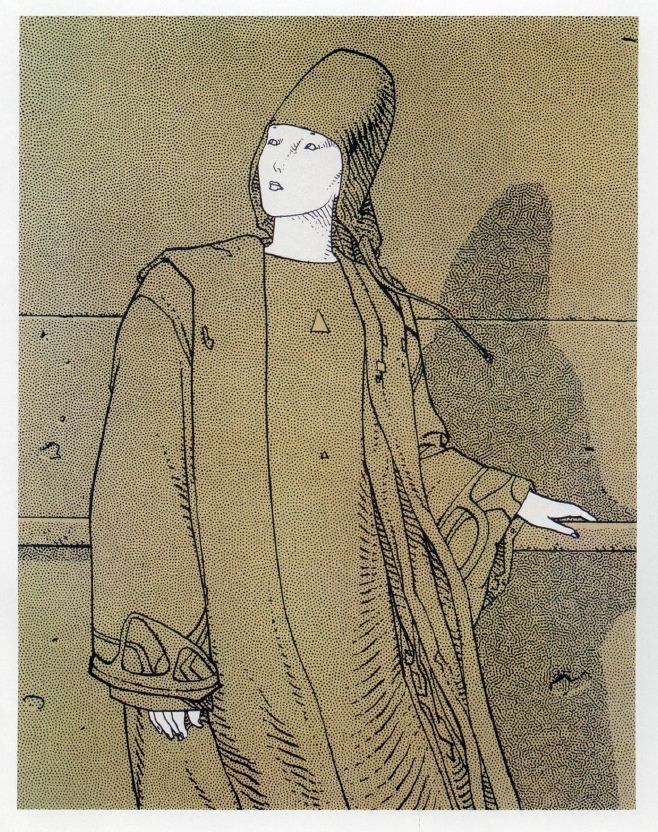
Helen — Moebius

helen

“Von Kempelen and His Discovery ” — Edgar Allan Poe

“Von Kempelen and His Discovery ” by Edgar Allan Poe

AFTER THE very minute and elaborate paper by Arago, to say nothing of the summary in ‘Silliman’s Journal,’ with the detailed statement just published by Lieutenant Maury, it will not be supposed, of course, that in offering a few hurried remarks in reference to Von Kempelen’s discovery, I have any design to look at the subject in a scientific point of view. My object is simply, in the first place, to say a few words of Von Kempelen himself (with whom, some years ago, I had the honor of a slight personal acquaintance), since every thing which concerns him must necessarily, at this moment, be of interest; and, in the second place, to look in a general way, and speculatively, at the results of the discovery.

It may be as well, however, to premise the cursory observations which I have to offer, by denying, very decidedly, what seems to be a general impression (gleaned, as usual in a case of this kind, from the newspapers), viz.: that this discovery, astounding as it unquestionably is, is unanticipated.

By reference to the ‘Diary of Sir Humphrey Davy’ (Cottle and Munroe, London, pp. 150), it will be seen at pp. 53 and 82, that this illustrious chemist had not only conceived the idea now in question, but had actually made no inconsiderable progress, experimentally, in the very identical analysis now so triumphantly brought to an issue by Von Kempelen, who although he makes not the slightest allusion to it, is, without doubt (I say it unhesitatingly, and can prove it, if required), indebted to the ‘Diary’ for at least the first hint of his own undertaking.

The paragraph from the ‘Courier and Enquirer,’ which is now going the rounds of the press, and which purports to claim the invention for a Mr. Kissam, of Brunswick, Maine, appears to me, I confess, a little apocryphal, for several reasons; although there is nothing either impossible or very improbable in the statement made. I need not go into details. My opinion of the paragraph is founded principally upon its manner. It does not look true. Persons who are narrating facts, are seldom so particular as Mr. Kissam seems to be, about day and date and precise location. Besides, if Mr. Kissam actually did come upon the discovery he says he did, at the period designated—nearly eight years ago—how happens it that he took no steps, on the instant, to reap the immense benefits which the merest bumpkin must have known would have resulted to him individually, if not to the world at large, from the discovery? It seems to me quite incredible that any man of common understanding could have discovered what Mr. Kissam says he did, and yet have subsequently acted so like a baby—so like an owl—as Mr. Kissam admits that he did. By-the-way, who is Mr. Kissam? and is not the whole paragraph in the ‘Courier and Enquirer’ a fabrication got up to ‘make a talk’? It must be confessed that it has an amazingly moon-hoaxy-air. Very little dependence is to be placed upon it, in my humble opinion; and if I were not well aware, from experience, how very easily men of science are mystified, on points out of their usual range of inquiry, I should be profoundly astonished at finding so eminent a chemist as Professor Draper, discussing Mr. Kissam’s (or is it Mr. Quizzem’s?) pretensions to the discovery, in so serious a tone. Continue reading ““Von Kempelen and His Discovery ” — Edgar Allan Poe”

World of Books — Winsor McCay

McCayWorldOfBooksBaja