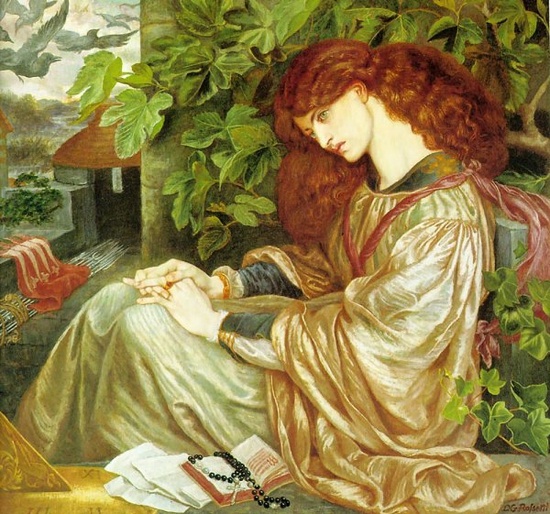
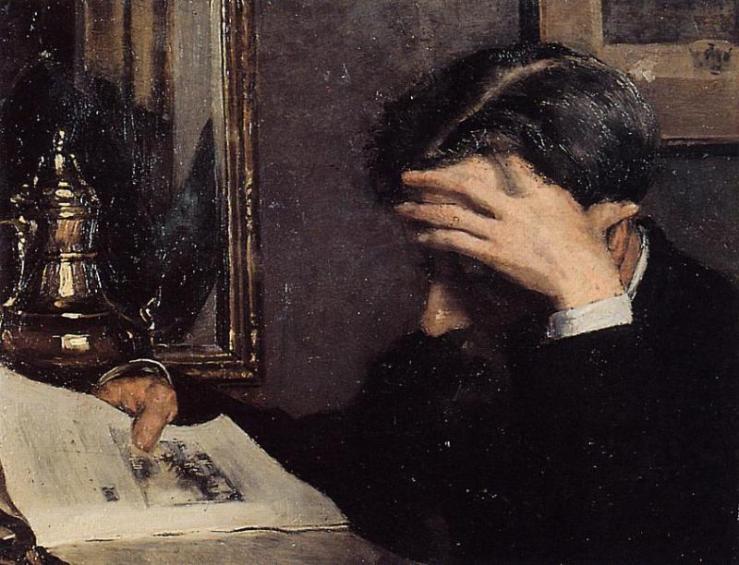
La Pia de’ Tolomei — Dante Gabriel Rossetti

1e562a1d6163fcb813dd68de136888a5

Family Nest — Béla Tarr (Full Film with English Subtitles)

“Your first nightmare away from home” (Infinite Jest)

Your first nightmare away from home and folks, your first night at the Academy, it was there all along: The dream is that you awaken from a deep sleep, wake up suddenly damp and panicked and are overwhelmed with the sudden feeling that there is a distillation of total evil in this dark strange subdorm room with you, that evil’s essence and center is right here, in this room, right now. And is for you alone. None of the other little boys in the room are awake; the bunk above yours sags dead, motionless; no one moves; no one else in the room feels the presence of something radically evil; none thrash or sit damply up; no one else cries out: whatever it is is not evil for them. The flashlight your mother name-tagged with masking tape and packed for you special pans around the institutional room: the drop-ceiling, the gray striped mattress and bulged grid of bunksprings above you, the two other bunkbeds another matte gray that won’t return light, the piles of books and compact disks and tapes and tennis gear; your disk of white light trembling like the moon on water as it plays over the identical bureaus, the recessions of closet and room’s front door, door’s frame’s bolections; the cone of light pans over fixtures, the lumpy jumbles of sleeping boys’ shadows on the snuff-white walls, the two rag throw-rugs’ ovals on the hardwood floor, black lines of baseboards’ reglets, the cracks in the Venetian blinds that ooze the violet nonlight of a night with snow and just a hook of moon; the flashlight with your name in maternal cursive plays over every cm. of the walls, the rheostats, CD, Inter-Lace poster of Tawni Kondo, phone console, desks’ TPs, the face in the floor, posters of pros, the onionskin yellow of the desklamps’ shades, the ceiling-panels’ patterns of pinholes, the grid of upper bunk’s springs, recession of closet and door, boys wrapped in blankets, slight crack like a creek’s course in the eastward ceiling discernible now, maple reglet border at seam of ceiling and walls north and south no floor has a face your flashlight showed but didn’t no never did see its eyes’ pupils set sideways and tapered like a cat’s its eyebrows’ \ / and horrid toothy smile leering right at your light all the time you’ve been scanning oh mother a face in the floor mother oh and your flashlight’s beam stabs jaggedly back for the overlooked face misses it overcorrects then centers on what you’d felt but had seen without seeing, just now, as you’d so carefully panned the light and looked, a face in the floor there all the time but unfelt by all others and unseen by you until you knew just as you felt it didn’t belong and was evil: Evil.

And then its mouth opens at your light.

And then you wake like that, quivering like a struck drum, lying there awake and quivering, summoning courage and spit, roll to the right just as in the dream for the nametagged flashlight on the floor by the bed just in case, lie there on your shank and side, shining the light all over, just as in the dream. Lie there panning, looking, all ribs and elbows and dilated eyes. The awake floor is littered with gear and dirty clothes, blond hardwood with sealed seams, two throw-rugs, the bare waxed wood shiny in the windows’ snowlight, the floor neutral, faceless, you cannot see any face in the floor, awake, lying there, faceless, blank, dilated, playing beam over floor again and again, not sure all night forever unsure you’re not missing something that’s right there: you lie there, awake and almost twelve, believing with all your might.

From David Foster Wallace’s Infinite Jest.

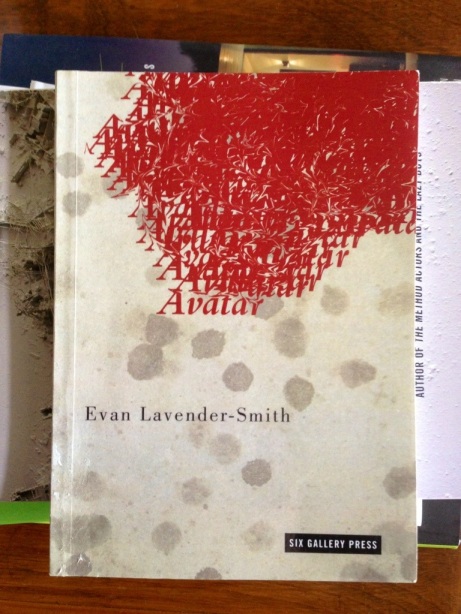
Evan Lavender-Smith’s Avatar (Book Acquired, 3.22.2013)

20130322-131801.jpg

Came home to Evan Lavender-Smith’s Avatar in the mail. Loved his book From Old NotebooksWhat is Avatar about? I asked Evan and he told me. This was in an interview we did that will run next week here on this very blog. Here’s a sample:

Biblioklept: I haven’t read your novel Avatar—can you tell us a little bit about it?

ELS: It’s a monologue spoken or thought by someone floating in the depths of space who can see only two points of light, two stars in the distance, one in front and one behind. The speaker/thinker has apparently been stuck in this condition for a very long time, having spent much of that time — hundreds, thousands, maybe millions of years — trying to puzzle out how he/she arrived in such an awful situation, what it means to be there, what to think about next, etc. It’s very different than From Old Notebooks in most respects — a number of people who liked From Old Notebooks told me they didn’t care for Avatar, and some people who liked Avatar told me they weren’t crazy about From Old Notebooks — but I believe they share at least one main concern, which is an attempt to come up with a formal analog that would describe a figure for thought, to formally systemize and to abstract or maybe almost to allegorize thought within the context of a book. Ulysses is probably my all-time favorite novel, and one of the things I love best about it is how its method of interior monologue functions, to my reading, both as this bizarre formal contrivance — people don’t really think like that at all, don’t rely so heavily on words to think, at least I don’t — and as a beautiful linguistic or formal analog to real human thought. In both From Old Notebooks and Avatar, I believe I was trying to do something along those lines, to come up with a way for a book to develop its own peculiar grammar or system of thought quite distinct from real human thought and at the same time have that grammar somehow formally or abstractly correspond to the ebbs and tides and the fits and starts and the beauty and boring repetition of how a mind really thinks; to develop over the course of a book a formal figure for thought that both does and doesn’t resemble thought as we encounter it in our day-to-day lives.

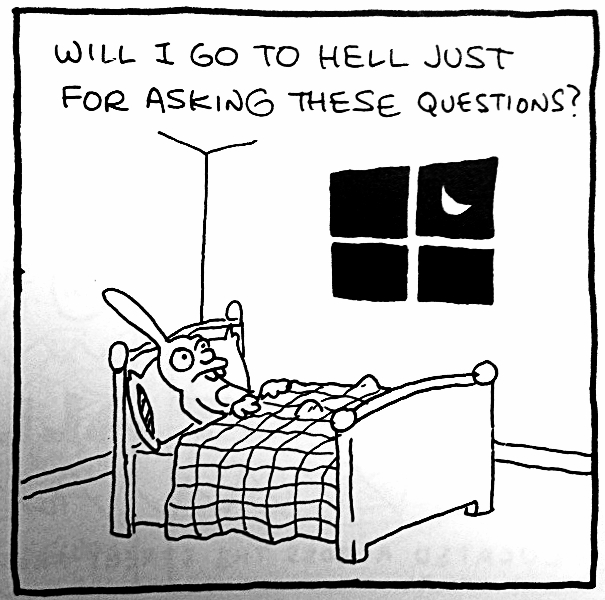
Questions (Life in Hell)

questions

RIP Chinua Achebe

Achebe

RIP Chinua Achebe, 1930-2013

Nigerian author Chinua Achebe died today at the age 82.

I will never forget the first time I read Things Fall Apart, Achebe’s famous novel that mixes elements of magical realism and postcolonial criticism into the story of brave, stubborn Okonkwo, a killer, an exile, a man too big for his world. I was a high school senior and the book was part of an AP Literature reading list. I found a tattered copy in my classroom library, and compelled by the cover and the book’s name (what a great name!) and the author’s name, I read it. I devoured it. I absorbed it. I read it again.

And I stole the book of course.

And then years later, a student of mine stole it from me, which is as it should be.

I used Things Fall Apart for years in the classroom, reading it aloud with my classes in the inner-city school where I taught. Few of my students were avid readers, especially the angry young boys, who often seemed to show up merely to escape the violent streets they roamed or the chaos at home. But they liked Things Fall Apart and they loved Okonkwo and they understood him, his anger, his pride, his fury. Over the years my class set experienced that special kind of attrition all well-loved books face: The books disappeared, secreted into knapsacks and lockers, loaned to students in other classes. Or they fell apart, fittingly, the spines cracked, the glue brittle and crumbling, the pages torn. This is love, of course.

Achebe was always thrust into a strange position. He had to defend writing in English, for example, and discourse about Things Fall Apart often dwells too much on the book’s final chapters, where British colonials begin systemically decimating traditional Igbo culture. It’s not that that final section isn’t important or meaningful to the book, but there’s so much more there—so much is preserved—and shared—of Igbo culture in the book’s first three quarters. (Achebe’s scathing attack on Conrad’s Heart of Darkness often overshadows his fiction).

If we’re being honest though, let’s admit that what makes Things Fall Apart a great work of literature, a strange, strong work of literature, isn’t merely its anthropological or folkloric or political values. It’s not a book we read again and again because of its allegorical values or its maddening critique of colonialism. The reason that we continue to read and reread Things Fall Apart is that it’s an excellent novel, an aesthetic achievement, a work that produces its own anxieties, that captures terror and pity and humanity. So much humanity.

Chinua Achebe in Conversation with Bill Moyers

“Plato’s Dream” — Voltaire

“Plato’s Dream” by Voltaire

In ancient times, dreams were much revered, and Plato was one of the greatest dreamers. His dream The Republic is deservedly famous, but the following little-known tale is perhaps his most amazing dream–or nightmare:

The great Demiurgos, the eternal geometer, having scattered throughout the immensity of space innumerable worlds, decided to test the knowledge of those lesser superbeings who were also his creations, and who had witnessed his works. He gave them each a small portion of matter to arrange, just as our own art teachers give their students a statue to carve, or a picture to paint, if we may compare small things to great.

Demogorgon received the lump of mold we call Earth, and having formed it as it now appears, thought he had created a masterpiece. He imagined he had silenced Envy herself, and expected to receive the highest praise, even from his brethren. How great was his surprise, when, at the presentation of his work, they hissed in disappoval!

One among them, more sarcastic than the rest, spoke:

“Truly you have performed mighty feats! You have divided your world into two parts; and, to prevent them from communicating with each other, placed a vast collection of waters between the two hemispheres. The inhabitants must perish with cold under both your poles, and be scorched to death under the equator. You have, in your great prudence, formed immense deserts of sand, so all who travel over them may die with hunger and thirst. I have no fault to find with your cows, sheep, cocks, and hens; but can never be reconciled to your serpents and spiders. Your onions and artichokes are very good things, but I cannot conceive what induced you to scatter such a heap of poisonous plants over the face of the planet, unless it was to poison its inhabitants. Moreover, if I am not mistaken, you have created about 30 different kinds of monkeys, a still greater number of dogs, yet only four or five races of humans. It is true, indeed, you have bestowed on the latter of these animals a faculty you call Reason, but it is so poorly executed that you might better call it Folly. Besides, you do not seem to have shown any very great regard for this two-legged creature, seeing you have left him with so few means of defense; subjected him to so many disorders, and provided him with so few remedies; and formed him with such a multitude of passions, and so little wisdom and prudence to resist them. You certainly were not willing that there should remain any great number of these animals on Earth at once; for, over the course of a given year, smallpox will regularly carry off a tenth of the species, and sister maladies will taint the springs of life in the remainder; and then, as if this was not enough, you have so disposed things that half of those who survive are occupied in lawsuits, or cutting each other’s throats. Yes, they must be infinitely grateful to you, and I must admit that you have executed a masterpiece.”

Demogorgon blushed. He now realized there was much moral and physical evil in his work, but still believed it contained more good than ill.

“It is easy to find fault,” he said; “but do you imagine it is so easy to form an animal, who, having the gift of reason and free will, shall not sometimes abuse his liberty? Do you think that, in rearing 10,000 plants, it is so easy to prevent some few from having noxious qualities? Do you suppose that, with a certain quantity of water, sand, and mud, you could make a globe without sea or desert?

“As for you, my sneering friend, I think you have just finished the planet Jupiter. Let us see now what figure you make with your great belts, and your long nights, with four moons to enlighten them. Let us examine your worlds, and see whether the inhabitants you have made are exempt from folly and disease.”

Accordingly, his fellow entities examined the planet Jupiter, and were soon laughing at the laugher. He who had made Saturn did not escape without his share of censure, and his fellows, the makers of Mars, Mercury, and Venus, was each in his turn reproached.

They were in the midst of railing against and ridiculing each other, when the eternal Demiurgos thus imposed silence on them all:

“In your performances there is both good and bad, because you have a great share of understanding, but at the same time fall short of perfection. Your works will endure for only a few billion years, after which you will acquire more knowledge and perform much better. It belongs to me alone to create things perfect and immortal.”

“Us, for example?” asked Demogorgon.

Demiurgos scowled, and with that Plato awoke.

Or did he?


Death and the Maiden — Egon Schiele

Marusia in the Library — David Burliuk

Val Kilmer Plays Val Kilmer in Harmony Korine’s The Fourth Dimension

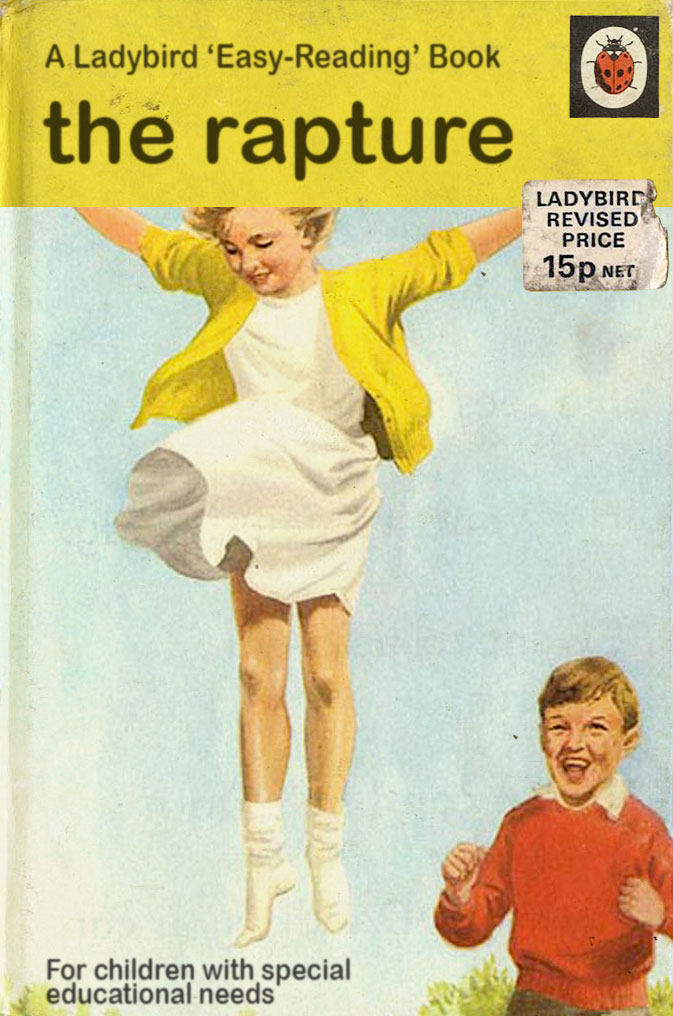
The Rapture — A Ladybird Easy-Reading Book for Children with Special Educational Needs

therapture

(From Scarfolk Council, a favorite new site).

Terence Malick’s Editor Billy Weber on the Art of Voiceover

Cannibal — Vasily Vereshchagin

“The Cupboard of the Yesterdays” — Saki

“The Cupboard of the Yesterdays” — Saki

“War is a cruelly destructive thing,” said the Wanderer, dropping his newspaper to the floor and staring reflectively into space.

“Ah, yes, indeed,” said the Merchant, responding readily to what seemed like a safe platitude; “when one thinks of the loss of life and limb, the desolated homesteads, the ruined—”

“I wasn’t thinking of anything of the sort,” said the Wanderer; “I was thinking of the tendency that modern war has to destroy and banish the very elements of picturesqueness and excitement that are its chief excuse and charm.  It is like a fire that flares up brilliantly for a while and then leaves everything blacker and bleaker than before.  After every important war in South-East Europe in recent times there has been a shrinking of the area of chronically disturbed territory, a stiffening of frontier lines, an intrusion of civilised monotony.  And imagine what may happen at the conclusion of this war if the Turk should really be driven out of Europe.”

“Well, it would be a gain to the cause of good government, I suppose,” said the Merchant.

“But have you counted the loss?” said the other.  “The Balkans have long been the last surviving shred of happy hunting-ground for the adventurous, a playground for passions that are fast becoming atrophied for want of exercise.  In old bygone days we had the wars in the Low Countries always at our doors, as it were; there was no need to go far afield into malaria-stricken wilds if one wanted a life of boot and saddle and licence to kill and be killed.  Those who wished to see life had a decent opportunity for seeing death at the same time.”

“It is scarcely right to talk of killing and bloodshed in that way,” said the Merchant reprovingly; “one must remember that all men are brothers.”

“One must also remember that a large percentage of them are younger brothers; instead of going into bankruptcy, which is the usual tendency of the younger brother nowadays, they gave their families a fair chance of going into mourning.  Every bullet finds a billet, according to a rather optimistic proverb, and you must admit that nowadays it is becoming increasingly difficult to find billets for a lot of young gentlemen who would have adorned, and probably thoroughly enjoyed, one of the old-time happy-go-lucky wars.  But that is not exactly the burden of my complaint.  The Balkan lands are especially interesting to us in these rapidly-moving days because they afford us the last remaining glimpse of a vanishing period of European history.  When I was a child one of the earliest events of the outside world that forced itself coherently under my notice was a war in the Balkans; I remember a sunburnt, soldierly man putting little pin-flags in a war-map, red flags for the Turkish forces and yellow flags for the Russians.  It seemed a magical region, with its mountain passes and frozen rivers and grim battlefields, its drifting snows, and prowling wolves; there was a great stretch of water that bore the sinister but engaging name of the Black Sea—nothing that I ever learned before or after in a geography lesson made the same impression on me as that strange-named inland sea, and I don’t think its magic has ever faded out of my imagination.  And there was a battle called Plevna that went on and on with varying fortunes for what seemed like a great part of a lifetime; I remember the day of wrath and mourning when the little red flag had to be taken away from Plevna—like other maturer judges, I was backing the wrong horse, at any rate the losing horse.  And now to-day we are putting little pin-flags again into maps of the Balkan region, and the passions are being turned loose once more in their playground.”

“The war will be localised,” said the Merchant vaguely; “at least every one hopes so.”

“It couldn’t wish for a better locality,” said the Wanderer; “there is a charm about those countries that you find nowhere else in Europe, the charm of uncertainty and landslide, and the little dramatic happenings that make all the difference between the ordinary and the desirable.”

“Life is held very cheap in those parts,” said the Merchant.

“To a certain extent, yes,” said the Wanderer.  “I remember a man at Sofia who used to teach me Bulgarian in a rather inefficient manner, interspersed with a lot of quite wearisome gossip.  I never knew what his personal history was, but that was only because I didn’t listen; he told it to me many times.  After I left Bulgaria he used to send me Sofia newspapers from time to time.  I felt that he would be rather tiresome if I ever went there again.  And then I heard afterwards that some men came in one day from Heaven knows where, just as things do happen in the Balkans, and murdered him in the open street, and went away as quietly as they had come.  You will not understand it, but to me there was something rather piquant in the idea of such a thing happening to such a man; after his dullness and his long-winded small-talk it seemed a sort of brilliant esprit d’esalier on his part to meet with an end of such ruthlessly planned and executed violence.”

The Merchant shook his head; the piquancy of the incident was not within striking distance of his comprehension.

“I should have been shocked at hearing such a thing about any one I had known,” he said.

“The present war,” continued his companion, without stopping to discuss two hopelessly divergent points of view, “may be the beginning of the end of much that has hitherto survived the resistless creeping-in of civilisation.  If the Balkan lands are to be finally parcelled out between the competing Christian Kingdoms and the haphazard rule of the Turk banished to beyond the Sea of Marmora, the old order, or disorder if you like, will have received its death-blow.  Something of its spirit will linger perhaps for a while in the old charmed regions where it bore sway; the Greek villagers will doubtless be restless and turbulent and unhappy where the Bulgars rule, and the Bulgars will certainly be restless and turbulent and unhappy under Greek administration, and the rival flocks of the Exarchate and Patriarchate will make themselves intensely disagreeable to one another wherever the opportunity offers; the habits of a lifetime, of several lifetimes, are not laid aside all at once.  And the Albanians, of course, we shall have with us still, a troubled Moslem pool left by the receding wave of Islam in Europe.  But the old atmosphere will have changed, the glamour will have gone; the dust of formality and bureaucratic neatness will slowly settle down over the time-honoured landmarks; the Sanjak of Novi Bazar, the Muersteg Agreement, the Komitadje bands, the Vilayet of Adrianople, all those familiar outlandish names and things and places, that we have known so long as part and parcel of the Balkan Question, will have passed away into the cupboard of yesterdays, as completely as the Hansa League and the wars of the Guises.

“They were the heritage that history handed down to us, spoiled and diminished no doubt, in comparison with yet earlier days that we never knew, but still something to thrill and enliven one little corner of our Continent, something to help us to conjure up in our imagination the days when the Turk was thundering at the gates of Vienna.  And what shall we have to hand down to our children?  Think of what their news from the Balkans will be in the course of another ten or fifteen years.  Socialist Congress at Uskub, election riot at Monastir, great dock strike at Salonika, visit of the Y.M.C.A. to Varna.  Varna—on the coast of that enchanted sea!  They will drive out to some suburb to tea, and write home about it as the Bexhill of the East.

“War is a wickedly destructive thing.”

“Still, you must admit—” began the Merchant.  But the Wanderer was not in the mood to admit anything.  He rose impatiently and walked to where the tape-machine was busy with the news from Adrianople.
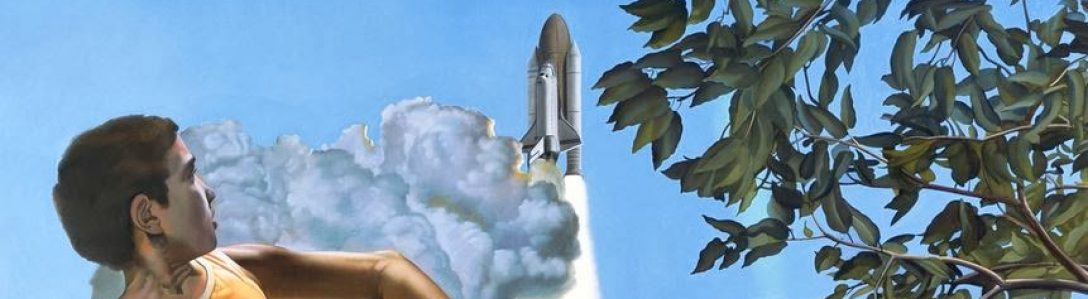
 

Man Reading — Georges Lemmen

man-reading

Krabat, The Sorcerer’s Apprentice — Karel Zeman (Full Film)