“The Surgeon General’s Report on Waiting” — David Berman

“The Surgeon General’s Report on Waiting”

by

David Berman


The situation in my country is this. Our poor love our rich, and our wives adore our wife-beaters.

It’s sad, yes, but let’s not talk about it. Even the subject of sadness will make us sad.

Here’s something else we do. In my country, when we’re waiting for someone who is very late, we stand at the meeting spot and smoke cigarette after cigarette. Then, when we die, we blame everybody who kept us waiting.


(via/more)

Tell your heart

RIP Julee Cruise, 1956-2022

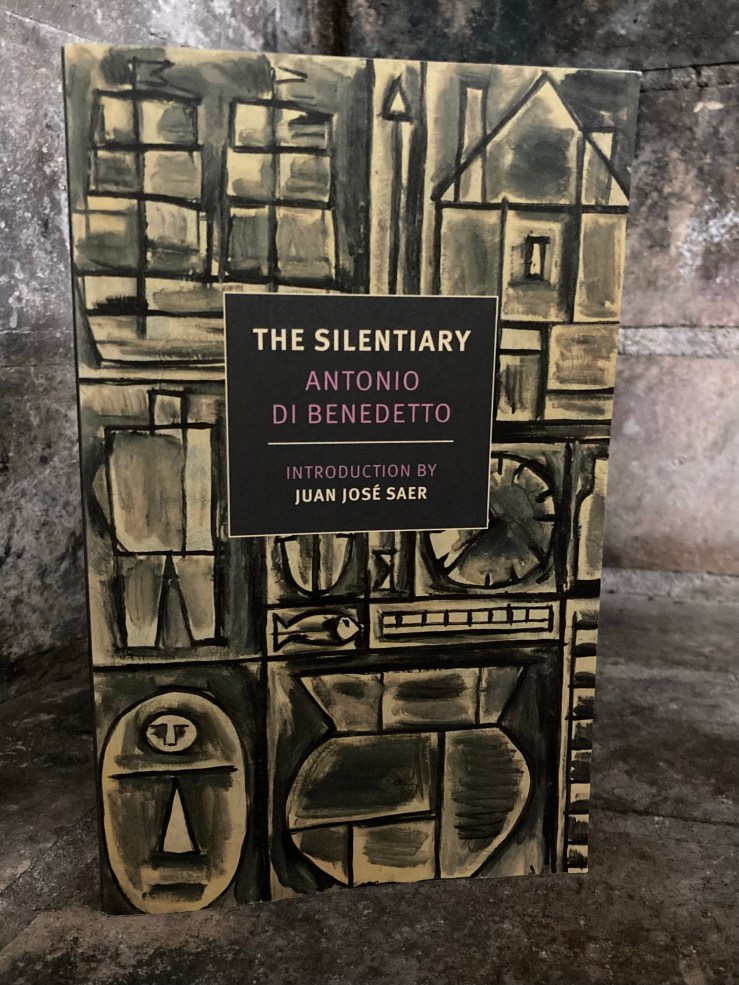
Not toward peace | On Antonio di Benedetto’s novel The Silentiary

“I don’t live well,” the unnamed narrator of Antonio di Benedetto’s novel The Silentiary tells the young woman he will soon marry. “The excuse isn’t clear to her, though she tries to follow its meaning,” he continues, this time to the reader. While the narrator seems, on the surface, a man with a good job as a clerk who lives in a respectable house with his mother, he doesn’t live well—the adverb modifies the verb live in a literal, visceral sense: our hero is an anxious wreck who cannot tune in to the modern condition. He “can’t sleep or eat or read or speak in the chaos of sound” that is the modern, post-war condition.

And that is the central problem of The Silentiary: the chaos of sound. Set in an unnamed, rapidly-growing Latin American city in the early 1950s, Di Benedetto’s 1964 novel belongs to the same canon of Kafkaesque, existentialist postwar novels like Albert Camus’s The Stranger and Walker Percy’s The Moviegoer. Like those novels, The Silentiary follows the nonadventures of a disaffected young man out of tune with his society.

There’s no need to summarize The Silenciary at length. The narrator works in an office, has a crush on his neighbor but ends up marrying her friend, and converses with his flighty philosophical foil, Besarion. He also dreams of completing a novel (to be called The Roof), but alas can never set about even getting started because of the “chaos of sound” that ever encroaches upon him. And that is the real plot of The Silentiary: our poor hero is ever retreating from modernity’s cacophony, only to find new, louder sounds piercing his repose.

His attempts to evade noise are simultaneously mundane and absurd. At one point, he’s schlepping around an old piano that no one can play (symbol of his mother’s middle-class respectability) like a giant anchor, trying to jam it into small quarters. Another sequence finds him moving to a small town, only to end up with a tragic punchline. He’s moved next door to a blacksmith: “Forge and bellows, the anvil and its hammers.”

The narrator’s wife loves him without understanding him, but he finds a confessor in his friend Besarion. This enigmatic character pops in and out of the novel, engaging in puzzling dialogues with the narrator, who is wary and possibly jealous of his friend: “He’s free. He has managed to make his life a long digression, or a kind of multiple metaphor.” Years ago, before the narrator had married and before Besarion had gone on a series of religious travels, he had diagnosed the narrator thusly: “Your quest against noise is metaphysical.” Upon return though, Besarion ironizes that diagnosis, stating that even though his friend believes that his “adventure is metaphysical,” it is actually “physiological, or psychic, or nervous.” This can’t relieve the narrator’s pain though: the chaos of noise “won’t let me exist,” he protests. Besarion solemnly tells him, “Bear up. Make do.”

For all its seriousness, The Silentiary is often a funny, wry novel. Consider the narrator’s description of the automechanics who’ve moved next door: “They seem to have abandoned themselves entirely to their passion for the hygiene of all that has four wheels and an engine.” Or our anxious guy getting dyspepsia: “The food I ingest at lunch does not resign itself to its destiny.”

The phrasing in such moments recalls Di Benedetto’s 1956 novel Zama, also ably translated by Esther Allen. Again, Allen captures something crisp and wry, subtle and precise that is surely native to Di Benedetto’s prose. The results are often beautiful, like in a strange little haiku-like moment early in the novel:

Last night the big gray cat of my childhood came to me.

I told him that noise stalks and harries me.

Slowly, intensely, he cast his animal, companionable gaze upon me.

Or the beautiful phrasing of another strange moment:

…I come across a photo of the lion tamer we dined with after the circus performance.

The tamer’s mane is as untamed as ever, in all the dishevelment of bad nights to which no comb can offer a morning remedy. He’s under double guard.

Lovely!

Yet for all its humor and beauty, The Silentiary is ultimately a sad, though never dour, read. The novel does not wax elegaic for a romanticized, quieter past, nor does it call to make peace with cacophony. There’s only Besarion’s stern intonation to “Bear up [and] Make do.” We’ve the portrait of one man who cannot escape or mute the chaos of sound. Ultimately, he cannot bear up and make do. So he resists, becoming a martyr for silence…but it doesn’t end well. The novel concludes darkly: “The night flows on…and not toward peace.” Recommended.

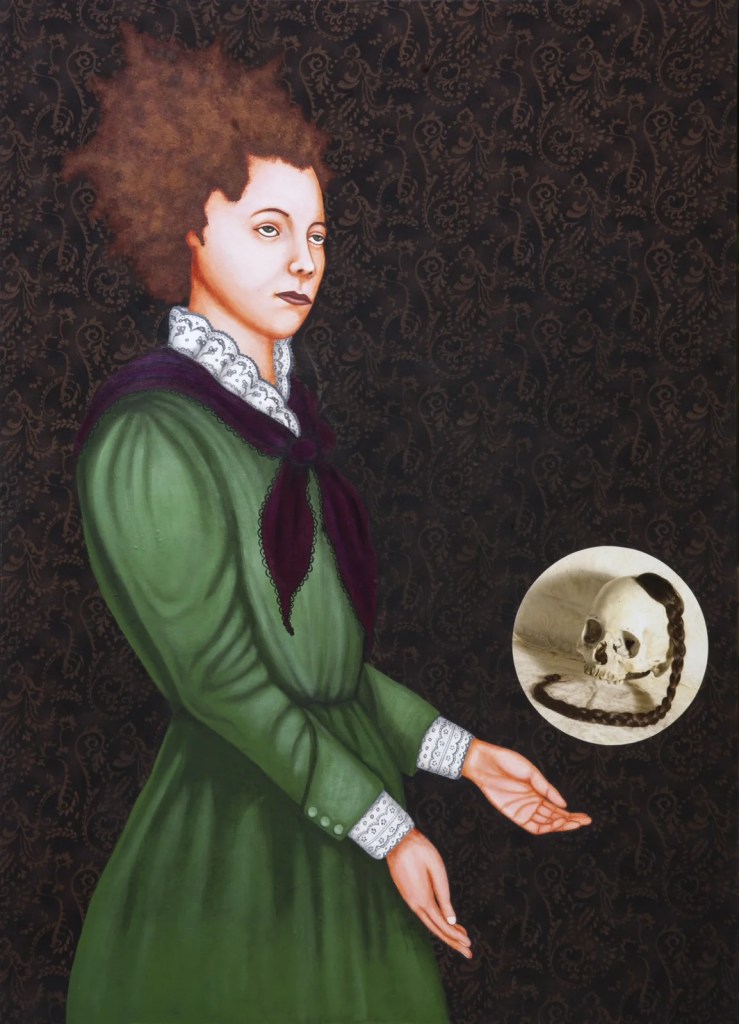
Melancholia Passing into Mania — Lezley Saar

Melancholia Passing into Mania, 2012 by Lezley Saar (b. 1953)

RIP Paula Rego


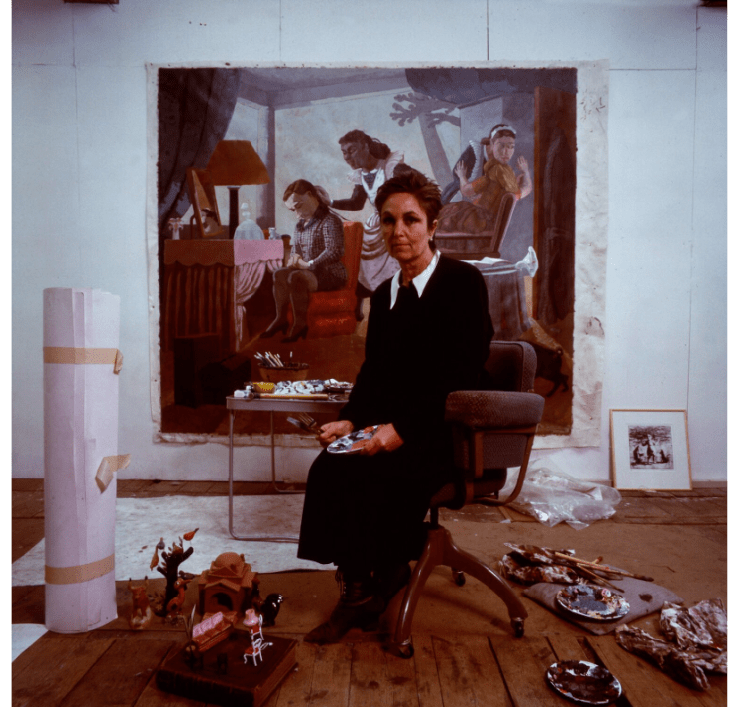
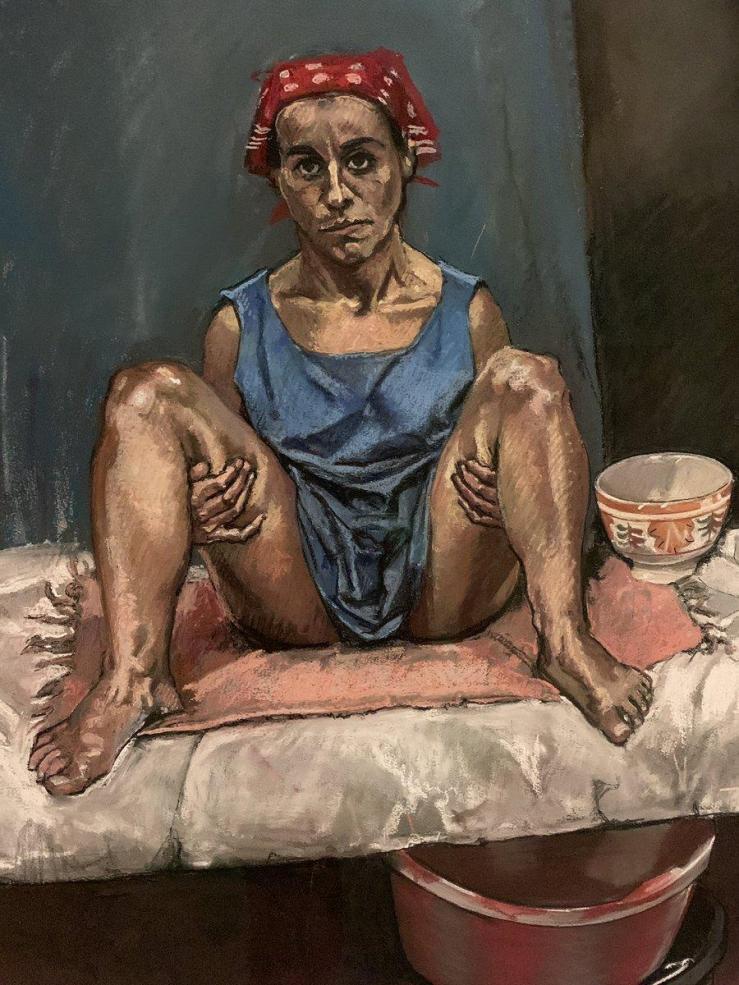
The Artist in Her Studio, 1993


RIP Paula Rego, 1935-2022

Paula Rego was one of the great figurative painters of the late-twentieth and early twenty-first centuries. Born in Portugal, Rego lived and worked most of her life in England. She first began exhibiting her work in the early 1960s with The London Group, and over the decades, her paintings were recognized for their haunting power in a series of career retrospectives at major museums, including the Tate Britain. She was also the first Associate Artist of the National Gallery in London.

Paula Rego portrait by Chris Garnham, 1988

Rego’s paintings are strange and disturbing, evoking the psychosexual tumult that underwrites Western myths and fairy tales. Obliquely feminist, Rego’s images conjure a counternarrative to patriarchal domination. As Whitney Chadwick put it in her book Women, Art, and Society, Rego’s paintings were part of “the figurative tradition of history painting but used heroic scale, harsh lighting, and theatrical compositions to present a pantheon of female figures traditionally suppressed in accounts of male exploits . . .[her] works propose a new iconography for the female heroine.”

Snow White Swallows the Poisoned Apple, 1995

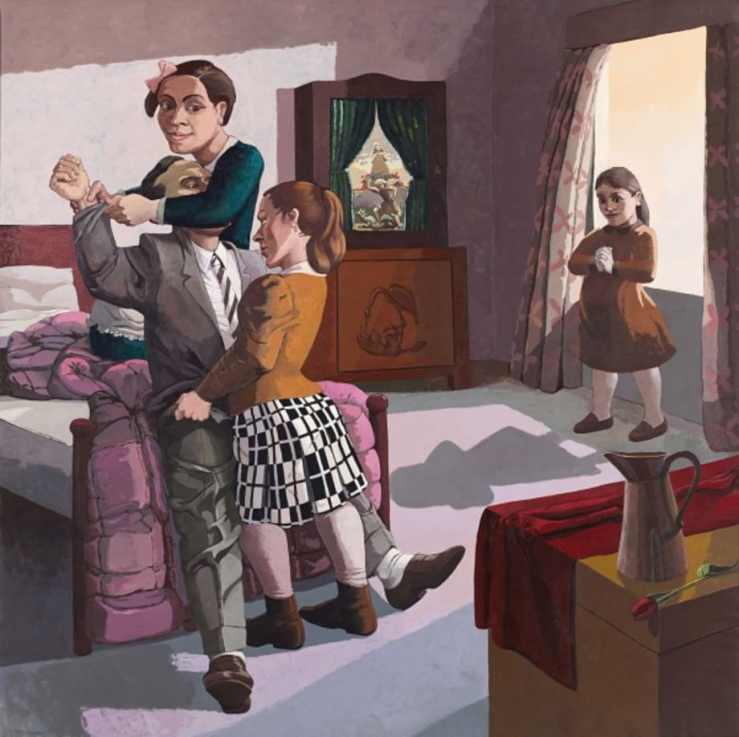
I’m pretty sure it was in Chadwick’s Women, Art, And Society that I first saw a reproduction of The Family, a painting that shocked me, and reminded me of the work of one of my favorite painters at the time, Balthus, as well as the films of David Lynch.

The Family, 1988
The Maids, 1987

There’s an uncanny mix of humor and paranoid terror in much of Rego’s work, and her feminist reimagining of folk tales and myths has much in common with the work of writers like Angela Carter and Anne Sexton.

little murderess
The Little Murderess, 1987
20091202023111_paularegofitting
The Fitting, 1989
1-1
The Policeman’s Daughter, 1987

A strong advocate of women’s rights, in 2019 Rego called out the increasingly-draconian anti-choice laws being acted in America, telling The Guardian, “It seems unbelievable that these battles have to be fought all over again. It’s grotesque.”

In 1998, Rego, who spoke publicly about her own abortions, created a series called The Abortion Pastels. The series depicted the reality of unsafe illegal abortions, and was a response to a failed referendum to legalize abortion in her native Portugal.

Untitled No.1 (from The Abortion Pastels), 1998

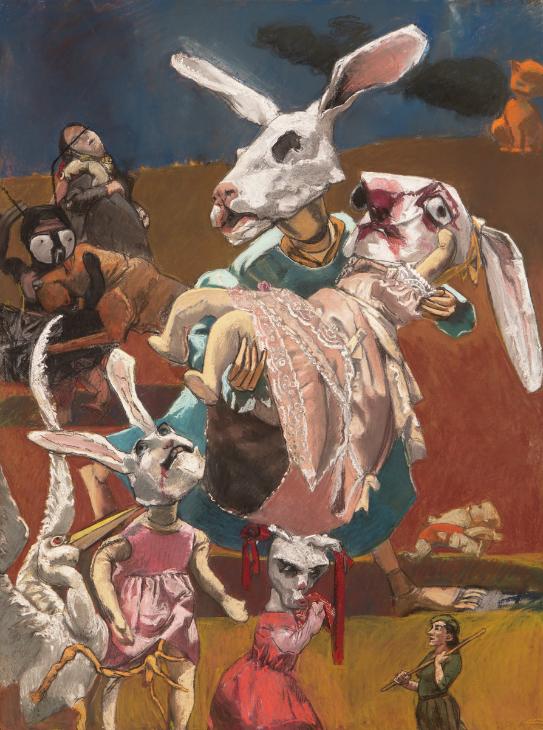
Rego’s work also addressed human trafficking, so-called “honor killings,” and war in an oblique, surreal-tinged style that transcends the limits of social realist figurative art.

Human Cargo, 2008
Two Women Being Stoned, 1995
War, 2003

And while Rego’s art addressed sociocultural ills, and in doing so was often shocking and disturbing, it is nevertheless beautiful—she was a fantastic painter and left a strong, large body of work that will, I suspect, feel even more relevant as the twenty-first century careens into fascism and fear.

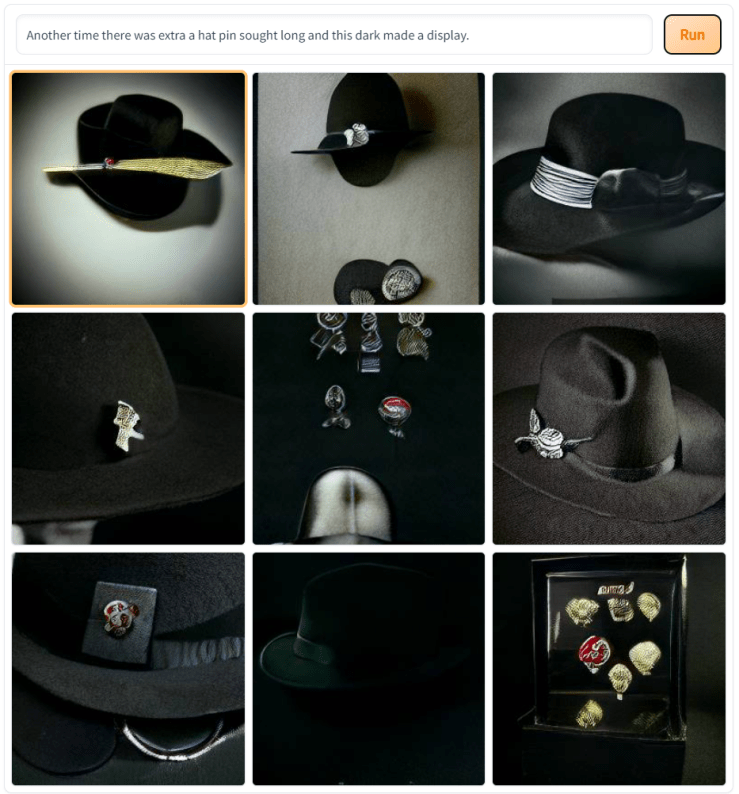
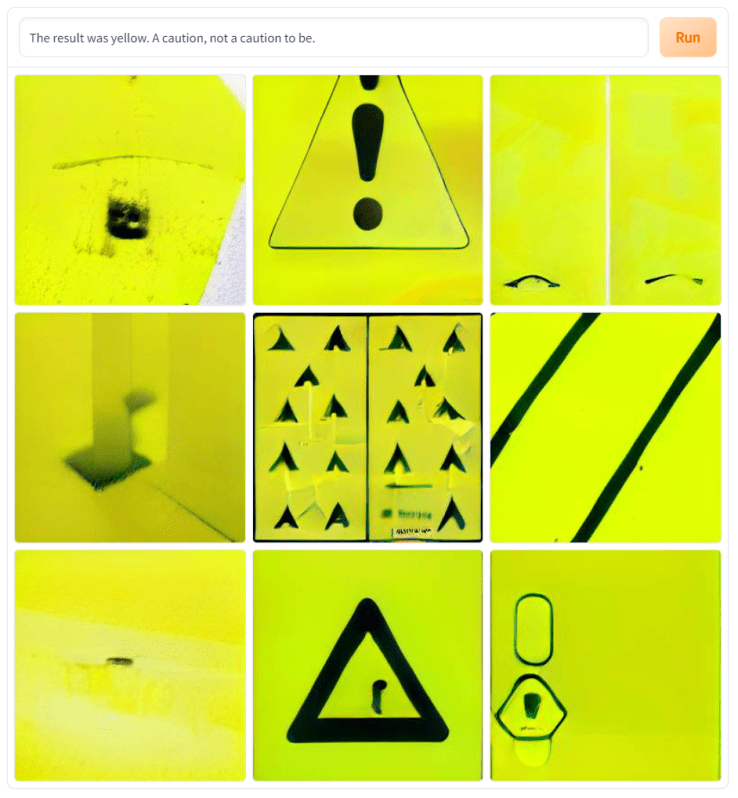
Gertrude Stein’s “Cake” via DALL-E mini


“Cake” by Gertrude Stein is from Food, part of Tender Buttons.

DALL-E mini is by Boris Dayma and colleagues.


“Cake”

by

Gertrude Stein

Cake cast in went to be and needles wine needles are such.

This is today. A can experiment is that which makes a town, makes a town dirty, it is little please. We came back. Two bore, bore what, a mussed ash, ash when there is tin. This meant cake. It was a sign.

Another time there was extra a hat pin sought long and this dark made a display. The result was yellow. A caution, not a caution to be.

It is no use to cause a foolish number. A blanket stretch a cloud, a shame, all that bakery can tease, all that is beginning and yesterday yesterday we had it met. It means some change. No some day.

A little leaf upon a scene an ocean any where there, a bland and likely in the stream a recollection green land. Why white.

Trey Ellis’s Platitudes (Book acquired, 6 June 2022)

I had a full 90 minutes to browse the second, downtown location of my favorite bookshop today, while my daughter completed onboarding at City Hall for her summer job. I picked up assigned summer reading for both of my kids, and came across a Vintage Contemporaries edition I’d never seen before: Trey Ellis’s debut novel PlatitudesThe blurb on the back by Ishmael Reed sold me on Platitudes:

I was zapped by Trey Ellis’s humongous talent. His book, Platitudes, is delightfully rad. He dares to have the gumption to write comically about American literary politics.

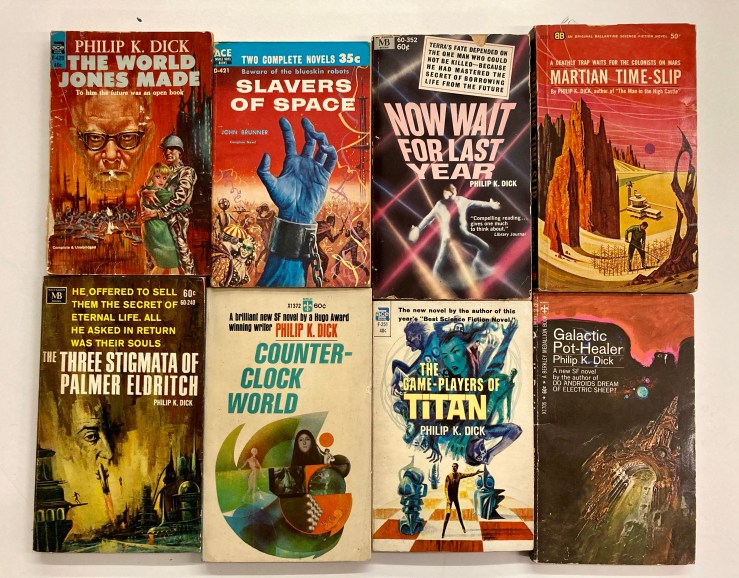
I also managed to avoid leaving with a bunch of massmarket paperbacks by Philip K. Dick—but here’s a pic of all their covers: 

—which I think are so much more interesting than these handsome, respectable, uniform contemporaries:

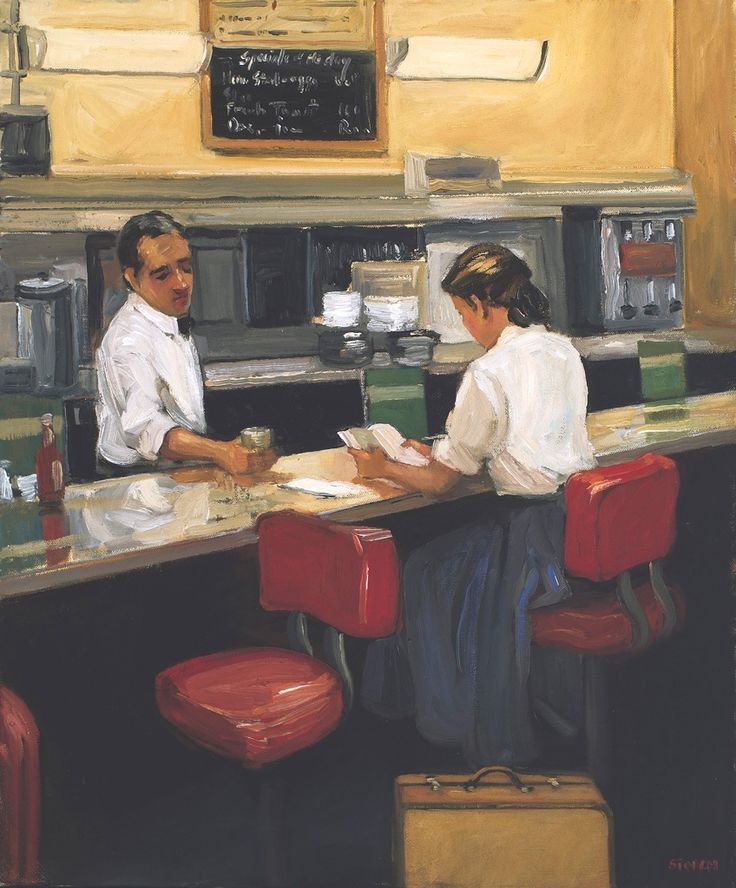
Grand Central Cafe, Girl in a Blue Skirt — Sally Storch

Grand Central Cafe, Girl in a Blue Skirt, 2006 by Sally Storch (b. 1952)

“June Wind” — Wendell Berry

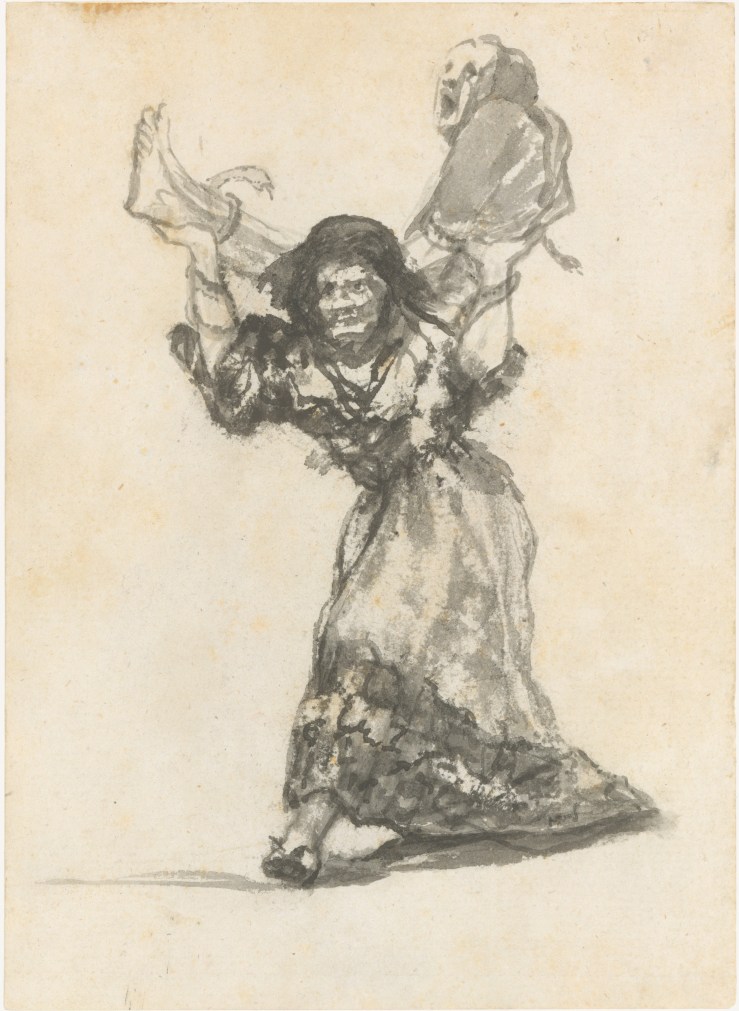
Unholy Union —  Francisco Goya

Unholy Union, c. 1801–3 or c. 1813–19 by Francisco Goya (1746-1828)

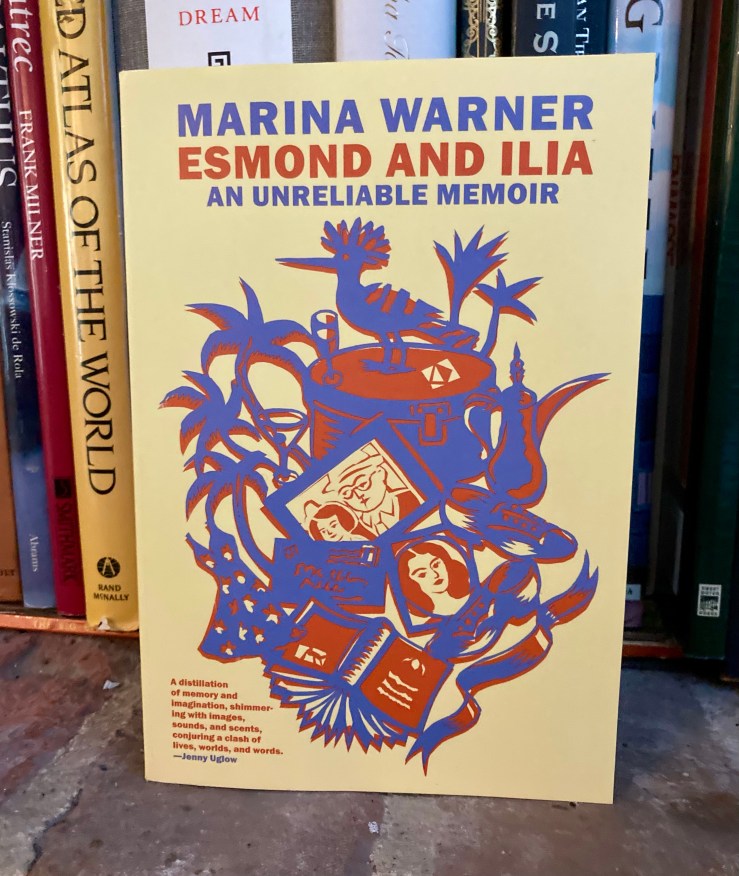
Marina Warner’s Esmond and Ilia (Book acquired, late May 2022)

Marina Warner’s “unreliable memoir” of her parents’ early life as a couple came to Biblioklept World Headquarters a few days ago. While I haven’t read much, the form (and content, to a certain degree), remind me of a post-Sebaldian mode. NYRB’s blurb:

Marina Warner’s father, Esmond, met her mother, Ilia, while serving as an officer in the British Army during the Second World War. As Allied forces fought their way north through Italy, Esmond found himself in the southern town of Bari, where Ilia had grown up, one of four girls of a widowed mother. The Englishman approaching middle age and the twenty-one-year-old Italian were soon married. Before the war had come to an end, Ilia was on her way alone to London to wait for her husband’s return and to learn how to be Mrs. Esmond Warner, an Englishwoman.

Ilia begins to learn the world of cricket, riding, canned food, and distant relations she has landed in, while Esmond, in spite of his connections, struggles to support his wife and young daughter. He comes up with the idea of opening a bookshop, a branch of W.H. Smith’s, in Cairo, where he had spent happy times during the North African campaign. In Egypt, however, nationalists are challenging foreign influences, especially British ones, and before long Cairo is on fire.

Deeply felt, closely observed, rich with strange lore, Esmond and Ilia is a picture of vanished worlds, a portrait of two people struggling to know each other and themselves, a daughter’s story of trying to come to terms with a past that is both hers and unknowable to her. It is an “unreliable memoir”—what memoir isn’t?—and a lasting work of literature, lyrical, sorrowful, shaped by love and wonder.

American Summer 2020 — Cristina BanBan

American Summer 2020, 2020 by Cristina BanBan (b. 1987)


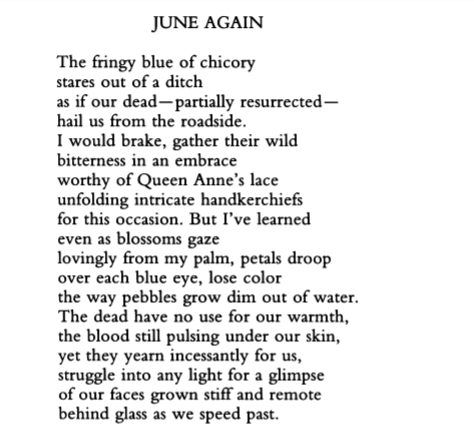
“June Again” — Judy Longley

Help II — William Crutchfield

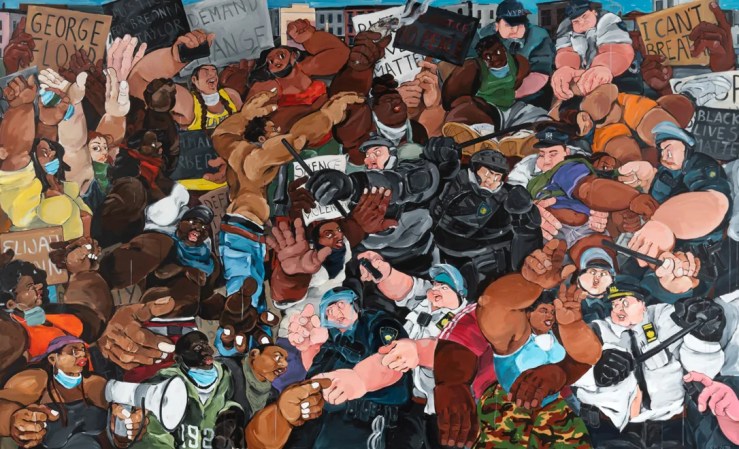
Help II, 1972 by William Crutchfield (1932-2015)

All these beefy Caucasians with guns! (From Neal Stephenson’s novel Snow Crash)


All these beefy Caucasians with guns!  Get enough of them together, looking for the America they always believed they’d grow up in, and they glom together like overcooked rice, form integral, starchy little units.  With their power tools, portable generators, weapons, four-wheel-drive vehicles, and personal computers, they are like beavers hyped up on crystal meth, manic engineers without a blueprint, chewing through the wilderness, building things and abandoning them, altering the flow of mighty rivers and then moving on because the place ain’t what it used to be.

The byproduct of the lifestyle is polluted rivers, greenhouse effect, spouse abuse, televangelists, and serial killers.  But as long as you have that four-wheel-drive vehicle and can keep driving north, you can sustain it, keep moving just quickly enough to stay one step ahead of your own waste stream.  In twenty years, ten million white people will converge on the north pole and park their bagos there.  The low-grade waste heat of their thermodynamically intense lifestyle will turn the crystalline icescape pliable and treacherous.  It will melt a hole through the polar icecap, and all that metal will sink to the bottom, sucking the biomass down with it.

From Neal Stephenson’s prescient 1992 cyberthriller Snow Crash.

Last day of school

Today was the last day of school for my kids. They both started new schools this year (high school and middle school). It’s been a weird few years and a bad few days. My son chose not to attend the last two days but my daughter wanted to see her friends. My mother called me the afternoon of the Ulvade murders to ask if my kids were okay and I didn’t even know how to answer. My daughter has been in two active-shooter lockdowns already in her life and she’s not even 15. They’ve spent their entire life fully inscribed in this nightmare. One of the worst memories of my early parenthood was my daughter coming home from kindergarten and describing her first active-shooter practice drill: “Some of us were weeping,” she said. It was the word weeping that really stuck with my wife and me—the odd precision of it.

I don’t want to rant on here; that’s not what this blog is for, and not what I imagine those who check in on it want to read or see. I expressed my own sense of horror and despair obliquely on here the other day, in any case.

I spent too much of today staring at screens, reading, horrified and angry, still stunned by the stupidity of the world we’ve botched together. I tried to pick up the book I’ve been trying to read, but I found I couldn’t press into it, couldn’t focus on a sentence let alone a paragraph. I ended up playing a lot of internet chess, on the smaller screen.

And then I found myself exhausted, needing to get out of the house. So I pulled the same Friday trick I always do, which sometimes works and sometimes doesn’t. I went to the used bookstore down the road.

I like to browse and handle the material there, looking for oddities and weird scores. I ended up with a hardback ex-library copy of Vladimir Sorokin’s Day of the Oprichnik (trans. Jamey Gambrell, RIP). It’s in the stack below, a stack of books I’ve read or am (ostensibly) reading:
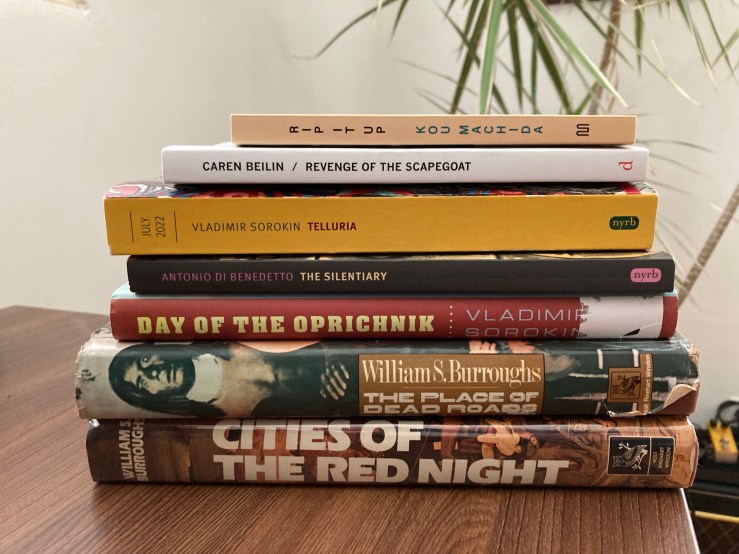
And so some mini-not-reviews, top to bottom:

Kou Machida’s Rip It Up (trans. Daniel Joseph): Read it back in April when I was finishing up the semester—it was a wonderful punk-psych antidote to final essay doldrums. Short, kinetic, caustic, and surreal. I wrote about the first part here.

Caren Beilin’s Revenge of the Scapegoat: This is the novel I attempted to start a few days ago, after finishing William Burroughs’s The Western Lands. I am having a hard time reading anything right now, let alone writing any proper review. I hope the thing I once had comes back.

Vladimir Sorokin’s Telluria (trans. Max Lawton): The best contemporary novel I’ve read in a long time—a polyglossic satirical epic pieced together in vital miniatures. Rich and dense but also loose and funny, Sorokin’s post-collapse world doesn’t seem all that bad.

Antonio di Benedtto’s The Silentiary (trans. Esther Allen): The narrator of this understated Kafkaesque novel cannot abide the increasing cacophony of 20th-century life. His resistance to noise is futile though, and comes at great cost to both himself and his family. The Silentiary is good stuff, but not as achieved as Di Benedetto’s novel Zama.

I bought Sorokin’s Day of Oprichnik today.

(Parenthetically: I went to the bookstore, as I stated above, to try to decompress, get away from screens, news, etc.—but I could not.

There was a young woman standing near the “RE” area in General Fiction having the loudest possible conversation one can have on a phone without actually yelling. She was talking at her mother about all the strife she has with her brother, who is also her roommate, and her father (who is divorced from the mother). The young woman cursed in almost every sentence she spoke, damning her brother for not taking out the trash, for not doing the dishes, etc. She near-shouted about her father’s siding with her brother, and about how the whole situation necessitates more therapy for her, and how she is the sane responsible one, while her brother is not. Her brother refuses to engage with her when she addresses him, claiming that he claims he can’t talk to her when she shouts, but how can she not be emotional when she’s angry? And how does that mean that she’s not rational, just because she’s yelling? And isn’t he really the abusive one, for shutting down on her and not responding when she, a grown-ass adult, is simply trying to confront him about not doing what he should be doing?

I put this information together in waves over 45 minutes. It was like running up a caustic radio show that tuned in and out depending on my proximity to its signal. Vile.)

William S. Burroughs’s final trilogy: I haven’t read WSB in ages, but I finished up his last novel, The Western Lands a few days ago (not pictured because it’s still in my car; I’d been rereading bits during carpool pick-up).. The final three books in Burroughs’s oeuvre are maybe his best (and most-overlooked), and The Place of Dead Roads is particularly fantastic.

Okay, I’m out of juice. I hope the summer is better for most of us, although there’s not much force in that verb, hope.
Coward — Kazimir Malevich

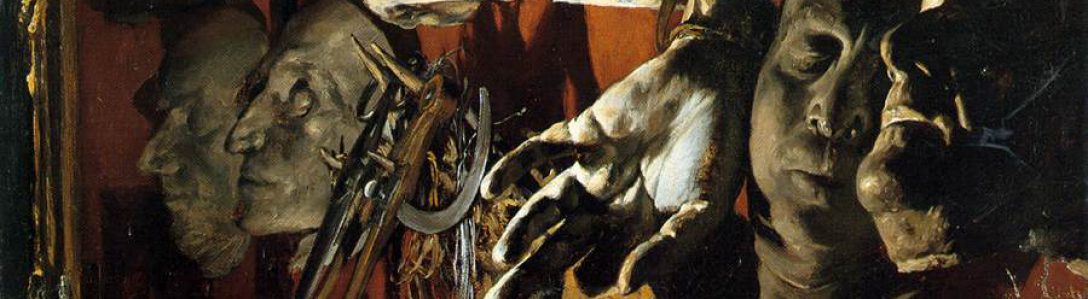
Coward, 1913 by Kazimir Malevich (1879-1935)