Friedrich Nietzsche. From Mixed Opinions and Maxims:
(138) Marks of the good writer.— Good writers have two things in common; they prefer to be understood rather than admired; and they do not write for knowing and over-acute readers.
Friedrich Nietzsche. From Mixed Opinions and Maxims:
(138) Marks of the good writer.— Good writers have two things in common; they prefer to be understood rather than admired; and they do not write for knowing and over-acute readers.
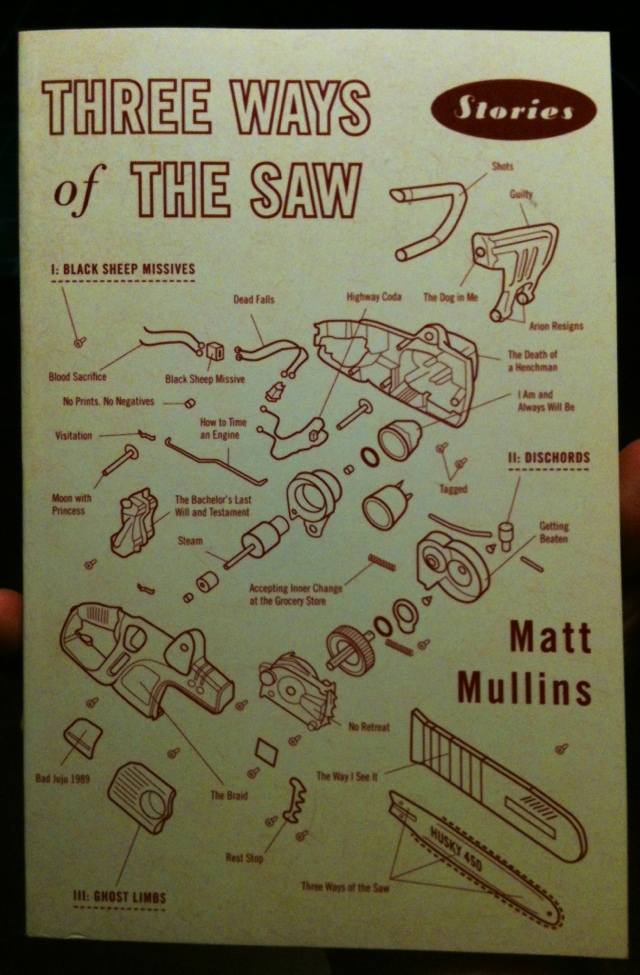
Matt Mullins’s Three Ways of the Saw (new in February from Atticus): Spent a few afternoons sifting through this volume, intrigued by its outstanding cover (I use the word “outstanding” literally; over a dozen titles came into Bblklpt Wrld Hdqrtrs this fine week). Mullins’s volume, stocked with short and short-short (and micro-) stories, bristles with boozy energy, grit, ugly druggy nervy episodes, shenanigans, dirty hi-jinks, breaking families, bad sons, bad people, broken people, desperate people . . . There’s a strong Bukoswkiish vibe to the business, with less ego, more concrete imagery, more Denis Johnson. I like this book.
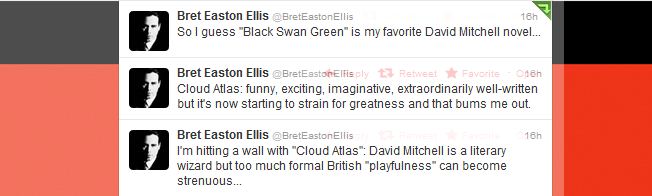
Friedrich Nietzsche. From Mixed Opinions and Maxims:
(137) The worst readers.— The worst readers are those who behave like plundering troops: they take away a few things they can use, dirty and confound the remainder, and revile the whole.
 Check out the Peabody Essex Museum’s marvelous interactive exhibit Navigating the Imagination, which lets you view (and play with) the works of artist Joseph Cornell. The images here come from a 1911 textbook that Cornell transformed into a magical book object, full of illustrations, collages, quotes, and cut outs (you can peruse the entire book).


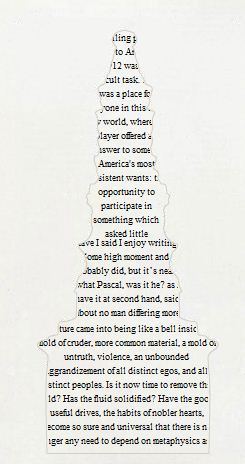
Bonus: Make your own Word Tower in the “Crystal Cage” machine. Here’s mine; I used snips from open tabs on my browser (two pieces from Gaddis and a Nietzsche):
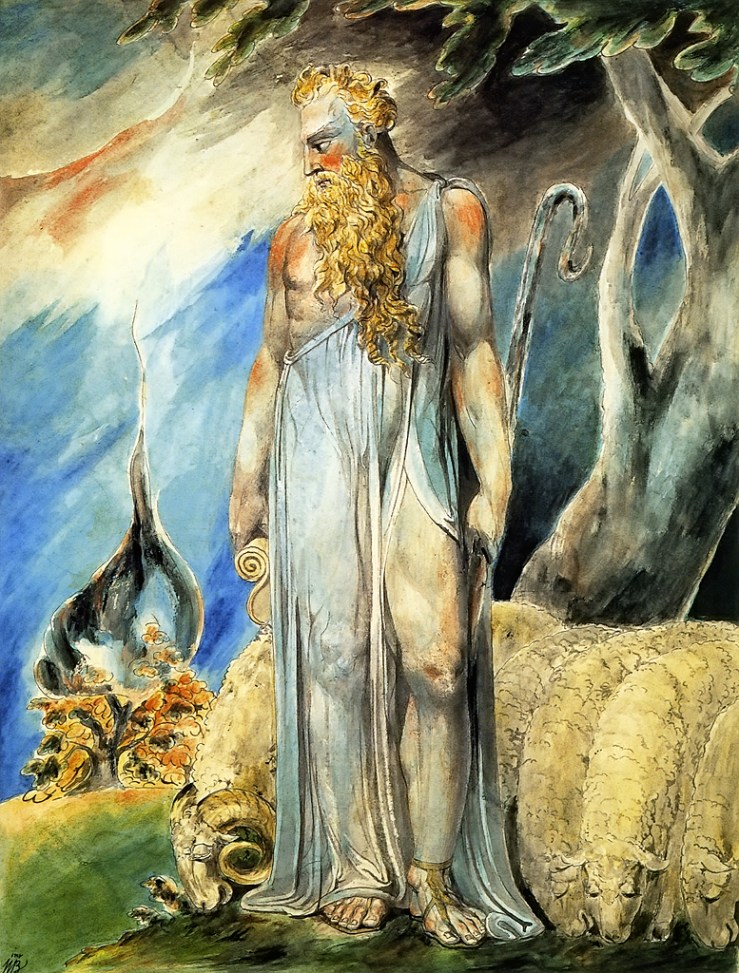
From Nathaniel Hawthorne’s journal (via):
September 1, 1842. Mr. Thoreau dined with us yesterday…. He is a keen and delicate observer of nature–a genuine observer–which, I suspect, is almost as rare a character as even an original poet; and Nature, in return for his love, seems to adopt him as her especial child, and shows him secrets which few others are allowed to witness. He is familiar with beast, fish, fowl, and reptile, and has strange stories to tell of adventures, and friendly passages with these lower brethren of mortality. Herb and flower, likewise, wherever they grow, whether in garden or wildwood, are his familiar friends. He is also on intimate terms with the clouds, and can tell the portents of storms. It is a characteristic trait that he has a great regard for the memory of the Indian tribes, whose wild life would have suited him so well; and strange to say, he seldom walks over a ploughed field without picking up an arrow-point, a spearhead, or other relic of the red men–as if their spirits willed him to be the inheritor of their simple wealth.
With all this he has more than a tincture of literature,–a deep and true taste for poetry, especially for the elder poets, and he is a good writer,–at least he has written a good article, a rambling disquisition on Natural History, in the last Dial, which, he says, was chiefly made up from journals of his own observations. Methinks this article gives a very fair image of his mind and character,–so true, innate, and literal in observation, yet giving the spirit as well as letter of what he sees, even as a lake reflects its wooded banks, showing every leaf, yet giving the wild beauty of the whole scene. Then there are in the article passages of cloudy and dreamy metaphysics, and also passages where his thoughts seem to measure and attune themselves into spontaneus verse, as they rightfully may, since there is real poetry in them. There is a basis of good sense and of moral truth, too, throughout the article, which also is a reflection of his character; for he is not unwise to think and feel, and I find him a healthy and wholesome man to know.
After dinner (at which we cut the first watermelon and muskmelon that our garden has ripened) Mr. Thoreau and I walked up the bank of the river; and, at a certain point, he shouted for his boat. Forthwith, a young man paddled it across the river, and Mr. Thoreau and I voyaged farther up the stream, which soon became more beautiful than any picture, with its dark and quiet sheet of water, half shaded, half sunny, between high and wooded banks. The late rains have swollen the stream so much that many trees are standing up to their knees, as it were, in the water, and boughs, which lately swung high in air, now dip and drink deep of the passing wave. As to the poor cardinals which glowed upon the bank a few days since, I could see only a few of their scarlet hats, peeping above the tide. Mr. Thoreau managed the boat so perfectly, either with two paddles or with one, that it seemed instinct with his own will, and to require no physical effort to guide it. He said that, when some Indians visited Concord a few years since, he found that he had acquired, without a teacher, their precise method of propelling and steering a canoe. Nevertheless he was desirous of selling the boat of which he is so fit a pilot, and which was built by his own hands; so I agreed to take it, and accordingly became possessor of the Musketaquid. I wish I could acquire the aquatic skill of the original owner.
from American Notebooks (1835-42)

Friedrich Nietzsche. From Mixed Opinions and Maxims:
(130) Reader’s bad manners. —A reader is doubly guilty of bad manners against the author when he praises his second book at the expense of the first (or vice versa) and then asks the author to be grateful for that.
The New Yorker has published an excerpt from The Secret of Evil, the latest posthumous offering from Roberto Bolaño (new this spring from New Directions). The excerpt begins by extrapolating on a photo of some of the Tel Quel folks, (including a striking Julia Kristeva):
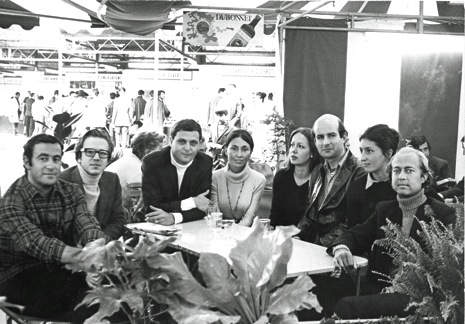
They’re seated. They’re looking at the camera. They are captioned, from left to right: J. Henric, J.-J. Goux, Ph. Sollers, J. Kristeva, M.-Th. Réveillé, P. Guyotat, C. Devade, and M. Devade.
There’s no photo credit.
They’re sitting around a table. It’s an ordinary table, made of wood, perhaps, or plastic, it could even be a marble table on metal legs, but nothing could be less germane to my purpose than to give an exhaustive description of it. The table is a table that is large enough to seat the above-mentioned individuals and it’s in a café. Or appears to be. Let’s suppose, for the moment, that it’s in a café.
The eight people who appear in the photo, who are posing for the photo, are fanned out around one side of the table in a crescent or a kind of opened-out horseshoe, so that each of them can be seen clearly and completely. In other words, no one is facing away from the camera. In front of them, or rather between them and the photographer (and this is slightly strange), there are three plants—a rhododendron, a ficus, and an everlasting—rising from a planter, which may serve, but this is speculation, as a barrier between two distinct sections of the café.
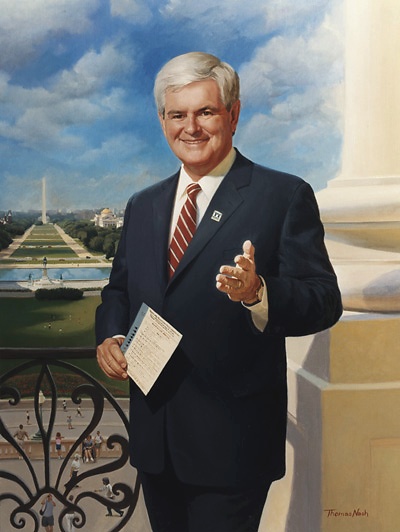
I recently saw this portrait of current Republican nomination candidate/constant font of regressive ideas Newt Gingrich on an image board I frequent. It’s by Georgia-based portrait artist Thomas Nash, whose website I had to visit after seeing this picture.
For some reason I can’t quite articulate, Nash’s portraits are surreal to me. I don’t think it’s purposeful, of course—he’s clearly a technically competent artist whose oil paintings are meant to confer a sense of power twinned in benevolence.
It must be my own sense of history, of power, of irony, that makes me feel thoroughly creeped out by this portrait of Newt—the manically glib glint in his eye (his left eyebrow ever-so slightly arched in cocky condescension), the sinister light that seems to emanate from his upraised, extended left hand, the mysterious document casually clutched in his right, the phallic authority of the Washington Monument jutting out from the Mall in the background as tiny tourists mill about, one even pausing to aim his camera from behind the scroll work at the viewer . . .
It’s odd, malevolent, and engrossing, but when paired against the other portraits in Nash’s collection of “Men,” like former Democratic Senator (and George W. Bush supporter) Zell Miller, it seems even more sinister and ironic to me, as if some evil scream lurked in the background, suppressed, detained, a black hood over its metaphorical head:
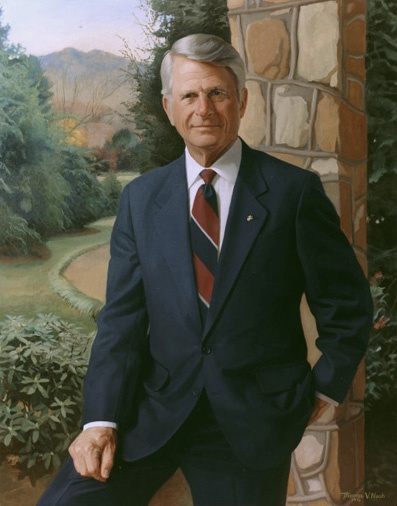
Or these guys:

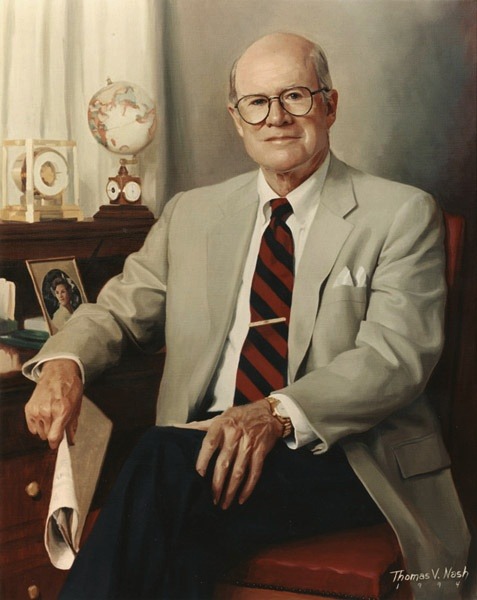
In some sense, these paintings strike me as the strange dry twins of the work of sensualist John Currin, a subjective claim that is perhaps unsupportable but nevertheless seems true to me.
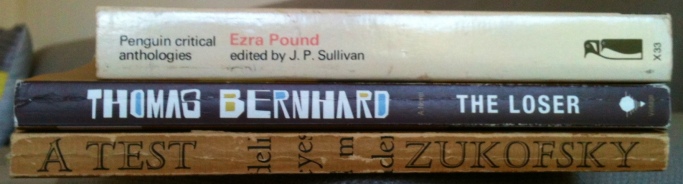
Picked up these three last Friday.
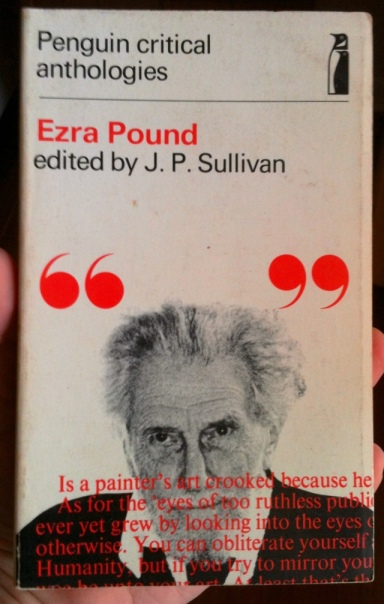
This is a collection of letters to and from Ezra Pound, as well as criticism, introductions, etc. I like the cover, which is a bit too busy.
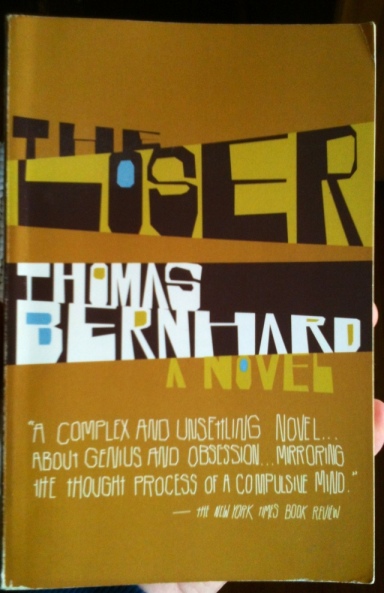
I picked up Thomas Bernhard’s Correction last year on reader recommendation (recommendation: read Bernhard). Saw The Loser in the shop used, so I picked it up. Any recommendation on which one to start with?
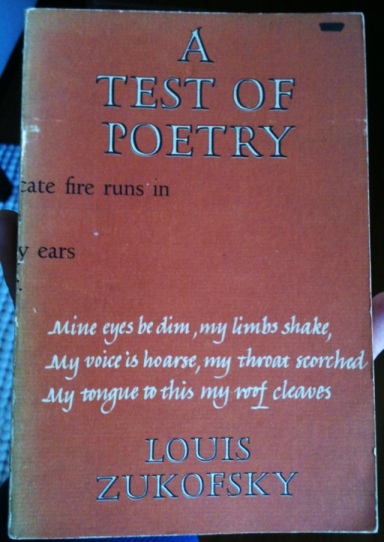
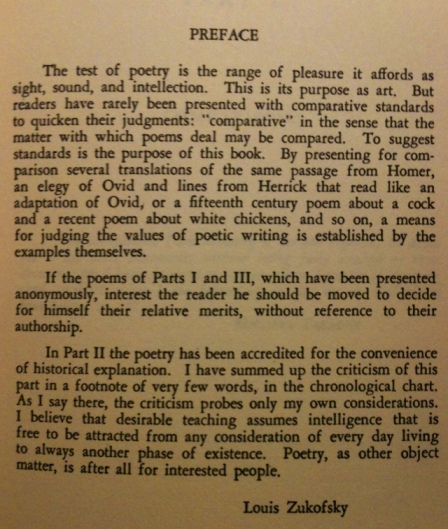
A midcentury paperback of Louis Zukofsky’s A Test of Poetry. This is a strange book. I’d better let Zukofsky explain it:
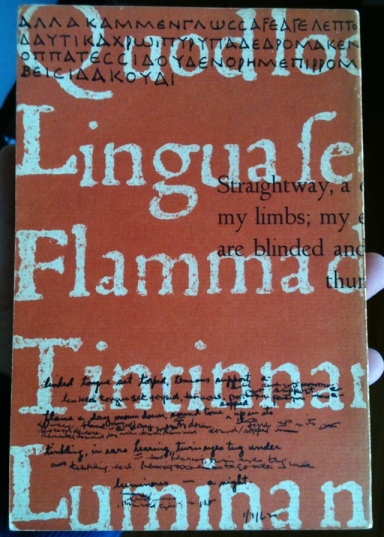
The back cover is lovely as well:
Critic/contrarian Armond White’s 2011 Better-Than-List uses one movie to beat up on another. It’s grand reading—read it in full! A few choice snips:




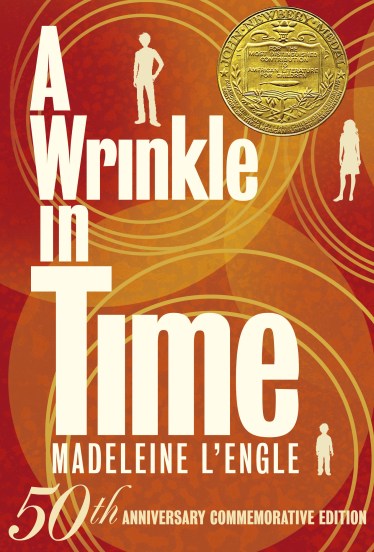
Madeleine L’Engle’s seminal fantasy novel A Wrinkle in Time turns 50 this year, and publisher Macmillan is celebrating by releasing a new anniversary edition with oodles of extras, including photos, manuscript pages, and new editorial content. They’ve also initiated a “50 Years, 50 Days, 50 Blogs Celebration Campaign” to promote the new book, and they asked Biblioklept to participate in the first week.
Here is the new cover:
And here is the cover to my beloved, ragged edition:
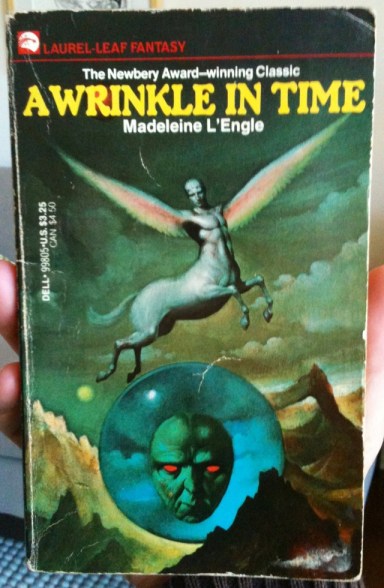
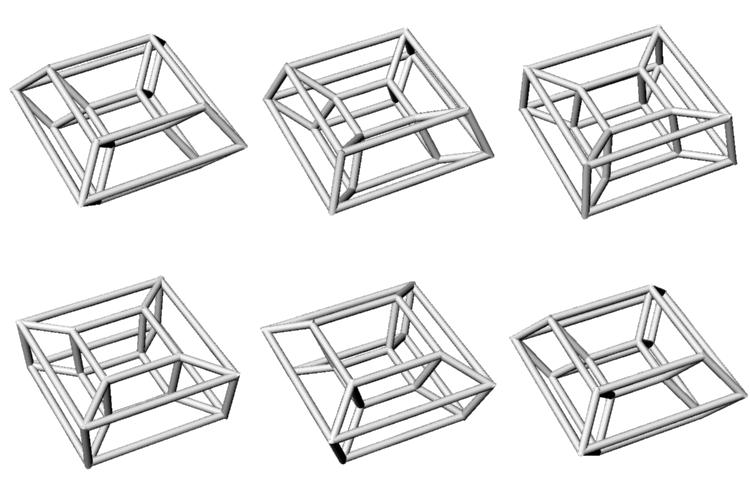
A Wrinkle in Time explores the strange intersections of space and time against a backdrop of adolescent angst. Our intrepid heroine Meg, her child genius brother Charles Wallace, and her would-be beau Calvin O’Keefe, go on a trans-dimensional quest to find her missing physicist father. They are aided (and initiated into) this quest by a trio of immortal women (shades of the Norns); their intergalactic mission finds them encountering angelic centaurs, motherly tentacled beasts, a red-eyed automaton, a disembodied brain, and more more more. Dr. Dad has disappeared while working on a mysterious project involving a tesseract.
Here’s a nifty visualization of the tesseract:
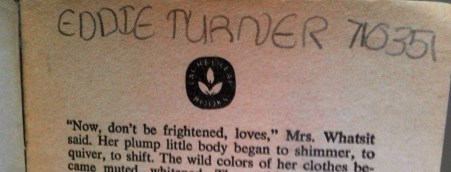
Like a lot of young people, as a child I was deeply fascinated by the concept of “tessering” away to a strange, marvelous, dangerous place, and it was surely this idea that most enthralled me as an early reader of the novel. I was probably ten when I first read the book, which I’m pretty sure was a gift from my aunt who brought it to me while our family was living in New Zealand. I actually wrote my name and our six-digit phone number into the book, which suggests that I loaned it out quite a bit.
A Wrinkle in Time gelled with all of the stuff I was reading then: lots of Tolkien, C.S.Lewis, and Douglas Adams, but also plenty of crappy Dr. Who novels and lots of execrable fantasy novels. L’Engle’s novels (of course I read all of them after reading Wrinkle; to this day, Many Waters is probably the one that stands out the most, weird and sexy as it was) were of a piece with Tolkien and Lewis (especially Lewis’s oft-overlooked space trilogy)—but there was something distinctly American about L’Engle’s characters—her writing even—that intrigued me. I had spent my entire childhood expatriated and was constantly looking for avenues of American expression, ways “to be American” (yes, I realize how silly that sounds now).
In retrospect, it’s not the tesseract and its fantastical properties that I so recall from A Wrinkle in Time so much as it is L’Engle’s characters, especially mercurial Meg and her future-husband Calvin. While much of literature emphasizes the clash between individual desires and societal conventions, L’Engle’s particular tone and characterization is keenly sensitive to the difficulties adolescents face navigating this conflict. In a sense, L’Engle is working out the early blueprint for what would become the conventions of Young Adult literature. L’Engle wrote a specific brand of sci-fi/fantasy that, on the surface, sets her apart from S.E. Hinton and Robert Cormier—but what these writers share in common, what makes their work so enduring even as society changes, is the essential emotional reality their characters share with readers.
Wrinkle endures also because of its handling of complex themes of conformity, idealism, faith, and science. It’s a book that challenges a youngish audience to read in new ways. It’s also a frequently challenged book—always the sign of something good—suggesting that it’s not going anywhere soon. In this sense, Wrinkle’s literary legacy externally recapitulates its internal themes of nonconformity.
Of course, characterization and strong themes probably wouldn’t get too far with young readers if Wrinkle didn’t deliver the goods that YA readers demand: a good yarn. Wrinkle is spry and engaging at fifty, and while it’s not as bloody as new kid on the block The Hunger Games (the protagonist of which owes some small debt to Meg Murray) it nevertheless negotiates the dangers of existence (both physical and metaphysical) with greater emotional intensity.
But I’ve veered off course here, invoking a newer, more violent YA star at the end of my riff, when what I really want to do is encourage young people who haven’t read Wrinkle yet to pick it up (okay, especially young people who think that Collins’s trilogy is the bee’s knees). It’s a wise, endearing, and enduring classic, one that deserves attention on its golden anniversary.

 Biblioklept