Peter Brook Talks About “The Theater of Silence”

Book Acquired, 9.29.2011

20110929-030604.jpg

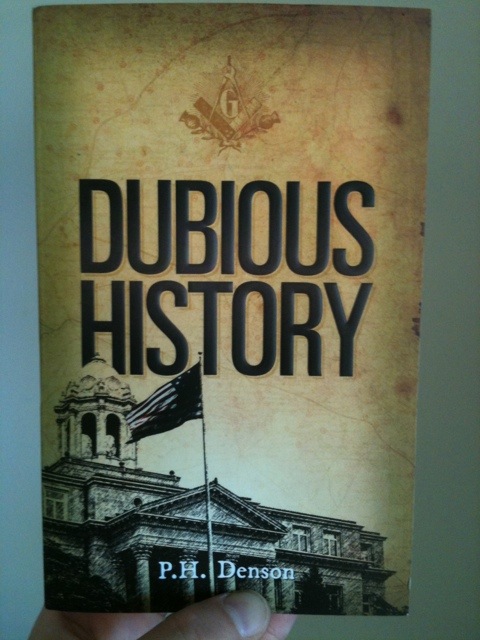
Dubious History by P.H. Denson. This sucker is thick; 550+ pages of conspiracy theory driven thriller. I read the first few pages this afternoon; the writing is much better than the swollen publisher’s description below—

Drawing on the secretive and intriguing mysteries of the Masonic brotherhood, the fast-paced, brilliantly layered storyline and its fascinating central characters have proved a big hit with readers who like to have their wits challenged and to be kept guessing right to the end. The story begins with what appears to be a hit-and-run ‘accident’ and moves rapidly to reveal a chilling web of serial murders and a deadly Masonic secret. George Fairfax, a Pulitzer nominee researching the history of a small American town, falls victim to a hit-and-run. When his nephew Zach steps in to complete writing the town’s history, he quickly becomes suspicious of his uncle’s ‘accidental’ death. Zach begins to unravel a spiderweb of clues that point to a dangerous Masonic secret which may also be responsible for the mysterious deaths of a number of other members of the Masonic lodge. Can Zach decode the clues to the two-hundred-year-old secret in time to find the serial killer before he claims his next victim? And what twists await at every turn as each clue uncovers more of the shocking truth behind the killer’s real end-game?

“We’re Made of Fragile Stuff” — Damien Hirst Rambles Incoherently on Francis Bacon

“Fictional Map of L.A.” — Geoff McFetridge


Geoff McFetridge’s fictional map of L.A., from GOOD magazine.

Hark! A Vagrant Does Wuthering Heights

At Hark! A Vagrant, satirist supreme Kate Beaton sends up Wuthering Heights. Beaton’s book is now available for preorder.

Harold Bloom Talks About Blood Meridian (Video)

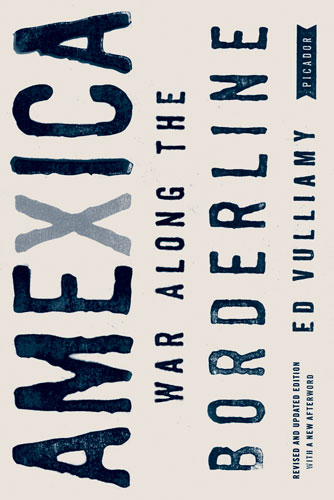
Amexica — Ed Vulliamy’s Violent Chronicle of the Border Wars

Like Cormac McCarthy’s Blood Meridian or Roberto Bolaño’s  2666, Ed Vulliamy’s Amexica explores violence and bloodshed along the porous border between Mexico and America. Unlike those blistering novels, Amexica belongs in the nonfiction section: it’s a sustained work of investigative journalism, part travelogue, part horror story, and all-too real. Blood Meridian and 2666 both have clear roots in the violent history of the borderland, but the membrane of literary fiction serves as a kind of psychological protection for the reader, an affective out, perhaps — “It’s just a book,” we might tell ourselves. Amexica, on the other hand, is unrelentingly true, real, and inescapably ugly. I have a predilection, I almost hate to admit, for literary violence, for bloody books—Blood Meridian and 2666 are two of my favorite books—although bloodshed is not the only reason I read. The violence in Amexica though can be stomach turning at times. Here’s a litmus test—the book’s first paragraph—

As dawn breaks over the vast desert, the body is hanging from a concrete overpass known as the Bridge of Dreams. It has been there for two hours—decapitated and dangling by a rope tied around the armpits. The sun begins to throw its rays across the busy intersection with its rush-hour traffic and former American school buses carrying workers to sweatshops. And it is still there an hour later, this grotesque, headless thing—swaying, hands cuffed behind its back—in the cold early morning wind that kicks up dust and cuts through the Mexican border town of Ciudad Juárez, the most dangerous city in the world.

From the outset, Vulliamy is unflinching in his portrayal of the borderland, the strange, amorphous world he calls “Amexica,” a place riddled with ambiguity, paradox, and uncertainty; indeed the only thing certain in Amexica is violence.

Vulliamy’s book is a west-to-east travelogue of Amexica, from the Pacific Coast (where he takes part in a surreal picnic on the beach where relatives pass food through a wire fence) to the Gulf Coast of Texas. What unites each stop along Vulliamy’s way is the relentless war between rivaling drug cartels and the federal, state, and local police. To clarify that last sentence, let me point out that the drug wars on the border are bellum omnium contra omnes, war of all against all—the drug cartels are at war with each other, but law enforcement are at war against each other as well, the various police forces backing various drug cartels.

Vulliamy’s difficult job is to suss out the whys and the hows of the drug war, but it’s an almost impossibly huge task. He tells us—

This book is not so much about a war as it is a view of a singular place in time of war. It is about the ways war impacts Amexica, but it is also about how the war is a consequence of other—mainly economic—degradations and exploitations, quite apart from drugs, from which the border’s people suffer. A suffering due not least to the fact that narco cartels are corporations like any other, applying the commercial logic and following the same globalized “business models” as the multiplicity of legal enterprises that have wreaked havoc along the borderline. Indeed, the drug violence is in many ways a direct result of this depredation caused by the legal globalized economy. The cartels are not pastiches of multinational capital—they are pioneers of it, integral to it, and apply its rules and logic (or, rather, lack of rules and logic) to their marketplace just as does any other commercial enterprise.

Vulliamy’s indictment of global capitalism as the root of the narco wars is plain—as is his righteous anger—but Amexica works better when it focuses on character and detail than when Vulliamy tries for targets that are simply too unwieldy. Amexica is at its best when Vulliamy plays tour guide, showing us the people of the border first hand, like the coroner in Tijuana who deciphers bodily mutilations as an Egyptologist might study hieroglyphs, or the bereaved mother of two notorious gangsters, or Julian Cardona, whose photographs of Juárez are charged with pathos, loss, and the traces of violence that plague that center of anarchy.

Indeed, Juárez is the grand, ugly center of both Vulliamy’s journey as well as his book; those who thrilled and suffered in Bolaño’s thinly-fictionalized version in 2666, “Santa Theresa,” will find a similar and equally disturbing beast. Anyone still searching for “the real killers” from Bolaño’s murder mystery are encouraged to read Vulliamy’s chapter on Juárez (short answer: we all did it).

Vulliamy’s journalism has a strong literary vein running through it, and like William T. Vollmann (who also chronicled a slice of the border in Imperial), he makes no pretense toward objectivity or neutrality. While Vulliamy puts his subjects and interviewees front and center, he never tries to hide or obscure his own involvement in the process; nor does he aggrandize his role, which surely must have been tempting given the extreme dangers of his project. And if at times his anger or indignation tips into furious verbosity (he could stand to slice a dependent clause or two), he’s surely earned it.

Amexica should be on the radar and reading list of anyone interested in the narco wars, or anyone who wants to learn more of the “real” story behind the murders explored in 2666. For all Amexica’s violence, there’s also dry, ironic humor, and a bristling current of justice, even optimism, at times. Amexica is not for everyone, to be sure, but those who wish to learn more about this massive war (which gets little or no coverage from major media outlets) will not be disappointed. Recommended.

Amexica is available now in an updated trade paperback edition from Picador.

Andy Griffith Tells the Story of Romeo & Juliet


Book Acquired, 9.27.2011

20110926-033724.jpg

I’m psyched about this one—Uncreative Writing by Kenneth Goldsmith, who you may know as UbuWeb.  Here’s the description from the publisher, Columbia UP

Can techniques traditionally thought to be outside the scope of literature, including word processing, databasing, identity ciphering, and intensive programming, inspire the reinvention of writing? The Internet and the digital environment present writers with new challenges and opportunities to reconceive creativity, authorship, and their relationship to language. Confronted with an unprecedented amount of texts and language, writers have the opportunity to move beyond the creation of new texts and manage, parse, appropriate, and reconstruct those that already exist.

In addition to explaining his concept of uncreative writing, which is also the name of his popular course at the University of Pennsylvania, Goldsmith reads the work of writers who have taken up this challenge. Examining a wide range of texts and techniques, including the use of Google searches to create poetry, the appropriation of courtroom testimony, and the possibility of robo-poetics, Goldsmith joins this recent work to practices that date back to the early twentieth century. Writers and artists such as Walter Benjamin, Gertrude Stein, James Joyce, and Andy Warhol embodied an ethos in which the construction or conception of a text was just as important as the resultant text itself. By extending this tradition into the digital realm, uncreative writing offers new ways of thinking about identity and the making of meaning.

The Animator — Nick Hilligoss

The Animator by Nick Hilligoss

I haven’t been able to find the artist/s behind this marvelous little film. I’d appreciate it if anyone who knows could tell me.

Writing (and Drinking) Advice from Christopher Hitchens

Book Acquired, 9.26.2011

20110926-033621.jpg

Beatitude by Larry Closs; ARC courtesy of the author. The book looks pretty cool—description from the author’s site

New York City, 1995: Harry Charity is a sensitive young loner haunted by a disastrous affair when he meets Jay Bishop, an outgoing poet and former Marine. Propelled by a shared fascination with the unfettered lives of Jack Kerouac and the Beat Generation, the two are irresistibly drawn together, even as Jay’s girlfriend, Zahra, senses something deeper developing.

Reveling in their discovery of the legendary scroll manuscript of Kerouac’s On the Road in the vaults of the New York Public Library, Harry and Jay embark on a nicotine-and-caffeine-fueled journey into New York’s thriving poetry scene of slams and open-mike nights.

An encounter with “Howl” poet Allen Ginsberg shatters their notions of what it means to be Beat but ultimately and unexpectedly leads them into their own hearts where they’re forced to confront the same questions that confounded their heroes: What do you do when you fall for someone who can’t fall for you? What do you do when you’re the object of affection? What must you each give up to keep the other in your life?

Beatitude features two previously unpublished poems by Allen Ginsberg.

The Origin of “Moby Dick”

Where did Herman Melville get the strange, marvelous name of the leviathan at the center of his strange, marvelous novel Moby-Dick? The name of the great white whale derives from  an 1839 article by Jeremiah Reynolds, “Mocha Dick: or The White Whale of the Pacific” (originally published in Knickerbocker Magazine). As the editors of Melville.org point out though (and thanks be unto them for all their hard, excellent work), how “Mocha Dick” morphed into “Moby Dick” remains “some strange piece of hermetic Melvillean arcana.” From Reynolds’s article

But to return to Mocha Dick — which, it may be observed, few were solicitous to do, who had once escaped from him. This renowned monster, who had come off victorious in a hundred fights with his pursuers, was an old bull whale, of prodigious size and strength. From the effect of age, or more probably from a freak of nature, as exhibited in the case of the Ethiopian Albino, a singular consequence had resulted — he was white as wool! Instead of projecting his spout obliquely forward, and puffing with a short, convulsive effort, accompanied by a snorting noise, as usual with his species, he flung the water from his nose in a lofty, perpendicular, expanded volume, at regular and somewhat distant intervals; its expulsion producing a continuous roar, like that of vapor struggling from the safety-valve of a powerful steam engine. Viewed from a distance, the practised eye of the sailor only could decide, that the moving mass, which constituted this enormous animal, was not a white cloud sailing along the horizon. On the spermaceti whale, barnacles are rarely discovered; but upon the head of this lusus naturae, they had clustered, until it became absolutely rugged with the shells. In short, regard him as you would, he was a most extraordinary fish; or, in the vernacular of Nantucket, “a genuine old sog”, of the first water.

H Is for House — Peter Greenaway

Oh Well, Whatever, Nevermind (Kurt Cobain Reconsidered)

I was twelve years old when Nirvana’s landmark record Nevermind came out in September of 1991 and supposedly changed the American cultural landscape forever. I was the perfect age to be radically influenced by the onset of the whole grunge thing. Before I got a hold of Nevermind, my favorite records were R.E.M’s Out of Time and De La Soul’s De La Soul is Dead, both of which had come out a few months earlier that year. I also really, really loved Aerosmith’s Greatest Hits (you know…the red album), and U2’s The Joshua Tree. These were some of the earliest CDs I ever owned, and reflecting on this now, it seems odd that my favorite albums could also be brand new, contemporary.

I mention a few of the CDs I owned because I think I’m a relatively typical audiophile of the age group I’m discussing here (roughly, persons born between 1975-1981, although these dates, as I write them, seem awfully silly and arbitrary). I had already outgrown dumb hair metal and had begun to realize that most of the hip-hop I was listening to was not nearly as offensive as I thought it should be. I wanted something new and different and weird, and by the beginning of the seventh grade I’d already begun to scour Rolling Stone, which still had a modicum of cultural relevance in the early nineties. I was also cherry-picking from cool movie soundtracks, and to this day I know that the soundtrack to the oh-so-forgettable 1990 film Pump Up the Volume (Christian Slater as pirate DJ leads a minor youth rebellion) had as much to do with the forging of my musical taste as any other source: this is where I was exposed to two of the bands that would help forge my musical taste for the next decade, Pixies and The Sonic Youth. So, like many other young audiophiles, by the end of 1991–around the time “Smells Like Teen Spirit” was blowing up–I was already moving away from “mainstream” music as quickly as I knew how. Only Nirvana became the new mainstream, grunge became a fashion status, and, feeling like a cultural movement that I was barely even tangentially a part of had been commodified and commercialized, I had rejected the whole thing by the time I had gotten to high school in 1993. This meant rejecting wholesale a number of albums I had loved throughout middle school.

The same month Nevermind came out, so did the Red Hot Chili Pepper’s Blood Sugar Sex Magik, spawning the massive hit “Under the Bridge.” Pearl Jam’s debut Ten came out a month before Nevermind, but really didn’t pick up steam until mid ’92–grunge was in full effect by then; it too produced a mega-hit with “Jeremy.” U2’s Achtung Baby dropped in November–at this point they seemed like the elder statesmen of what was now so brashly defined as “alternative” music (“Alternative to what?” we wondered). “One” was a smash hit. The aforementioned R.E.M. album Out of Time became the year’s critical favorite, with “Losing My Religion” as one of the most unexpected number-ones of 1991. By the end of 1992, U2 and R.E.M. were “the most important bands in the world,” according to every music and entertainment magazine, and Nirvana was getting major credit for initiating a cultural revolution. I loved all of these albums dearly, and, as I mentioned above, denied all of them just a few short years later in favor of a new wave of independent label music–bands like Pavement, Superchunk, and the Archers of Loaf–bands that probably would never have achieved such successful careers without the aforementioned mega-hits that prompted the shift in cultural zeitgeist.
I present all of this evidence merely to point out that the success of these bands–contrasted with the other crap that was happening at the end of the 80s and beginning of the 90s, like White Snake and The New Kids on the Block and Warrant and Nelson and C + C Music Factory–points to something larger than the force of Nevermind alone. (It’s worth pointing out here that Guns N’ Roses released Use Your Illusion I & II a week before Nevermind; these albums had a number of hits including the monster-success of “November Rain,” and, in retrospect, I believe, for all their cock-rockery, are more akin to the albums indicative of paradigm shift I described above than to the hair metal schlock they’re often identified with). Nevermind is often credited with spearheading a musical/cultural “revolution”; this “revolution” in music was already well underway though.

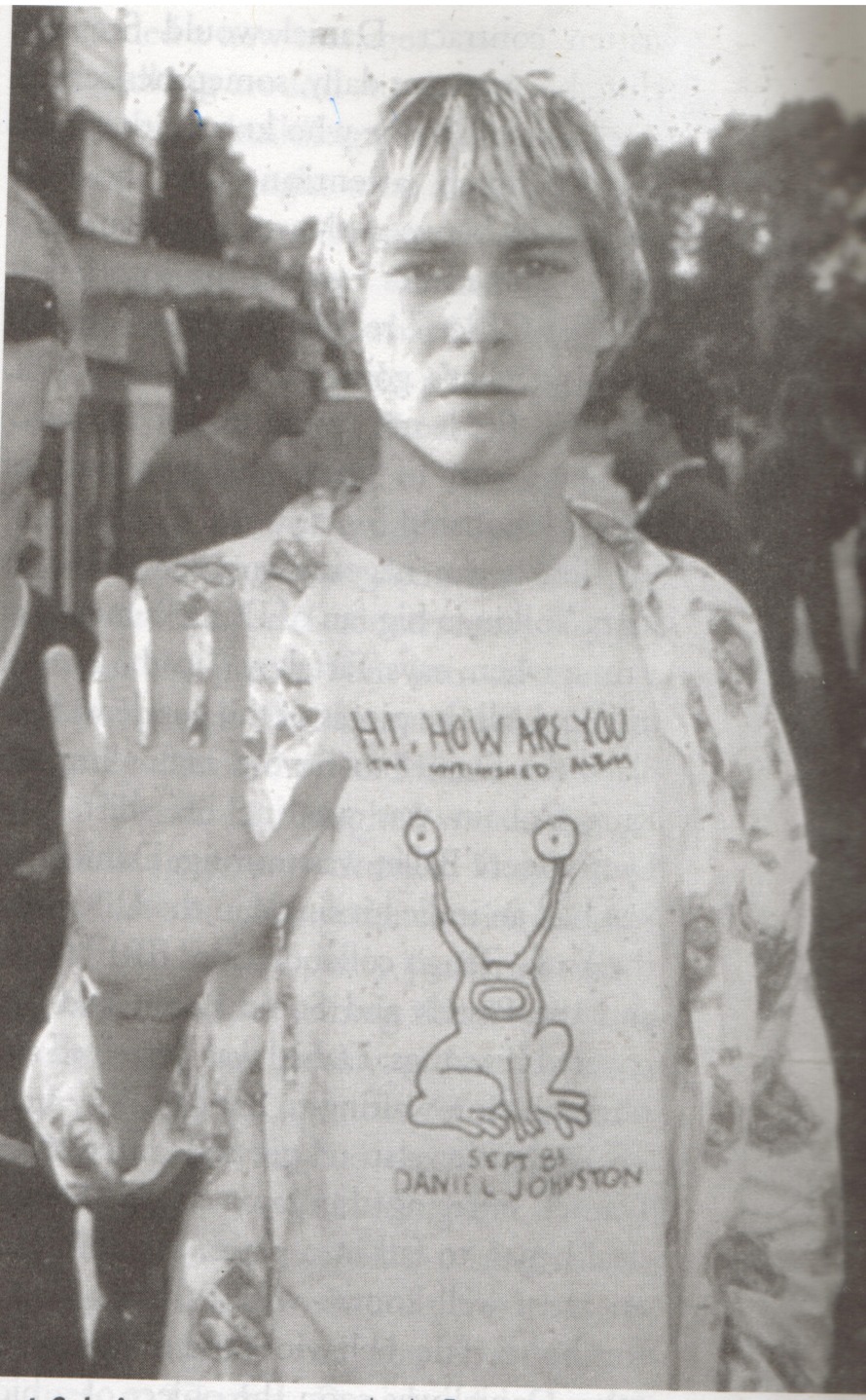
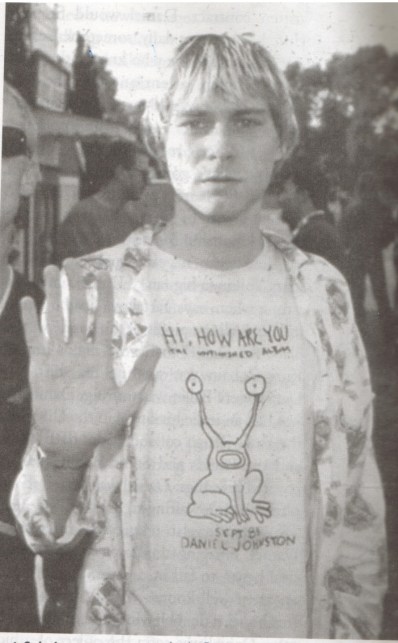
To be sure, Nevermind is a great album, but its cultural cache has more to do with the figure of Kurt Cobain than its relevance and popularity at the time (to see how the myth of Nevermind has grown, simply look at Rolling Stone‘s successive reviews of the album, from 1991, 1992, and 2004, respectively: the magazine gives the album three out of five stars, then four, before finally awarding it five stars thirteen years after the fact). Millions of kids saw Cobain wear Daniel Johnston t-shirts, reference the Melvins, and admit that his songs were really just crude Pixies ripoffs. Cobain, in short, exposed millions of regular kids to an angrier, rougher youth culture, a truly underground music that could react to the failed youth culture of the (now old) boomer generation of the 1960s, which had been forcing an illusory idealization of that decade down our throats forever. Ironically, it was this same boomer generation that greedily milked grunge for all it was worth, commodifying youth culture again into a twisted joke, a stupid lunch box, an action figure, a t-shirt at the mall. No wonder Cobain offed himself.

So why write about this now? It’s been 20 years, and there hasn’t been a record like Nevermind or mega-hits as salient, and dare I suggest meaningful, as “Smells Like Teen Spirit,” “Losing My Religion,” “Under the Bridge,” “One,” or “Jeremy” for quite sometime. The success in the mid-nineties of bands like Smashing Pumpkins and Soundgarden–bands that I didn’t hate but made fun of–seems strange now. Even the music of those elegant bachelors, the Stone Temple Pilots–grunge 2.0–seems oddly strong when held up against the watered-down drivel that passes for contemporary hard rock. Youth music today is archly, ironically aware of its own cultural position and its own performativity in a marketplace. I’m sickened by even thinking of the toothless fourth generation emo-or-whatever-you-wanna-call-it derived from Green Day (another band I didn’t hate but but made fun of) that passes for “pop-punk.” In all its silly winking at the audience, its safe-as-milk non-personality, much of this music represents the ultimate commodifiaction and commercialization of “punk”–the aesthetic that Nevermind helped to re-ignite. (In another genre, hip-hop, after 30 years of existence, has claimed its right–with a sharp vengeance–to be as stupid as any other form of music. Don’t get me started). The irony Cobain and others explored was never a smart-assed irony that coyly winked at the audience, inviting them to laugh along with whatever cultural references were being rehashed; Cobain’s irony was mean and angry–it was a critique of American hegemonic mall culture. Current youth music, rock, emo, whatever it is, is simply a celebration of greedy materialism hiding under the thinnest ironic sheen.

And here’s what I think is the saddest part: I don’t think there can be another Nevermind. To be sure, there will always be fantastic, landmark, music-changing records–I have no doubt about that (see: 1997’s OK Computer f’r’instance). But a record that channels a truly punk aesthetic into mainstream American consciousness is simply not going to happen again. For over fifteen years, critics (and executives) have been looking to award “next big thing” status to just about anyone (do you remember when the Chemical Brothers were supposed to be the “next big thing”? You don’t?). The internet has changed the old model. In the past, records like Nevermind propagated a “trickle-down” effect, if you will–kids in the heartland see Cobain give the Raincoats props, buy Raincoats’ records, get into X-Ray Spex, get into Black Flag, get into Pavement, whatever. In contrast, the internet provides a diffusion model of immediately accessible cultural immersion. Anyone with a DSL connection and a few hours to kill on Allmusic can access indie culture. And that’s a good thing. But still: I’ll get nostalgic here: in the old days, we used to write to the labels and get catalogs and order music via snail mail. We used to buy albums on pure faith that they were good. You couldn’t just click on an mp3 (or steal entire albums on p2p networks or over torrents). But I’m not railing against the internet. I think it’s great that a kid in Montana can become thoroughly exposed to Drag City records or the works of Big Black in just a week. But that will never translate into a wide-scale youth culture shift. Instead, we’ll continue to have what we have now: lots of really, really shitty music on radio and TV. And this is our culture.

There won’t be another Beatles or another Sex Pistols–there won’t be another group that challenges our collective cultural sensibility to make a large jump. There won’t even be an Elvis or a Madonna, a performer that challenges our ethics and morality. Instead, we will continue to have watered-down crap on mainstream media, as well as plenty of choices for those who take the time to look. But those choices will be marginalized, kept on the sidelines out of mainstream American-consciousness, and what we’ll lose is an opportunity to progress and enrich the entirety of our culture. Who knows though–I could be wrong; perhaps I’m just old and out of touch. Perhaps a wholly new and dynamic artist or group will come out that will capture the anti-establishment roots of rock and roll and inspirit a new and dramatically different course in contemporary youth culture. But I don’t see it happening again. I hope I’m wrong.

[Editorial note: We ran a slightly different (but pretty much the same) version of this post in April of 2008]

Jesse James’s Death Mask

Winterfell Weather Report