Ezra Pound’s Composition Exercises for Young Writers

From Ezra Pound’s literary study, ABC of Reading

1. Let the pupil write the description of a tree.

2. Of a tree without mentioning the name of the tree (larch, pine, etc.) so that the reader will not mistake it for the description of some other kind of tree.

3. Try some object in the classroom.

4. Describe the light and shadow on the school-room clock or some other object.

5. If it can be done without breach of the peace, the pupil could write descriptions of some other pupil. The author suggests that the pupil should not describe the instructor, otherwise the description might become a vehicle of emotion, and subject to more complicated rules of composition than the class is ready to cope with.

In all these descriptions the test would be accuracy and vividness, the pupil receiving the other’s paper would be the gauge. He would recognize or not recognize the object or person described.

Rodolfo Agricola in an edition dating from fifteen hundred and something says one writes: ut doceat, ut moveat, ut delectet, to teach, to move or to delight.

A great deal of bad criticism is due to men not seeing which of these three motives underlies a given composition.

The converse processes, not considered by the pious teachers of antiquity, would be to obscure, to bamboozle or mislead, and to bore.

The reader or auditor is at liberty to remain passive and submit to these operations if he so choose.

Jonathan Littell’s The Kindly Ones Is Lurid Abject Art

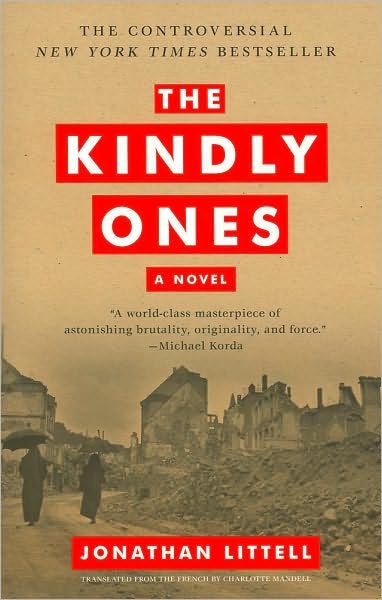
Yesterday, I finished listening to the unabridged audiobook version of Jonathan Littell’s 900+ page novel The Kindly Ones, the plot of which is too long and complex and detailed (and frankly, often boring) to unpack here. To make a very long story short (after which I’ll talk about the book’s scandalous and (deservedly) tawdry reputation), Maximilien Aue is an SS officer of mixed Franco-Germanic parentage, who, amazingly, seems to be present at an unlikely number of key events during WWII. These events include time at the eastern front, orchestrating mass killings in Ukraine and holing up during the battle of Stalingrad, where he gets shot through the head yet miraculously survives. After this, Aue convalesces in Berlin, and later visits his mother and stepfather in Antibes. He soon takes up the project of improving conditions for concentration camp prisoners, visiting camps like Auschwitz, all the while meeting and working with Nazi bigwigs like Albert Speer, Adolf Eichmann, and Heinrich Himmler. After an intense illness (the book is full of illness–more on that in a moment), Aue seeks his twin sister (uh, yeah, more on her shortly) at her husband’s house in Pomerania, where, finding her absent, he indulges in a psychotic wine-fueled masturbation binge (yes, more presently). The end of the novel ups the psycho-ante, detailing the last days of the Third Reich in Berlin, a period Littell depicts as dripping in decadent nastiness. Aue survives via murder murder murder.

This is a very brief outline of a very long book, the kind of book that dares to be important, and Littell surely knows his history. In fact, the book is often incredibly dry, dusty even, constipated by historical facts that Aue and other characters frequently reveal in long, clunky passages of exposition. Indeed, one of the great weaknesses of The Kindly Ones is Littell’s tendency to use his characters as mouthpieces, little pawns who will discourse on politics or linguistics or music or whatever for a few pages. At the same time, it’s clear that Littell wants certain passages to bore the reader. A lengthy episode in the Ukraine concerns the fate of a group of Caucus mountain people of whom the SS wish to determine a “racial origin.” Littell presents the process of deciding whether or not these people should be exterminated or not in excruciatingly bureaucratic (bureaucratically excruciating?) detail. One of the novel’s core points is an observation of the Nazi Reich as a lurching machine, a sick machine whose various limbs were often at bureaucratic war with each other.

If The Kindly Ones is often dry, its wetness is all the more foul. This is a novel that might as well take place in the asshole, or at least the colon. Our hero (?!) Aue spends much of his time describing his alternate diarrhea and vomiting; indeed, emetic purging seems to be his only form of absolution from the constant sin he’s wallowing in. It’s as if the entire Nazi project—its racial purging, its mass murder, its bureaucratic domination, its lies that were obvious to any person with eyes—is a constant stream of shit and vomit that Aue is forced to (yet unable to) process. The Nazis worked to elevate their unnatural sins to a kind of weltanschauung, yet Aue is unable to reconcile this world view with the visceral reality of the organized mass murder he daily helps orchestrate. This hardly absolves him; indeed, Aue seems to engage in every perversion and sin imaginable as a means to release the metaphysical pressure valve that’s pushing down on him all the time.

And this is the core of The Kindly Ones, and certainly why the novel is so infamous. The Nazis were an abject regime, a force that sought to “cleanse” Europe and the world of a perceived filth, and set about doing so in the most paradoxical way imaginable—by engaging in genocide, the worst kind of moral filth. Littell’s novel explores the bureaucratic nature of these abject sins in detail, but Aue is the very (tortured) soul of abjection. He is a paradoxical figure, a “true” SS party member who nevertheless idealizes Greek culture—an ironic twist, given the book’s title, a not-so-subtle nod to Aeschylus’ Oresteia. Quick warning: spoilers ahead—although, given Littell’s potboileresque structure, you’d have to be a blind Oedipus to miss these twists.

Yes, young Max Aue is a thoroughly Greek figure. He’s a homosexual who longs to be a woman so he can feel the “pleasure” that only women can feel, yet he’s obsessively in love with his twin sister, whom he buggered regularly in their pre-teen days (and perhaps a few times afterwards). He fights Nazi bureaucracy to improve the living conditions of doomed concentration camp victims, yet he periodically murders the people around him, for no discernible reason. He delights in his own illnesses, his own filth and shit. He facilitates child murder. He fantasizes about coprophagiac feasts, sticks bottles up his ass while wet-daydreaming about Edgar Rice Burroughs novels, and pays starving boys a few marks for a dirty fuck. And, like Orestes, pursued by the Furies, he kills his mother and step-father. The novel’s greatest concession to Greekness is its reveling in horror, horror, horror.

The Kindly Ones is a bizarre book, one that asks its readers to sympathize with the lowest of low-lifes, and yet somehow nevertheless succeeds, at least in a marginal sense. Littell requires tremendous patience from his readers—and strong stomachs as well, perhaps. In short, I don’t know who The Kindly Ones is for. It’s a bit of a potboiler, yet hardly a genre novel, and certainly not the kind of thing most people would want to read on the beach. I’m not sure if most folks who read historical WWII fiction want theirs served up with so much psycho sickness. To call The Kindly Ones an oddity is an understatement. There are stunning (and I don’t use that word loosely here) passages in the book, moments of overwhelming psychosis, dream sequences that might match the verity of war, including its utter spiritual despair. There’s also a fine tawdriness to The Kindly Ones, an overwhelming sense of the lurid and grotesque, overcompensated, as I mentioned earlier, with the dry crust of historical detail. The result is messy and brutal and uneven, but nonetheless compelling, like a foul, open wound that attracts even as it repels.

Book Xylophone

[Via Ebert].

The Third Reich: Part I — Roberto Bolaño

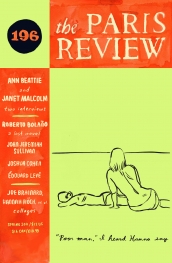
Two years ago, a typed manuscript for Roberto Bolaño’s unpublished novel The Third Reich The Third Reich was discovered. The Paris Review is serializing the novel, publishing it in full over four issues in a translation by Natasha Wimmer. I finished the first part of The Third Reich last night, reading the 63 pages in one engrossing session.

Udo Berger, a German from Stuttgart with a passion for war games, narrates the story in the form of a journal he keeps, detailing the daily events of a vacation he is taking in a Spanish resort town with his girlfriend Ingeborg. The couple checks in to the Del Mar, a seaside hotel where Udo spent a few teenage summers with his family. He seems driven to return to this particular hotel, at least in part, by memories of the enigmatic Frau Else, an alluring German woman who married the hotel’s Spanish owner. Frau Else barely remembers Udo, a fact that disappoints him, yet he nevertheless pursues strange awkward conversations with her; it’s unclear to both Udo and the reader what, exactly, he hopes to gain from talking to her.

Indeed, Udo’s intentions and motivations are strange and murky in general. He’s the classic unreliable narrator. In particular, Udo’s perceptions (and descriptions of those perceptions) seem to be clouded by a radical fear of otherness, and an underlying contempt for almost everyone. He’s also a little paranoid, perhaps, in part anyway, because we get the sense that Ingeborg might be just a bit out of his league. Consider the following scene—

Ingeborg was at her most radiant, and when we walked into the club we were greeted with covert admiring glances. Admiring of Ingeborg and envious of me. Envy is something I always pick up on right away. Anyways, we didn’t plan to spend much time there. And yet as fate would have it, before long a German couple sat down at our table.

That German couple is Hanna and Charly, and Udo quickly comes to detest them, although he repeatedly points out that he covers his disgust at all times (and, by the end of Part I, it’s clear that he has an unvoiced sexual attraction to Hanna). Charly is boorish, foolhardy, and quick to make friends with the locals. Through him, the Germans become acquainted with two locals Udo dubs the Wolf and the Lamb. The Wolf and the Lamb take the four tourists to the kind of working class haunts that only locals go to; Charly and the girls find adventure in this, but Udo is contemptuous and disgusted of these clubs, bars, and restaurants. His depictions of the local spots veer into classic Bolaño territory, that mix of unnerving dread and surreal energy, a kind of Lynchian anxiety that suggests abyssal darkness looms under the veneer of every “normal” surface.

Udo would rather stay in the hotel and work on his war game; he’s devoted the summer to playing out a new strategy and writing an essay about it for one of the various magazines devoted to the hobby. Ingeborg is embarrassed and ashamed of Udo’s passion for games, and when Hanna shows interest in the large hexagonal board set up in their room, Ingeborg quickly rushes her out to the beach. Udo, for the first time realizes this division in his relationship with Ingeborg, who spends her time on various daytrips (perhaps, although Udo doesn’t seem to recognize this, with the Wolf and the Lamb)—yet he fecklessly makes amends by buying cheap gift store jewelery, and avers that losing Ingeborg would destroy him. A dark set up.

The only person apart from Frau Else who Udo takes any interest in is El Quemado (“the Burned One”), a horribly burn-scarred, well-muscled man who makes a living renting paddle boats to tourists. Udo becomes obsessed with El Quemado when he realizes that the man seems to build a shelter out of the paddle boats each night; over time, he strikes up a strange friendship, leading to the revelation that they share a trait: both consider themselves writers.

The Third Reich, composed at the beginning of Bolaño’s career as a novelist, doesn’t feature the labyrinthine syntax or heteroglossia of later works, but it does showcase the particularly Bolañonian sense of dread that seethes under so many of his works. The novel feels like a slow burn, with plenty of sinister elements in play—but there’s also the possibility that this nervous dread stems from Udo’s internal paranoia. In any case, Bolaño is beginning to play with the tropes of the detective novels and crime fiction he loved so much. As I argued in my review of Amulet last month, the more one reads Bolaño, the more difficult it is to parse his fictions from each other. Instead, they seem part of the Bolañoverse, a dark visceral inversion of our own world. Thus The Third Reich strongly recalls the title story in the collection Last Evenings on Earth, where the narrator B and his father take a bizarre, sinister vacation in Acapulco. The Third Reich also obviously recalls Nazi Literature in the Americas, which featured an entire chapter on neo-Nazi boardgames.

Of course, my observations are only drawn from the first fourth of the novel, but as a Bolaño fan I was not disappointed. I just wanted more—but I guess I’ll have to wait for the summer issue.

“How to Recognize a Piece of Art” — Roberto Bolaño on the Power of Translation

A sample of Roberto Bolaño’s short essay “Translation Is an Anvil” (from New Directions’ forthcoming Between Parentheses, a collection of Bolaño’s essays, newspaper columns, and other ephemera)——

How to recognize a work of art? How to separate it, even if just for a moment, from its critical apparatus, its exegetes, its tireless plagiarizers, its belittlers, its final lonely fate? Easy. Let it be translated. Let its translator be far from brilliant. Rip pages from it at random. Leave it lying in an attic. If after all of this a kid comes along and reads it, and after reading makes it his own, and is faithful to it (or unfaithful, whichever) and reinterprets it and accompanies it on its  voyage to the edge, and both are enriched and the kid adds an ounce of value to its original value, then we have something before us, a machine or a book, capable of speaking to all human beings; not a plowed field but a mountain, not the image of a dark forest but the dark forest, not a flock of birds but the Nightingale.

Hunter S. Thompson for Sheriff — HST’s 1970 Campaign Ad

George Washington’s Death Mask

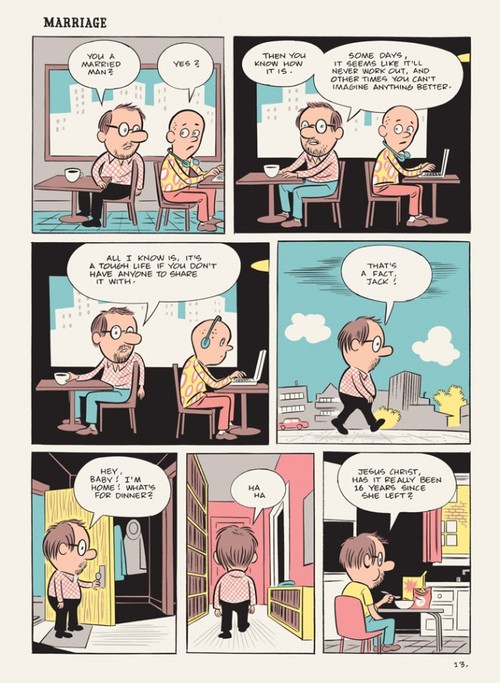
“Marriage” — Daniel Clowes

From Daniel Clowes’s graphic novel Wilson, available from Drawn & Quarterly.

Steven Soderbergh Makes Silly Faces in Schizopolis

A favorite scene from a fine film—

“An Earthly Story with a Hellish Meaning” — D.H. Lawrence on The Scarlet Letter

From D.H. Lawrence’s Studies in Classic American Literature, Chapter VII, “Nathaniel Hawthorne and The Scarlet Letter

NATHANIEL HAWTHORNE writes romance.

And what’s romance? Usually, a nice little tale where you have everything As You Like It, where rain never wets your jacket and gnats never bite your nose and it’s always daisy- time. As You Like It and Forest Lovers, etc. Morte D’Arthur.

Hawthorne obviously isn’t this kind of romanticist: though nobody has muddy boots in The Scarlet Letter, either.

But there is more to it. The Scarlet Letter isn’t a pleasant, pretty romance. It is a sort of parable, an earthly story with a hellish meaning.

All the time there is this split in the American art and art- consciousness. On the top it is as nice as pie, goody-goody and lovey-dovey. Like Hawthorne being such a blue-eyed darling, in life, and Longfellow and the rest such sucking- doves. Hawthorne’s wife said she ‘never saw him in time’, which doesn’t mean she saw him too late. But always in the ‘frail effulgence of eternity’.

Serpents they were. Look at the inner meaning of their art and see what demons they were.

You must look through the surface of American art, and see the inner diabolism of the symbolic meaning. Otherwise it is all mere childishness.

That blue-eyed darling Nathaniel knew disagreeable things in his inner soul. He was careful to send them out in disguise.

Always the same. The deliberate consciousness of Americans so fair and smooth-spoken, and the under-consciousness so devilish. Destroy! destroy! destroy! hums the under-consciousness. Love and produce! Love and produce! cackles the upper consciousness. And the world hears only the Love-and- produce cackle. Refuses to hear the hum of destruction under- neath. Until such time as it will have to hear.

The American has got to destroy. It is his destiny. It is his destiny to destroy the whole corpus of the white psyche, the white consciousness. And he’s got to do it secretly. As the growing of a dragon-fly inside a chrysalis or cocoon destroys the larva grub, secretly.

Though many a dragon-fly never gets out of the chrysalis case: dies inside. As America might.

So the secret chrysalis of The Scarlet Letter, diabolically destroying the old psyche inside.

Be good! Be good! warbles Nathaniel. Be good, and never sin! Be sure your sins will find you out..

So convincingly that his wife never saw him ‘as in time’.

Then listen to the diabolic undertone of The Scarlet Letter.

“The Fall of Rome” — W.H. Auden

“The Fall of Rome,” a poem by W.H. Auden

The piers are pummelled by the waves;
In a lonely field the rain
Lashes an abandoned train;
Outlaws fill the mountain caves.

Fantastic grow the evening gowns;
Agents of the Fisc pursue
Absconding tax-defaulters through
The sewers of provincial towns.

Private rites of magic send
The temple prostitutes to sleep;
All the literati keep
An imaginary friend.

Cerebrotonic Cato may
Extol the Ancient Disciplines,
But the muscle-bound Marines
Mutiny for food and pay.

Caesar’s double-bed is warm
As an unimportant clerk
Writes I DO NOT LIKE MY WORK
On a pink official form.

Unendowed with wealth or pity,
Little birds with scarlet legs,
Sitting on their speckled eggs,
Eye each flu-infected city.

Altogether elsewhere, vast
Herds of reindeer move across
Miles and miles of golden moss,
Silently and very fast.

Highway Robbery in Barry Lyndon

A favorite scene from a favorite movie—

First Love and Other Sorrows — Harold Brodkey

One way to measure how great a work of literature is might be to ask how true (or “True,” if one is feeling particularly romantic) the writing is. We can find facts anywhere, but details and data are not the same as art. Great literature happens in the arrangement of that data, by presenting details with the right ear and eye for truth—and also, the good sense to know what to withhold from the audience, who, after all, are a part of the equation. The stories collected in Harold Brodkey’s First Love and Other Sorrows, both inspiriting and crushing, are some of the most psychologically true pieces of fiction I’ve ever read.

First Love collects nine stories, all composed and published in the 1950s; all but one was originally published in The New Yorker. Although discrete entities, the stories function together. First Love is very much a novel-in-stories, with recurring characters, themes, and motifs. Brodkey’s stories document the strange little bubble of time between WWII and the turmoil of the sixties, and his writing, a kind of late modernism, reflects this period, when the ideal of the American Dream began to be redefined in terms of new modes of class and education.

The first few stories in the collection are told from the first-person perspective of an adolescent, likely an iteration of Brodkey himself. Opener “State of Grace” serves as an overture to the collection, introducing a family that will be transposed throughout the tales. There’s the narrator, a sensitive, awkward boy, beginning to feel strains of alienation from his older sister and his mother. Dad is out of the picture, and with him, the family’s fortunes have fallen: big sis is expected to marry the right man for money—and for class.

These themes are explored in greater length in the very-long short story “First Love and Other Sorrows,” a compact little novella, really, that everyone should read at some point. The narrator, likely the same boy from the first story, describes his life at the end of his high school career in St. Louis, as he prepares to move on to college soon. Again, the major explicit conflict of the story revolves around his sister’s romances, as their mother pressures her to marry the right man. The real conflict though is the boy’s emerging realization of his own dramatic detachment from his family; or, more accurately, the young man is coming to realize the underlying instability that adults tend to hide from children. The boy observes his older sister, whom he reveres—

It occurred to me that she didn’t really know what she was doing; she was not really as sure of everything as she seemed. It was a painfully difficult thought to arrive at, and it clung to me. Why hadn’t I realized it before? Also, she sort of hated me, it seemed to me. I had never noticed that before, either. How could I have been so wrong, I wondered. Knowing how wrong I had been about this, I felt that no idea I had ever had was safe. For instance, we were not necessarily a happy family, with the most wonderful destinies for my sister and me. We might make mistakes and choose wrong. Unhappiness was real. It was even likely…

The narrator’s epiphany is articulate and crushing and wholly real: it documents the ugly realization that the fantasies of a middle class childhood — “happily ever after” — are, indeed, mere fantasies. Brodkey twins this moment in another epiphany at the end of the story that I would love to discuss but fear spoiling; suffice to say that the final line of the story, forever etched in my brain, is simply one of the finest and most fitting moments I’ve ever read.

The next story, “The Quarrel,” finds our young hero, a bit more jaded, off to Harvard, where he falls in with a bitter rich kid named Duncan; they quickly make it their business to despise everything, adopting (unearned) world-weary poses and contrarian natures. Against the advice of their families, the two take a semester off college to tour Europe, spending much of their time bicycling across France. The story documents the kind of friendships that many young people emerging from adolescence engage in: fierce, passionate, identity-defining relationships that always buckle under their own weight. Hence—

Duncan enjoyed Pernod. It made me sick. Duncan hated talking to people. I talked to everyone. My French vocabulary was better than Duncan’s. His pronunciation was better than mine. I became terribly adept at not irritating Duncan before breakfast. I couldn’t see that he appreciated any of this, or that he responded with any similar awareness. For the fiftieth time, I thought him unfair. The moment came when I could no longer stand the sound of his voice, or his ideas. After traveling with him day and night, without a break, for fifty-three days, I felt my senses suffocating in an awareness of Duncan.

“The Quarrel” perfectly captures the strange paradoxes of youthful, immature friendships that can’t survive; reading it forced me to remember myself at eighteen, and to recall a friendship similar to that between the narrator and Duncan, an intense friendship that burned out bitterly and quickly, yet nevertheless helped me to define myself.

“The Quarrel” is the last story in the collection written in first-person perspective; indeed, Brodkey’s narrative shift signals a shift in development; as his characters age (as they do through the collection), he allows himself to step outside of them a bit, as if the psychological pain he explores is almost too much to bear. “Sentimental Education” tells the story of an intense first love (the male lead seems like another iteration of the narrator from the first three stories). In a free indirect style, Brodkey glamorizes, valorizes, and satirizes the young lovers, all at once, exploring the passion and shame and confusion of early adulthood. Here, he describes what happens when the pair begin a sexual relationship—

Their first dip in sensual waters left them nonplussed. They didn’t know what to make of it. They tried to persuade themselves that something had really happened, but the minute it was over, they couldn’t believe they had ever done such a thing. They rushed into further experiences; they broke off in the middle of embraces and looked at each other, stunned and delighted. “Is this really happening?” they both asked at different times, and each time the other said, “No,” and they would laugh. They knew that nothing they did was real, was actual. They had received a blow on the head and were prey to erotic imaginings, that was all. But at the same time they half realized it was true, they were doing these things, and then the fact that they, Caroline and Elgin, shared such intimacy dazed and fascinated them; and when they were together, they tried to conceal it, but this indescribable attraction they felt for each other kept making itself known and draining all the strength from their bodies.

“Sentimental Education” retraces the fallout explored in “The Quarrel,” as the young lovers inevitably fall apart.

After this love story, Brodkey shifts his attention to a character named Laura (or, in one version, “Laurie”), who seems to be a version of the narrator’s sister from the first few stories. The five Laura stories are much shorter than the other narratives. These tightly detailed miniature portraits trace the development of Laura as she chooses the man her mother didn’t approve of; this plot is very much in the background of the stories, though, an implicit detail that nevertheless hangs over Laura’s psychological development. The Laura stories seem to trace what it means to grow old but not mature. They recall the narrator in “First Love and Other Stories” epiphany that adulthood might be a murky or unhappy place. “Laura” documents postpartum depression and “Trio for Three Gentle Voices” subtly explores the ways in which parents seek to avoid repeating their own parents’ mistakes. “Piping Down the Valley’s Wild” is a simple, elegant story about Laura’s husband’s college roommate coming over for dinner. Reading it, I experienced an uncanny transposition, as if I were observing a reinterpretation of something I experienced a few weekends ago. The story ends with another sad epiphany—

She just wanted this day to go on forever and ever, unending, with all its joys intact, and no one changing, nothing new happening, just these same things occurring over and over. Because how did you know happiness would come back? Or if it came back, that it would be as good as this? Laura sighed and wiped her eyes surreptitiously. The trouble with being happy was that it made you frightened.

This realization again encodes the paradox of adulthood, pointing toward its radical instability. To grow up, in Brodkey’s terms (terms I again point out strike me as utterly true) is to face irretrievable loss at every single moment, even as you gain new friends, new lovers, or new children. The joys of life are predicated on the necessary loss of these joys: existence costs.

First Love and Other Sorrows is a book that deserves more attention. In its spirit and art, it matches (and perhaps surpasses) other mid-century American narratives like The Catcher in the Rye or The Glass Menagerie, and in its spare, precise, minimal style, it points toward the later fiction of writers like Raymond Carver. This is a beautiful, sad book, the kind that leaves a deep impression. Very highly recommended.

Werner Herzog Talks Culture and Caves

The AV Club interviews Werner Herzog. Sample—

AVC: In 20,000 years, could it be our culture that’s discovered in a cave somewhere?

WH: In 20,000 years, there will be significant things in the environment that will be preserved, like certain dams. Like Vajont Dam near Longarone [Italy], where there was this catastrophic event almost 50 years ago now. An incredibly massive landslide came down into the lake. The entire lake, over 50 billion cubic meters, shot up into the air in a tsunami of 700 feet that came down in this gorge and wiped out the town of Longarone. I have studied the place over and over. I do my pilgrimages to the place. At its base, [the dam] is something like a hundred feet thick. The steel-reinforced concrete. The whole thing is about 180 meters at its highest, and it withstood the landslide coming into it. It’s still intact, and most of it will be intact hundreds of thousands of years from now. So in the future, when people are looking for the Neanderthals of the 21st century, they will see our traces standing in open air. They will see the sarcophagus of Chernobyl, which is going to be built over it now. It will be there in 20,000 years. They won’t have to search in a cave.

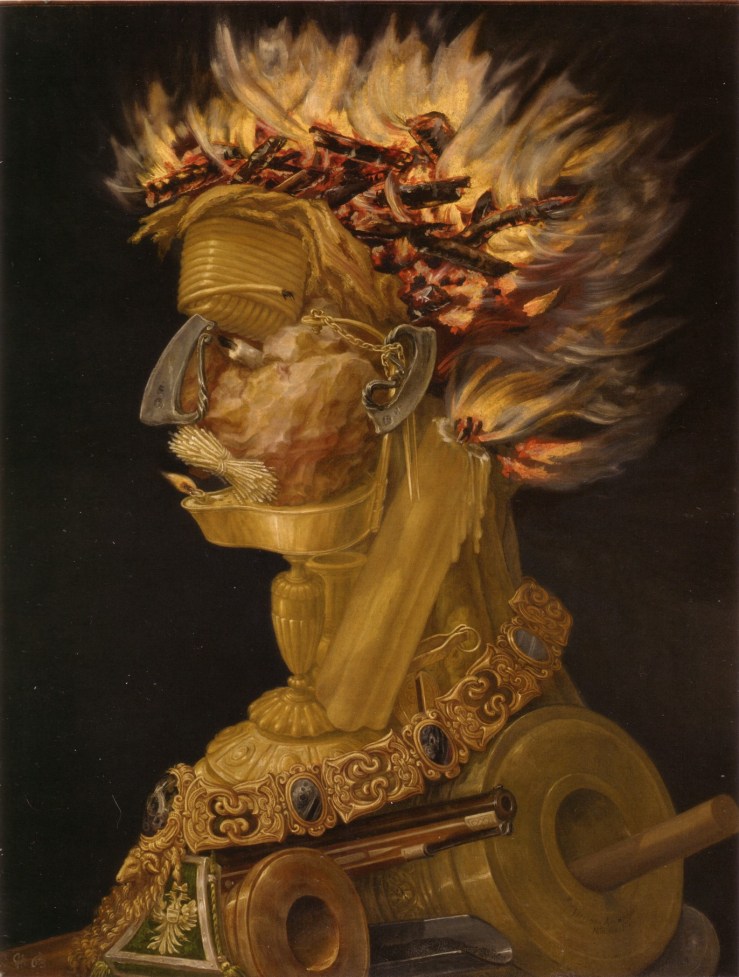
The Fire — Giuseppe Arcimboldo

“All News Is Fake” — Marshall McCluhan

“In the Dry” — Breece D’J Pancake

Read Breece D’J Pancake’s short story “In the Dry.” Excerpt —

He sees the bridge coming, sees the hurt in it, and says aloud his name, says, “Ottie.” It is what he has been called, and he says again, “Ottie.” Passing the abutment, he glances up, and in the side mirror sees his face, battered, dirty; hears Bus’s voice from a far-off time, I’m going to show you something. He breathes long and tired, seems to puff out the years since Bus’s Chevy slammed that bridge, rolled, and Ottie crawled out. But somebody told it that way—he only recalls the hard heat of asphalt where he lay down. And sometimes, Ottie knows. Now and again, his nerves bang one another until he sees a fist, a fist gripping and twisting at once; then hot water runs down the back of his throat, he heaves. After comes the long wait—not a day or night, but both folding on each other until it is all just a time, a wait. Then there is no more memory, only years on the hustle with a semi truck—years roaring with pistons, rattling with roads, waiting to sift out one day. For one day, he comes back.

This hill-country valley is not his place: it belongs to Sheila, to her parents, to her Cousin Buster. Ottie first came from outside the valley, from the welfare house at Pruntytown; and the Gerlocks raised him here a foster child, sent him out when the money-crop of welfare was spent. He sees their droughty valley, cannot understand—the hills to either side can call down rain. Jolting along the pike, he looks at withered fields, corn tassling out at three feet, the high places worse with yellowish leaves. August seems early for the hills to rust with dying trees, early for embankments to show patches of pale clay between milkweed and thistle. All is ripe for fire.