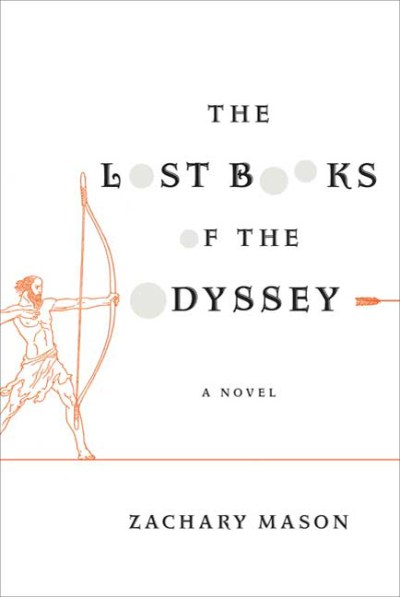
Win a Copy of Zachary Mason’s Novel The Lost Books of the Odyssey

The kind folks at Picador are offering you, dear reader, a chance to win one of two copies of Zachary Mason’s The Lost Books of the Odyssey, a dazzling re-imagining of Homer’s epic tale. And you’ll want to read this book, folks. Here’s a snippet from our review–

In his preface to The Lost Books of the Odyssey, author Zachary Mason tells us that before the story we now know as the Odyssey was organized by the poet Homer, the “material was formless, fluid, its elements shuffled into new narratives like cards in a deck.” Mason’s goal in The Lost Books is to echo these older versions of the story of Odysseus, omitting “stock epic formulae in favor of honing a single trope or image down to extreme clarity.” He succeeds admirably — Lost Books is an engaging and perplexing work that challenges our assumptions about one of the most foundational stories of Western literature. Mason’s “novel” (it is not really a novel, of course) strikes a wonderfully resonant and deeply upsetting chord, disrupting our sense of narrative satisfaction, breaking us away from the outcomes we thought we knew.

So, how do you get your grubby little hands on a copy? First, you need to have a U.S. mailing address. Second, you need to email us at biblioklept.ed@gmail.com, responding to this simple prompt: Who is your favorite character in The Odyssey, and why? Our esteemed judges will choose the winners from the best responses and post them as an announcement next Friday. Good luck!

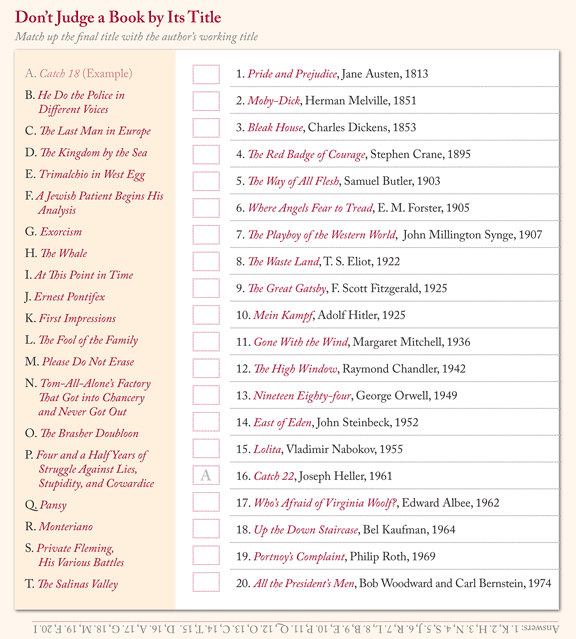
Don’t Judge a Book by Its Title

From Lapham’s Quarterly, via.

Wesley Stace and Rosanne Cash Discuss Bob Dylan’s Chronicles

Wesley Stace (aka John Wesley Harding), author of Charles Jessold, Considered as a Murderer (which I’m reading and enjoying) talks to Rosanne Cash about Bob Dylan’s Chronicles Volume One–

“An Account of Sharing an Ambien with a Girl I Met One Week Prior at a Party” — Tao Lin

“An Account of Sharing an Ambien with a Girl I Met One Week Prior at a Party” is a short short story (?) by Tao Lin published this week at Thought Catalog. An excerpt–

We went into her room ~6:55PM. She asked if I wanted wine and I said no. She asked again and I said no. I said “I brought the Ambien.” She said something about Tiger Woods and I felt confused and said “we should see if it’s okay with alcohol.” She typed “ambient” into Google. I said “no, that’s the music, delete the t, ambient music.” She laughed and typed “ambien and alcohol and klonopin and” and grinned and said “just kidding.” She deleted all but “ambien and alcohol.” The first result said not to combine Ambien and alcohol. Every result seemed to say that. She clicked the first result. It said not to combine Ambien and alcohol. She said she drank a lot so it was okay.

Melville House Introduces The Neversink Library

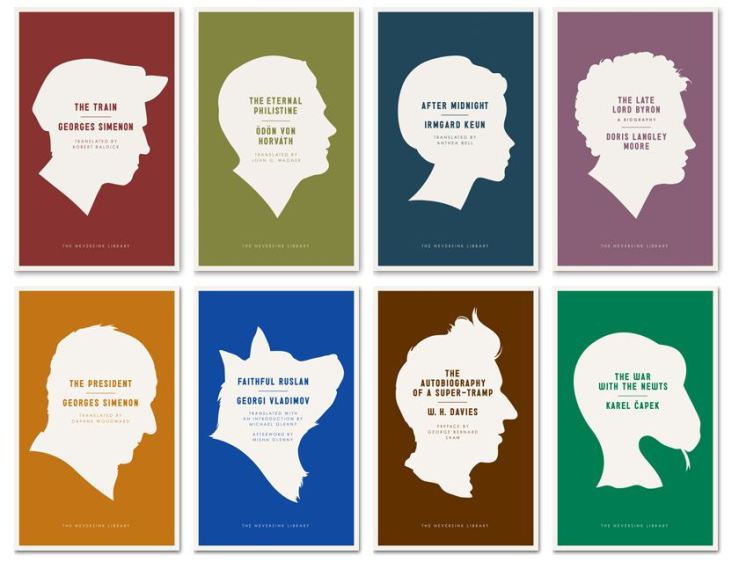
The bibliophiles over at one of our favorite indies, Melville House, are introducing The Neversink Library, a line of international titles that have been overlooked, neglected, and under-appreciated, many languishing out of print for years. The line debuts this summer; the graphic below gives us a good idea of what titles to expect and shows off Neversink’s beautiful design–

I haven’t heard of most of these authors, but Melville House has a great record of bringing neglected and cult authors back to print; their Contemporary Novella series in particular stands out, and Neversink seems to follow this mode in some respects. Even better, you can suggest titles for the series. Looks promising.

Bob Dylan Plans Six New Books

According to AV Club, Bob Dylan has inked a deal with Simon & Schuster to write six books, including the long-awaited follow ups to Chronicles, Volume One (easily one of our favorite memoirs or music books or Dylan books or whatever you want to call it). Also connected: MobyLives reports that literary agent/villain-in-an-alternate-universe-where-everyone-actually-cares-about-publishing Andrew “The Jackal” Wylie may be the guy responsible for the delay of Chronicles Volume 2.

Here’s Dylan haranguing a journalist in one of my favorite scenes from Don’t Look Back

“Nobody can be more clownish, more clumsy and sententiously in bad taste, than Herman Melville” — D.H. Lawrence on Moby-Dick

From D.H. Lawrence’s Studies in Classic American Literature, Chapter XI, “Herman Melville’s Moby-Dick“–

A hunt. The last great hunt.

For what ?

For Moby Dick, the huge white sperm whale: who is old, hoary, monstrous, and swims alone; who is unspeakably terrible in his wrath, having so often been attacked; and snow- white.

Of course he is a symbol.

Of what ?

I doubt if even Melville knew exactly. That’s the best of it.

He is warm-blooded, he is lovable. He is lonely Leviathan, not a Hobbes sort. Or is he ?

But he is warm-blooded and lovable. The South Sea Islanders, and Polynesians, and Malays, who worship shark, or crocodile, or weave endless frigate-bird distortions, why did they never worship the whale? So big!

Because the whale is not wicked. He doesn’t bite. And their gods had to bite.

He’s not a dragon. He is Leviathan. He never coils like the Chinese dragon of the sun. He’s not a serpent of the waters. He is warm-blooded, a mammal. And hunted, hunted down.

It is a great book.

At first you are put off by the style. It reads like journalism. It seems spurious. You feel Melville is trying to put something over you. It won’t do.

And Melville really is a bit sententious: aware of himself, self-conscious, putting something over even himself. But then it’s not easy to get into the swing of a piece of deep mysticism when you just set out with a story.

Nobody can be more clownish, more clumsy and sententiously in bad taste, than Herman Melville, even in a great book like Moby Dick. He preaches and holds forth because he’s not sure of himself And he holds forth, often, so amateurishly.

The artist was so much greater than the man. The man is rather a tiresome New Englander of the ethical mystical- transcendentalist sort: Emerson, Longfellow, Hawthorne, etc. So unrelieved, the solemn ass even in humour. So hopelessly au grand serieux, you feel like saying: Good God, what does it matter? If life is a tragedy, or a farce, or a disaster, or any- thing else, what do I care! Let life be what it likes. Give me a drink, that’s what I want just now.

For my part, life is so many things I don’t care what it is. It’s not my affair to sum it up. Just now it’s a cup of tea. This morning it was wormwood and gall. Hand me the sugar.

One wearies of the grand serieux. There’s something false about it. And that’s Melville. Oh dear, when the solemn ass brays! brays! brays!

But he was a deep, great artist, even if he was rather a sententious man. He was a real American in that he always felt his audience in front of him. But when he ceases to be American, when he forgets all audience, and gives us his sheer apprehension of the world, then he is wonderful, his book commands a stillness in the soul, an awe.


Lydia Davis Reads Five of Her Short Stories

New in Paperback: Ali Shaw Does Creepy Fables, Cathleen Schine Channels Jane Austen, and Joan Schenkar Plumbs Patricia Highsmith

The Girl with Glass Feet is the début novel from British author Ali Shaw. Set in the remote archipelago of St. Hauda’s Land and steeped in the traditions of English folklore, Shaw’s novel works in the idiom of magical realism. His titular girl Ida Maclaird suffers from a strange affliction: she’s slowly turning into glass. She returns to St. Hauda’s land in the winter (after a previous summer holiday there) in the hopes of finding a cure. There she meets Midas Crook (whose symbolically overdetermined name seems part and parcel of Shaw’s program), a photographer fascinated by his father’s ghost stories about the isolated archipelago who is trying to capture something of its haunted spirit in his pictures. Together (and with the help of some strange locals) the pair tries to find answers against a melancholy and magical backdrop of tiny winged cows, albino crows, and other grotesques. A sample ghost story, one of many in Glass Feet

His father had once told him a legend: lone travelers on overgrown paths would glimpse a humanoid glow that ghosted between trees or swam in a still lake. And something, some impulse from the guts, would make the traveler lurch off the path in pursuit, into the mazy trees or deep water. When they pinned it down it would take shape. Sometimes it would form a flower of phosphorescent petals. Sometimes it drew a bird of sparks whose tail feathers fizzled embers. Sometimes it became like a person and they’d think they saw, under a nimbus like a veil, the features of a loved one long lost. Always the light grew steadily brighter until–in a flash–they’d be blinded. Midas’s father hadn’t needed to elaborate on what happened to them after that. Lost and alone in the cold of the woods.

In The Three Weissmanns of Westport, Cathleen Schine transposes the Dashwoods of Jane Austen’s Sense and Sensibility to a dilapidated beach cottage in Westport, Connecticut. When 78 year old Joseph divorces his 75 year old wife Betty, and his mistress essentially forces her from their high-end NYC apartment, Betty rallies by moving to the beach cottage with her daughters, impulsive Miranda, a literary agent, and practical Annie, a library director. The premise may sound like the domain of that most maligned of genres, “chick lit,” a fact that many reviewers tackled when it debuted in hardback last year. Here’s Dominique Browning in The New York Times

Schine sets her novel squarely in the most appealing part of chick-lit territory — its light-hearted readability — and then thumbs her nose as she starts kicking up the dust. The strange thing about the Jane brigade is that most of its practitioners have raided only her plots, apparently not quite up to the task of honoring the essence of Austen. But Schine’s homage has it all: stinging social satire, mordant wit, delicate charm, lilting language and cosseting materialistic detail.

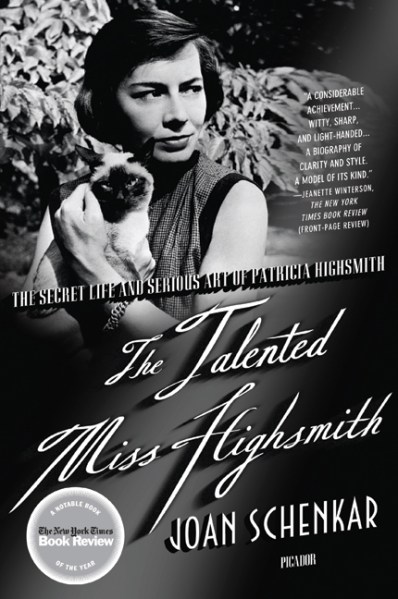
Before looking over Joan Schenkar’s exhaustive biography of Patricia Highsmith, The Talented Miss Highsmith: The Secret Life and Serious Art of Patricia Highsmith, I have to admit that I thought of the writer primarily as a practitioner of pulp fiction, the kind of lurid crime tales at home in airport bookshops. In recent years, I’ve come to reevaluate my stance on crime noir in particular (which I wrote about here), a genre whose conventions I find increasingly more apparent in the “literary fiction” that I enjoy. Anyway, Schenkar’s book places much stress on the Serious Art section of Highsmith’s biography. I knew Highsmith mainly from her Ripley novels, which I’ve never read, but gather to be smart and psychologically complex. I didn’t know that Highsmith wrote Strangers on a Train, adapted by Hitchcock into a noir classic. I didn’t know that she wrote comic books for years — the weird crime ones that stirred up so much commotion in the fifties. I didn’t know that she worked homoerotic themes into her novels, and wrote one very openly lesbian novel that was published during her lifetime (albeit under a pseudonym), The Price of Salt. Schenkar makes a case for a Highsmith as an underappreciated novelist, a contemporary of Mailer and Capote who never got her due (even if her novels were bestsellers), a writer in the tradition of Kafka and Freud. Rounding out the biography is a complex investigation of Highsmith’s strange relationship with her mother, a look at her long list of lovers, and plenty of charts, diagrams, and photos (Schenkar even sneaks a topless pic in, if that piques your interest).

All three titles are new in trade paperback from Picador.

Books I Am Always (Re-)Reading

Trudging through a very long book the other night–never mind the title, at least now anyway–it occurred to me that I’d rather be reading from 2666; that, at that particular moment, I’d rather re-read from “The Part About the Crimes.” I don’t know if it was the effete dullness of the first volume that made me want to pick up Bolaño’s epic, perhaps trying to zap some life into my waning eyeballs; perhaps it was just the sense that I was wasting my time with the merely good, which, after all, is mediocrity when set against genius (yes, these are subjective terms).

Anyway, I didn’t have to go looking for 2666 — I have a copy (yes, I have two) right there jammed into my nightstand, along with a few other books that I realize that I’m always reading. Furthermore, I’m always reading these books in the most discontinuous, stochastic fashion, often picking them up at random and thumbing through them. I think I use these books to clear my literary palate, to get a bad (or worse, boring) taste out of my brain, to inspire me, to suggest another book. Some of these books, like 2666 are big, fat volumes, volumes that I set close at hand in the hopes of rereading in full. Sometimes I’ve met this goal; in the case of Moby-Dick, I’ve read the book through at least three times now, and yet never tire of it. I’m always picking it up again and again, sometimes to find Elijah’s rant or to dip into Ahab’s mad monologue or perhaps just to hear Stubb comment on the proper preparation of shark steaks. Of a piece with those big novels is David Foster Wallace’s Infinite Jest, which I turn to repeatedly, reading over a riff or two at a time, perhaps still trying to figure out the ending, or some clue of the ending, perhaps trying to figure out why Hal can’t speak (you know, beyond like, a a metaphorical level).

There’s also Blood Meridian.

A book I always keep proximal is D.H. Lawrence’s Studies in Classic American Literature, which, if this were a dictatorship under Biblioklept might replace the Constitution (jaykay, Tea Partiers!). Tellingly, I’ve never managed to finish one of Lawrence’s novels (I even struggle through his much-anthologized piece, “The Rocking Horse Winner”), but I consider his dissertations on Hawthorne, Poe, and Melville indispensable (and creative in their own right). I guess I just like lit crit; Harold Bloom’s too-huge volume The Western Canon is a book I return to again and again. Sometimes I find myself throwing it to the ground, quite literally (if I’ve enjoyed a drink or two, that is), in disgust. Bloom’s battle with “The School of Resentment” can be maddening, especially when he’s so up front about essentially making Shakespeare God. Still, Shakespeare doesn’t seem like a bad God to have.

I should point out that I’ve made no attempt to read The Western Canon the whole way through; in fact, I’ve never made a single attempt to read it systematically. I just sort of pick it up, thumb through it, occasionally plumb the index. There are several books that I am always rereading in this category: Books That I Am Always Reading and Yet Have Never Finished. Foremost among these is Nietzsche’s Human, All Too Human, a book that I probably, at this point, have read in full, but never fully through. Its aphorisms beg to be read discontinuously; I think Nietzsche wet-dreamed about his fragmentary works being literally fragmented and then later found, read piecemeal against some newer, more garish culture. Or perhaps that’s just my metaphorical wet dream.

Other Books That I Am Always Reading and Yet Have Never Finished — The Life and Opinions of Tristram Shandy, Gentleman stands out, as does Finnegans Wake. Sterne’s book is such an oddity: I remember picking it up in a stack of books to be shelved at my college library, thumbing through it, bewildered, thinking that it must be contemporary with John Barth. A bit of research left me even more perplexed. Like Tristram, who can’t seem to finish his story, I can’t seem to actually finish it, but I’m okay with picking it up again and again. Similarly, Finnegans Wake strikes me as an unfinished-unfinishable volume (I do not mean this literally; I know that Joyce “finished” the book as an infinite strange loop, just as I know that the book can be read). I have an audio recording of Finnegans Wake that I like to listen to occasionally (especially while driving), as well as William York Tindall’s  guide (which is fun), but I’d rather just sort of grab the thing at random and read a page or two. I know, in an intellectual sense, that is, that I could easily read the book in a calendar year by committing to three pages a day (plus a few pages of Tindall), but I don’t think that I can read books in an intellectual sense. I think, at the risk of sounding unbearably corny, that books have to call to their readers in an emotional and perhaps even spiritual sense. Otherwise, what’s the point?
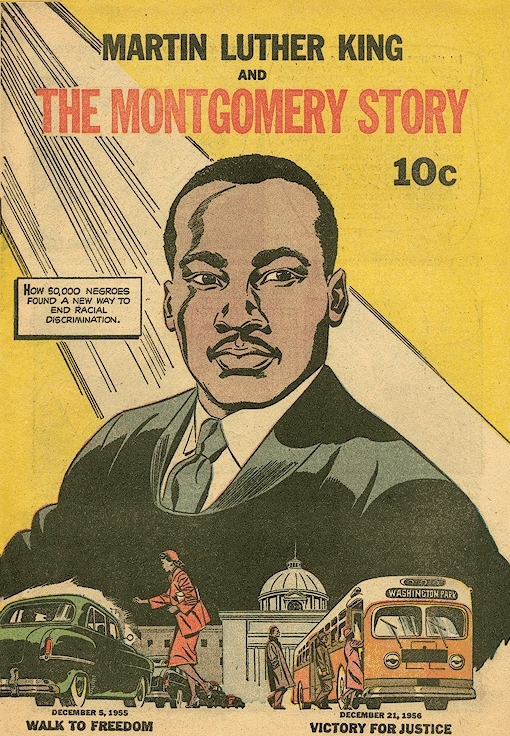
Martin Luther King and The Montgomery Story: The Comic Book

You can read the entire comic here.

Jonathan Swift’s Death Mask

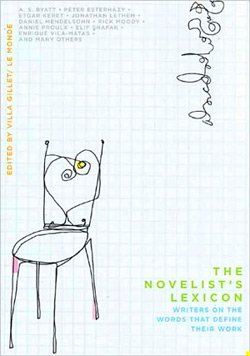
The Novelist’s Lexicon

The Novelist’s Lexicon, new in hardback from Columbia University Press, is an auspicious and at times bewildering project originating from an international literary conference hosted by Le Monde a few years ago. Over seventy authors from more than a dozen countries were asked to write about a “key word that opens the door to his work.” A list of just a few of the authors here is probably more than enough to pique interest: Rick Moody, Helene Cixous, Colum McCann, Jonathan Lethem, Adam Thirlwell, A.S. Byatt, David Peace, Dennis Cooper, and Annie Proulx all contribute pieces, mostly short, somewhere between 100 and 500 words. By nature, The Novelist’s Lexicon is a fragmentary affair, discontinuous, open to multiplicity, and unified only by its authors’ sense of craft, as well as an abiding intelligence.
Some authors take the project in earnest, like Lethem, whose piece “Furniture,” (which we excerpted late last year) pinpoints a fundamental yet largely unremarked upon element of novel-writing. French author Nicholas Fargues taps into etymology, offering a bit of advice in his piece “Novice”–

Don’t ‘make’ literature. Don’t write because that’s what people expect of you now that you’re a ‘writer.’ Don’t write for the beauty of the gesture or the love of art. Beware of fine phrases and well-turned maxims; that’s not your thing. Watch out for words that strike a pose. But do let your memory and your instincts flow; let the aptest words, the words that resemble you most closely, come of their own accord.

Anne Weber’s piece “Waiting/Attention” suggests that a key word — or any key, really — is an impossible dream–

It would be a word that encapsulated my aspirations and expectations, my sadness and my joy, my amazement at the quince’s hairy skin, the wash of the sky, and the delicate pattern of the cyclamen’s leaves. And since everything would be contained in this single, essential word, since it would express everything, I wouldn’t need to write anymore. And good riddance, too!

Swedish author Jonas Hassen Khemiri, who goes with “Un-” also points to language’s simultaneous limitations and possibilities–

Un- as in never being satisfied with the language we have. Un- as in the realization of how difficult it is to communicate with people in a language you have invented yourself. Un- as in doubting whether you will ever succeed. Un- as in continuing to try even so. Un- as in suddenly launching yourself over a coffee table and transforming a dictionary into confetti.

Khemiri’s frustration with language (and paradoxical love) is thematic throughout Lexicon; we see it, for instance in David Peace’s “Plague.” Peace comes off like the crotchety old man in the group–

To be honest or stupid or both, but not churlish or contrary (I hope), I am uncertain I understand the premise of this lexicon. However, I am against the presumption of all premises and, equally, I am against all definitions and dictionaries, lexicons and lists, which, in their commodification and exclusivity, are the preserve and the territory of fascists and shoppers.

After this radical caveat, including the claim that he is under “duress” (did the folks at Le Monde put guns to these authors’ heads?), Peace goes on to discuss the word “plague,” tracing it through Western lit and showing how it evinces in his novel Occupied City (which we reviewed here, by the way).

Perhaps Peace should’ve just ignored the assignment, like Dennis Cooper, whose piece is “Signed D.C.” is simply a work of microfiction, imagining what would happen if Olive Oyl and Popeye who “peel like decals from the TV and live in the world.” The story is a clever, short five paragraphs, and ends with at least a trace of insight into Cooper’s writing process: “I am heavier than my constructions understand.” Maybe he didn’t ignore the assignment.

Cooper is not the only writer to let fiction reign — there are poems and meditations and strange riffs here, largely divorced of discussion from technique or craft. In any case, those interested in getting into the heads of some of the 21st century’s most prominent (and skillful) writers will wish to take notice of The Novelist’s Lexicon, a fun and repeatedly rewarding book. Recommended.

Why Robert Coover Writes

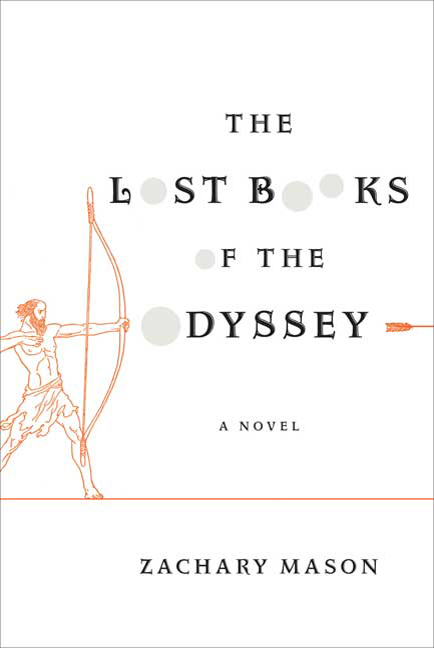
The Lost Books of the Odyssey — Zachary Mason

In his preface to The Lost Books of the Odyssey, author Zachary Mason tells us that before the story we now know as the Odyssey was organized by the poet Homer, the “material was formless, fluid, its elements shuffled into new narratives like cards in a deck.” Mason’s goal in The Lost Books is to echo these older versions of the story of Odysseus, omitting “stock epic formulae in favor of honing a single trope or image down to extreme clarity.” He succeeds admirably — Lost Books is an engaging and perplexing work that challenges our assumptions about one of the most foundational stories of Western literature. Mason’s “novel” (it is not really a novel, of course) strikes a wonderfully resonant and deeply upsetting chord, disrupting our sense of narrative satisfaction, breaking us away from the outcomes we thought we knew. I’ll share an example. Here’s chapter 14, “Fragment,” in its entirety–

A single fragment is all that survives of the forty-fifth book of the Odyssey:

Odysseus, finding that his reputation for trickery preceded, started inventing histories for himself and disseminating them wherever he went. This had the intended effect of clouding perception and distorting expectation, making it easier for him to work as he was wont, and the unexpected effect that one of his lies became, with minor variations, the Odyssey of Homer.

Lies with minor variations is a pretty good definition for storytelling. As the fragment above may skew a bit too academic for some readers, a bit too meta-textual, I’ll hasten to point out that Mason’s primary concern is storytelling. We get all the old characters: Penelope and Telemachus, Agamemnon and Achilles, Circe and Cassandra, and so on. Mason’s take is programmatic from the example above though — he works by “clouding perception and distorting expectation.” The opening chapter, “Sad Revelation,” begins with Odysseus returning home to find that Penelope is an old woman, and remarried at that. This revelation turns false, a “vengeful illusion, the deception of some malevolent god. The real Ithaca is elsewhere, somewhere on the sea-roads, hidden. Giddy, Odysseus turns and flees the tormenting shadows.” Hence, the real joy here is in movement and adventure. The journey is the telos, not Ithaca itself. Homecoming is always a deferral.

The opening chapter’s theme of an illusory home and wife repeats throughout the text, as Mason suggests again and again that notions of a stable, fixed identity will always prove untrue. Odysseus, through a clerical error, is ordered to carry out his own assassination. Later, he seems to swap souls with a Trojan enemy, living out another person’s life entirely. In another episode, we see that Odysseus never really escapes Hades, that he is simply always travelling through it, catching glimpses of another, older life.

While many of Mason’s pieces are short — one to three pages — there is a richness here that taps into the history of Western literature. What’s striking is how alienating it can all be: how dark, how cold, how scary. We are reminded that Odysseus can trace his lineage to lycanthropes, an odd call to Scandinavian myth, one reinforced later on a beach with three witches, a tale that echoes (or prefigures) the horror of Macbeth. Mason shows us (or, perhaps more accurately reminds us) that the Odyssey uncannily permeates more of our literature than we might readily recall.

The Lost Books of the Odyssey is post-modern through and through, fragmentary and elliptical, meta-textual and highly ironized. There’s of course a rich tradition of reinterpreting the Odyssey, from Tennyson’s poem to Joyce’s classic, from the Coen brothers’ film O Brother, Where Art Thou? to Margaret Atwood’s The Penelopiad, and Mason’s book will not disappoint those who are interested int the subject (although admittedly, some readers may find too much academic commentary in his work — not me though). In his brevity and frank humor, but most of all in the seemingly unclassifiableness of his work, Mason’s writing reminds me of Lydia Davis or Amy Hempel, but also Borges and Calvino. These are stories that might not be stories in a novel that might not be a novel. Highly recommended.

The Lost Books of the Odyssey is new in trade paperback from Picador.

RIP Trish Keenan

Warp’s statement

It is with great sadness we announce that Trish Keenan from Broadcast passed away at 9am this morning in hospital. She died from complications with pneumonia after battling the illness for two weeks in intensive care.

Our thoughts go out to James, Martin, her friends and her family and we request that the public respect their wishes for privacy at this time.

This is an untimely tragic loss and we will miss Trish dearly – a unique voice, an extraordinary talent and a beautiful human being. Rest in Peace.


“The Thirty-Six Dramatic Situations” — Georges Polti

“The Thirty-Six Dramatic Situations” is a list compiled by nineteenth-century French writer George Polti intended as a literary criticism device; in 2011 it reads almost like some kind of story or prose poem in itself–
  1. Supplication (in which the Supplicant must beg something from Power in authority)
  2. Deliverance
  3. Crime Pursued by Vengeance
  4. Vengeance taken for kindred upon kindred
  5. Pursuit
  6. Disaster
  7. Falling Prey to Cruelty of Misfortune
  8. Revolt
  9. Daring Enterprise
  10. Abduction
  11. The Enigma (temptation or a riddle)
  12. Obtaining
  13. Enmity of Kinsmen
  14. Rivalry of Kinsmen
  15. Murderous Adultery
  16. Madness
  17. Fatal Imprudence
  18. Involuntary Crimes of Love (example: discovery that one has married one’s mother, sister, etc.)
  19. Slaying of a Kinsman Unrecognized
  20. Self-Sacrificing for an Ideal
  21. Self-Sacrifice for Kindred
  22. All Sacrificed for Passion
  23. Necessity of Sacrificing Loved Ones
  24. Rivalry of Superior and Inferior
  25. Adultery
  26. Crimes of Love
  27. Discovery of the Dishonor of a Loved One
  28. Obstacles to Love
  29. An Enemy Loved
  30. Ambition
  31. Conflict with a God
  32. Mistaken Jealousy
  33. Erroneous Judgment
  34. Remorse
  35. Recovery of a Lost One
  36. Loss of Loved Ones.