Jon Lovitz’s Writing Tips

Jon Lovitz does AV Club’s Random Rules today. Here, he gives some pretty good writing advice. Context: he’s describing coming back as the host of the show in 1997, and going to the writer’s meeting on Monday. The “They” is the SNL writers–

They’d say, “We have an idea for a sketch. You’re a teacher, and the student brings you an apple.” I go, “Right.” “And then another comes in and another brings you an apple, and then another brings you an apple.” I go, “Then what happens?” They go, “No, that’s the sketch. They’re just all bringing you apples.” I said, “That’s not a sketch. That’s just a premise.” They didn’t know what I was talking about. I said, “A sketch is supposed to have a beginning, middle, and end. It’s like a movie. It’s supposed to have a story. You have a who, what, where—the beginning, and the conflict, and it builds and builds. That’s how you do improv. You’re filling in all those spots to make the scene work. It builds to a climax. Then there’s a resolution, which is the ending. It takes hours to write the ending. It’s hard to come up with them.” They just looked at me blankly.

I think the writers thought I was a jerk, because I was like, “Then what happens?” to all of it. They’d go, “That’s it.” Maybe they didn’t like that. They wrote a first draft, and, “Who are you to touch our brilliant first draft?” Writing is rewriting.


“Declaration on the Notion of ‘The Future'” — The International Necronautical Society

At The Believer, you can read the entirety of “Declaration on the Notion of ‘The Future’by The International Necronautical Society (aka Simon Critchley and Tom McCarthy (although we’re pretty sure that the essay’s authorization code TMcC010910 indicates that McCarthy is its author)). Playful and provocative stuff. A sample–

5. The INS rejects the Enlightenment’s version of time: of time as progress, a line growing stronger and clearer as it runs from past to future. This version is tied into a narrative of transcendence: in the Hegelian system, of Aufhebung, in which thought and matter ascend to the realm of spirit as the projects of philosophy and art perfect themselves. Against this totalizing (we would say, totalitarian) idealist vision, we pit counter-Hegelians like Georges Bataille, who inverts this upward movement, miring spirit in the trough of base materialism. Or Joyce’s Stephen Dedalus, who, hearing the moronic poet Russel claim that “art has to reveal to us ideas, formless spiritual essences,” pictures Platonists crawling through Blake’s buttocks to eternity, and silently retorts: “Hold to the now, the here, through which all future plunges to the past.”

6. To phrase it in more directly political terms: the INS rejects the idea of the future, which is always the ultimate trump card of dominant socioeconomic narratives of progress. As our Chief Philosopher Simon Critchley has recently argued, the neoliberal versions of capitalism and democracy present themselves as an inevitability, a destiny to whom the future belongs. We resist this ideology of the future, in the name of the sheer radical potentiality of the past, and of the way the past can shape the creative impulses and imaginative landscape of the present. The future of thinking is its past, a thinking which turns its back on the future.


“The Old Year” — John Clare

John Clare’s poem “The Old Year”—

The Old Year’s gone away
To nothingness and night:
We cannot find him all the day
Nor hear him in the night:
He left no footstep, mark or place
In either shade or sun:
The last year he’d a neighbour’s face,
In this he’s known by none.

All nothing everywhere:
Mists we on mornings see
Have more of substance when they’re here
And more of form than he.
He was a friend by every fire,
In every cot and hall–
A guest to every heart’s desire,
And now he’s nought at all.

Old papers thrown away,
Old garments cast aside,
The talk of yesterday,
Are things identified;
But time once torn away
No voices can recall:
The eve of New Year’s Day
Left the Old Year lost to all.

“There Must Be Some Level of Indignation” — William Gaddis

A Scene from Infinite Jest in the Xtranormal Style

Mario can’t sleep. Hal tells a joke. Not sure how I feel about this.


Kate Beaton Spoofs Charlotte Perkins Gilman’s “The Yellow Wallpaper”

At Hark, A Vagrant!, Kate Beaton spoofs Charlotte Perkins Gilman’s seminal feminist/horror short story “The Yellow Wallpaper”–


“Getting Closer” — Steven Millhauser

The New Yorker publishes Steven Millhauser’s “Getting Closer.” First paragraph–

He’s nine going on ten, skinny-tall, shoulder blades pushing out like things inside a paper bag, new blue bathing suit too tight here, too loose there, but what’s all that got to do with anything? What’s important is that he’s here, standing by the picnic table, the sun shining on the river, the smell of pine needles and river water sharp in the air, somewhere a shout, laughter, music from a radio. His father’s cleaning ashes out of the grill, his mother and sister are laying down blankets on the sunny grass not far from the table, Grandma’s carrying one of the aluminum folding chairs toward the high pine near the edge of the drop to the river, and he’s doing what he likes to do best, what he’s really good at: standing around doing nothing. Everyone’s forgotten about him for a few seconds, the way it happens sometimes. You try not to remind anybody you’re there. He loves this place. On the table’s the fat thermos jug with the white spout near the bottom. After his swim he’ll push the button on the spout and fill up a paper cup with pink lemonade. It’s a good sound: fsshhpsshh. In the picnic basket he can see two packages of hot dogs, jars of relish and mustard, some bun ends showing, a box of Oreo cookies, a bag of marshmallows which are marshmellows so why the “a,” paper plates sticking up sideways, a brown folded-over paper bag of maybe cherries. All week long he’s looked forward to this day. Nothing’s better than setting off on an all-day outing, in summer, to the park by the river—the familiar houses and vacant lots no longer sitting there with nothing to do but drifting toward you through the car window, the heat of the sun-warmed seat burning you through your jeans, the bottoms of your feet already feeling the pebbly ground pushing up on them as you walk from the parking lot to the picnic grounds above the riverbank. But now he’s here, right here, his jeans tossed in the back seat of the car and his T-shirt stuffed into his mother’s straw bag, the sun on one edge of the table and the piney shade covering the rest of it, Grandma already setting up the chair. And so the day’s about to get going at last, the day he’s been looking forward to in the hot nights while watching bars of light slide across his wall from passing cars, he’s here, he’s arrived, he’s ready to begin.

A Kidnapping in Milan: The CIA on Trial — Steve Hendricks

Steven Hendricks’s A Kidnapping in Milan: The CIA on Trial details the story of radical imam Abu Omar. Omar, an Egyptian radical who sought political asylum in Italy, was the focus of an investigation by the Milan police force, who, via wiretaps and other forms of surveillance, were building a case against Omar for recruiting a network of Islamist terrorists. In early 2003, the Milanese case fell apart when Omar was disappeared in what turned out to be one of the most conclusively documented cases of the CIA’s “extraordinary renditions.” Omar was kidnapped, relocated to Germany, and then returned to Egypt, where he was tortured and held by Egypt’s SSI–under the watchful eyes of the CIA. Italian prosecutor Armando Spataro, erstwhile protagonist of Kidnapping, reconstructed the evidence of the CIA’s extraordinary (and extra-legal) rendition, leading to the prosecution of twenty-six CIA operatives for kidnapping; twenty-three were convicted.

Hendricks combines journalistic clarity with the structure of a detective novel in Kidnapping, giving his book the urgency of a modern thriller, all the more striking for its cold reality. The book is well-researched; Hendricks interviewed, among others, Spataro, Omar, and even some of the indicted CIA agents–but Kidnapping never reads as a dry recitation of facts or a ponderous series of analyses. Additionally, Hendricks fleshes out his story with a consideration of the CIA’s history in Italian politics, with an emphasis on why Milan is such a hotbed for clandestine activities. Guiding the narrative is a refined sense of moral outrage against the idea that dark deeds done in the dark make our world somehow safer. While there are some that will remain unmoved by his descriptions of Omar’s torture — the cleric is a “bad guy,” in the Bush admin’s parlance, after all — Hendricks builds a clear case that the “outsourcing of torture” is a vile practice, and one antithetical to the spirit of our Constitution. And, even if the Obama administration is unwilling to shed further light on such crimes, it is good to know that there are writers who will.

A Kidnapping in Milan is new in hardback from W.W. Norton.

Alexander Pushkin’s Death Mask

This Is Probably the Best Way I Can Share Joy with You (Merry Christmas)

The Price of Reindeer Meat, How Fast A Fake Christmas Tree Burns, and Other Fun Facts from Harper’s Index

The following citations are culled from a search of Harper’s Index that used the term “Christmas.” (If it’s not obvious, the numbers before each datum are the month and year that Harper’s originally published the datum in its Index)–

12/84   Number of robots FAO Schwarz expects to sell this Christmas season: 10,000

12/84   Total number of recordings of “White Christmas” that have been sold: 150,431,669

12/84   Chance of a white Christmas in New York: 23%

In Minneapolis: 73%

12/85   Percentage of Jewish households in the United States that had Christmas trees in 1984: 12

12/85   Rank of “Grandma Got Run Over by a Reindeer,” among all Christmas singles, in sales last year: 1

12/87   Price of a pound of reindeer meat at Lobel’s Prime Meats in New York City: $14.98

12/88   Estimated cost of a partridge in a pear tree, retail: $39.95

12/89   Percentage of Americans who say they didn’t get what they wanted for Christmas last year: 6

12/89   Percentage of Americans who say they ate plum pudding last Christmas: 1

12/89   Ratio of U. S. households that have real Christmas trees to those that have artificial Christmas trees: 1:1

12/90   Average number of Christmas cards received by an American household each December: 26

12/91   Estimated number of cookies that will be left out for Santa Claus this Christmas Eve: 84,000,000

12/92   Price paid at auction in October for a 1942 Christmas card signed by Adolf Hitler: $3,025

12/93   Maximum speed at which the seeds of the dwarf mistletoe are expelled when ripe, in miles per hour: 60

12/93   Price of a life-sized computer-controlled triceratops, from the Neiman Marcus Christmas catalogue: $93,000

12/93   Percentage of Americans who say they enjoy Christmas shopping “a great deal”: 28

12/93   Pages of forms an applicant must fill out to be considered for the position of elf at Macy’s: 10

12/95   Fee charged by a California design firm to place a string of lights on an outdoor Christmas tree, lights not included: $75

12/96   Estimated number of Americans hospitalized last year for injuries involving the ingestion of Christmas ornaments: 687

12/97   Chance that an American adult can name all of Santa’s reindeer: 1 in 4

12/98   Year in which Christmas celebrations, plum pudding, and mince pie were outlawed in England: 1647

12/00   Minutes required to take in “the true story of Christmas ” at Little Rock’s Living Nativity drive-through: 2

12/01   Number of Montreal stores vandalized last year for mounting Christmas displays in November: 14

12/02   Chances of getting a hotel room in Bethlehem on Christmas in 2000 and 2001, respectively: 0, 9 in 10

Chance that a Bethlehem hotel expects to be open this Christmas: 1 in 5

12/02   Rank of a burning Yule-log video loop among the top-rated 8-10 a.m. TV shows in New York City last Christmas: 1

12/03    Estimated number of artificial Christmas trees displayed in U.S. homes each year for every real one: 2.6

12/05   Miles per hour of two low-flying Danish fighter jets in February when they startled a reindeer named Rudolph to death: 450

Amount his owner, a professional Santa, was paid by the Air Force in September to buy a new Rudolph: $5,000

12/06   Number of worldwide incidents last Christmas of “Santarchy,” which involves roving mobs of unruly Santas: 29

Number of fruitcakes that drunken Santas catapulted into the air at the event in Portland, Oregon: 6

1/07   Percentage change since 1970 in the height of the National Christmas Tree: +63

12/07   Number of golf clubs a Phoenix tourism group is sending to troops overseas as part of its “Operation White Christmas”: 14,000

12/07   Number of Christmas trees FedExed last year to U.S. troops: 11,854

12/07   Number of seconds it takes a synthetic Christmas tree to burn: 32

12/08   Percentage of U.S. Christmas trees purchased in 2001 and 2007, respectively, that were artificial: 21, 36

“A Prayer for Baby Jesus” — Ricky Bobby

Walt Kelly’s Pogo Does “Twas the Night Before Christmas”


Read the rest of Walt Kelly’s Pogo take on “Twas the Night Before Christmas” here.

“The Junky’s Christmas” — William Burroughs

Heroes of 2010 — Beach House

“A Christmas Card” by Etgar Keret

“A Christmas Card” by Etgar Keret, via the good people at Electric Literature

Hemorrhoid

This is the story of a man who suffered from a hemorrhoid. Not a lot of hemorrhoids. A single, solitary one. This hemorrhoid started out small and annoying, but very soon it became medium-sized and irritating, and in less than two months it became big and really painful. The man continued to live his life as usual: he worked long hours every day, took time off on weekends and fucked on the side whenever he had the chance. But this hemorrhoid, which was clinging to a vein, kept reminding him at every long meeting or painful BM that to live is to suffer, to live is to sweat, to live is an ache you can’t fucking forget . And so, before every important decision the man would listen to his hemorrhoid the way others listen to their conscience. And the hemorrhoid, like any hemorrhoid, would give the man some asshole advice. Advice on whom to fire, advice on aiming higher, advice to pick a fight and with whom he should conspire. And it worked. With every passing day, the man became more and more successful. The earnings of the company he headed kept growing, and so did the hemorrhoid. It reached a point where the hemorrhoid outgrew the man. And even then, it didn’t stop. Until eventually it was the hemorrhoid that was Chairman of the Board. And sometimes, when the hemorrhoid took its seat on the chair in the board room, it found the man underneath a little irritating.

This is the story of a hemorrhoid that suffered from a man. The hemorrhoid continued to live its life as usual: it worked long hours every day, took time off on weekends and fucked on the side whenever it had the chance. But this man, who was clinging to a vein, kept reminding him at every long meeting or painful BM that to live is to yearn, to live is to burn, to live is to fucking screw up and wait for fate to turn. And the hemorrhoid would listen to the man the way people listen to their stomach when it rumbles and asks for food – passively but acceptingly. And thanks to this man, the hemorrhoid tried to believe it could live and let live, it could learn to forgive. It could conquer its urge to look down on others. And even when it swore, it didn’t mention people’s mothers. And so, thanks to the irritating little man under him, everyone came to value the hemorrhoid: hemorrhoids, people, and of course, the company’s satisfied shareholders all around the world.

The Adventures of Tintin, Vol. 3 — Hergé

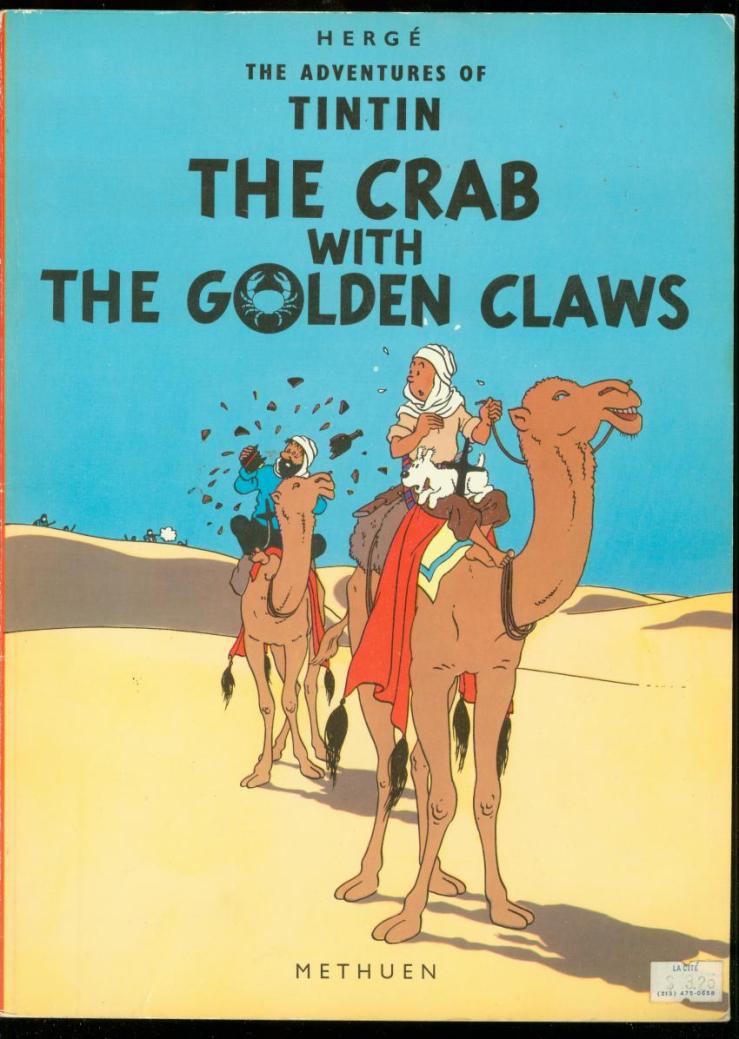
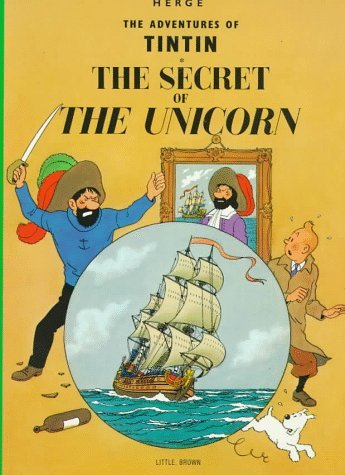
I’ve long been interested in Hergé’s Belgian comic series Tintin, which chronicles the adventures of Tintin, boy reporter, and his faithful dog Snowy. When a batch of hardback three-in-one editions showed up at my favorite used book store I picked up Vol. 3, which collects The Crab with the Golden Claws, The Shooting Star, and The Secret of the Unicorn. I read The Crab with the Golden Claws in one pleasant sitting that night and finished the other two adventures in similar fashion. Then I went back to the bookshop and picked up the other four three-in-one editions they had in stock.
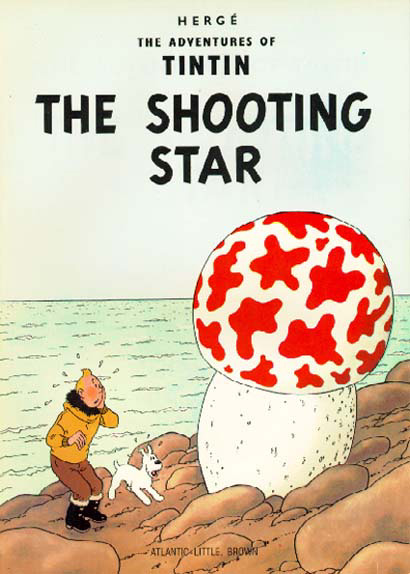
It’s hard to divide the tales, which are all fun adventures in the high style of boy-adventuring, but I think Crab was my favorite of the three. It involves a drug smuggling ring and a trip to the Sahara desert. It also introduces Captain Haddock, an alcoholic lummox who tips into a verbose stream of insults whenever he’s in a rage (he merely stutters when in his cups). Haddock is Tintin’s unlikely (but totally likely) sidekick in the other tales in the volume, and he shows up in the other books I bought as well. The Shooting Star is a bit more sporadic in its plot–it begins with the end of the world (by asteroid!) and when that doesn’t pan out, moves into an ocean race to recover a meteorite. Unicorn also boasts a nautical theme; Tintin finds part of a treasure map in a model ship and fights against antique-collecting brothers to recover the booty (Keno Bros. beware). These adventure stories share more in common with Indiana Jones and Edgar Rice Burroughs than Marvel or DC comics; there’s a prevalent sense of danger, fun, and mystery that underscores the series.

Hergé’s clean, efficient style evokes beautiful and strange worlds. His economy of storytelling is simply brilliant; he knows how to connote his characters’ movements–including some sweaty action sequences–and he also knows how to move the plot forward without resorting to talking heads (although you will find the occasional expository-friendly radio broadcast pop up in a Tintin comic). It’s when Hergé drops a luscious market scene or a crowded basement-dungeon larded with antiquities that the art in Tintin shines. Hergé’s great talent is to evoke a startling sense of place for each setting in his comics, a fully-realized set that creates a sort of visual (and emotional) baseline for the reader. This allows for the cleaner, crisper panels to relay action without clutter. Hergé’s knack for storytelling cannot be underestimated either. He blends high adventure with slapstick and verbal comedy, much of it courtesy Tintin’s foils: the Thompsons, bungling detectives, precisely, who provide Tintin with many of his cases; Haddock; and Snowy, of course.
If you know a bit about Hergé’s Tintin series, you may know that its depiction of non-white and non-European characters has come under attack in recent years; Tintin in the Congo has been singled out in particular. I haven’t read Congo, but Crab’s representation of  Arabs (and Asians) is riddled with all kinds of wrong–at least when viewed from a PC postmodern post-colonialist post-whatever perspective. Hergé’s comics reveal at times a particularly suspect Western European ideology, one that privileges white male authority in the form of white male adventure. We can see the same colonialism and Orientalism at work decades later in the Indiana Jones movies (particularly Temple of Doom). This comparison is not meant to indict Indy (or Spielberg, rather) or excuse Tintin (and Hergé); instead, I’m merely pointing out that adventure tales that feature white heroes exploring–and dominating–the Other are hardly new; nor have they disappeared. The big mistake would be not to read Hergé’s work for fear of tripping over politically-correct mores. Banning a book is never a smart practice.

Far better is Charles Burns’s recent Tintin revisionism in X’ed Out: he moves his inverted hero Nitnit to a bizarro world version of the Saharan market, a place teeming with strangeness that is also largely indebted to William Burroughs’s Interzone. The inversion reverses Tintin’s a priori white male domination into an equally fantastic (but far more horrific) vision of confrontation with radical Otherness. Shit gets weird (as alien encounters should). Nitnit is not in control, not the master of this domain, which is plainly not his. Burns’s Tintin revision saliently calls attention to the ways that the best in art might be transformed and reinterpreted. It points toward the subconscious inheritance intrinsic to art.

But back to the book I am ostensibly reviewing. The Adventures of Tintin, Vol 3 seems to me as good a place as any to start with Tintin, and those interested should dig in. These three-in-one editions are smaller than the traditional oversized format, but you can compensate by holding the book closer to your face (ah, intimacy). Lovely stuff.