Zora Neale Hurston’s Mulatto Rice

[Editorial note: We originally ran a version of this post in November of 2009. We’re republishing it as part of a series celebrating Thanksgiving, featuring recipes and food from some of our favorite books].

At the beginning of Zora Neale Hurston’s novel Their Eyes Were Watching God, Janie returns from the Everglades to Eatonville in ragged overalls to a gossipy and unwelcoming town. The one exception is her best friend Phoeby, who brings Janie a “heaping plate of mulatto rice.” Janie gobbles up the simple, delicious meal, even as Phoeby notes that it “ain’t so good dis time. Not enough bacon grease.” She does however concede that “it’ll kill hongry.” No doubt.

We’ve always been intrigued by mulatto rice. What could it be? Is the dish still around today, but under a new name? Although the term “mulatto” has fallen into disuse, and perhaps distaste (just ask Larry David if you don’t believe us), organizations like mulatto.org have also taken a certain ownership of it. For Hurston, mulatto rice is a positive thing. Hurston could have had Phoeby bring any number of dishes to her friend Janie, so it’s telling that she chooses “mulatto rice” as a homecoming meal. The dish represents a communion, an admixture that reflects Janie’s multiracial identity as well as her resistance to gender-typing. “Mulatto” is also probably etymologically akin to the word “mule,” and if you’ve read Eyes, you know that mules are a major motif in the story. But enough literazin’.

Down to the nitty-gritty–we made up a mess of mulatto rice tonight thanks to a recipe from The Savannah Cook Book by Harriet Ross Colquitt. Not that we found this 1933 cookbook ourselves. No, the real merit here goes to the very cool website Take One Cookbook, which explores the history and culture and sociology behind old, weird cookbooks–all while making the recipes. Colquitt’s recipe, via Wendy at Take One Cookbook (see Wendy’s versionhere):

Mulatto Rice

This is the very chic name given to rice with a touch of the tarbrush.

Fry squares of breakfast bacon and remove from the pan. Then brown some minced onion (one small one) in this grease, and add one pint can of tomatoes. When thoroughly hot, add a pint of rice to this mixture, and cook very slowly until the rice is done. Or, if you are in a hurry, cold rice may be substituted, and all warmed thoroughly together.

The rice is very easy to make and very, very tasty. We substituted green onions for a small onion, and used a hickory-smoked bacon that infused the rice with a lovely sweetness (we also included a tablespoon of brown sugar right after the tomatoes). We served the dish, pictured above, with ham steaks and fried green tomatoes with a spicy yogurt sauce. Hearty and rich and satisfying–just the sort of thing one wants to eat after a soul-searching quest (or maybe just a long day). Recommended.

The Hunting of the Snark — Lewis Carroll (with Surreal New Illustrations by Mahendra Singh)

I scrapped my first two drafts for a review of Melville House’s new edition of Lewis Carroll’s The Hunting of the Snark. The problem was that I was struggling to figure out Carroll’s Nonsense poem (subtitled An Agony in Eight Fits) about a ten man crew who take to the sea, to, you know, hunt a Snark. The Bellman seems to lead them. There’s the Banker, Baker, and other guys whose names start with “b” — including enemies the Beaver and the Butcher (who wind up tight allies). The poem is both silly and dense, rippling with weird wordplay and allusions that are, for the most part, beyond me. It’s often hard to follow, and sometimes has the effect of making the reader (or at least this reader) feel like he’s skating on the surface of some deeper profundities — or, alternately, maybe it’s just Nonsense, to use Carroll’s term.

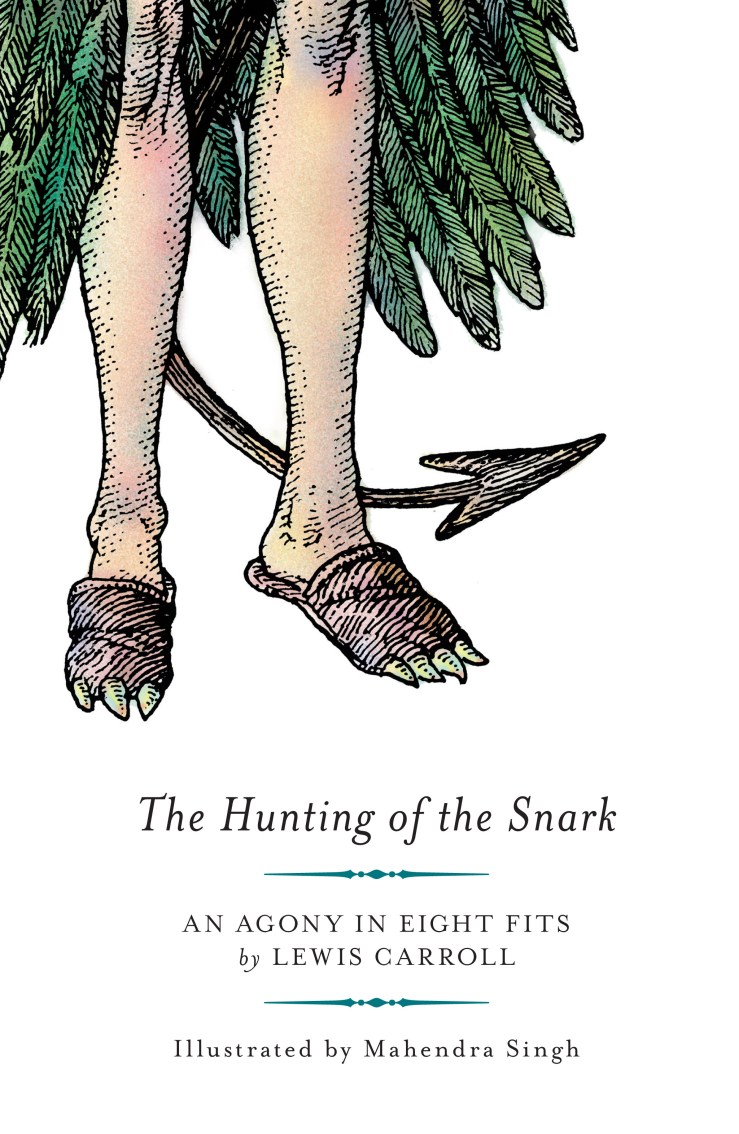
Anyway. I solve my dilemma by retreating to the real occasion for reviewing the book, namely Mahendra Singh’s marvelous and strange illustrations. Singh, a member of the Lewis Carroll Society of North America (and an editor of their journal, Knight Letter), describes his illustrated version as “fitting Lewis Carroll into a proto-Surrealist straitjacket with matching Dada cufflinks.” In both its imagery and heavy, dark lines, Singh’s project readily recalls one of my favorite books, Max Ernst’s proto-graphic novel, Une Semaine de Bonté, as well as Henry Holiday’s original illustrations for the book. Singh lards his illustrations with visual paradoxes, puzzles, and puns, as well as references to artists ranging from de Chirico and Magritte to Dali and Bosch. There are also nods to pop culture (including the Beatles).  And Freud, because, hey, why not. Observe–

Singh’s puzzles, like Lewis’s, do not immediately reveal their meaning, but of course this is part of the joy of the book. In his instructive afterword, Singh tells us that “each drawing should make some sort of sense of the verse it explains or at least, make Nonsense.”  His greater goal though seems to be to share his love of Carroll with his readers (“in particular the younger ones”), who he hopes will “further pursue on their own that immense cultural heritage which silently — and so faithfully — awaits them.” My three year old daughter enjoyed the book very much, and had the good sense (Nonsense?) not to get too flummoxed over what Snark means. This is probably a wise course to follow. As Singh observes in his afterword, “whenever Carroll was asked what the poem meant, he always replied that he did not know. “Of course, just because its creator didn’t know its meaning (or at least claimed not to) doesn’t mean that Snark doesn’t have meaning–it’s just the kind of ambiguous meaning that floats around on dream logic, and Singh’s surrealism, with its playful, amorphous shifts, is the right choice to illustrate the poem. I’m not sure if “illustrate” is the right verb here, though. Certainly these are illustrations, but Singh’s goal isn’t so much to literally render Lewis’s words in pictures as it is to echo their spirit. Singh’s art works in tandem with the poem, accompanying it through symbolic and metaphorical transfers, arriving at times to weird conjunctions and discordances, and, perhaps, generating new meanings. Recommended.

The Hunting of the Snark is new in hardback this month from Melville House. More at Singh’s blog.

“Housewife” — Amy Hempel

“Housewife,” a very short story by Amy Hempel

She would always sleep with her husband and with another man in the course of the same day, and then the rest of the day, for whatever was left to her of that day, she would exploit by incanting, “French film, French film.”

(From Micro Fiction, edited by Jerome Stern).

Jonathan Lethem Talks to Patti Smith

Voltaire’s Death Mask

Kurt Vonnegut Grades His Books

A Map of Philip K. Dick’s The Man in the High Castle

“There Are Anthropological Limits on Reading” — David Mitchell Talks About Writing

Newsweek Publishes Deleted Scenes from David Foster Wallace’s Infinite Jest

Newsweek has published a series of scenes David Foster Wallace cut from his manuscript of Infinite Jest. Fascinating for fans. (Thanks to @mattbucher for the tip). Here’s “Hal’s Essay on Ducks”–

At Hark! A Vagrant, Kate Beaton Does Macbeth

Cartoonist Kate Beaton riffs on Macbeth. From her site Hark! A Vagrant.

The AV Club Interviews Charles Burns

The AV Club’s Sam Adams interviews Charles Burns about Tintin, Burroughs, why he’s not involved in making the Black Hole movie, 1977, why he had to change how he colored his art, and his new book, X’ed Out. There’s also this nugget (we’d been wondering)–

AVC: Is the completed three-volume work going to be called X’ed Out?

CB: They’re all going to be different stories. So for the next one, it says “Next: The Hive.” So the next book is called The Hive.

AVC: Is there a name for the trilogy?

CB: No, not in my mind.

Slavoj Žižek on Children of Men


Sex, Drugs, and Harry Potter

[Editorial note–We originally ran this post in the summer of 2009 when Harry Potter and the Half-Blood Prince was in theaters. We run it again now to celebrate the premiere of Harry Potter and the Deathly Hallows, Part I (we also are running it again ’cause we’re lazy)].

First thing’s first: if you’re looking for Harry Potter slash fiction, you’ll have to check out our original Harry Potter Sex Romp post for links, you dirty dawg (you’re weird but you’re welcome). Just like that post a few years ago, this post’s title is really kinda sorta mostly irrelevant to what this post is about. What is it about? I want to take a look at some of the homoerotic tension in the new Harry Potter movieHarry Potter and the Half-Blood Prince. If you want to find a proper review of the film, with plot summary and insight, shop around. That’s not gonna happen here.

Also, there will be SPOILERS, okay? Fair warning.

INTL_HarryDumbledore (Large)

Okay. So, I saw the new film last night (henceforth HP6). And it was pretty good or whatever. But I noticed a subtext that cracked me up quite a bit, an underlying motif that might be lost on most summer blockbuster audiences. I’m talking about the implicit love between men and boys in this film.

At the beginning of the film, in an apparently insignificant scene, young Harry makes a date with an attractive young girl. However, old man Dumbledore shows up and dashes any hopes for a late sumer romance. Instead of meeting up with this lithe young thing, Harry has to grip hard to Dumbledore’s stiff arm to be apparated away to meet Horace Slughorn, an old potions master. Dumbledore uses Harry as fresh young bait for Slughorn, who has something the old wizard needs–a key memory about the development of Tom Riddle–Voldemort–a former protégé of Horace’s (lots of mentors and mentees here). Much of the narrative’s conflict revolves around the task Dumbledore has given Harry; it’s almost as if Dumbledore is pimping out the young wizard. These multiple man-boy relationships are doubled darkly in the failing bond between Snape and emo Draco.

In contrast, heterosexual relationships between the teens are treated with a lightness and even frivolity that codes such romances as ephemeral, or perhaps even inessential. Although the film solidifies the groundwork for the long-term relationships between the series’ principals (Harry-Ginny/Ron-Hermione), the real love story here is between older men and their young apprentices. HP6 depicts teen romance as silly without coloring any of its fragility with pathos. What the film really argues for is a sort of Greek or Platonic ideal of love; that love exists as a conduit for wisdom, passed from an older, experienced man to a younger boy in exchange for some of that youth’s beauty and vitality. Although moments of teenage adventure punctuate the film, the real scope of heroic encounters are shared between older men and their attendant lads (particularly Dumbledore and Harry, although even Snape, through the annotations of his old textbook, manages to plant part of himself into Harry).

The film reaches its climax with a lot of phallic wand waving and a bit of indecision over who gets to shoot off at whom. The climactic scene encodes the strange aggressions and series of shifting allegiances between the male wizards present. Dumbledore becomes the tragic figure; his death allows for Harry’s maturation, enacting a definitive arc in Harry’s Oedipal complex, where Dumbledore is both father figure and secret sex object. The weight of this tragedy initiates Harry into the adult world and adult responsibilities.

So why bother to write about this? No reason really, and I’m sure plenty of readers will find my analysis insupportable, silly, offensive, or just plain wrong. That’s fine. I guess I mostly find it remarkable that this motif should prevail so heavily in a summer blockbuster. There was also a whole drug motif going on–so many of the film’s plot development hinge on the ingestion of mind-altering substances–so maybe I just like the idea that the film is kinda sorta subversive.

“Have You Ever Been Diddled?”

The Ozark folktale “Have You Ever Been Diddled?” from Vance Randolph’s indispensable collection, Pissing in the Snow & Other Ozark Folktales

[Told by J.L. Russell, Harrison, Ark., April, 1950. He heard this one near Berryville, Ark., in the 1890s.]

One time there was a town girl and a country girl got to talking about the boys they had went with. The town girl told what kind of car her boyfriends used to drive, and how much money their folks has got. But the country girl didn’t take no interest in things like that, and she says the fellows are always trying to get into her pants.

So finally the town girl says, “Have you ever been diddled?” The country girl giggled, and she says yes, a little bit. “How much?” says the town girl. “Oh, about like that,” says the country girl, and she held up her finger to show an inch, or maybe an inch and a half.

The town girl just laughed, and pretty soon the country girl says, “Have you ever been diddled?” The town girl says of course she has, lots of times. “How much?” says the country girl. “Oh, about like that,” says the town girl, and she marked off about eight inches, or maybe nine.

The country girl just sat there goggle-eyed, and she drawed a deep breath. “My God,” says the country girl, “that ain’t diddling! Why, you’ve been fucked!

Win a Copy of The Collected Stories of Lydia Davis

UPDATE: The contest is closed–and in record time.

Want to win a copy of The Collected Stories of Lydia Davis? Of course you do. The book makes a hefty stocking stuffer, so you could even give it away if you wanted to, but we suggest you do the selfish thing and hold on to it. It’s excellent.

Picador has kindly agreed to give a copy to one lucky Biblioklept reader (you must have a U.S. address, though). Win this handsome Davis volume by being the first to correctly answer all three questions of our quiz. Post your answers in the comments section.

1. Lydia Davis was married to another famous writer back in the 1970s. Name that writer and his new novel.

2. One of Davis’s short story collections is titled Samuel Johnson Is Indignant. Why is Dr. Johnson indignant? (Hint: Read our review).

3. In a 2008 interview with The Believer, Davis commented that she tried to translate/update a famous 18th century Irish novelist’s work. Who was the writer?

Charles Burns Interviewed

Vodpod videos no longer available.

“Hostess” — Amy Hempel

“Hostess” by Amy Hempel–

She swallowed Gore Vidal. Then she swallowed Donald Trump. She took a blue capsule and a gold spansule–a B-complex and an E–and put them on the tablecloth a few inches apart. She pointed the one at the other. “Martha Stewart,” she said, “meet Oprah Winfrey.” She swallowed them both without water.

(From Micro Fiction, edited by Jerome Stern).