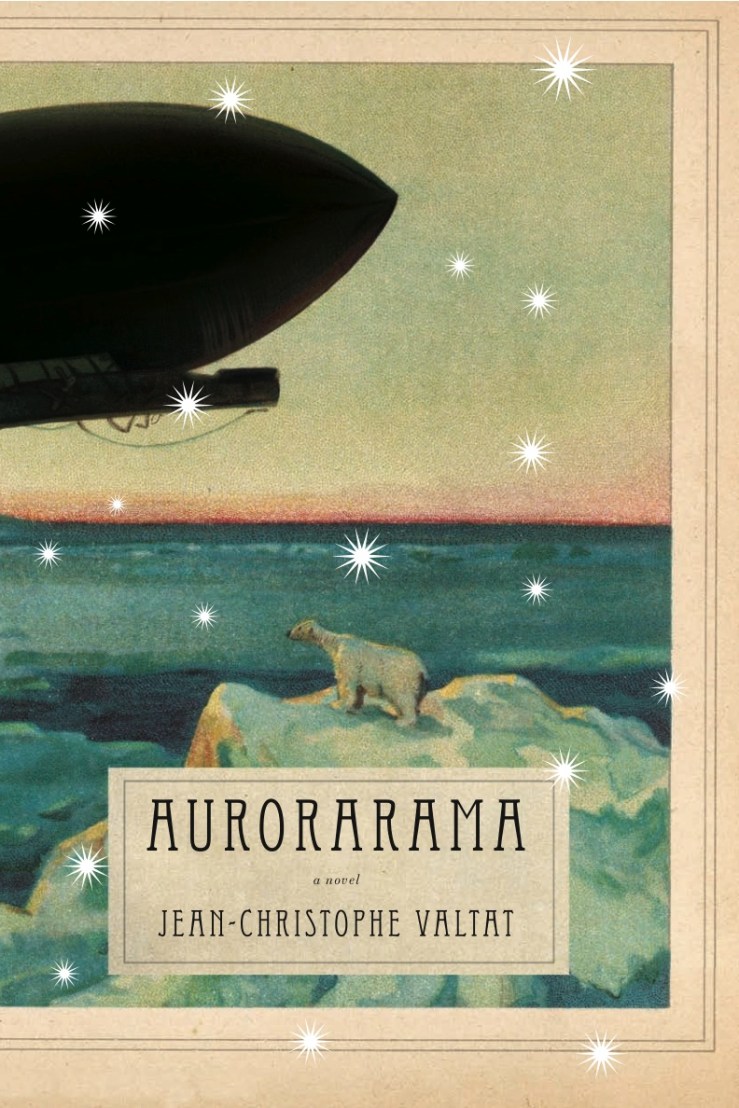
In Aurorarama, Jean-Christophe Valtat imagines an alternate world where the strange wilderness of the Arctic north has been colonized. The centerpiece of this world is New Venice, a bizarre metropolis on ice, bustling with a hodgepodge of cultures and brimming with dire conspiracies. New Venice showcases a kind of steampunk technology that surpasses its otherwise post-Victorian-era manners and mores: there are airships and pneumatic tubes, dream chambers and psychedelic drugs (lots and lots of drugs). Those drugs are part of New Venice’s underground, a subculture that also features a “Polar Pop” scene (although most of the groups seem to make art-noise-dirge-weird music, not pop). Beyond the subversive art scene, however, more sinister forces are at work in New Venice. The city lies under the shadow of a mysterious black zeppelin; a samizdat Utopian text is circling the underground, challenging the establishment’s authority–and causing the secret police, the Gentlemen of the Night, to shake down suspects left and right; the native Inuit are preparing to revolt; the secretive Scavengers have found a dead woman in a mysterious automotive sled. If this sounds awfully complex, it is. Thrown into the middle of the mess are the book’s protagonists. Duke Brentford Orsini, a reserved and idealistic man, is ostensibly the director of the city’s greenhouse–although he seems to spend most of his time juggling the various political (or, in the book’s terms, “poletical”) problems that surge and resurge in New Venice. Brentford’s levelheadedness contrasts with his friend Gabriel d’Allier’s rakish charm. Gabriel is a literature professor on the edge of collapse–not that that gets in the way of his frequent drug binges and sexual escapades. Valtat alternates his chapters between the pair, forwarding the plot via Brentford’s mounting political (and supernatural!) problems and Gabriel’s libertine snags.
Valtat’s world is as thick as polar ice, with its own history, mythology, culture, and political science. The events in Aurorarama are essentially in media res; the adventure begins at the tail-end of a previous disaster. Valtat has given himself plenty of space here to expand the story–both in sequels and prequels (a novel detailing the founding of New Venice, an event alluded to in Aurorarama, would be fascinating). Valtat also exhibits a playful sense of humor, both in the story’s plot, but also in his tone, which often plays off of stodgy Victorian tropes in humorous ways, particularly in the chapters featuring Gabriel. At the same time, Valtat’s book is quite serious, as he labors to evoke a wholly-realized, wholly-strange world. Sometimes his sentences strain under this pressure, no doubt in part because Valtat is a native French speaker; this is his first novel composed in English. The occasionally over-long or clunky phrase does not, however, detract much from the pleasures of Aurorarama, which rest rather in Valtat’s vital imagination. This is an intelligent work of speculative fiction, steeped in the tradition of Jules Verne and H.G. Wells; it also readily recalls The Difference Engine (by William Gibson and Bruce Sterling), Philip Pullman’s His Dark Materials trilogy, and even, in some of its strong imagery, the steampunk visions of Hayao Miyazaki. Recommended.
Aurorarama is new in hardback from Melville House.





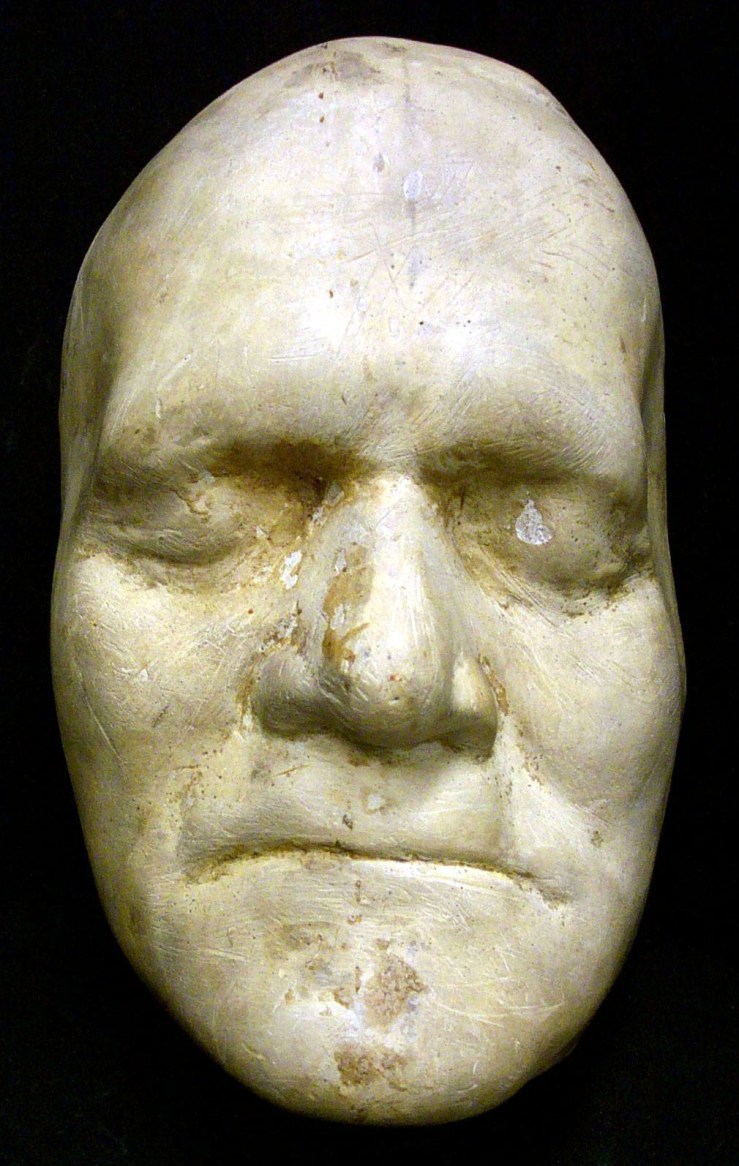
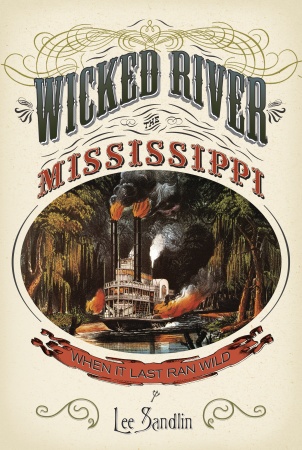 The mighty Mississippi River remains perhaps the signal geographical symbol of the United States of America. It divides our country neatly into East and West, flowing down from the industrial North to the agricultural South, and in this sense, the Mississippi is the major artery of America’s heart. We find in the Mississippi a rich mythos, one that both informs and reflects our national character. And while plenty of writers have striven to capture and express the river’s culture and character, it is Mark Twain who more or less invented our idea of the Mississippi. In his fascinating new history Wicked River, Lee Sandlin observes that, “There is a pretty much universal idea that Twain has a proprietary relationship to the Mississippi. It belongs to him, the way Victorian London belongs to Dickens or Dublin belongs to Joyce.” Sandlin’s goal in Wicked River is not to wrest the Mississippi from Twain; rather, he aims to show us the gritty turbulence swelling under Twain’s romantic myth–a myth that many Americans have come to hold as a received truth. Sandlin points out that Twain’s “Mississippi books are works of memory, even of archaeology”; they point to a vibrant river culture in a prelapsarian past, one “with its own culture and its own language and its own unspoken rules.” Sandlin’s own book plumbs that culture, revealing strange, wild tales of river pirates and con-men, fiddlers and gamblers, road agents and robbers, politicians and drunkards, and Indians and would-be “civilizers.” Sandlin’s canny observations come from a myriad of first-hand accounts–always the sign of a legitimate history–but Wicked River is never dry or dusty, but rather brims with vigor and intensity, whether we’re learning about the earthquakes that shook up New Madrid, the tornado that smashed Natchez, the sinking of the Sultana, or the ice floe that destroyed the St. Louis Harbor. Sandlin’s writing is concise, lively, and often wry and earthy–although always grounded in fact. (One colorful passage begins, “There was one simple explanation for the wildness of river culture: everybody was drunk”). Wicked River does a marvelous job conveying the tumultuous and eclectic history of an American frontier in the nineteenth century. Recommended.
 Listen to