The Ramen King and I — Andy Raskin

ramenking550hshadow

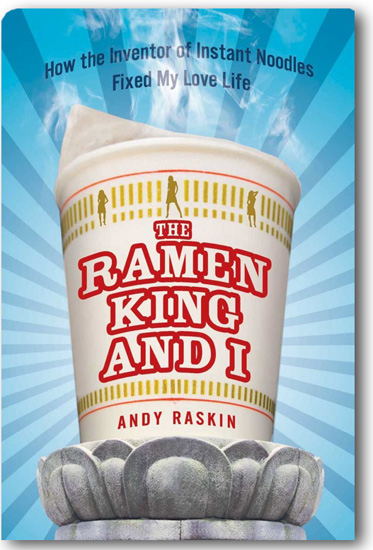
In his new memoir The Ramen King and I, Andy Raskin connects sex, desire, Japanese culture, and instant noodles in an often funny, sometimes poignant, and ultimately redemptive narrative that memoir-enthusiasts (and Japanese food fans) will enjoy. Raskin’s narrative works along several tracks that eventually intertwine. The book begins with Raskin’s obsession over Momofuku Ando, inventor of instant ramen (and gifted inspirational author, to boot), backtracking in time to slowly reveal just how a kid from Long Island got to be so wound up in the writings and philosophy of an ancient Japanese businessman. Raskin balances a straightforward, chronological narrative with intensely personal letters (supposedly) written to Momofuku. These letters often read like diary entries and help to expose the core of Raskin’s dilemma: in short, he’s an emotionally detached womanizer with extreme fears of commitment (in some of the memoir’s skeevier sections, we’re treated to Raskin’s descriptions of making “dates” via Craigslist). Raskin relates his life as a tech and business writer, and his frequent trips to Japan. Eventually, after a chance encounter in a sushi bar, Raskin enters the strange world of ramen, a world that eventually leads him to Momofuku, whose zen writings in turn lead Raskin to a transcendental breakthrough.

Raskin lets his audience get to know Momofuku too, both through the narrative proper and also through short, scattered sections titled “A Very Brief History of Momofuku.” Each part delivers another pithy bit of wisdom from the ramen master (who, strangely enough, invented instant noodles in a wood shack in his back yard). It’s easy to see why Raskin admires Momofuku, especially when we’re treated to a koan like “In a line, you can see the desires of the world” (to clarify, Momofuku is referring to a queue). Raskin’s descriptions actually make readers want to pick up Mr. Ando’s books–who could resist a chapter title like “I Am a Salad Bar Man,” from Momofuku’s collection of food essays Praise the Appetite. Indeed, the best parts of The Ramen King and I center around food and Japanese culture. Raskin is particularly passionate when describing his favorite semi-secret sushi spot (in one of the book’s saddest moments, he’s banned–this only helps to facilitate that redemptive arc, though, folks); the book also shines when Raskin details the rigmarole of the ordering ritual at Ramen Jiro–a Tokyo ramen shop complete with its own shaming ceremonies. Raskin’s evocations of sushi and ramen manga also fascinates. I lived in Tokyo long enough myself to know that the Japanese have comic books about everything, but I must admit I was still surprised by the range of sushi comics Raskin describes. He also takes one of the books major thematic cues from a Japanese game show called Go Forth, where the young hosts blurt out “I wanna _____!” and fill in that blank with a random phrase; they then go attempt to fulfill their task.

On the other hand, the parts of The Ramen King and I which center on Raskin’s relationships with women often drag, or at least blur into each other. Raskin seems to understand his “ex-girl to the next-girl” mentality is detrimental to his mental health, but he’s rarely reflective about it in a meaningful way, and he certainly doesn’t attempt to plumb its roots. However, he often admits as much, pointing out that the details he remembers from relationships–even long term ones–tend to be pretty ephemeral (and, not coincidentally, attached to food). On the whole though, Raskin’s book reads at a quick, easily digestible pace without resorting to the clichés or stock phrasing that often plague memoirs. Sure, the book follows a pretty predictable pattern of fall and redemption, but it does so in a manner that enlightens without being didactic. Memoir fans, foodies, and anyone interested in contemporary Japanese culture will likely enjoy The Ramen King and I. Recommended.

The Ramen King and I is available May 7th, 2009 from Gotham/Penguin.
The Rings of Saturn — W.G. Sebald

rings

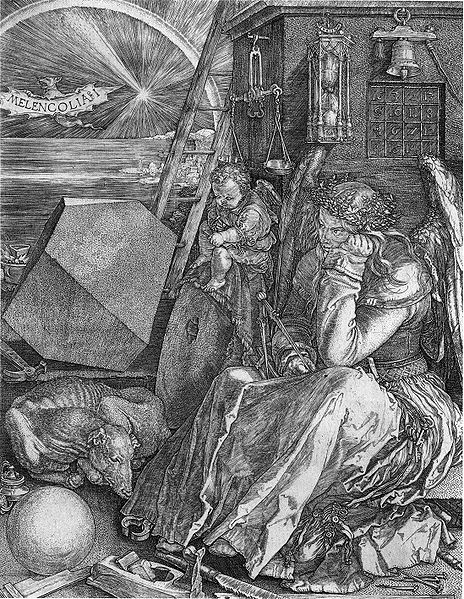
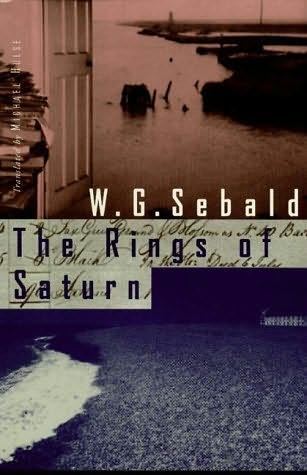
Early on in W.G. Sebald‘s strange and beautiful novel The Rings of Saturn, the erudite narrator (seemingly) offhandedly alludes to Albrecht Dürer’s 1514 engraving Melencolia I. Rings is larded with such references, stuffed to the gills with analysis of history and literature and art (and so much more), but the quick allusion to Melencolia I seems a particularly informative way of interpreting–or at least comprehending–Sebald’s grand, glorious book. Before we begin though, it will be useful to quickly summarize the plot: In 1992, a German intellectual named W.G. Sebald takes a walking tour of the east coast of England. He visits old English manors, the homes of dead writers, decaying seaside resorts, abandoned islands, and many other melancholy spots. In true King Lear style, he wanders the heath a bit. But this walking tour is not the real plot: no, instead, Sebald, in a casual, sometimes wryly humorous, and mostly melancholy tone reflects on the global and historical implications of a host of subjects far too numerous to try to list here. In other words, this is a very smart book about everything.

464px-durer_melancholia_i1

The Rings of Saturn, as its title suggests, is a book about melancholy (Renaissance medical texts identified Saturn with the bodily humor melancholy–black bile–indicated by sluggishness and moroseness, paradoxically paired with an eagerness for action (hence the modern word saturnine)). The melancholy of Rings pervades the whole text and even infiltrates each sentence. Like Dürer’s engraving, Sebald’s text is complexly and richly detailed, overflowing with allusion and symbolic registry that defies simple or easy interpretation. Just as Dürer situates the winged figure of genius at the (slightly off-) center of his image, contemplative yet dreamy, we find Sebald’s narrator to be a flighty genius made forlorn by the world he sees. And yet, just as Dürer’s figure is ultimately ambiguous (is he despondent or merely in the throes of absent fancy? Is he shirking his duty or contemplating a new grand work?) so too does Sebald’s narrator resist any simple interpretation. The narrative bulk of Rings consists of the narrator’s perspectives on history and memory, art and economics, literature and suffering. Like the myriad strange objects that surround the figure of genius in Dürer’s engraving, the connections between the subjects of the narrator’s lessons seem tenuous at first (indeed, several interpretations of Dürer’s piece have argued that it is simply a failed allegorical vision). As the text develops, we begin to see how the narrator’s obsession with, say, Thomas Browne’s skull connects to a biographical account of Joseph Conrad, or early English colonial forays into Imperial China, or reflections on the life cycle of the herring. Like the objects that litter Dürer’s engraving, the narrator’s varied lessons are detailed things, concretizations of history, or art, or literature, or science, and, at the same time–like Dürer’s objects–the narrator’s lessons are also symbols connected to grander abstractions. The work–and joy–of the reader is to link these symbols, these abstractions, into meaning. This is no simple task, but Sebald’s masterful writing ensures that it is a rewarding (and downright fun) adventure.

The flip side to melancholy is the potential energy writhing within its dramatic inertia. The very nature of the narrator’s simple quest–a walking tour–dramatizes this energy; at the same time, the decay and erosion of English coastal life threatens to overwhelm it for good. The narrator’s access to so much human knowledge, both miserable and horrible, attests to the power of history to survive through–but also to paradoxically crush–the living. This paradox of melancholy, dramatized in Dürer’s Melencolia I, is neatly summed up in a line from the first page of The Rings of Saturn (a page I immediately returned to after finishing the book, I must add):

At all events, in retrospect I became preoccupied not only with the unaccustomed sense of freedom but also with the paralysing horror that had come over me at various times when confronted with the traces of destruction, reaching far back into the past, that were evident to me even in that remote place.

In this “remote place,” this forlorn milieu, Sebald’s narrator (Sebald?) again and again uses the lens of history to–again paradoxically–attempt to come to terms with history, both collective and individual.

The result of all this is a wonderful, engaging read, on par with the greatest books I’ve read. Sebald’s command of language, his ability to dip into another’s voice recalls Roberto Bolaño’s great work 2666; Sebald’s narrator, in his will to understand and catalog recalls Ishmael in Melville’s masterpiece Moby-Dick, as does his human sympathy, humor, and sensitivity. At the same time, Sebald’s scope spills out of the conventional borders of what we’ve come to know as the novel. While hardly as dry–or neutral–as a history or science text, Sebald’s narrator’s takes on sericulture, or the life of Joseph Conrad, or the relationship between art museums and the sugar trade of the 18th century all vibrate with an intense truthfulness that informs and engages the reader without ever falling into didactic prattle.

At the end of The Rings of Saturn, Sebald’s narrator returns to Thomas Browne’s skull again–only this time resurrected, a living brain. He discusses at length Browne’s Musaem Clausum, an imaginary library that Browne invented containing texts, artifacts, and relics of every manner of wonder. Sebald’s narrator goes on for pages listing the contents of Musaem Clausum with fervor and passion–the reader realizes that the book, and the narrator, could go on and on, detailing these wonders and their connected histories under more intense scrutiny. Rings replicates both Browne’s Musaem Clausum and Dürer’s engraving, offering readers a tour through myriad marvels–and if the walk is melancholy and strange, it is also profound and beautiful, and very, very rewarding. Very highly recommended.

May Day? Labour Day? Loyalty Day?

The following is excerpted from one of our favorite freely-found books, Alice van Straalen’s The Book of Holidays Around the World:

May Day Worldwide In a festival that lasted from April 28 to May 3, the Romans offered flowers to Flora, their goddess of spring. They brought the custom to all the European lands they conquered; and by the Middle Ages it became especially popular in England. People rose early in the morning to “bring in the May.” They gathered flowers and tree branches to decorate their homes and later went to the town square where the maypole–often over 100 feet tall–was raised, and a woman representing the May Queen presided over the celebrations. Dancers held the streamers that fell from the top of the pole and, as they circled around it, wove them into tight patterns. When they changed directions the streamers untangled again and blew free, a tradition that some towns in England and America have continued. In 1889 the Second Internationale, an association of French socialists, dedicated May Day to working people, and today in many countries it is celebrated as a labor day. The Soviet Union marks the day with a military parade in Moscow.

Soviet Union…yeah, the book is almost 25 years old…

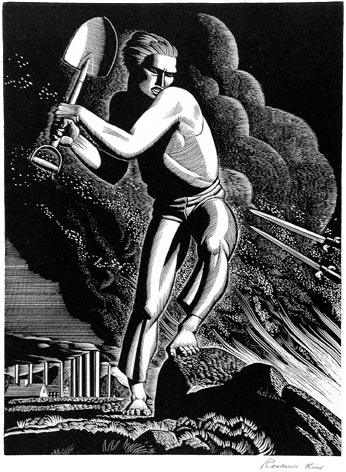
Workers of the World Unite -- Rockwell Kent

But don’t worry, God-fearing Americans! It turns out that, in order to reclaim May Day from pinkos and anarchists, the U.S. government declared May 1st “Loyalty Day.” From 36 US Code §115:

(a) Designation.— May 1 is Loyalty Day.

(b) Purpose.— Loyalty Day is a special day for the reaffirmation of loyalty to the United States and for the recognition of the heritage of American freedom.
(c) Proclamation.— The President is requested to issue a proclamation—

(1) calling on United States Government officials to display the flag of the United States on all Government buildings on Loyalty Day; and
(2) inviting the people of the United States to observe Loyalty Day with appropriate ceremonies in schools and other suitable places.

Loyalty Day? Okay, sure, why not? I wonder though, in 2009, are the two perspectives on this ancient festival–the concept of workers standing up for the right to control the means of production, etc., and the idea of being loyal to America–are they so different?

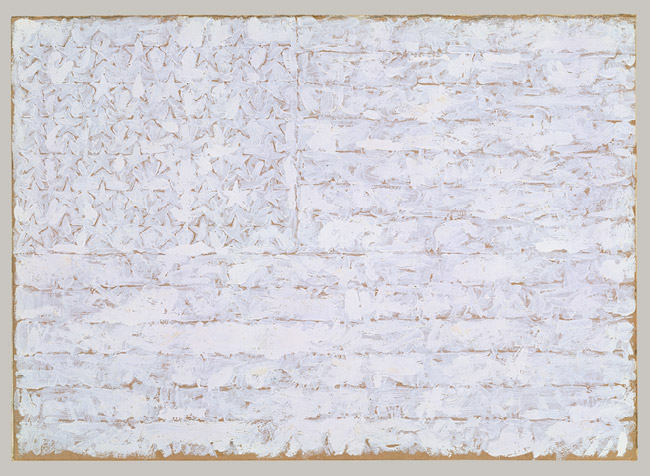
Flag -- Jasper Johns

The 2009 PEN/O. Henry Prize Stories

penab

The short story often gets short shrift. While Hemingway’s “Hills Like White Elephants” is an astounding feat of economy, it’s rarely mentioned in the canon of Hemingway’s masterpieces like For Whom the Bell Tolls. There’s a strong case to be made that Kafka’s little fables are far more perfect than his unfinished novels, and yet The Trial, incomplete as it is, is still considered his finest work. I would take any one of Nathaniel Hawthorne’s Twice-Told Tales over the interminable stuffiness of The Scarlet Letter. There exists, perhaps, a feeling that the short story as art form is incapable of making Grand Gestures or Big Important Statements. Collections that are lauded tend to function (or at least pretend to function) as homogeneous “novels in short story” –which can be great, of course (see Denis Johnson’s inimitable volume Jesus’ Son) — but why should that be? To often, readers dismiss short stories, particularly short stories, as little more than time-fillers, neat little chunks of text to occupy specific moments in time: a subway ride, an term in a waiting room, a spare half-hour. Sometimes we set aside our real Reading Time for those oh-so important novels, so that we might Learn and Grow as a Person (or whatever). And while the tales comprising the 2009 PEN/O. Henry Prize Stories certainly won’t disappoint as time-fillers, they offer so much more than simple leisure reading.

Repeatedly, the stories in this collection explore what is at stake in the human condition, and a sense of loss underpins many (if not most) of the tales. Take the lead story, Graham Joyce’s “An Ordinary Soldier of the Queen,” for instance. This story of a British Army officer who may or may not have been exposed to toxic nerve gas during the first Gulf War unfurls in a realistic, funny, and often affecting voice. Joyce’s tale dips from a military procedural into uncanny, fantastic territory, making the reader question the perception of the narrator, who never wavers in his beliefs about the strange events (namely, meeting a djinn) that are (maybe) happening to him. I thought about “An Ordinary Soldier of the Queen” for days after I read it and I made a colleague read it so that I could force him to discuss it with me. Karen Brown’s “Isobel’s Daughter” also explores loss, communicating the profundity of those everyday tragedies we often look away from. (Brown’s evocation of Tampa, Florida is spot-on, I must add). In “Purple Bamboo Park,” E.V. Slate lets us peer into the life of an old maid in modern China. The story is heartbreaking from the get-go, and yet her protagonist is not a wholly sympathetic character; Slate’s handle on human failure and our investment in mundane adventures is crushing–who knew we could have so much in common with an aging domestic worker? Caitlin Horrocks literalizes loss in “This Is Not Your City,” thrusting her readers into the panic of Russian immigrants whose daughter goes missing. In “The Order of Things,” Judy Troy examines loss and meaning through an affair, concluding that “Feeling came first and though after; that was the order of things,” much to the surprise of her protagonist. And while Paul Theroux’s “Twenty-two Stories” is more playful in both structure and content (it is comprised of twenty-two short short short stories), again we find characters pondering loss and the circumstances of their losses. Theroux’s characters, like those in James Joyce’s Dubliners, repeatedly come to negative epiphanies, whether they lose their faith in God and religion or realize that they were unfit parents. The closing story, Junot Díaz’s “Wildwood” makes me kind of ashamed that I still haven’t read Brief Wondrous Life of Oscar Wao. I will remedy this omission forthwith.

While readers may not love every story collected in The 2009 PEN/O. Henry Prize Stories, it would take a pretty cold automaton to dismiss most of what’s presented here. The project, helmed by editor Laura Furman with jury prize selections by A.S. Byatt, Anthony Doerr, and Tim O’Brien, is really an exploration of how people handle loss and beauty and family and adventure and boredom and all those things that happen in life (and death). And isn’t that what we ask of our literature? Read this book, but give these stories their proper due. They’re more than just time-fillers; each one is a perfectly crafted little world waiting to be explored. Recommended.

The 2009 PEN/O. Henry Prize Stories is available May 5th, 2009 from Anchor Books.

“The Distance from the Moon” — Italo Calvino

We’re loving this very cool animation of Calvino’s short tale “The Distance from the Moon,” from the collection Cosmicomics. This month’s Harper’s features two funny and thoughtful little fables told by Cosmicomic‘s strange narrator Qfwfq , and if you’re too lazy to buy that, check out The New Yorker‘s recent publication of “The Daughters of the Moon.” Presumably these stories will be published in the upcoming volume Complete Cosmicomics. Stay ahead of the curve by reading them now. Special mp3 bonus: actress Maria Tucci reads from Cosmicomics.

Shanghai Jim

Shanghai Jim is a fascinating BBC documentary about the strange expatriated life of J.G. Ballard. While the doc focuses on Ballard’s autobiographically-inspired works like Empire of the Sun, there is some detail about his experimental works. Lots of cool footage here, but the highlight, of course, is hearing Ballard tell his own story. Plenty of insight into his characters, their motives, and his reasons for writing. Go here if you hate squinting at Youtube vids or here for Ubuweb’s avi.

Continue reading “Shanghai Jim”

J.G. Ballard Cover Gallery

Some of our favorite Ballard covers:

1crash_cover2Nice gear shift…

1pocket_crashLove the enthusiasm there…

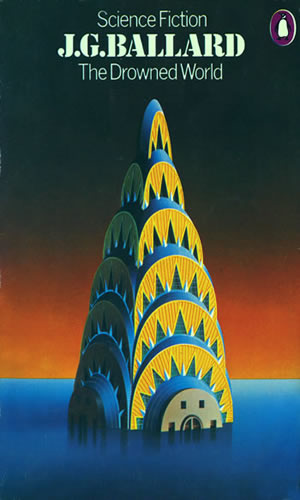
1drowned_pelham

1atrocityc760

My buddy Tilford lent me his RESearch edition of The Atrocity Exhibition (I didn’t steal it and that makes me a moral being). I think it’s probably the definitive edition. I wish I had it (maybe I should’ve stolen it…).

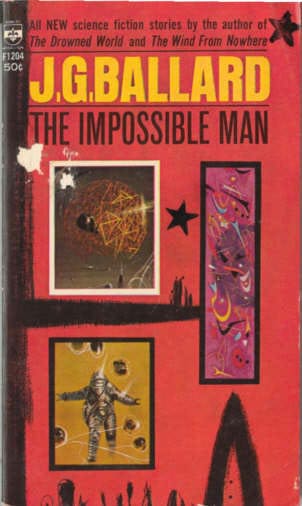
1impossiblec2143

Pulp fiction.

1terminalbeach1

Why is “Ballard” in katakana?

1highrise-book

This one is sorta Magritte by way of Calvino (if that makes any sense).

For lots more covers and lots more Ballard check out JG Ballard and Ballardian.

J.G. Ballard Remembered

jgballard

Author J.G. Ballard died of prostate cancer yesterday, at the age of 78. Ballard wrote over a dozen novels and hundreds of short stories. Ballard is probably most famous for his 1984 epic Empire of the Sun, which draws heavily on his childhood experiences during WWII Japanese-occupied Shanghai, but here at the Biblioklept we love his dystopian visions the most. Ballard’s early books like The Drowned World and short-story collection The Terminal Beach extend traditional adventure novels into strange dystopias and bizarre thought experiments. From the get-go, Ballard’s “sci-fi” (if you want to call it that) was less concerned with alien intelligences than it was with our internal and collective psychologies, and how we react to an increasingly mediated world. Hence novels like Crash, where human sexuality melds into technological fetishism, or The Atrocity Exhibition, a fragmented novel exploring the intersection of celebrity and Armageddon. Later novels like Cocaine Nights and Super-Cannes respond to an increasingly paranoid and disconnected world, with a sardonic humor that is ultimately more frightening than soothing. Ballard never sought to alleviate or mock or answer to an increasingly complex and increasingly absurd world–he just dissected it and extrapolated it beyond most of our dim imaginations.

Ballard belongs to a select counter-tradition of writers and artists, fitting neatly between William Burroughs and William Gibson. Like his strange brothers Philip K. Dick and Thomas Disch, Ballard will always have a place in the avant-garde sci-fi cannon, and it’s likely that that place will only grow. Ballard was still writing up to his death, and his last novel Kingdom Come, a book that detailed the descent of consumerism into a type of fascism was as relevant as ever. Indeed, Ballard was far ahead of his time; as our world catches up to his visions, we will surely find an increasing relevancy in his body of work. He will be missed.

Historic Photos of Ernest Hemingway

eh-coverhihgres5

Historic Photos of Ernest Hemingway, new this month from Turner Publishing, combines over 200 black and white photographs of Hemingway with text and captions by James Plath to form a sort of visual biography of one of America’s most iconic writers. Spanning the entire 61 years of the author’s life, the book treats us to over a dozen photos of Hemingway’s childhood, including several (surprisingly high resolution) images of Papa as a baby. Admittedly, these are kind of uncanny, but for me, seeing baby Hemingway is not nearly as strange as seeing the many photos of teenage/early 20s Hemingway. The Key West Hemingway–bearded and burly–has become so iconic that seeing the writer in his youth is almost like seeing an entirely different person. He’s very handsome, with a vigorous smile that radiates charm and energy–much like the older Hemingway–but with a certain sheen and optimism missing in the older Hemingway. Even on crutches or in a wheelchair, young Hemingway seems less damaged than old Hemingway.

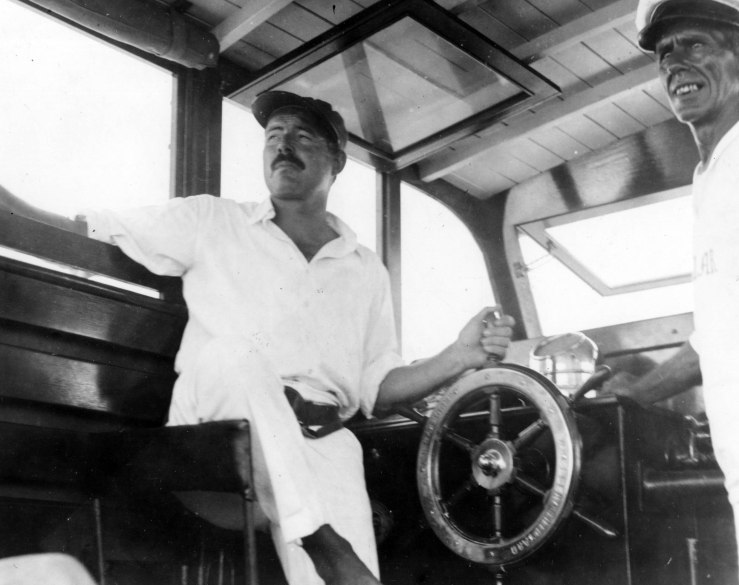
Hemingway on the Pilar

As you might expect, a majority of the pictures throughout the volume find Hemingway engaged in some sort of sport or activity–sport fishing, hunting, sailing, boxing, skiing, and so on. And drinking. Lots and lots of drinking. There’s plenty of shots of Hemingway with famous friends (fishing, boxing, and, um, drinking), but also many images of Hemingway with his various families (the man had four wives in 25 years). There’s an unexpected vitality in the photos that sustains throughout the volume, due in part perhaps to Hemingway’s engaging, larger-than-life personality, but also attributable to the fact that the book works in some ways as a cultural history of the first half of the 20th century. The images trace Hemingway from his Illinois birth, to Italy in WWI, to his ex-pat glory days in Paris (in particular) and Europe (in general). Of course, there’s plenty of Papa in Key West, as well as his time in Bimini on his boat Pilar. As Hemingway moves from Spain to Communist Cuba, we see his health deteriorate: all that boxing and drinking and loving and fighting has clearly caught up to him. He looks very, very old for a man in his late fifties. With the specter of his impending suicide hanging over the final photos, it’s hard not to read pain and depression into those last images.

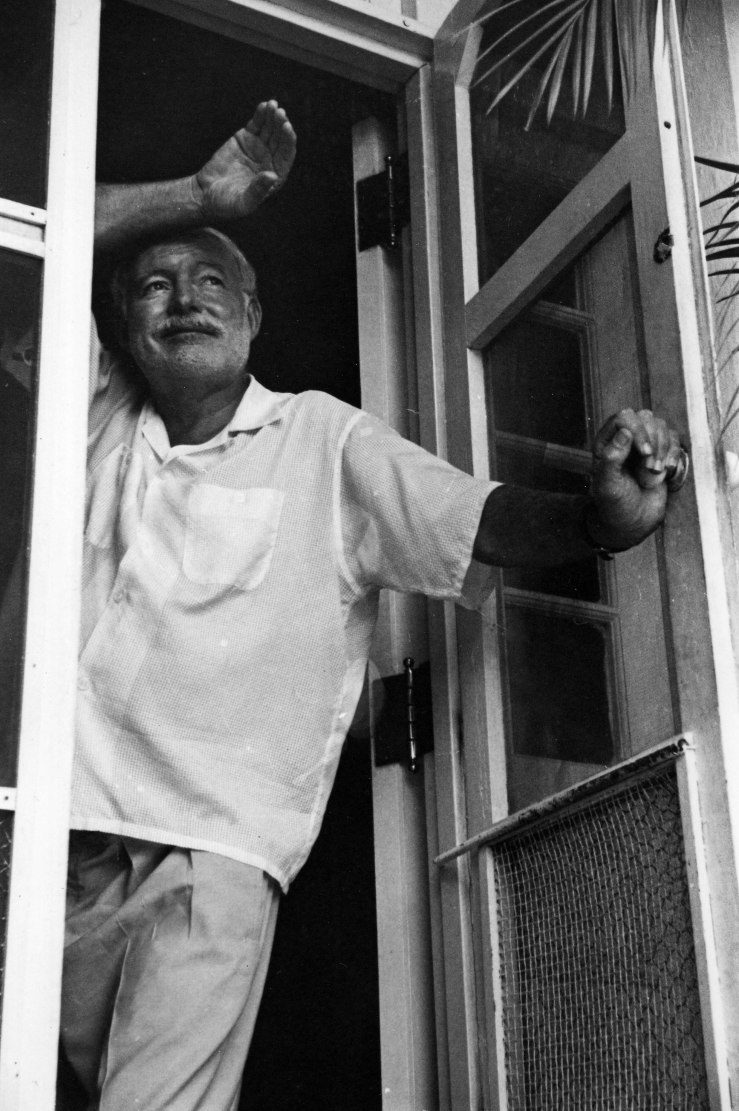
Hemingway in Cuba
Hemingway in Cuba

Plath’s text adds greater depth to Hemingway’s biography than one might expect from a coffee table book. He explicates the photos by providing context and background, both historical and literary, and while he’s never gossipy, there’s a wry humor and ironic understatement to many of his captions that help to shade Hemingway’s character (Plath’s deadpan note that Hemingway “broke poet Wallace Steven’s jaw, marooned poet Archibald MacLeish on an abandoned cay after an argument [and] got sore at Fitzgerald when he messed up on timekeeping in a supposedly friendly boxing match” is particularly funny). Plath also proffers insight into Hemingway’s literary works. And about those literary works. They are not dominant in Historic Photos of Ernest Hemingway, nor should they be. If anything, the book makes a solid visual case for Hemingway as icon, a figure that at least appeared to live the life he wrote about. Plath’s text is hardly fawning, pointing to many of Hemingway’s myriad flaws, but it also recognizes Hemingway as a kind of symbol of America’s progression in the 20th century, its movement from isolation to the world stage. Recommended.

The Penelopiad – Margaret Atwood

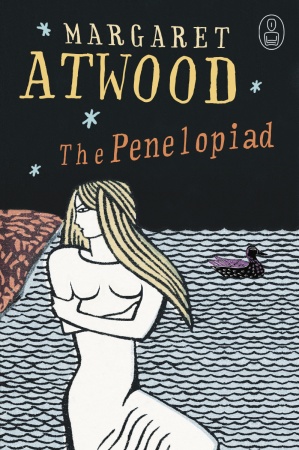
thepenelopiad

The Odyssey has long been my go-to example for phallocentric literature in the high school classes I teach. The story of wily Odysseus and his crew wandering the high seas for a decade after the Trojan War prototypifies a literature of masculine fantasy full of adventure, intrigue, and romance. While Odysseus explores the world, bedding nymphs and witches and having every kind of adventure with his boys, his wife Penelope is at home, faithful and chaste, raising kid Telemachus and keeping the would-be usurpers at bay. In short, the story of Odysseus licenses an entire tradition of phallocentric literature wherein the clever protagonist is able to duck familial and social duty and have a great adventure in the process. Think of Huck lighting out for the territory. Same deal. Not that there’s anything wrong with that. But as Margaret Atwood saliently demonstrates in The Penelopiad, her reworking of The Odyssey, there’s always another side to that story of masculine escape–and a price to that adventure, as well.

As its title suggests, The Penelopiad tells the story from the perspective of Penelope, a plain but clever girl, who–like Odysseus–must learn to live by her wits. Atwood, working from several myths, details Penelope’s divine parentage (she’s half-naiad), and her upbringing as a young maid in her father’s home. In an early key scene, Penelope’s father supposedly (the details are fuzzy, she admits) tries to murder her by drowning her, after learning that she will weave his shroud. This infanticide echoes the story of Oedipus, and also serves as a dominant motif throughout the story (it’s also twinned with a motif of eating meat–Penelope remarks at one point that she is just “meat” to be eaten). As the story progresses, young, shy Penelope slowly transforms from a naive gal with a chip on her shoulder about her preternaturally beautiful cousin, Helen, into a woman as wily as Odysseus himself. Atwood treats us to Penelope’s inner thoughts on all sorts of subjects, and even though Penelope claims to love Odysseus, it’s repeatedly clear how angry she is at not only him, but also her son.

While Penelope’s story is dominant, Atwood is very concerned with Penelope’s twelve maids, orphaned servants slain by Odysseus and Telemachus after Odysseus’ return. The maids serve as a chorus, interjecting their voice in short chapters written in a variety of styles, ranging from epic poetry to sea shanties to short skits. One of the most fascinating choral sections plays as an anthropological seminar, in which Atwood’s maids suggest that the real story of Odysseus and Penelope is in fact the displacement of a matriarchy by a wandering warrior. There’s also an inspired court scene where Odysseus is tried for killing the suitors, and the maids sue for justice.

Ultimately, Atwood paints the maids, poor orphans and slaves, as the real victims in this ancient tale. While Penelope complains that she is treated as “meat,” Atwood makes it clear that it’s really the maids who are treated as mere flesh to be consumed–slaves forced to clean, bodies subjected to repeated rapes. And while Penelope repeatedly expresses sorrow and dismay for the murder of the maids, complaining that their deaths were a result of tragic miscommunication, the maids have a different story to tell–one that ironizes much of what Penelope has to say. As the story progresses, we are frequently reminded by Penelope herself that she is a liar and storyteller on par with Odysseus and because of this insight we begin to realize that there might be something to some of the slanderous rumors she’s been protesting in her narrative. It would’ve been simple for Atwood to give Penelope a straightforward and strong voice, a voice that communicated the virtue classically identified with Penelope along with a feminist slant of insight. Instead, Atwood’s Penelope is far more complex and human, gossipy and spiteful, sympathetic and ripe for contempt. The Penelopiad ironizes not only The Odyssey (and the phallocentric literary tradition after it), but also itself; its a book that complicates our notions of history, memory, and identity, and it does so in ways both playful and profound. Highly recommended.

Good Friday

As the B-52s understood so well, we all need some good stuff in our life. Here’s some good stuff:

unaccustomed-earth

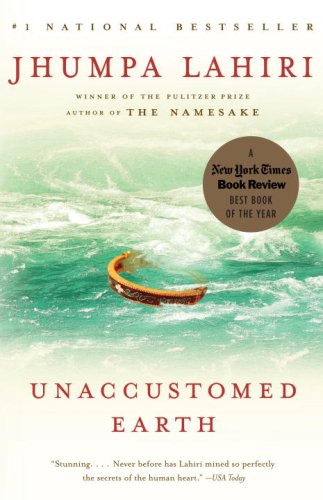
Jhumpa Lahiri’s much-lauded collection of short stories, Unaccustomed Earth, is out in paperback from Vintage this week. Although I’ve only read three of the collection’s eight stories so far, it’s already easy to see why the book was so beloved last year. Lahiri explores the intersection of different cultures and the subtleties of generational conflict, but the themes and content of her stories always veer toward universals of domesticity–siblings, marriage, children, and all the troubles that go with them are studied here. I found bits of my own life echoed here in insightful and analytical detail, particularly in the heart breaker “Only Goodness.” Good stuff.

the-story-of-forgetting

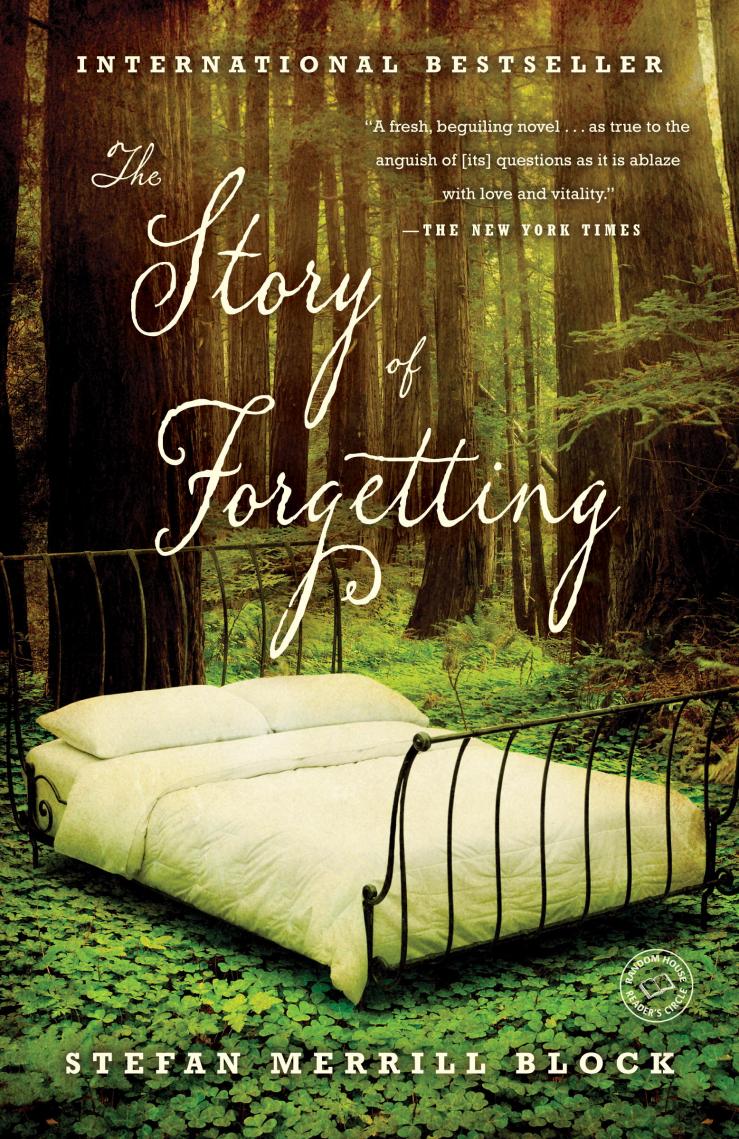
Also new in paperback this week from Randomhouse is Stefan Merrill Block’s debut novel The Story of Forgetting, and while I haven’t had a chance to get too far into it, its blend of science, medicine, memory, and fantasy seems pretty intriguing. Block examines Alzheimer’s disease through the lens of an elderly man named Abel, a misanthropic teen named Seth, and a Calvinoesque fantasy world called Isadora–a world without memory. Seems pretty cool; potential good stuff. Trailer here.

For more good stuff, check out our new tumblog Pet Zounds.

Here’s a cool interview from The Times with Bob Dylan on Presidential autobiographies and more. Good stuff.

neko-case-an02

You can also listen to all ninety minutes of Neko Case’s concert at the 9:30 club, broadcast live last night on NPR. Lovely Ms. Case transcends good stuff, of course.

dirty_projectors-bitte_orca-art

Speaking of transcendent good stuff, the new Dirty Projectors album, Bitte Orca, has, ahem, leaked. It’s the sort of greatness that makes you ashamed to be a pirate, the kind of album you can’t wait to actually buy even though you’ve been listening to it in full for a few months (it doesn’t drop until June 9th). Lush and ethereal, somewhere between Kate Bush and Storm & Stress, Bitte Orca is the sort of stuff that would play at high school proms around this country this year if this country had any class. Here they are playing “Stillness is the Move”:

Che’s Afterlife: The Legacy of an Image — Michael Casey

ches-afterlife

I have a memory–a surprisingly distinct one, considering the circumstances–I was about nineteen, a sophomore in college, hanging out at a friend’s house, listening to records and going through his books. He had a large red book, a Che Guevara reader that I recognized not by the name (which I’d never heard pronounced) but rather by the iconic image of the Argentine Marxist revolutionary. Of course, I didn’t know that Che was an Argentine Marxist revolutionary at the time–I just knew the image. “Is this any good?” I asked my friend, thumbing through the thick, stiff volume. “No idea,” he replied. “Who is this guy, anyway?” My friend smiled at me — “You don’t know who Che Guevara is? Neither do I.” This admission speaks volumes to Che’s legacy, a legacy of image over substance, form over idea, iconography over doctrine–a legacy thoroughly and playfully covered in Michael Casey’s intriguing new study, Che’s Afterlife.

guerrilleroheroico
Guerrillero Heroico -- Alberto Korda

Casey’s book begins in the back of a tuk tuk in Bangkok, where the author sees two images juxtaposed: the iconic photograph of Che by Alberto Korda next to a picture of Rambo–the Communist revolutionary and the all-American defender of the capitalist way of life. In Che’s Afterlife, Casey follows this strange juxtaposition across the globe, from the moment Korda captures the image while on assignment recording Jean Paul Sartre and Simone de Beauvoir’s 1960 trip to Cuba, to the image’s rallying explosion across the Western world, to its modern implications in Chavez’s Venezuela and its infamy among Cuban Republicans in Miami. The global ride is packed with fascinating historical characters, artists, and writers, but at its heart is the central paradox of how a Communist firebrand became a capitalist brand. “It’s impossible to overlook the irony,” Casey writes, “the commoditization of an anticapitalist rebel who opposed all that his hyper-commercialized image now represents.”

reagan-che

Che’s Afterlife is not so much another Che Guevara biography as it is an exploration of the power of imagery and media in a global world. Casey works from sources like Andy Warhol and Susan Sontag, along with contemporary political and economic analysts to explore how and why the “the Korda image remains a powerful indicator of rebellion and resistance.” I saw myself in the book time and again, not in any of the political ideologies, but rather as one of the many “young Americans [who] know [Che] only as a T-shirt logo.” Casey’s study is well-researched, well-written, and lots of fun, a book more at home under the cultural studies rubric than biography or history. Recommended.

Che’s Afterlife: The Legacy of an Image by Michael Casey is available April 7th, 2009 from Vintage.

Pride and Prejudice and Zombies — Jane Austen and Seth Grahame-Smith

pride-zombies

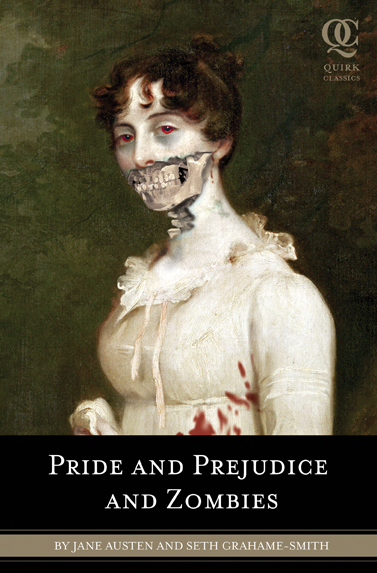
The blurb on the back of Pride and Prejudice and Zombies brazenly declares that Seth Grahame-Smith’s addition of zombie-fighting action to Austen’s classic “transforms a masterpiece of world literature into something you’d actually want to read.” Perhaps the blurb’s brag is just a bit of cheeky fun; after all, Austen’s staid survey of manners and mores is a perennial favorite, coming in second to only The Lord of the Rings in a recent BBC poll of British readers, as well as topping a similar poll in Australia. Clearly, people not only want to read it, they actually do, and in large numbers each year. There’s even been enough interest in it for a not-that-bad movie update just a few years ago. So it’s hardly as if Pride and Prejudice is a corpse in need of resuscitation. This begs the question: What nuances and comments does Grahame-Smith have to add? Not much, we’re afraid.

The most interesting aspect of Pride and Prejudice and Zombies is its concept, a promise for weird laughs and sick kicks neatly summed up in its fantastically morbid cover. Grahame-Smith doesn’t so much re-imagine Pride, but simply stuff a murderous host of zombies into Austen’s romance. These “unmentionables,” as the polite Regency society folks call them, wage a war on good stolid Englishmen. Fortunately Mr. Bennet has trained his daughters, led by feisty Elizabeth, in the ways of the ninja. Between matchmaking, letter-writing, polite dances, and furtive glances at Mr. Darcy, the Bennet sisters slice up zombies left and right with their katanas. The press-release for Pride and Prejudice and Zombies claims that the book retains 85% of Austen’s original, and no major plot points are changed or missing. Instead, the reader is subjected to seemingly purposeless bouts of zombie fighting after every scene. Of course, to decry these fights as purposeless seems silly; after all, when you pick up a book called Pride and Prejudice and Zombies, you expect zombies, don’t you?

Grahame-Smith’s premise sounds like great good fun in theory, but it turns out that adding zombies and ninjas to a classic beloved romance is neither terribly engaging or interesting. We love zombies at Biblioklept, but the most effective zombie tales–28 Days Later, Night of the Living Dead, Dawn of the Dead–work beyond horror and serve also as a form of social commentary or even satire. Grahame-Smith seems to miss, or even ignore, any opportunity to comment on, criticize, or otherwise inform the novel he’s cannibalizing. Instead, his additions convey the energy, wit, and sophistication of a one-note SNL sketch. The premise gets old fast, and it becomes increasingly confusing who this novel is for. It’s unlikely to appeal to most Austen fans, as it provides no real comment on her methods, plotting, or characterization, and as far as a zombies-and-ninjas riff goes, it’s pretty standard fare. Ultimately, it seems like more of a conversation piece than something you’d actually read for enjoyment, a little coffee table book that might evoke some interest. Flick through the amusing illustrations, chuckle, and move on.

Pride and Prejudice and Zombies is available soon from Quirk Books.

Beer and Book Pairing: Shandies + García Márquez’s Chronicle of a Death Foretold

While the special pleasures of drinking a beer have undergone something of a renaissance in the past ten years in America, what with all the awesome microbreweries popping up left and right, there remains among many a staunch and unjustified prejudice against the world’s oldest liquor. In short, wine is still the go-to beverage for fine dining, and for many, the mark of sophistication and refinement. And while we certainly don’t begrudge a glass of pinot or chardonnay, why all the prejudice? Beer goes great with food–especially fine food–and also with books. In order to make headway against overcoming beer’s unjust vulgar reputation with some folks, we proudly present a new ongoing series of beer-book pairings, hopefully lending a little weight to our favorite beverage’s literary caché. It’s Spring Break Week at Biblioklept International Headquarters, and what better way to celebrate the season than with our crisp homemade shandies paired with Gabriel García Márquez’ s Chronicle of a Death Foretold.

Shandies are made simply by mixing beer with ginger ale, ginger beer, or, preferably, lemonade. Our recipe for shandies is pretty basic. We recommend starting with a lager–Tecate, Red Stripe, or even Corona will do fine (we’re featuring Red Stripe at the BIH this week). You can certainly use an ale, but ales tend to have richer, sharper, and more complex flavors, and they tend to be not as smooth as lagers. (We suppose you could make shandies with a porter or stout or a lambic ale, but this seems kinda sorta reprehensible). Next, you’ll need either an imperial pint glass (20 oz.) or an American pint glass (16 oz.). Pour your lager into the glass, then add your lemonade in desired ratio (we prefer to fill an imperial pint glass, creating roughly a 3 to 2 ratio of beer to lemonade. Oh yeah, we’re lazy and use store bought lemonade (Minute Maid sugar free), but we’ve made our own in the past. Making your own lemonade is easy, and if you don’t know how to do it you probably are too dimwitted to be reading these words right now). Final step: stir, drink, enjoy.

chronicle

We’ve chosen shandies for their crisp lightness. They’re the perfect early afternoon drink, cool and refreshing, preferably enjoyed on porches or hammocks (we don’t really recommend them for indoors or at night). We’ve paired them with a fresh little jewel of a book, Gabriel García Márquez’ s Chronicle of a Death Foretold. Chronicle is a murder/love story with about a million little twists, the biggest twist being that there is no twist: we know from the first sentences exactly what will happen. Still, García Márquez’ s kaleidescopic reconstruction of the day of the murder is thoroughly engrossing, bewildering, and un-put-downable. The book’s rhetoric is hardly as morbid as its subject matter–it’s great hammock/beach reading, and its crisp lightness belies its complex flavors. Like a shandy, it slowly, subtly intoxicates you. It’s also pretty short, about 130 pages, and despite its infinite digressions, its the sort of book that you read in just one or two sittings.

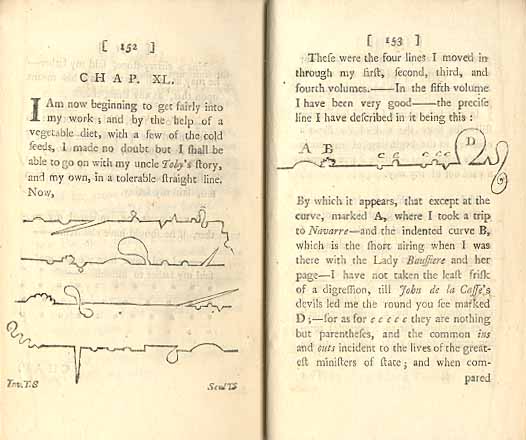
Of course, maybe you’ve read Chronicle but you’re still dying to drink some shandies on your porch with a good book, and you want Biblioklept to give you a literary excuse. Well, here’s another option: take a shot at another book of infinite digressions, Laurence Sterne’s 1759 (anti-)novel The Life and Opinions of Tristram Shandy, Gentleman. The fun of pairing a shandy with Shandy will be doubled in Sterne’s love of wordplay in the text. And sure, there’s no way you’ll finish it, but it’s not that sort of book anyway–it doesn’t finish its self! Pick it up at random, flip around, marvel at its weirdness, at the very idea that the first post-modern novel could somehow come before the modern novel. Then get up, make another shandy, and pick up again elsewhere. Fun stuff.

shandy
Shandy charts the course of his narrative thus far

“William S. Burroughs” — Robert Crumb

billrc1

Une Semaine de Bonté — Max Ernst

semaine

Max Ernst’s graphic novel, Une Semaine de Bonté, is one of the coolest books I own. Comprised of concise collages utilizing black and white images from periodicals and catalogs, Ernst’s narrative is both engrossing and disturbing. Full of birds and breasts and beasts, Semaine plays out like a weird, violent, funny mindfuck, its repeated scenes of submission and domination ironizing its title (A Week of Kindness). Great stuff. There’s a decent enough chunk of the book available for preview at Google Books.

When Skateboards Will Be Free — Saïd Sayrafiezadeh

skateboardsSaïd Sayrafiezadeh’s memoir When Skateboards Will Be Free recounts the author’s youth as the son of two diehard socialists, Party members who are far more devoted to the impending Revolution than their family. Sayrafiezadeh’s father, an Iranian intellectual, leaves the family before the boy can even speak, and throughout the book he remains a paradoxical touchstone, a living emblem of Sayrafiezadeh’s alienation. Sayrafiezadeh is raised by his Jewish-American mother, first in New York City, then in Pittsburgh, always in poverty. His mother Martha is such a committed socialist that she willfully chooses a life of poverty for both herself and her young son. Sayrafiezadeh writes:

…my mother actively, consciously, chose not only for us to be poor but for us to remain poor, and the two of us suffered greatly for it. Because to suffer and to suffer greatly was the point. It was the fulfillment of ourselves. My mother was no doubt emboldened by the philosophy that ther was honor in wretchedness, virtue in misery, nobility in hardship.

The passage above is one of the rare reflective moments in this memoir; most of the time, Sayrafiezadeh’s strategy is to relate his youth in simple, immediate terms. We see Sayrafiezadeh and his mother move from squalid apartment to squalid apartment,  we experience the boredom that a young boy would feel at Socialist party meetings, we feel the strange alienation Sayrafiezadeh experiences at school–an alienation that does not emanate from his parents’ political stance alone, but also in his ethnic identity. To be in  middle school is hard; to be in middle school as a person of Iranian descent during the 1979 hostage crisis is really hard. Sayrafiezadeh always follows the “show don’t tell” dictum of good writing, and, as a result, his description of the suffering he experiences as a young person–poverty, confusion, and alienation–never seems contrived or out of place. Indeed, these are feelings common for any kid, here magnified exponentially. Ultimately, however, it is not so much sympathy that the reader experiences but anger, a specific, concentrated anger at Sayrafiezadeh’s selfish parents coupled with a more muted sense that pure adherence to any ideology can be emotionally destructive.

The book moves episodically between a chronological telling of Sayrafiezadeh’s life and the narration of a grown-up Sayrafiezadeh still navigating his strange identity in contemporary New York. This grown-up Sayrafiezadeh is hardly a screw-up, but he is clearly marked by the ideology his parents have attempted to imprint upon him. In one clever passage, an adult Sayrafiezadeh ponders over tissue box holders–ephemeral, essentially unnecessary items, products born of capitalism’s need to manufacture desire–and buys a ridiculously overpriced one with a certain relish. The scene plays as a muted “fuck you” to his parents, but is perhaps unnecessary in this regard, as the whole of When Skateboards Will Be Free paints Sayrafiezadeh’s mother and father as neglectful figures. Sayrafiezadeh’s father not only abandons the family, but is largely absent from his son’s life in any regard. He’s late–often months late–to special birthday dinners and any scene where the two interact shows that they do not know each other. While Sayrafiezadeh’s mother manages to eke out a living for the two of them, it is also repeatedly clear that her ideological choice to live in poverty has hurt her son beyond mere embarrassment. Sayrafiezadeh is the emblematic latchkey kid, left to himself for long stretches of time–even whole weekends–at a very young age, as his mother attends her Socialist meetings. In one grim episode, a very yong Sayrafiezadeh is sexually molested by a “comrade” of the Socialist party who has generously volunteered to babysit. This is just one extreme example of the underlying irony of the memoir, an irony that Sayrafiezadeh does not specifically name: his parents, in the name of a political philosophy that espouses the value of caring for one’s fellow man, have failed to adequately care for him.

Written in a brisk, lucid style with simple dialogue, When Skateboards Will Be Free effectively compresses a young life into three hundred pages that can be read over three or four afternoons. We’re not exactly big fans of the memoir around Biblioklept, but Sayrafiezadeh’s effort eschews many of the genre’s hallmarks (sensationalism, overly-reflective post-event analysis) in favor of a style that allows his readers to draw their own conclusions. This isn’t to suggest that Sayrafiezadeh doesn’t lead his readers to some definitive ends, but rather that his writerly approach is less overt manipulation than the stuff of most memoir. While Skateboards isn’t exactly essential reading, those who can’t get enough memoir in their reading diet will surely appreciate its vitality and generous honesty.

When Skateboards Will Be Free is available in hardcover March 24, 2009 from Random House.