High Society–Dave Sim

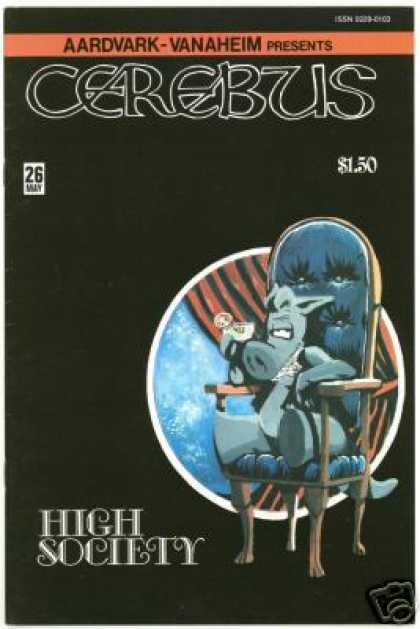
If you’re at all interested in reading any of Dave Sim’s epic 300-issue comic book Cerebus, a book chronicling the life–and death–of a misanthropic mystical barbarian aardvark, High Society is the best (and possibly only) starting point. High Society tells the story of Cerebus’s political adventures in Iest, the largest cosmopolitan city-state of Estarcion. Guided (or perhaps manipulated) by Machiavellian Astoria, Cerebus undertakes a strange, comic odyssey of political ascendancy, culminating in an election for Prime Minister (against Groucho Marx stand-in Lord Julius’s goat, of all things). Sim has a deft ear for political satire and the volume holds up particularly well to a rereading against the backdrop of the current American electoral process. While High Society conveys a certain cynical contempt for the cronyism, deal-making, and the general nasty malfeasance that underwrites politics, there’s also a reconciling of democracy, liberty, and art here that you could never find from a CNN analyst or a Fox News hack. By this point, the crude art and flubbed pacing that hampered the first few years of Cerebus are nowhere to be found. High Society is tightly-plotted, full of smart gags expressed in Sim’s keen lines, without an over-reliance on bubbles overstuffed with exposition.
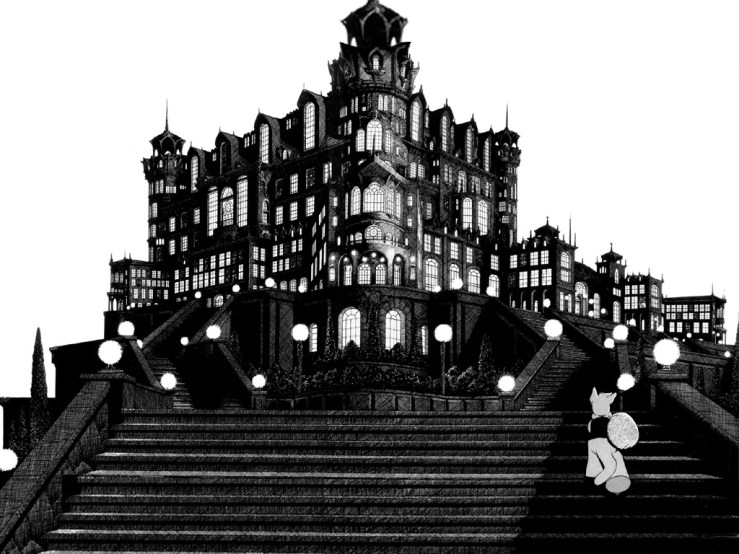
The book is funny without ever being light, and rereading it again, I was surprised at how moved–and exhilarated–I was by the conclusion. Although the parody of Marvel’s forgotten Batman ripoff Moon Knight doesn’t hold up very well, and the “sideways” issues at the end are an annoying (but interesting) experiment, High Society continues to deliver both laughs and insight about the political process over twenty years after its single-volume publication. Very good stuff, and highly recommended (read it along with/against the 2008 election).

(Strange aside that I couldn’t work into the piece–remember Ken Jennings? That guy who won Jeopardy! like, a year straight? According to his blog he’s a huge Cerebus fan).
Writing in the Ellipses

Balthus--The Living Room
Balthus–The Living Room

Flipping through Balthus‘s digressive, discursive, elliptical memoir Vanished Splendors, I came across this notation:

I deeply believe in the genius of painting, which parallels that of childhood. I’ve used painting as a language without really having decided to do so, because it suits me better than writing. Writing tries to be too explicit and go directly to meaning. That’s why I could never be a writer like many of my friends. Some aspects of my life might be clarified by the present short texts, similar to letters. . . . For me, writing can only be in the ellipses, where I express myself; painting conveys this magnificently, sometimes unbeknownst to the painter himself.

Elsewhere, Balthus lists the writers and texts he loves, and gives us (what I believe to be) a great definition for reading:

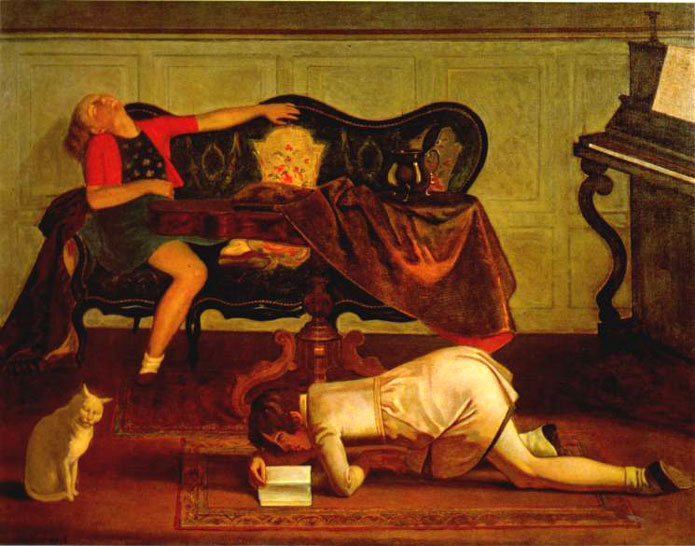
I often paint young girls who are reading. It’s surely because I saw the act of reading as a way to enter life’s deeper secrets. Reading is the great means of access to myths. Green, Gracq, Char, Jouve, Michaux, and Artuad were frequent passageways, as well as the great holy writings of the Bible and initiates like Dante, Rilke, the Pléiade poets, the great Chinese writers, the mystics John of the Cross and Teresa of Avila, not to mention Carroll, the pure German poet Ludwig Tieck, and Indian epics. All these texts and authors were landmarks in my life, and gave me another dimension of time to which I soon felt myself summoned. My young girls who read in dreaming poses are escaping from fleeting, harmful time . . . Fixing them in the act of reading or dreaming prolongs a privileged, splendid, and magic glimpsed-at time. A suddenly opened curtain sheds light from a window and is seen only by those who know how. Thus a book is a key to open a mysterious trunk containing childhood scents. .

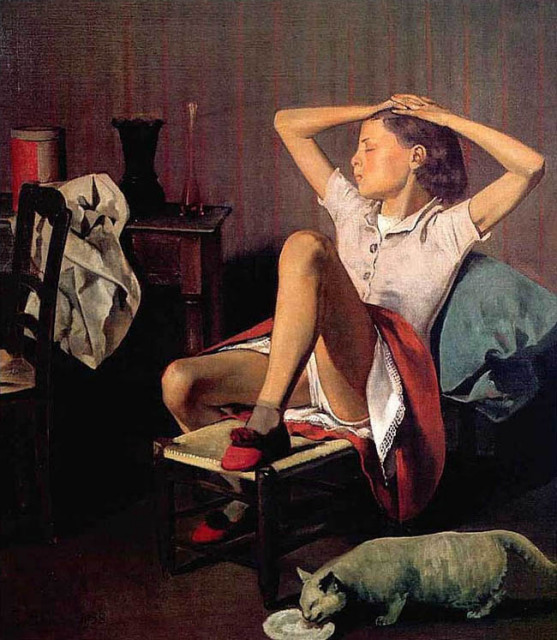
Balthus--Girl with Cat

But, my favorite lines in the book come at the end of the following passage:

Painting is something both embodied and spiritualized. It’s a way of attaining the soul through the body. . . . Being too cerebral and jokey can obstruct an artisan’s manual labor, and impede the ascent to the soul. Believing that my young girls are perversely erotic is to remain on the level of material things. It means understanding nothing about the innocence of adolescent languor, and the truth of childhood.

Exactly. Whenever I look at Girl with Cat, I think, man, that’s not perversely erotic at all…that’s just the innocence of adolescent languor–the real truth of childhood, actually. Nice try, Count Balthasar.

Moral Relativism — Steven Lukes

Moral relativism is the belief that ideals of right and wrong and good and bad are contextually determined by one’s local culture, as opposed to a theory of morality that holds that good and bad exist as absolute, metaphysical values existing cross-culturally, values intrinsic to one’s humanness. At the same time, individuals, even those (sometimes especially those) who see moral relativism as the overwhelmingly rational, sensical position, nonetheless are inextricably tied to their own sense of right and wrong, and this sense often leads them into a position of judgment–and perhaps action–against, over, and/or in reaction to the perceived wrongs of other cultures and societies.

In his new book Moral Relativism, NYU sociology professor Steven Lukes employs an interdisciplinary approach to tackle one of the biggest sticking points of contemporary thought. Using a variety of methods including philosophy, anthropology, history, and literature, Lukes addresses the fundamental conflict of moral relativism: that what’s right and good in one’s own culture may not be right and good in another’s culture, yet a will remains to believe in ideals of universal human rights. Lukes uses a number of timely concrete examples, including female genital circumcision, Islamic fundamentalism, and mass immigration, to assess the costs and payoffs of holding a view that says that no absolute morality exists. Perhaps the most fascinating part of Moral Relativism is Lukes’s negotiation of Western (or globally Northern, as he saliently points out) human rights actions as an extension of colonialism, with the one-time colonists imposing their values–again–upon the one-time colonized.

Lukes concludes that “the question Who are we to judge other cultures? is a bad question.” Arguing that the “postcolonial and multicultural contexts of our time do not require us to see the discourse and practice of human rights as ethnocentric,” Lukes takes up a position–well-argued–that a moral fundamentalist might claim is simply a liberal humanist wanting to have his cake and eat it too. Which, of course, is the problem with the book. It’s a fantastic argument for moral relativism, one that points out that no one–no one–is absolutely relativist, and that, in fact, being a moral relativist entails recognizing that within cultures certain perceived absolutes exist. The idea that right and wrong are relative doesn’t mean that right and wrong are arbitrary or don’t exist–it simply means that ideals of right and wrong have to be reconstituted within different systems of social and cultural order. Yet Lukes’s book isn’t going to convince the types that need convincing. Still, those of us who think that moral relativism is simple common sense will find plenty of concrete, contemporary, real world ammunition here in case we feel like arguing with a–gasp–moral fundamentalist.

Moral Relativism, available now, is part of the new BIG IDEAS // small books series from Picador Books.

In the Land of No Right Angles — Daphne Beal

In the Land of No Right Angles tells the story of Alex, an American college student backpacking in Nepal for a year. Alex’s overseas adventure becomes complicated when she meets fellow American Will. Will prompts Alex to help bring a poor Nepalese girl named Maya to the capital city of Kathmandu, and the three move in to an apartment together. Awkwardness ensues, including a failed threesome, a bad drug trip, and some major cultural misunderstandings. Alex leaves on a sour note, returning eight years later as a professional photojournalist to expose the horrors of human trafficking, only to find Maya embroiled in Bombay’s seedy sex trade.

The novel reads at a rapid clip, propelled by lots of dialog, and Beal certainly shows a complex knowledge of Nepali culture. Still, there’s something pervasively shallow, even troubling about Alex’s interactions with and reactions to her experience with this alien culture that the novel doesn’t quite resolve. The reader is meant to identify with Alex, the privileged American on her adventure to the exotic East. At one point, Alex states, “I wanted to come home different from what I’d been–bolder, wiser, happier.” This desire to find one’s self far away from home is nothing uncommon, of course, yet Alex’s–and Will’s–professed altruism toward their subject, poor little Maya, ultimately comes off as paternalistic and demeaning, culminating in the older Alex’s quest to “save” Maya. It’s hard to feel the empathy or sympathy that Beal wishes to evoke for Alex’s dilemma: in spite of all her questing, she still falls prey to the illusion of her own power as an educated Westerner to control the outcomes of alien others. To take a cue from Edward Said’s work revealing Orientalism in Western thinking, Alex’s East–and the people in it–exist mostly to reify and stabilize her own identity, give her her the adventure she needs to “come home different” with plenty of great stories to share.

Orientalist critique aside, Alex does have a pretty good story to tell. Beal’s descriptions are vivid and the novel has the compressed vitality of a good memoir coupled with a tone of immediacy that makes it easy and enjoyable to read. In the Land of No Right Angles will no doubt end up in more than a few book clubs this fall, and it’s certainly your smarter than average beach read–and there’s still plenty of summer left.

In the Land of No Right Angles is available August 12th from Anchor Books.

Violence — Slavoj Žižek

Slavoj Žižek describes Violence as “six sideways glances” examining how our preoccupation with subjective violence (that is, the personal, material violence that we can see so easily in crime, racism, etc.) masks and occludes our understanding of the systemic and symbolic violence that underwrites our political, economic, and cultural hierarchies. Žižek believes that a dispassionate “step back enables us to identify a violence that sustains our very efforts to fight violence and promote tolerance,” and that a rampant “pseudo-urgency” to act instead of think currently (detrimentally) infects liberal humanitarian efforts to help others. This is where the fun comes in. Žižek delights here in pointing out all the ways in which we fool ourselves, all the ways in which we believe we’ve gained some kind of moral edge through our beliefs and actions.

I use the words “fun” and “delight” above for a reason: Violence is fun and a delight to read. Žižek employs a rapid, discursive method, pulling examples from contemporary politics, psychoanalysis, films, poetry, history, jokes, famous apocryphal anecdotes, and just about every other source you can think of to illustrate his points. And while it would be disingenuous to suggest that it doesn’t help to have some working knowledge of the philosophical tradition and counter-traditions to best appreciate Violence, Žižek writes for a larger audience than the academy. Yet, even when he’s quoting Elton John on religion or performing a Nietzschean reading of Children of Men, Žižek’s dalliances with pop culture always occur within the gravest of backdrops. Within each of Violence‘s six chapters, there’s a profound concern for not only the Big Questions but also the big events: Žižek frequently returns to the Iraq War, the 9/11 attacks, and the Israeli-Palestinian conflict as major points of consideration. This concern for contemporary events, and the materiality of contemporary events, is particularly refreshing in a work of contemporary philosophy. Undoubtedly some will pigeonhole Žižek in the deconstructionist-psychoanalytical-post-modernist camp (as if it were an insult, of course)–he clearly has a Marxist streak and a penchant for Lacanian terminology. Yet, unlike many of the writers of this philosophical counter-tradition, Žižek writes in a very clear, lucid manner. There’s also a great sense of humor here, as well as any number of beautiful articulations, like this description of the “dignity and courage” of atheism:

[A]theists strive to formulate the message of joy which comes not from escaping reality, but from accepting it and creatively finding one’s place in it. What makes this materialist tradition unique is the way it combines the humble awareness that we are not masters of the universe, but just a part of a much larger whole exposed to contingent twists of fate, with a readiness to accept the heavy burden of responsibility for what we make out of our lives. With the threat of unpredictable catastrophe looming from all sides, isn’t this an attitude needed more than ever in our own times?

I’m inclined to answer, “Yes.” Highly recommended.

Violence, part of the new BIG IDEAS // small books series from Picador Books, is available August 1st.

Chemical Chords — Stereolab

When “Valley Hi!” pops up roughly half way through Chemical Chords, Stereolab’s ninth studio album, the realization sinks in that on just about any new group’s new album the song would be a great achievement, a perfectly constructed pop song, fun, bouncy, a little sly even, with sexy lead vocals, effervescent harmonies, and tight but lush instrumentation. However, wedged into Stereolab’s nearly two-decade-long oeuvre, the song barely stands out, and that’s the problem. The band consistently delivers material like this, to the point that it all kinda sounds the same–a charge that’s been leveled at them by critics and fans alike for a few years now, starting more or less with 1999’s Cobra and Phases Group Play Voltage in the Milky Night, a record that some (maybe many) thought failed to live up to the radical revisionist pop tendencies of 1996’s Emperor Tomato Ketchup (it’s hard to top a perfect album, folks!) or the digital experiments of 1997’s Dots and Loops (my least favorite Stereolab album; sounds like marbles rolling on ice). I happen to like Cobra a lot: it’s warm (and literally fuzzy) and masterfully played–and kinda anonymous, a trend that Stereolab continues with Chemical Chords.

From the outset of the new album, Stereolab establishes a metronomic motortik pop vibe from which they rarely deviate. Opener “Neon Beanbag” flows into first single “Three Women” without much to differentiate the two besides a two second gap and a key change, and the third track, “One Finger Symphony,” only stands out due to its throwaway brevity. It isn’t until Sean O’Hagan’s slinky strings announce the title track that the album grabs onto something new. “Chemical Chords” approaches a ’70s blaxploitation vibe–think Curtis Mayfield or Bobby Womack here–but ends up being (you guessed it) just another Stereolab song, beautifully polished and meticulously executed with little or no risk to band or audience. The next track, “The Ecstatic Static” slides right into the same groove, and it becomes apparent that Stereolab have released yet another perfect ambient soundtrack for any polite social gathering. The rest of the album follows this mode of flawless and ultimately forgettable songwriting.

There are moments of exception, of course, but only moments. The countryfied swagger that initiates the penultimate track, “Daisy Click Clack,” is pretty great, if only for simply hitting a different rhythm and sound, and the song’s lyrics are about making music, which is always cool. It’s on “Pop Molecule (Molecular Pop 1),” where Stereolab employ backmasked drones and triumphant chugging guitars that recall the glory days of tracks like “Crest,” from ’93’s Transient Random-Noise Bursts with Announcements (or anything off of ’92’s dreampop singles collection, Switched On), that the band finally gets its hands a little dirty–with great results. Too bad they only play it out for about two minutes; the old groop would’ve droned those two chords for at least six–the listener doesn’t ever get a chance to get hypnotized.

It seems like I’m bashing the album, but I’m not. I love Stereolab. Really. And Chemical Chords is pretty good — it will hang out in my stereo for a month, maybe two, and then I’ll forget about it. Ultimately, it’s too polished, too precise, and too meticulous to make any long-term impact. We know Stereolab are fantastic arrangers and musicians, and their taste is impeccable, but when bands fail to take risks, the music gets stale.

Chemical Chords is available from 4AD Records in the US on August 19th.

On the Third Beer

I thought this notation, from Toni Morrison’s Song of Solomon, was too beautiful not to share (also, I’ve been too busy to write and appropriating the words of Nobel prize winners seems like an easy alternative to actually, y’know, coming up with original content). Context unimportant:

She was the third beer. Not the first one, which the throat receives with almost tearful gratitude; nor the second, that confirms and extends the pleasure of the first. But the third, the one you drink because it’s there, because it can’t hurt, and because what difference does it make?

The Rough Guide to Conspiracy Theories

There’s something fun-but-not-too-fun about James McConnachie and Robin Tudge’s The Rough Guide to Conspiracy Theories, a lovely little coffee-table encyclopedia that investigates everything from the strange death of playwright Christopher Marlowe to the disputed Apollo 11 moon landings to the sinister happenings at Bohemian Grove to the 9/11 attacks. The book is dubious and skeptical in all the right places, yet never snotty or wholly dismissive of the marginalized ideas it presents. Also, none of the lurid tabloid earnestness that marks the work of lifers like Alex Jones or David Icke can be found here (Icke does get his own five paragraph section, however). For the most part, the 450 or so pages of Conspiracy Theories are evenhanded, concise, and well-researched. A bibliography follows each section, and at the end of the book there’s a “Conspiracy Archive” suggesting books, websites, and films for those who can’t get enough paranoia. Conspiracy Theory devotes a good number of pages to recent events like Hurricane Katrina and the Iraq War, a choice that will perhaps date the book eventually–but of course, by that time we’ll need a new edition to record all the nefarious invisible acts committed by the Bilderberg Group, NWO, Masons, and, uh, reptilian beings posing as European royalty. Good stuff.

The updated U.S. edition of The Rough Guide to Conspiracy Theories is available this fall from Rough Guides.

Abolish No Child Left Behind

I teach at an inner-city school, and I’ve witnessed first hand just how awful NCLB has been: it basically aims to make zombies out of kids. Here’s a personal anecdote that best sums up how NCLB’s rigid testing processes work to attack the fostering of free thought: I was administering an FCAT practice test, and a young lady of about 15 years or so raised her hand for my assistance. Her problem was that the answer box for a short response question was far too small to accommodate her answer (her handwriting was also large). We are teaching kids to literally “think inside the box”; we are also mandating that there is always only “one right” answer to problems, which is plainly false.

Please take a few seconds to sign the online petition to abolish this heinous crime against our young people.

More information–far more salient than my anecdotal ranting–from Stan Karp’s excellent critique of NCLB (via the ANCLB Facebook Group):

Claim: Annual standardized testing is the key to bringing school improvement and accountability to all schools. “For too long,” says the Department of Education, “America’s education system has not been accountable for results, and too many children have been locked in underachieving schools and left behind. … Testing will raise expectations for all students and ensure that no child slips through the cracks.”

Reality: A huge increase in federally mandated testing will not provide the services and strategies our schools and students need to improve. Most states and local districts have dramatically increased the use of standardized tests over the past two decades, but this did not solve the problems of poor schools. Some estimate that the new federal law will require states to give more than 200 additional tests at a cost of more than $7 billion.
Many studies show that standardized testing does not lead to lasting increases in student achievement and may in fact reduce it. Researchers at Arizona State University recently completed the largest study ever done on the issue. They concluded that “rigorous testing that decides whether students graduate, teachers win bonuses and schools are shuttered, an approach already in place in more than half the nation, does little to improve achievement and may actually worsen academic performance and dropout rates.” (New York Times, 12/28/02)

Continue reading “Abolish No Child Left Behind”

“Some Principles of Democracy and Deconstruction—American or Otherwise” by A. S. Kimball

“Some Principles of Democracy and Deconstruction—American or Otherwise” by Sam Kimball.

1. Democracy and deconstruction name the namelessness of a we, the people in relation to this people’s unimaginable possibilities of collective self-identification to come.

2. For this reason democracy and deconstruction locate the we in a future that transcends any possible transcendence of time, and therefore that remains utterly contingent and extinguishable, able to be obliterated in an apocalypse of the name.

3. Democracy and deconstruction attempt to respond to a demand—untraceable to any face or mind, to any consciousness—for absolute justice.

4. To this end, and because “we are all heir, at least, to persons or events marked, in an essential, interior, ineffaceable fashion, by crimes against humanity” (Derrida, Of Cosmopolitanism and Forgiveness, 29), democracy and deconstruction demand of the citizen to come an attitude of radical forgiveness and hospitality.

5. To this same end, and for similar reasons, democracy and deconstruction also entail a radical affirmation—that is, they are ways of saying “Yes?” or “Who’s there?” in the absence of any determinate voicing.

6. This means that democracy and deconstruction respond to a call that comes from an unimaginable and indeterminate future.

7. For all these reasons as well as the fact that “all nation-states are born and found themselves in violence” (Of Cosmopolitanism and Forgiveness, 57), democracy and deconstruction are provisional names for an historically unrealized ideal.

8. Thus, democracy and deconstruction require an incessant work of critique.

9. Democracy and deconstruction are ways of working toward forms of community that must necessarily exceed, transgress, transcend, and therefore remark all political borders, most especially those that define the sovereignty of the nation-state.

10. The spirit of the spirit of democracy and deconstruction has no single emotional marker, cannot be contained within or encompassed by any single emotional apprehension, is not identifiable as an affective state.

11. Democracy and deconstruction are inseparable from the fictionalizing, virtualizing power of literature.

Underworld — Don DeLillo

Don DeLillo’s Underworld explores American culture and psyche throughout–and immediately after–the Cold War era. The book centers loosely on waste management exec Nick Shay, but diverges in constant achronological loops, employing dozens of different voices and viewpoints in order to handle a variety of themes and subjects that are, frankly, too massive to get a grip on. At all times though, Underworld seems aware of this inability to document its subject’s vastness, but, like Ishmael in Moby-Dick who attempts to systemize the unknowable whales, the characters in Underworld nevertheless try and try again to find order and meaning in a paranoid and increasingly disconnected world. The real center of the book is a baseball, the ball pitched by Brooklyn Dodger Ralph Branca to New York Giant Bobby Thomson, who won the game in a hit known as “The Shot Heard ‘Round the World.” However, this ball, this center, is repeatedly transferred, deferred, shifted, and even characters who claim to own the “real” ball understand that the validity or “realness” of the home run ball is always under question. DeLillo seems to suggest that finding fixed, stable meaning is an illusion; the best that people can hope for is to find solace in their family and friends in open, honest relationships.

By the time DeLillo had published Underworld in 1997, he had already established himself as a canonized saint of the American postmodern literary tradition, yet Underworld, in its massive size and scope (it weighs in at over 800 pages) seems primed to be the author’s “big book,” destined to fit neatly in the new canon of large and long American postmodern novels next to John Barth’s The Sot-Weed Factor, Robert Coover’s The Public Burning, Thomas Pynchon’s Gravity’s Rainbow, and David Foster Wallace’s Infinite Jest. Underworld utilizes nearly every postmodernist trope, including a nonlinear plot, myriad, discursive voices, and a willingness to engage historical figures. The novel also manages to contain a bulk of themes and devices DeLillo has employed throughout his body of work: find here the paranoid alienation of The Names, the shadow of assassination-as-spectacle from Libra, the intersection of art, violence, economics, and politics of Mao II, and the exploration of the new American religion, consumerism, that underpinned White Noise.

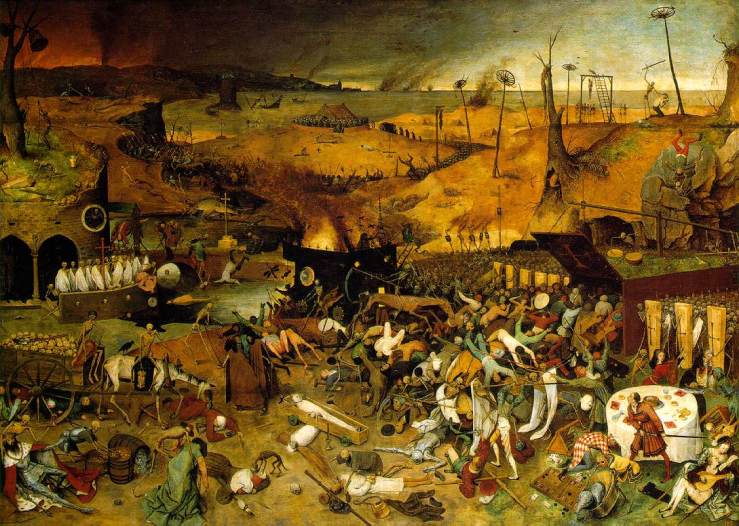
Ultimately, all of Underworld‘s themes–garbage, art, war, insulation, paranoia, drugs, death, secrets, baseball, identity, etc.–threaten to crush the narrative under their sheer weight. Unlike Pynchon, Barth, Coover, and DFW, DeLillo is rarely playful or even fun; most of the humor here serves to alienate rather than connect the reader to the characters. The book is masterfully written, and any number of the little vignettes, like the sad life of the Texas Highway Killer, or the Space-Age compartmentalization of a 1950s suburban family, expertly delineate DeLillo’s handling of concepts and motifs. However, the book’s prologue, “The Triumph of Death” (the title alludes to Bruegel’s painting), an account of the 1951 Dodgers-Giants pennant game is easily the most passionate, intense, and engaging moment of the novel. This assessment isn’t meant to suggest that the remaining 700 pages or so of Underworld aren’t as rewarding, they just aren’t as fun. Underworld is probably a work of genius, and the sum of its many, many parts do add up to more than the corpus, only that sum will probably leave a lot of readers feeling cold.

Great American Heroes

Teddy Roosevelt was the best American president. Just look at this guy. TR: the original rough rider. Painting by Tadé Styka.

Great American Heroes

Biggie Smalls is basically a metaphor for America. This painting is by Kehinde Wiley. We love it.

Great American Heroes

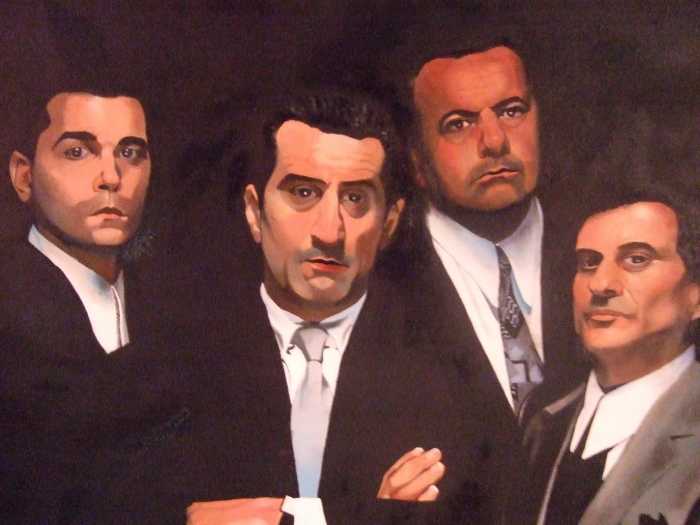
Who is more heroic or more American than Henry Hill, Jimmy Conway, Paulie Cicero, or Tommy DeVito? No
one, that’s who! Also, for that matter, is there anyone more American than Joe Pesci? No way, Jose! Painting by William Parsons.

Great American Heroes

Okay well so, we’re more or less “off” this week, because we love America sooooooooo much that we’re going on vacation. Still, because we are totally American, which is to say totally industrious, and because “the U.S. is the greatest, best country god has ever given man on the face of the Earth,” we’ll be leaving you with a series of fantastic images of great American heroes over the next week, starting with this stunning portrait of Superman himself, Christopher Reeve, by talented painter Adam Brooks. Great stuff.

Brundibar — Maurice Sendak

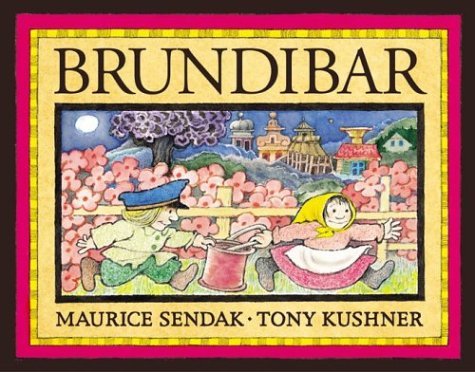
Adapted by playwright/screenwriter Tony Kushner and illustrated by Maurice Sendak, Brundibar retells Hans Krása’s children’s opera about a brother and sister who go on an adventure to get their ailing mother some fresh milk. The penniless pair decides to sing in order to earn milk money, but the cruel organ grinder Brundibar chases them away. However, they triumph with the help of a sparrow, a cat, a dog, and a cadre of helpful children.

The original opera was first performed by the children-inmates of a Nazi concentration camp in occupied Czechoslovakia. The symbolic overtones of the story are pretty straightforward, and Sendak emphasizes the point, marking his Brundibar with a Hitlerish mustache and a ridiculous Napoleon Bonaparte hat. Political symbolism aside, Brundibar is simply a great book, full of little songs, beautiful art, and a unique narrative style in which individual characters get their own speech bubbles and even street signs tell a story. This isn’t my one-year old daughter’s favorite book–yet–but it’s certainly one of my top picks from her little library. Good stuff.

On Rereading

So I just read Blood Meridian again. And–

Like many bibliophiles, I have a stack of books marked “to read,” both a physical and a mental one, a stack that only grows, one that my book-buying addiction feeds and that the reader in me can in no way deplete. The saddest thing in the stack–or about the stack, really (about is the proper preposition, not in) are all the books that I’m sure are just totally great (Atonement, The Sot-Weed Factor) and the ones that I’ve started at least half a dozen times yet never finished–yet (Gravity’s Rainbow, The Wind-up Bird Chronicles) that might not ever get read because of all the new books that get thrown on the stack.

The saddest thing though, is that we–and the “we” here is not editorial, folks, it refers to bibliophiles–we simply don’t reread enough. Because I teach high school, there are dozens of books that I get to reread every year. Every time I read Macbeth or Of Mice and Men or Their Eyes Were Watching God, I’m amazed by how rich and complex and just downright masterful these books are. Each new reading produces new insights, layers, new motifs unraveled, new details, once seemingly mere happenstances, reveal themselves as key to the whole ship and shebang. Rereading is good. And yet we don’t reread enough, precisely because of the stack, the insane egomaniacal compulsion to read all of the great books before, uh, death.

And so well and so thus I reread Blood Meridian. I read it a few months ago, put it down in a daze, read a few more books, all etiolated by comparison, and then, despite the stack I picked up Blood Meridian again, a strange ineffable compulsion forcing it into my hands; I didn’t want to reread the whole thing, just a few passages, and then, and then, well and then so well and thus I was just rereading the whole thing, a whole new book there under the book I thought I had read, had known, knew. I had experienced this before: when I first read Holden Caulfield, we were the same age; five years later I was five years older and he was a jerk. A decade passed and he was an alien (maybe I was a phony). Now, well, now I’m afraid to read the book

We can’t ever really know a book because we change. The book doesn’t change but the reading of the book changes. Because I get so much out of a rereading, because I know that reading in itself is not enough, the stack–which, I should probably emphasize, is a very real, physical presence, a little mound by my bed–because of this, there is a second distress, a pain of not only not being able to read all of the books, but also not being able to not reread many of them that deserve it.

So and well, after I reread Blood Meridian, I do something that I do after I finish every book–I go pick up a couple of books that I’m desperate to reread, as well as a few from the stack. The feeling is strange and breathless and giddy, and ultimately overwhelming. I uncover over old bookmarks, shocked that I made it so far on the last attempt, or stumble over the first five pages. I lie to myself, reading sections of Finnegans Wake, as if.

Right now I’m halfway through DeLillo’s masterpiece Underworld. It’s huge and unwieldy and really fucking good, and I will finish it–this time–but even as I read it I know that I’m missing half of it, that I can only really “get it” in the rereading. And yet and well this is a book that’s been in the stack for years. I have no solution, and I guess there’s no point to this post, only that I wish I had more time to read and then to read again.