I recently re-read all of Jeff Smith’s massive comic Bone—this time to my son, and this time in the Scholastic color reprints. (I read Bone in full with my daughter years ago through the unwieldy 1,300 page single-volume single edition; I read bits and pieces of it earlier in the late nineties, when Dave Sim (of Cerebus fame/infamy) was an early champion of Smith’s cartooning charms).
Anyway, we enjoyed the read, and the fourth book, The Dragonslayer, seemed particularly timely.
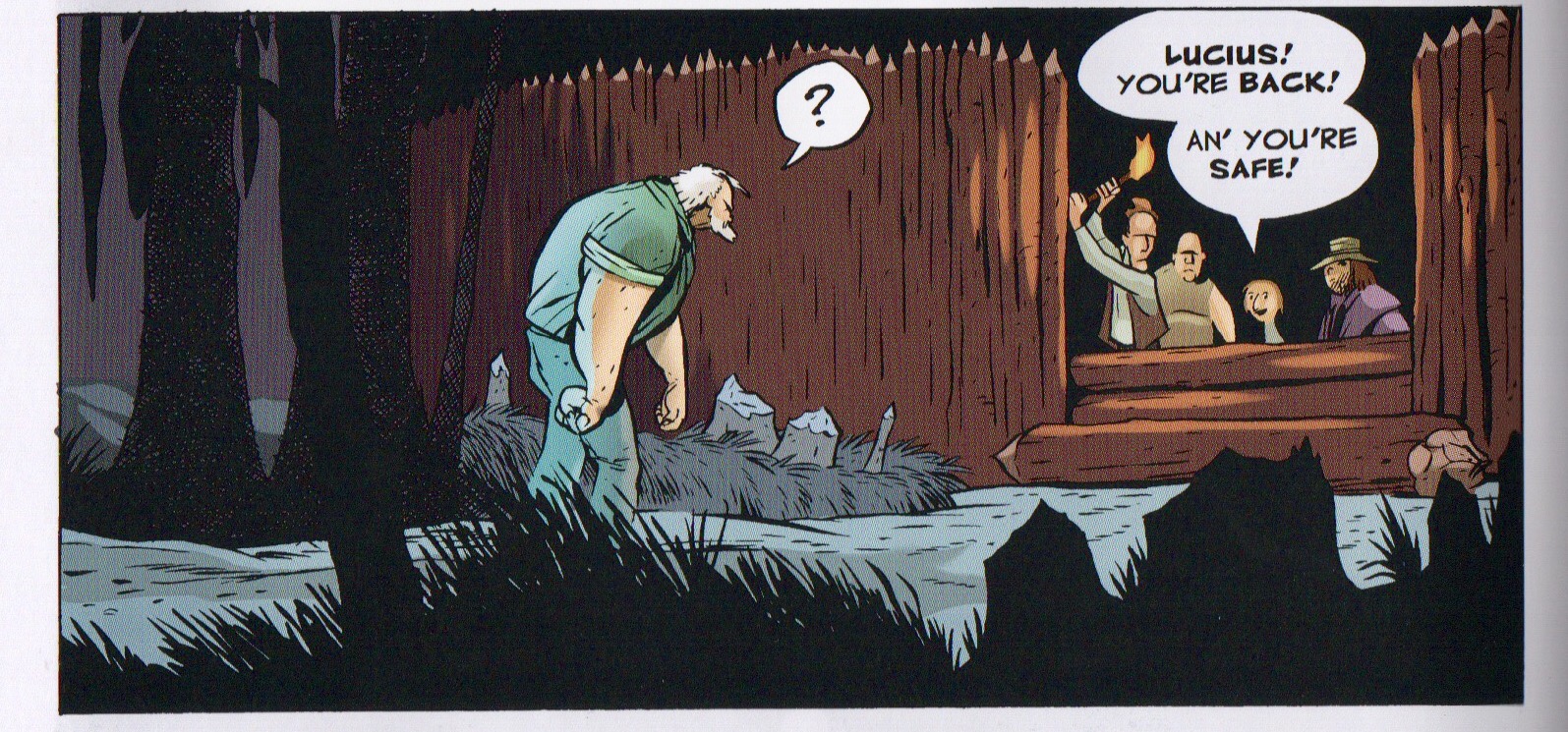
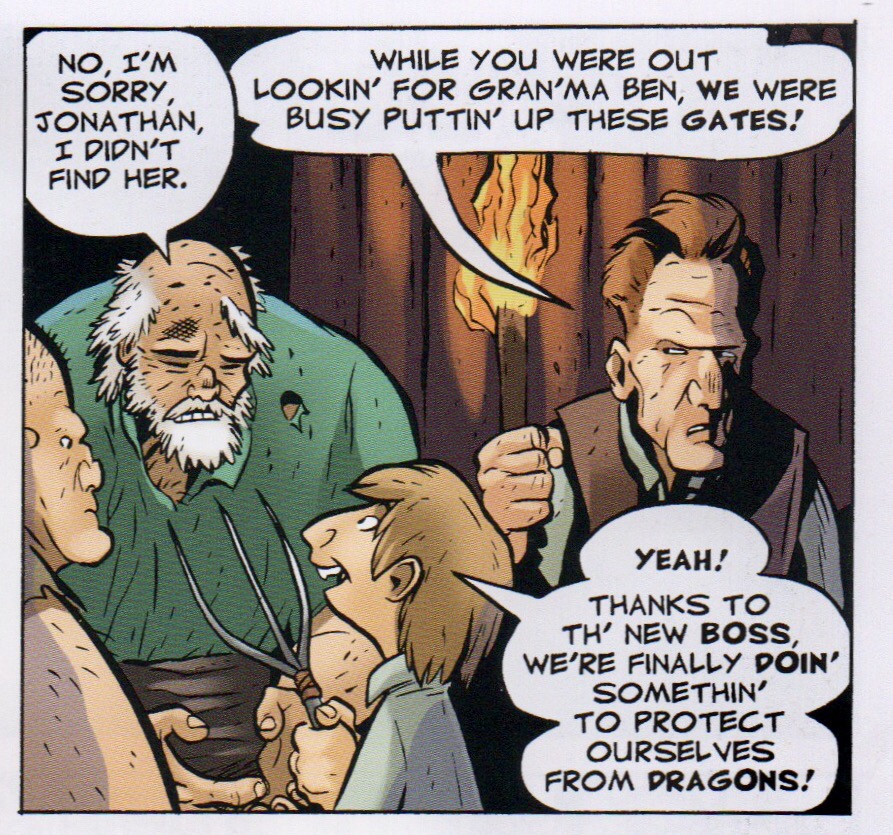
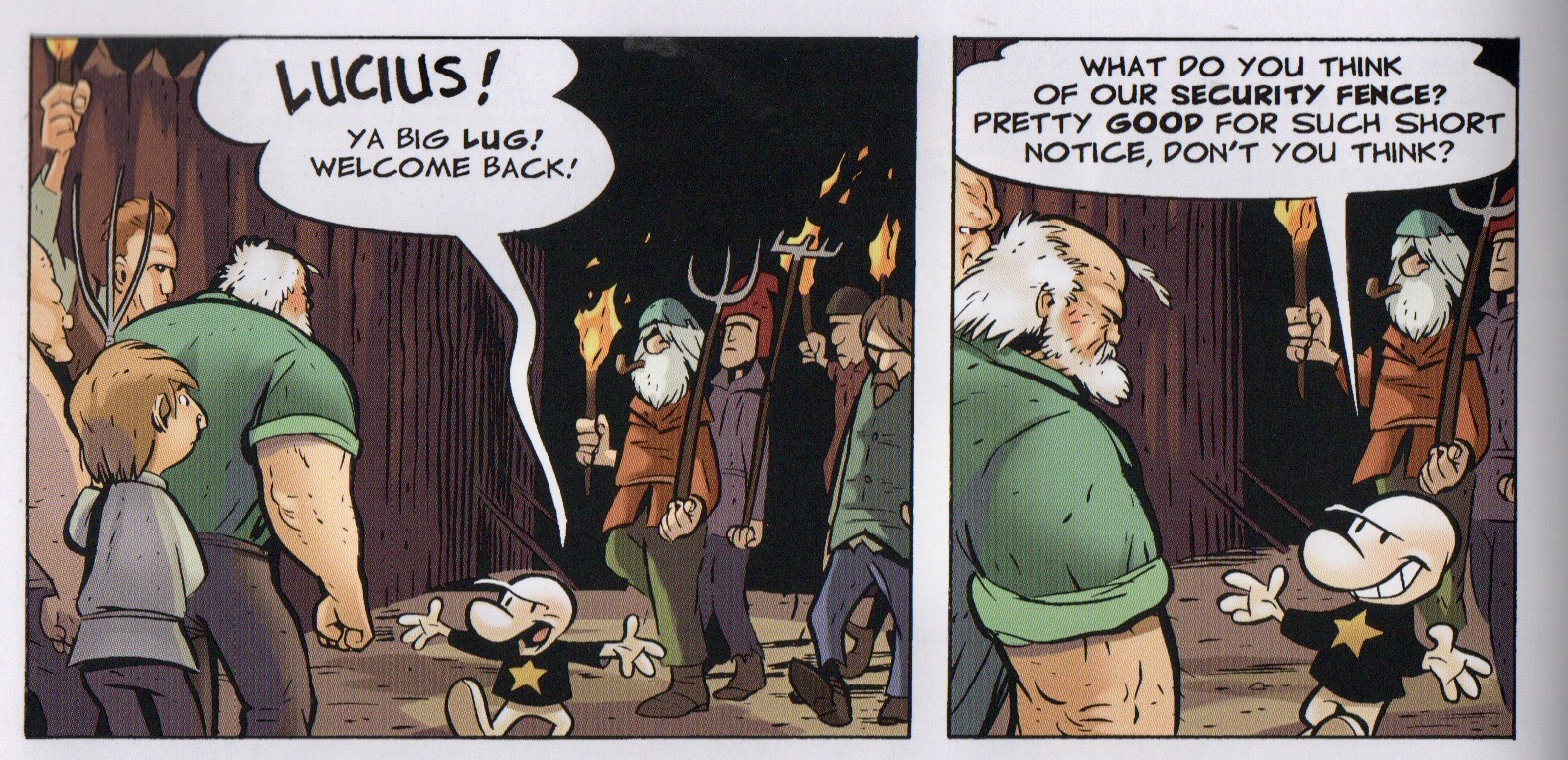
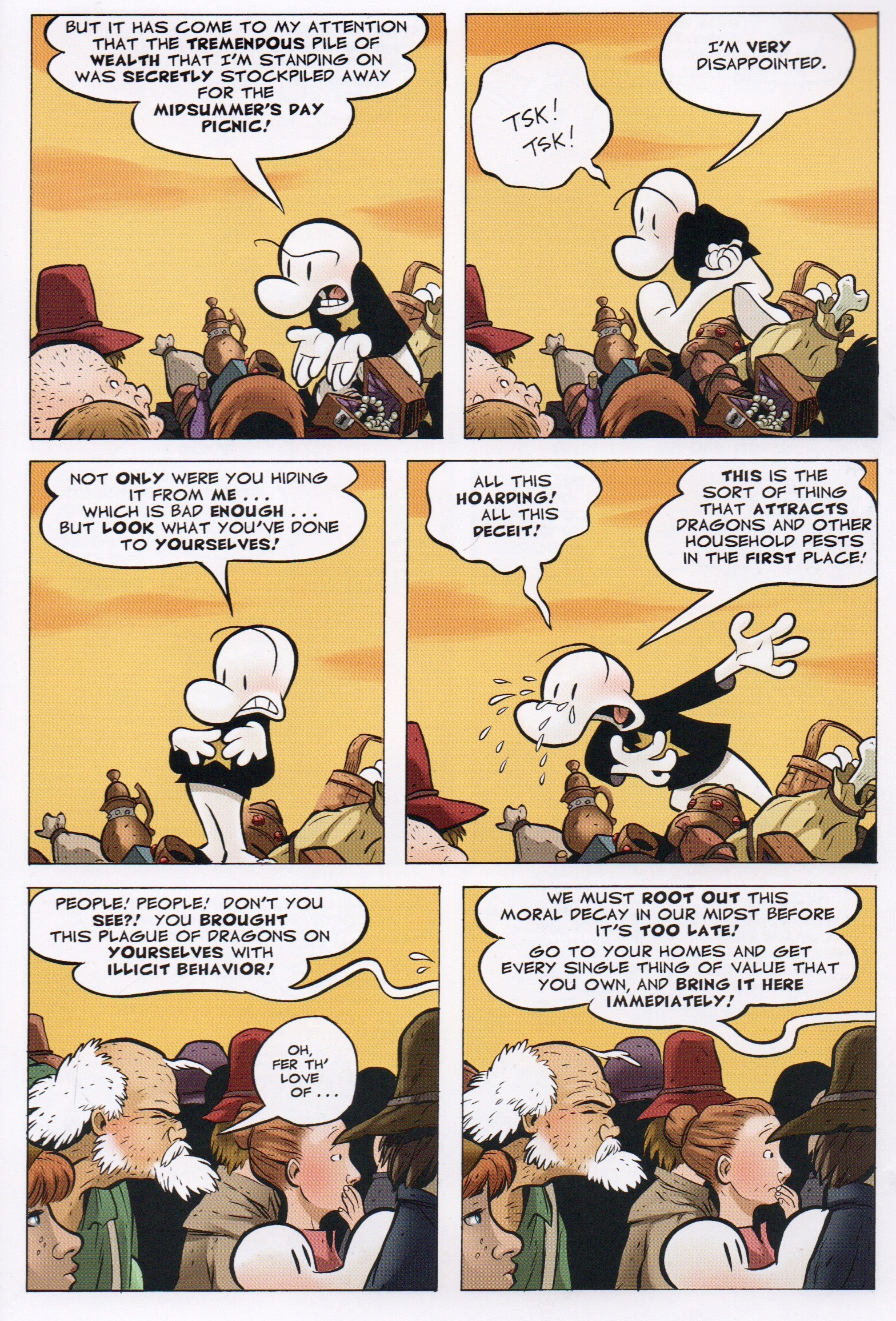
In this volume, Phoncible P. Bone—aka Phoney Bone—manipulates the fears of the populace of Barrelhaven. A natural conman, Phoney instructs the townspeople to build a wall to keep “dragons” out. Only sensible Lucius Down (and Phoney’s cousins, who know he’s a scammer) realize that Phoney is driven by egomania and greed.
Perhaps the most infuriating moment in the story comes when Phoney—a gifted pitchman—cloaks his greed in the language of ethics and morality.
Of course Phoney doesn’t win in the end. And Bone is just a comic; it’s not real life. It’s not like a xenophobic conman could really take sway over the zeitgeist.
He 1 gets back to the Casino just as big globular raindrops, thick as honey, begin to splat into giant asterisks 2 on the pavement, inviting him to look down at the bottom of the text 3 of the day 4, where footnotes will explain all 5. He isn’t about to look. Nobody ever said a day has to be juggled into any kind of sense at day’s end 6. He just runs. Rain grows in wet crescendo. His footfalls send up fine flowers of water, each hanging a second behind his flight. It is flight. He comes in speckled, pied with rain, begins a frantic search through the great inert Casino, starting again with the same smoky, hooch-fumed bar, proceeding through the little theatre 7, where tonight will play an abbreviated version of L’Inutil Precauzione (that imaginary opera with which Rosina seeks to delude her guardian in The Barber of Seville) 8, into its green room where girls, a silkenness of girls 9, but not the three 10 Slothrop wants most to see, tease hair, arrange garters, glue on eyelashes, smile at Slothrop. No one has seen Ghislaine, Françoise, Yvonne. From another room the orchestra rehearses a lively Rossini tarantella. The reeds are all something like a half tone flat. At once Slothrop understands that he is surrounded by women who have lived a good fraction of their lives at war and under occupation, and for whom people have been dropping out of sight every day… yes, in one or two pairs of eyes he finds an old and European pity, a look he will get to know, well before he loses his innocence and becomes one of them… . 11
So he drifts 12 through the bright and milling gaming rooms, the dining hall and its smaller private satellites, busting up tête-à-têtes, colliding with waiters, finding only strangers wherever he looks. And if you need help, well, I’ll help you… . 13
1 The “he” here is again Our Boy Tyrone Slothrop, and again, these annotations pick up right damn exactly where the last set left off. (Do not worry. I will not be annotating the entire novel paragraph by paragraph. I hope). Slothrop returns to the Casino Hermann Goering after an unsuccessful search for his friend Tantivy Mucker-Maffick.
2 What a wonderful series of transformations here, as the phenomenological world — “rain” — is converted via simile into “honey,” which transforms again into typographical representation — “asterisks.”
3 …and then the phenomenological world—which is to say here, the phenomenological world’s representation in literature—is converted into text. This is, uh, whattayoucall it, that metafiction? Slothrop’s family, recall, made their non-fortune in paper, a fact foregrounded near his introduction. We learn the Slothrops turned the natural world into a medium for text:
…green reaches were converted acres at a clip into paper—toilet paper, banknote stock, newsprint—a medium or ground for shit, money, and the Word. (28)
Shit, money, and the Word—key themes in Gravity’s Rainbow.
4 The phrase “the day” appears like a signature note not just throughout Gravity’s Rainbow but throughout Pynchon proper.
5 “….the bottom of the text of the day, where footnotes will explain all”—well, um. Lovely to look for answers, I suppose.
6 I’ll spell the line out in full again: “Nobody ever said a day has to be juggled into any kind of sense at day’s end.” Lovely on its own, but again, a concise if incredibly oblique gloss on Gravity’s Rainbow’s own end some 556 pages from now.
7 Cf. the fourth line of the novel (page 3): “The Evacuation still proceeds, but it’s all theatre.”
8 Weisenburger’s gloss from A Gravity’s Rainbow Companion:
The opera-within-an-opera is a kind of meta-textual, self-referencing recursion—what André Gide termed a mise en abyme.
Consider, by way of example, Velázquez’s meta-paintingLas Meninas, with its blurring of frame, gaze, reflection, self-reflection, and meta-reflection.
Las Meninas (detail), Diego Velázquez, 1656
You’re undoubtedly familiar with The Murder of Gonzago, the play-within-a-play in Hamlet, which Shakespeare uses to satirize and comment on the “text” proper of his great tragedy.
The Play Scene in Hamlet, Daniel Maclise, 1842
Pynchon posits a play-within-a-play in his earlier novel The Crying of Lot 49 (1969), when he includes a summary performance of The Courier’s Tragedy.
Mise en abyme reaches a sort of apotheosis in Charlie Kaufman’s film Synecdoche, New York (2008):
9A silkenness of girls is the correct and proper term (if overlooked by some, if not most, linguistic authorities). English terms of venery are the best.
Cf. James Lipton’s An Exaltation of Larks (1968).
A Shrivel of Critics, James Lipton, 1968
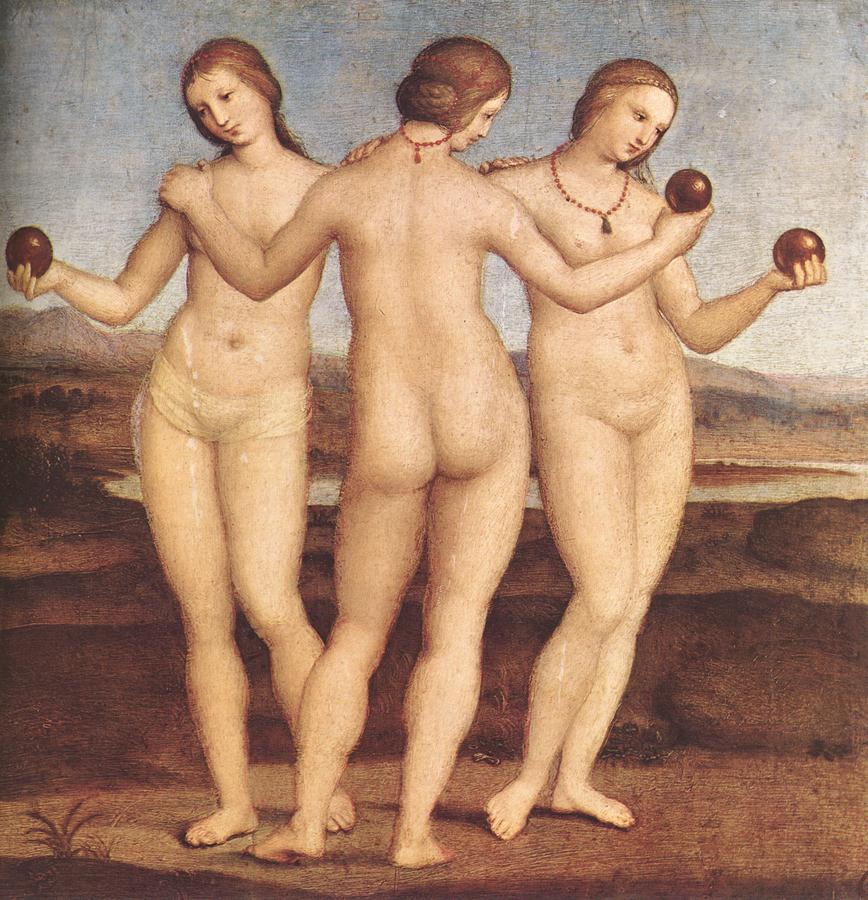
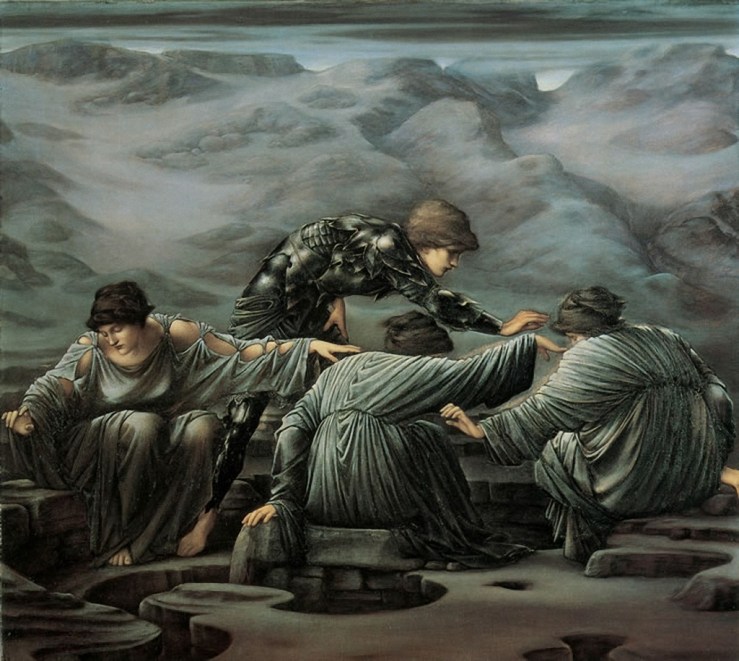
10 The three…Graces? Fates? Furies?
The Three Graces, Raphael, 1504-1505
…or just Ghislaine, Françoise, and Yvonne?
11 Slothrop among the women.
What is the antecedent for the sentence-final pronoun “them”—what does the text promise Slothrop will become once he “loses his innocence”? (And how ironic is this reference to Slothrop the Innocent?)
Possible referents for the “them” included the implied antecedent “European” (later, Slothrop will become the European folk hero Plechazunga the Pig), “pairs of eyes” (not likely), and “women” (also not likely). No, the “them” to which Slothrop shall eventually be elected are those “people [who] have been dropping out of sight every day.” Slothrop the Invisible. Note that Pynchon hides the referent in a tangle.
12 “He drifts”—a key verb for Our Drifter Slothrop.
13 Slothrop alone. The final italicized line are Tantivy’s last words.
“The blackmarket blights peace,” Dutch postwar propaganda poster, 1946
Don’t forget the real business of the War is buying and selling 1. The murdering and the violence are self-policing, and can be entrusted to non-professionals. The mass nature of wartime death is useful in many ways 2. It serves as spectacle, as diversion from the real movements of the War. It provides raw material to be recorded into History, so that children may be taught History as sequences of violence, battle after battle, and be more prepared for the adult world 3. Best of all, mass death’s a stimulus 4 to just ordinary folks, little fellows 5, to try ’n’ grab a piece of that Pie while they’re still here to gobble it up. The true war is a celebration of markets 6. Organic markets, carefully styled “black” 7 by the professionals, spring up everywhere. Scrip, Sterling, Reichsmarks continue to move, severe as classical ballet, inside their antiseptic marble chambers. But out here, down here among the people, the truer currencies come into being. So, Jews are negotiable. Every bit as negotiable as cigarettes, cunt, or Hershey bars. Jews also carry an element of guilt, of future blackmail, which operates, natch, in favor of the professionals. 8
From page 105 of Thomas Pynchon’s 1973 novel Gravity’s Rainbow.
1Gravity’s Rainbow is often (unjustly and unfairly) maligned as a messy, even pointless affair—but here’s our author speaking through the narrator, offering up one of the novel’s points—clearly, without equivocation.
2 Our narrator digs irony though…
3 Entropy is all—but entropy doesn’t make for good capitalism, by which our sly narrator means, Their Capitalism. The adult world needs to be organized, systematized, caused and effected.
Cf. Jack Gibbs’s rant to his erstwhile young students, early in William Gaddis’s 1975 novel of capitalism, J R:
Before we go any further here, has it ever occurred to any of you that all this is simply one grand misunderstanding? Since you’re not here to learn anything, but to be taught so you can pass these tests, knowledge has to be organized so it can be taught, and it has to be reduced to information so it can be organized do you follow that? In other words this leads you to assume that organization is an inherent property of the knowledge itself, and that disorder and chaos are simply irrelevant forces that threaten it from the outside. In fact it’s the opposite. Order is simply a thin, perilous condition we try to impose on the basic reality of chaos . . .
4 Note the not-so-oblique reference to GR’s theme of stimulus-response (and upending that response).
Not too much earlier in the narrative, dedicated Pavlovian Dr. Edward W.A. Pointsman worries about the end of cause and effect, the rise of entropy:
Will Postwar be nothing but ‘events,’ newly created one moment to the next? No links? Is it the end of history?
5…the preterite?
6 Pynchon reiterates his thesis.
7 Note that organic (entropic?) markets fall outside of Their System—y’know, Them—the Professionals—these organic (chaotic, necessary) markets must be labeled “black” (preterite?).
Here’s another Dutch propaganda poster:
“Protect them against the black market!”, Dutch propaganda poster, 1944
Page 105 of Gravity’s Rainbow “happens,” more or less, in 1944, in the middle of an extended introduction of Katje Borgesius, a Dutch double agent. (Or is that double Dutch agent?). The propaganda poster above strikes me as overtly racist, but also seems to nod to King Kong (1933, dir. Cooper and Schoedsack). Gravity’s Rainbow is larded with references to King Kong, a sympathetic but powerful force of entropy, a force against the Professionals.
Fay Wray look, 57; Fay Wray, 57, 179, 275; “You will have the tallest, darkest leading man in Hollywood,” 179; “headlights burning like the eyes of” 247; “the black scapeape we cast down like Lucifer,” 275; Mitchell Prettyplace book about, 275; “Giant ape” 276; “the Fist of the Ape,” 277; “orangutan on wheels,” 282; taking a shit, 368; “The figures darkened and deformed, resembling apes” 483; “a troupe of performing chimpanzees” 496; “on the tit with no motor skills,” 578; “Negroid apes,” 586; “that sacrificial ape,” 664; “a gigantic black ape,” 688; Carl Denham, 689; poem based on King Kong, 689; See also: actors/directors film/cinema references;
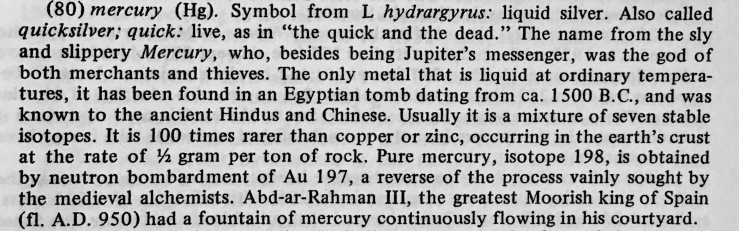
The Kong-figure in the Dutch propaganda poster seems to wear the petasos (winged hat) and wield the caduceus of Hermes or Mercury—god of thieves. But also god of the market, of commerce, merchandise, all things mercenary.
From Joseph T. Shipley’s The Origin of English Words: A Discursive Dictionary of Indo-European Roots (1984):
8 The passage as a whole, which emphasizes war as a conduit for the techne of the market (or do I have that backwards? should I note the market of techne?) echoes an earlier passage. From page 81:
It was widely believed in those days that behind the War—all the death, savagery, and destruction—lay the Führer-principle. But if personalities could be replaced by abstractions of power, if techniques developed by the corporations could be brought to bear, might not nations live rationally? One of the dearest Postwar hopes: that there should be no room for a terrible disease like charisma.









 Biblioklept