The Red Queen Dies (Book Acquired, 8.22.2013)

20130824-102919.jpg

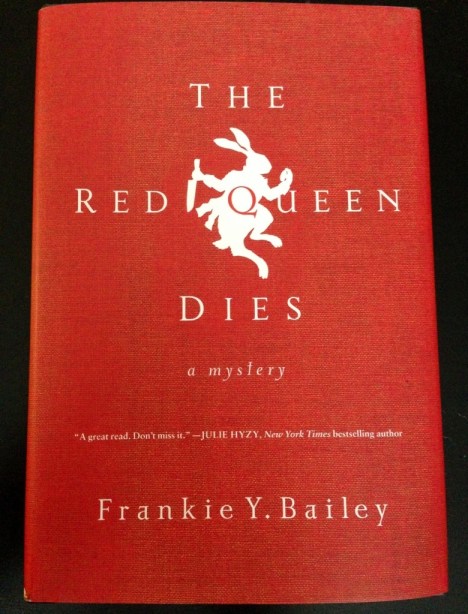
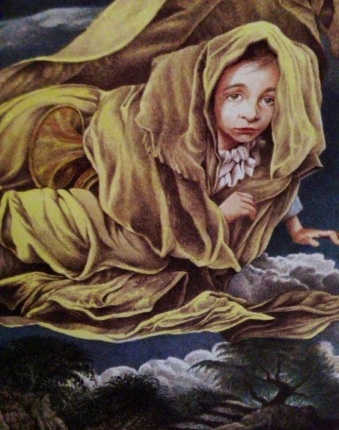
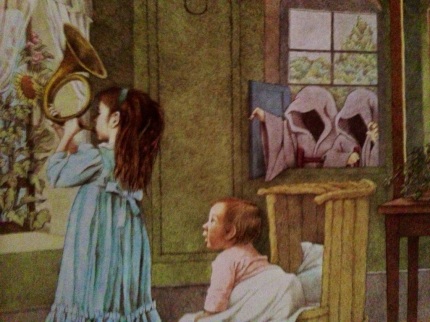
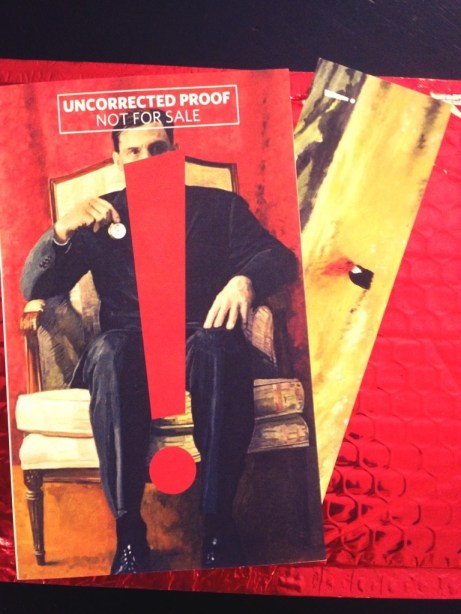
Great cover design for Frankie Y. Bailey’s new set-in-the-future-kinda-sci-fi-definitely-mystery The Red Queen Dies: elegant, minimal, and very striking. Wish there was more of this in genre fiction. Publisher Macmillan/Minotaur’s blurb:

Frankie Bailey introduces readers to a fabulous new protagonist and an Alice in Wonderland-infused crime in this stunning mystery, which kicks off an exciting new series set in the near future.

The year is 2019, and a drug used to treat soldiers for post-traumatic stress disorder, nicknamed “Lullaby,” has hit the streets. Swallowing a little pill erases traumatic memories, but what happens to a criminal trial when the star witness takes a pill and can’t remember the crime? When two women are murdered in quick succession, biracial police detective Hannah McCabe is charged with solving the case. In spite of the advanced technology, including a city-wide surveillance program, a third woman is soon killed, and the police begin to suspect that a serial killer is on the loose. But the third victim, a Broadway actress known as “The Red Queen,” doesn’t fit the pattern set by the first two murders.

With the late September heat sizzling, Detective Hannah McCabe and her colleagues on the police force have to race to find the killer in a tangled web of clues that involve Alice in Wonderland, The Wizard of Oz, and Abraham Lincoln’s assassination. Fast-paced and original, this is a one-of-a-kind mystery from an extremely talented crime writer.

S.D. Chrostowska’s Permission (Book Acquired, 8.10.2013)

20130814-174008.jpg

Sylwia Chrostowska’s novel Permission—got it in the mail on Saturday. I’d been swimming in the river, in the relentless August sun, for most of the day, and when I got home I just wanted to watch a film and drink some wine and pass out.

But I started reading. And reading. And then I looked up and and I was like fifty pages in.

Here’s publisher Dalkey Archive’s blurb:

Composed of anonymous e-mail messages sent by the author to an acclaimed visual artist over the course of a year, Permission is the record of an experiment: an attempt to forge a connection with a stranger through the writing of a book. Part meditation, part narrative, part essay, it is presented to its addressee as a gift that asks for no thanks or acknowledgment—but what can be given in words, and what received?Permission not only updates the “epistolary novel” by embracing the permissiveness we associate with digital communication, it opens a new literary frontier.

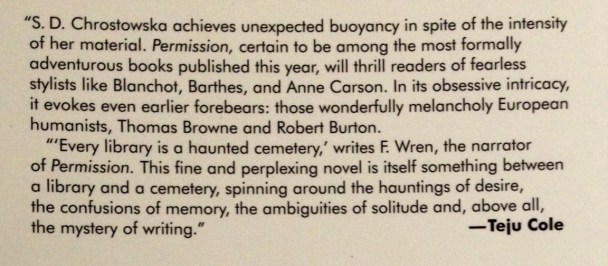
And here’s novelist Teju Cole’s blurb, from the back of the book (for some reason not posted at Dalkey):

20130814-174328.jpg

Permission’s central premise (if such a work so soaked in deconstruction could be said to have a center) immediately recalled to me Jacques Derrida’s discussions of the paradox of giving:

To rephrase my experimental question: can I give away what is inalienable from me (my utterance, myself) without the faintest expectation or hope of authority, solidarity, reciprocity? Can my giving be unhinged from a sense of both investment and pointless expenditure?

The first few “chapters” — the narrator’s weekly missives to the unnamed artist — are thoroughly soaked in deconstruction and continental philosophy; this is a novel that cites Blanchot and Deleuze in its first twenty pages. However, the narrator promises that her book, “through its progressive dissolution, towards the final solution of this writing (my work) . . . becomes progressively less difficult, less obscure.”

This promise seems true, as subsequent passages flow into personal memory, reflection—storytelling. We get a brief tour of cemeteries, a snapshot of the narrator’s father (as a child) at a child’s funeral, a recollection of the narrator’s first clumsy foray into fiction writing, a miniature memoir of a failed painter, color theory, the sun, the moon.

Strange and lovely stuff. More when I finish.

Books Acquired, 8.06.2013

20130809-114547.jpg

Son of a Gun (Book Acquired, 8.5.2013)

20130806-162848.jpg

Son of a Gun, Justin St. Germain’s memoir, explores the life and death of his mother, who was killed by her fifth husband. Here’s publisher Random House’s blurb:

Tombstone, Arizona, September 2001. Debbie St. Germain’s death in her remote trailer, apparently at the hands of her fifth husband, is a passing curiosity. “A real-life old West murder mystery,” the local TV announcers intone before the commercial break, while barroom gossips snicker cruelly. But for her twenty-year-old son, Justin St. Germain, the tragedy marks the line that separates his world into before and after.

Justin decides to confront people from his past and delve into the police records in an attempt to make sense of his mother’s life and death. All the while he tries to be the type of man she would have wanted him to be. Brutally honest and beautifully written, Son of a Gun is a brave, unexpected and unforgettable memoir.

Here’s Publishers Weekly’s write-up:

A young man wrestles with his heartache over his mother’s murder in this lacerating memoir of family dysfunction. St. Germain was a 20-year-old college student when his mother Debbie was shot to death in 2001 by her fifth husband in a desolate trailer in the Arizona desert, a disaster that threw into sharp relief the chaos of his working-class background. St. Germain revisits Debbie’s unstable life as an Army paratrooper and businesswoman, the string of men she took up with (some physically abusive), and his own boyhood resentment at their presence and at incessant domestic upheaval. Intertwined is a jaundiced, somewhat self-conscious meditation on St. Germain’s claustrophobic hometown of Tombstone—all sun-bleached ennui, arid hardpan, and tourist kitsch—and its presiding spirit, Wyatt Earp, archetype of the violent, trigger-happy machismo that he blames for killing his mother, yet feels drawn to as a touchstone of manhood. St. Germain makes harsh judgments of the men in his past (as well as of his sullen, callous adolescent self), but as he seeks them out later, he arrives, almost against his will, at a subtler appreciation of their complexities. At times his trauma feels more dutiful than deeply felt, but his memoir vividly conveys the journey from youthful victimization toward mature understanding.


Books Acquired, 7.26.2013

20130726-150353.jpg

20130726-150358.jpg

20130726-150402.jpg

20130726-150415.jpg

20130726-150421.jpg

Mother Daughter Me (Book Acquired, 7.08.2013)

20130709-141434.jpg

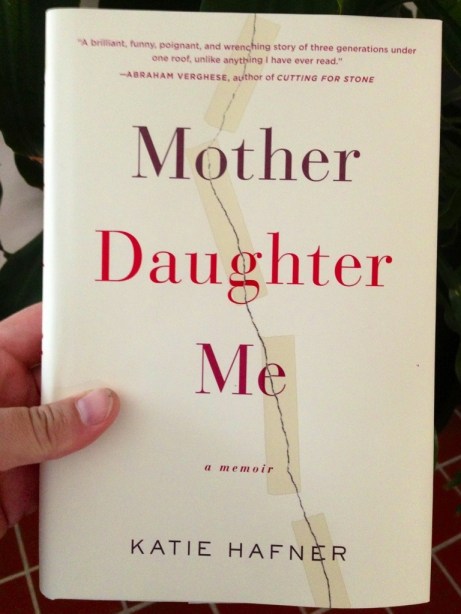
Mother Daughter Me is Katie Hafner’s memoir, new in hardback from Random House. Their blurb:

The complex, deeply binding relationship between mothers and daughters is brought vividly to life in Katie Hafner’s remarkable memoir, an exploration of the year she and her mother, Helen, spent working through, and triumphing over, a lifetime of unresolved emotions.

Dreaming of a “year in Provence” with her mother, Katie urges Helen to move to San Francisco to live with her and Zoë, Katie’s teenage daughter. Katie and Zoë had become a mother-daughter team, strong enough, Katie thought, to absorb the arrival of a seventy-seven-year-old woman set in her ways.

Filled with fairy-tale hope that she and her mother would become friends, and that Helen would grow close to her exceptional granddaughter, Katie embarked on an experiment in intergenerational living that she would soon discover was filled with land mines: memories of her parents’ painful divorce, of her mother’s drinking, of dislocating moves back and forth across the country,  and of Katie’s own widowhood and bumpy recovery. Helen, for her part, was also holding difficult issues at bay.

How these three women from such different generations learn to navigate their challenging, turbulent, and ultimately healing journey together makes for riveting reading. By turns heartbreaking and funny—and always insightful—Katie Hafner’s brave and loving book answers questions about the universal truths of family that are central to the lives of so many.

Bride of New France (Book Acquired, 7.09.2013)

20130709-141512.jpg

Bride of New France, an historical novel by Suzanne Desrochers, was a hit in Canada, where it was published by Penguin. Norton is publishing it in the States in trade paperback. Their blurb:

A Canadian bestseller, this richly imagined novel is about a young French woman sent to settle in the New World.

Transporting readers from cosmopolitan seventeenth-century Paris to the Canadian frontier, this vibrant debut tells of the struggle to survive in a brutal time and place. Laure Beausejour has been taken from her destitute family and raised in an infamous orphanage to be trained as a lace maker. Striking and willful, she dreams of becoming a seamstress and catching the eye of a nobleman. But after complaining about her living conditions, she is sent to Canada as a fille du roi, expected to marry a French farmer there. Laure is shocked by the primitive state of the colony and the mingling of the settlers with the native tribes. When her ill-matched husband leaves her alone in their derelict hut for the winter, she must rely on her wits and her clandestine relationship with an Iroquois man for survival.


The Spanish Holocaust (Book Acquired, 7.09.2013)

20130709-141528.jpg

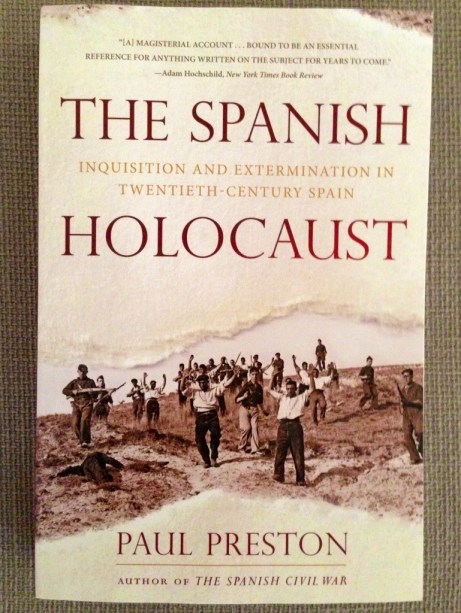
Paul Preston’s history The Spanish Holocaust is now out in trade paperback. Here’s publisher Norton’s blurb:

Long neglected by European historians, the unspeakable atrocities of Franco’s Spain are finally brought to tragic light in this definitive work.

The remains of General Francisco Franco lie in an immense mausoleum near Madrid, built with the blood and sweat of twenty thousand slave laborers. His enemies, however, met less-exalted fates. Besides those killed on the battlefield, tens of thousands were officially executed between 1936 and 1945, and as many again became “non-persons.” As Spain finally reclaims its historical memory, a full picture can now be given of the Spanish Holocaust-ranging from judicial murders to the abuse of women and children. The story of the victims of Franco’s reign of terror is framed by the activities of four key men-General Mola, Quiepo de Llano, Major Vallejo Najera, and Captain Don Gonzalo Aguilera-whose dogma of eugenics, terrorization, domination, and mind control horrifyingly mirror the fascism of Italy and Germany.

Evoking such classics as Gulag and The Great Terror, The Spanish Holocaust sheds crucial light on one of the darkest and most unexamined eras of modern European history.

And, from Adam Hochschild’s review last year in The New York Times:

An eminent and prolific British historian of modern Spain, Preston says this was “an extremely painful book to write.” It is also, unlike several of his other works, a difficult book to read. The newcomer to Spanish history will nowhere learn the difference between the Assault Guard and the Civil Guard, or between a Carlist and an integrist. Chapters roll on for 40 or 50 pages without a break. A blizzard of names of thousands of perpetrators and the towns where they carried out their tortures and killings overwhelms the reader. “The Spanish Holocaust” is not really a narrative but a comprehensive prosecutor’s brief. With its immense documentation — 120 pages of endnotes to both published and unpublished material in at least five languages, including corrections of errors in these sources — it is bound to be an essential reference for anything written on the subject for years to come.


Books Acquired, 7.12.2013

20130712-171908.jpg

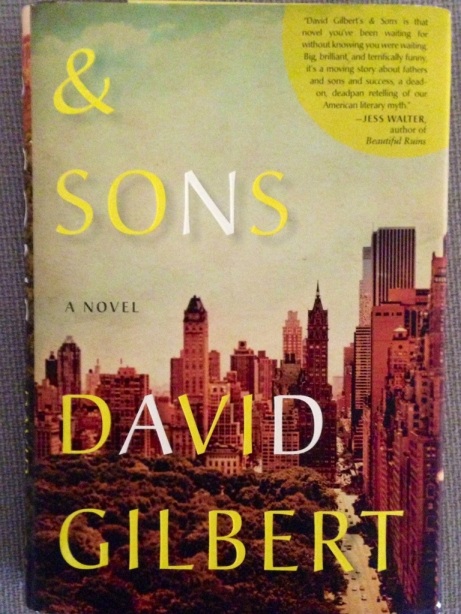
& Sons (Book Acquired, 7.09.2013)

20130709-141542.jpg

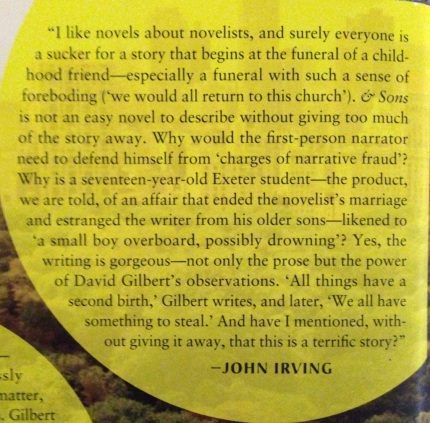
David Gilbert’s & Sons has gotten plenty of advanced praise and been likened to Wonder Boys and The Art of Fielding (which I couldn’t bring myself to waste my time to finish). Here’s John Irving’s blurb:

20130709-141554.jpg

And publisher Random House’s blurb:

The funeral of Charles Henry Topping on Manhattan’s Upper East Side would have been a minor affair (his two-hundred-word obit in The New York Times notwithstanding) but for the presence of one particular mourner: the notoriously reclusive author A. N. Dyer, whose novel Ampersand stands as a classic of American teenage angst. But as Andrew Newbold Dyer delivers the eulogy for his oldest friend, he suffers a breakdown over the life he’s led and the people he’s hurt and the novel that will forever endure as his legacy. He must gather his three sons for the first time in many years—before it’s too late.

So begins a wild, transformative, heartbreaking week, as witnessed by Philip Topping, who, like his late father, finds himself caught up in the swirl of the Dyer family. First there’s son Richard, a struggling screenwriter and father, returning from self-imposed exile in California. In the middle lingers Jamie, settled in Brooklyn after his twenty-year mission of making documentaries about human suffering. And last is Andy, the half brother whose mysterious birth tore the Dyers apart seventeen years ago, now in New York on spring break, determined to lose his virginity before returning to the prestigious New England boarding school that inspired Ampersand. But only when the real purpose of this reunion comes to light do these sons realize just how much is at stake, not only for their father but for themselves and three generations of their family.

In this daring feat of fiction, David Gilbert establishes himself as one of our most original, entertaining, and insightful authors. & Sons is that rarest of treasures: a startlingly imaginative novel about families and how they define us, and the choices we make when faced with our own mortality.


Aftermath (Book Acquired, 7.08.2013)

20130709-141450.jpg

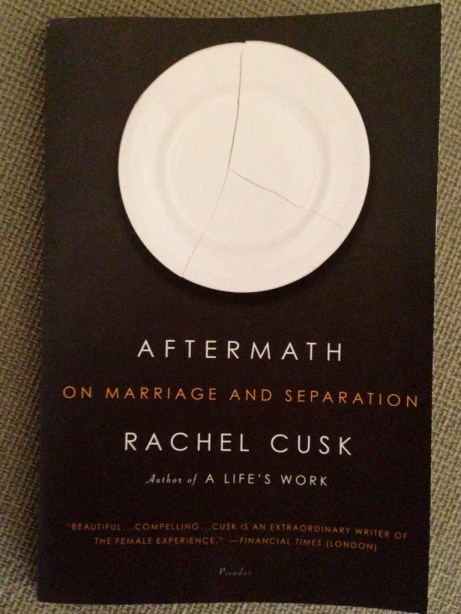
When a review copy of Rachel Cusk’s memoir Aftermath: On Marriage and Separation (new in trade paperback from Picador) showed up the other day, a dim bulb went off—where did I know Cusk’s name? I’m not generally a fan of the memoir, so I doubt I’d read it. And then! Aha! Yes—it was a review of Cusk’s memoir that won Camilla Long this year’s “Hatchet Job of the Year” award.

From Long’s review (originally published in The Sunday Times):

The book is crammed with mad, flowery metaphors and hifalutin creative-writing experiments. There are hectic passages on Greek tragedy and the Christian concept of family, as well as fragments of ghost stories, references to the Anglo-Saxon heptarchy, and heavy Freudian symbolism, including a long description of the removal of a molar, “a large tooth,” she writes portentously, “of great…personal significance”. The final chapter is an out-of-body experience — her situation seen through the eyes of her pill-popping Eastern European au pair. Oddly, I read the whole thing in a Bulgarian accent.

I don’t know, that sounds pretty weird. Kinda intrigues me.


The NewerYork #3 (Book Acquired, 6.17.2013)

20130709-154848.jpg

I kept meaning to do a book acquired post of the forthcoming issue of TheNewerYork but the smallish book was sort of with me in a lot of places, like tucked in my pocket or a car or my backpack. I actually should review it at this point, but I haven’t read everything in it yet. Short review: An increase in print quality over the last issue (read my review of The NewerYork #2), and the same spirit.

This little anthology’s vision might be bizarre, but it’s also clear. Anyway, good stuff (Anton Nimblett’s “Show & Tell: An American Game” might be my favorite—simultaneously witty and devastating). Full review to come. In the meantime, some samples: 

20130709-154256.jpg

20130709-154303.jpg
Detail from The Beauty Curse by Lori Nelson

20130709-154308.jpg


The Seventh Trumpet (Book Acquired, 7.01.2013)

20130709-140949.jpg

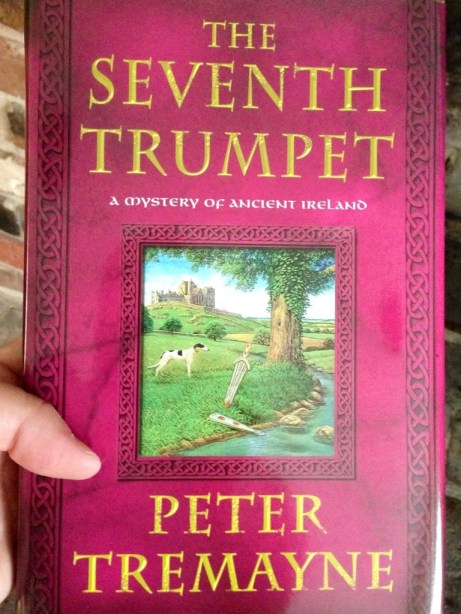
The Seventh Trumpet, another mystery from Peter Tremayne. Publisher Minotaur’s blurb:

When a murdered corpse of an unknown young noble is discovered, Fidelma of Cashel is brought in to investigate

Ireland, AD 670. When the body of a murdered young noble is discovered not far from Cashel, the King calls upon his sister, Fidelma, and her companion Eadulf to investigate. Fidelma, in addition to being the sister of the king, is a dailaigh—an advocate of the Brehon Law Courts—and has a particular talent for resolving the thorniest of mysteries.

But this time, Fidelma and Eadulf have very little to work with—the only clue to the noble’s identity is an emblem originating from the nearby kingdom of Laign. Could the murder be somehow related to the wave of violence erupting in the western lands of the kingdom? The turmoil there is being stirred up by an unknown fanatical figure who claims to have been summoned by “the seventh angel” to remove the “impure of faith.” Fidelma and Eadulf, once again grappling with a tangled skein of murder and intrigue, must somehow learn what connects the dead noble, a murdered alcoholic priest, and an abbot who has turned his monastery into a military fortress. When it appears that things cannot get more complex, Fidelma herself is abducted, and Eadulf must rescue her before the mystery can be solved.


George Catlin Biography (Book Acquired, Some Time Back in the End of June)

20130708-151619.jpg

The end of June kinda got away with me with these books acquired posts.

Anyway, I haven’t really made any time to check out Benita Eisler’s biography of lawyer-turned-painter George Catlin, a self-taught artist who chronicled the lives and culture of the Indians of the Great Plains in the nineteenth century. I like Catlin’s work, so this one might be interesting.

Publisher Norton’s blurb, followed by two of Catlin’s paintings:

The first biography in over sixty years of a great American artist whose paintings are more famous than the man who made them.

George Catlin has been called the “first artist of the West,” as none before him lived among and painted the Native American tribes of the Northern Plains. After a false start as a painter of miniatures, Catlin found his calling: to fix the image of a “vanishing race” before their “extermination”—his word—by a government greedy for their lands. In the first six years of the 1830s, he created over six hundred portraits—unforgettable likenesses of individual chiefs, warriors, braves, squaws, and children belonging to more than thirty tribes living along the upper Missouri River.

Political forces thwarted Catlin’s ambition to sell what he called his “Indian Gallery” as a national collection, and in 1840 the artist began three decades of self-imposed exile abroad. For a time, his exhibitions and writings made him the most celebrated American expatriate in London and Paris. He was toasted by Queen Victoria and breakfasted with King Louis-Philippe, who created a special gallery in the Louvre to show his pictures. But when he started to tour “live” troupes of Ojibbewa and Iowa, Catlin and his fortunes declined: He changed from artist to showman, and from advocate to exploiter of his native performers. Tragedy and loss engulfed both.

This brilliant and humane portrait brings to life George Catlin and his Indian subjects for our own time. An American original, he still personifies the artist as a figure of controversy, torn by conflicting demands of art and success.


Gordon Lish on John the Posthumous (Book Acquired, 6.26.2013)

20130630-091606.jpg

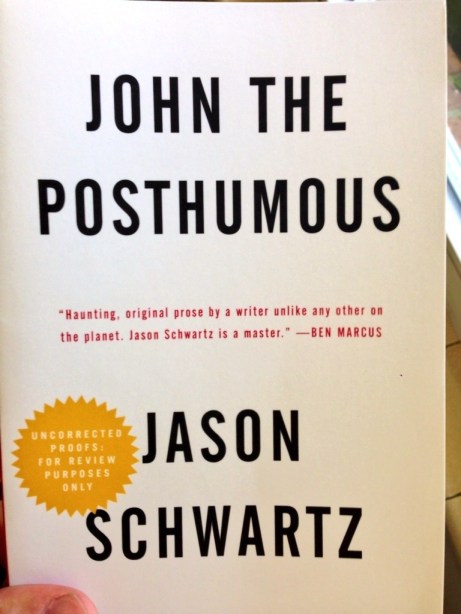
Some folks I know and whose taste I trust told me about Jason Schwartz, whose new novel (“novel” is not the right word) John the Posthumous is forthcoming from OR Books (the final cover art, which you can see via OR’s site, is much nicer than the reader copy above).

The book bears blurbs from Sam Lipsyte and Ben Marcus and Gordon Lish—so that should be enough for you. (It was enough to pique me).

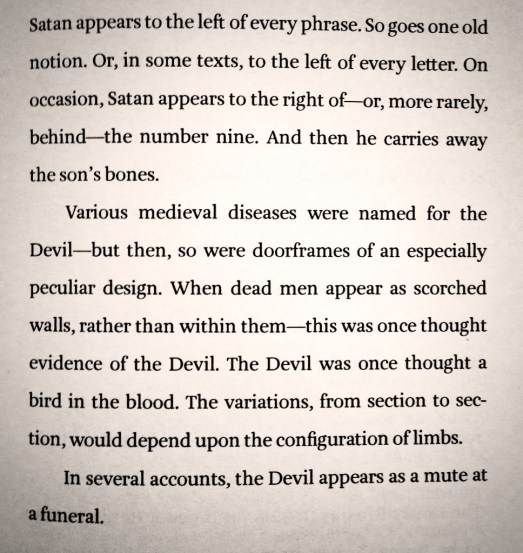
What is it about? Violence. Cuckoldry. Murder. Satan. Ritual. Animals. Beds. Etc. I don’t know. I’m a little over half way through, and I keep rereading it compulsively, rereading the sentences. Schwartz’s prose approaches a dark, poetic logic of substitutions and omissions that is probably best left unexplicated, but I’ll do a write up after the Fourth of July anyway. Here’s Lish’s praise (a short story in itself):

 20130630-091646

And two samples from the book (context is unimportant; or, rather everything—that is, the context of the entire book, in that the book is its own idiom, if you follow (or don’t)):

20130630-091623.jpg

20130630-091641.jpg


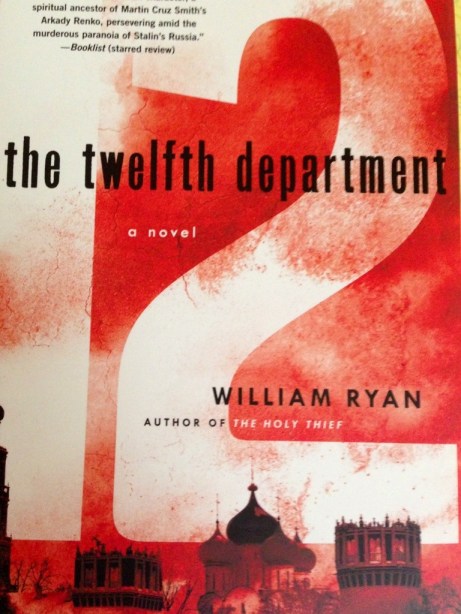
The Twelfth Department (Book Acquired, Sometime Last Week)

20130621-194131.jpg


The Twelfth Apartment is a forthcoming thriller from William Ryan. Macmillan’s blurb:

The new Captain Korolev mystery set in 1930s Stalinist Russia, from the lauded author of The Holy Thief and The Bloody Meadow

Moscow, 1937. Captain Korolev, a police investigator, is enjoying a long-overdue visit from his young son Yuri when an eminent scientist is shot dead within sight of the Kremlin and Korolev is ordered to find the killer.

It soon emerges that the victim, a man who it appears would stop at nothing to fulfil his ambitions, was engaged in research of great interest to those at the very top ranks of Soviet power. When another scientist is brutally murdered, and evidence of the professors’ dark experiments is hastily removed, Korolev begins to realise that, along with having a difficult case to solve, he’s caught in a dangerous battle between two warring factions of the NKVD. And then his son Yuri goes missing . . .

A desperate race against time, set against a city gripped by Stalin’s Great Terror and teeming with spies, street children and Thieves, The Twelfth Department confirms William Ryan as one of the most compelling historical crime novelists at work today.


Enormous Norm Sibum Novel (Book Acquired, 6.06.2013)

20130610-135947.jpg

A reader copy of Norm Sibum’s enormous (like, 700 page) debut novel The Traymore Rooms arrived last week. I’d normally be wary of a 700-page debut novel but Sibum, a poet, has been publishing for years, and the blurb intrigued me. Here is publisher Biblioasis’s blurb:

A place: the Traymore Rooms, downtown Montreal, an old walk-up. Those who live there and drink at the nearby café form the heart of Traymorean society. Their number includes: Eggy, red-faced, West Virginian, a veteran of Korea; Eleanor R (not Eleanor Roosevelt); Dubois, French-Canadian, optimist; Moonface, waitress-cum-Latin-scholar and sexpot inexpert; and, most recently, our hero Calhoun. A draft dodger and poetical type.

For a time all is life-as-usual: Calhoun argues with Eggy and Dubois, eats Eleanor’s cobblers, gossips of Moonface, muses on Virgil and the Current President. With the arrival of a newcomer to Traymore, however, Calhoun’s thoughts grow fixated and dark. He comes to believe in the reality of evil. This woman breaks no laws and she inflicts no physical harm—yet for the citizens of Traymore, ex-pats and philosophers all, her presence becomes a vortex that draws them closer to the America they dread.

Intelligent and frighteningly absurd, with a voice as nimble as Gass’s and satire that pierces like Wallace’s, The Traymore Rooms is a sustained howl against libertarianism under George W. Bush.

I read the first book of the first book of this book on Saturday, in a hammock—great start. Dude can write.

Here’s an excerpt of an excerpt:

Now Edward Sanders, aka Fast Eddy, hatless in winter, beetle-browed and barrel-chested, shows up in the Blue Danube, the left side of his face inflamed. He is not happy; deep-set eyes accuse. Silent, he joins us at our table. A round of greetings. He raises his hand to check our effusions. He will make the most of this moment, encased in layers of sweatshirts, nylon coat, baggy denims. His pale blue eyes flirt with woe and misery. His eyes are absolutes, so complete is his revulsion for all accidents of time and space, he claiming a sparrow flew into his mug. Well, how? He was turning a corner at the back of his duplex just as a bird endeavoured to do the same, its flight path minimizing the possibilities of attack from predators. Chicago school of physics: two solid objects cannot, at one and the same time, inhabit the same space, unless one was to speak of hand-to-hand combat or acts of passion.

Eggy, old and decrepit, snorts, octogenarian bravado and envy asserting: ‘She must’ve squeezed too hard.’ Yes, there it is, what explains Fast Eddy’s wounded pride. But his love of Moonface is pure, as the girl is a noble creature, she our waitress. Eggy’s hand begins its journey to his glass. Eventually, the glass secured, wine is consumed. And the world, like Fast Eddy, might have cause to complain of what has been seemingly inadvertent, all the world gobsmacked by phantom dominion. ‘Oh well,’ says Eggy, ‘just trying to cheer you up. Effing hell.’ The old man would sow the wild oats he had failed to sow, his Ebenezer, willie, Priapus now inert. One day, perhaps, Fast Eddy may declare to Moonface his love of her, and she grant him the justice of his argument; and she reward him with some tender ministration, her smile daffy. Fast Eddy blinks, frowns and suffers. He might have to see a doctor, his left ear shiny red, grown enormous.

I have been a Traymorean for some time. Congratulations are in order, I think. It is to say I reside in the Traymore Rooms – along with Eggy, Moonface, Dubois and Eleanor R, Mrs Petrova our live-in landlady – and they have not yet turfed me into the street. What has been more spectacular than spectacular failure, than the truths that did not quite endure, than the lies that all too often succeeded? In any case, snow is falling. It settles on fur hats and tuques and caps. Wind drives it against scarved shoulders. I observe what, beyond the cold café window, has all the attributes of a dream: the afternoon commute, its sounds muffled