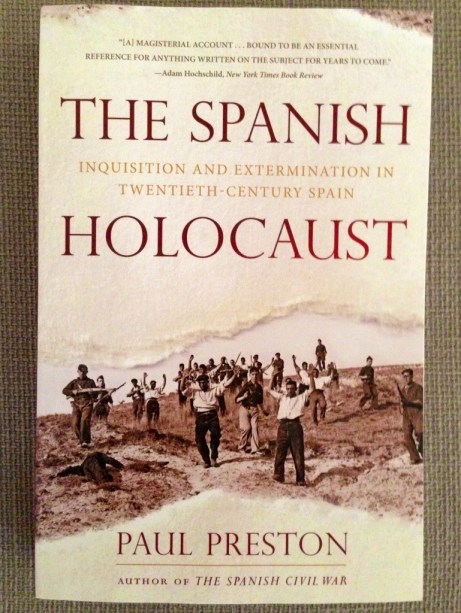
The Spanish Holocaust (Book Acquired, 7.09.2013)

20130709-141528.jpg

Paul Preston’s history The Spanish Holocaust is now out in trade paperback. Here’s publisher Norton’s blurb:

Long neglected by European historians, the unspeakable atrocities of Franco’s Spain are finally brought to tragic light in this definitive work.

The remains of General Francisco Franco lie in an immense mausoleum near Madrid, built with the blood and sweat of twenty thousand slave laborers. His enemies, however, met less-exalted fates. Besides those killed on the battlefield, tens of thousands were officially executed between 1936 and 1945, and as many again became “non-persons.” As Spain finally reclaims its historical memory, a full picture can now be given of the Spanish Holocaust-ranging from judicial murders to the abuse of women and children. The story of the victims of Franco’s reign of terror is framed by the activities of four key men-General Mola, Quiepo de Llano, Major Vallejo Najera, and Captain Don Gonzalo Aguilera-whose dogma of eugenics, terrorization, domination, and mind control horrifyingly mirror the fascism of Italy and Germany.

Evoking such classics as Gulag and The Great Terror, The Spanish Holocaust sheds crucial light on one of the darkest and most unexamined eras of modern European history.

And, from Adam Hochschild’s review last year in The New York Times:

An eminent and prolific British historian of modern Spain, Preston says this was “an extremely painful book to write.” It is also, unlike several of his other works, a difficult book to read. The newcomer to Spanish history will nowhere learn the difference between the Assault Guard and the Civil Guard, or between a Carlist and an integrist. Chapters roll on for 40 or 50 pages without a break. A blizzard of names of thousands of perpetrators and the towns where they carried out their tortures and killings overwhelms the reader. “The Spanish Holocaust” is not really a narrative but a comprehensive prosecutor’s brief. With its immense documentation — 120 pages of endnotes to both published and unpublished material in at least five languages, including corrections of errors in these sources — it is bound to be an essential reference for anything written on the subject for years to come.

 

Books Acquired, 7.12.2013

20130712-171908.jpg

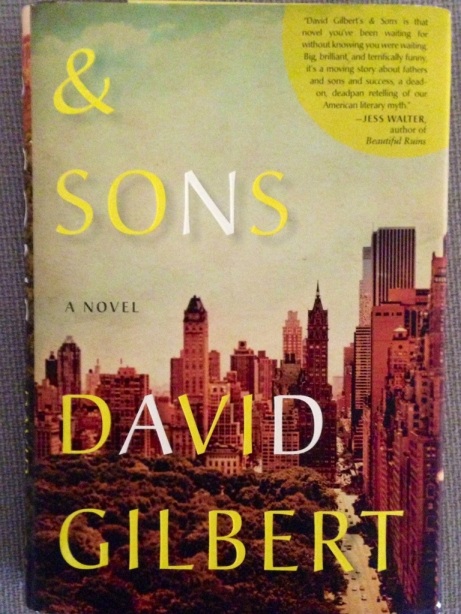
& Sons (Book Acquired, 7.09.2013)

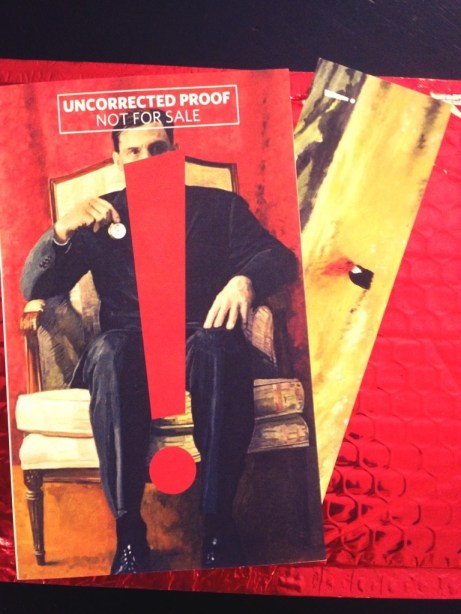
20130709-141542.jpg

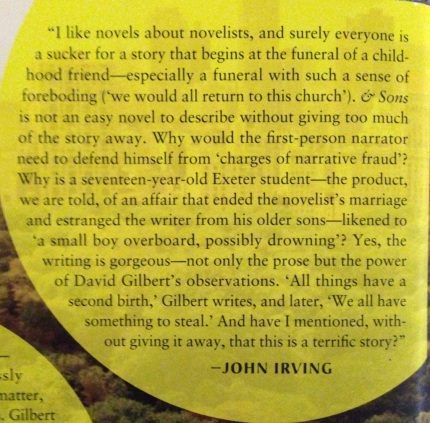
David Gilbert’s & Sons has gotten plenty of advanced praise and been likened to Wonder Boys and The Art of Fielding (which I couldn’t bring myself to waste my time to finish). Here’s John Irving’s blurb:

20130709-141554.jpg

And publisher Random House’s blurb:

The funeral of Charles Henry Topping on Manhattan’s Upper East Side would have been a minor affair (his two-hundred-word obit in The New York Times notwithstanding) but for the presence of one particular mourner: the notoriously reclusive author A. N. Dyer, whose novel Ampersand stands as a classic of American teenage angst. But as Andrew Newbold Dyer delivers the eulogy for his oldest friend, he suffers a breakdown over the life he’s led and the people he’s hurt and the novel that will forever endure as his legacy. He must gather his three sons for the first time in many years—before it’s too late.

So begins a wild, transformative, heartbreaking week, as witnessed by Philip Topping, who, like his late father, finds himself caught up in the swirl of the Dyer family. First there’s son Richard, a struggling screenwriter and father, returning from self-imposed exile in California. In the middle lingers Jamie, settled in Brooklyn after his twenty-year mission of making documentaries about human suffering. And last is Andy, the half brother whose mysterious birth tore the Dyers apart seventeen years ago, now in New York on spring break, determined to lose his virginity before returning to the prestigious New England boarding school that inspired Ampersand. But only when the real purpose of this reunion comes to light do these sons realize just how much is at stake, not only for their father but for themselves and three generations of their family.

In this daring feat of fiction, David Gilbert establishes himself as one of our most original, entertaining, and insightful authors. & Sons is that rarest of treasures: a startlingly imaginative novel about families and how they define us, and the choices we make when faced with our own mortality.


Aftermath (Book Acquired, 7.08.2013)

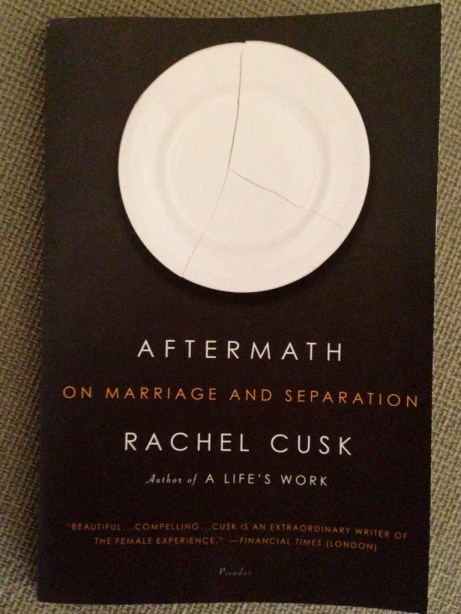
20130709-141450.jpg

When a review copy of Rachel Cusk’s memoir Aftermath: On Marriage and Separation (new in trade paperback from Picador) showed up the other day, a dim bulb went off—where did I know Cusk’s name? I’m not generally a fan of the memoir, so I doubt I’d read it. And then! Aha! Yes—it was a review of Cusk’s memoir that won Camilla Long this year’s “Hatchet Job of the Year” award.

From Long’s review (originally published in The Sunday Times):

The book is crammed with mad, flowery metaphors and hifalutin creative-writing experiments. There are hectic passages on Greek tragedy and the Christian concept of family, as well as fragments of ghost stories, references to the Anglo-Saxon heptarchy, and heavy Freudian symbolism, including a long description of the removal of a molar, “a large tooth,” she writes portentously, “of great…personal significance”. The final chapter is an out-of-body experience — her situation seen through the eyes of her pill-popping Eastern European au pair. Oddly, I read the whole thing in a Bulgarian accent.

I don’t know, that sounds pretty weird. Kinda intrigues me.


The NewerYork #3 (Book Acquired, 6.17.2013)

20130709-154848.jpg

I kept meaning to do a book acquired post of the forthcoming issue of TheNewerYork but the smallish book was sort of with me in a lot of places, like tucked in my pocket or a car or my backpack. I actually should review it at this point, but I haven’t read everything in it yet. Short review: An increase in print quality over the last issue (read my review of The NewerYork #2), and the same spirit.

This little anthology’s vision might be bizarre, but it’s also clear. Anyway, good stuff (Anton Nimblett’s “Show & Tell: An American Game” might be my favorite—simultaneously witty and devastating). Full review to come. In the meantime, some samples: 

20130709-154256.jpg

20130709-154303.jpg
Detail from The Beauty Curse by Lori Nelson

20130709-154308.jpg


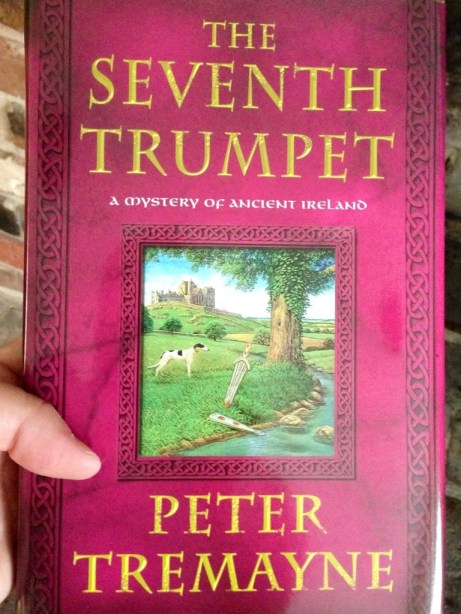
The Seventh Trumpet (Book Acquired, 7.01.2013)

20130709-140949.jpg

The Seventh Trumpet, another mystery from Peter Tremayne. Publisher Minotaur’s blurb:

When a murdered corpse of an unknown young noble is discovered, Fidelma of Cashel is brought in to investigate

Ireland, AD 670. When the body of a murdered young noble is discovered not far from Cashel, the King calls upon his sister, Fidelma, and her companion Eadulf to investigate. Fidelma, in addition to being the sister of the king, is a dailaigh—an advocate of the Brehon Law Courts—and has a particular talent for resolving the thorniest of mysteries.

But this time, Fidelma and Eadulf have very little to work with—the only clue to the noble’s identity is an emblem originating from the nearby kingdom of Laign. Could the murder be somehow related to the wave of violence erupting in the western lands of the kingdom? The turmoil there is being stirred up by an unknown fanatical figure who claims to have been summoned by “the seventh angel” to remove the “impure of faith.” Fidelma and Eadulf, once again grappling with a tangled skein of murder and intrigue, must somehow learn what connects the dead noble, a murdered alcoholic priest, and an abbot who has turned his monastery into a military fortress. When it appears that things cannot get more complex, Fidelma herself is abducted, and Eadulf must rescue her before the mystery can be solved.


George Catlin Biography (Book Acquired, Some Time Back in the End of June)

20130708-151619.jpg

The end of June kinda got away with me with these books acquired posts.

Anyway, I haven’t really made any time to check out Benita Eisler’s biography of lawyer-turned-painter George Catlin, a self-taught artist who chronicled the lives and culture of the Indians of the Great Plains in the nineteenth century. I like Catlin’s work, so this one might be interesting.

Publisher Norton’s blurb, followed by two of Catlin’s paintings:

The first biography in over sixty years of a great American artist whose paintings are more famous than the man who made them.

George Catlin has been called the “first artist of the West,” as none before him lived among and painted the Native American tribes of the Northern Plains. After a false start as a painter of miniatures, Catlin found his calling: to fix the image of a “vanishing race” before their “extermination”—his word—by a government greedy for their lands. In the first six years of the 1830s, he created over six hundred portraits—unforgettable likenesses of individual chiefs, warriors, braves, squaws, and children belonging to more than thirty tribes living along the upper Missouri River.

Political forces thwarted Catlin’s ambition to sell what he called his “Indian Gallery” as a national collection, and in 1840 the artist began three decades of self-imposed exile abroad. For a time, his exhibitions and writings made him the most celebrated American expatriate in London and Paris. He was toasted by Queen Victoria and breakfasted with King Louis-Philippe, who created a special gallery in the Louvre to show his pictures. But when he started to tour “live” troupes of Ojibbewa and Iowa, Catlin and his fortunes declined: He changed from artist to showman, and from advocate to exploiter of his native performers. Tragedy and loss engulfed both.

This brilliant and humane portrait brings to life George Catlin and his Indian subjects for our own time. An American original, he still personifies the artist as a figure of controversy, torn by conflicting demands of art and success.


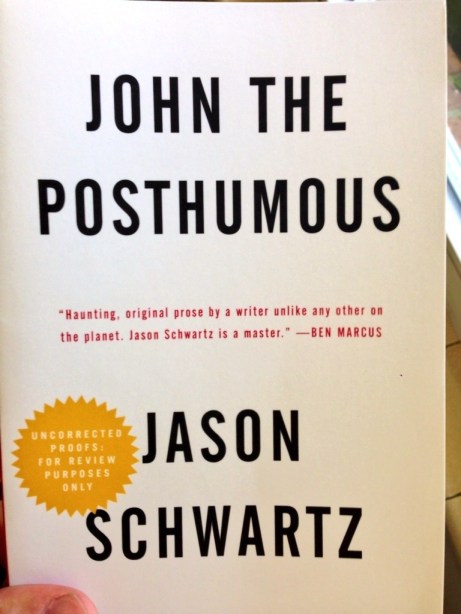
Gordon Lish on John the Posthumous (Book Acquired, 6.26.2013)

20130630-091606.jpg

Some folks I know and whose taste I trust told me about Jason Schwartz, whose new novel (“novel” is not the right word) John the Posthumous is forthcoming from OR Books (the final cover art, which you can see via OR’s site, is much nicer than the reader copy above).

The book bears blurbs from Sam Lipsyte and Ben Marcus and Gordon Lish—so that should be enough for you. (It was enough to pique me).

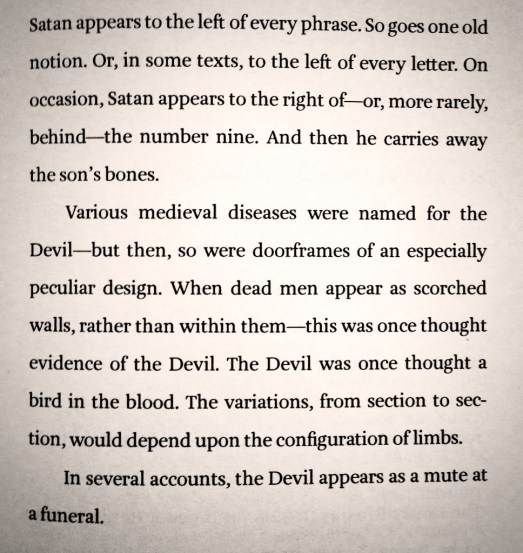
What is it about? Violence. Cuckoldry. Murder. Satan. Ritual. Animals. Beds. Etc. I don’t know. I’m a little over half way through, and I keep rereading it compulsively, rereading the sentences. Schwartz’s prose approaches a dark, poetic logic of substitutions and omissions that is probably best left unexplicated, but I’ll do a write up after the Fourth of July anyway. Here’s Lish’s praise (a short story in itself):

 20130630-091646

And two samples from the book (context is unimportant; or, rather everything—that is, the context of the entire book, in that the book is its own idiom, if you follow (or don’t)):

20130630-091623.jpg

20130630-091641.jpg


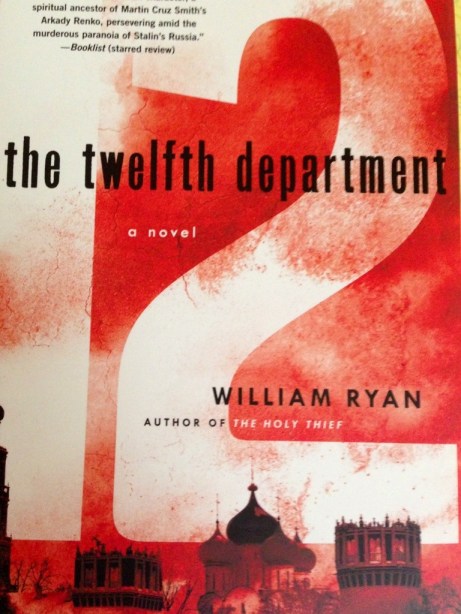
The Twelfth Department (Book Acquired, Sometime Last Week)

20130621-194131.jpg


The Twelfth Apartment is a forthcoming thriller from William Ryan. Macmillan’s blurb:

The new Captain Korolev mystery set in 1930s Stalinist Russia, from the lauded author of The Holy Thief and The Bloody Meadow

Moscow, 1937. Captain Korolev, a police investigator, is enjoying a long-overdue visit from his young son Yuri when an eminent scientist is shot dead within sight of the Kremlin and Korolev is ordered to find the killer.

It soon emerges that the victim, a man who it appears would stop at nothing to fulfil his ambitions, was engaged in research of great interest to those at the very top ranks of Soviet power. When another scientist is brutally murdered, and evidence of the professors’ dark experiments is hastily removed, Korolev begins to realise that, along with having a difficult case to solve, he’s caught in a dangerous battle between two warring factions of the NKVD. And then his son Yuri goes missing . . .

A desperate race against time, set against a city gripped by Stalin’s Great Terror and teeming with spies, street children and Thieves, The Twelfth Department confirms William Ryan as one of the most compelling historical crime novelists at work today.


Enormous Norm Sibum Novel (Book Acquired, 6.06.2013)

20130610-135947.jpg

A reader copy of Norm Sibum’s enormous (like, 700 page) debut novel The Traymore Rooms arrived last week. I’d normally be wary of a 700-page debut novel but Sibum, a poet, has been publishing for years, and the blurb intrigued me. Here is publisher Biblioasis’s blurb:

A place: the Traymore Rooms, downtown Montreal, an old walk-up. Those who live there and drink at the nearby café form the heart of Traymorean society. Their number includes: Eggy, red-faced, West Virginian, a veteran of Korea; Eleanor R (not Eleanor Roosevelt); Dubois, French-Canadian, optimist; Moonface, waitress-cum-Latin-scholar and sexpot inexpert; and, most recently, our hero Calhoun. A draft dodger and poetical type.

For a time all is life-as-usual: Calhoun argues with Eggy and Dubois, eats Eleanor’s cobblers, gossips of Moonface, muses on Virgil and the Current President. With the arrival of a newcomer to Traymore, however, Calhoun’s thoughts grow fixated and dark. He comes to believe in the reality of evil. This woman breaks no laws and she inflicts no physical harm—yet for the citizens of Traymore, ex-pats and philosophers all, her presence becomes a vortex that draws them closer to the America they dread.

Intelligent and frighteningly absurd, with a voice as nimble as Gass’s and satire that pierces like Wallace’s, The Traymore Rooms is a sustained howl against libertarianism under George W. Bush.

I read the first book of the first book of this book on Saturday, in a hammock—great start. Dude can write.

Here’s an excerpt of an excerpt:

Now Edward Sanders, aka Fast Eddy, hatless in winter, beetle-browed and barrel-chested, shows up in the Blue Danube, the left side of his face inflamed. He is not happy; deep-set eyes accuse. Silent, he joins us at our table. A round of greetings. He raises his hand to check our effusions. He will make the most of this moment, encased in layers of sweatshirts, nylon coat, baggy denims. His pale blue eyes flirt with woe and misery. His eyes are absolutes, so complete is his revulsion for all accidents of time and space, he claiming a sparrow flew into his mug. Well, how? He was turning a corner at the back of his duplex just as a bird endeavoured to do the same, its flight path minimizing the possibilities of attack from predators. Chicago school of physics: two solid objects cannot, at one and the same time, inhabit the same space, unless one was to speak of hand-to-hand combat or acts of passion.

Eggy, old and decrepit, snorts, octogenarian bravado and envy asserting: ‘She must’ve squeezed too hard.’ Yes, there it is, what explains Fast Eddy’s wounded pride. But his love of Moonface is pure, as the girl is a noble creature, she our waitress. Eggy’s hand begins its journey to his glass. Eventually, the glass secured, wine is consumed. And the world, like Fast Eddy, might have cause to complain of what has been seemingly inadvertent, all the world gobsmacked by phantom dominion. ‘Oh well,’ says Eggy, ‘just trying to cheer you up. Effing hell.’ The old man would sow the wild oats he had failed to sow, his Ebenezer, willie, Priapus now inert. One day, perhaps, Fast Eddy may declare to Moonface his love of her, and she grant him the justice of his argument; and she reward him with some tender ministration, her smile daffy. Fast Eddy blinks, frowns and suffers. He might have to see a doctor, his left ear shiny red, grown enormous.

I have been a Traymorean for some time. Congratulations are in order, I think. It is to say I reside in the Traymore Rooms – along with Eggy, Moonface, Dubois and Eleanor R, Mrs Petrova our live-in landlady – and they have not yet turfed me into the street. What has been more spectacular than spectacular failure, than the truths that did not quite endure, than the lies that all too often succeeded? In any case, snow is falling. It settles on fur hats and tuques and caps. Wind drives it against scarved shoulders. I observe what, beyond the cold café window, has all the attributes of a dream: the afternoon commute, its sounds muffled

The Resurrectionist (Book Acquired, 6.04.2013)

20130607-155808.jpg

20130607-155816.jpg

Matthew Guinn’s The Resurrectionist showed up in the mail a few days ago. Haven’t really had time to get into it, but the premise seems promising, and Guinn’s Southern lit bona fides also intrigue me.

Publisher W.W. Norton’s blurb:

A young doctor wrestles with the legacy of a slave “resurrectionist” owned by his South Carolina medical school.

“Dog days and the fresh bodies are arriving once again.” So begins the fall term at South Carolina Medical College, where Dr. Jacob Thacker is on probation for Xanax abuse. His interim career—working public relations for the dean—takes an unnerving detour into the past when the bones of African American slaves, over a century old, are unearthed on campus. Out of the college’s dark past, these bones threaten to rise and condemn the present.

In the middle of the nineteenth century, Dr. Frederick Augustus Johnston, one of the school’s founders, had purchased a slave for his unusual knife skills. This slave, Nemo (“no man”) would become an unacknowledged member of the surgical faculty by day—and by night, a “resurrectionist,” responsible for procuring bodies for medical study. An unforgettable character, by turns apparently insouciant, tormented, and brilliant, and seen by some as almost supernatural, Nemo will seize his self-respect in ways no reader can anticipate.

With exceptional storytelling pacing and skill, Matthew Guinn weaves together past and present to relate a Southern Gothic tale of shocking crimes and exquisite revenge, a riveting and satisfying moral parable of the South.


Barry Hannah/Stanley Elkin (Books Acquired, 5.29.2013)

20130529-164927.jpg

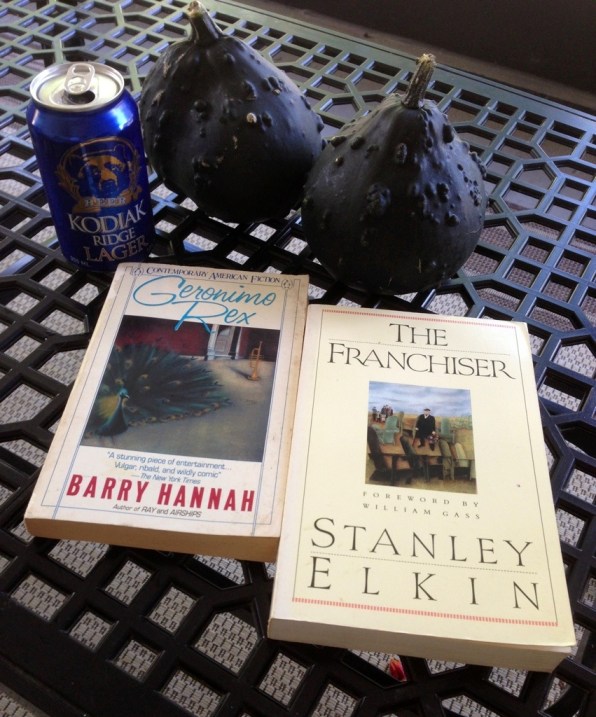
I was thrilled to find a somewhat tattered copy of Barry Hannah’s Geronimo Rex, after trolling the [huge, unorganized] “HA” section of my favorite used bookstore. Years ago, I found like seven of Hannah’s books used there and picked up only one. I devoured it, returned, the rest were gone. Regrets, regrets. I will review this maybe at the end of the summer (?) — until then:  reviews of Hannah’s Airshps, Hey Jack!, and Ray.

I’ve never read Stanley Elkin, but sort of feel like I should. Mr. BLCKDGRD (-a, -o, -e) suggested The Franchiser as a good starting point (although he said that The Magic Kingdom is his pers. fav. {disney fan?}). Some dude named Billy Gass wrote the forward. 

Also pictured: Two weird black gourds that grew in my garden, right in the midst of my cucumber patch. Also: Kodiak Ridge Lager, a weak lager with a beautiful blue an’ gold can.

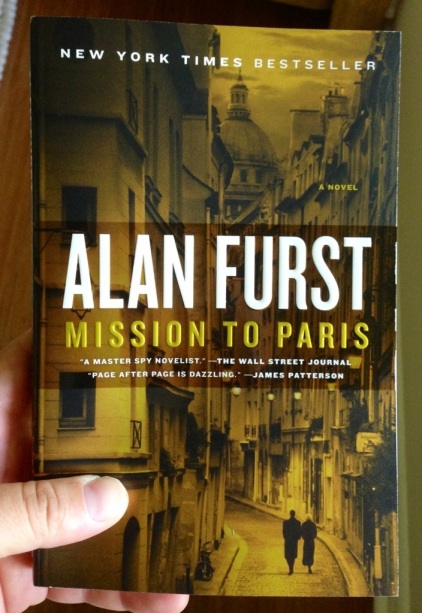
Alan Furst Novel (Book Acquired, 5.22.2013)

20130523-101727.jpg

Alan Furst’s Mission to Paris is new in trade paperback this month. Publisher Random House’s blurb:

Late summer, 1938. Hollywood film star Fredric Stahl is on his way to Paris to make a movie. The Nazis know he’s coming—a secret bureau within the Reich has been waging political warfare against France, and for their purposes, Fredric Stahl is a perfect agent of influence. What they don’t know is that Stahl, horrified by the Nazi war on Jews and intellectuals, has become part of an informal spy service run out of the American embassy. Mission to Paris is filled with heart-stopping tension, beautifully drawn scenes of romance, and extraordinarily alive characters: foreign assassins; a glamorous Russian actress-turned-spy; and the women in Stahl’s life. At the center of the novel is the city of Paris—its bistros, hotels grand and anonymous, and the Parisians, living every night as though it were their last. Alan Furst brings to life both a dark time in history and the passion of the human hearts that fought to survive it.


A Short Bright Flash (Book Acquired, 5.15.2013)

20130521-093914.jpg

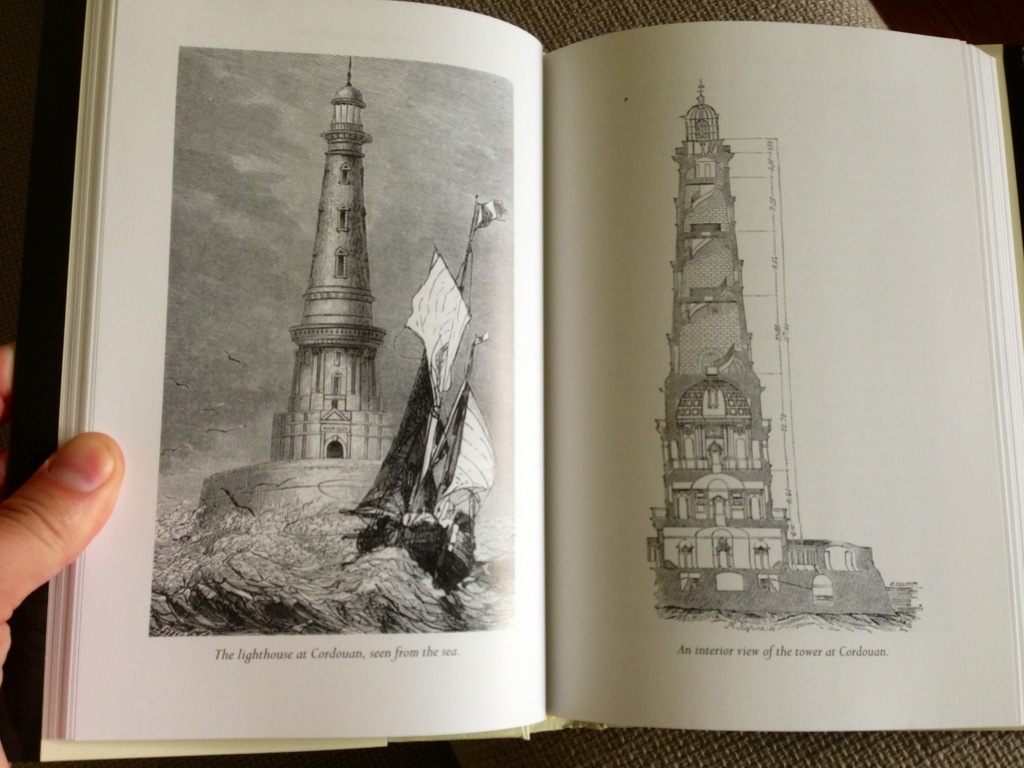
Theresa Levitt’s A Short Bright Flash, new in hardback from WW Norton, traces the story of scientist and engineer Augustin Fresnel, a major contributor to wave optics. Fresnel originated a lens that lighthouses adopted; the Fresnel lens is still used today.

Levitt’s book focuses on Fresnel’s mission to change some of the fundamental ways lighthouses operated and the legacy of the Fresnel lens. The book is handsome an illustrated in glorious black and white:

20130521-093919.jpg

Here’s the publisher’s blurb:

How a scientific outsider came up with a revolutionary theory of light and saved untold numbers of lives.

Augustin Fresnel (1788–1827) shocked the scientific elite with his unique understanding of the physics of light. The lens he invented was a brilliant feat of engineering that made lighthouses blaze many times brighter, farther, and more efficiently. Battling the establishment, his own poor health, and the limited technology of the time, Fresnel was able to achieve his goal of illuminating the entire French coast. At first, the British sought to outdo the new Fresnel-equipped lighthouses as a matter of national pride. Americans, too, resisted abandoning their primitive lamps, but the superiority of the Fresnel lens could not be denied for long. Soon, from Dunkirk to Saigon, shores were brightened with it.  The Fresnel legacy played an important role in geopolitical events, including the American Civil War. No sooner were Fresnel lenses finally installed along U.S. shores than they were drafted: the Union blockaded the Confederate coast; the Confederacy set about thwarting it by dismantling and hiding or destroying the powerful new lights.

Levitt’s scientific and historical account, rich in anecdote and personality, brings to life the fascinating untold story of Augustin Fresnel and his powerful invention.

20130521-093925.jpg


Patricio Pron Novel (Book Acquired, 5.08.2013)

pron

I got a review copy of My Father’s Ghost Is Climbing in the Rain, the first novel from Patricio Pron a few days ago and wandered into it a bit yesterday afternoon but then got distracted by something else. Anybody read this one—or anything by Pron? Curious what you think…

From a Granta interview:

Name the five writers you most admire at the moment (any period, language or genre).

David Foster Wallace, Vladimir Nabokov, Flannery O’Connor, W. G. Sebald, Roberto Bolaño.

Here is publisher Knopf’s blurb for My Father’s Ghost Is Climbing in the Rain:

The anticipated American debut of one of Granta’s Best Young Spanish-Language Novelists: a daring, deeply affecting novel about the secrets buried in the past of an Argentine family.

A young writer, living abroad, makes the journey home to South America to say good-bye to his dying father. In his parents’ house, he finds a cache of documents—articles, maps, photographs—and unwittingly begins to unearth his father’s obsession with the disappearance of a local man. Suddenly he comes face-to-face with the ghosts of Argentina’s dark political past and with the long-hidden memories of his family’s underground resistance against an oppressive military regime. As the fragments of the narrator’s investigation fall into place—revealing not only a part of his father’s life he had tried to forget but also the legacy of an entire generation—this audacious novel tells a completely original story of corruption and responsibility, history and remembrance.

You can also read “Ideas,” a story by Pron published in The Paris Review, which I think is an excerpt from the book. First paragraph:

On April 16, 1981, at approximately three P.M., little Peter Möhlendorf, whom everyone called der schwarze Peter, “black Peter,” went home from the village school. His house was on the eastern edge of Sterberode, a town of some five thousand inhabitants outside the East German town of Magdeburg whose main economic activity is farming—asparagus, mostly. His father, who was in the basement of the house when little Möhlendorf arrived, would later say that he heard him come in and then could infer from the sounds in the kitchen, which was above the basement, what he was doing: he flung his backpack beneath the staircase landing, went to the kitchen, took a carton of milk out of the refrigerator, and poured himself a glass, which he drank standing; then he put the carton back in the refrigerator and went out into the backyard. Anyway, that was what he did every day when he came home from school and it could be that his father hadn’t really heard the noises he later would say he heard but rather had heard Peter come home and from that had guessed the rest of the series of actions. However, what his father did not know, as he listened or thought he listened to the noises his son was making above his head, was that little Peter was not going to return home that night or the nights that would follow, and that something incomprehensible and frightening was going to open up before him and the rest of the townspeople, and it would swallow everything up.

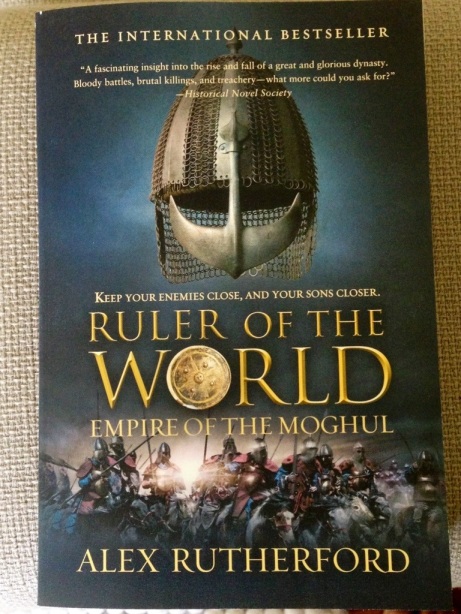
Ruler of the World (Book Acquired, 5.06.2013)

20130506-191048.jpg

Ruler of the World by Alex Rutherford. Pub’s copy:

Alex Rutherford’s internationally bestselling series continues with Ruler of the World, the story of the third great Moghul Emperor, Akbar, leader of a triumphant dynasty which contained the seeds of its own destruction.

Akbar, ruler of a sixth of the world’s people, colossally rich and utterly ruthless, was a contemporary of Elizabeth I, but infinitely more powerful. He extended his empire over much of Asia, skillfully commanding tens of thousands of men, elephants and innovative technology, yet despite the unimaginable bloodshed which resulted his rule was based on universal religious tolerance.

However, Akbar’s homelife was more complicated. He defied family, nobles and mullahs to marry a beautiful Rajput princess, whose people he had conquered; but she hated Akbar and turned Salim, his eldest son, against him. What’s more, as any Moghul prince could inherit his father’s crown and become Emperor, his sons were brought up to be intensely competitive and suspicious of each other: to see each other as rivals for the greatest prize of all. And, as Salim grew to manhood, the relationship between father and son became tainted by rebellion and competition to be the greatest Moghul of them all.


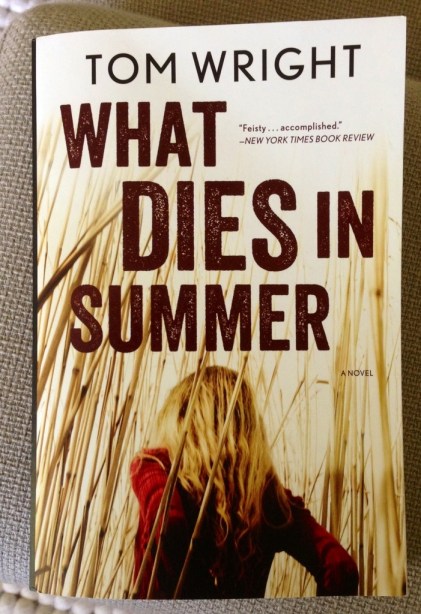
What Dies in Summer (Book Acquired, 5.02.2013)

20130505-185201.jpg

Tom Wright’s What Dies in Summer is new in trade paperback. Pub’s blurb:

A riveting Southern Gothic coming-of-age debut by major new talent.

“I did what I did, and that’s on me.” From that tantalizing first sentence, Tom Wright sweeps us up in a tale of lost innocence. Jim has a touch of the Sight. It’s nothing too spooky and generally useless, at least until the summer his cousin L.A. moves in with him and their grandmother. When Jim and L.A. discover the body of a girl, brutally raped and murdered in a field, an investigation begins that will put both their lives in danger. In the spirit of The Lovely Bones and The Little Friend, What Dies in Summer is a novel that casts its spell on the very first page and leaves an indelible mark.

And the lede from Julie Myerson’s review last year in the NYT:

Why do teenagers make such ideal protagonists? Maybe it’s because they’re doing just what novels do: struggling to make sense of a troubling and imperfect world. And at first, Jim, called Biscuit, and L. A. (Lee Ann), the teenage cousins at the heart of Tom Wright’s feisty first novel, are ­exactly what you hope they’ll be: funny, frank, mouthy and more than a touch off kilter. Both are forced to live with their grandmother because their mothers aren’t up to the task of child rearing. Their homes are haunted by alcoholism and violence, but Gram takes a simple, affectionate, responsibility for them — though it’s almost inevitable that certain questions, if not the answers, will push their ugly way to the surface sooner or later.