Have a weird Xmas (Blog about books acquired in Dec. 2023)

Maybe an hour ago, browsing in a used bookstore, I opened a worn and some might say dirty copy of Iain Banks’s 1985 novel Walking on Glass. The very first page of this old book was inscribed with the following:

Have a weird Xmas ’90

                 John

This copy of Iain Banks’s 1985 novel Walking on Glass—a 1990 Abacus trade paperback printed in London, the embossing on its cover yellowed by wear on its cover and back near its spine—this particular copy was addressed to no named person, its inscription signed by a name so anonymous we apply it to unidentified cadavers and prostitute clients.

I take myself to be the unidentified person being addressed by the identified generic John, wishing me weird wellness, a ghost of Xmas past.

Earlier this year I made the tragic mistake of not pulling the trigger on first-edition hardbacks of Banks’s first two novels, The Wasp Factory and Walking on Glass. I hadn’t read Banks at that point, and my familiarity with his work came almost entirely of his proximity to the J.G. Ballard titles I routinely perused. I ended up reading and loving The Wasp Factory this summer (reviewed it here), and the blurb on the back of Walking on Glass promising further perversions intrigues me too, of course.

Today, I also came across a first-edition, first-U.S.-printing of Roberto Bolaño’s opus 2666It was marked at a third of the original cover price and has never been read. I could not leave it behind.

I actually traded some books in today, including my trade paperback of Alasdair Gray’s Poor Things. I had recently reread the novel in anticipation of Yorgos Lanthimos’ film adaptation, and, during that reread, oddly came across an inexpensive pristine first edition of the novel while browsing for something else. Maybe a week or two after finding that hardback of Poor Things, I found a hardback first edition of Gray’s 1990 novel Something Leather. Unlike Poor Things, which features lots of art and typographic adventures, Something Leather is pretty standard (apart from a few chapter heading illustrations)—but it does have a lovely cover under its cover:

Maybe a week after that, I was browsing with my son, who wanted a collection of Harlan Ellison short stories. I was shocked that we couldn’t find any—I had given away two mass market collections to some students maybe seven or eight years ago in a purge. Apparently a lot of it is out of print, but a “greatest hits” collection is coming out this spring. Anyway, I ended up finding hardback editions of Robert Coover’s Whatever Happened to Gloomy Gus of the Chicago Bears? Denis Johnson’s novel Fiskadaro. 

The Johnson is a British edition, Chatto & Windus, and while it’s hardly my favorite novel by him, I found its form too attractive to pass (and it was, like, cheaper than a beer in the same bookstore). I also picked up a book by Lewis Nordan, a slim collection of short stories called Welcome to the Arrow-Catcher Fair. I picked it up because I love those horrid lovely wonderful gross stylish Vintage Contemporaries editions, and then acquired it based on the blurb, which compared it to Flannery O’Connor, Ellen Gilchrist, and Harry Crews. Here it is next to my Vintage Contemporaries copy of Denis Johnson’ Fiskadaro:

I hope you have a weird Xmas. And I hope that John, wherever they are, has a weird Xmas too.

Books acquired, 13 Oct. 2023

I couldn’t pass on a used copy of the second edition of Steven Weisenburger’s A Gravity’s Rainbow Companion even though it ate up most of my trade credit. I used the first edition of the Companion when I reread Gravity’s Rainbow about eight years ago and then gave it to a friend I had been encouraging to read GR. He still hasn’t read it.

I also picked up a hardcover first edition of Cormac McCarthy’s The Road and a pristine 1946 hardback edition of Joyce’s Ulysses. I’ll probably trade in the Gabler edition of Ulysses I have, but I think I’m too sentimental to let go of the copy of The Road I read in the hospital over a few days when my daughter was born.

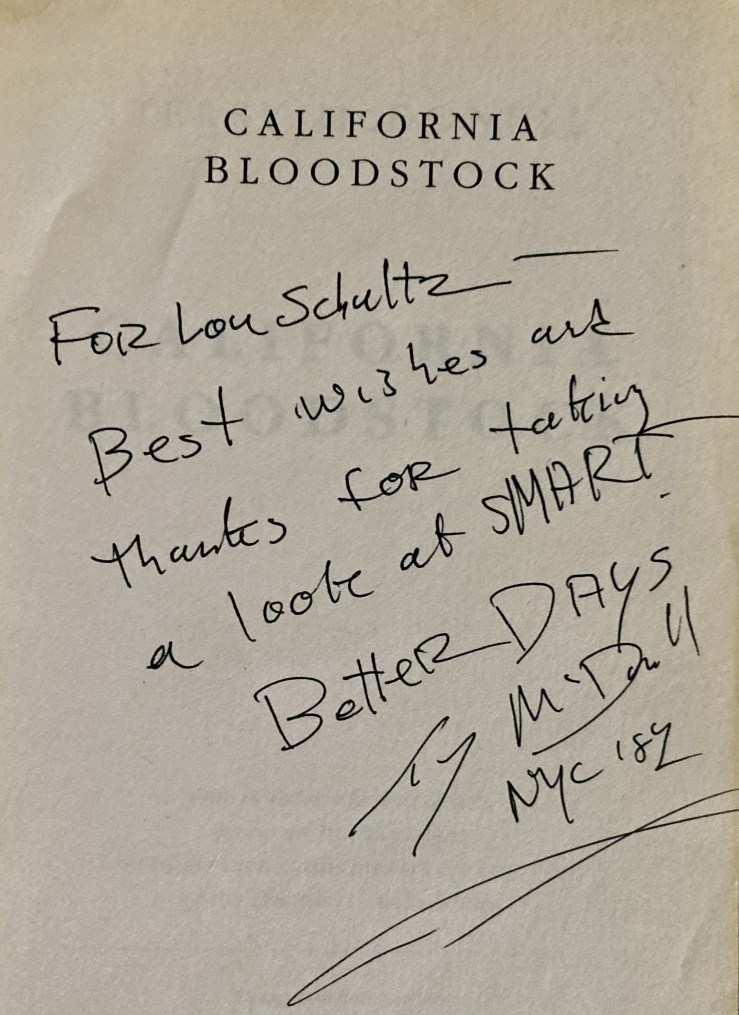
I’m a big fan of Vintage Contemporaries, but I’d never seen Terry McDonell’s California Bloodstock. I pulled it out because of its spine, and found the cover intriguing–it reminded me of these weird paintings that hang in a decrepit hotel in St. Augustine Beach that we stay at for a few nights every year. The blurb from H.S. Thompson didn’t hurt either.


I opened it to find that the novel is inscribed:

Anyone know Lou Schultz? Or what SMART might be?

Portis’s Gringos, Essays on Pynchon, Elkin’s End (Books acquired, 29 Sept. 2023)

So two of the three books I picked up today I’d read before, but I couldn’t pass on the editions.

I read Stanley Elkin’s The Living End last summer, checking a digital version out from the library. I wanted something very short and funny at the time, and it worked wonders. I couldn’t pass up this Warner Books edition with design by Gene Light featuring art by Don Ivan Punchatz. I have a few other Elkins in this series and I adore them, even if my eyes are fading to the point that mass market paperbacks cause me to squint.

I also picked up another book I’ve already read, a book I already own a copy of—Charles Portis’s last novel Gringos. But I didn’t own a first edition with this fun, silly cover.

On the last day of 2020, the year I read Gringos, I wrote:

Gringos was the last of Portis’s five novels. I read the other four greedily last year, and pulled them all out when he passed away in February. I started in on Gringos, casually, then just kept reading. Sweet and cynical, spiked with strange heroism, strange grace, and very, very funny, Gringos might just be my favorite Portis novel. But I’d have to read them all again to figure that out.

I also picked up Mindful Pleasures: Essays on Thomas Pynchon, a 1976 collection that seems ahead of its time. From Scott Sanders’ essay “Pynchon’s Paranoid History”:

Aira/Márquez/Moore (Books acquired, 18 Aug. 2023)

Last week I read a 1985 Washington Post profile of the American novelist William Gaddis. The profile, by Lloyd Grove, celebrated the publication of Gaddis’s third novel Carpenter’s Gothic. In the profile, Grove paraphrases literary critic Frederick Karl’s 1985 essay “The Mega-Novel” in the following way:

Karl argues that unlike “categories of Jewish novelists, gays, Black writers [and] female authors” who address special interests, “these white Protestant males [Gaddis, Pynchon, John Barth et al.] write very close to what America is,” having “sensed the country as a whole.”

I tracked down and read Karl’s essay “The Mega-Novel”; it is, almost entirely, a sustained argument for the kind of giant-assed so-called “experimental” novels typical of the bracketed Gaddis, Pynchon, and Barth above. And yet Karl seems to slide into and side with Harold Bloom in that old man’s pompous war against the so-called “School of Resentment”; once in the quote above, and then a few pages later, when he chooses to claim that “The Mega-Novelists have avoided the individuation of ethnic, gay, female (or even strictly male) experience and sensed the country as a whole.” Yes—Grove weds this second line in Karl’s covert attack on the “School of Resentment,” this maddening and dismissive “country as a whole” bit to the previous language. The effect is so odd, as if Grove has purposefully ignored every other bit of Karl’s essay and cherry-picked the lines that valorize the Real American Viewpoint™ as White Protestant Straight and Male.

Karl’s essay is, apart from these unnecessary declarations, really quite good—he champions Gaddis’s J R and Joseph McElroy’s Lookout Cartridge in particular. And yet I found myself troubled by his claim that it is the dead white guys who write very close to what America is because they sense the country as a whole, in a way that somehow, like, I guess Ishmael Reed or Fran Ross or Toni Morrison or etc. just can’t. And because I’m so simpatico with Karl’s general idea in “The Mega-Novel,” I found myself looking for his 1983 book American Fictions 1940-1980 : A Comprehensive History and Critical Evaluation.

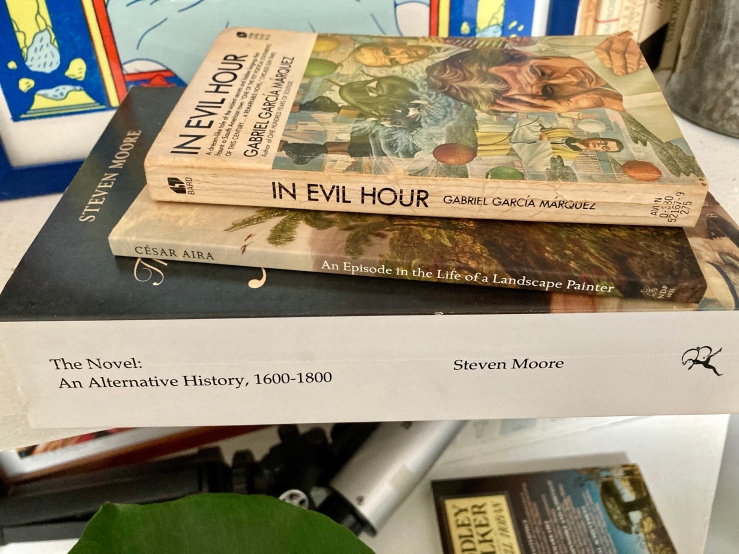
While I didn’t find it in the literary criticism section of my beloved used bookmine, I did find the second volume of Gaddis-scholar Steven Moore’s The Novel, covering 1600-1800.

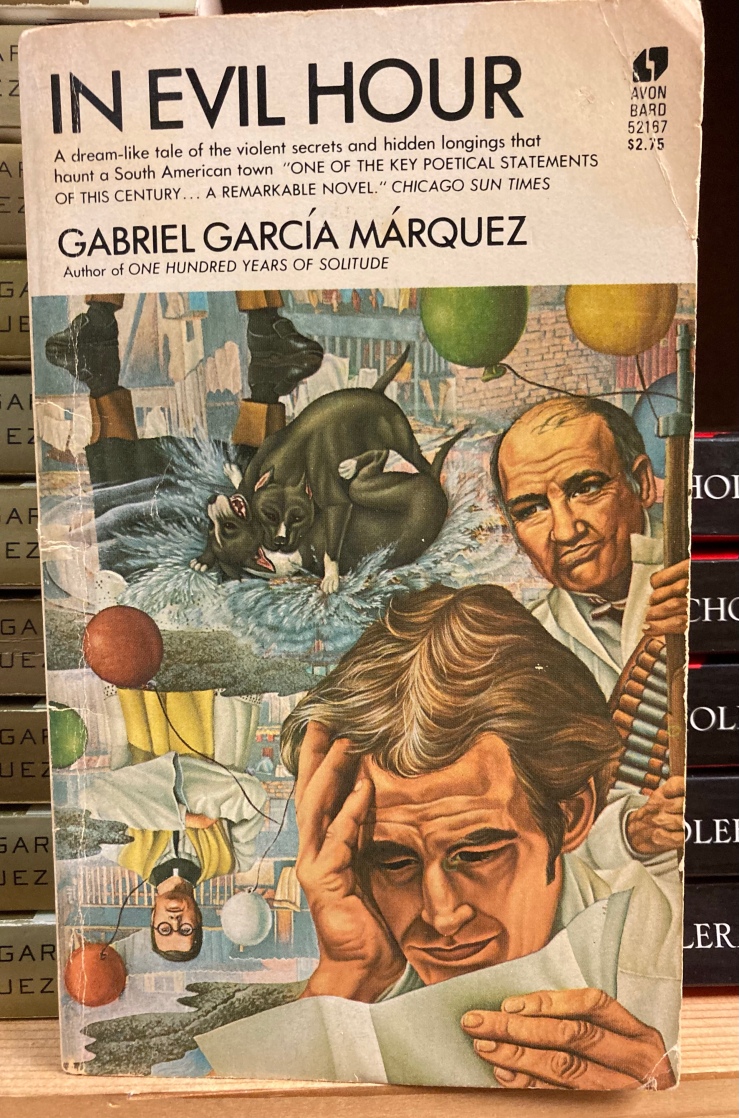
I also picked up César Aira’s An Episode in the Life of a Landscape Painter (in translation by Chris Andrews) and Gabriel García Márquez’s In Evil Hour (in translation by Gregory Rabassa). The latter is another title in Avon/Bard’s Latin American authors series, and I can’t resist them.


The next day, yesterday, Saturday, I participated in an online discussion about the literature of William Gaddis on non-academic forums. (I represented Ye Olde Bloggers, and I will share more about the forum some time in the future.) Early in our forum, one of the participants, the author Jeff Bursey, raised a copy of Frederick Karl’s American Fictions 1940-1980 in front of his webcam. I believe he declared it one of the first places he’d heard of Gaddis, although I could be misremembering. It seemed like a serendipitous moment. I hope to muster more words on most of this later.

Cortazar/Crowley/Ford (Books acquired, 27 July 2023)

I went to the bookstore today looking for a copy of Katherine Burdekin’s dystopian 1937 novel Swastika Night. I was unsuccessful there, but while browsing the scifi and fantasy section, I came across three books that I couldn’t resist.

The first was an unread hardcover first edition of John M. Ford’s 1983 novel The Dragon Waiting. This book was only on my radar because Slate republished a 2019 article on Ford by Isaac Butler and a friend sent me the link (his message was simply “?”). From Butler’s article:

The Dragon Waiting is an unfolding cabinet of wonders. Over a decade before George R.R. Martin wrote A Song of Ice and Fire, Ford created an alternate-history retelling of the Wars of the Roses, filled with palace intrigue, dark magic, and more Shakespeare references than are dreamt of in our philosophy. The Dragon Waiting provokes that rare thrill that one gets from the work of Gene Wolfe, or John Crowley, or Ursula Le Guin. A dazzling intellect ensorcells the reader, entertaining with one hand, opening new doors with another.

Wolfe blurbed the back cover of the copy I bought, by the way.

Maybe Crowley was in my subconscious too; while searching for Swastika Night under the Cs (it was first published under the pseudonym “Murray Constantine”), I came across a cheap hardcover copy of Crowley’s 1976 novel Beasts. I’d read Little, Big years ago, enjoyed it, but gone no further. (There were no copies of Little, Big in Crowley’s placarded section, all though I did find three copies in the “General Fiction” section, away from the beautiful weird scifi fantasy ghetto.)

I’ve long been a sucker for the mass market Avon Bard Latin American writers series, so I couldn’t pass up the copy of Julio Cortazar’s Hopscotch (translated by Gregory Rabassa). It sat upon a miscellaneous, dusty stack of outcasts in the middle of the “D” aisle in the scifi fantasy ghetto, waiting for me.


Bunch’s Moderan/Ginzburg’s Dry Heart (Books acquired, 14 July 2023)

Picked up two on Friday—

I’ve been wanting to read Natalia Ginzburg for a while, and when I saw a used copy of her novella The Dry Heart (translated by Frances Frenaye), it seemed like a good entry point. It was really the description on the back that grabbed me:

The Dry Heart begins and ends with the matter-of-fact pronouncement: “I shot him between the eyes.” As the tale—a plunge into the chilly waters of loneliness, desperation, and bitterness—proceeds, the narrator’s murder of her flighty husband takes on a certain logical inevitability. Stripped of any preciousness or sentimentality, Natalia Ginzburg’s writing here is white-hot, tempered by rage. She transforms the unhappy tale of an ordinary dull marriage into a rich psychological thriller that seems to beg the question: why don’t more wives kill their husbands?

I read NYRB’s collected Moderan a few years ago, but I couldn’t pass up this Avon Bard mass market paperback.

Opening track:

“THINKING BACK (OUR GOD IS A HELPING GOD!)”

by

David R. Bunch


FLESH seemed doomed that year; death’s harpies were riding down. The once-beautiful, sweet and life-sustaining air was tinged with poison now, and man drank at his peril from the streams that had once been pure. He prayed to a God that was said to be in all things good, true and beautiful, but especially was thought to be all sternness and goodness, justice and loving-care, in some milk-white place far away, “On High.” And those prayers if answered were answered very obliquely indeed. For the air got deeper in poison from the tinkering with lethal things the flesh-man indulged in when not praying, and the water got fuller with danger as each new explosion pounded the bomb-fevered air. There was talk of the End; great discussions were handled in great halls across the land. Treaties were signed among statesmen to help the air get better, to allow the streams to recover and run pure once again. But even as the flesh-hands grasped the pens to scrawl the marks of good faith in some countries, fear lashed at capitals in other countries. Arsenals were tested anew. Things done were undone. The air got sicker; the streams ran not pure but pure danger—There seemed no chance for flesh-man, and his God seemed entirely silent wherever He was, wherever His white throne was. The HOPELESS signs were out everywhere. Little children asked that they be allowed to go quickly and not grow up hurting and maimed. Adults in what should have been the full flower of brave manhood and fair womanhood quaked, looked heavenward for some hopeful sign and, finding none, fell down and cried bitterly. The aged ones, quavering and whining now, finally decided that yes, truly they were most glad that they were so very old. The flesh billions courted at the Palace of Danger so ardently had turned against them and the mass wedding of Death and Destruction seemed now all but assured.

And then—and then this chance! Offered to all. It came first as small hope, the rumor of it, a faint faint breath of a chance seeping through the flesh-fouled metropolises. And then it was confirmed as glowing fact when the tour went round that year, year of the Greatest Darkness. And yet—and yet they scoffed, scoffed by the billions at this man working his hinges and braces, would not believe his heart was an ever-last one, had no credulity for his new wonderful lungs that could breathe him a forever-life even in bomb-tainted air. When they saw that his hands were steel they yelled robot! robot! When they saw that his eyes were wide-range, mechanism-helped, and that he’d a phfluggee-phflaggee button on his talker that he pressed from time to time to aid in his speech expression they laughed and yelled . . . Continue reading “Bunch’s Moderan/Ginzburg’s Dry Heart (Books acquired, 14 July 2023)”

Jim Dodge/Steve Erickson (Books acquired, 22 June 2023)

I picked up my daughter’s assigned summer reading today — Steven King’s On Writing and Strunk & White’s The Elements of Style. It’s not exactly clear to me if she’s supposed to, like, read, the Strunk & White, although I recall actually reading it when I was around her age, but I also enjoyed reading the thesaurus. The bookstore had a used copy of Penguin’s hardback edition with illustrations by Maira Kalman for only a few bucks more than the cheap paperback copies, so I got it for my daughter. I have the same edition at my office.

wcs

I finally found a copy of Jim Dodge’s 1990 novel Stone Junction. I’d been looking casually looking for it for a few years now, and was pleased to find it in a Canon edition (although the big sticker over the tarot card on the cover is kinda bewildering). If you’re interested in Pynchon’s intro you can read it here. There’s an excerpt from the beginning of the novel here.

I didn’t really mean to pick up Steve Erickson’s third novel, Tours of the Black Clock (1989) but then I did. I mean I went to the Erickson books, picked this one out, started to read the back cover, read the sentence “Cutting a terrifying path from a Pennsylvania farm to the Europe of the 1930s, Banning Jainlight becomes the private pornographer of the world’s most evil man,” and decided I wanted to read it.” I finished Erickson’s second novel, Rubicon Beach (1986) a few days ago and his first, Days Between Stations (1985) a few weeks ago and I guess I want more of that particular flavor.

Three books (Books acquired, 8 June 2023)

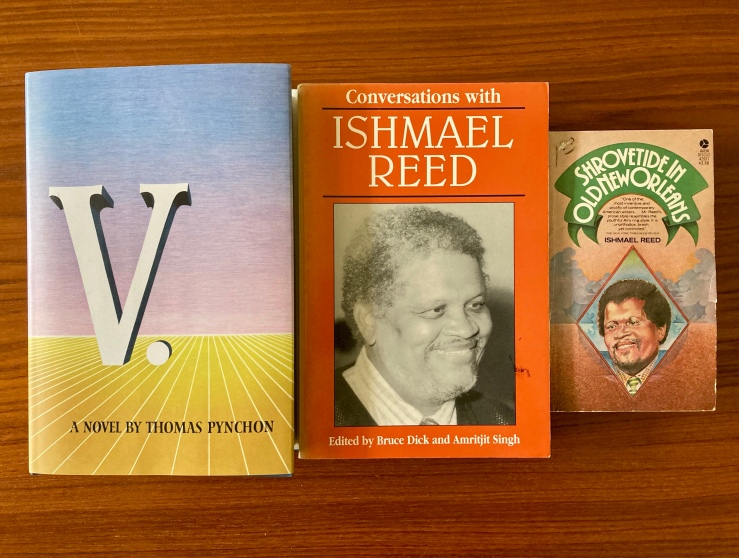
I got a facsimile hardback sixtieth anniversary edition of Thomas Pynchon’s novel V. for my birthday. I also picked up two Ishmael Reed books: Conversations with Ishmael Reed and an Avon Bard edition of Shrovetide in Old New Orleans. Before I even physically picked up these last two, I knew that they formerly belonged to a guy from Perry, Florida and that a stamp with his name and address would be on the inside of the cover or first page. I was correct in this intimation. I now have probably thirty to forty books once owned by this person. I wrote about some Reeds, formerly his, here.

Maybe I should compare my shelf with the checklist he made in the inside cover of Conversations with Ishmael Reed—


Books acquired, 26 May 2023

I brought a box of old books to my spot; I did not intend to pick up any books but then I picked up six:

I’d been looking for a handsome and/or cheap copy of Aldous Huxley’s The Devils of Loudon for a few years ago; success.

I posted something on Twitter a few days ago about how much I’ve been enjoying Steve Erickson’s Days Between Stations; one of the replies put James Crumley in his company (along with McCarthy and Joy Williams), so I picked up Dancing Bear and The Last Good Kiss:

I’ve long loved Peter Mendelsund’s cover designs, so I didn’t pass up on a used copy of What We See When We Read. It has a lot of pictures and diagrams and such.

I saw a very interesting looking person reading an actor’s edition of Philip Ridley’s play Mercury Fur on the train a few weeks ago. I had never heard of the play, but looked it up, thought it sounded pretty cool, and then looked for it in the drama section of this same book store the last time I was there. I didn’t find it. I found it yesterday mixed in with the novels. (I wasn’t actually looking for it.)

I don’t own physical copies of The Last Novel and Vanishing Point, two of the three novels collected in David Markson’s This Is Not a Novel and Other Novels, so I couldn’t pass on this omnibus. I do own a copy of Reader’s Block, which is not collected in This Is Not a Novel and Other Novels.

Mystery box (Books acquired, 17 May 2023)

One of my oldest friends (by which I mean friend I’ve had for a long time, not, like, old, although we’re both getting up there, although by no means old, but I suppose certainly definitely no longer youngmiddleaged, I guess, although when we were young we would have thought ourselves now (middleaged) old)

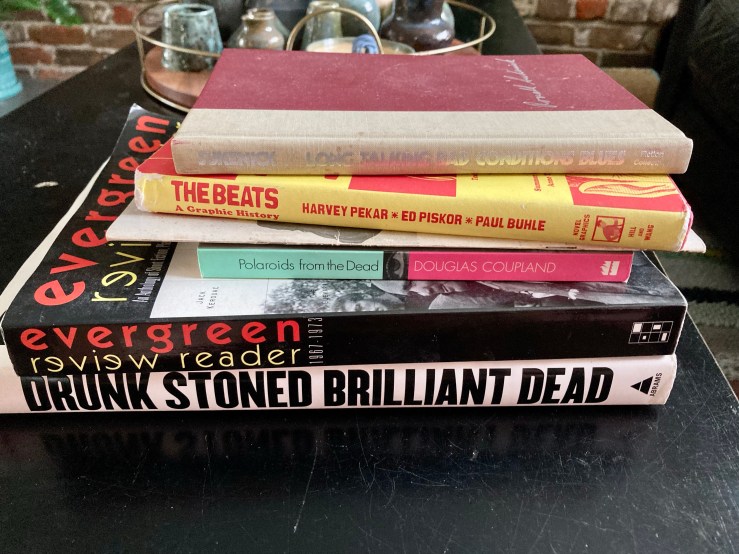
—one of my oldest friends Patrick sent me a mystery box of books earlier this week. Highlights include The Evergreen Review Reader (begins with William S. Burroughs and ends with Kathy Acker, two writers Patrick introduced me to way back in seventh or eighth grade), a graphic history of the Beats by Harvey Pekar et al, and a signed copy of Ronald Sukenick’s Long Talking Bad Condition Blues. Thanks PT!

Books acquired (First week of May, 2023)

My wife and I spent a lovely few days in Sunny Manhattan last week in celebration of a recent anniversary. We stayed in the venerable Hotel Chelsea, where we were lucky enough to get a brief visit to room 629, the former residence of the artist Vali Myers. The current resident, photographer Tony Notarberardino was hosting a party later, and the theatrical currents outside of his door, accompanied by ethereal music, attracted us to peer in as we were looking around the hotel. Tony graciously invited us for a brief peek before his party, and the rooms are simply otherworldy, covered in murals by Myers along with beautiful paintings, furniture, and other sundries. Among other books, he recommended Sherill Tippins’ history of the hotel, Inside the Dream Palace. The short tour was a highlight of our visit.

I wasn’t able to find Tippins’ book at any of the four bookstores I visited in NYC, but I found it at my trusty enormous used bookstore when I got home. I’m enjoying it very much so far—it’s really almost like a history of 20th c. modernism focused around one locale. I’m not quite halfway through, around the early 1960s, in a chapter focusing on Harry Smith (he of the Anthology of American Folk Music, and many other things), who was a one-time resident of the Chelsea.

Admittedly, I didn’t scour the history books at The Strand’s main store too closely, spending most of my time browsing fiction. I ended up with László Krasznahorkai’s Spadework for a Palace (trans. by John Batki) and a hardback copy of Joy Williams’ HarrowHarrow was one of my favorite books of last year. I listened to the audiobook twice and have had an eye out for a physical copy since then. Something I wrote on it in a 2022 round up:

Williams takes the “post-apocalyptic” quite literally–Harrow is about post-revelation, an uncovering, a delayed judgment from an idiot savant. It’s one of those books you immediately start again and see that what appeared to be baggy riffing was knotting so tight you couldn’t recognize it the first time through — the appropriate style for a novel that dramatizes Nietzsche’s eternal return as a mediation of preapocalyptic consciousness in a post-apocalyptic world.

Ballard/Colquhoun/Gray (Books acquired, 28 April 2023)

After an early spring purge n’ clean, I took a few boxes of books to my local used bookstore. I had intended to browse just a bit and not pick up anything (apart from a few Jeff VanderMeer novels my son had asked for), but I wound up getting three books: a pristine first U.S. edition of J.G. Ballard’s The Unlimited Dream Company, Alasdair Gray’s Unlikely Stories, Mostly, and surrealist artist Ithell Colquhoun’s ostensible biography of the occultist Samuel Liddell MacGregor Mathers (of the Golden Dawn).

I had never heard of Colquhoun’s book, but I’m a fan of her paintings and the cover struck me. The book seems to be a history of the occult organization the Golden Dawn, or, more to the point, the roots of that organization. It’s filled with photographs and diagrams and charts. Like this one:

Alasdair Gray’s collection Unlikely Stories, Mostly is also crammed with illustrations—Gray’s own, like this one:

Like Gray’s 1984 novel 1982, Janine, the collection is filled with typographic experiments, a kind of concrete poetry in prose I guess. The “About the Author” blurb on the flap is great stuff (still can’t top the blurb for 1982, Janine though):

Under the Volcano and elsewhere (Books acquired, week of 10 March 2023)

My family and I had a wonderful time vacationing in Mexico City last week. We rented an apartment in Condesa, a friendly, walkable neighborhood marked by shade trees, lush gardens, and robust parks. And dogs. Lots of lovely dogs. Over eight days, we took in as much of the city as we could (as well as some excellent day trips to Grutas Tolantongo in Hidalgo and Teotihuacán in Edomex). The city is huge, with more than 150 museums, and the food is excellent. While the four members of our family share common interests (including a love of art), making sightseeing somewhat streamlined, I left Mexico City feeling like I had barely scratched the surface. It reminded me in disparate ways of New York City, Bangkok, and New Orleans. Like those cities, there’s not a single aspect that intrigues me, but rather a vibe. But this is not a travel blog, it is a book blog, so:

The first thing I noticed is that the selection of titles in the several bookstores I visited (a few just very briefly) was generally excellent. Shops tended to feature big-ell Literature titles in lieu of bestsellers and airport novels, with new releases like Mircea Cartarescu’s Solenoid and Yuri Herrera’s La estación del pantano getting prominent displays.

I visited both locations of Cafebrería El Péndulo, and picked up an inexpensive Debolsillo edition of Roberto Bolaño’s La literatura nazi en America, resisting the urge to grab one of the big novels. I’ve read Chris Andrews’ translation of Nazi Literature in the Americas a few times, and I figured that it would be better for me to attempt reading and comparing the shorter sketches here than to jump into 2666 in Spanish. Although I practiced my Spanish for a year in preparation for the trip (it helps to have a Spanish professor friend whose office is down the hall from mine), my vocabulary is still limited and my conjugations are a mess.
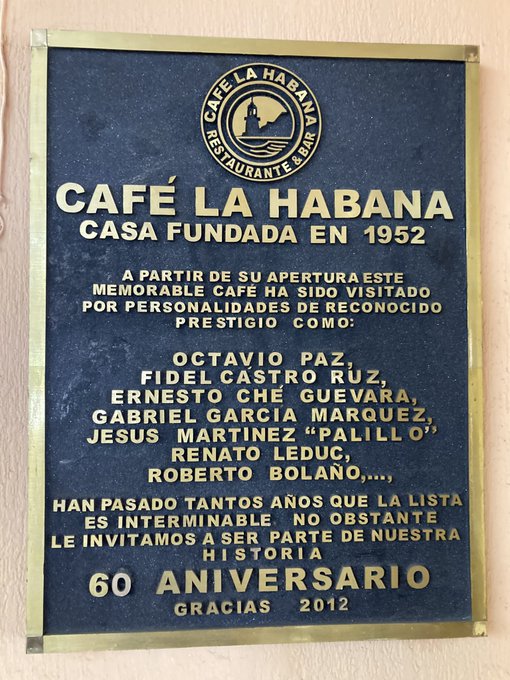
Also Bolaño-related: We lunched at Café la Habana, a charming restaurant boasting a history as a salon for poets, politicians, theorists and other bullshitters. In Bolaño’s Mexican opus The Savage Detectives, Café la Habana appears as Café Quito.

I also visited Under the Volcano, a tiny and charming bookstore in Condesa that carries English-language books–mostly literature. The store is named for Malcolm Lowry’s excellent novel, but there didn’t appear to be any of his books there the day I visited. There was a first-edition hardback copy of Robert Coover’s Pricksongs and Descants, but it was jacketless and out of my price range. There was also a standalone magazine-sized Dalkey Archive edition of William H. Gass’s story Willie Master’s Lonesome Wife, which, based on its price, the owner seemed to believe the most valuable item in the store. I also spied a copy of Jay McInerney’s 1984 novel Ransom, notable because it’s the first and so-far only hardcover of a Vintage Contemporaries edition I’ve ever seen.
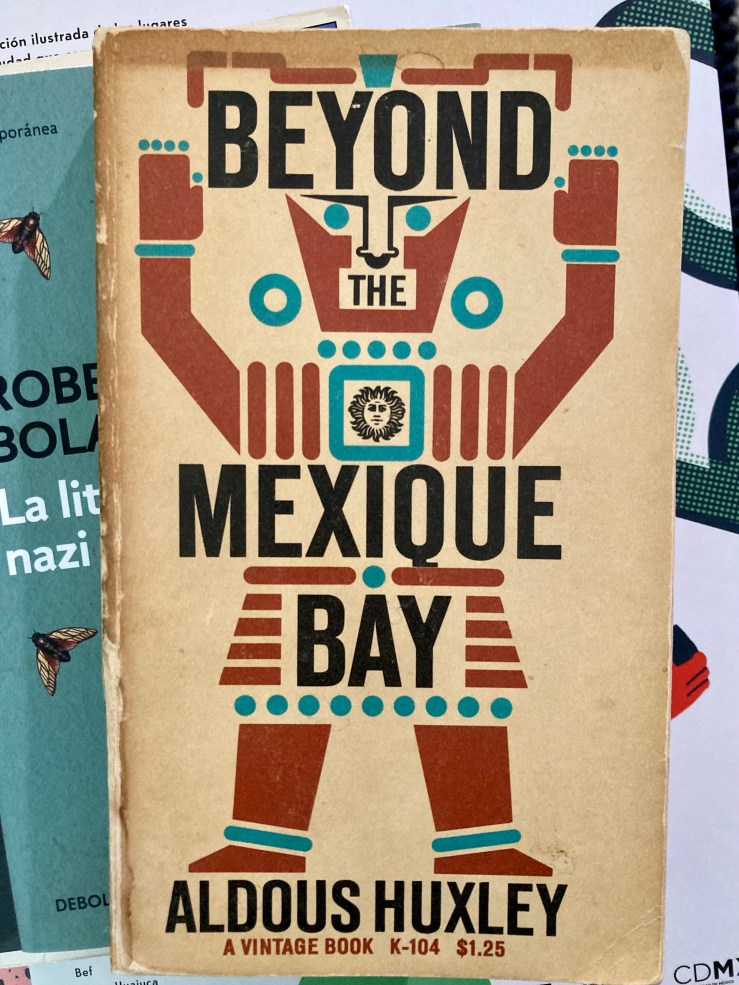
I wound up with two books from Under the Volcano: a Europa Editions of Steven Erickson’s Zeroville and Vintage edition of Aldous Huxley’s Beyond the Mexique Bay. I listened to the audiobook of Zeroville a few years ago, loved it, and have kept an eye out for a reasonably-priced copy ever since. I admit that I picked up Huxley’s essay collection in large part because of its title and its cover design (by Bradbury Thompson). I only found it because I was looking for a copy of Huxley’s The Devils of Loudun. I’ve been falling asleep to an audiobook version of Devils for about three weeks now.

I stopped into a La Increíble Librería at random while walking through Condesa. It’s a charming store that specializes in art books and arty children’s books. They also sell a small but excellent selection of Latin American titles in English translation. I picked up a coffee table book there called 50 íconos de la Ciudad de México. The book is in both Spanish and English, and features lovely illustrations of iconic Mexico City locations by ten different artists. Here’s a detail from Diego Huacuja’s illustration of the Auditorio Nacional:

As we looked through this book this morning, my wife remarked on just how few of the fifty icons presented we missed seeing on this trip. And although we saw a lot that’s not in the book, it nevertheless confirmed my feeling that we need to visit Mexico City again.

Blog about some weekend book browsing and book buying, other stuff

I took a box of books to trade in at my local used bookstore on Saturday. I was hoping to find a short history of Mexico City, or maybe some travel writing about Mexico City, but I didn’t find anything like that, although I rarely look through the history section or travel writing section when I browse there so was perhaps a bit overwhelmed. .

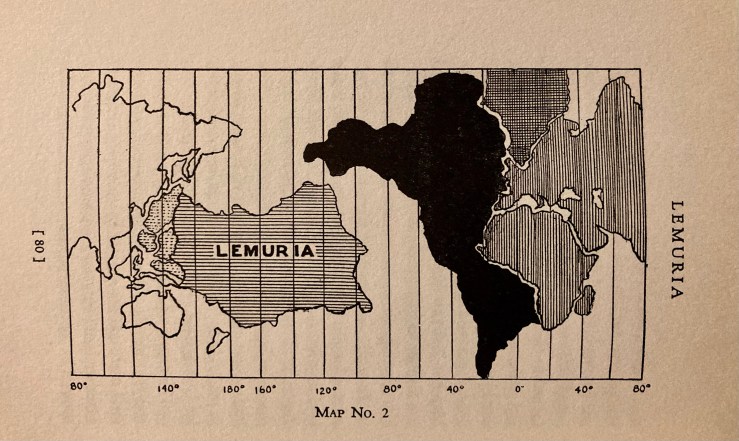
did come across a book published by something called Rosicrucian Press in the 1930s–W.S. Cerve’s Lemuria: The Lost Continent of the Pacific. Lost Lemuria hangs over a few Pynchon novels (and is touched on in Charles Portis masterful and zany Masters of Atlantis)—so of course I picked up Cerve’s book. Chapters include “The First Races of Man in America,” “Mysterious Forces in the Universe,” and “Present Day Mystic Lemurians in California.” There are also diagrams, charts, and maps, like this one:

This bookstore, Chamblin’s Bookmine, also featured a display of books removed from classrooms and school libraries in our city as a result of the current Florida Governor’s efforts to suppress critical thinking, whitewash American history, and generally turn Florida’s soul into a puddle of tepid piss. University of North Florida English Professor Laura Heffernan documented the display in the following tweet (notice a common thread?):

Today I stopped by Chamblin’s second, downtown location, Chamblin’s Uptown, mostly because I was dropping my daughter off at a birthday party about five minutes away. I go there only a few times a year, so it was nice to browse for a spare hour.

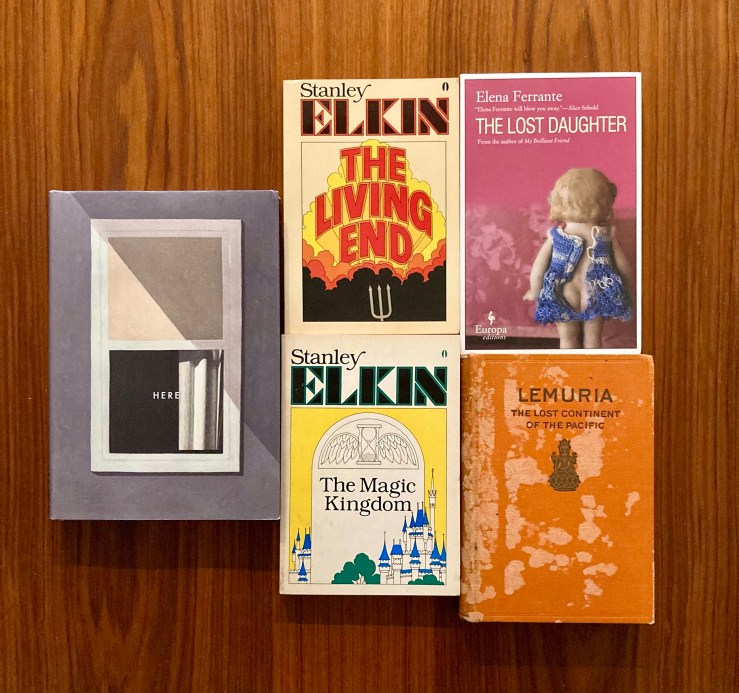
I snapped up two Stanley Elkins, The Magic Kingdon and The Living End, in Janet Halverson-designed editions that match my copy of Elkin’s The Dick Gibson Show. I listened to an audiobook of The Living End this summer and loved it–it made me want to get into more Elkin.

Going from the Es to the Fs, I spotted a nice used copy of Ann Goldstein’s translation of The Lost Daughter. I’ve been wanting to read it for a while, but picked it out for my wife to read first (I don’t think she really likes reading Valeria Luiselli’s Lost Children Archive, which I gave her a few weeks ago. And now that I type this out, I see that I may have picked a weird substitute).

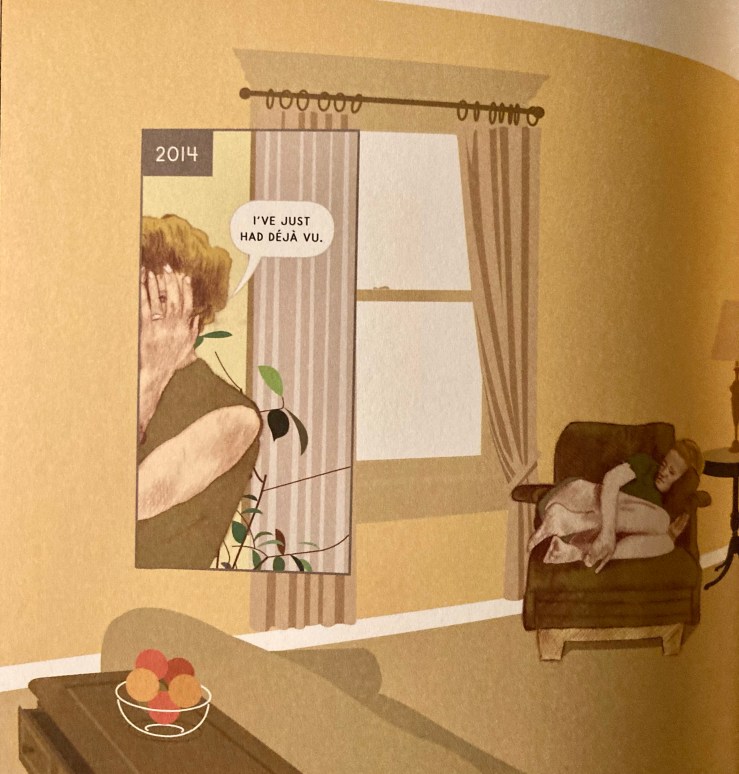
I also snagged a pristine used copy of Richard McGuire’s graphic novel Here. I checked it out from the library a few years ago when new copies seemed prohibitively expensive.

At the checkout I picked up a pamphlet describing strategies for undoing the book banning here in Jacksonville (and Florida in general). This whole fucking thing has had me so mad and sad, and I have friends who are checking out of Florida, but I feel like we shouldn’t have to cede territory to these dull monsters—and it feels good to see other people who feel the same.

A succinct summary from the pamphlet:


Four from Sublunary (Books acquired, 23 Dec. 2022)

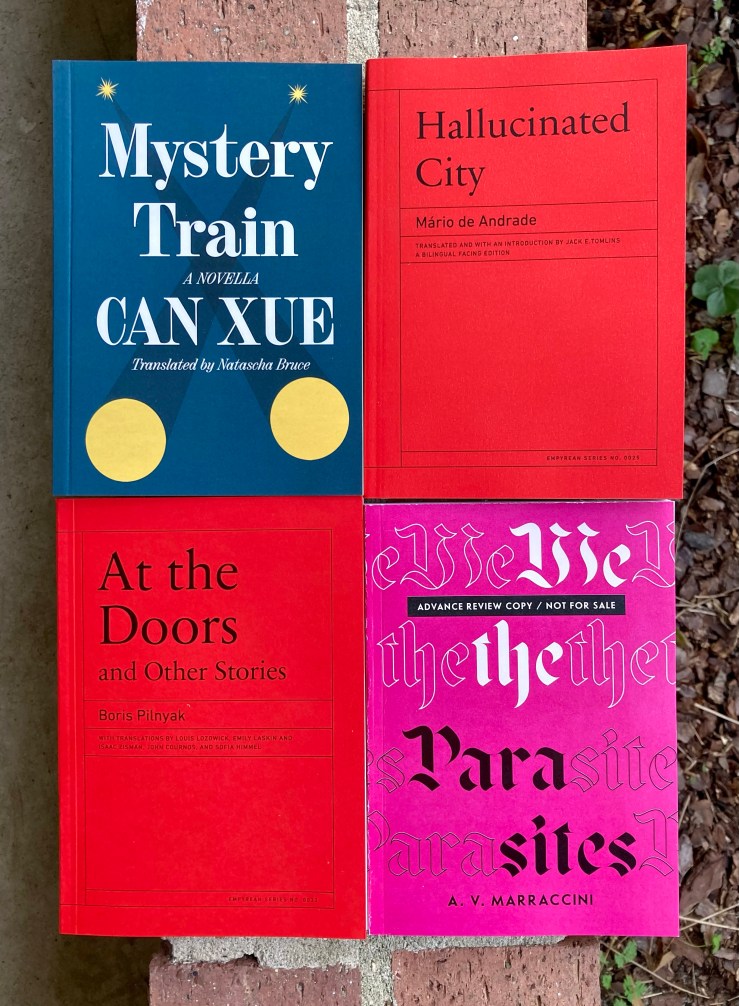
Four handsome fellas from Sublunary Editions.

I really enjoyed At the Doors and Other Stories by Boris Pilnyak (in translation by Emily Laskin, Isaac Zisman, Louis Lozowick, Sofia Himmel, and John Cournos). I dipped into the title story and just kept going. It reminded me a lot of “Mondaugen’s Story” in Pynchon’s V. While the other tales weren’t quite as strong, they were definitely weird. Great stuff.

I also read Mário de Andrade’s Hallucinated City (Jack E. Tomlins), and while these poems by the Brazilian modernist didn’t wholly zap me, there’s nonetheless a persuasive energy here.

Can Xue is maybe the “big name” in this fine little quadrant. Her novella Mystery Train is translated by Natascha Bruce, and it looks pretty fucked-up. Sublunary’s jacket copy:

A chicken-farm employee named Scratch, sent by his manager to buy feed, has boarded the right train. Hasn’t he? So what if the destination on the ticket is wrong, or if he’s locked in his compartment, or if the lights are off and it’s suddenly freezing cold? And surely the whispers of a pending accident are referring to some other event, long in the past. Right? Part allegory, part fever dream, Mystery Train leads the reader on an unsettling journey into a dark wilderness thick with intrigue, mysterious women… and wolves.

A. V. Marraccini’s We the Parasites also seems very promising. The jacket copy describes content—

Intertwining fig wasps, Updike, Genet, Twombly, Rilke, jewel heists, and a vividly rendered panoply of histories and myths from classical antiquity, it both tells a strange love story and makes a slantwise argument about reading with the body. We The Parasites reconfigures how longing changes and informs our relationship with art and literature, and asks what it means to want.

—but the small book’s rhetorical form seems even more intriguing.

Last Friday (Books acquired, 30 Dec. 2022)

I picked up first edition hardbacks of The Box Man by Kobo Abe and Fantômas by Marcel Allain and Pierre Souvestre today at the used bookstore I like to wander around every other Friday afternoon (or, if I’ve had a bad week, maybe every Friday afternoon, or even a Monday, or Thursday). I wasn’t really looking for anything in particular (okay, I was looking for a physical copy of Joy Williams’ novel Harrow) but I couldn’t resist these two hardbacks (the Abe ate up the rest of my trade credit).

The spine of Fantômas—the font, really—made me pull it down. The cover promised an intro by John Ashbery, and the dual-author thing intrigued me. I also dug the cover, which I didn’t immediately identify as a Fred Marcellino, although the jacket confirmed him as the designer. Unless I am missing it from the jacket or front matter, no translator is credited.

E. Dale Saunders is credited as the translator of Kobo Abe’s novel The Box Man — and not just on the back jacket flap of this 1974 Knopf edition (design by K.B. Hwang), but also on the cover (eh, K.B. Hwang again). From Jerome Charyn’s contemporary NYT review:

Abe’s book is a stunning addition to the literature of eccentricity, those bitter, crying voices of Melville’s Bartleby the scrivener and Dostoevsky’s underground man. It gnaws at the reader, forces him to question his values, his Shibboleths and his ritualistic props, and shoots an energetic poison into his ear. The Box Man is funny, sad and destructive, an ontological “thriller” that bumps into and contradicts its own clues.


Two signed William S. Burroughs novels (Books acquired, 15 Oct. 2022)

Huge huge huge thanks to my twitter friend Prabhakar Ragde for sending me his signed copies of two William S. Burroughs novels: Cities of the Red Night and Naked Lunch. Prabhakar is downsizing his book collection as he moves to Europe, abandoning, I guess, the totally-sane, rational heaven that is the U.S. of A.

Prabhakar got the volumes signed at a 1984 in-store appearance at Moe’s Books in Berkeley. (“He asked for my name, but I told him it was too hard to spell, so it’s just his signature,” Prabhakar told me.)

Thanks again, Prabhakar!