The Biblioklept Interview: Mathias Freese

Mathias Freese, author of Down to a Sunless Sea and The i Tetralogy, was kind enough to answer a few questions for us. This interview took place over the course of several emails.


Biblioklept: Have you ever stolen a book? If so, could you tell us a little bit about that?

Mathias Freese: No, I’ve never stolen a book.

B: Have you ever borrowed a book without returning it–purposefully or not?

MF: The amount of guilt for both of these questions, as a young boy, would be too much to bear; and then obsessing about it enters the picture and I’d end up in central casting auditioning for a role in The Possessed.

B: What are you currently reading?

MF: Dan Wakefield’s, New York in the Fifties. Living in Arizona, a geriatric Disneyland, I remember well Brooklyn – Brighton Beach, Manhattan Beach, and Coney Island. I grew up in the Fifties and Wakefield evokes the literary times very well – Ginsburg, Kerouac, Mailer – as well as the cultural sensibilities of the time. I was too young for all this but reading about it evokes Greenwich Village, egg creams, and a great bialy.

B: What are you writing right now?

MF: I am editing a novel, my first, written more than two decades ago. Sojourner is a philosophical tale dealing with the emigration of a young Chinese farmer to the Mountain of Gold (California) as it was called.

B: Sojourner sounds interesting. Is it research-based historical fiction? (Perhaps you hate to classify what you write into a specific genre, of course). Tell us more.

MF: Sojourner began as a 30 page short story in the years 1969 to 1972; I was working on a federal project dealing with racial-ethnic relations in the town of Freeport, on Long Island, NY. I had met a Chinese-American librarian who had written on the emigration to Gum Shan, Mountain of Gold. I researched only details that would be useful for verisimilitude, such as Gum Shan, and began a short story about the subject. The book ultimately reflects my own philosophical needs and emotional cravings for meaning. When submitted to publishers as a novel for young adults almost all of them wrote that I had made an error, and that this fiction was serious and for adults. Who knew? I do believe that the writer is the last to truly appreciate his work. The i Tetralogy which began in 1996, is a more thoroughly researched book , and it is a historical fiction on the Holocaust based on my experiences as an American Jew. I had read a significant amount of the literature on the Holocaust with no intent of being a writer. If you read my “On the Holocaust” in the Pages section of my website, you will get a rather complete statement of my point of view.

B: The Marxist critic Theodor Adorno famously declared: “To write poetry after Auschwitz is barbaric.” How do you interpret this remark?

MF: Adorno’s comment was of its time. I feel what he means, how can we allow beauty in the presence of such unspeakable evil! However, it does not make sense. When you write you metabolize feelings – all kinds – thoughts, experiences and all the rest. When the ancients passed down Homer’s Odysseus orally, the words saturated the listener with meaning and continuity. We must write about the Holocaust until the end of time, although we face psychological resistance every step of the way. I have faced this with The i Tetralogy. One of the most significant gifts of Judaism to civilization is memory. We do not forget – and most assuredly, we do not “put it behind us,” one of the more inane “truisms” in this culture – re: Mel Gibson and Jesse Jackson. Adorno is dead wrong.

B: The back of your book, Down to a Sunless Sea, mentions that you worked for over twenty-five years as a social worker and psychotherapist. Several of the stories in the book seem to explore explicitly psychoanalytical themes, yet these themes are never overstated. Is this purposeful?

MF: I have been accused of being too clinical; I think that is unfair. I use my therapeutic insights when I can while integrating them with my psychological and emotional wisdoms (if that) and try to make a story. I recall covering for a teacher in an eleventh grade class. He was teaching Oedipus Rex. I asked him if I could treat it the way I wanted to. He agreed. In class, in a small review, the students told me that they were up to where Oedipus scratches out his eyeballs, consequently the interpretation was stressed that he chose not to see – and how very symbolic that was. I asked them if they were opened to another way of looking at it. I shared that to me it was a case of displacement. Duh! In effect, he was castrating himself. Titters and titters. I went on to say that they touch their eyes now and make an observation. Finally, one student said that they felt like balls. And away we go! The next day the teacher was bent out of shape because he had heard that I said that Oedipus ripped out his eyes, in effect, his balls. I am sure some students came away believing that balls evolve from eye sockets. Why should I give up insight (no pun intended) no matter where it comes from?

B: I teach eleventh-graders, actually. You never know what weird mutation of what you discussed that they will commit to memory forever. Do you enjoy being in a classroom? Have you ever taught fiction writing? What do you think of MFA programs?

MF: I was terribly misplaced in that career. The consensus was that I was a terrific teacher but I detested the rules, the administration and the deadness. You read “Nicholas.” He has it right. So I studied to become a therapist and it worked very well for me, my craft and my self. I have taught seminars on fiction writing and if you go to the site you will see a course description and in the Pages section there are short essays all dealing with writing. Go nosh. As to MFA programs I have a simple premise: if it is organized, go elsewhere. Same feelings I have about religion, et al. I cannot think of any world class writer who has a MFA. What about good old suffering and pain as a motivator?

B: Many of the stories in Down to a Sunless Sea utilize a very tight, condensed prose style. How much do you edit out of your work?

MF: I like this question in that it touches upon something I truly believe in. Some writers secrete out paragraphs per day. I can’t handle that anality. I write, let us say, 10 pages knowing full well I cut back to maybe 4. The art of writing is revise, revise and revise. I like pruning the story tree so that new growth is inaugurated. Like poetry, which I find, of course, the most condensed of writing, I believe stories should be very tight – let the reader infer rather than I tell. Indeed, one reviewer complained she couldn’t understand the stories, at least in her first reading. Good. Get back to it and reread it. I am not fooling around here and I deserve a better reading if you feel there is more to my stories than Oprahesque fluff.

B: When you re-read “Arnold Schwarzenegger’s Father Was a Nazi” now, do you consider it prescient? How do you think Arnie turned out?

MF: I had a sense about Arnie, of that tom tom in his character, that immigrant feeling that America can be tamed and domesticated to one’s own ends. I associate to Daniel Day-Lewis [in] There Will Be Blood, that tornadic energy to succeed, ambition on speed. In many ways Arnie is an athletic Algeresque character. I was not conscious of making any predictions, but it did feel to me, on a gut level, that he had other measures and goals to achieve and one of them is to marry into a famous family and all the rest. He is a delightful social climber who has denied, at least in the media, his background. I can write about Arnie because I don’t know him and that is the freedom of the writer. Give a writer one telling detail and the rest is extrapolation; think Kafka.

B: You maintain a website, www.mathiasbfreese.com. Do you write certain pieces specifically for the site? Corollary–How does your writing change when you write specifically for hypertext publishing?

MF: Blogging is new to me and I find it frustrating that so few people respond, given that I have had over 8400 hits; something is awry. Nevertheless, I enjoy writing every few days to keep my skills sharp. I am presently sharing a memoir about a fire on Mt. Lemmon in Tucson; it is filled with reflections, moods, sadnesses, and philosophy. Who cares if the reader is bored? I like it. I think the blog is excellent for short pieces, mini essays, faction. The reader gets bored with long pieces, but who knows in this new century of the Borg.
Ta-Nehisi Coates on Hip-Hop’s Daisy Age

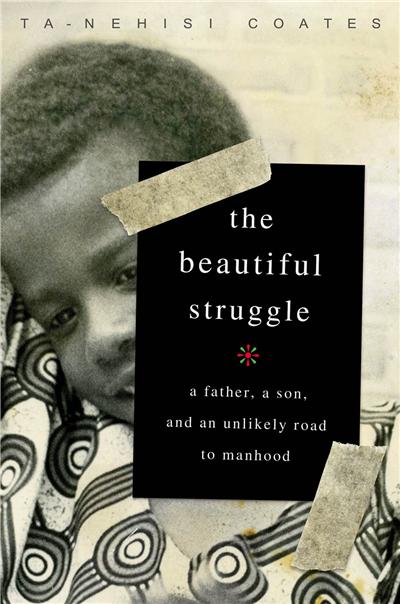
Earlier this week, The Root published a fantastic excerpt from Ta-Nehisi Coates’s recent memoir The Beautiful Struggle. In “Hip-Hop’s Daisy Age,” Coates contextualizes a Golden Age–the arcadian summer of ’88–when a new “consciousness” movement in hip-hop brought together both the discordant militarism of Chuck D’s Public enemy and the neo-hippie soul of De La Soul. Although Coates grew up African-American in an economically-depressed Baltimore and I am white, and was living in Dunedin, New Zealand in the summer of ’88, we are roughly the same age. When he writes, “I was all X-Men, polyhedral dice, and Greek myths,” it’s not hard for me to imagine that we actually probably have at least a few things in common. And while I was clearly in a different cultural place, I owned and cherished most of the albums that Coates cites in his piece. I played them repeatedly, furtively listening in secret to the alien sounds on my Sony Walkman. I can’t help thinking of 3 Feet High and Rising without a warm tinge of nostalgia coupled with a sadness that something so fresh and vital and just plain different probably won’t come out of mainstream hip-hop again–or at least any time soon. Perhaps this is hip-hop’s legacy–20 years after its Golden Age, it’s earned the right to be as shitty, conformist, and downright stupid as any other commercial genre. But I’ve digressed. Coates’s piece is no lament. Instead, it’s a loving tribute to a particular moment, which, for him at least, seemed to transcend the space he was in and extend into all “the ghettos of the world, with their merchant vultures, wig stores, sidewalk sales, sub shops, fake gold, bastard boys, and wandering girls.” In the summer of ’88, I was living comfortably in a lovely harbor town, but the sentiment Coates expresses reached me nonetheless. As corny as it sounds, hip-hop in ’88 provided a cultural education for me, not just about the African-American experience specifically, but, more generally, as an expatriate, hip-hop told me something about what was new and fresh and vital in America. Now I realize that my own early love for hip-hop simply preceded the eventual mainstreaming, commercialization, and consequent dumbing-down of hip-hop. And honestly, I could never have the same spiritual attachment that Coates describes:

“…the rhyme-pad was a spell-book, it summoned asphalt elementals, elder gods, and weeping ancestors, all of whom had your back. That summer, I beheld the greatest lesson of 88, that when under the aegis of hip-hop, you never lived alone, you never walked alone.”

Where Coates experienced soul music, I heard punk rock. But for each of us, the hip-hop in ’88 was a new kind of rebel music. Looking back, it’s hard to believe that 20 years have passed. When I get home tonight, I’ll listen to EPMD’s Strictly Business and try to forget about Soulja Boy for 45 minutes.

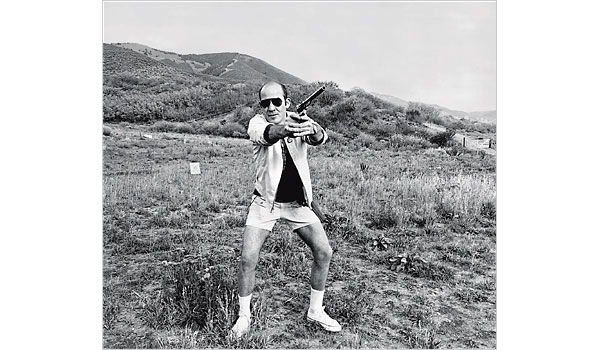
The Rum Diary–Hunter S. Thompson

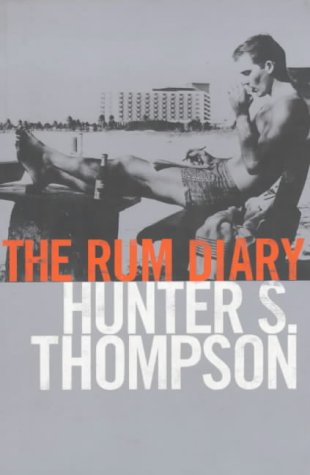
Set in the 1950s, Hunter S. Thompson’s second novel The Rum Diary chronicles the drunken misadventures of Paul Kemp, a journalist who moves from New York City to Puerto Rico to write for a small newspaper. While there, Kemp gets involved with a crazy couple who fight all the time (he develops a serious crush on the girl), attends a rum festival, and winds up in jail. Along the way there’s enough drinking to put Hemingway’s characters to shame, and plenty of nude swimming to boot.

Although The Rum Diary was written in the early sixties, it wasn’t published until 1998, long after the infamous gonzo godfather had made his indelible mark on the American literary consciousness. Thompson was 22 when he wrote The Rum Diary, a significant eight years younger than his stand-in in the novel, jaded journalist Paul Kemp. And while it’s easy to imagine that HST was born a cranky old man, at times Kemp’s world-weariness reads more like an affected pose rather than an earned cynicism.

The novel works best when HST focuses on denigrating the cretins, phonies, perverts, and degenerates that are never in short supply in his sick universe. Where the average travel writer might see a joyous festival throbbing with life and humanity, HST finds dread and disgust, fear and loathing. His frenzied yet steady prose moves quickly, adding to the general manic tone of the novel, and, despite its 200+ pages, The Rum Diary is an easy weekend read. Additionally, HST’s reflections on American imperialism and tourism in general remain relevant and fresh over forty years later.


The Rum Diary is hardly the HST starting place, but this is quite obvious (if, dear reader, this is not obvious to you, get thee to a bookstore posthaste and obtain Fear and Loathing in Las Vegas). However, for casual fans The Rum Diary will make an interesting beach read. Apparently a movie featuring HST friend-alum Johnny Depp (as Paul Kemp) is slated to come out next year, so stay one step ahead of Hollywood by reading this now. Recommended.

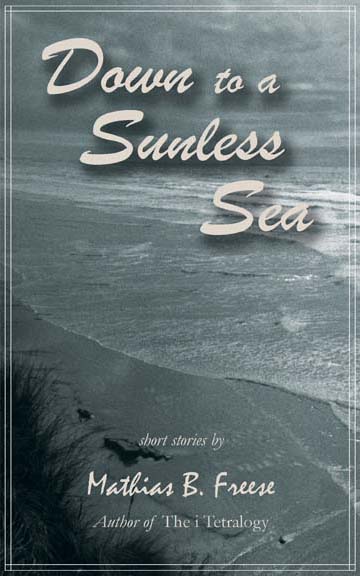
Down to a Sunless Sea

Mathias B. Freese’s slim collection of short stories, Down to a Sunless Sea, relays the weird, miserable, and even sometimes ghoulish existences of people you might pass on the street everyday. The stories read like psychological case studies, and there’s frequently a strange distance between the clinical detachment of the prose and the depressed or depraved sentiment expressed by the narrator. At times the effect is painful, as in “Herbie,” where the titular protagonist’s rage at his abusive father spills over into Oedipal violence. Elsewhere, the stories take on a wry surrealist humor. Freese’s knack for dissonance evinces in “Juan Peron’s Hands,” where a grave robber pines for a head but settles for hands. Far closer to home is “Young Man,” where Freese distills an entire life to a few bitter pages, exploring the modern disconnect between thought, action and identity.

I can’t be who I am in real life, so I can be who I am in thought, but who I am in thought is not who I am in deed, so I live between what is and what should be, and this serves to make sharper the cleavage–the crevices are clearly marked.

One of my favorites in the collection, “Arnold Schwarzenegger’s Father Was a Nazi,” disconcertingly (and humorously) condenses American obsession with celebrity into a fantasy ski trip, complete with the oddly sorta-prescient line: “I might even run for president if I can lose this accent” (the story was originally published in 1991). It is probably the deformed voyeur hero of “I’ll Make It, I Think” who delivers the closest thing to a mantra for these characters:

I’m not hurting anyone. So what if my morning shorts are sticky. I’m a good person. The outside, for sure, is a shambles–that’s not completely true, but I’ve made my point. Inside is fucked up some, but I’ll make it, I think.

Down to a Sunless Sea, for all its monsters and perverts and manic depressives, is never cruel in its darkness or unsympathetic in its distance. Freese creates real people here, and if we laugh at their pain, we’re laughing with them. Highly recommended.

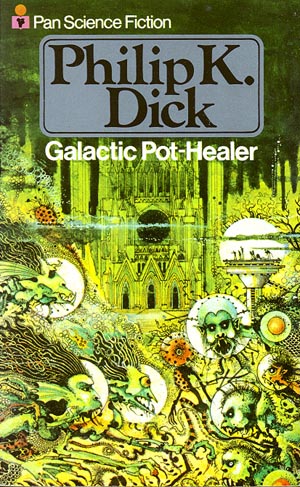
Galactic Pot-Healer–Philip K. Dick

Philip K. Dick’s bizarrely titled Galactic Pot-Healer begins in a dystopian future (more 1984 than Brave New World), before moving into–you guessed it–more galactic territory. Joe Fernwright “heals” ceramic pots–a relatively useless job, seeing as all the broken pots have now been mended. He wiles away his time playing word games with other cubicle minions across the globe, until an alien called Glimmung wisps him away to Sirius Five so that he can aid in resurrecting an ancient cathedral from the depths of an ocean where the laws of time do not apply. Lots of very strange stuff happens.

Galactic Pot-Healer is typical PKD, which is to say thoroughly atypical sci-fi with a philosophically paranoid twist (or is that a paranoid philosophical twist?). The story begins as a satire of modern workaday existence, and Dick’s assessment of cubicle life, written in the late 1960s, is almost too-prescient. Fernwright is a typical Dickian hero, a Walter Mitty figure who, real or not, gets to live his dream out (there’s a girl, of course, a sexy alien). After the action moves to Sirius Five, Dick becomes overtly concerned with the major themes of the novel. A precognitive alien race called the Kalends publish a book, a sort of daily newspaper, that accurately predicts the future. The Kalends predict that the raising of the cathedral will fail, and all involved will die. Glimmung, who is repeatedly compared to Faust by everyone in the book (all of these aliens from different planets are not only familiar with Goethe’s version, but other versions as well), attempts to prove that he is master of his own fate. Attracted to this, Fernwright risks his life in the project, and finds a new hope and vitality in meaningful work that he didn’t have back in his cubicle on Terra.

Galactic Pot-Healer is as weird as its title, and at times suffers from Dick’s manic jumpiness. One imagines him sweating out the novel over a few weeks, feverishly hacking at his typewriter. The links between concrete events–narrative action–are often frantic (if they exist at all), and there’s little subtlety here: Dick’s characters will quote verbatim Kant or Goethe, or wax heavy on determinism and ontology at the drop of a hat. At other times, the prose sings with lyrical beauty, sorrow, and a density of imagination that more than makes up for Dick’s occasional lack of cohesion. As good a place as any to begin a journey into the weird wonderful world of PKD.

(Images from philipkdick.com’s kickass covers gallery)

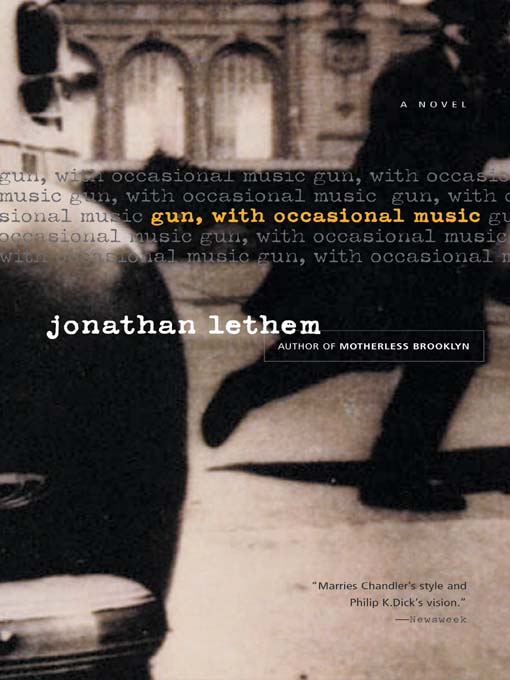
Gun, with Occasional Music–Jonathan Lethem

Jonathan Lethem’s novel Gun, with Occasional Music blends hardboiled crime noir with trippy sci-fi to examine the ethical ramifications of murder in a dystopian future where evolved animals work along side humans, mind altering drugs are not only free but encouraged by the authorities, and asking questions requires a license. Conrad Metcalf is a Private Inquisitor trying to solve a murder case involving a urologist, a baby-head (a failed evolved baby), and a gun-wielding kangaroo.

Two of the blurbs for Lethem’s debut describe the work as a marriage of Philip K. Dick and Raymond Chandler, but for my taste their wasn’t enough PKD. The details involving the “make” that Metcalf compulsively snorts, the genetic evolution techniques society now uses to produce children, and the genital nerve-ending swaps that people now enjoy are never fully explored. Sometimes bizarre details left unexplained create the dramatic immersion that the best SF achieves; Gun seems to throw ideas up against a wall to see if any stick. Many of the SF tropes that Lethem evokes are simply under-utilized. His ideas are playful, so why doesn’t he play with them more?

On the noir, end, the book also disappoints a little. The case is solved, but Metcalf’s solution–delivered entirely in a brief chapter crammed with exposition–seems hardly believable, or even really that interesting. This isn’t to suggest that Lethem’s/Conrad’s Chandlerisms aren’t enjoyable, and at times downright genius. Even when Lethem cranks out a clunker of a simile–and there’s more than one here–the rhetoric comes across more as satire of the genre as opposed to bad writing. The book also moves at a nice clip, with short, snappy chapters that always propel the narrative action. Eventually though, it just runs out steam. The story doesn’t really add up, and towards the end, it becomes clear that Lethem’s not going to fill us in on all of the cool ideas he initiated. I recommend those new to Lethem start with Motherless Brooklyn or The Fortress of Solitude instead. Or Men and Cartoons. Or The Disappointment Artist. Avoid You Don’t Love Me Yet like the plague.

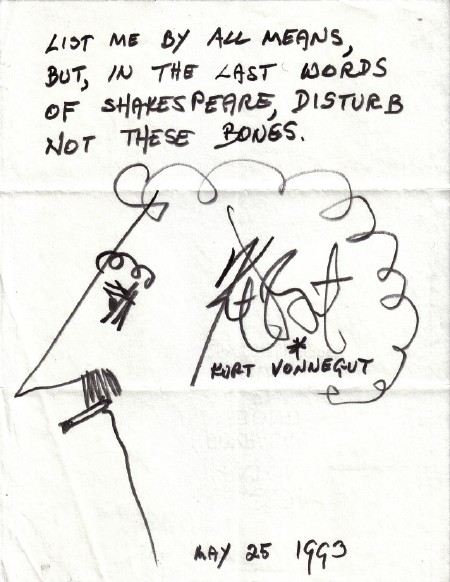
Kurt Vonnegut Reconsidered

Kurt Vonnegut died a year ago today. Vonnegut’s death has left neither a cultural vacuum nor a pining after another great work now never to be. And why should it? He was pretty old–84–and he’d written a relatively substantial collection of novels, plays, essays, and short stories. And admittedly, he hadn’t written a truly great book in decades. Like Bob Dylan, Vonnegut produced his greatest work in the 1960s: Mother Night, Cat’s Cradle, God Bless You, Mr. Rosewater, and, of course, Slaughterhouse-Five (even 1968’s short story collection Welcome to the Monkey House–a book I proudly admit I stole from my 10th grade English teacher–is superior to Vonnegut’s later work). Yet there’s still something about his death that makes me feel a little melancholy, even now–not sad, per se, but rather–and it sounds corny–like something is missing.

See, I learned to read by reading Vonnegut. Sure, I knew how to read before I read Cat’s Cradle, but, beyond Tolkien, C.S. Lewis, and a number of classic adventure books by authors like Edgar Rice Burroughs and Mark Twain, Vonnegut was the first “literary” author I was exposed to. I learned irony. I learned detached pessimism. I was exposed to a writer who knew how to explode genre convention. And, in a short period–roughly from the ages of 12 to 16–I read everything that Vonnegut had written. Then I dismissed him as a “lesser” writer, and moved on, until I was required to re-read Slaughterhouse-Five in college. I’d forgotten how good it was. I re-read Cat’s Cradle, my first and favorite (to this day) Vonnegut novel. Again, great. I then picked up Vonnegut’s final novel, 1997’s Timequake, a shambolic wreck of semi-autobiography that is at turns drastically pessimistic, utterly depressive, and hilariously cynical. It’s really a terrible book, to be honest, but taken as a final statement, I think it works. In any case, after college I managed to get over the silly embarrassment I felt for my love of Vonnegut, an author often relegated to the second or even third tier of American letters, or, even worse, a personality reviled in the press (watch Fox News’s scandalous obituary. Or, if you prefer watching something positive, watch Vonnegut on The Daily Show.)

I suppose, when I say that Vonnegut’s death presents an absence, a feeling of something missing, I really mean to say that it marks me, it ages me: it makes me feel old. After all, we measure our own lives in part against the deaths of others, particularly against the deaths of the famous and celebrated. Vonnegut preceded me; his novels were there, waiting for me, and I was grateful. I read all of them–all of them–I don’t know if I can say that of another author (except maybe Salinger, and I don’t think that counts). But I still haven’t read A Man Without a Country, his 2005 collection of essays, and I haven’t read the posthumously published short story collection, Armageddon in Retrospect, which came out just the other week. It makes me happy to know that there’s something out there of his that I haven’t yet touched, that I can read for the first time as an adult, and not a teenager. I don’t know why I should feel this way, but I do. So it goes.

Vonnegut plays himself in an classic film:

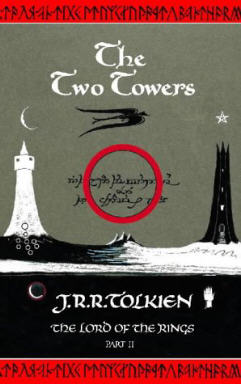
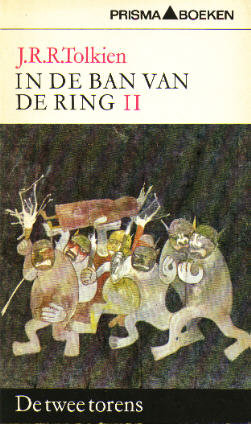
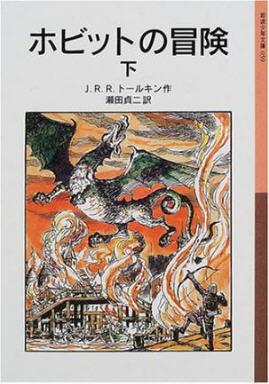
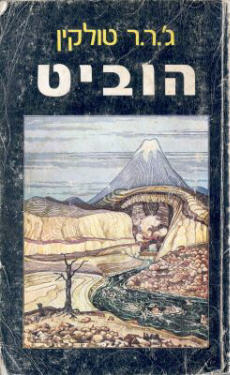
Tolkien Cover Gallery

All images from the LOTR Fanclub Scrapbook outstanding cover gallery. Their collection is exhaustive (literally), so we’ve cherry-picked for you. Enjoy!

The original 1935 first edition of The Hobbit, featuring Tolkien’s own artwork and design

More of Tolkien’s own art and design

Watercolors by–you guessed it–Tolkien

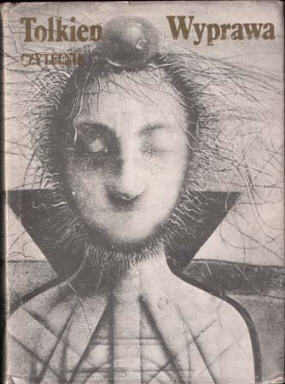
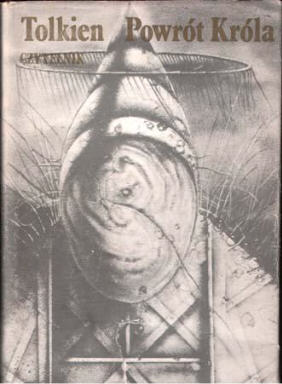
These Polish editions are, um, kinda freaky

Happy fun times

There’s a certain Where the Wild Things Are quality to this one

According to the cover gallery site, this 1977 edition was the first Hebrew translation of The Hobbit, the work of Israeli air pilots passing time while imprisoned in Egypt. Art by Tolkien hisself.

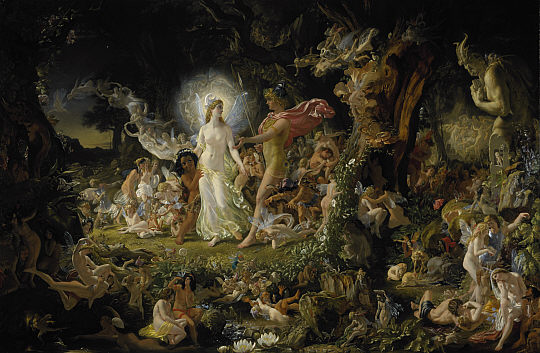
A Midsummer Night’s Dream

Every year, I try to pick a different Shakespeare play to read with my students, preferably one I haven’t read in a long time. This year, I have one group of tenth graders, and right now we’re reading A Midsummer Night’s Dream. As I’ve mentioned elsewhere on this blog, most of the students at my school read well below their grade level, so Shakespearean language can often be a challenge. I’ve found that Alan Durband’s Shakespeare Made Easy series does a great job at clarifying the narrative action without sacrificing too much of Shakespeare’s poetry. It presents the original text on the left side with the clarified “translation” on the right, which allows us to read and act out the play without spending too much time and effort breaking down every little (or long…) speech. Every couple of pages I’ll pick out a key passage from the original text which we’ll read and discuss. I’ve also been showing them the film adaptation that came out in the nineties (with Kevin Kline, Michelle Pfeiffer, and Christian Bale). We’re about half way through so far, and we’re enjoying the whole process.

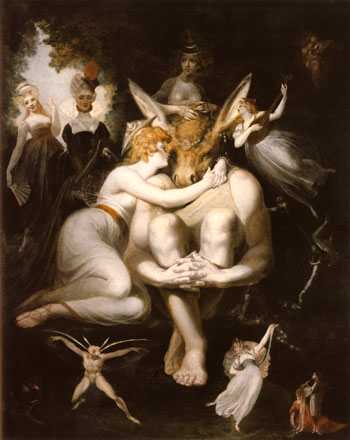
I haven’t read this play since I was in the tenth grade, and I really didn’t think too much of it then–it certainly didn’t seem as weighty as, say, Othello, Macbeth, or Hamlet. Anyway, in re-reading it, I notice now that there’s an underlying rape motif throughout the text. For example, Theseus has captured his bride Hippolyta by seizing her in a classical rape; Demetrius threatens taking the “rich worth” of Helena’s virginity if she won’t quit stalking him in the woods; Lysander forces himself onto Hermia in the woods, and she’s barely able to keep him off. Oberon and Titania’s quarrel over the beautiful Indian boy is pretty weird, and is just one strange detail in a play full of aggressive sexuality, possibly most neatly summed up in the bestiality implicit in Titania’s affair with ass-headed Bottom. Of course, Titania doesn’t really love bottom–she’s just been dosed by her jealous hubby, who has a frat boy’s penchant for drugging people to get the love buzz going. Good stuff.

Blood Meridian–Cormac McCarthy

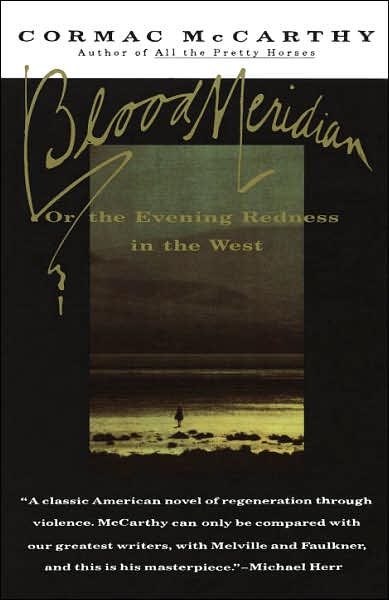
Blood Meridian is a blood-soaked, bloodthirsty bastard of a book, and certainly the most violent piece of literature I’ve read outside of the Bible and certain Greek tragedies. Cormac McCarthy’s 1985 novel passes itself off as a Western–and it is a Western, to be sure–but more than anything, it’s a brutal horror story.

Set predominantly in the 1850s, Blood Meridian chronicles the westward journey of a protagonist we know only as “the kid.” After a few false starts (including getting shot, robbed, arrested, and surviving a Comanche massacre) the kid eventually meets up with John Joel Glanton‘s “expedition”–a group of men of mixed backgrounds hired by Mexican authorities to kill–and scalp–the nomadic Apache that prey upon Mexican villages. However, led by the nefarious, larger-than-life Judge Holden, Glanton’s gang quickly descends into a relentless robbing, raping, and killing spree; they savagely massacre peaceful Indian settlements along with the Mexican villages they were contracted to protect.

I could keep summarizing the book, but I don’t see the point, honestly–a mere description of the plot could never do real justice to the weight of this book. The narrative is taut and fast-paced–in fact, at points the action is so radically condensed that I had to go back and re-read sections–and there’s no shortage of the “men doing men stuff” that McCarthy is so good at detailing–but it’s really the combination of the book’s evocative imagery and philosophical pondering that hook the reader.

Most of that philosophical pondering comes from the Judge, who waxes heavy on everything from space aliens to metallurgy. In his parables and aphorisms, the Judge comes across as part-Mephistophelean, part-Nietzschean, all dark wisdom and irreverent chaos. I found myself re-reading the Judge’s speeches several times and chewing them over, trying to digest them; for me, they were the best part of a great book.

Blood Meridian, like most excellent things, is simply not for everyone, and I don’t mean that in any snobbish, elitist sense. Any reader turned off by its freewheeling violence would be justified, and I’m sure plenty of folks out there would take issue with its ambiguous conclusion. Depictions of genocidal mania that seem to end inconclusively are not for everyone, particularly when they are rife with archaisms, untranslated Spanish, and McCarthy’s signature, apostrophe-free punctuation. I had two false starts with the novel, including one where, at about exactly half way through, I realized I had to go back and start the novel again. I owed it that much. And it was worth it.

Blood Meridian is literally stunning; perhaps the best analogy I can think of is going to see a really, really good band that plays really, really brutal and strange music that sorta melts your face off. After the show you’re sweaty and exhilarated and even unnerved; your ears are ringing and your chest is pounding. And then the band packs up, and the house lights go on, and they pump in music from a CD, of all things, and the music just sounds tinny and pale and blanched of life after the raw power you’ve witnessed. Reading anything else right after finishing Cormac McCarthy’s Blood Meridian, or the Evening Redness in the West is sort of like that. Highly recommended.

No Country for Old Men Reconsidered

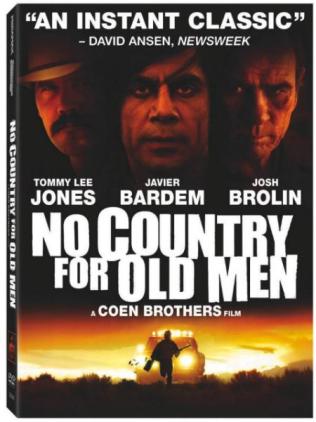
nocountryboxart.jpg

On my Superlatives list at the end of last year, I awarded No Country for Old Men “Most Disappointing Film of 2007.” Here’s what I wrote:

Although it was by no means bad, I was disappointed in the Coen’s adaptation of Cormac McCarthy’s No Country for Old Men. It was a good movie–Javier Badem was fantastic, great pacing and tone–but still it didn’t blow me away like, say, Fargo or Blood Simple or Miller’s Crossing did. Ditto Werner Herzog’s Rescue Dawn. Chalk it up to hyperbolic expectations, I guess. Maybe I need to watch these films again on DVD and reconsider.

Ok. So. I went back and watched No Country on DVD this weekend. One of my criteria for a great film is that it has to be great without the transfixing power of a huge screen and roaring sound system. The Lord of the Rings movies, for example, suffer greatly on TV; the epic magnitude is diminished, and you realize just how much the movies relied on the the modern movie screen. I still like them though. I just don’t think they work too well on small screens (god forbid you watch them on a phone). So how does No Country hold up?

I don’t think it fairs any worse, but I still have to argue that this movie is incredibly overrated. I’d read the book (listened to the audiobook, actually) before I’d seen the film the first time, and watching it again I was doubly-prepared for the film’s decidedly non-Hollywood ending (and non-Hollywood climax, to boot).

Oh, by the way, a few SPOILERS ARE COMING UP. Fair warning, right?

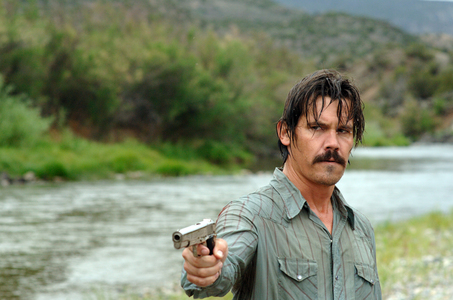
Ok. When I initially saw the film, many of the people of the audience were disappointed and angered at the end of the movie, including my mom’s cousin, a man in his sixties from South Carolina. My uncle zoned out at the end, during Tommy Lee Jones’s last speech. When the movie ended and we walked out of the theater, he asked me to explain what happened. He’d missed the end. Three young men overheard, came up, and started asking me questions– “Did that guy [Llewellyn Moss] die?” etc. My mom’s cousin summed up the way a lot of people probably felt about the end of this movie– “I didn’t like it that the bad guy got away and the good guy died. Why didn’t the Sheriff go get him?” That the film is deeply dissatisfying to our collective sense of justice is kind of a thematic point, and that’s not what bothers me about No Country–although I understand why it would bother many audience members.

chigurh.jpg

The film omits the two scenes we ache to see–the initial massacre that sets events in motion, and the death of Llewellyn Moss. We barely get to identify Llewellyn’s body, in fact. The substitutions for these elisions all involve Anton Chigurh, who pretty much steals the show. His murder of a deputy at the beginning of the film enacts a sacrificial slaughter, a substitution for the greater violence of the drug massacre that we don’t witness. He murders Carson Wells, a silly and ultimately trivial character whose sense of self-importance is quickly put under erasure. Finally, he kills Carla Jean Moss, before becoming the victim of a random violent car accident. An accident–not a just punishment for the atrocities he’s committed. Despite the severe accident, Chigurh is able to get up and walk away; presumably, he will continue to wreak havoc. Before Chigurh leaves the screen he turns two boys against each other. They squabble over a bloodied piece of money, recapitulating the larger theme of the movie–an echo of Fargo–that greed is destructive. The message is not overstated, but plain nonetheless. So what’s wrong with this film? Nothing, really. It’s just not as good–and certainly not as profound–as everyone makes it out to be.

In the book, the third act rests mostly on the “old men”–Tommy Lee Jones’s Sheriff Ed Tom Bell, a fellow sheriff, and Ellis, Ed Tom’s uncle. The film omits much of the book here, including a scene where Ed Tom visits another “old man”–Llewellyn’s father. The film also omits a key story from Ed Tom’s past, an act of cowardice in war. The Coens were right to leave much of this stuff out–there are too many monologues from Ed Tom as it is. Still, the titular point of the book becomes eclipsed, subsumed into Chigurh’s violence. Chigurh is a “new man,” part of what Ed Tom perceives as a new direction in our country–a violent and impersonal world he doesn’t belong in. Ed Tom fails to realize that the country was founded and maintained in many ways via impersonal violence, despite the fact that his own past–as well as the past of his family–is entrenched in this violence. His real problem is with the lack of clear, absolute morality, pure right and wrong, good and evil, an attitude best summed up with his assertion that once people quit saying “Ma’am and Sir,” everything else goes to hell. He brushes off Ellis when the old man tells him that the country has always been violent and difficult. The movie ends the same as the novel, with Ed Tom relating two dreams he had about his father.

large_0288_2326.jpg

The film ultimately fails to relate the depth of the novel, opting instead for a competent depiction of the surface tensions at work. The Coens accurately captures the “men doing stuff” aspect of McCormac’s writing without getting to any of the meaning behind it all. And that’s fine. The movie’s fine. It’s just not as great as everyone is pretending it is. Perhaps we’re all just so happy that the Coens have stepped up from their previous lightweight projects–The Ladykillers and Intolerable Cruelty–that we feel the need to fawn all over No Country. Or maybe I’m wrong–maybe this is a profound thriller, a truly excellent movie; maybe this is the Coens’ masterpiece. But I think not.

His Dark Materials Trilogy — Philip Pullman

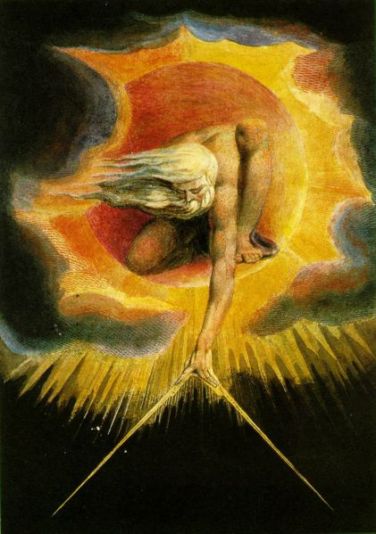
421px-blake_ancient_of_days.jpg
William Blake, “Ancient of Days”

Over the past three weeks, I read, and, alternately listened to, Philip Pullman’s fantastic His Dark Materials trilogy–The Golden Compass, The Subtle Knife, and The Amber Spyglass. Here’s the short review:

If it’s necessary to critically situate and compare a fantasy or sci-fi series against precursor series–namely, The Lord of the Rings, The Chronicles of Narnia, The Chronicles of Prydain, Harry Potter, etc.–and I don’t think it is necessary to critically situate and compare a fantasy or sci-fi series against its precursors, but that’s generally how these things are done–(this is turning into a monster of a “short review”)–but if it is necessary to critically situate and compare a fantasy or sci-fi series against precursor series, I think that Pullman’s His Dark Materials must be considered a new classic, an instantly-canonizable contribution to children’s literature, imaginative fiction, sci-fi, fantasy, or whatever genre you want to affix to these marvelous books.

His Dark Materials follows Lyra and Will, two children from different worlds (literally) who must work together to repair a damaged multiverse. Lyra comes from a world where people travel side by side with their daemons, spirit-images of their souls who take animal shapes. Will is an outsider in “our” world, a young fatherless boy who must take care of his mentally ill mother. The novels, in their simplest sense, detail the coming of age of these two as the traverse multiple parallel universes. In the backdrop there are witches and zeppelins, armored bears and dark specters, a compass that can point to the truth and a knife that can open all worlds, angels and scientists, and Lyra’s cruel and terrible parents, the cunning Mrs. Coulter, and Lord Asriel, whose will to kill God–The Authority–precipitates the action of the narrative.

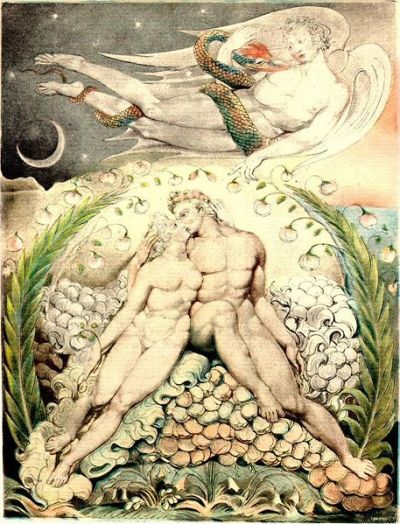
blake_satan_adam_eve.jpg
William Blake, “Satan Watching the Caress of Adam and Eve”

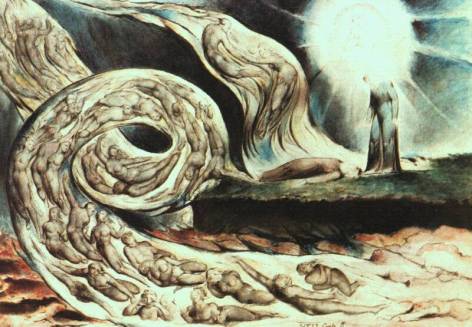
As many critics have pointed out, His Dark Materials recapitulates Milton’s Paradise Lost (the series takes its name from a line from that epic poem). However, the series really reinterprets the British Romantics’ assessment of Paradise Lost. Pullman engages a host of Romantic writers, foregrounding Keats’s idea of negative capability, and prefacing many of the chapters with quotes from Romantic poetry. In particular, Pullman cites William Blake. Indeed, it seems to me that His Dark Materials effectively synthesizes many of Blake’s poems and ideas, The Marriage of Heaven and Hell and Songs of Innocence and of Experience in particular. The novel also engages a number of Nietzsche’s ideas, and even, I believe, alludes to several concepts of Derrida’s (in particular, the idea of the gift of death). Additionally, Pullman weaves in the many-worlds theory, extended discussions of evolutionary anthropology, rampant infanticide, and auto-trepanation. Good stuff.

When the film of The Golden Compass (I didn’t see it) came out last year, it ignited a small controversy about the books. According to the Baptist Press, Pullman presents “a fantasy universe where witches are good, the church is bad, and at the end of it all, God dies.” This really isn’t the case, if you want to go with a precise reading of Pullman’s actual words, but, consider the source. I’m sure the controversy is healthy for Pullman’s sales; it certainly piqued my interest in the book, and I’m guessing that there are plenty of kids who, once their private Christian schools banned the books, couldn’t wait to get their hands on the verboten goods. And that’s a good thing.

blake2.jpg
William Blake, “Whirlwind of Lovers”

His Dark Materials meets and surpasses my notions of good fantasy/sci-fi/imaginative fiction: the books engage multiple complex ideas in a new and often unsettling way. Unlike the Harry Potter series, which simply operates within familiar, preexisting archetypes of fantasy, Pullman’s work consistently disrupts reader expectations, pushing set ideas about religion and science, art and fantasy into new and fantastic places. Ultimately, although many will seek to suppress this book as an “amoral” work, His Dark Materials proposes a very real set of ethics inscribed in a world of moral relativity. The characters grow up and make good, selfless choices, decisions they make independent of absolute moral authority.

I very highly recommend these books.

The Art of Modern Memory

From conscientious reader Dave C. ((very) minor editorial changes by the Biblioklept):

“The NY Times posted an article about an author who was outed as a fraud for writing a memoir about her life as a half-Native American, half-white gangbanger from South Central Los Angeles who escaped to the University of Oregon when she was really just an activist who at one point worked with gangs and created the characters in her memoir based on real people she had met in her real/fake life.The Times actually reviewed the book just last week and praised it.

I’ve just been pissed ever since that James Frey controversy about the idea that a supposed memoir has to be true. Does the fact that she made up portions of this book make her accomplishment any less significant? Isn’t a moving work of fiction a greater accomplishment than a moving autobiography? Are people really so concerned with whether someone actually did something that they are willing to ignore a touching, well-written narrative?

That James Frey novel, what I’ve read of it, was a tad overcooked, but about 10 people told me I had to read it because it was sooooo good. After Oprah (who made a gazillion dollars promoting his work) sold him down the river, he became a literary pariah.

Is the phrase “based on a true story” important in the appreciation of a story at all?”

I wrote a blog a few weeks ago about a few run-ins I had at an AP workshop, specifically related to teaching the canon. Anyway, that aside, during that workshop, this question came up. The mediator/instructor had the room show, by hands, their opinion on the issue. It was roughly a 70-30 split, with the majority favoring “authenticity” in their memoirs. I was, of course, in the minority.

Like Dave, I was steamed over the James Frey thing, not because I cared about the book–it looked like trash, frankly–but because he became a strange acid test for what America now thinks it needs from a memoir.

If we start from the assumption that genres impose a functional structure that inheres within the reading of a book, we’ve already made a strange, silly, and ultimately illusory set of distinctions to guide our reading. All one has to do is look at the travel literature of the sixteenth century or a science text book from the 1920s to see how quickly “validity” melts under context.

But even if we grant that genre has a meaningful or necessary purpose, and we work from this assumption, I think it’s a huge mistake to believe that “memoir” is the same as “nonfiction.” There are several simple reasons for this.

For one, to tell an effective and affecting story requires a manipulation of events–editing, hyperbole, recoloring, touch-ups, and so on. Events in life don’t necessarily unfold in a “readable” way. And I think that many, if not most readers go into a memoir understanding that the tale they read may be compressed or somehow aestheticized.

But I think a more fundamental reason that memoir shouldn’t be held to the strictest ideals of verity follows from the simple fact that memory is in no way perfect, absolute, or unchanging. We cannot perfectly record our memories, nor do they stay stable to us. Memories are always volatile, swirling; we forge our identity in every moment by reinterpreting and reimagining our past.

Any memoirist must literally reimagine their memories in order to write, and if they choose not to reimagine, but to instead imagine (invent and create) memories, what does it say about our expectations and needs as readers to judge their writing based solely on adherence to structural genre?

In the preface to Dave Eggers’s What is the What, Valentino Achak Deng foregrounds these problems. He says that the book–his “autobiography,” written by Dave Eggers (and hence not his autobiography)–must be considered a novel, as he was very, very young when many of the events recorded in the book happened. Similarly, Eggers’s own memoir, A Heartbreaking Work of Staggering Genius, repeatedly references its own flights of fiction, acknowledges its own need to invent a new imagined version of memories that never happened in order to better explain what really did happen. The Autobiography of Malcolm X was written by Alex Haley; The Interesting Narrative of Olaudah Equiano is rife with distortions, inaccuracies and completely fabricated events; in crafting A Portrait of the Artist as a Young Man–which may or may not be a memoir (although it is certainly a book…)–James Joyce wholly lifted entire passages of contemporary religious tracts.

James Weldon Johnson’s novel, The Autobiography of an Ex-Colored Man, illustrates how easily notions of genre–just like notions of race and stable identity–can be deconstructed. Johnson anonymously published the “autobiography” in 1912, and it was received as the true life story of an extraordinary “Negro” who shockingly was able to “pass” as a white man, to the extent that he (gasp!) married a white woman and became a major property owner. The book initiated a minor racial panic, causing some critics to insist that it must be fake because no black man could effectively “pass” as the unnamed narrator claimed to do. JWJ’s deconstruction of race and identity could not have worked in the same way had he presented it within the limits of a “true” memoir. It took fiction (masquerading as fact) to reveal a more profound reality.

A good writer makes stuff up and writes it down in a way that makes us want to read it and not put it down and keep reading it until we’ve read it all and want to read it again. If finding out the circumstances of the writing of the book do not match a set of expectations we had going into reading the book, we need to re-evaluate those expectations.

A Diddy in the Sun

I teach four sections of 11th grade AP English Language and Composition; I’m really hard on these kids. I also teach one section of 10th graders. I see these kids dark and early every morning, and I’m not very hard on them. It’s impossible to be, really. They–and I–are still sort of asleep. So, even though the FCAT is but a week away, when one assertive young lady in the class thought to tape record the new TV movie version of A Raisin in the Sun and bring it in, I agreed to let them watch it. After all, we’d read the play in class back in November, and watched the entire 1989 filmed stage production starring Danny Glover, as well as parts of the 1961 version starring Danny Glover.

glover.jpg

I’ve been using Lorraine Hansberry’s play in the classroom for years, with great success, I might add–the themes of race, economics, integration, assimilation, acculturation, generational change, and women’s rights continue to be as vital and thought-provoking as when the play was first produced a half-century ago. Which is why the early aughties revival starring Sean “Puff Daddy P-Diddy, No, Just Diddy (Diddy Dumb Diddy Do)” Combs seemed like a great idea. It was met with good reviews and ran to 88 performances. I know this play inside and out, and was excited to see a new version of it.

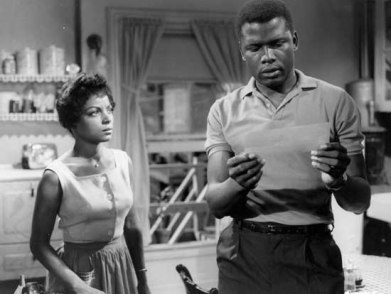
It was awful. Just plain awful. I can only hope that most of the people who saw it last week had some previous exposure. The depth of inter-generational conflict of Hansberry’s original text is drained of all energy and force, leaving only a weak trace of sappy melodrama. Both Poitier and Glover carried their versions, exploring the role of Walter Lee, a man whose dreams and ambitions are outmatched by the limited station thrust upon him. Walter Lee, properly, must be a man-child animal, lean and angry, a volcano ready to explode in rage and desperation. Walter Lee’s transformation into an adult man is painful; it almost undoes his family, metonymized neatly in the abortion his wife plans to have. Diddy, however, turns in one of the laziest one-note performances I’ve ever seen. He relies on every hackneyed trope of melodrama as a substitution for really emoting his part. In short, it’s impossible to believe that he’s Walter Lee. He’s just Diddy casually pretending to be Walter Lee. And the producers and director seem to know this. Whereas Walter Lee at least punctuates each scene of ARITS–and usually is at the forefront of catalytic action–the 2008 version reduces the scope of Diddy’s screen time, even omitting the famous “flaming spear” scene (my students were appalled at this elision–they determined that Diddy wouldn’t want to appear foolish). Furthermore, every single scene with Puffy Daddy (yes, I kept track) relies on the most saccharine of music to make sure the audience knows how to feel.


diddy.jpg

It’s left then to a chubbyish Phylicia Rashad to carry the movie, and while she’s a great actress, her Mama Younger is far too keenly self-aware. She’s simply not Hansberry’s Mama; instead, she’s Rashad’s late aughties update on what Rashad thinks a strong black woman should be. The original Mama’s ideology is defined (perhaps even limited) by the Great Migration; ARITS is largely the story of this mentality clashing with the artistic, educational, and economic aspirations inherent in the Civil Rights movement. Rashad’s Mama is never confused or even especially distraught over this changing ideology, and even some of the original lines that show her distress are cut. It just doesn’t work.

Maybe I gripe too much–my kids enjoyed it on the whole, but conceded that it wasn’t nearly as good as Glover’s take. I have to admit that I liked John “Uncle Jessie” Stamos as Mr. Lindner. He brought a silly unself-conscious humor to the role that exposed the inherent conflict of the original character: a guy whose actions are incredibly racist who can at no point recognize this racism because it’s so indelibly entrenched within him.

Still, if you’ve never seen the play before, I recommend going to the Danny Glover version, or at least the Poitier “classic.” Our inaugural post was about A Raisin in the Sun.

poitier.jpg

Open to All: Monumentalizing Cultural Spaces

Witold Rybczynski’s “Borrowed Time,” an interesting photo-essay published at Slate today, considers the architecture, purpose, and meaning of libraries in the “”digital world” of Google, Wikipedia, and Kindle.” Rybczynski’s essay is typical Slate writing–it picks at its topic a little bit, rifles through a few examples, and ends with an empty platitude.

The article cites Jacksonville’s own new downtown branch among several examples of a new direction in library building, arguing that the “library building boom of the last two decades is closely tied to efforts to rejuvenate downtowns. Cities can’t re-create the department stores, movie palaces, and manufacturing lofts that once made downtowns the vital centers of American metropolitan life, so they build convention centers, ballparks, museums, and concert halls instead.” Rybczynski concedes that “Retro ballparks have enjoyed success with the public,” but insists that the days of “library-as-monument” are over. Instead, he sees the library of the future as more of a social meeting place, a community center with internet access, coffee shops, and magazines–with less and less room for books.

publiclibrary.jpg
Jacksonville’s new Main Library (Downtown)

Although the trend that Rybczynski points out does evince a change in both the architecture and organization of the library–a trend that does reflect (relatively) recent changes in technology–I just don’t see the library losing its monumental status. Rather, I think that 21st-century notions, concepts, and constructions of what exactly a society should monumentalize, and how that culture should monumentalize whatever it decides it should monumentalize (whether it’s a sports arena, a church, a library, or a shopping mall) are changing. The purpose of a library–extending all the way back to the Library at Alexandria–is akin to (and yet, of course, different from) the purposes of churches and art and science museums: libraries serve as a nexus of a culture’s collected knowledge, and as a point of access to that knowledge. This is why the concept of a public library is extremely important, indeed vital, to a free and democratic society. Just because greater access to technology holds the possibility of displacing books does not mean that books will disappear forever and that museums will have to suddenly become glorified Starbucks. Change is normal, and a library that fails to reflect the zeitgeist of its age would cease to become a library (it would be a history museum). And yet the core mission of public libraries will (and should) remain as long as people endeavor to enter the epochs-old conversation that is human culture.

extinction_timeline.jpg

Improbably, Rybczynski cites the “Extinction Timeline” created last year by What’s Next and Future Exploration Network as evidence that the library will certainly disappear (in 2019). While this type of thinking is fun–and I certainly get a kick out of the “Extinction Timeline”–it belongs to the realm of science fiction, not cultural criticism. Although much of what the Extinction Timeline predicts will almost certainly come about (how much longer can printed telephone directories last?) I suspect that more than half of it is tongue-in-cheek. Will “Childhood” really disappear in 2030? Will “Sit down breakfasts” become insignificant? Can “Natural Childbirth” really go away by 2038? If these guys are serious, this is teleological thinking at its worst. But perhaps I’m ludicrously old fashioned. After all, I still think that “Mending Things” (“Existence insignificant” as of 2009) is both important and worthwhile, and, in a more abstract sense, both healthy and good for people. And I’ll be mending things in 2009.

If our libraries need to be mended, or amended, rather, let’s change them in ways that suitably monumentalize and grant access to our culture. I think that the Jacksonville library alluded to in Rybczynski’s article monumentalizes the best aspects of human culture and technology, and is more than just, as Rybczynski suggests, an “urban hangout” or mere “arbiter of information.” And even if, like the Seattle Public Library, the Jacksonville Public Library is full of “street people” (Rybczynski’s contemptuous term), significantly, it is, as its stairwell mural proudly declares, “OPEN TO ALL”–a monument to democratic and egalitarian access to information.

c-documentsandsettings-cat-desktop-12707-pict0043-1.jpg

Azar Nafisi to Speak at UNF

nafisi-cropjpg.jpg

Readers in Northeast Florida may be interested in catching Azar Nafisi speak at the University Center of the University of North Florida at 7:30PM on Monday, March 3rd. Nafisi’s bestselling memoir Reading Lolita in Tehran recounts the Western literature course that Nafisi taught in secret to a small group of Iranian women in her house in the late 90s, and engages the events of the Islamic Revolution, the Iran-Iraq war, and the conservative cultural revolution that led to the necessity of keeping such a course on the down-low. My wife didn’t finish the book; I didn’t start it. My wife said it was good though; she told me she can’t remember why she quit reading it. How’s that for a book review? (I highly recommend Hamid Dabashi’s highly-critical and thoroughly engrossing critique of the book, “Native informers and the making of the American empire,” in which he refers to Reading Lolita in Tehran as “the locus classicus of the ideological foregrounding of the US imperial domination at home and abroad” — read the whole essay here.)

lolita.jpg

Nafisi’s lecture, “The Republic of the Imagination,” is part of UNF’s ongoing “Distinguished Voices” series (great name, by the way, guys. Lot of thought and creativity put into that one). The next speaker in the series is pretty-boy news analyst and frequent Daily Show guest Fareed Zakaria. Get free tickets for any of the lectures in the series here.

Profanity/Hogs Mating

mating-pigs-thumb2869398.jpg

I work as a teacher for Duval County Public Schools. Last week, a 15 page document titled “Alphabetical Listing of Multimedia Material Reevaluated in Duval County” was dropped off in my mailbox; I’m not sure exactly why. The document lists well over 250 books, magazines, videos, and albums that were “reevaluated” due to complaints. Some of these books are frequent guests on the censorship block (The Adventures of Huckleberry Finn, “Racial,” Catcher in the Rye, “Offensive Language,” Are You There God? It’s Me, Margeret, “Religious, Sex, Introduction to Pornography,” As I Lay Dying “Profanity/Racial Slur”) and some are destined to be under scrutiny for a long time (Harry Potter, entire series, “Witchcraft, Occult, Spellcasting”). As you might expect, the dominant complaints revolve around profanity, sex, and a general sense that the book doesn’t fit in to the complainant’s worldview. Here are a few favorites of mine:

Goosebumps Series, R.L Stine — “Scary” (Yes. Correct. They’re supposed to be scary, jackass).Guns, Germs, and Steel, Jared Diamond — “Bestiality/Darwinian evolution” (Natch–bestiality and Darwinian evolution go together like PB & J).

Halloween, Joyce K. Kessell — “Evil, Full of Lies” (Ach! Oh no! A fiction book that doesn’t tell the truth!)

The Butter Battle Book, Dr. Seuss — “Violence” (Admittedly, The Butter Battle Book was the peak of Seuss’s “Tarantino phase”)

Four Good Friends, Margaret Hillert — “Negative, Nonproducive tone” (What the fuck is a “Nonproducive tone”? What does that even mean?)

In the Night Kitchen, Maurice Sendak — “Nudity” (This charming kid’s book repeatedly lands on the Most Frequently Challenged Books List)

Learning to Swim, Ann Turner — “Erotic and Sexual Nature” (Erotic and sexual? Intriguing…)

A Light in the Attic, Shel Silverstein — “Illustrations” (Huh? “Illustrations”? Huh? This book is actually right by me, my childhood copy, proudly shelved on the mantle…let’s review these nefarious illustrations…let’s see, let’s see…An Icarian hippo, perhaps? An unscratchable itch?Rhino pen? Nah…Is it perhaps, the “Union for Children’s Rights” picture (pgs 140-141 in my 1981 Harper & Row edition)? Gotta be…unionized kids…scary!)

Kid in the Red Jacket, Barbara Park — “”Stupid” and “God”” (Again, I ask “Huh?”)

Little Red Riding Hood, Paul Galdone — “Violence/Wine” (Two of my favorite things!)

Marijuana, Martin Godfrey — “Drugs” (Really? Who knew Marijuana would contain “drugs”)

Matilda, Roald Dahl — “Vulgar, Unethical” (This is one of my favorite books. Attempting to suppress it and keep kids from reading it is both vulgar and unethical)

Our Country Spain, David Cumming — “Mediterranean Beach Picture” (Good lord no!)

The Picture of Dorian Gray, Oscar Wilde — “Morality” (What is the problematic “morality” of Dorian Gray? Or did the offended parent have a problem with Oscar’s proclivities for the lovely youths?)

Santa Claus Mystery, John Godman — “Conflict w/ Santa Myth” (I wish they’d be more specific–what’s the conflict? Is there a “set” Santa myth? What is it?)

Tar Baby, Toni Morrison — “Sex, Violence, Myth” (Myth? Really? Myth is offensive?)

The Visitors Who Came to Stay, A. McAffee and A. Browne — “Pictures” (Again, please, be specific when you want to ban a book. “Pictures” simply won’t cut it)

Where is Gah-Ning, Robert Munsch — “Blatant disregard for moral standard” (Okay, that’s a little more specific, I guess–but still asinine).

Which Witch, Eva Ibboston; The Witches, Roald Dahl; Witches, Witches, Witches, Helen Hoke; Witches, Rhoda Blumberg; The Witches of Worm, Z. Keatley Snyder; The Witch’s Handbook, Malcolm Bird — “Witchcraft, Occult” (Duh)

Worry Worts, Morris Gleitzman — “Sexual Context” (I wonder if this book is about STDs…)

A Day No Pigs Would Die, Robert Newton — “Profanity/Hogs Mating” (Sounds like a party to me!)