Writing in the Ellipses

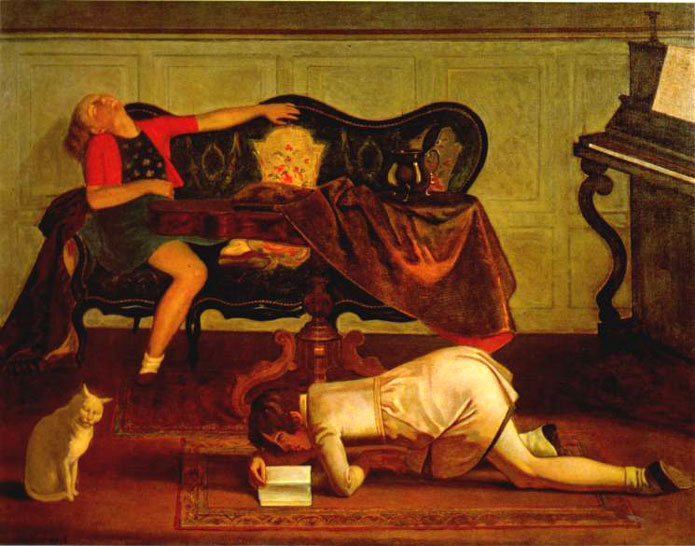
Balthus--The Living Room
Balthus–The Living Room

Flipping through Balthus‘s digressive, discursive, elliptical memoir Vanished Splendors, I came across this notation:

I deeply believe in the genius of painting, which parallels that of childhood. I’ve used painting as a language without really having decided to do so, because it suits me better than writing. Writing tries to be too explicit and go directly to meaning. That’s why I could never be a writer like many of my friends. Some aspects of my life might be clarified by the present short texts, similar to letters. . . . For me, writing can only be in the ellipses, where I express myself; painting conveys this magnificently, sometimes unbeknownst to the painter himself.

Elsewhere, Balthus lists the writers and texts he loves, and gives us (what I believe to be) a great definition for reading:

I often paint young girls who are reading. It’s surely because I saw the act of reading as a way to enter life’s deeper secrets. Reading is the great means of access to myths. Green, Gracq, Char, Jouve, Michaux, and Artuad were frequent passageways, as well as the great holy writings of the Bible and initiates like Dante, Rilke, the Pléiade poets, the great Chinese writers, the mystics John of the Cross and Teresa of Avila, not to mention Carroll, the pure German poet Ludwig Tieck, and Indian epics. All these texts and authors were landmarks in my life, and gave me another dimension of time to which I soon felt myself summoned. My young girls who read in dreaming poses are escaping from fleeting, harmful time . . . Fixing them in the act of reading or dreaming prolongs a privileged, splendid, and magic glimpsed-at time. A suddenly opened curtain sheds light from a window and is seen only by those who know how. Thus a book is a key to open a mysterious trunk containing childhood scents. .

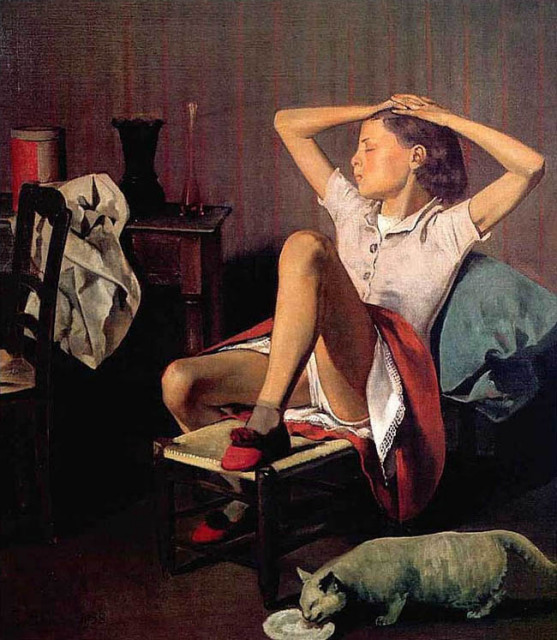
Balthus--Girl with Cat

But, my favorite lines in the book come at the end of the following passage:

Painting is something both embodied and spiritualized. It’s a way of attaining the soul through the body. . . . Being too cerebral and jokey can obstruct an artisan’s manual labor, and impede the ascent to the soul. Believing that my young girls are perversely erotic is to remain on the level of material things. It means understanding nothing about the innocence of adolescent languor, and the truth of childhood.

Exactly. Whenever I look at Girl with Cat, I think, man, that’s not perversely erotic at all…that’s just the innocence of adolescent languor–the real truth of childhood, actually. Nice try, Count Balthasar.

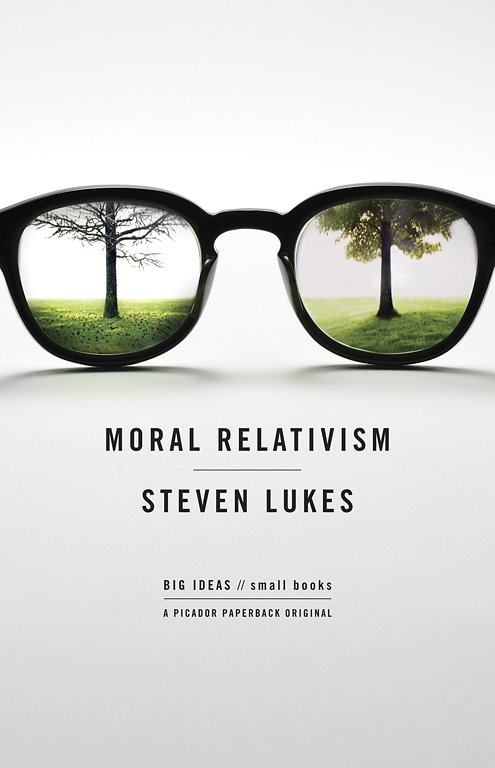
Moral Relativism — Steven Lukes

Moral relativism is the belief that ideals of right and wrong and good and bad are contextually determined by one’s local culture, as opposed to a theory of morality that holds that good and bad exist as absolute, metaphysical values existing cross-culturally, values intrinsic to one’s humanness. At the same time, individuals, even those (sometimes especially those) who see moral relativism as the overwhelmingly rational, sensical position, nonetheless are inextricably tied to their own sense of right and wrong, and this sense often leads them into a position of judgment–and perhaps action–against, over, and/or in reaction to the perceived wrongs of other cultures and societies.

In his new book Moral Relativism, NYU sociology professor Steven Lukes employs an interdisciplinary approach to tackle one of the biggest sticking points of contemporary thought. Using a variety of methods including philosophy, anthropology, history, and literature, Lukes addresses the fundamental conflict of moral relativism: that what’s right and good in one’s own culture may not be right and good in another’s culture, yet a will remains to believe in ideals of universal human rights. Lukes uses a number of timely concrete examples, including female genital circumcision, Islamic fundamentalism, and mass immigration, to assess the costs and payoffs of holding a view that says that no absolute morality exists. Perhaps the most fascinating part of Moral Relativism is Lukes’s negotiation of Western (or globally Northern, as he saliently points out) human rights actions as an extension of colonialism, with the one-time colonists imposing their values–again–upon the one-time colonized.

Lukes concludes that “the question Who are we to judge other cultures? is a bad question.” Arguing that the “postcolonial and multicultural contexts of our time do not require us to see the discourse and practice of human rights as ethnocentric,” Lukes takes up a position–well-argued–that a moral fundamentalist might claim is simply a liberal humanist wanting to have his cake and eat it too. Which, of course, is the problem with the book. It’s a fantastic argument for moral relativism, one that points out that no one–no one–is absolutely relativist, and that, in fact, being a moral relativist entails recognizing that within cultures certain perceived absolutes exist. The idea that right and wrong are relative doesn’t mean that right and wrong are arbitrary or don’t exist–it simply means that ideals of right and wrong have to be reconstituted within different systems of social and cultural order. Yet Lukes’s book isn’t going to convince the types that need convincing. Still, those of us who think that moral relativism is simple common sense will find plenty of concrete, contemporary, real world ammunition here in case we feel like arguing with a–gasp–moral fundamentalist.

Moral Relativism, available now, is part of the new BIG IDEAS // small books series from Picador Books.

In the Land of No Right Angles — Daphne Beal

In the Land of No Right Angles tells the story of Alex, an American college student backpacking in Nepal for a year. Alex’s overseas adventure becomes complicated when she meets fellow American Will. Will prompts Alex to help bring a poor Nepalese girl named Maya to the capital city of Kathmandu, and the three move in to an apartment together. Awkwardness ensues, including a failed threesome, a bad drug trip, and some major cultural misunderstandings. Alex leaves on a sour note, returning eight years later as a professional photojournalist to expose the horrors of human trafficking, only to find Maya embroiled in Bombay’s seedy sex trade.

The novel reads at a rapid clip, propelled by lots of dialog, and Beal certainly shows a complex knowledge of Nepali culture. Still, there’s something pervasively shallow, even troubling about Alex’s interactions with and reactions to her experience with this alien culture that the novel doesn’t quite resolve. The reader is meant to identify with Alex, the privileged American on her adventure to the exotic East. At one point, Alex states, “I wanted to come home different from what I’d been–bolder, wiser, happier.” This desire to find one’s self far away from home is nothing uncommon, of course, yet Alex’s–and Will’s–professed altruism toward their subject, poor little Maya, ultimately comes off as paternalistic and demeaning, culminating in the older Alex’s quest to “save” Maya. It’s hard to feel the empathy or sympathy that Beal wishes to evoke for Alex’s dilemma: in spite of all her questing, she still falls prey to the illusion of her own power as an educated Westerner to control the outcomes of alien others. To take a cue from Edward Said’s work revealing Orientalism in Western thinking, Alex’s East–and the people in it–exist mostly to reify and stabilize her own identity, give her her the adventure she needs to “come home different” with plenty of great stories to share.

Orientalist critique aside, Alex does have a pretty good story to tell. Beal’s descriptions are vivid and the novel has the compressed vitality of a good memoir coupled with a tone of immediacy that makes it easy and enjoyable to read. In the Land of No Right Angles will no doubt end up in more than a few book clubs this fall, and it’s certainly your smarter than average beach read–and there’s still plenty of summer left.

In the Land of No Right Angles is available August 12th from Anchor Books.

Violence — Slavoj Žižek

Slavoj Žižek describes Violence as “six sideways glances” examining how our preoccupation with subjective violence (that is, the personal, material violence that we can see so easily in crime, racism, etc.) masks and occludes our understanding of the systemic and symbolic violence that underwrites our political, economic, and cultural hierarchies. Žižek believes that a dispassionate “step back enables us to identify a violence that sustains our very efforts to fight violence and promote tolerance,” and that a rampant “pseudo-urgency” to act instead of think currently (detrimentally) infects liberal humanitarian efforts to help others. This is where the fun comes in. Žižek delights here in pointing out all the ways in which we fool ourselves, all the ways in which we believe we’ve gained some kind of moral edge through our beliefs and actions.

I use the words “fun” and “delight” above for a reason: Violence is fun and a delight to read. Žižek employs a rapid, discursive method, pulling examples from contemporary politics, psychoanalysis, films, poetry, history, jokes, famous apocryphal anecdotes, and just about every other source you can think of to illustrate his points. And while it would be disingenuous to suggest that it doesn’t help to have some working knowledge of the philosophical tradition and counter-traditions to best appreciate Violence, Žižek writes for a larger audience than the academy. Yet, even when he’s quoting Elton John on religion or performing a Nietzschean reading of Children of Men, Žižek’s dalliances with pop culture always occur within the gravest of backdrops. Within each of Violence‘s six chapters, there’s a profound concern for not only the Big Questions but also the big events: Žižek frequently returns to the Iraq War, the 9/11 attacks, and the Israeli-Palestinian conflict as major points of consideration. This concern for contemporary events, and the materiality of contemporary events, is particularly refreshing in a work of contemporary philosophy. Undoubtedly some will pigeonhole Žižek in the deconstructionist-psychoanalytical-post-modernist camp (as if it were an insult, of course)–he clearly has a Marxist streak and a penchant for Lacanian terminology. Yet, unlike many of the writers of this philosophical counter-tradition, Žižek writes in a very clear, lucid manner. There’s also a great sense of humor here, as well as any number of beautiful articulations, like this description of the “dignity and courage” of atheism:

[A]theists strive to formulate the message of joy which comes not from escaping reality, but from accepting it and creatively finding one’s place in it. What makes this materialist tradition unique is the way it combines the humble awareness that we are not masters of the universe, but just a part of a much larger whole exposed to contingent twists of fate, with a readiness to accept the heavy burden of responsibility for what we make out of our lives. With the threat of unpredictable catastrophe looming from all sides, isn’t this an attitude needed more than ever in our own times?

I’m inclined to answer, “Yes.” Highly recommended.

Violence, part of the new BIG IDEAS // small books series from Picador Books, is available August 1st.

On the Third Beer

I thought this notation, from Toni Morrison’s Song of Solomon, was too beautiful not to share (also, I’ve been too busy to write and appropriating the words of Nobel prize winners seems like an easy alternative to actually, y’know, coming up with original content). Context unimportant:

She was the third beer. Not the first one, which the throat receives with almost tearful gratitude; nor the second, that confirms and extends the pleasure of the first. But the third, the one you drink because it’s there, because it can’t hurt, and because what difference does it make?

The Rough Guide to Conspiracy Theories

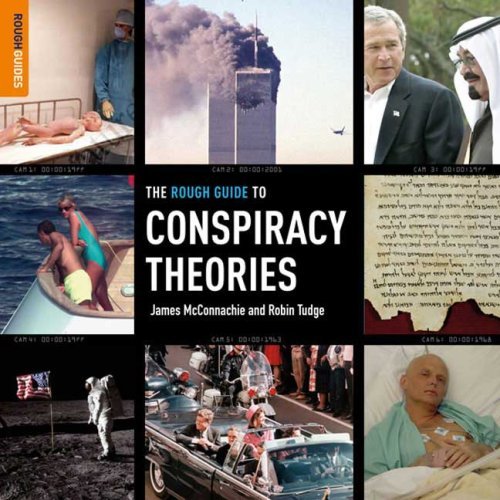
There’s something fun-but-not-too-fun about James McConnachie and Robin Tudge’s The Rough Guide to Conspiracy Theories, a lovely little coffee-table encyclopedia that investigates everything from the strange death of playwright Christopher Marlowe to the disputed Apollo 11 moon landings to the sinister happenings at Bohemian Grove to the 9/11 attacks. The book is dubious and skeptical in all the right places, yet never snotty or wholly dismissive of the marginalized ideas it presents. Also, none of the lurid tabloid earnestness that marks the work of lifers like Alex Jones or David Icke can be found here (Icke does get his own five paragraph section, however). For the most part, the 450 or so pages of Conspiracy Theories are evenhanded, concise, and well-researched. A bibliography follows each section, and at the end of the book there’s a “Conspiracy Archive” suggesting books, websites, and films for those who can’t get enough paranoia. Conspiracy Theory devotes a good number of pages to recent events like Hurricane Katrina and the Iraq War, a choice that will perhaps date the book eventually–but of course, by that time we’ll need a new edition to record all the nefarious invisible acts committed by the Bilderberg Group, NWO, Masons, and, uh, reptilian beings posing as European royalty. Good stuff.

The updated U.S. edition of The Rough Guide to Conspiracy Theories is available this fall from Rough Guides.

Underworld — Don DeLillo

Don DeLillo’s Underworld explores American culture and psyche throughout–and immediately after–the Cold War era. The book centers loosely on waste management exec Nick Shay, but diverges in constant achronological loops, employing dozens of different voices and viewpoints in order to handle a variety of themes and subjects that are, frankly, too massive to get a grip on. At all times though, Underworld seems aware of this inability to document its subject’s vastness, but, like Ishmael in Moby-Dick who attempts to systemize the unknowable whales, the characters in Underworld nevertheless try and try again to find order and meaning in a paranoid and increasingly disconnected world. The real center of the book is a baseball, the ball pitched by Brooklyn Dodger Ralph Branca to New York Giant Bobby Thomson, who won the game in a hit known as “The Shot Heard ‘Round the World.” However, this ball, this center, is repeatedly transferred, deferred, shifted, and even characters who claim to own the “real” ball understand that the validity or “realness” of the home run ball is always under question. DeLillo seems to suggest that finding fixed, stable meaning is an illusion; the best that people can hope for is to find solace in their family and friends in open, honest relationships.

By the time DeLillo had published Underworld in 1997, he had already established himself as a canonized saint of the American postmodern literary tradition, yet Underworld, in its massive size and scope (it weighs in at over 800 pages) seems primed to be the author’s “big book,” destined to fit neatly in the new canon of large and long American postmodern novels next to John Barth’s The Sot-Weed Factor, Robert Coover’s The Public Burning, Thomas Pynchon’s Gravity’s Rainbow, and David Foster Wallace’s Infinite Jest. Underworld utilizes nearly every postmodernist trope, including a nonlinear plot, myriad, discursive voices, and a willingness to engage historical figures. The novel also manages to contain a bulk of themes and devices DeLillo has employed throughout his body of work: find here the paranoid alienation of The Names, the shadow of assassination-as-spectacle from Libra, the intersection of art, violence, economics, and politics of Mao II, and the exploration of the new American religion, consumerism, that underpinned White Noise.

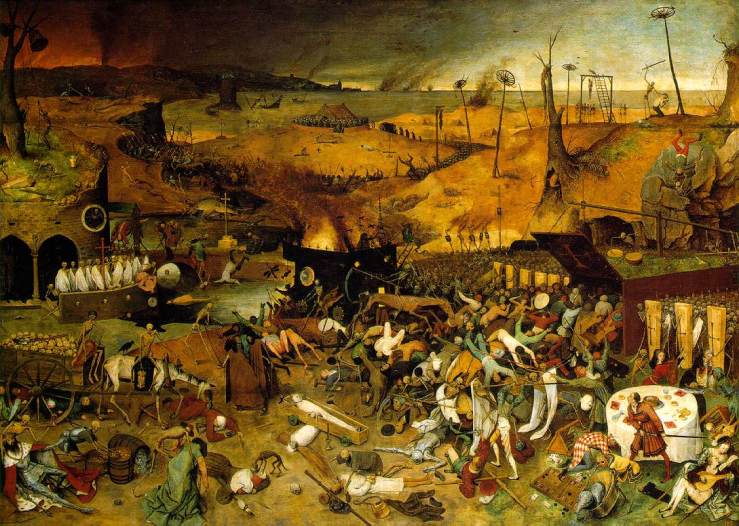
Ultimately, all of Underworld‘s themes–garbage, art, war, insulation, paranoia, drugs, death, secrets, baseball, identity, etc.–threaten to crush the narrative under their sheer weight. Unlike Pynchon, Barth, Coover, and DFW, DeLillo is rarely playful or even fun; most of the humor here serves to alienate rather than connect the reader to the characters. The book is masterfully written, and any number of the little vignettes, like the sad life of the Texas Highway Killer, or the Space-Age compartmentalization of a 1950s suburban family, expertly delineate DeLillo’s handling of concepts and motifs. However, the book’s prologue, “The Triumph of Death” (the title alludes to Bruegel’s painting), an account of the 1951 Dodgers-Giants pennant game is easily the most passionate, intense, and engaging moment of the novel. This assessment isn’t meant to suggest that the remaining 700 pages or so of Underworld aren’t as rewarding, they just aren’t as fun. Underworld is probably a work of genius, and the sum of its many, many parts do add up to more than the corpus, only that sum will probably leave a lot of readers feeling cold.

Brundibar — Maurice Sendak

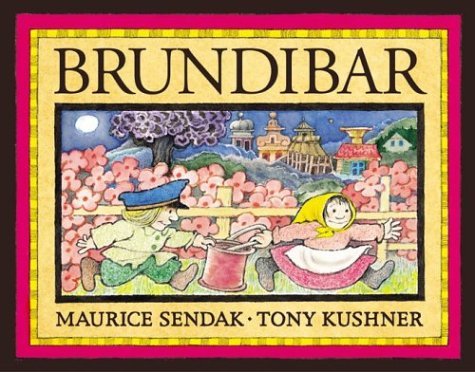
Adapted by playwright/screenwriter Tony Kushner and illustrated by Maurice Sendak, Brundibar retells Hans Krása’s children’s opera about a brother and sister who go on an adventure to get their ailing mother some fresh milk. The penniless pair decides to sing in order to earn milk money, but the cruel organ grinder Brundibar chases them away. However, they triumph with the help of a sparrow, a cat, a dog, and a cadre of helpful children.

The original opera was first performed by the children-inmates of a Nazi concentration camp in occupied Czechoslovakia. The symbolic overtones of the story are pretty straightforward, and Sendak emphasizes the point, marking his Brundibar with a Hitlerish mustache and a ridiculous Napoleon Bonaparte hat. Political symbolism aside, Brundibar is simply a great book, full of little songs, beautiful art, and a unique narrative style in which individual characters get their own speech bubbles and even street signs tell a story. This isn’t my one-year old daughter’s favorite book–yet–but it’s certainly one of my top picks from her little library. Good stuff.

On Rereading

So I just read Blood Meridian again. And–

Like many bibliophiles, I have a stack of books marked “to read,” both a physical and a mental one, a stack that only grows, one that my book-buying addiction feeds and that the reader in me can in no way deplete. The saddest thing in the stack–or about the stack, really (about is the proper preposition, not in) are all the books that I’m sure are just totally great (Atonement, The Sot-Weed Factor) and the ones that I’ve started at least half a dozen times yet never finished–yet (Gravity’s Rainbow, The Wind-up Bird Chronicles) that might not ever get read because of all the new books that get thrown on the stack.

The saddest thing though, is that we–and the “we” here is not editorial, folks, it refers to bibliophiles–we simply don’t reread enough. Because I teach high school, there are dozens of books that I get to reread every year. Every time I read Macbeth or Of Mice and Men or Their Eyes Were Watching God, I’m amazed by how rich and complex and just downright masterful these books are. Each new reading produces new insights, layers, new motifs unraveled, new details, once seemingly mere happenstances, reveal themselves as key to the whole ship and shebang. Rereading is good. And yet we don’t reread enough, precisely because of the stack, the insane egomaniacal compulsion to read all of the great books before, uh, death.

And so well and so thus I reread Blood Meridian. I read it a few months ago, put it down in a daze, read a few more books, all etiolated by comparison, and then, despite the stack I picked up Blood Meridian again, a strange ineffable compulsion forcing it into my hands; I didn’t want to reread the whole thing, just a few passages, and then, and then, well and then so well and thus I was just rereading the whole thing, a whole new book there under the book I thought I had read, had known, knew. I had experienced this before: when I first read Holden Caulfield, we were the same age; five years later I was five years older and he was a jerk. A decade passed and he was an alien (maybe I was a phony). Now, well, now I’m afraid to read the book

We can’t ever really know a book because we change. The book doesn’t change but the reading of the book changes. Because I get so much out of a rereading, because I know that reading in itself is not enough, the stack–which, I should probably emphasize, is a very real, physical presence, a little mound by my bed–because of this, there is a second distress, a pain of not only not being able to read all of the books, but also not being able to not reread many of them that deserve it.

So and well, after I reread Blood Meridian, I do something that I do after I finish every book–I go pick up a couple of books that I’m desperate to reread, as well as a few from the stack. The feeling is strange and breathless and giddy, and ultimately overwhelming. I uncover over old bookmarks, shocked that I made it so far on the last attempt, or stumble over the first five pages. I lie to myself, reading sections of Finnegans Wake, as if.

Right now I’m halfway through DeLillo’s masterpiece Underworld. It’s huge and unwieldy and really fucking good, and I will finish it–this time–but even as I read it I know that I’m missing half of it, that I can only really “get it” in the rereading. And yet and well this is a book that’s been in the stack for years. I have no solution, and I guess there’s no point to this post, only that I wish I had more time to read and then to read again.

Poster Making

If you had a million years to do it in, you couldn’t rub out even half the ‘Fuck you’ signs in the world. It’s impossible. –Holden Caulfield in The Catcher in the Rye

Royal Art Lodge piece from Lots of Things Like This, a slim volume of pictures with words (or words with pictures?) included with McSweeney’s #27 (two other books comprise the issue: a volume of short stories including pieces by Jim Shepard and Stephen King, and a really cool notebook of weird doodles and crazy thoughts by Art Spiegelman). Other artists represented in Lots of Things Like This include Magritte, Goya, Warhol, Raymond Pettibon, Jeffrey Brown, Leonard Cohen, David Mamet, David Berman, Basquiat, and more.

The Believer’s 2008 Reader Survey: (What Some Jokers Thought Were) The Best Books of 2007

The current issue of The Believer features the results of the reader’s poll, as well as the editor’s top pick, for the best books published in 2007. The editors chose Tom McCarthy’s Remainder, which we haven’t read, and the readers picked Junot Díaz’s The Brief Wondrous Life of Oscar Wao, probably because the hero is such a nerd. The list follows with our comments; titles are linked to our reviews.

  1. The Brief Wondrous Life of Oscar Wao—Junot Díaz
  2. The Yiddish Policemen’s Union—Michael Chabon: We didn’t like this book and are frankly astounded at all the praise it’s garnered.
  3. The Savage Detectives—Roberto Bolaño: It’s in a stack waiting to be read. The stack is very big though, and the book is very big, so, who knows (in all likelihood it will beat out last year’s reader fave, Pynchon’s impossibly large Against the Day).
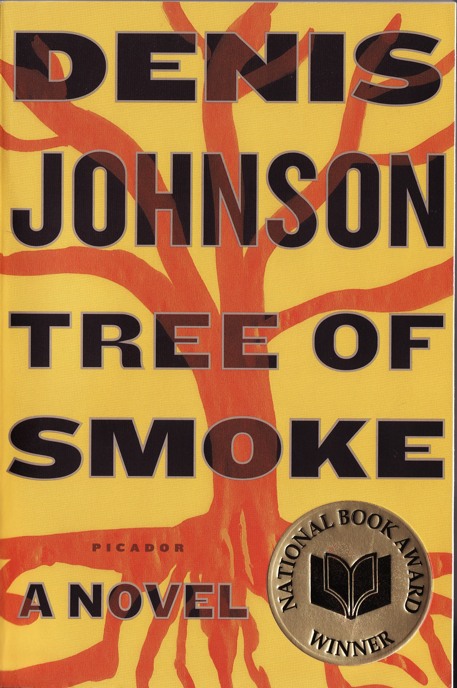
  4. Tree of Smoke—Denis Johnson: We loved it. Top pick of the year. Very divisive, strangely–just read through the Amazon reviews.
  5. Then We Came to the End—Joshua Ferris
  6. No One Belongs Here More Than You—Miranda July: Oh my gosh. Seriously? Really? I read half of this at a Barnes & Noble, no exaggeration. I sat and drank coffee and read it. I’m not saying that a book has to take a while to read in order to have weight or substance, but in this particular instance, no, nothing, fluff. This is the kind of thing that people who quit reading after high school mistake for literature.
  7. On Chesil Beach—Ian McEwan: The library has this on CD; I’ll listen to it this summer. I’ve grappled with the first five pages of Atonement too many times to bother, really. And then I saw the movie, and it sucked. So…
  8. Zeroville—Steve Erickson
  9. Like You’d Understand, Anyway—Jim Shepard
  10. Slam—Nick Hornby: We suspect that The Believer‘s readers are partial to Hornby; would they have given another Young Adult novel a nod? We doubt it.
  11. Divisadero—Michael Ondaatje: Also in the stack.
  12. Bowl of Cherries—Millard Kaufman: A pamphlet containing the first three chapters was published as an insert in an issue of McSweeney’s. It was pretty funny.
  13. Varieties of Disturbance—Lydia Davis
  14. The Absolutely True Diary of a Part-Time Indian—Sherman Alexie: This was fantastic. And it was YA! We rescind our Hornby complaint.
  15. The Abstinence Teacher—Tom Perrotta
  16. Call Me by Your Name—André Aciman
  17. After Dark—Haruki Murakami: Murakami is the writer we wished that we love but we just can’t get into. We remember reading some of his short fiction years ago, in Harper’s and other places, but even The Elephant Vanishes was a trial to get through.
  18. Darkmans—Nicola Barker
  19. Diary of a Bad Year—J. M. Coetzee
  20. Falling ManDon DeLillo: Dry, self-important, rarely engaging, and not nearly as good as it was pretending to be, Falling Man was only a step above its dark twin, Cosmopolis. Continue reading “The Believer’s 2008 Reader Survey: (What Some Jokers Thought Were) The Best Books of 2007”

To the Castle and Back — Vaclav Havel

Václav Havel’s latest memoir To the Castle and Back plays as a strange series of paradoxes. It’s elliptical and fragmentary yet thorough and exhaustive; it’s personal and introspective yet political and social; it presents a total picture of Czechoslovakia’s 1989 Velvet Revolution and the subsequent dissolution of Czechoslovakia into the Czech Republic and Slovakia, yet it repeatedly admits to being unable to convey the full story. The narrative of the Velvet Revolution is fascinating even for those who aren’t political junkies. Make no mistake though–To the Castle in Back will be most enjoyed by people who can’t get enough of world politics. The book is larded with dry political details, and Havel the poet and playwright, Havel Lou Reed’s buddy, Havel the Zappa enthusiast–in short Havel as hipster–is largely absent from this text. Instead, we get journalistic accounts of Havel as politician and speech maker interwoven with Havel’s own commentary and even interoffice memos. At times the level of detail is almost excruciating, but Havel seems to understand this. His preface to the book actually serves as the best review (and guide) possible:

If you occasionally feel like putting the book aside because it seems to skirt some of the world-shaking events that I lived through, or to burrow too deeply into exclusively Czech or Czechoslovak matters, I urge you to skip ahead. It’s easy to do because the book is divided not only into chapters but into short sequences, separated by horizontal lines.

Late in the memoir, Havel writes that for all of his life, he’d “longed to write a brutally honest diary, something in the style of Henry Miller, Charles Bukoswki, [or] Anaïs Nin.” And while To the Castle and Back hardly approaches the rough and scandalous material of that mid-century triad, it does contain something just as honest perhaps: an unglamorous, unromanticized accounting of the past told at all times with the caveat that this story is not history writ large, but rather the perspective of someone who lived through it and acted upon it. Honest, moving, often humorous, and, yes, occasionally dull, To the Castle and Back is probably not a book for everyone, but for those interested in the man and the events of the Velvet Revolution it makes a competent introduction.

Summer Reading List: Anthologies to Know and Love

No summer reading is complete without imbibing the variegated prose of an anthology. The following are the literary equivalents of skillfully-detailed mixtapes, made by a friend who wishes to communicate only that he or she has your best interest at heart.

The 2008 O. Henry Prize Stories anthology is a great way to play catch up on all of the reading you missed last year. Culled from publications like Zoetrope, Harper’s, Granta, and Tin House, this anthology features established masters like William Gass and Alice Munro along with newer voices. There are plenty of highlights and no duds. Sharon Cain’s “The Necessities of Certain Behaviors” explores an amorphous world of gender-bending, while Stephen Millhauser’s “A Change in Fashion” imagines a new mode where women cover every inch of their flesh from the gaze of men. Lore Segal’s “Other People’s Deaths” perfectly captures the painful awkwardness and shame we experience when encountering, um, other people’s deaths. Similarly, the title of Tony Tulathimutte’s “Scenes from the Life of the Only Girl in Water Shield, Alaska” is spot-on, and Gass’s contribution, “A Little History of Modern Music,” is the funniest monologue we’ve read all year. But our favorite in the collection has to be Edward P. Jones’s “Bad Neighbors,” which examines the changing fortunes of an African-American neighborhood in Washington, D.C. A great collection, and if a story disappoints you, there’ll be three to make up for it.

In the ultimate in lazy reviewing, we will let the title of McSweeney’s kids anthology Noisy Outlaws, Unfriendly Blobs, and Some Other Things That Aren’t as Scary, Maybe, Depending on How You Feel About Lost Lands, Stray Cellphones, Creatures from the Sky, Parents Who Disappear in Peru, a Man Named Lars Farf, and One Other Story We Couldn’t Quite Finish, So Maybe You Could Help Us Out stand as its own summary. However, this is a beautiful book with lots of lovely pictures, and the collection is worth it for Nick Hornby’s story alone. Good stuff.

Edited by superstar Chris Ware, The Best American Comics 2007 serves as a delicious tasting menu of some of the best comix published in the past few years. Although hardcore comix fans will no doubt have already read the selections from Charles Burns’s Black Hole and Adrian Tomine’s Optic Nerve, there’s plenty here for aficionados and newbies alike.

Chances are you’ve read a number of the canonical texts in 50 Great Short Stories, but it’s also likely you haven’t read them in years. We’ve had this book for years, and have revisited often to indulge in old favorites for new inspiration. Classics like Shirley Jackson’s “The Lottery” and Hemingway’s “The Three-Day Blow” nestle up against lesser-reads like Edmund Wilson’s “The Man Who Shot Snapping Turtles” and Francis Steegmuller’s “The Foreigner.” And have you read Flannery O’Connor’s “A Good Man is Hard to Find” since high school? No? Shame on you! What about Carson McCuller’s “The Jockey”? Dorothy Parker? Kipling? Consider it a light crash course in great literature.

Summer Reading List: Tales of Romance

Summer lovin’: have a blast. You don’t have to read harlequin schlock to get romantically fulfilled on the beach this year.

Why not start with an overlooked, under-read classic from American Renaissance master Nathaniel Hawthorne. The Blithedale Romance is a fictionalized account of Hawthorne’s time on Brooke Farm–here called Blithedale–an attempt at a utopian commune founded by artists and free-thinkers. Free lovin’, amorous passions, and, uh, farming. Great stuff–and romance is right in the title.

For lighter yet still substantial fare, check out Lara Vapnyar’s Broccoli and Other Tales of Food and Love, a delicious collection of snack-sized short stories (please, please, please forgive this awful extended metaphor). Sly, smart, and occasionally sexy, Vapnyar’s tales of dislocated immigrants continue to linger on the palate long after they’ve been digested (sorry!). The recipe section at the end is the sweetest dessert (ok, I swear I’m done now).

If you like your love stories rougher around the edges, check out Charles Bukowski’s only masterpiece, Women. This rambling novel follows alter-ego Henry Chinaski’s late-in-life successful turn with the ladies. Ugly, unforgiving, honest, and hilarious, Women is one of my favorite books. Also, unlike Henry Miller’s Tropic books, you’ll actually finish this one.

We finally read Charlotte Brontë’s Jane Eyre last summer, and believe it or not, the book is pretty great. Truly a romantic classic, but also a fine comment on gender, class, and social mores in general. And if you like it, check out Jean Rhys’s Wide Sargasso Sea, which tackles the back-story of a certain crazy lady in the attic who didn’t exactly get a voice in Jane Eyre.

Finally, if you want to get very specific, don’t hesitate to search the Romantic Circles website. Plenty of resources and lots of electronic texts: your source for all things Blake, Wordsworth, Coleridge, Shelley, Keats, and more. Good stuff.

Summer Reading List: Tales of Adventure

Indulge yourself this summer by taking a fantastic voyage–literary or literally. To help you get started, check out the following tales of adventure.

William Vollman’s The Rifles, part of his as-yet-unfinished Seven Dreams series is a brilliant engagement of history, colonialism, identity, and all of those Big Profound Issues that we so adore in our modern literature. It’s also a really cool adventure story, the tale of John Franklin’s nineteenth-century exploration of Inuit territory. Sad, beautiful, breathtaking.

If you prefer your adventure tales uncomplicated by postmodern gambits, check out John Krakauer’s Into Thin Air, a journalistic account of the writer’s 1996 ascent of Mt. Everest, and the disasters that befell his expedition. The word “harrowing” fits well, gentle readers.

On the lighter-but-not-too-much-lighter side, Jeff Smith’s self-published comic Bone is fantastic; even better, you can get the entire 1300 page run of the whole series in Bone: One Volume Edition. We use the word “delightful” here in an absolutely unpejorative sense, friends: the adventures of Fone Bone, his cousins Phoney Bone and Smiley Bone, and Thorn, Granma Rose, and the Red Dragon are epic in scope yet retain an honest humor that will keep in the most cynical folks laughing. A major literary accomplishment that has been unjustly overlooked.

Also somewhat overlooked is Herman Melville’s Benito Cereno. In Bone, protagonist Fone Bone lugs around a massive copy of Melville’s masterpiece Moby-Dick everywhere he goes–and while that book is undoubtedly a desert island classic, Benito Cereno is an underappreciated gem of a tale. Revealing the strange secret at the heart of this book would spoil it, so suffice to say that the short novel enigmatically investigates slavery and colonialism in ways that beg for closer analysis. Good stuff.

Perhaps, though, you beg for the real thing. In that case, we recommend Ultimate Adventures (from Rough Guides) for all your camel-trekking-in-the-Sahara, rock-climbing-at-Joshua-tree, Pacuare-River-rafting needs. Beautiful photography and tantalizing descriptions are coupled with informative “Need to Know” sections that spell out the who-what-when-where-and-how that will help you get your adventure under way.

Also in the exploratory vein, Where to Go When: The Americas, from DK’s Eyewitness Travel, serves as a kind of travel almanac–the kind that makes you wish you were very, very rich with an excess of free time. If that were the case, you’d be spending nine days in May on the Amazon River, spotting pink river dolphins, gorgeous macaws, and darling squirrel monkeys instead of reading this blog right now. Even if you’re not excessively rich with nothing more pressing to do other than trek the Alaskan fjords, The Americas is fun daydreaming material–perhaps the realist response to Vollman’s Seven Dreams. In any case, Ultimate Adventures and The Americas both come out at the end of this summer, giving you plenty of time to plan that awesome adventure getaway for next year.

Summer Reading List: Primer–Beach Reading and School Reading

The end of the Memorial Day weekend marks the beginning of summer, and with it, summer reading. This week Biblioklept will offer up some swell reading suggestions that will both entertain you and make you a better human being (seriously). In advance of that, let’s start with a silly question: just what is “summer reading” and how is it different–or is it different–than any other type of reading?

We’ll divide summer reading into two distinct camps: there’s elective summer reading, which we will henceforth call beach reading (no beach need be involved, as we will soon see), and then there’s the summer reading forced upon young people, henceforth known as the mandatory summer reading list. Let’s look at mandatory reading first, and then quickly dismiss it.

The lists. Oh the lists. We imagine most of our audience has been through the whole mandatory summer reading drill: schlepping around Barnes & Noble (or B. Dalton, back in the day), diligent Mom with said list clutched in hand, the embarrassment of the whole thing summed up in the piles of A Raisin in the Sun and A Separate Peace displayed in the aisles, the sullen look of an emerging sophomore gripping various honeybee-colored editions of Cliff’s Notes, the indignant cries of younger siblings, also forced to read, your never-read copy of My Side of the Mountain foisted upon them. The list seems impossible: A Portrait of the Artist as a Young Man? The Aeneid? Tess of the D’Ubervilles? Christ on crutches! Almost everything else in the bookstore seems doubly alluring by comparison. We want to read what we want to read, not what you tell us we want to read

This isn’t to suggest that a codified summer reading list should be done away with, of course. Summer reading helps to keep young people’s minds engaged during a time when they’d otherwise, let’s face it, consume naught but the cotton candy fare of Grand Theft Auto and Flavor of Love. Without the rigors of summer reading, students would return to school in the fall with their mind-muscled atrophied, puny, impotent. Still, having someone mandate what you should read is never fun. We had to go back years later, on our own, to appreciate much of what was forced upon us in youth.

That said, summer is a fine time to go back to those very lists. Just because you didn’t “get” Don Quixote when you were fifteen (and really, why would you have?) doesn’t mean that you won’t find it hilarious now that you’re older and your frames of reference have so greatly expanded. Ditto Moby-Dick, The Turn of the Screw, Walden, et al. There’s no rule that what we are calling here “beach reads” have to be light and fluffy. Still.

Ideas of just what constitutes beach reading, are, of course varied. But for many of us, beach reading implies a book that we can read on the beach or by the pool or swaying in a hammock in our backyard. Beach reading is a book that we can still follow after three beers on the porch. Beach reading can be trashy and lurid; beach reading can be literary junk food. Beach reading is genre fiction in cheap mass produced paperbacks, the kind of books we’re happy to leave at the condo when we’re through with them. Someone else will find them, digest them along with a blender of margaritas. At the same time, for a lot of us beach reading is the time to play catch up with all those books that have been stacking up in the margins of our homes, neglected, unread. In any case, summer is a time that many of us put renewed energies into pursuing the endangered pastime of reading, and over the next week Biblioklept aims to aid the cause.

Tearing Down the Wall of Sound: The Rise and Fall of Phil Spector

Even if Phil Spector hadn’t given us the recent spectacle of an outlandish murder trial, Mick Brown’s Spector biography Tearing Down the Wall of Sound would still make for a gripping read. Brown’s biography, simply put, is the definitive Spector book. At nearly 500 pages (including endnotes and an extensive bibliography), Tearing consistently treads the thin line between exhaustive and exhausting, but the source material–Spector’s insane life–is simply too compelling to ever earn a yawn. Just when it begins to feel that Brown has given us too much detail, we’re rewarded with yet another tale of Spector’s lunatic shenanigans. And whether he’s pulling a gun on the Ramones, drunkenly berating Michelle Phillips, praising Ike Turner and Yoko Ono, or fighting with the Beatles, Spectors’s crazy mischief is exactly the kind of stuff we love to read in a celebrity biography. However, lurid stories never trump the real reason to read this book: Spector as musical genius. There’s plenty here to please hardcore audiophiles, including long discussions of the evolution of Spector’s famous “wall of sound” and the producer’s tumultuous relationship with arranger/songwriter Jack Nitzsche. All the episodes of Spector’s life are here–his early teenybopper days with the Ronettes, his “making” of Tina Turner, his battles with the Beatles (both as a group and individuals), his “comeback” shot with the Ramones, and even his late disillusionment with, um, Celine Dion. These segments are bookended with a detailed consideration of Spector’s recent troubles, beginning with a secretive Spector secluded in his California mansion right before the alleged murder of B-movie actress Lana Clarkson, and a lengthy, journalistic afterword explaining the events of Spector’s much-publicized trial, right up to the September 2007 mistrial ruling. Heady stuff.

Photograph by Brad Elterman

Ultimately, Brown crafts Spector’s strange life into a bizarre bildungsroman; he paints Spector respectfully but never reverentially, revealing a Promethean hubris in his subject that veers into self-annihilation. At the same time, Brown’s Spector is an utterly American story, a classic reinvention tale. Even when Spector is at his most petulant, paranoid, and downright awful, Brown never lets us lose sight of the man’s sheer force of will and his enormous contribution to American music and culture. Brown’s book reminds us of the myriad ways Spector transformed our notions of pop music, but he leaves us wondering if Spector will indeed be able to rise like the phoenix from his latest debacle or if his upcoming retrial will be the end of the music.