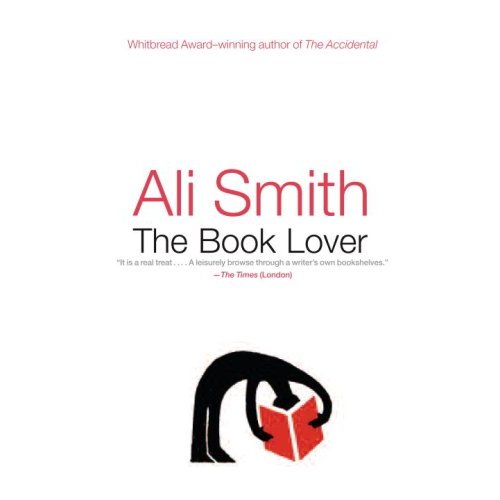
The Book Lover – Ali Smith

the-book-lover1

Let’s start with a confession–I haven’t finished reading all of Ali Smith’s anthology The Book Lover yet. Like most collections I own, there’s a fair chance that I won’t read every story, essay, or poem collected here, but chalk that up to the nature of anthologies. With any compilation, there are always going to be those great, transcendental moments where you’re suddenly hipped to a new voice, a new sound, a new vision, or re-introduced to an old friend you hadn’t thought about in quite some time. There will also be those texts that fail to grab you at the first sentence (or, rather, you fail to put the work in), and those texts that are simply a bit too long for the gap you’re presently trying to fill. So far, The Book Lover has been mostly filled with bits of shining revelation, startling wit, and plain old great writing, and I’m not going to spoil the meal by forcing it all down at once.

In collecting some of her favorite voices, Scottish author Ali Smith displays a keen understanding that the literary omnibus is peculiarly open to discontinuous and scattered readings. She prefaces The Book Lover with a quote from Virginia Woolf: “Any method is right, every method is right, that expresses what we wish to express, if we are writers; that brings us closer to the novelist’s intentions if we are readers.” Woolf’s words invite us to read the collection in any manner we wish, and I followed suit, picking it up in spare moments, usually at work, where I rarely get the time to concentrate on anything like a novel for a sustained amount of time. Still, Smith has put a great deal of thought into the arrangement of her sources, grouping them into six sections, GIRLS, DIALOGUES, JOURNEYS, THE WORLD, HISTORIES, and BELIEFS. The pieces in the section sometimes speak to each other directly (Hilda Doolittle’s “The Cinema and the Classics: Beauty” followed by Colette on “Mae West” followed by Lee Miller on “Colette”), but more often than not the pieces respond to each other in an oblique, layering fashion. It’s left to the reader to link William Blake’s “Infant Joy” to a section from Anne Frank’s diary, or connect the dots between Tom Leonard’s hilarious poem “baa baa black sheep” and the strange journalism of Lorna Sage’s “Our Lady of the Accident.” These connections were most interesting to me when re-encountering a text I was utterly familiar with, like the “pear tree” passage from Zora Neale Hurston’s Their Eyes Were Watching God, re-contextualized with something I’d never read, like the selection from Billie Holiday’s autobiography, Lady Sings the Blues (note to self: go get Lady Sings the Blues).

Ultimately, The Book Lover is successful in that it doesn’t attempt to be a “greatest hits” collection; instead, we’re treated to a wide selection of diverse and often dazzling writers. Smith’s project will not only introduce you to writers you haven’t yet read, it will make you want to read their works as well. I will, however, admit to being a little bit jealous: I think I’d love to put my own anthology together. After all, I’m a book lover too. In this sense, The Book Lover inspires its readers to think about the value of their own libraries, the way that the authors that they love speak to each other across time and space. Recommended.

The Book Lover is now available in the US from Anchor Books.

Child of God — Cormac McCarthy

child-of-god

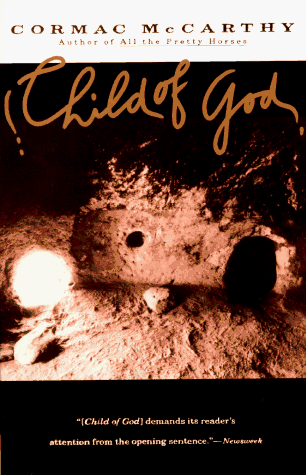
In Greek drama, acts of violence or sex were “ob skena” and had to take place off stage. Thus, the horrific violence of Oedipus gouging out his eyes is not shown, but rather reported by a messenger. We see the same tradition in Shakespeare, of course, as well as the modern novel. And while many writers elide scenes too taboo or offensive to the sensibilities of the general reading public, books like Ulysses, Lolita, and Tropic of Capricorn, demonstrate that novels are often the site of debate over what can and cannot be shown or described or articulated plainly in our culture. Our concept of “the obscene” (the Greek “ob skena” simply translates to “off stage”) demands that certain actions might only be referred to or implied, but not graphically depicted, that the offensive action takes place out of our vision. The great lie or paradox of the obscene then is that in pushing the offensive action off stage, the author necessitates that the audience must envision that very action that was removed, that they must articulate their own understanding or schema or representation of what is taboo. While this strategy can often be quite effective and affecting (think of Tarantino pulling the camera away as Mr. Blonde cuts off the cop’s ear in Reservoir Dogs), in a character-centered novel it can also lead to a larger denial, a larger exclusion. What if one’s whole life was obscene? In his third novel, Child of God, Cormac McCarthy tells the story of a man who has been pushed from life’s stage, who exists in the uncanny and indigent margins of society.

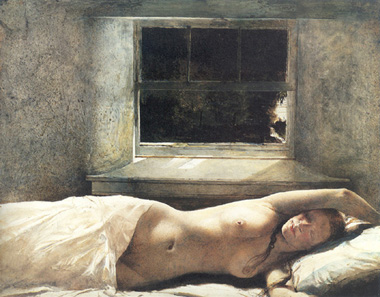
The ersatz protagonist of Child of God, Lester Ballard, is a poor, stooped, abject wretch of a man. The book opens with Ballard losing his house in a humiliating debacle. From there, he wanders the earth, finding an abandoned shack and barely eking out the means to leave. Ballard is an outsider, literally, always looking in at the lives of more normal, more stable people. His voyeurism leads him to creep up to parked cars to spy on the lovers inside. Wanting some connection or sense of love–or perhaps just out of general dejected weirdness–he masturbates against the cars, watching the people inside. His identity as voyeur is magnified in his only apparent skill. Ballard is an ace sharpshooter who carries his rifle almost everywhere he goes, surreptitiously spying on the normal folks through its lethal scope.

wyeth2

As the book develops in McCarthy’s spare, terse prose, Ballard becomes more and more unhinged. Everywhere he goes he is slighted or outright rejected and cheated by his fellow man. The indignities and affronts against Ballard range from being falsely accused of rape to simply being ignored by his neighbors. At the same time, Ballard is a creep, a loser, and seems largely deserving of this treatment. And yet, as McCarthy points out early in the novel, he is a “child of God, much like yourself perhaps.” This early call to identify with Ballard as a fellow human being is constantly strained by his wildly antisocial behavior, and yet it’s McCarthy’s genius as a writer that anchors the novel in some measure of sympathy for such a wretched anti-hero. When a young girl rejects Ballard’s advances, she taunts him, saying, “You ain’t even a man. You’re just a crazy thing.” In many ways, this is the major question of the novel: Is Ballard a man, or a thing? What makes a person a person, and not simply an object estranged from the human race? To test this question, McCarthy has Ballard plumb almost every conceivable taboo, from murder to arson to necrophilia. However, Ballard isn’t the only one in these Tennessee backwoods who behaves despicably: there’s the father who rapes his daughter, the gangster behavior of the Ku Klux Klan, and the mob justice of the townspeople as a whole. Still, Ballard’s descent into violence and madness–graphically portrayed by McCarthy–is the central action in this compelling novel.

Readers looking for redemptive story arcs or tales of heroism will likely be turned off by Child of God, and squeamish readers will probably not get past the first fifty pages. Those interested in McCarthy’s fiction will find more in common here with the visceral grit of The Road or Blood Meridian than the reflective romanticism of his “Border Trilogy” novels (including crowd pleaser All the Pretty Horses). Child of God is in many ways a response to the Gothicisms of Carson McCullers and William Faulkner, and certainly bears favorable comparison to those writers’ works. And like those writers’ works, McCarthy’s novel has its challengers–just as recently as 2007 an English teacher found himself in quite a bit of trouble for loaning the book to a student. Those who see the book as obscene are perhaps right, in the sense that the word implies “that which must be shown off stage.” However, one of the legal definitions of obscenity necessitates that the work “lacks serious literary, artistic, political or scientific value,” a claim that I do not think can be seriously substantiated against Child of God. Don’t believe me? Read it for yourself.

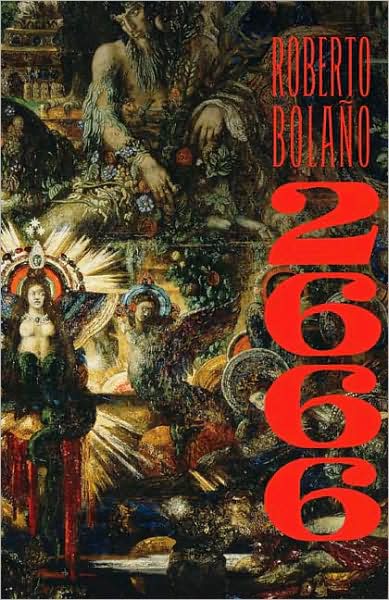
2666 – Roberto Bolaño

2666

Where to start, where to start…

Do I say that the book is good, great, fantastic, a literary achievement? These words don’t seem big enough, or they seem like hackneyed clichés, ugly inadequacies. Here’s a very short review: go get the book and read it. Worried that 900 pages is too long? Don’t worry. They fly by. I read the book in less than a month, usually in forty or fifty page sittings, something I usually don’t make time to do. But hang on, I’m already off to a bad start I admit, there’s no context here, is there? Let me try again.

2666 is Chilean exile Roberto Bolaño’s posthumous magnum opus. The book comprises five sections, each focusing on a separate but often overlapping set of characters and locations. The book is, in my paperback edition (composed of three separate books) 893 pages long. The book is excellent, addictive, full of pain and pathos and humanity. Most of the sentences are very, very long. What is it about, then? There are too many answers to that question, but here goes–

There are two major, intertwined plot threads in 2666, one about a series of gruesome rapes and murders in the fictional city of Santa Teresa, Mexico, and the other concerning an obscure German writer with the improbable name Benno Von Archimboldi. These two threads weave through the labyrinth that is 2666, connecting the many themes and tropes and moods and tones of this massive novel. Bolaño’s styles shift and weave and morph throughout the book, evoking laughter and rage and pity and anticipation and overwhelming sadness. He’s very often philosophical but never abstract, lyrical but grounded, and always entertaining. Bolaño’s command of thousands of different voices is on display here, whether he’s telling the tale of an ex-Black Panther or an exiled Russian sci-fi writer, a Romanian general or a crippled Italian critic. Bolaño’s voices layer upon each other in a strange chorus; often I found myself shocked at how, 300 pages later, a different character in a different place and time will hit on the same note–a comment about semblances and reality, or graveyards, or fate and chance and choice, or mirrors, or dreams and nightmares, or giants, or insane asylums, or aliases and pseudonyms–only this new character will express this note in a new or different tone, adding to the richness and dazzling complexity of the tale. Bolaño’s voices are often framed in a series of tales like Russian nesting dolls, only, where a writer like John Barth might explicitly announce or call attention to this device, Bolaño’s storytelling has a humanistic, natural quality, a quality that provokes and calls attention to the limits of human memory and our collective capabilities to narrativize our lives. But hang on again, I’ve gotten away from plot summary, haven’t I? Do you really need a summary? Yes? Will, “It’s about everything. Life, death, all that shit,” will that not do? Okay. Another attempt, then.
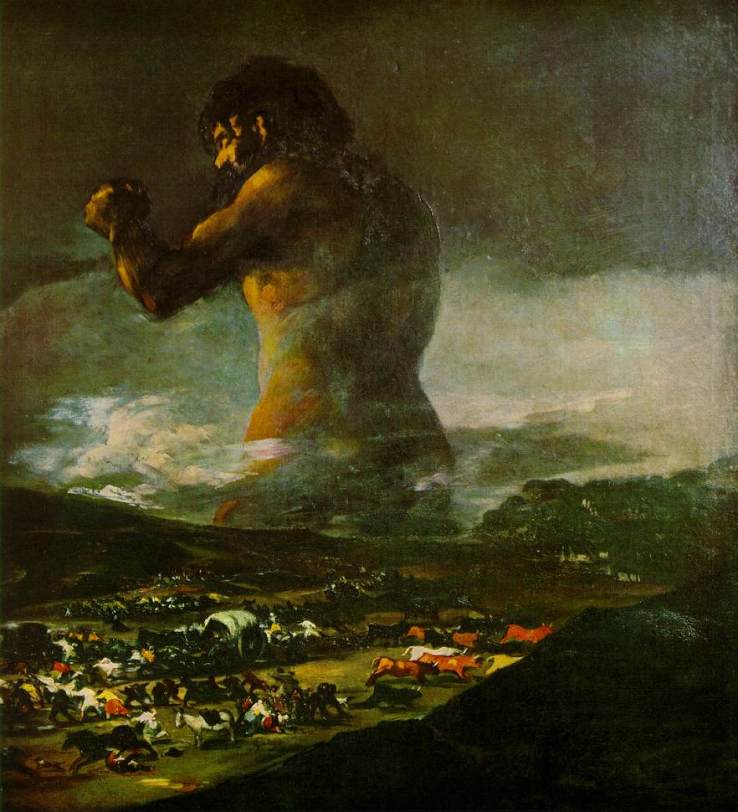
goya-colossus

The first section of 2666, “The Part About The Critics,” tells the story of four critics from four European countries who specialize in Archimboldi; in fact, two of the critics pretty much invent Archimboldi studies. Through their critical endeavors, the obscure, unphotographed writer rises to greater prominence. The four set out to find him, initiating the novel’s detective lit thread. They wind up in Santa Teresa, a city experiencing a seemingly endless slew of murders. In Santa Teresa, they meet a Chilean professor named Amalfitano, who (obviously) features heavily in the next section, “The Part About Amalfitano.” At this point, we start discover more about the unsolved rapes and murders of young women in Santa Teresa, but these crimes linger in the background, the story of Amalfitano, his ex-wife, his daughter, and a geometry book hanging from a clothes line at the fore. Amalfitano’s teenage daughter returns in the third section, “The Part About Fate.” This part of the novel details Oscar Fate, an African-American reporter who travels to Santa Teresa to cover a boxing match only a few days after the death of his mother. “The Part About Fate” builds to a rapid, grotesque, nightmarish climax, where the journalist, alien and impartial visitor, silent observer, becomes implicated in the ugly violence and grim desperation of Santa Teresa. This rhetorical move leads the reader into the longest section of 2666, “The Part About The Crimes,” in which we finally learn about the gruesome murders–hundreds and hundreds of murders–of the young women who work in the factories of Santa Teresa. The final section, “The Part About Archimboldi,” works as a partial bildungsroman, revealing the life story of the man who becomes Benno von Archimboldi. But does “The Part About Archimboldi” wrap up all the riddles, seal the deal, lead us out of the labyrinth and into the light–do we get answers? Let’s see–

Readers enthralled by the murder-mystery aspects of the novel, particularly the throbbing detective beat of “The Part About The Crimes,” may find themselves disappointed by the seemingly ambiguous or inconclusive or open-ended ending(s) of 2666. While the final moments of “The Part About Archimboldi” dramatically tie directly into the “Crimes” and “Fate” sections, they hardly provide the types of conclusive, definitive answers that many readers demand. However, I think that the ending is perfect, and that far from providing no answers, the novel is larded with answers, bursting at the seams with answers, too many answers to swallow and digest in one sitting. Like a promising, strangely familiar turn in the labyrinth, the last page of the book invites the reader back to another, previously visited corridor, a hidden passage perhaps, a thread now charged with new importance. Like Ulysses or Moby-Dick or Infinite Jest before it–and yes, yes, I would class this book with those without batting an eye–2666 is a book that demands multiple readings. Fortunately, despite its grim subject, it’s endlessly entertaining, rich with literally hundreds and hundreds of stories, stories that impel and compel you to read, read, read. But, again like Ulysses or Moby-Dick or Infinite Jest before it, 2666 is not for everyone.
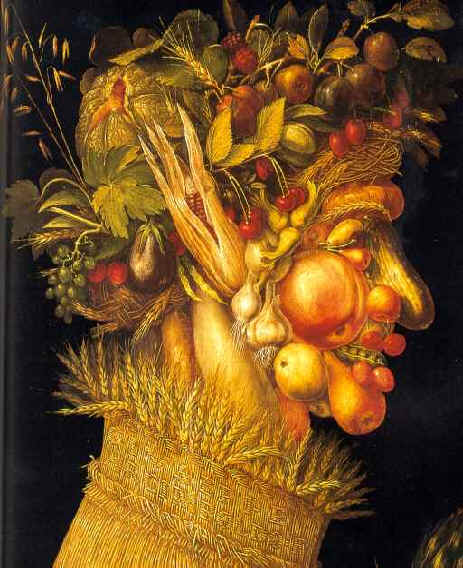
arcimb1

I’ll quote from the only negative review at Amazon right now, by one Mr. Nathan King, who writes, “This is not an enjoyable/pleasurable book to read. . . . this book is a GRUESOME and HORRIFICALLY VIOLENT book. The largest section of the book is basically 300+ pages of autopsy reports. You will read the words “vaginally and anally raped” over and over and over, until it runs through your mind day and night.” King’s review is accurate in several ways, although I fundamentally disagree with his overall assessment, of course. The book’s violence will run through your mind day and night: the book is awfully affecting. One of Bolaño’s missions in the book, it seems, is to continually press on the reader a horrific assemblage of dead, raped, mutilated bodies, bodies found in Dumpsters, trash heaps, ditches, alleys; violated, nameless, unclaimed bodies. While “The Part About The Crimes ” clearly contains most of these horrors, disposable bodies litter the entire book, whether they are Jews to be executed by Nazis in WWII or young men murdered in prison while the wardens watch. Bolaño’s method then is to confront his readers with all these unsolved, perhaps unsolvable crimes, and ask how one can witness to the horrors of life without giving in to despair or madness or suicide. Callous or cynical readers, looking for a simple answer to “Whodunnit?” will miss the multiplicity of answers that Bolaño provides, which might be boiled to: We all did it. We are all responsible for these crimes.

At many points throughout the massive tome Bolaño addresses this central problem, but this passage from “The Part About Amalfitano” sums up one possible solution quite beautifully. Amalfitano, slowly going insane, wondering about existence and movement and sleep and reality, thinks–

Anyway, these ideas or feelings or ramblings had their satisfactions. They turned the pain of others into memories of one’s own. They turned pain, which is natural, enduring, and eternally triumphant, into personal memory, which is human, brief, and eternally elusive. They turned a brutal story of injustice and abuse, an incoherent howl with no beginning or end, into a neatly structured story in which suicide was always held out as a possibility. They turned flight into freedom, even if freedom meant no more than the perpetuation of flight. They turned chaos into order, even if it was at the cost of what is commonly known as sanity.

To systematize, to narrativize then, to try to put order and meaning into one’s life, or the lives around you, to witness to others’ pain by claiming it as your own, these moves then betray one’s ability to accurately, or sanely, perceive the world. It’s this great cost that Bolaño navigates in 2666, and he does so with aplomb and precision and grace.

Have I still not convinced you to read 2666? I could keep going and going, on and on, and I won’t be the only one–Bolaño’s book will be one for posterity, a great work that literary critics (much like the ones he sympathetically parodies and valorizes here) will debate over, ponder over, discuss, write about, love, and be tortured by for ages to come. At the same time, this is not a book that one should feel is only for the “literary élite” (whatever that means)–with its force and vitality and inventiveness, with its rich, detailed dream/nightmare world, 2666 is a book that you, dear reader, should read, must read. Very highly recommended.
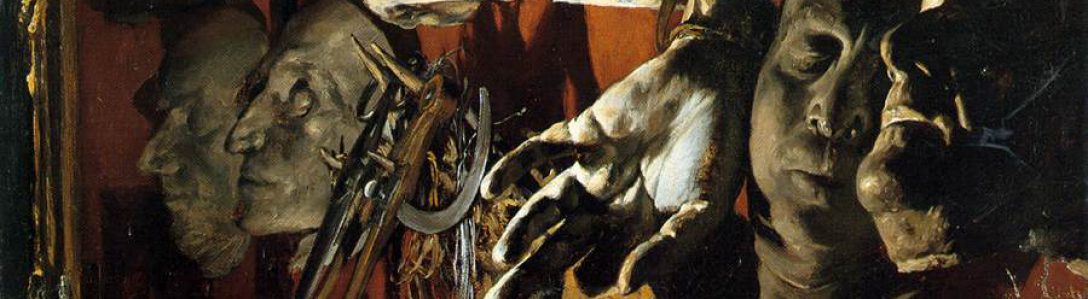
The Nation Guide to the Nation–Richard Lingeman

the-nation-guide

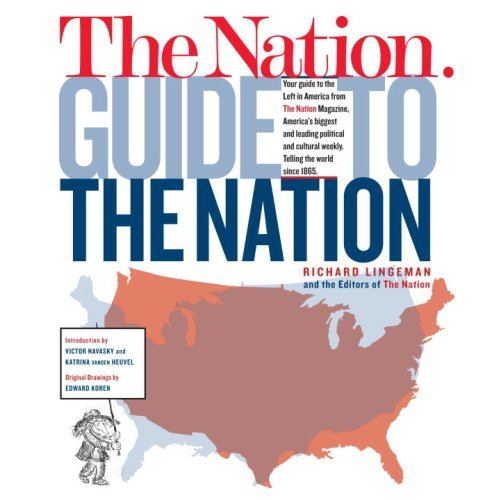
Part travel guide, part almanac, The Nation Guide to the Nation aims to be the go-to resource for progressive liberals around the U.S. The editors of America’s oldest liberal organ, The Nation, have compiled their Guide to help you answer burning questions: Need to find a “100 percent vegetarian restaurant” in Bloomington, Indiana? Interested in checking out “The world’s only unionized, worker-owned peep show co-op” ? Want to “wear a hemp dress at your wedding”? ( “It’s a cool thing to do,” the text assures us). Look no further. Organized into six sections — Cultural, Social, Environmental, Organizations, Media, and Goods and Services — The Nation Guide to the Nation covers everything from fair trade coffee to anarchist film festivals to organic soul food. Interspersed throughout the book are sections labeled the “Left Heritage Trail,” a shot at attempting to institute a sort of “must-see” registry of sites in the history of the progressive left. The “Left Heritage Trail” sections also serve as a (very brief) history of labor, environmental, and Civil Rights movements in the United States. The editors attempt to further expand the scope of the book by adding sections like “25 Greatest Political Films” (a fairly successful list), “A Left Mystery Tour” (do we really need our mystery novels to have a liberal bent?), and “Anthems of the Left” (Ugh. Their (hopelessly out-of-touch) top ten list includes frat boy favorite “Get Up, Stand Up” by Bob Marley and U2’s “Pride (In the Name of Love)”).

The book’s entries are short and informative, providing addresses, numbers, and websites, and in this sense, it’s really quite successful. However, its overall tone veers into a sort-of “How to Be a Liberal for Dummies” territory. It seems that most progressive thinkers already have the resources or networks to discover this stuff on their own, if they don’t already know about it. For example, do we really need help finding progressive radio stations in Berkeley or San Francisco, and is it especially revelatory to note that New York City has some great bookstores? Still, I will concede that there is probably a young kid in Iowa who would be quite turned on to see what else is out there (no offense to Iowa; apparently the Cedar Falls Farmers’ Market is a great place “to chat, hug, cuddle babies” and just generally have a great Saturday). It is really the uninitiated (or, I suppose, the poseur) who will benefit the most from this guide. Hopefully, as our new President takes office, Americans will begin to see that “liberal” is not a dirty word, and that progressive ideas and radical movements have driven most of the positive social changes in this country, from ending slavery to instituting a 40 hour work week to extending suffrage to women. Those uninitiated in–or resistant to–these historical realities would be well-served by checking out The Nation Guide to the Nation.

Timothy Fadek’s Images of Juárez

juarez

I’m about 60 pages away from finishing Roberto Bolaño’s posthumous magnum opus, 2666, an astounding, shocking book that you should pick up right now and start reading, unless, of course, you hate the idea of getting hopelessly addicted to a book that coerces you to read it, that lingers in the back of your mind and gut, beckoning, calling you, even as you should be working or spending time with your family or doing errands or chores, etc. But otherwise: read it. A proper review forthcoming.

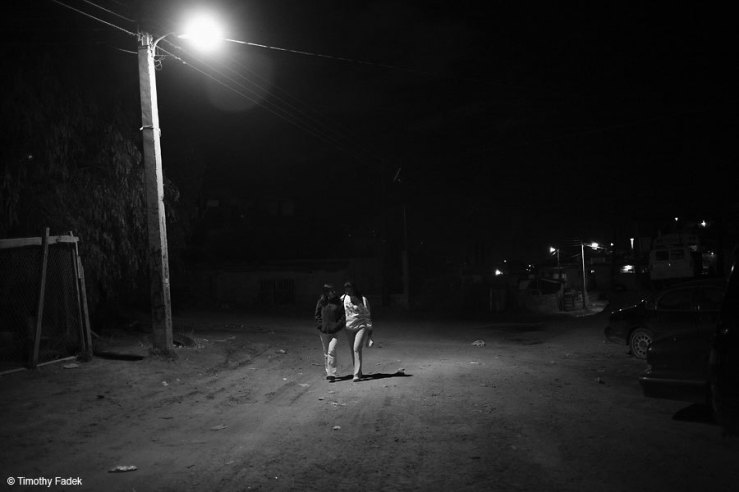
Anyway. The backbone of the plot, or, rather, the peripheral story that haunts the plot(s) of this massive, heavy novel, involves a seemingly endless string of largely unsolved murders in the fictional Mexican border city of Santa Teresa. An ugly industrial town in the Sonora Desert, Santa Teresa is a thinly disguised stand-in for Ciudad Juárez, where over the past 15 years over 400 young women have been raped and killed, their murders unsolved. While searching the gruesome real-life back story that informs Bolaño’s masterpiece, I came across Fadek’s eerie and sympathetic images of Juárez (this background story on Fadek and the Juárez photos is also quite good). Fadek aims clearly to draw attention to these underreported crimes, but his photographs also capture the doom and foreboding that looms in the blood of 2666. Those who’ve read the novel will no doubt find them evocative of the fourth book of 2666, “The Part About the Crimes,” and those who are flirting with undertaking Bolaño’s big book may find their interest redoubled. In any case, Fadek’s photojournalism is well worth a look. Great stuff.

The Book of Dead Philosophers — Simon Critchley

the-book-of-dead-philosophers

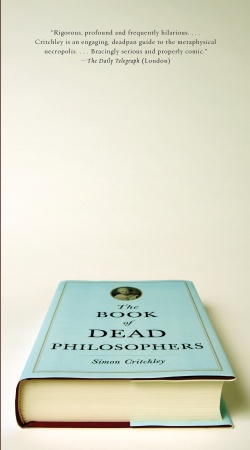
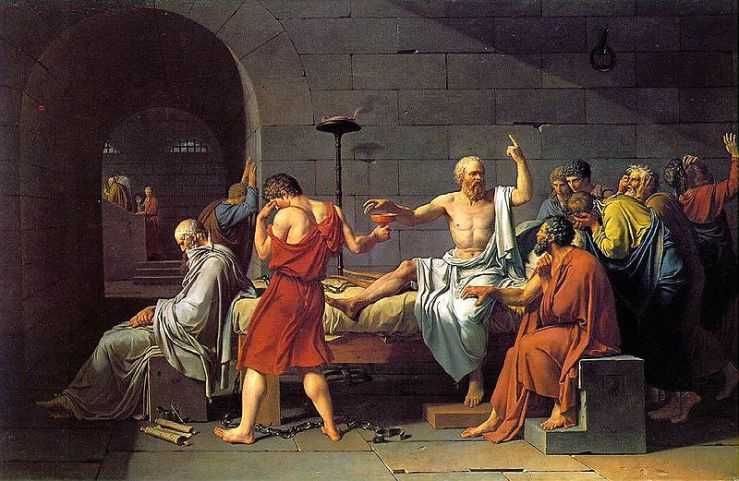
A cursory glance at Simon Critchley’s skinny new work, The Book of Dead Philosophers, might lead one to misjudge the book as an ephemeral, superfluous, and even downright jokey sort of “Philosophy for Dummies.” That would be a mistake. While The Book of Dead Philosophers does aim for a broad, popular appeal, Critchley’s wily cataloging of the deaths of nearly 200 philosophers is hardly insubstantial reading. Working from Cicero’s maxim that “To philosophize is to learn how to die,” Critchley sets out to contextualize these philosophers’ writings on death against the very deaths of those philosophers. Ranging from the sophists of ancient Greece to the Classical Buddhists of China to post-modern gadflies like Foucault and Derrida, Critchley’s writing evokes both humor and pathos, and works in some ways as an overview of the history of philosophy without ever becoming didactic or overreaching its central goal.

800px-david_-_the_death_of_socrates
The Death of Socrates - Jacques-Louis David

While Critchely’s main purpose in Dead Philosophers seems to be to entertain and perhaps enlighten, he doesn’t shy from injecting his own attitude about his subject. In his introduction he addresses philosophies that emphasize an afterlife, arguing “that they cultivate the belief that death is an illusion to be overcome with the right spiritual preparations. However, it is not an illusion, it is a reality that has to be accepted. I would go further and argue that it is in relation to the reality of death that one’s existence should be structured.” Later, Critchley condemns the metaphysical, Platonist tradition further, and, at the same time, provides a greater rationale for his book: “I hope to show the material quality of the many lives and deaths that we will review disrupts the move to something like “Spirit” and places a certain way of doing philosophy in question. To that extent, there is something intensely arrogant, even hubristic, about a philosopher’s disregard for the lives and deaths of other philosophers.” Critchley’s materialist philosophy leads to an occasionally snarky–and quite humorous–tone when writing about the likes of Anslem, Thomas Aquinas, or even Heidegger and Schopenhauer. His sympathies are more earnestly apparent when he addresses the death of someone whose outlook he shares. Critchley on Bertrand Russell: “Any conception of the immortality of the soul is therefore both iniquitous, because it is untrue, and destructive of the possibility of happiness, which requires that we accept our finitude.”

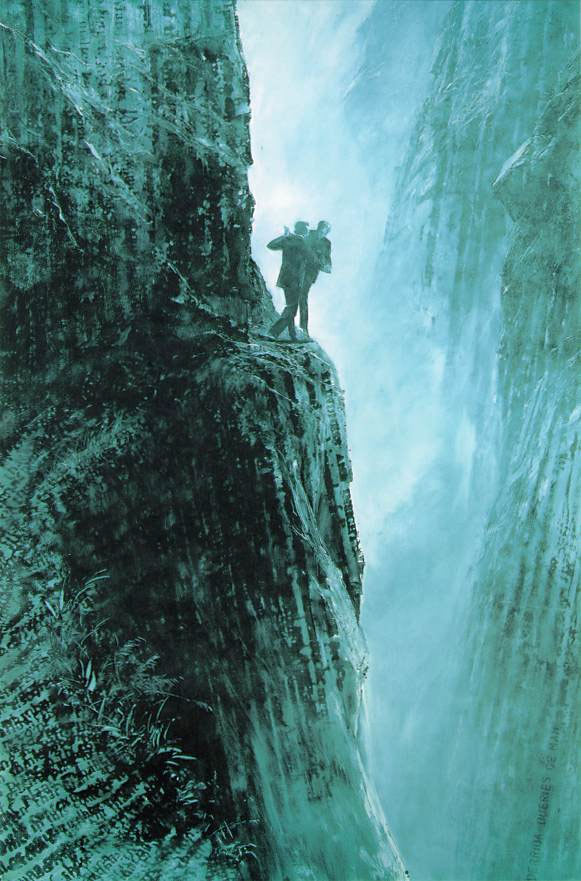
Derrida Queries DeMan -- Mark Tansey

Arranged both chronologically and geographically into short sections ranging from a few sentences to a few pages, Dead Philosophers encourages jumpy, discontinuous, and episodic readings. Still, despite his caveat that he is presenting a “messy and plural ragbag of lives and deaths that cannot simply be ordered into a coherent conceptual schema,” Critchley nonetheless manages to create nuance, layer, and perhaps even a touch of narrative to this work. In one of the final entries of the book, a touching tribute to Jacques Derrida (at three pages, one of the longest in the book–twice as long as the section on Plato), Critchley writes, “the dead live on, they live on within us in a way that disturbs any self-satisfaction, but which troubles us and invites on us to reflect on them further. We might say that wherever a philosopher is read, he or she is not dead. If you want to communicate with the dead, then read a book.” Lovely.

The American publication of The Book of Dead Philosophers is available February 10th, 2009 from Vintage Books.

Many readers will may also be interested in Simon Critchley’s essay on Barack Obama and metaphysical philosophy, “The American Void,” published in last November’s issue of Harper’s Magazine, or the post-victory essay, “What’s Left After Obama?” published last November in Adbusters.

Amerika — Franz Kafka

amerika

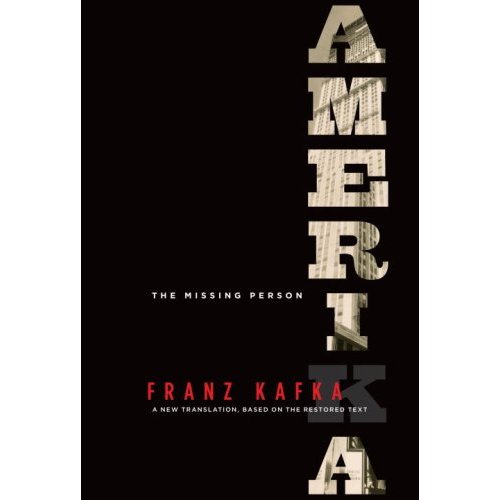
I had a (very, very minor) Kafkaesque moment when Mark Harman’s new translation of Franz Kafka’s unfinished first novel, Amerika first arrived at Biblioklept International Headquarters. Wanting to compare the style of Harman’s translation to Edwin and Willa Muir’s work, I searched for my old copy of Amerika. I figured I’d re-read the first chapter, “The Stoker,” the only part of the novel that Kafka reworked (it was published as a short story). So I looked and looked and it turns out that I don’t own Amerika, despite the obligatory Kafka phase I went through in high school (followed by a post-bac Kafka phase years later). But I knew I’d read “The Stoker,” or at least it seemed likely that I’d read “The Stoker,” and it turned up in a collection of Kafka’s short stories that I own–only it was the Donna Freed translation. So I re-read it, only I’m not sure that I was re-reading it. I didn’t remember any of it, other than the famous opening image of a Statue of Liberty armed with a sword. I’m still not sure that I ever read it before now; that is, I’m not sure that I read the Muir translation that Harman seeks to amend. I guess it doesn’t matter, and it seems appropriate that a Kafka review begin with a meandering false start. Where were we?

Yes. Harman’s translation. With Amerika, Harman continues a project he initiated with his translation of another unfinished Kafka novel, The Castle. (This book was published in 1998, and I listened to the audio book last summer, incidentally, and it was really, really good). Harman’s translations aim to restore some of the humor, ambiguity, and modernism that the Muirs’ early translations occlude in favor of their own religious readings. Harman also takes great pains to remove Max Brod’s editorial interventions, even going as far as to keep many of Kafka’s consistent solecisms (“Oklahoma” is restored to Kafka’s original – and consistent – “Oklahama”). Now, my Kafkaesque confusion over whether or not I’ve read the Muirs’ translation of Amerika prevents me from commenting here on Harman’s apparent restoration of Kafka’s humor, but I do think that Amerika is often funny, and often terrifying. Its protagonist Karl finds himself in a parallel-universe America (one constructed wholly from Kafka’s imagination, and announced in its surreal glory from the opening image of a Statue of Liberty armed with sword), one where he’s consistently misled, swindled, cornered, cramped, and generally mistreated by various enigmatic authority figures (yes, its Kafkaesque, if you’ll allow the tautology). As noted, Kafka never finished writing the book (or any of his three novels, for that matter), and Harman makes no attempt to reconcile the plot, opting instead to simply reproduce (in frank English, of course) the words Kafka wrote.

Amerika is not the starting place for those new to Kafka’s work–I would suggest readers who weren’t turned off by their high school English teacher’s inept bungling of The Metamorphosis start with a collection of the short stories. However, I think Harman’s translation is not only essential for fans who wish to rediscover an old favorite, I also believe that it will quickly become the definitive translation. It’s modern and terse and funny, and it also pays subtle respect to the dialogic interplay between Karl’s point of view and that of the omniscient narrator, often creating moments of intense and delicious irony. Reading a translation of Kafka focusing on his oft-neglected humor brought to mind the late great David Foster Wallace’s essay, “A Series of Remarks on the Funniness of Kafka, from Which Not Enough Has Been Removed” (read it here or get the mp3 of DFW reading it here). Here is Wallace, explaining why American undergrads don’t get Kafka’s humor:

And it is this, I think, that makes Kafka’s wit inaccessible to children whom our culture has trained to see jokes as entertainment and entertainment as reassurance. It’s not that students don’t “get” Kafka’s humor but that we’ve taught them to see humor as something you get — the same way we’ve taught them that a self is something you just have. No wonder they cannot appreciate the really central Kafka joke — that the horrific struggle to establish a human self results in a self whose humanity is inseparable from that horrific struggle. That our endless and impossible journey toward home is in fact our home.

Wallace’s observation stealthily acknowledges why the heroes of Amerika and The Trial and The Castle never get to where they’re going, why Kafka could never wrap up his big stories. Kafka, the first modern writer, embraced the “horrific struggle” of humanity and never sought easy reconciliation or pat conclusions. Harman’s new translation brings this critical aspect of Kafka’s writing to the fore, and he achieves this in the most simplistic manner: unobtrusively letting Kafka’s words stand on their own. Recommended.

Amerika is now available from Schocken Books.

The Best Books of 2008

We read many, many books this year, but most of the books we read–especially the very best ones–were not published this year. And as usual, we’re always playing catch up. Case in point: we finally finished Roberto Bolaño’s much-lauded-in-2007 hit The Savage Detectives just last month, and despite feeling that it was kinda overrated we couldn’t help picking up his much-lauded-in-2008 hit 2666 at Green Apple Books in San Francisco this weekend (sidebar that will not surprise any San Francisco reader: San Francisco has the best book shops. Sick). So, we will spend at least the first part of 2009 getting through that massive tome.

Bar none, the best book we read in 2008 was Cormac McCarthy’s masterpiece Blood Meridian, published back in 1985. So good we read it twice, and so should you. We also loved loved loved Philip Pullman’s Nietzschean sci-fi trilogy His Dark Materials. Finally, we must highly recommend E.L. Doctorow’s novel Ragtime, which we finally got around to reading this year (last week, so, no review). This book is great, and you will wonder why you haven’t read it before now. A somewhat neglected classic. But. Let us move on.

a-mercy

There were a couple of fantastic highlights in 2008, of course, most notably Toni Morrison’s A Mercy, a novel on which we cannot heap enough praise. In a time of overstuffed, overlong novels, A Mercy is rich and complex yet lean at just over 170 pages, and, as many critics and reviewers have pointed out, the novel serves as a touching counterpoint for her 1988 masterpiece Beloved.

violence

We also loved–and frequently returned to–Slavoj Žižek’s Violence, a work of cultural criticism that managed to be fun and infuriating and serious and frivolous at the same time. Too often reviewers fall back on hackneyed phrases like “thought provoking,” but Žižek’s work really is provoking, often to the point of confrontation. Like Plato, Nietzsche, and Derrida before him, Žižek is the gadfly, the upsetter, the spoiler. He has earned his haters.

The Paris Review Interviews, Volume III and The O. Henry Prize Stories collections were also sublime–great interviews, great stories, lovely tasty morsels. Ralph Ellison, William Carlos Williams, Stephen Millhauser–what’s not to love? We also really were digging Mark Reibstein and Ed Young’s sumptuous children’s book, Wabi Sabi. You’d think a book that included a haiku on each page would be cheesy or cloying or too precious, but no. Great stuff.

wabi-sabi

We’d also be remiss not to give props (again) to Wendell Berry’s essay “Faustian Economics,” published in the May, 2008 issue of Harper’s. Berry’s piece is beautiful and sad and timely, and everyone should read it. It was one of the best things we read all year. Speaking of Harper’s, the latest issue includes–along with a touching memorial to critic John Leonard, who died last month–the remarks of those who spoke (including Zadie Smith and Don DeLillo) at David Foster Wallace’s memorial service this October. Wallace’s suicide was and is awful, and remarking on it in a “Best of 2008” section seems tacky, but we can’t help it. We love his work and are sad that there won’t be any more, or at least much more, or at least any “finished” work from the man, but, as George Saunders puts it in his portion of the memorial: “In time–but not yet–the sadness that there will be no new stories from him will be replaced by a deepening awareness of what a treasure we have in the existing work.” So, if we remark on DFW here, it is only because he was one of the best, and he died this year, and in some sense, we need to remark on it yet again, despite having written too much already.

But let’s not end on a sad or sour note. Plenty of great reads in 2008, and surely we neglected a tome or three in this rehash, but hey, we’re human, we err, etc. We look forward to more reading in 2009, and perhaps, improbably (we lie to ourselves, who doesn’t though?) we may actually defeat that stack of books by the bed, on the night stand, on the coffee table.

A Mercy — Toni Morrison

a-mercy

With her latest novel A Mercy, Toni Morrison offers up more evidence of why she is possibly America’s greatest living author. As in earlier works like Sula, Song of Solomon, and Beloved, in A Mercy Morrison examines the strange intersections of race and geography, family and culture, memory and storytelling. And like those great novels before it, at the center of A Mercy (a center, mind you that Morrison frequently works to decenter) is that great post-modern question: what is identity?

The late-seventeenth-century America of A Mercy is at once paradoxically both alien and familiar. This America is seemingly wild and free and unconstrained, yet the land–purchased with the blood of the native Indians–is worked by slaves and indentured servants. The freedom to be viciously intolerant of anyone else’s religion abounds. A lazy eye might get you burned for a witch. Life is cheap and difficult, but there is also much beauty here, and for a time, the makeshift family of characters who populate A Mercy seems happy enough. Morrison’s genius in this novel, however, is to only present these moments of contentment and happiness in fragments, interspersed between each of her character’ desires for freedom, future, family, and ultimately, self. We see glimpses of one character’s joys or sufferings through the eyes of another character, a technique that builds and layers and enriches a narrative where, honestly, very little happens. A farmer-turned-trader gets sick and dies, never finishing the house he was building. Then his wife gets sick, and sends her young slave to get the blacksmith, a free black man, who she believes can heal her. By the time he arrives, she’s better, but her ersatz family is forever sundered. Summarized, the linear plot sounds thin, but the depth of storytelling around Morrison’s deceptively simple story is marvelous. Morrison achieves this depth via the different voices and perspectives that propel her novel.

The voice of the young enslaved girl Florens initiates the novel with the enigmatic opening line, “Don’t be afraid.” Her opening command both engages and disorients (and, sign of a great novel, begs to be read again after completing the book). “Stranger things happen all the time everywhere,” she recognizes, before asking “One question is who is responsible? Another is can you read?” Right away, Morrison tells us this a novel about how to read, where to find cause, and possibly, how to create one’s own agency in a world that makes slaves and servants–or food–out of almost everybody.

William Blake - Europe Supported by Africa and America (1796)

This question of agency runs throughout each of the chapters that alternate with Florens’s first person narrative. There’s Jacob Vaark, who takes Florens as part of a debt owed him by a fading aristocrat. Vaark is disgusted at the aristocrat’s lavish lifestyle, and although the slave trade repels him – “God help me if this is not the most wretched business” – he agrees to take Florens at the pleading of her mother (Florens will be haunted forever by what she interprets as abandonment). Vaark is, however, smitten by the slaver’s elaborate house and vows to build one just as grand. His attempt to build a castle from his own labor in the New World, a castle free from any title or rank or order is his own claim to agency. There’s also the voice of his wife Rebekkah, who spends her chapter in a pox-ridden fever dream that dips and floats and weaves through time and space. Her father essentially sells her mail-order to Jacob. She leaves the dirty, crowded Old World on a dirty, crowded ship. Stuck in dark steerage, she makes a community with a group of whores, “Women of and for men,” who, in transit, exist in a strange uncomfortable comfort, a “blank where a past did not haunt nor a future beckon.” Rebekkah will attempt to forge another strange, transitory family when she arrives in America. She grows quickly to love Jacob; soon, she even loves Lina, the enslaved Indian girl Jacob buys for both pity and service. Lina and Rebekkah forge an alliance, weathering the death of the Vaark’s children, as well as Jacob’s extended absences as he expands his trade. They are less ready to accept another foundling, Sorrow, who Jacob brings home (solely for pity); a little bit crazy (“daft”), she spends much of the novel mysteriously pregnant. However, Lina quickly warms to Florens, treating her as her own daughter, even if Rebekkah will not. Also there are Scully and Willard, two indentured servants who may never gain their freedom. Willard imagines the family they all comprise: “A good-hearted couple (parents), and three female servants (sisters, say) and them helpful sons.” But it’s not family, or community, or the idea of a country that A Mercy will validate. Instead, the novel suggests these concepts are ultimately transitory–like a passage over the Atlantic–and that there can only be a claiming of self.

Throughout the book, some characters gain agency, others die trying, and several lose themselves to grief and loss. But it’s Florens’s narrative that binds the text. She grows from a lovesick kid, desperate to please everyone, to a realized person with a conscious sense of her self. “The beginning begins with the shoes,” she says. “When a child I am never able to abide being barefoot and always beg for shoes, anybody’s shoes.” By the end of the novel she can go barefoot, free, in a sense, the soles of her feet “hard as cypress” – and this New World requires hard soles. And even if Morrison suggests that we need to learn to walk, hard-soled on our own feet, there is a great pleasure–a sad, sometimes sour, shocking pleasure–to be gained in walking for just a little while in these characters’ shoes. Very highly recommended.
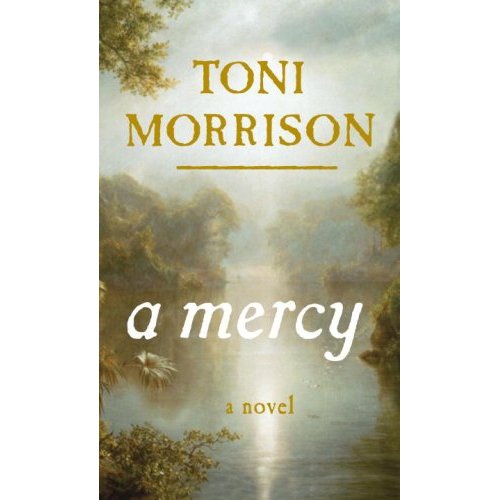
A Mercy is now available from Knopf.

Roughing It

Classic_Novels_pub_coverUS.indd
The American cover isn’t bad…

Simon Mason’s The Rough Guide to Classic Novels covers “a selection of 229 novels . . . from 36 countries, published between 1604 and 2002.” Roughly pocket-sized (if you have big pockets), Classic Novels provides short, simple summaries of each of the books, outlining the plot as well as contextualizing the relative importance of the novel. Mason also recommends the best English translations and discusses film adaptations (quite even-handedly), where applicable. He also includes a “Where to Go Next” bullet for each novel. Sometimes these suggestions work: liked Brave New World? Then check out Russell Hoban’s Riddley Walker. Other times, they’re a bit nonsensical–does anyone really go to A Portrait of the Artist as a Young Man after they’ve made it through Ulysses?

...but we prefer the British cover
…but we prefer the British cover

But this criticism is mere quibbling; Mason does a great job with an almost impossible task–after all what books would you cover in such a limited space (and you’d have to include Ulysses, and you’d have to give it pride of place over the Portrait, right?). Simon admits in his preface that inevitably “the selection is a personal one, and not likely to be the same as anyone else’s.” Of course he includes the “classics” that will jump to anyone’s mind–Jane Eyre, War and Peace, Moby-Dick, etc., but he also includes works by Toni Morrison, Don DeLillo, and Haruki Murakami, along with dozens and dozens of books I’ve never heard of, but now feel that I simply must read. And in exposing a potential reader to a book they’ve never heard of, Classic Novels is a success.

graphic-novels

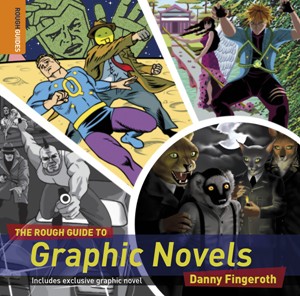
If Danny Fingeroth’s The Rough Guide to Graphic Novels is less successful than Mason’s Classic Novels, that shortcoming is in his attempt to sanctify a canon in a medium that is still often misunderstood as a genre. While most of us will readily agree that Don Quixote and The Catcher in the Rye are classics, the canonical works of the comic book medium still need some sorting out, and many fans of graphic novels will find Fingeroth’s language a bit too-definitive. After a great first chapter that asks “What Is a Graphic Novel?,” a brief history of the comic book story-telling medium, and his own comic, “For Art’s Sake,” (a fun but forgettable overview of the graphic story-telling arts from an artist’s perspective), Fingeroth initiates the bulk of the book, “The Canon: The Sixty Best Graphic Novels.” As if his language weren’t definitive enough, he kicks the section off with “Ten Graphic Novels Everyone Should Read.” And while Fingeroth’s “Canon” and top-ten list are full of obvious choices that should certainly be there–Spiegelman‘s Maus, Satrapi’s Persepolis, Charles Burns’s Black Hole, Clowes‘s Ghost World–there are also gaping holes on one hand and complete over-representation on the other, as well as some real head-scratchers thrown in to boot. Why, for instance, does Fingeroth include Frank Miller’s The Dark Knight Strikes Again over its vastly superior and more influential predecessor, The Dark Knight Returns? Why is Sin City canonized at all? Although Alan Moore’s From Hell is canonized, why is his controversial recent novel Lost Girls included over work like Watchmen, V for Vendetta, or Saga of Swamp Thing–all books that had a tremendous impact on comic book storytelling? Why does Dave Sim’s massive contribution Cerebus get glossed over in a single sentence, while Kyle Baker’s trifling missive Why I Hate Saturn is given pride of place on the top ten list? Fingeroth could’ve saved himself a lot of nitpicking by simply changing his language a bit to at least admit that his choices are subjective. Far more satisfying is the next chapter, “The Icons,” covering some of the most influential persons in comic history, including Robert Crumb, Chris Ware, Joe Sacco, and the Hernandez Brothers. I would’ve liked to have seen this chapter expanded quite a bit (perhaps at the expense of the superfluous chapter on manga); if The Rough Guide to Graphic Novels is to be a starting place for new readers interested in this medium, “The Icons” best represents that starting place. Those interested in discovering graphic novels they haven’t heard of will also be pleased with the many full-page art reproductions throughout the book, probably its best feature. Despite its flaws, however, there is something admirable about Fingeroth’s attempt to create a canon out of a medium that has for far too long been marginalized.

The Rough Guide to Classic Novels and The Rough Guide to Graphic Novels are now available from Rough Guides,

After the jump: Fingeroth’s top ten list vs. Biblioklept’s top ten list–

Continue reading “Roughing It” →

The Savage Detectives — Roberto Bolaño

savage

I give up. I don’t know how to review The Savage Detectives.

Everyone told me I was supposed to love this book, but I didn’t. There, that’s a review. Not a good review, but there. I can’t remember a book ever taking me so long to finish or a book that I put down so often. When I truly love a book, I am moved. Often physically. Sometimes I have to stand up to read a book, I’m so moved. That’s a good book. (I never had to stand up during The Savage Detectives, although I often had to force myself to read thoroughly and not just skim). When I truly love a book, I’m a little sad and deflated when it’s over. I know a book is great if I’m compelled to go back and immediately reread sections. (Again, with Detectives, this didn’t happen). But it looks like I’m trashing the book. I shouldn’t. It has a lot going for it.

I read the first 140 pages, the journal entries of young Garcia Madero, in a blur. Funny and passionate, Madero’s voice explodes with the immediacy and intensity of youth. He joins up with the visceral realists, a group of anti-establishment poets (who no one cares about). Led by two enigmatic outsiders, Ulises Lima and Arturo Belano, the visceral realists gripe about the state of Mexican and Latin American literature, screw around, and argue with each other (no one else will listen to them). Madero paints Mexico City in the mid-1970s as vibrant, a place full of poetry and art. He becomes a biblioklept, God bless him (yet he ethically agrees not to steal from a poor old blind bookseller). He writes poems. He has sex. He runs away from home, sort of. There’s a breathless energy to Madero’s narrative that makes the book hard to put down, and the first section of The Savage Detectives, “Mexicans Lost in Mexico” culminates in one of the book’s most exciting events. Madero, Lima, and Belano help a young girl named Lupe escape from her belligerent pimp. Then, that portion of the story unresolved, the narrative shifts dramatically.

In the second section, “The Savage Detectives,” we are treated to, or subjected to, or made to endure, or made to navigate–pick your verb, please–over 450 pages of (one-sided) interviews spanning 20 years. Some of the interviewees appear consistently throughout this section, like Amadeo Salvatierra, who helps Lima and Belano in their quest to find the lost original visceral realist, Cesárea Tinajero. Other voices only pop up once to tell a weird story about Lima or Belano–or more accurately, a weird story about themselves with Lima or Belano playing bit parts. Some of these stories, like Lima’s strange time in a Tel Aviv prison, or Belano’s tenure as a national park guard in France are great; other times they are painfully tedious or repetitive (you know, like real life).

Technically, The Savage Detectives is quite an achievement. The myriad stories in the book’s main section represent the fragmented narratives that might compose a person’s life–a series of perspectives that others have about us, views that can never add up to a unified truth. The bulk of these stories are very much about poetry, art, and travel. Like Joyce’s Ulysses, Detectives is a peripatetic novel, full of specific locations and very, very explicit directions (Joyce famously claimed that were Dublin destroyed in a catastrophe, it could be rebuilt based on his novel; the same seems true for Bolaño’s Mexico City). Also like Ulysses, Detectives is an epic about the banal, ordinary things that fill our lives: jobs and eating and getting to places and having one’s friendships sour and being disappointed and so on. Lots and lots of “and so on.” This isn’t to say that there aren’t moments of heroism and adventure–saving kids from satanic caves, stow-away sea voyages, and dodging bullets from Liberian rebels make for interesting narrative peaks. However, most of the novel remains rooted in a realism that is often dreadfully visceral in its painstaking replication of just how depressing a life could be. As the seventies and eighties turn into the nineties, things get more bleak and more depressing for Lima and Belano. And it all adds up to an incomplete picture (literally; check out the last page of the book if you don’t believe me).

o_roberto-bolano

By the time we return to Madero’s journals in the third and final part of the novel, “The Sonora Desert,” the sadness and deflation of the previous section infects and tints every aspect of the narrative. Lima and Belano, with Madero and Lupe in tow, search desperately for the forgotten poet Cesárea Tinajero. Their search works as a pitiful parallel to “The Savage Detectives” section, a comment on the elusive nature of identity, and the strange disappointments that punctuate our expectations. Even the novel’s climactic ending seems understated after the monolithic middle section. And while this deflationary technique is undoubtedly a carefully considered conceit on Bolaño’s part, the payoff for the reader–this reader anyway–did not merit the effort and concentration that the book required. Or, to put it another way, after hours of time invested, I was unmoved.

As rave reviews of the English translation of his last novel 2666 begin seeping out of the critical woodwork (this month’s Harper’s has devoted a full four pages to the book), it seems that Bolaño will top most critics’ lists again this year. At over 900 pages and reportedly full of grim, bleak violence, it’s hard to imagine 2666 will be any easier to get through, and as FS&G summarily ignored our requests for a review copy, there’s no pressing obligation, I suppose. The critical praise heaped on 2666 this year will surely lead interested readers to The Savage Detectives. I think Mark Twain’s infamous note at the beginning of The Adventures of Huckleberry Finn would provide the best warning to these potential readers: “Persons attempting to find a motive in this narrative will be prosecuted; persons attempting to find a moral in it will be banished; persons attempting to find a plot in it will be shot.” While no serious critic could dismiss Bolaño’s lyrical skill and complex control of the many voices that populate Detectives, I think a number of readers–serious readers–would not be wrong for considering the tome a bit overrated.

The Tenth Muse — Judith Jones

tenth-muse

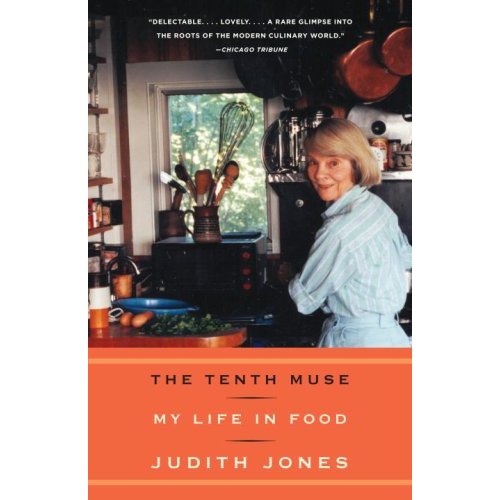
Judith Jones’s memoir The Tenth Muse, aptly subtitled My Life in Food, chronicles the life of one of the most influential foodies you’ve never heard of. The book moves quickly through Jones’s terse blueblooded Vermont childhood, through her time at Bennington College, and her first trip to Paris, all the while keeping Jones’s passion for food as its focus. This passion leads her to move to Paris after her college days, where she and future husband (and fellow writer) Evan Jones can eat pâté to their hearts’ content while palling around with writers, artists, and other beautiful people (even Balthus pops up in her narrative here). After some years of bohemian bliss, Jones returns to the U.S. to champion Julia Child, working hard to get her seminal cook book Mastering the Art of French Cooking to an American audience (she also manages to get The Diary of Anne Frank translated for publication as well). Shocked at the paltry selection of fresh foods in New York City, Jones and her now-husband Evan learn to make many of the fine French foods they enjoyed in their Paris days. At the same time, they continue to introduce a wider audience of Americans to cooks like James Beard, M.F.K. Fisher and Edna Lewis. Through it all, food (rich, thick, luscious French food) remains the primary focus, with the art of writing–and editing–a close second. Jones’s narrative abounds with anecdotes of chefs (Claudia Roden, Lidia Bastianich), editors, and writers (Camus, Capote, Updike), but readers who pine for psychological introspection or juicy melodrama won’t find much to chew on here.

Jones tends to gloss over information that most memoirs would milk for maximum drama. Evan was married when she first began living with him, a fact that would’ve scandalized many women in the 1950s but here goes largely unremarked. Two teenage children are adopted with little explanation or follow-up. Even the focus of Jones’s mastectomy returns to food, her pre-op meal, which Evans sneaks in to the hospital (“good pâté de campagne, some ripe cheese, a baguette, and a bottle of wine”). Also, readers who tend to pay attention to matters of class and economics might find Jones’s complete lack of self-reflection on how her wealth and background have allowed her to live and eat so richly a bit distasteful, particularly when she rails against the state of the modern American kitchen (too unused, or too full of processed, “quick and easy solutions.” Jones would have us killing and dressing beavers we catch on our vast estates, apparently. (Relax, I’m exaggerating (although she does prepare a beaver her son-in-law shoots)–but seriously, preparing a duck for dinner is not nearly as easy as she cheerily suggests)). But ultimately in The Tenth Muse, such lack of reflection simply leaves room for the food, which is really why you want to read this book anyway.

Jones caps off her book with over 80 pages of recipes, lovingly arranged in their own sort of narrative, one that parallels her life story. Jones includes favorite dishes from her early youth (“Spaghetti and Cheese”), plenty of French favorites (“Boudin Blanc,” simple “Baguettes,” “Brains with a Mustard Coating”), and recipes from her country estate (“Gooseberry Tart”). The selection of recipes at the end, “Cooking for One,” inspired by her continued love of complex cooking even after the death of her husband, is particularly poignant (Jones includes seven things to make from one duck).

The Tenth Muse may not meet the usual memoir-reader’s needs for salacious detail or analytical introspection, but those who simply want a glimpse into the life of an influential foodie–and some great recipes to boot–will not be disappointed. Recommended.

The Tenth Muse is now available in paperback from Anchor Books.

The Wasted Vigil — Nadeem Aslam

the-wasted-vigil

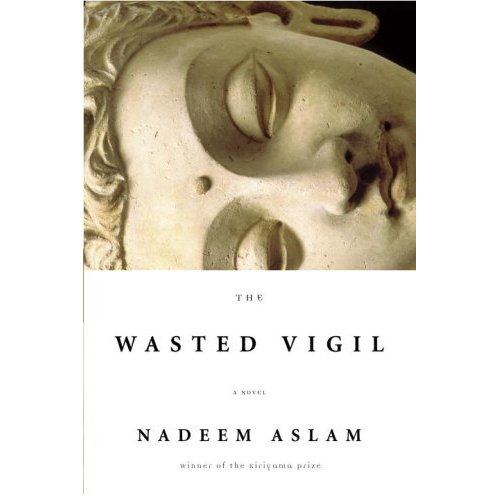
Nadeem Aslam’s new novel The Wasted Vigil ambitiously attempts to contextualize three decades of conflict in Afghanistan through the lives of its three main characters: Marcus, an English doctor living near Tora Bora, whose Afghani wife was killed by the Taliban, Lara, a Russian woman searching for her missing brother who disappeared during the Soviet invasion, and David, the ex-CIA operative tortured by his past. There’s also the young Islamic fundamentalist Casa, who dreams of jihad–possibly the novel’s most interesting character. Aslam weaves these stories together in a meditation on art and war, beauty and violence, and family and politics, never shying away from the brutality of a good stoning or elective amputation.

The Wasted Vigil works best when Aslam restrains his language and communicates in a more journalistic style. These moments are few and far between, however; most of the time, Aslam is overly concerned with explicitly announcing every allusion and broadly indicating the critical or aesthetic importance of even the slightest of his characters’ actions. Aslam’s prose is far more satisfying when he backs away from overblown, overwritten sentences and simply lets his readers figure out what’s going on for themselves. That said, Aslam can certainly turn an artful phrase–it’s just that artful phrase piled upon artful phrase becomes showy, even tacky. Restraint allows prose to build rhythmically and payoff meaningfully, but there isn’t enough restraint here.

Of course, Aslam’s subject matter is hardly restrained. Afghanistan is a place of remarkable violence and brutality, but also a place rich with history and culture. Perhaps Aslam’s editors believed his audience deserved an overtly complex representation of Afghanistan, and perhaps they are right in this belief. After all, the country has been very much in the background of the West’s political conscience for the past decade (translating in to big success for other books about Afghanistan, notably Khaled Hosseini’s The Kite Runner). Undoubtedly, there are a great many who will enjoy The Wasted Vigil. Those fascinated with Afghanistan and its sad, strange, violent history will have more than enough to mull over in this elaborate, intelligent, thoughtful novel.

The Wasted Vigil is now available in hardback from Knopf.

The Paris Review Interviews, Volume III

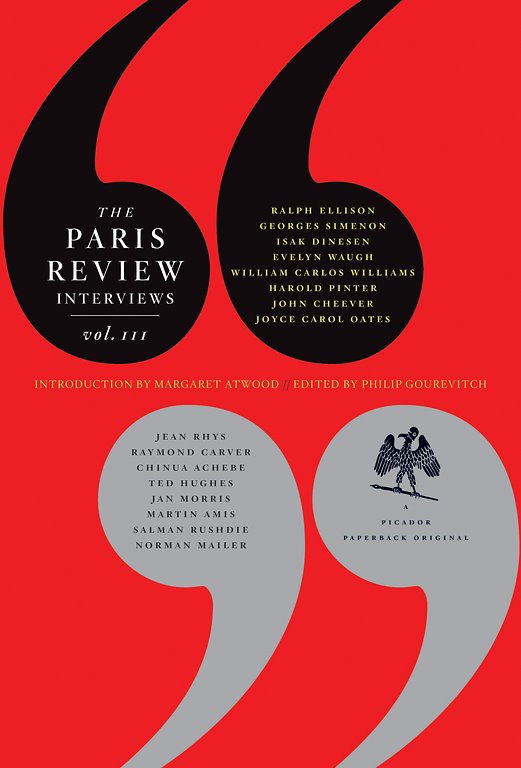
How much you enjoy the third collection The Paris Review Interviews will depend entirely on how much you enjoy reading intelligent and thoughtful writers discussing intelligent and thoughtful subjects. I happen to love reading author interviews–even interviews with authors I don’t particularly like–and hence, I enjoyed this book quite a bit.

Covering sixteen disparate authors and fifty-two tumultuous years, the interviews here are by turns insightful, hilarious, strange, and at times, infuriating. The first interview (the book is organized chronologically), a 1955 conversation with Ralph Ellison evokes all of these emotions. One can almost feel Ellison’s restraint as he patiently replies to asinine questions like, “Then you consider your novel a purely literary work as opposed to one in the tradition of social protest?” and, “But isn’t it going to be difficult for the Negro writer to escape provincialism when his literature is concerned with a minority?” If anything, these politicized charges prompt Ellison to some of the most salient observations about literature’s universalizing powers that I’ve ever read.

In his 1964 interview, poet William Carlos Williams also sheds quite a bit of light on his art and craft. Interestingly, his wife is also a major part of the interview, discussing at some length her own role in her husband’s writing. Beyond literature, craft, and writing, Williams also sets another early theme that unites the interviews collected here–dissing other writers. He calls T.S. Eliot a “conformist” determined to set poets back twenty years. Evelyn Waugh picks up on this theme in his 1963 interview. Of Faulkner: “I find Faulkner intolerably bad.” And Raymond Chandler: “I’m bored by all those slugs of whiskey. I don’t care for all the violence either.” Zing!

Don’t feel too bad for Chandler, though; he comes off funny and earthy and sad in his 1983 interview, especially when he discusses his alcoholism, and how and why he quit drinking. Apparently, teaching–and drinking–with John Cheever when the two were teaching at the Iowa Writer’s Workshop in 1973 had a major impact on Chandler’s decision to stop drinking.

John Cheever focuses mostly on the writing craft in his 1976 interview–not much talk of drinking here. He does, however, share this insight: “Plot implies narrative and a lot of crap. It is a calculated attempt to hold the reader’s interest at the sacrifice of moral conviction.” I’ve never liked Cheever’s writing, but he’s a great interview. In his 1994 interview, Achebe–an author whose fiction (and essays) I do like comes off as far more insightful and far less pretentious. On why creative writing classes exist: “I think it’s very important for writers who need something else to do, especially in these precarious times. Many writers can’t make a living. So to be able to teach how to write is a valuable to them. But I don’t really know about its value to the student.” Lovely. MFAs beware!

The interviews collected here are funny, smart, and very entertaining–whether its Achebe on general misunderstandings of his famous Conrad essay, Salman Rushdie on New Wave Cinema, or Joyce Carol Oates on Finnegans Wake, The Paris Review Interviews, Volume III is full of smart people talking about smart things–and what’s better than that? Highly recommended.
The Paris Review Interviews, Volume III is available October 28th, 2008 from Picador.

Hitler’s Private Library — Timothy W. Ryback

In Hitler’s Private Library, Timothy W. Ryback works from Walter Benjamin’s assertion that “a private library serves as a permanent and credible witness to the character of its collector.” Ryback delves into the books–the actual, physical books–that Hitler studied and pondered, paying particular attention to the dictator’s annotations and marginalia. To be sure, there are plenty of political tracts–especially anti-Semitic writings, such as Henry Ford’s The International Jew–to be found in Hitler’s library, but far more fascinating is Ryback’s analysis of Hitler’s love for Robinson Crusoe, Shakespeare, Don Quixote, and Uncle Tom’s Cabin, of all books. Hitler’s taste was varied–there’s an early infatuation with Max Osborn’s Berlin, an architectural guide to that city, an obsession with Ibsen’s Peer Gynt, and Hitler’s final day’s poring over a biography of Frederick the Great (he also comforted himself in the final days of his regime by rereading his boyhood favorite Karl May).

The Nazi party’s lurid mania for occultism is well documented, but Ryback brings a fresh perspective here, eschewing tabloid histrionics in favor of a measured approach to Hitler’s volumes of bizarre and arcane works. More troubling is the public misconception that the works of Schopenhauer and Nietchzsche some how gave philosophical weight to the Nazi’s crime spree; Ryback eliminates that notion:

For all the talk of Hitler’s exploitation of Friedrich Nietzsche’s concepts of the “master race” or Arthur Schopenhauer’s notion of the “will to power” that Hitler used to headline the 1934 party rally and Riefenstahl cribbed as a title for her cinematic chronicle of the event, we have little credible evidence of Hitler’s personal engagement with serious philosophy. Most of what we know is tenuous and at best anecdotal.

In short, Hitler was a poseur who recontextualized bit parts of great thinkers into mind-numbing sloganeering for his own ends (luckily, no politicians today would be so crude). Ryback’s even-handedness here is indicative of the project of his book: his is not a psychological study; he never seeks to explain the motivations for Hitler’s evil actions, but rather report what Hitler read closely. What we get in the end is an historicized, contextualized account of a bibliophile who initiated book burnings and mandated reading lists.

Hitler’s Private Library is really a book about books and how what we read shapes and then testifies to who we are and what we did in our life. I am not particularly interested in Hitler or the (well-documented) history of WWII, but I found in Hitler’s Private Library both a fascinating dialogic analysis as well as a new narrative take on some pretty stale material. The philosophy of Walter Benjamin permeates Ryback’s book, which is also a big plus. I’m not sure if the world needs another book about WWII, but I’m always a sucker for books about books. Recommended.

Hitler’s Private Library is available in hardback and ebook on October 21st, 2008 from Knopf.

Road Movie

“Having your book turned into a movie is like seeing your oxen turned into bouillon cubes” — John LeCarre

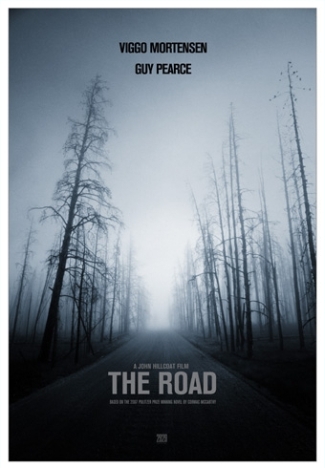
Movies rarely compare favorably to the books from which they are adapted and almost never surpass them. Still, film adaptations of books can be fantastic if handled by the right director–take Mexican director Alfonso Cuarón for example, whose brilliant films Children of Men and Harry Potter and the Prisoner of Azkaban (adaptations of books by P.D James and J.K. Rowling, respectively) convey richly imagined, engrossing worlds. Cuarón’s films join a small stable of adaptations that live up to–if not surpass–the books on which they are based. Most great film adaptations turn good genre fiction into great art. However, great literature doesn’t usually fare so well. Geniuses like Kubrick and Coppola have reconfigured airport reading like Stephen King’s The Shining and Mario Puzo’s The Godfather into cinematic masterpieces, but has anyone ever done justice to Melville or Hemingway or Hawthorne or Fitzgerald (of the four attempts at translating Gatsby to the screen, the 1974 Coppola-produced effort is arguably the best, but consider how short it falls of capturing Fitzgerald’s vision)? Which brings up the question: just how good, bad, or indifferent will the upcoming movie adaptation of Cormac McCarhy’s Pulitzer Prize winner The Road be? We thought we’d navigate the pros and cons here.

What The Road film adaptation has going for it:

The director: Australian director John Hillcoat’s 2005 feature film debut The Proposition captured the bloody violence and moral ambiguity of a world alienated from civilization. We loved the movie, and not enough people have seen it. The tone Hillcoat achieved in The Proposition seems well matched to McCarthy’s grim vision.

The producer: Nick Wechsler’s list of films includes Sex, Lies, and Videotape, The Player, Requiem for a Dream, 25th Hour, and Drugstore Cowboy–so it seems like he knows how to sit back and let a filmmaker create art without trying to, you know, have a massive Hollywood hit.

The leading man: Viggo Mortensen as the father seems like a great choice. Mortensen brought depth to the role he’s most famous for–Aragorn in The Lord of the Rings trilogy–something of a feat when you consider most of his screen time was devoted to scowling, brooding, or chopping up orcs. He was fantastic in the films he did with David Cronenberg, A History of Violence and Eastern Promises (his bathhouse fight scene is unbelievable). Mortensen’s a published author who started his own publishing house, Perceval Press, so he probably understands the literary gravity of The Road.

The story: Anyone who’s read The Road knows that it’s a sad and moving and strangely beautiful take on one of the most hackneyed devices of science fiction: the post-apocalyptic wasteland.

No Country for Old Men: The Coen brothers did a great job with No Country for Old Men.

Potential problem spots for The Road film adaptation:

The cast: We don’t know much about twelve year old Kodi Smit-McPhee who plays the son, but we do know that that is a major role. Let’s hope Kodi is more Jodie, less Jake Lloyd or (shiver) Dakota Fanning. However, Viggo’s had pretty positive things to say about him. Ringers Robert Duvall and Guy Pearce are also in there, but there aren’t too many other speaking parts in the book besides the father and the son, so it’s hard to predict what they’ll be doing–hopefully Hillcoat hasn’t fiddled with the story too much. Charlize Theron is also in the movie. The wife character showed up in a few dreamy flashbacks, but was more of a shadow than a fleshed out character; again, hopefully Hillcoat hasn’t chosen to expand the role to appease a wider demographic.

The story: Some of the best moments of The Road consist of the father’s inner monologues on memory and loss and very few directors can pull off a voice-over successfully (Terrence Malick is the only one who comes to mind right now). Of course, this problem of language is always the problem of movie adaptation.

All the Pretty Horses: Billy Bob Thornton’s leaden 2000 adaptation of the first of McCarthy’s “border trilogy” is pretty boring. I’ll admit that I’ve never finished the book, despite three attempts [ed. note: I finished the “border trilogy” in spring of ’09. Books are far, far, far superior to the film].

No Country for Old Men: Even though the Coens did a great job with No Country for Old Men, the book was still better than the movie–and No Country is, in some ways, McCarthy’s take on a genre novel, the crime procedural. In this sense, the Coens made a smart move, but they still couldn’t convey the depth and meaning of the book–again, much of it delivered via Sheriff Ed Tom Bell’s inner monologues. Although The Road may appear to have genre fiction elements–namely, the tropes of post-apocalyptic sci-fi–to describe it as such would be a severe limitation, as would be to film it in such a manner.

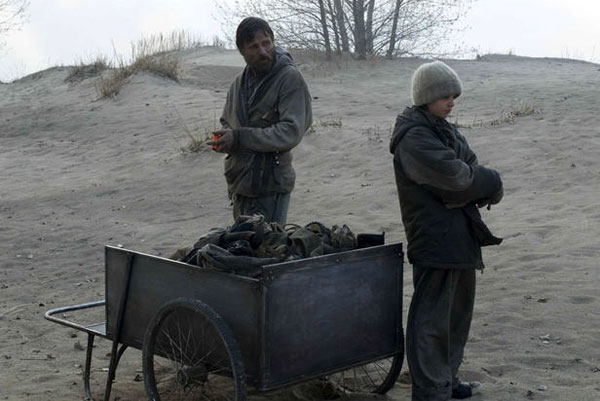
The advance stills: Sure, they’re grim and bleak, but are they grim and bleak enough?

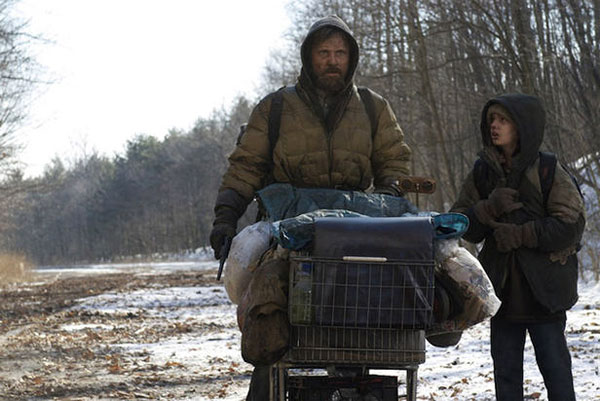
Also, why the stylized cart? If you’ve read the novel, you know what I mean–the cart needs to be a grocery store cart, homeless style! Hang on–

–that’s better! (NB: images link to a gallery of advance images)

Does it seem worth seeing in the theater?

Yes. We’ll be carrying the fire on or around November 26th (and just in time for Thanksgiving!)

Cheat Code

Motoko Rich’s article “The Future of Reading,” published in today’s New York Times, discusses the emerging trend in publishing and education of reaching out to young readers via video games. According to the article–

Increasingly, authors, teachers, librarians and publishers are embracing this fast-paced, image-laden world in the hope that the games will draw children to reading. Spurred by arguments that video games also may teach a kind of digital literacy that is becoming as important as proficiency in print, libraries are hosting gaming tournaments, while schools are exploring how to incorporate video games in the classroom. In New York, the John D. and Catherine T. MacArthur Foundation is supporting efforts to create a proposed public school that will use principles of game design like instant feedback and graphic imagery to promote learning.

Loyal readers will recall that last year I wrote quite positively about the MacArthur grant to promote gaming literacy. However, the trend detailed in today’s article seems like a big step in the wrong direction. While graphic design and computer programming are vital skill sets we should be teaching our kids, trying to hook them on reading through video games is altogether different. It smacks of cheap gimmickry that dismisses outright that reading might be a pleasure unto itself. In an age when the majority of college students can’t handle complex but necessary reading tasks and high school illiteracy rates are woefully underreported, trying to hook kids on books with Dance Dance Revolution just doesn’t seem like a great plan. If anything, it’s yet another step in the dumbing-down of America, a land increasingly hostile to anything with a hint of intellectualism–reading included. No wonder the Nobel Committee are such dicks to the U.S. Buried at the end of the article, luckily, is a voice of reason–

“I actually think reading is pretty great and can compete with video games easily,” said Mark S. Seidenberg, a professor at the University of Wisconsin in Madison who specializes in reading research. “So rather than say, ‘Oh, books are irrelevant in the modern era because there are all these other media available,’ I would ask shouldn’t we be doing a better job of teaching kids how to read?”

Professor Seidenberg seems like a wise and reasonable man. Let’s hope that we can get this country back on track and realize that the skill sets needed to survive and compete in a technological world do not replace but rather augment traditional literacy. Video games are great entertainment but it’s hard to imagine that they could ever trump the depth and breadth of philosophy and cultural currency contained in literature. Let’s not cheat our children out of that heritage by mistakenly believing that they cannot be taught to access it.