
Tag: Books
Le Guin, Stapledon, and the Brothers Strugatski (Books acquired, 11.13.2015)
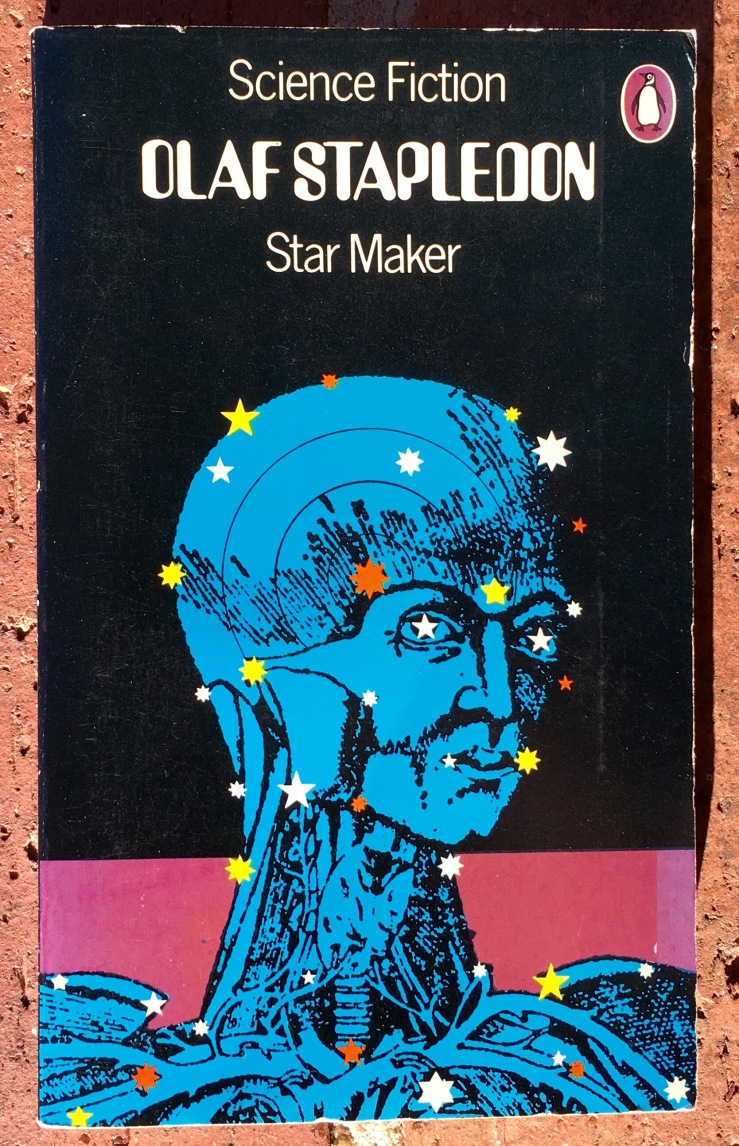
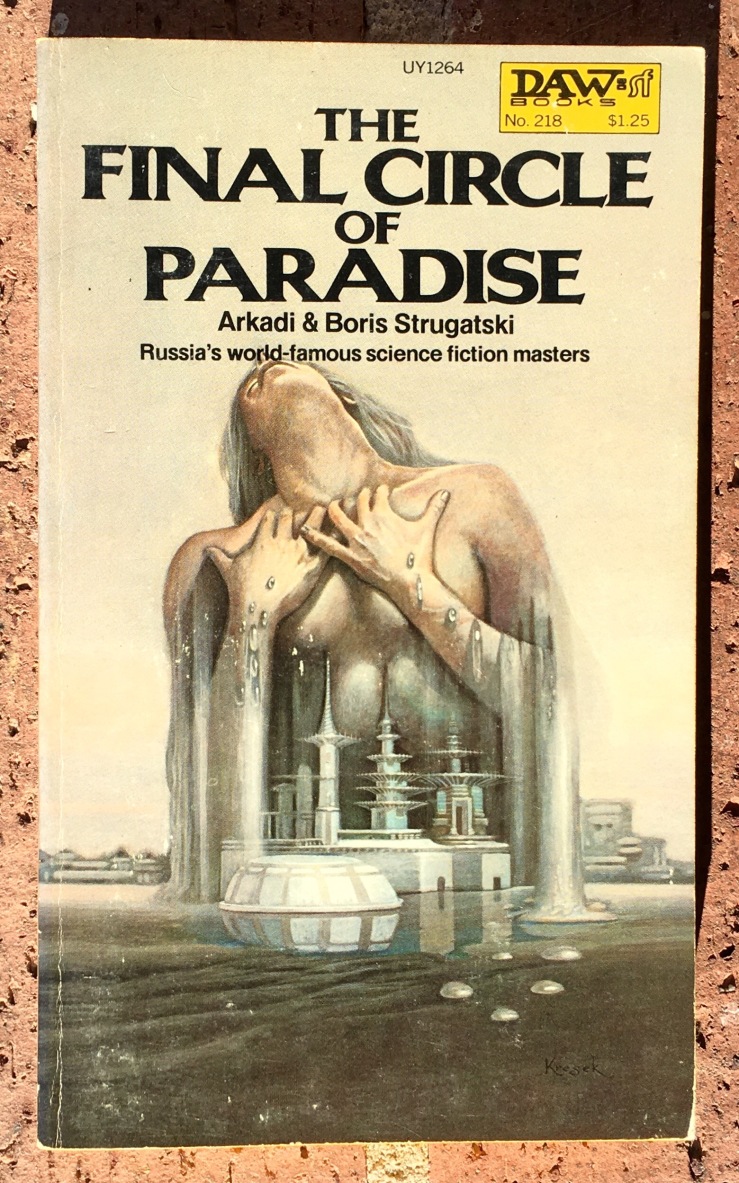
I like to think I know my way around the labyrinthine used bookstore I frequently frequent, but I somehow missed the “Ls” of the Sci-Fi/Fantasy section and wound up in Misc S. I was headed to the “Ls” to pick up another Ursula K. Le Guin novel, after having finished Rocannon’s World this afternoon. (I was looking not-so-specifically for The Word for World Is Forest, which my bookshop somehow didn’t have). Anyway, my eye was drawn to the Penguin edition of Olaf Stapledon’s Star Maker (above), which was one of those yeah, I know, I need to read it books. I also saw another one by the Strugatski bros, which I picked up, even though I still haven’t read Hard to Be a God.
I couldn’t resist this hardback edition of Three Hainish Novels, an Ursula K. Le Guin omnibus, which collects Rocannon’s World with Planet of Exile and City of Illusion. I haven’t read the other two, but I’ll get to them after a rereading of The Dispossessed. 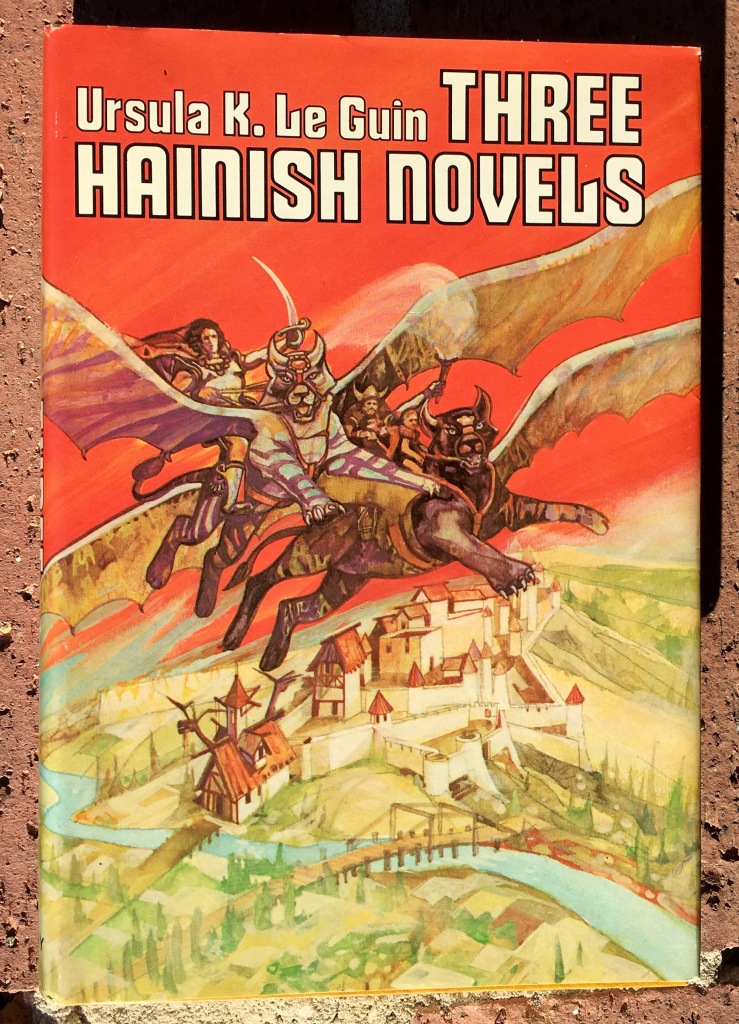
Selections from One-Star Amazon Reviews of Virginia Woolf’s Mrs. Dalloway
[Editorial note: The following citations come from one-star Amazon reviews Virginia Woolf’s novel Mrs. Dalloway. I’ve preserved the reviewers’ original punctuation and spelling. More one-star Amazon reviews.].
I had been warned about Woolf
written, I believe, to impress rather than to relate.
I don’t appreciate her writing and keep coming back for more
I may not be giving it a fair review since I only made it to page 65
pages and pages of surreal metaphors that go on for 10 paragraphs
Woolf had a huge obsession with semi-colons
The book just does not make any sense
I really liked the movie “the Hours”
nonsensical semi-flashbacks
Groundbreaking prose?
I tried, I really did
describing nothing
Written by a lesbian
Kind of like F. Scott Fitzgerald’s works
DO read “The Hours”, you will be impressed
I kept losing track of which character was musing about nothing
I suppose Woolf is considered a genius since she was apparently a cavalier writer of her generation
Let us listen to an old farty woman stream her consciousness to us to hear, pointless thoughts that go nowhere
I’m grateful that contemporary writers can at least string together 2 sentences that follow one another in a logical sequence
Lets burn every sentence she ever penned to end all the unneccesary suffering that curious readers have to go through when they first pick up “Mrs. Dalloway.”
My suggestion: just watch The Hours – you’ll get all the beauty and none of the confusion
the person responsible, Virginia Wolf, has been dead for quite some time now
i have no interest in reading about that lifestyle
am stuck in her growling semicolons
slower than a tortoise
ramblings of a lunatic
As bad as Faulkner
So much language
dreadfully boring
run-on sentences
“literary” drivel
terribly written
so many words
and never getting to a plot
Stream of conscience you say?
I normally enjoy stream of consciousness
The narrative reads like the inner thoughts of a sugar crazed autistic kid with ADD in the middle of a carnival
everyone i know who likes this book only does so because he or she was told by some professor that it’s supposed to be good and can provide no evidence to confirm it
This book certainly shows the depravity of man and a self-centered life and the meaningless found amongst those who think of none but themselves.
The absence of spacing to differentiate between each character’s thought process makes for unnecessary confusion
I really liked the idea of the story taking place over the course of one day
THIS BOOK IS WORSE THAN AIDS!
meandering and repetetive
will suffice as kindling
The party! The party!
VW was mentally-ill
“Dense”
put me off
definitley not a fun read
pretty gross hair and stuff on it/ in it
I had had to read it, or was supposed to
haven’t been able to get past the first chapter
lovely idea, virginia and i applaud you for your creativity
I felt like I was reading some writing student’s homework assignment
The Hours is better, despite its inspiration
this story line is too depressing for me
Descriptions were beaten to death
Not one thing uplifting
I am an avid reader!
the book failed
hyphens
Ezra Pound wondered which should be sovereign, the verb or the noun (William H. Gass)
It is too easy—the name game—in this case.
Christened “Pound, Ezra Loomis.” If used as a verb, “pound” means to beat. If used as a noun, “pound” signifies a unit of weight, a measure of money, pressure of air, or physical force. From time to time, apropos poetry, Pound wondered which should be sovereign, the verb or the noun, and concluded, if his practice may be entered as evidence, that the verb was most noticed when knocked off the sentence like a phallus from a kouros—“Spiretop alevel the well curb”—and when effects were hammered back into their causes with naillike hyphens—“Seal sport in the spray-whited circles of cliff-wash”—hence into a compaction like a headache … splitting.
As location, a pound sequesters sick animals and strays. “Places of confinement for lawbreakers” is the definition that immediately precedes Pound’s name in The American Heritage Dictionary, after which we encounter the listing for “pound of flesh” and read of “a debt harshly insisted upon.” Certainly a pound is a large bite by any standard, yet it resembles, in being Shylock’s payment, the neschek of the Jews: money for the rent of money; not a gnaw but, in the way it feels coming due, not a nibble either. It is a tax on use, this thinning of the dime, as if money would otherwise be free of entropy; although to put the bite on someone has come to mean to beg for a loan, possibly as a return of favor, where the request is clearly not intended to invite the interest of the loan’s own teeth. So one meaning of “pound” has a relative called “blood money.” It suggests racial forfeiture.
On the other hand, the pound of flesh we subtract from the flank of a steer may increase our girth and relieve many a primordial anxiety. We call it “putting our money to work.” Wear and repair, profit or loss, depends upon your point of view, the angle of the bank and the direction of the bounce. Our poet depended without protest, for much of his life, upon funds supplied by the family of his wife.
The first few paragraphs of William H. Gass’s essay “Ezra Pound.” Collected in Finding a Form.
Three Books

Mumbo Jumbo by Ishmael Reed. 1978 mass market paperback by Bard Books, a division of Avon Books. No designer or illustrator credited. I picked this copy up after giving away the edition I read this summer. An amazing novel.
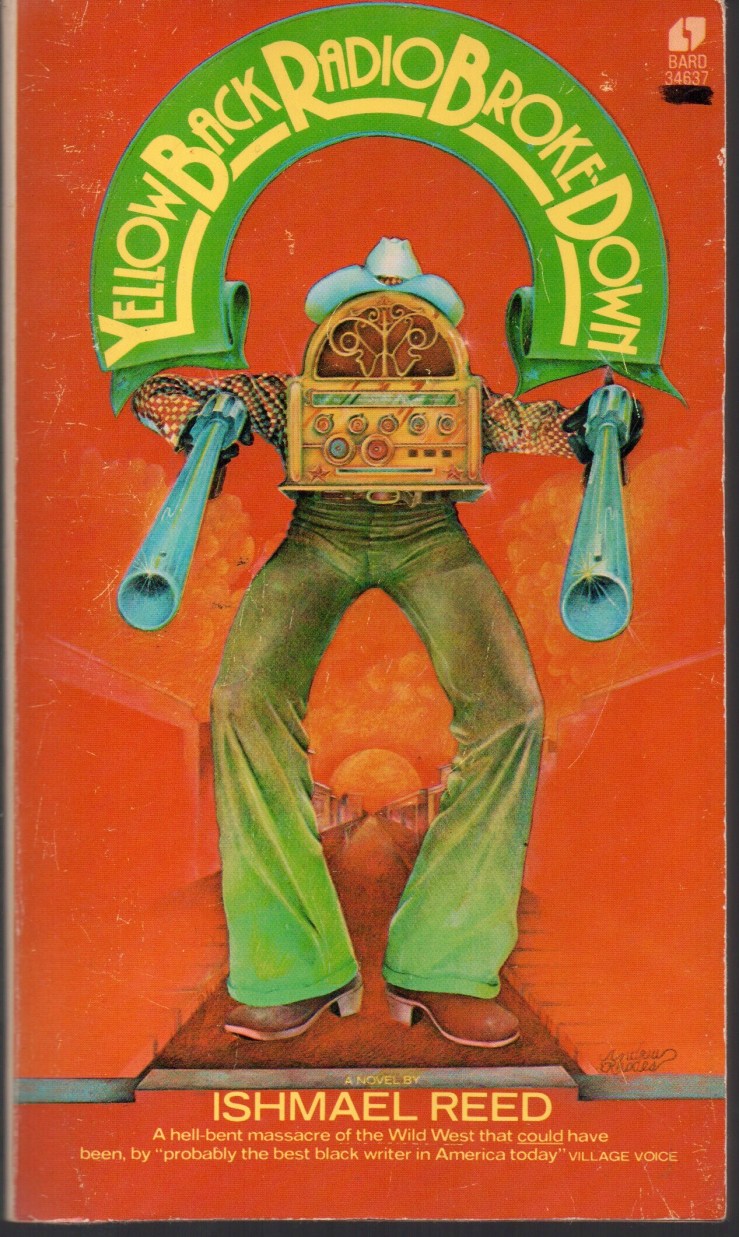
Yellow Back Radio Broke-Down by Ishmael Reed. 1977 mass market paperback by Bard Books, a division of Avon Books. No designer or illustrator credited—but the cover illustration seems to be signed “Andrew Rhodes.” Haven’t read this one yet. The Free-Lance Pallbearers by Ishmael Reed. 1969 mass market paperback by Bantam Books. No designer or illustrator credited. I finished this last week—a slim, strange, dazzling work.
Most newness is new in all the same old ways (William H. Gass)
‘Make it new,’ Ezra Pound commanded, and ‘innovative’ is a good name for some kinds of fiction; however, most newness is new in all the same old ways: falsely, as products are said to be new by virtue of minuscule and trivial additions; or vapidly, when the touted differences are pointless; or opportunistically, when alterations are made simply in order to profit from imaginary improvements; or differentially, when newness merely marks a moment, place, or person off from others and gives it its own identity, however dopey.
From William H. Gass’s essay “Anywhere but Kansas.” Collected in Tests of Time.
Bret Easton Ellis and the Other Dogs (Book acquired, 11.02.2015)

Lina Wolff’s novel Bret Easton Ellis and the Other Dogs is coming out early next year from And Other Stories. Their blurb:
At a run-down brothel in Caudal, Spain, the prostitutes are collecting stray dogs. Each is named after a famous male writer: Dante, Chaucer, Bret Easton Ellis. When a john is cruel, the dogs are fed rotten meat. To the east, in Barcelona, an unflappable teenage girl is endeavouring to trace the peculiarities of her life back to one woman: Alba Cambó, writer of violent short stories, who left Caudal as a girl and never went back.
Mordantly funny, dryly sensual, written with a staggering lightness of touch, the debut novel in English by Swedish sensation Lina Wolff is a black and Bolaño-esque take on the limitations of love in a dog-eat-dog world.
Vincent Mahé’s 750 Years in Paris (Beautiful book acquired, 10.28.2015)
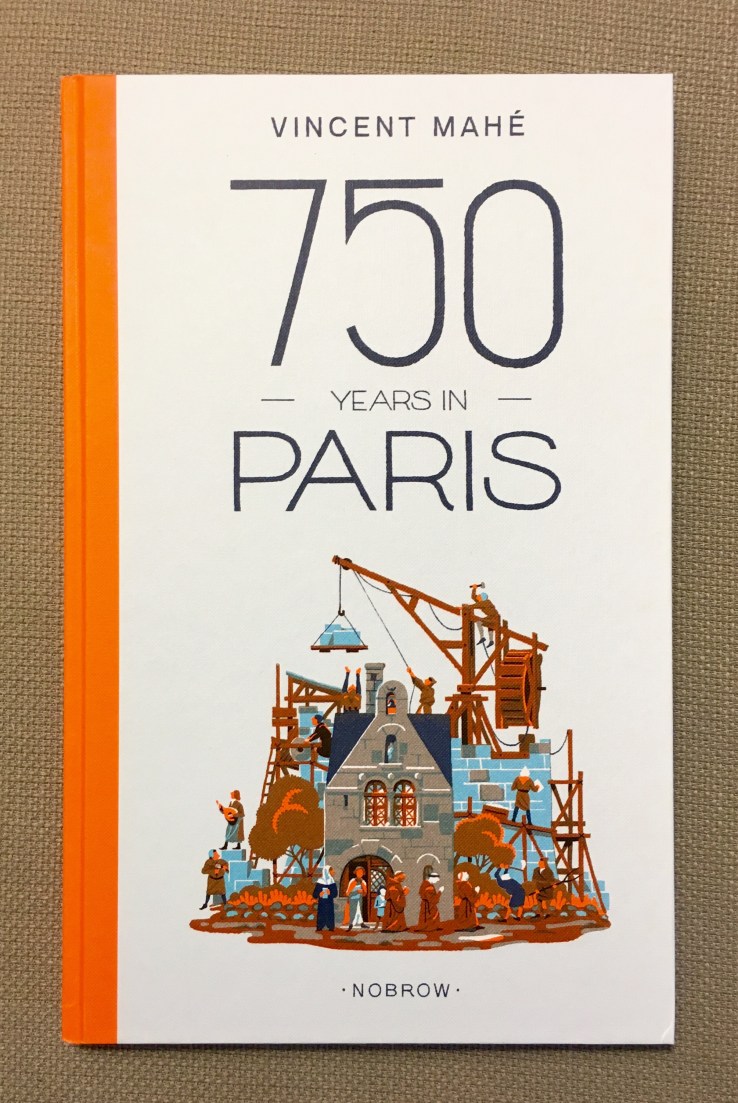
I’ve said it before, but the good people at Nobrow are making some of the best literary objects I’ve seen in years—the graphic novels they publish are smart, beautiful, strange, and witty. The last time I wrote about a Nobrow title, it was Jon McNaught’s Birchwood Close, which I read after a weekend of (very) primitive island camping. In a little coincidence (or not), Nobrow’s new title, Vincent Mahé’s 750 Years in Paris showed up as I was packing my Subaru for a camping trip with my family. I couldn’t help but fly too-quickly through the pages, before relinquishing it to my daughter, who tried to take it camping with us. “I need something to read on the beach,” she claimed, but I told her it was too big to take along (it’s about the height of a wine bottle). In truth, I just didn’t want to risk the book’s getting damaged. We read it again a few times when we got home—first very quickly, then more slowly. Fun.

I owe the thing a proper review, but for now here’s Nobrow’s blurb:
If you could stand still for 750 years, what could you learn about the world? It’s time to find out.
A literary graphic novel unlike anything else on the racks, 750 Years tells the story of our time, focusing on one single building in France as it sees its way through the upheavals of history. Beginning in the 13th Century and making its way towards today, this historically accurate story is the eagerly anticipated debut from Vincent Mahé.
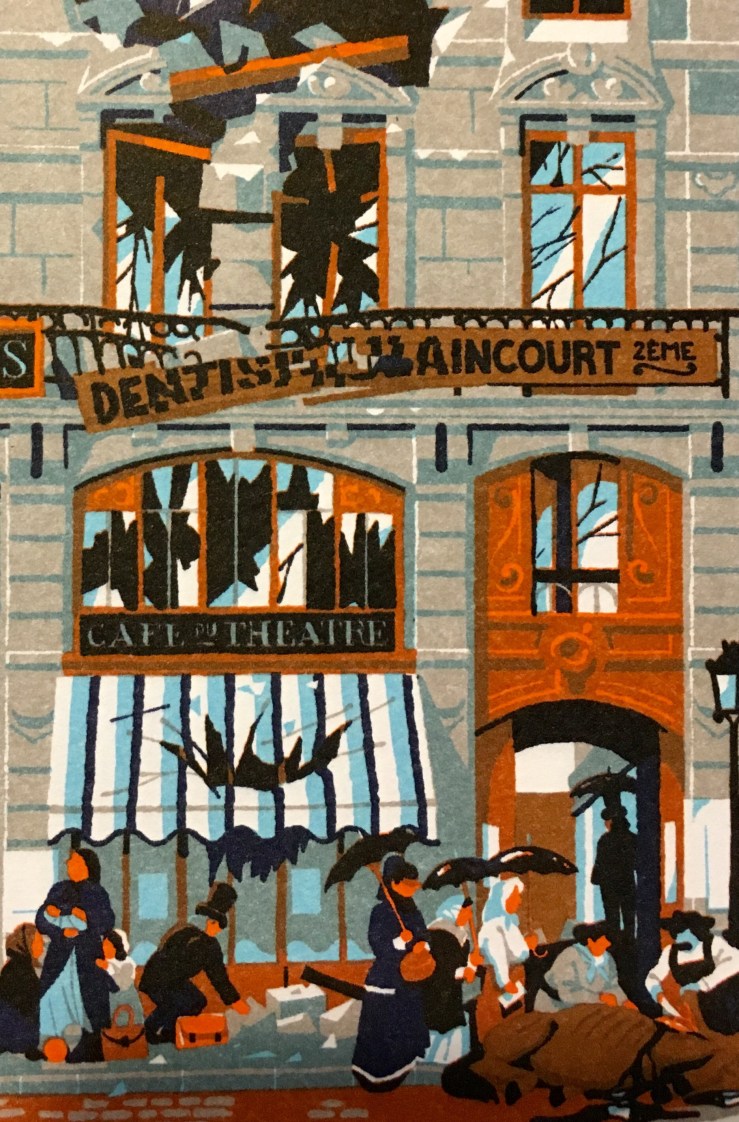
nogu: naked. Gk gumnos.

From Joseph T. Shipley’s The Origin of English Words: A Discursive Dictionary of Indo-European Roots.
Three Books
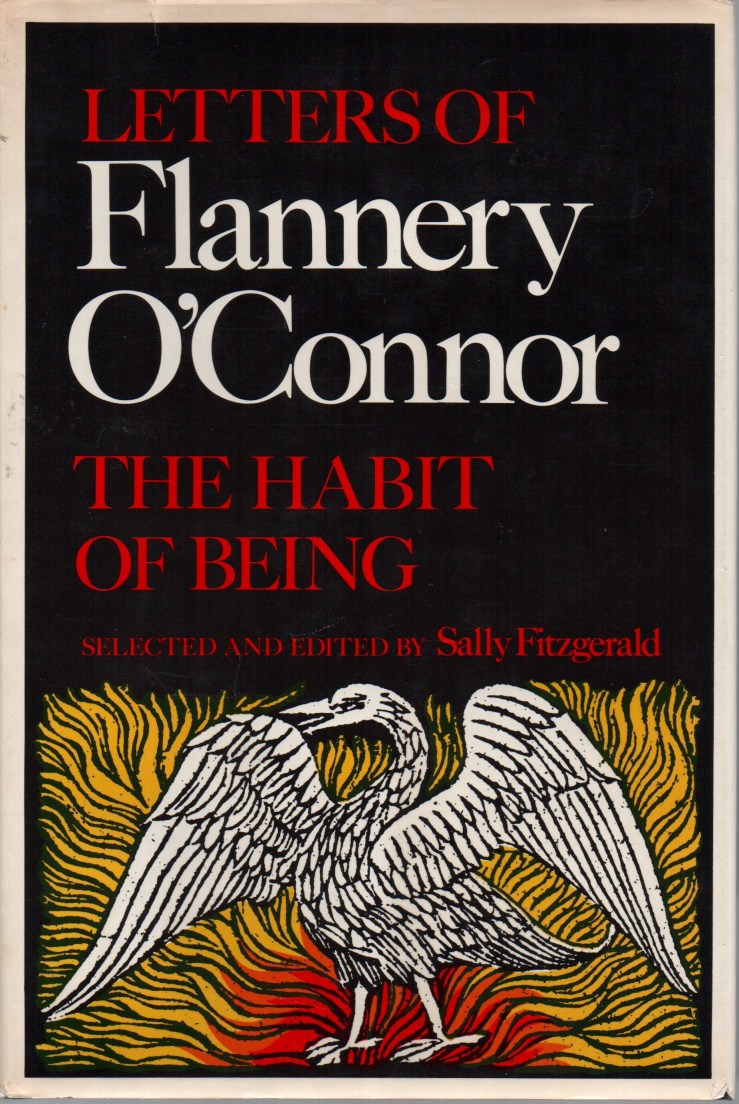
The Habit of Being: Letters of Flannery O’Connor. Edited by Sally Fitzgerald. 1979 2nd edition hardback from FS&G. Jacket design by Janet Halverson. A marvelous book—Fitzgerald’s editing is wonderful here—there’s a rich index that makes this book a pick me up and read me anytime kind of resource. Particularly great are O’Connor’s letters to ‘A,’ a smart reader whom O’Connor struck up a friendship with in letters.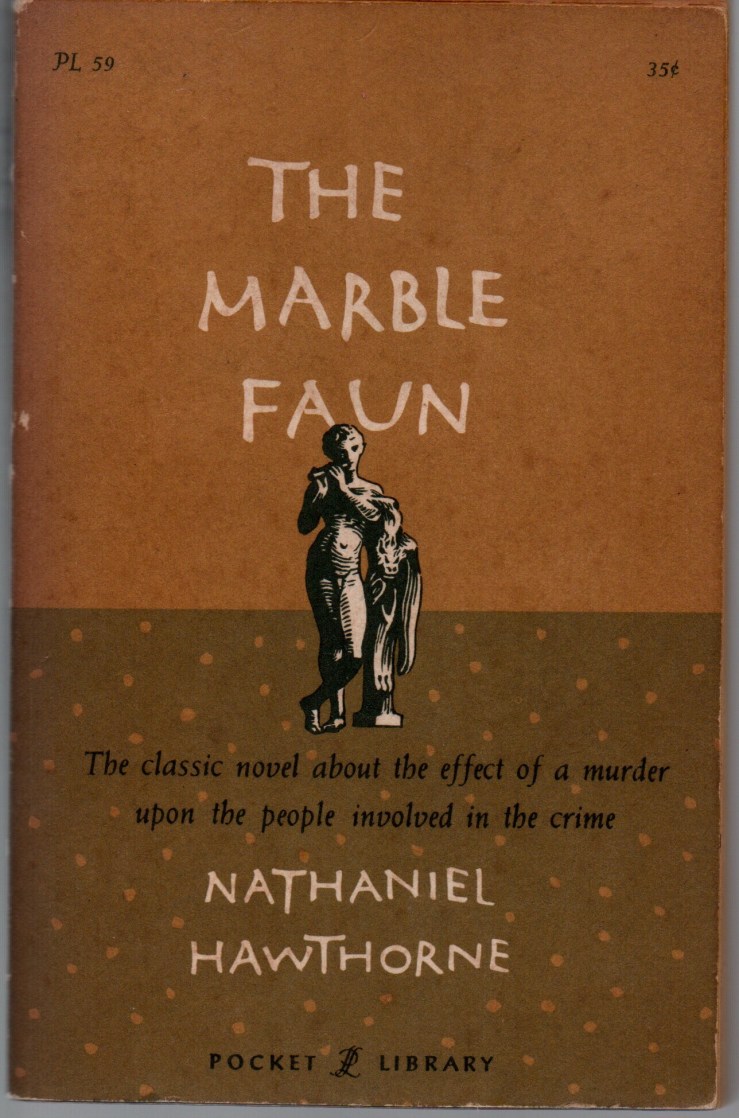
The Marble Faun; or The Romance of Monte Beni by Nathaniel Hawthorne. 1958 mass market paperback by Pocket Books. No designer credited. I love this cover and design—simple and elegant. The Marble Faun is the only Hawthorne novel (book, really) that I’ve yet to read.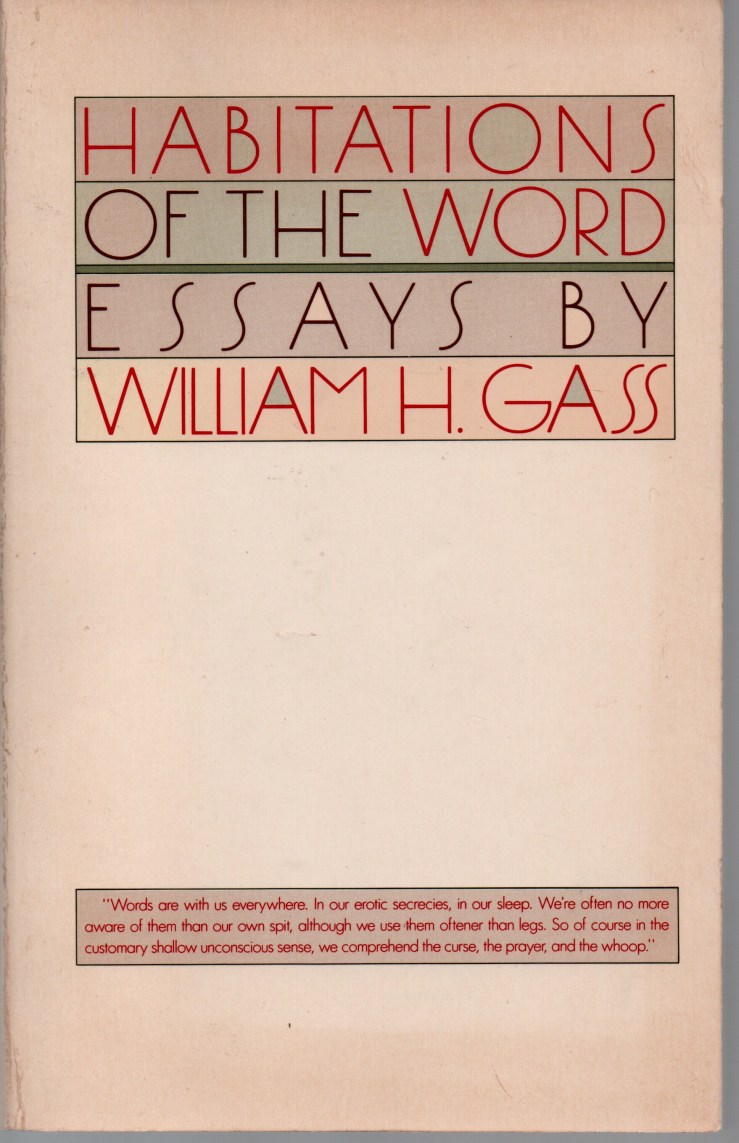
Habitations of the Word: Essays by William H. Gass. 1985 trade paperback by Touchstone/Simon and Schuster. Cover design by Koppel & Scher—and what a great design! (The quotation on the cover is from Gass’s essay “The Soul Inside the Sentence”). I had pulled this book out to find some lines from the first essay, “Emerson and the Essay,” for an American lit class I’m teaching. The essays collected here are brilliant stuff—literary criticism that surpasses “literary criticism.”
Reviews and riffs of September and October, 2015 (and an unrelated tiger)
I reread Cormac McCarthy’s Suttree in September and considered if Suttree dies at the end.
Then I reread Blood Meridian for the umpteenth time.
I reviewed Penguin Classics bicentennial edition of Jane Austen’s Emma.
I had somehow never read Ursula K. Le Guin’s The Lathe of Heaven before October of 2015.
I also read Autobiography of Red and Red Doc> by Anne Carson during September-October, but erased everything I tried to write on them. I found Autobiography particularly excellent—a real How is this possible? kind of read.
Unrelated tiger by Utagawa Kunisada:

The Witch — Salvator Rosa

No supernaturalism, only the occult continuation of infinite nature
Daydream, which is to thought as the nebula is to the star, borders on sleep, and is concerned with it as its frontier. An atmosphere inhabited by living transparencies: there’s a beginning of the unknown. But beyond it the Possible opens out, immense. Other beings, other facts, are there. No supernaturalism, only the occult continuation of infinite nature … Sleep is in contact with the Possible, which we also call the improbable. The world of the night is a world. Night, as night, is a universe … The dark things of the unknown world become neighbors of man, whether by true communication or by a visionary enlargement of the distances of the abyss … and the sleeper, not quite seeing, not quite unconscious, glimpses the strange animalities, weird vegetations, terrible or radiant pallors, ghosts, masks, figures, hydras, confusions, moonless moonlights, obscure unmakings of miracle, growths and vanishings within a murky depth, shapes floating in shadow, the whole mystery which we call Dreaming, and which is nothing other than the approach of an invisible reality. The dream is the aquarium of Night.
— VICTOR HUGO, LES TRAVAILLEURS DE LA MER
The Hugo citation comes from Ursula K. Le Guin’s 1971 novel The Lathe of Heaven—Le Guin uses it as a preface to the seventh chapter. It’s beautiful on its own; it also functions as a kind of poetic summary of The Lathe of Heaven.
Greg Graffin’s Population Wars (Book acquired some time in September, 2015)
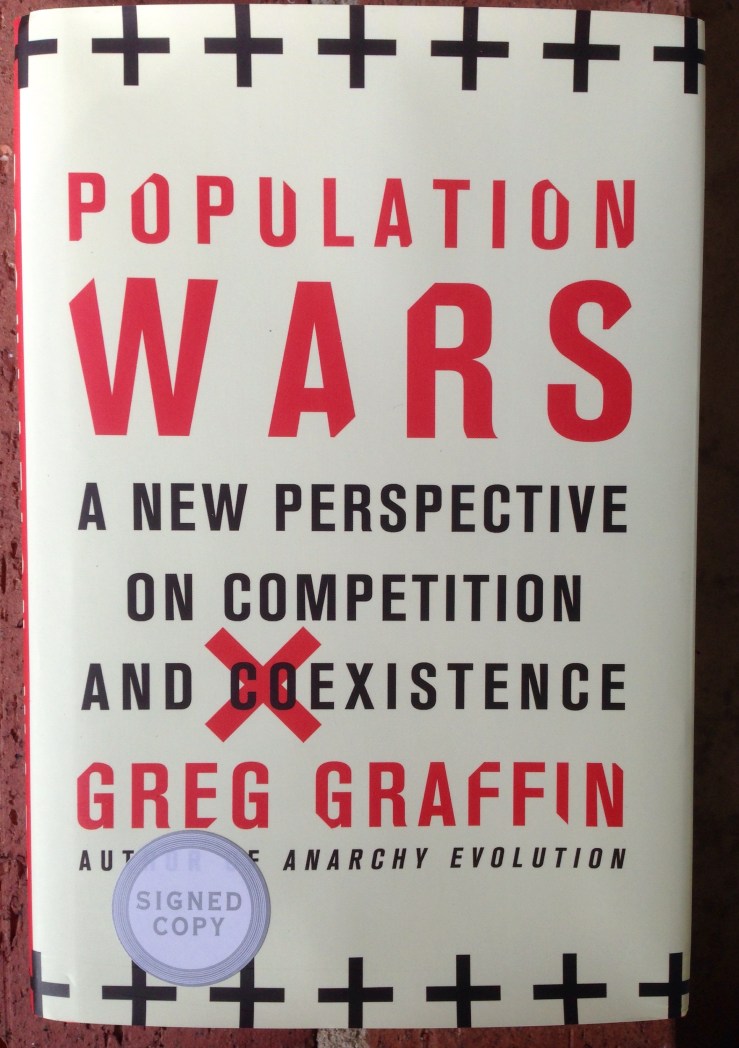
Greg Graffin is probably best known for his work as the leader of Bad Religion, a band he formed when he was 15. Graffin is also an academic and author. His latest book, Population Wars, makes a compelling argument for coexistence. It’s an accessible and persuasive read, rooted in biology and hope. (And of the three books I’ve read by indie rockers of yore this year, it’s easily the best). Publisher Thomas Dunne’s blurb:
From the very beginning, life on Earth has been defined by war. Today those first wars continue to be fought around and inside us, influencing our individual behavior and that of civilization as a whole. War between populations—whether between different species or between rival groups of humans—is seen as an inevitable part of the evolutionary process. The popular concept of survival of the fittest explains and often excuses these actions.
In Population Wars, Greg Graffin points to where the mainstream view of evolutionary theory has led us astray. That misunderstanding has allowed us to justify wars on every level, whether against bacterial colonies or human societies, even when other, less violent solutions may be available. Through tales of mass extinctions, developing immune systems, human warfare, the American industrial heartland, and our degrading modern environment, Graffin demonstrates how an oversimplified idea of war, with its victorious winners and vanquished losers, prevents us from responding to the real problems we face. Along the way, Graffin reveals a paradox: When we challenge conventional definitions of war, we are left with a new problem—how to define ourselves.
Population Wars is a paradigm-shifting book about why humans behave the way they do and the ancient history that explains that behavior. In reading it, you’ll see why we need to rethink the reasons for war, not only the human military kind but also Darwin’s “war of nature,” and find hope for a less violent future for mankind.

Three Blurbs

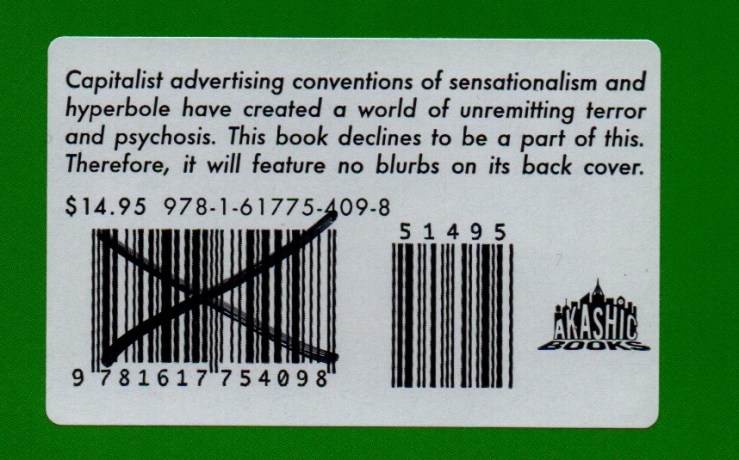
Three Books

The Crack-Up by F. Scott Fitzgerald; edited by Edmund Wilson. A 1956 New Directions mass market paperback. No designer credited. The Crack-Up collects autobiographical pieces by Fitzgerald, along with letters and essays by some of Fitzgerald’s contemporaries and near-contemporaries—but the highlight is the inclusion of Fitzgerald’s note-books. (I shamelessly plundered them on this blog for years). Its cover is black and white and gray.
An Armful of Warm Girl by W.M. Spackman. 1981 trade paperback edition by Van Vactor & Goodheart. Cover design by Leslie Evans. A perfect little novella, with a perfect opening page. Its cover is black and white and gray.

Flee by Evan Dara. 2013 trade paperback edition by Aurora. Design by Todd Michael Bushman. Blogged about it here and here. Its cover is black and white and gray.
Extinction — Anton Kannemeyer
 (More/about; via).
 Biblioklept