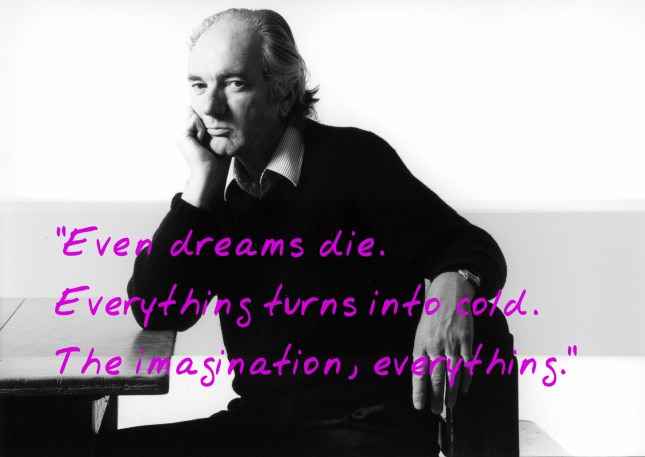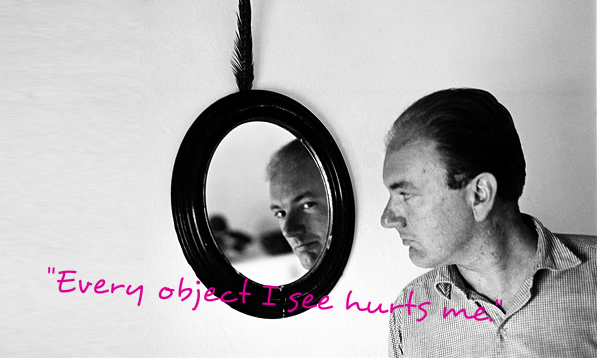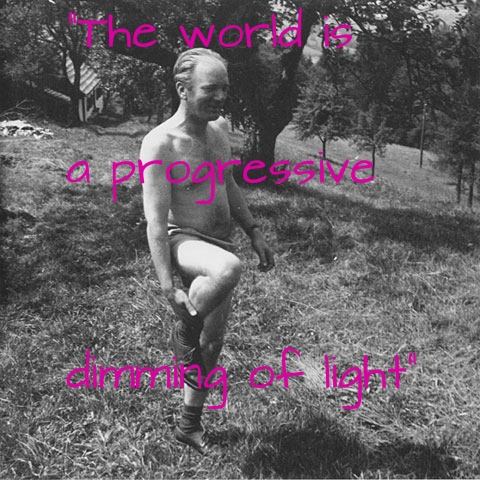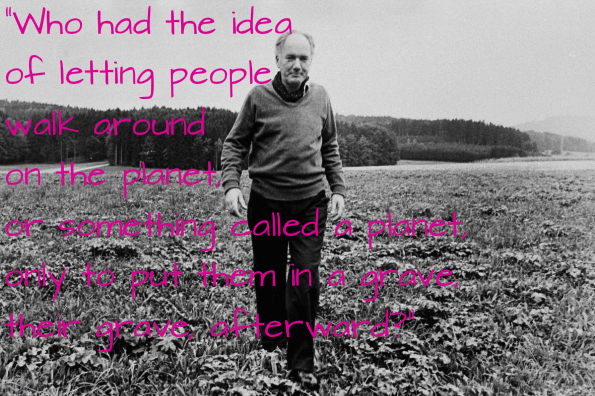
Valentine’s Day Wishes from Thomas Bernhard

tb1

tb2

tb3

tb5

tb6

ThomasBernhardWalking

A Spool of Blue Thread (Book acquired some time in January, 2015)

IMG_4954Anne Tyler’s novel A Spool of Blue Thread is new in hardback from publisher Random House. Their blurb:

“It was a beautiful, breezy, yellow-and-green afternoon. . .” This is how Abby Whitshank always begins the story of how she fell in love with Red that day in July 1959. The Whitshanks are one of those families that radiate togetherness: an indefinable, enviable kind of specialness. But they are also like all families, in that the stories they tell themselves reveal only part of the picture. Abby and Red and their four grown children have accumulated not only tender moments, laughter, and celebrations, but also jealousies, disappointments, and carefully guarded secrets. From Red’s father and mother, newly arrived in Baltimore in the 1920s, to Abby and Red’s grandchildren carrying the family legacy boisterously into the twenty-first century, here are four generations of Whitshanks, their lives unfolding in and around the sprawling, lovingly worn Baltimore house that has always been their anchor.

Brimming with all the insight, humor, and generosity of spirit that are the hallmarks of Anne Tyler’s work, A Spool of Blue Thread tells a poignant yet unsentimental story in praise of family in all its emotional complexity. It is a novel to cherish.

The Little Cigarette — Theodor Pallady

Some notes on beginning Evan Dara’s novel Flee

B8jFz0WCYAAghDz

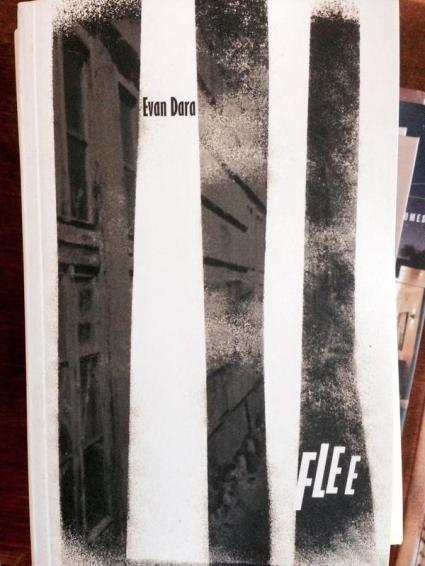
A. What a cover on Evan Dara’s 2013 novel Flee, don’t you agree?

B. From the back cover:

IMG_5030

C. That’s all there is. Well, okay, there’s an ISBN too. But no blurbs, no other text.

D. “Something always going on—” is the first line of Flee. It’s also an apt description of Dara’s formal technique, a constantly-shifting series of dialogues, monologues, overlapping, cross-cutting, diverging—always out there ahead of the reader. That dash there—that dash is the simple summative signal of it all, a little typographic pole that simultaneously connects and interrupts.

E. The most obvious point of comparison for Dara’s technique (besides his amazing debut novel The Lost Scrapbook) is William Gaddis’s stuff, particularly J R—the verbal dazzle, the few stray lines of poetic stage-setting in lieu of traditional exposition—the throw-the-reader-in-the-deep-end stuff. David Foster Wallace frequently attempted the same rhetorical mode, most successfully in §19 of The Pale King. (It’s entirely likely that The Lost Scrapbook could have had the same following that Infinite Jest achieved had Dara done anything to promote the book. But here I think of Gaddis in his Paris Review interview: “I’d go back to The Recognitions where Wyatt asks what people want from the man they didn’t get from his work, because presumably that’s where he’s tried to distill this ‘life and personality and views’ you speak of. What’s any artist but the dregs of his work: I gave that line to Wyatt thirty-odd years ago and as far as I’m concerned it’s still valid”).

F. The point of contrast though is Dara’s abrupt transition, sometimes it seems mid-sentence, from one speaker to the next. Just as we feel (nearly) comfortable with who this particular narrator might be, another voice interjects, or rather continues, or re-trajects the discourse—as in the second chapter of Flee (“38,842”), where a college student driving home in snowy weather to pick up a book by Paul Krugman gives over to a number of speakers all describing the closing of the local university, Pitkinson (this closing’s being the presumable, like, plot of Flee so far I suppose)—faculty and staff and townies and residents—until a grad student takes over to report the speech of one Professor Gray, himself bearing witness to the downfall of the school (Ghost Sociology is the issue)—and then of course the chapter gives over to more rumor, more speculation. “Something always going on—.”

G. So I’ve read the first three chapters (“38,839,” “38,842,” “36,551”). But wait: The next chapter (“35,717”–do the titles reflect the dwindling population of the town (Anderburg)?)—but wait the next chapter, I see by scanning, offers some new, perhaps, rhetorical gesture—a section in a different font? Chunkier paragraphs?

I have to go see about this. (More to come).

The Poet — Adrian Gottlieb

The_Poet_internet

Jane Bowles’s novel Two Serious Ladies confounds with sinister humor and dark delight

Two Women, Gwen John

Here’s a short review of Jane Bowles’s only novel, Two Serious Ladies: The book is amazing, a confounding, energetic picaresque suffused with sinister humor and dark delight. I read it knowing nothing about the plot on the recommendation of Ben Marcus, who described it as “so insane, so beautiful, and in some sense, unknowable to me. On the surface, it’s not really about much, but the arrangement of words does something chemical to me.” My recommendation is to dispense with the rest of my review and read Bowles’s novel.

“Unknowable” is a fair description, and Two Serious Ladies was met with bewilderment when it was first published in 1943, as Negar Azimi points out in the comprehensive essay “The Madness of Queen Jane”:

Edith Walton, writing in the Times Book Review, called the book senseless and silly: “To attempt to unravel the plot of ‘Two Serious Ladies’ would be to risk, I am sure, one’s own sanity.” Another reviewer said, simply, “The book is about nothing.” Jane’s family, in the meantime, found it unseemly in its stark depiction of lesbianism. Its characters, who have goals and motivations that are hard to grasp, were difficult to relate to. Yet another critic wrote, “The only shocking thing about this novel is that it ever managed to find its way to print.” Jane was only twenty-four.

The notion that “The book is about nothing,” is corrected by Marcus’s qualifier about its “surface”: Two Serious Ladies moves through the phenomenological world that its characters experience, but it does not mediate the concrete contours of that world in a way that its characters can name for the reader. When the characters, those two serious ladies, do stumble into language that might name, pin down, or otherwise fix their experience, fix their consciousness into a stable relation with the world, Bowles spins the wheel again, flings her characters into new scenarios. Moments of epiphany are transitory and hard-purchased. A (perhaps) illustrating passage, offered without context:

Mrs. Copperfield started to tremble after the girl had closed the door behind her. She trembled so violently that she shook the bed. She was suffering as much as she had ever suffered because she was going to do what she wanted to do. But it would not make her happy. She did not have the courage to stop from doing what she wanted to do. She knew that it would not make her happy, because only the dreams of crazy people come true. She thought that she was only interested in duplicating a dream, but in doing so she necessarily became the complete victim of a nightmare.

The free indirect style here still hides so much from the reader, who must suss the characters’ unnamed desires from bewildering details alone. The passage above shows us fear and trembling, dream, nightmare—and crazy people. What does Copperfield want to do? One subtext here is a lesbian desire seemingly comprehended by everyone but Mrs. Copperfield herself. (In some of the book’s strangest moments, Mr. Copperfield leaves his near-mad wife in a dangerous part of a foreign city to encounter hookers of every stripe). Two Serious Ladies is about women searching for something, but something they can’t name, can’t conceive in language—but can perhaps imagine. Continue reading “Jane Bowles’s novel Two Serious Ladies confounds with sinister humor and dark delight” →

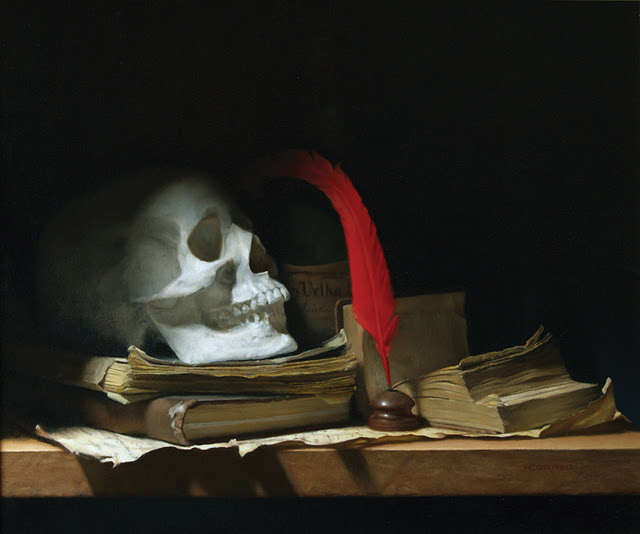
Vanitas of the Angels — Martinho Correia

tumblr_ltrk52Z9CG1r5569zo1_1280 (1)

The Complete Short Stories of Mark Twain

TheCompleteShortStoriesOfMarkTwain

1971 Bantam edition.

Evan Dara (Books acquired 1.28/29/2015)

IMG_4990

Selections from One-Star Amazon Reviews of Harper Lee’s To Kill a Mockingbird

[Ed. note: The following citations come from one-star Amazon reviews of Harper Lee’s novel To Kill a Mockingbird. (See also: Thomas Pynchon’s Mason & Dixon, Chinua Achebe’s Things Fall Apart, Mary Shelley’s Frankenstein, Thomas Pynchon’s Gravity’s Rainbow, George Orwell’s 1984, Herman Melville’s Moby-Dick, James Joyce’s Ulysses and David Markson’s Wittgenstein’s Mistress). I’ve preserved the reviewers’ own styles of punctuation and spelling].

the prejudice part was good

A classic american piece of caca

A court case is hardly a thrilling idea.

It mainly compared people to Mockingbirds

it was just like any other book, nothing special.

It uses unutterable words and displeasing language.

I’m not rascist at all, so don’t make that assumption either.

Worst book ever written, a disgrace to American Liturature

Well, at least it was in my own language. Otherwise, it sucked.

I reckon this be anoth’r classic that doesn’t deserve that status.

I don’t like these kinds of books anyway, but I was assigned to read it! Yuk!

Simply put, this is a novel about racism written for people who received their knowledge about racism from this book!

If people would just leave old prejudices to heal themselves, it would all be better, and best of all, this book wouldn’t exist

In 1960 Harper Lee published To Kill A Mockingbird. About thrity years earlier William Faulkner had published the short story Dry September. ITS THE SAME STORY.

Although the author had some good points, I must say that this book sucked a big fat one star. I thought it was horribly thought out and it was considerably a snoozer. I seriously feel asleep readin this

I could write a novel that had notecard characters–even the narrator seemed a little hollow, and Boo Radley was just deus ex machina with a clever, sleepy-southern-town name–and no one would care.

this novel features the archetypal White hero with few flaws, his perfect children, the maid with just the right amount of “colored wisdom,” a black amn who is little more than a dullard, and the evil redneck who actually commited the crime!

It’s an uneven paste-job of short stories and pieces by Harper Lee promoted by her liberal New York publishing friends.

It is a very interesting and great book!!!!! I expecially liked how they talked of people standing up for what is right!! NOT!!!!!!!!!!!!!

I kept hoping that they would get to the point and give me some instructions, but I still don’t know how to kill a mockingbird.

Thanks to all my friends who had to tourchure threw reading this disgrace and supporting me in not likeing the book.

Who really cares about a little girl that goes around the neighborhood doing things like spying on her albino neighbor.

Dissgusting beyond belief. Harper Lee owes an apology to untold numbers of girs, women, and families.

The rednecks are evil, the blacks are victims, and the self-righteous Atticus is too good to be true.

In a just world Harper Lee and her acolytes would be forced to live in the Hell the helped create.

i know slavery was bad and judging blacks and all that is bad but like come on were over it

By the way, DO NOT BUY, because if i find it in your house i won’t think to kindly of you.

All the book consists of is a middle-class family in the south with a few weird neighbors.

Scout and her brother, Jem, grow up while some wierd stuff happens all around them.

the charecters were poorly developed and obviously fake

no excimet in besides when it was in the court spot

I find no point in writing a book about segregation

I don’t see why this book is so fabeulos.

This book is very nasty

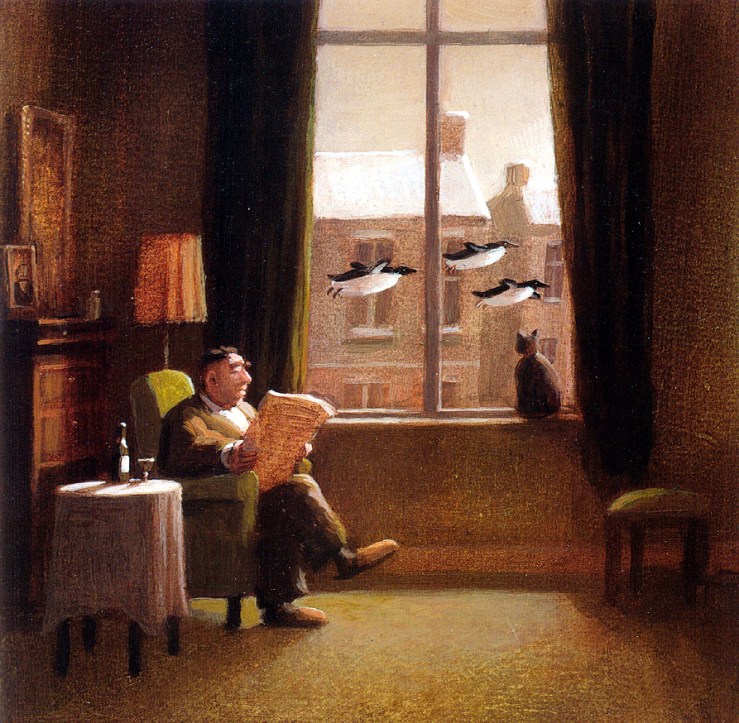
February — Michael Sowa

february

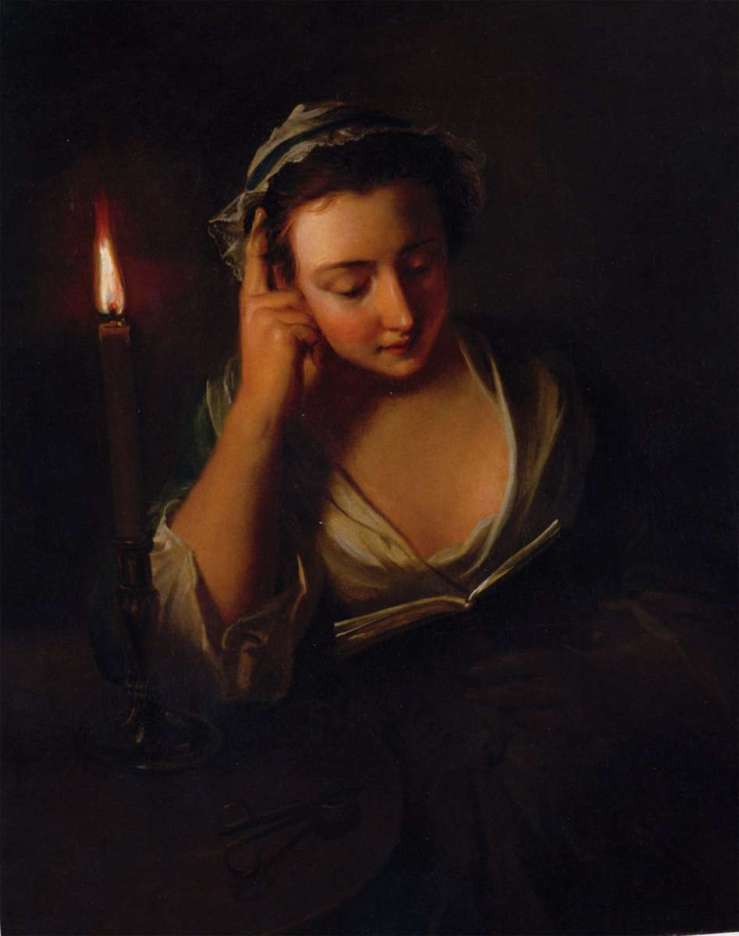
A Young Girl Reading by Candlelight — Philip Mercier

tumblr_nfocfu0dSZ1rrnekqo1_1280

Twilight — Angelo Morbelli

images158

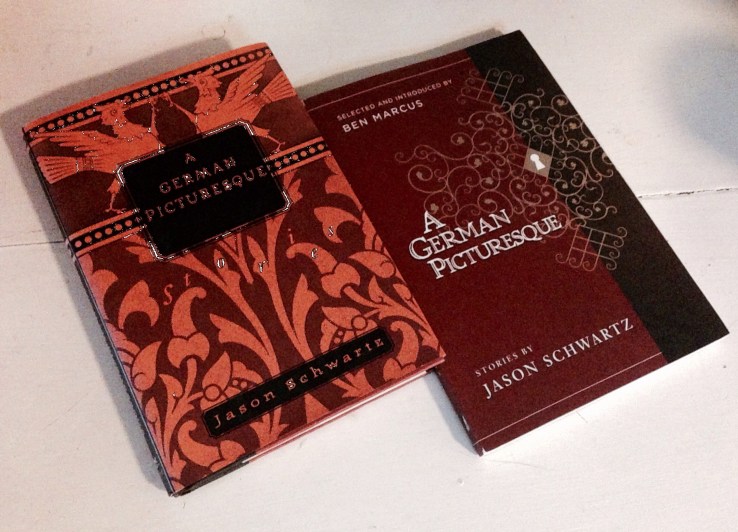
A German Picturesque (Book acquired, 1.23.2014)

2015/01/img_4947.jpg

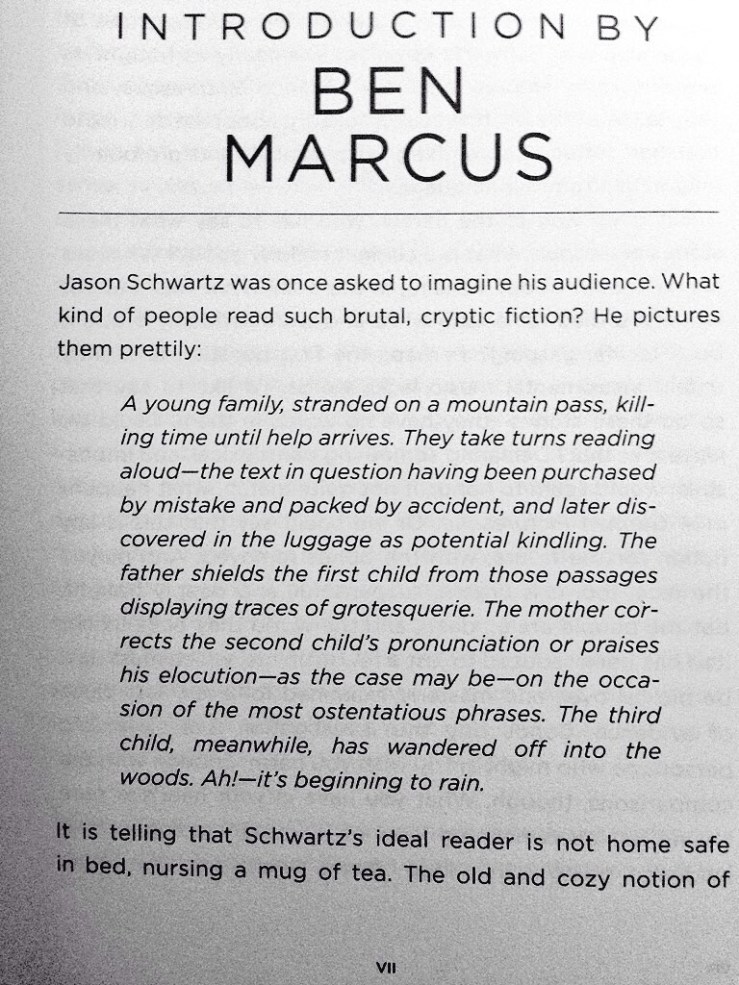
Pharos is reissuing Jason Schwartz’s debut collection A German Picturesque, pictured on the right, above, by the original. The title was selected and introduced by Ben Marcus, who quotes from the interview Schwartz granted me last year—

2015/01/img_4923.jpg

I actually think that it was this review which led to Ben Marcus consenting to talk with me over the phone for an hour in December. I’ve been typing that interview very slowly and swear it’s on the horizon. Painful dreadful anxious work. Interview with Marcus to come. Review of Schwartz to come.

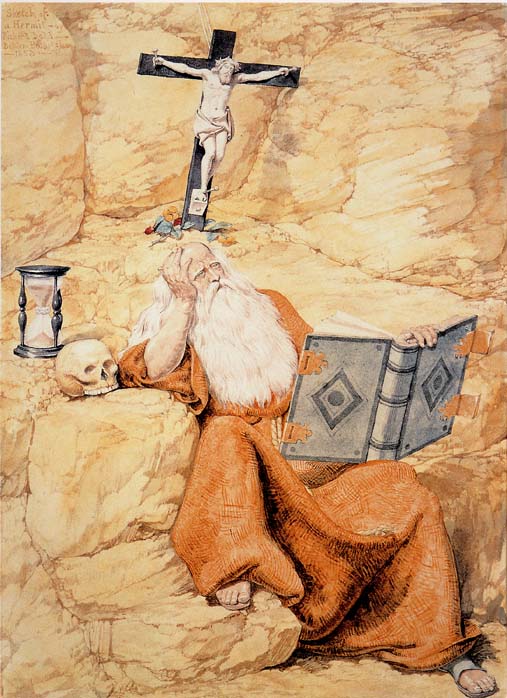
A Hermit — Richard Dadd

a_hermit-large

Paranoia Alert (Inherent Vice)

paranoia alert

DFW’s Brief Interviews with Hideous Men, books as memory objects, etc.

2015/01/img_4925.jpg

On our short walk home from her school yesterday, my darling daughter inquires if we can go to the bookstore. She needs some new Junie B. Jones, she reports. I assent.

This particular bookstore is about a mile away, a big labyrinth of shelves and stacks and strange little closets crammed with books. The owner once kindly estimated to me that the place houses somewhere between one million and two million books, but probably not more than three million books. The place is a hive, or better yet a brain. An archive.

On this warmish January afternoon, a coverless paperback wedged and warped keeps the front door propped open. My daughter doesn’t dally, fetching up a bevy of Ms. Jones’ adventures (and the third volume of Ivy + Bean to boot: “It’s Ivy “plus” Bean, not Ivy “and” Bean, her graceful correction).

We have a few minutes before we need to pick up my son, so I do a fairly regular patrol about the premises, looking for a copy of Jane Bowles’s Two Serious Ladies for a colleague. No dice. And, out of weird old habits, go past the last shelf, where Vollmann’s underattended tomes rest near David Foster Wallace novels, always depleted. I like to look at the new covers, I guess.

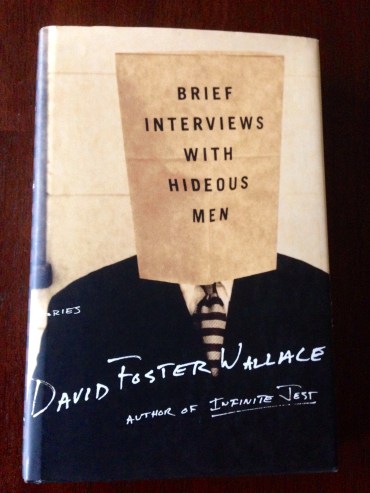
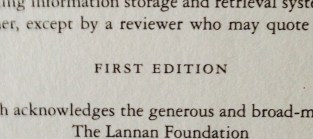
Well so and anyway, I spied a pristine hardcover copy of Brief Interviews with Hideous Men, clearly never read, and thought, Oh hey, this must be a first edition. Which it was and Oh hey you don’t need this book.
2015/01/img_4926.jpg

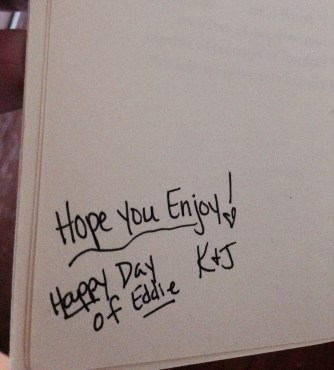
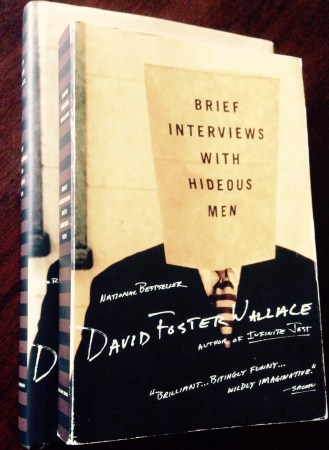
There is nothing rare or especially valuable about a first hardback U.S. edition of Hideous Men. The store is selling it for half of the publisher’s recommended price, but I have more than enough credit (thanks unsolicited review copies!) to pick it up. Which I do. Despite of course already owning it in the far more flexible trade paperback edition (first edition!) inscribed by some of the dearest damn friends who gave it to me for a birthday, an edition I reread memorably over a few weeks in Italy, an edition warped by strange moistures (I’d love to pretend the warping arose from the salty splash of the ancient Mediterranean but my own body sweat is a far more likely culprit).
2015/01/img_4927.jpg

Brief Interviews is my favorite collection of David Foster Wallace stories. The stories here are much better than those in his first collection, Girl with Curious Hair (which, the first DFW I read, has a special place in my gizzards), and though there’s nothing here that can touch the best moments of Oblivion (“The Suffering Channel” and “Good Old Neon”), the collection is cohesive, propulsive, engaging, its longer pieces punctuated by blips and vignettes. Here is the first selection, “A Radically Condensed History of Postindustrial Life”:

When they were introduced, he made a witticism, hoping to be liked. She laughed very hard, hoping to be liked. Then each drove home alone, staring straight ahead, with the very same twist to their faces.

The man who’d introduced them didn’t much like either of them, though he acted as if he did, anxious as he was to preserve good relations at all times. One never knew, after all, now did one now did one now did one.

So I picked up the hardback first edition, realizing that what I really wanted (in addition to this edition that I didn’t and don’t really need) was the copy that I read in college, the copy I borrowed from UF’s Library West (I’ll pay you $10,000 if you can think of a better library name, which you can’t), a flat brown squashed brick—-I must’ve been one of the first to read it, this was in ’99 or early ’00—I checked it out three times and then I had to return it. I ripped off “Adult World (I)” and “Adult World (II)” (these are actually the same story, but…) for a project in some bullshit class I was taking at the time, some class called Post-Historical Visual Culture or some other such nonsense—I didn’t rip off the plot, but the structure, the whole narrative/outline thing that Wallace did there. (My story was about a geneticist trying to clone a son or maybe someone to love, I can’t recall, shudder to recall…And why was I turning in a story and not an essay?!).

Why do I want the very edition that I first read, Dewey’s decimals imprinted on its drab jacketless spine? Why do I want an object that proclaims first, first, first, even though I don’t need it—why the compulsion? And then the sentimental compulsion to keep a less sturdy paperback version just because my name is incribed in it, just because I recall so vividly shaving my beard in Minori in Amalfi after reading “Tri-Stan: I Sold Sissee Nar to Ecko” and realizing that Oh my god this story is fucking terrible, DFW, I get what you’re doing, but my god. 

A book is a memory object, a placeholder, a bookmark for the memory of the reading experience, because we don’t remember what we read, not really. I have a few novels committed to memory (more or less) through yearly rereading, through teaching, but on the whole the details fade, the misremembering opens to misreading. My dream is to disband all of my books, march them out into the world, my memory secure, transcendent, stable, eternal, etc.—the objects gone, their dusty physicality imprinted in some psychic library of the soul. But I don’t believe in my dream, and even though I dig e-books, they don’t shock my memory in the same way that old pressed leaves do. So I live with these guys, nestled together unnecessarily, necessarily so.
2015/01/img_4928.jpg