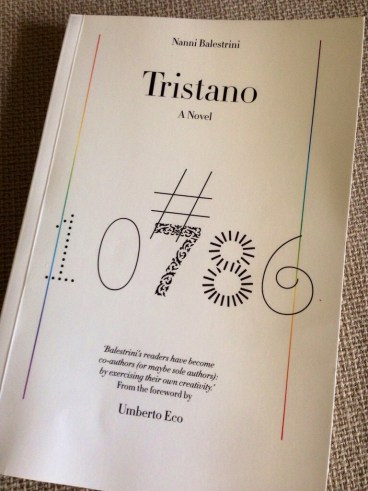
I Review (Version #10786 of) Nanni Balestrini’s Novel Tristano

20140318-103552.jpg

Let’s start with some facts:

Nanni Balestrini originally composed Tristano in the 1960s with the aid of an algorithm supplied to an IBM computer.

There are ten chapters in the novel.

Each chapter is comprised of twenty paragraphs.

Balestrini’s algorithm shuffles fifteen of those paragraphs within each chapter.

There are thus 109,027,350,432,000 possible versions of Tristano.

Tristano was published in 1966 by the Italian press Feltrinelli, but in only one of those 109,027,350,432,000 possible versions.

Now, Verso Books has published 4,000 different versions of Tristano in English.

They sent me #10786 to review.

Maybe a few more facts, and then some opinions—and citations from the novel—no?

Umberto Eco spends the first five pages of his six page introduction to Tristano situating Balestrini’s project in its proper literary-historical context. (He names some names: Pascal, Georg Philipp Harsdörffer, Christopher Clavius, Pierre Guldin, Mersenne, Leibniz, Borges, Queneau, Mallarmé, Manzoni, Joyce. There is no mention of Cortázar’s Hopscotch or Bantam’s Choose Your Own Adventure series).

Mike Harakis translated Tristano into English.

Harakis preserves Balestrini’s spare (and often confusing) style of punctuation.

The book is exactly 120 pages.

In his contemporary “Note on the Text” of Tristano, Balestrini says that the book is “an ironic homage to the archetype of the love story.”

The title of course alludes to the legend of Tristan and Iseult.

In his note, Balestrini uses the term “experiment” at least three times, suggesting that “to experiment with a new way of conceiving literature and novels” can make it more “possible to represent effectively the complexities and unpredictability of contemporary reality.”

Balestrini’s 2004 novel Sandokan is in my estimation one of the finest books of the past decade: A poetic examination of criminal brutality told in a bold voice, its syntactical experiments not experiments at all, but rather the base of a strong, strange tone that perfectly synthesizes plot and voice.

Okay. Opinions and citations:

In chapter 2 of my edition of Tristano—on page 19 of version #10786—we get a paragraph that begins: “To be one-sided means not to look at problems all-sidedly.”

Does Tristano, through its formal, discursive, algorithmic structure seek to approach an all-sided perspective? Significantly, we can’t be sure who says the line. There are two characters, male and female, both named C (an algebraic variable?).

There seems to be an argument here, an investigation. A crime, a love affair. But Tristano is a dialectic without synthesis. Or maybe that failure is mine. Maybe I’ve failed as the reader. Neglected my part. “Treat life as if it were a game,” we’re told in the aforementioned paragraph (page 19 of version #10786, if you’re keeping score). Or maybe we’re not told. Maybe C is telling C to treat life as a game (and not just telling the reader), but the context is not (cannot) be clear.

But again, that’s probably maybe almost certainly but okay maybe not quite the point of Tristano. From paragraph 18 of chapter 6 (page 71 of version #10786): “First of all one must have a fairly clear idea of the content of the text.” And a few lines down: “Her story weaves and unweaves like the tapestry she was working on.” And: “It’s the unconditional loss of language that starts.” And: “It might never have an end.” Freeing these lines from the sentences around them ironically stabilizes them.

Tristano isn’t just line after line of Postmodernism 101 though. There is actual imagery here, content. In fairness, let me share entire paragraph (from page 69  of version #10786):

In the internal part of the cave along with an abundance of Pleistocene fauna a human Neanderthaloid tooth was recovered. You’ve already told me this story. The cave is divided into two levels one upper and one lower that host a subterranean lake which can be visited by boat. It might even be another story. They had warned him it wouldn’t be a walk in the park. Inside you can go down into a great cavern in the centre of which there is a rock surmounted by a giant stalagmite. We’ll stay and look for another thirty seconds then we’ll leave. All the stories are different one from the other. On returning he found that C had bought herself a new blue silk dress. C remained standing while he explained to her how it had gone. She ran a finger over his lips to wipe the lipstick off them. I have to go. It’s still early. I’ll be away all day perhaps tomorrow too. He gave her a long kiss on the lips.

This paragraph is maybe almost kind of sort of a synecdoche of the entire book—sentences that seem to belong to other paragraphs, story threads that seem part of another tapestry. Let us pull a thread from another paragraph, another chapter (chapter 9, paragaph 8, page 102 of  of version #10786):

All imaginable pathways of the line that represents a direct connexion to the objective are equally impracticable and no adjustment of the shape of the body to the spatial forms of the surrounding objects can allow the objective to be reached.

Do you believe that? Did Balestrini? Or did it just allow him a neat little piece of rhetoric to gel with the concept of his experiment? The verbal force, dexterity, and dare I claim truth of Sandokan, composed a few decades later, suggests that yes, language can be shaped to mean.

And this, I think, is the big failure of Tristano—it’s a text afraid to mean, to even take a shot at meaning. Content to be simply an experiment, its sections adding up to nothing more than the suggestion that its sections could never add up to anything, Tristano offers little beyond its concept and a few observations on storytelling that dwell on paralysis instead of freedom. The whole experiment strikes me as the set up for a joke played on the reader: Look at all this possibility, look at all these iterations—and what’s at the core? Nothing.

I hate to end on such a negative note. I’m thankful that Verso published Tristano, which I think shows courage as well as a commitment to literature that you just aren’t going to see from a corporate house.  I’m thankful that I got to read (version #10786 of) Tristano, and I plan to order his novel The Unseen via my local bookstore. The expectations that I brought to the book were huge: Loved the concept, loved the last book I’d read by the author—and I want to read more by the author. Indeed, it’s entirely possible that failed Tristano’s experiment. But I would’ve been happier to learn something or feel something from that failure other than disappointment.

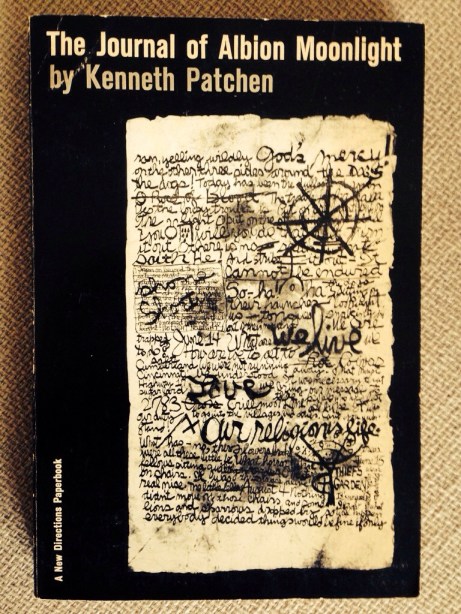
“We Need Cruel Comedy” | A Lars Iyer Interview

I first interviewed Lars Iyer in 2011, after the publication of his novel Spurious, the beginning of a trilogy that concluded with Exodus (my favorite of the three). I asked Lars to talk with me about his trilogy for an email interview, and we ended up discussing failure, comedy, optimism, academia, American writing, Britain in the mid-eighties, and his forthcoming novel Wittgenstein Jr.

You can get Lars Iyer’s trilogy from publisher Melville House, check out his blog, and find him on Twitter.

Biblioklept: Why a trilogy? Was that by design? Is it a trilogy?

Lars Iyer: Spurious was only a beginning. I wanted to historicise my characters, to present their friendship as part of a larger social, economic and political context. Otherwise, I risked merely contributing belatedly to the literature of the absurd.

Biblioklept: I want to talk about the end of Exodus but that seems like bad form for an interview. Spoilers, etc. Can you comment on where you leave your protagonists, or how you leave them, or why you leave them?

LI: I leave my protagonists roughly where they were at the beginning of the trilogy: rudderless, rather lost, full of a sense of their failure, but with their friendship, such as it is, intact. ‘No hugs, no lessons’: my characters haven’t learned anything…

larsBiblioklept: Why can’t they learn? Why the repetition? Why not a heroic arc? Why not a saving grace?
LI: Perhaps because learning implies a kind of resolution that I think is inappropriate for the characters. Kundera says something apposite about Don Quixote. Cervantes makes his would-be knight-errant set off in search of battles, ready to sacrifice his life for a noble cause, ‘but tragedy doesn’t want him’. Kundera goes on:

since its birth, the novel is suspicious of tragedy: of its cult of grandeur; of its theatrical origins; of its blindness to the prose of life. Poor Alonzo Quijada. In the vicinity of his mournful countenance, everything turns into comedy.

So it is with my trilogy. No tragedy! No heroism! No tragic catharsis, that would see the tragic hero being dragged back into line. And no comic catharsis either, in which the older norms of a traditional societal system are reaffirmed. So much comedy is self-congratulatory, self-reassuring: the humour of good cheer, of port and cigars. It shores up things as they are. This is why I can never bear to watch comedy on television. It’s so rare to see comedians turn the joke on themselves. We need cruel comedy. Black comedy, which laughs at itself laughing…

Why the use of repetition in my novels? Because I want to portray the breakdown of things as they are, not once, but again and again. Failure, without amelioration. Serio-comic breakdown, without restitution. Anomie. Helplessness. Crushed hope. How else to acknowledge the prose of our lives?

Much of the humour of Don Quixote, depends on the contrast between lofty ideals and the concrete, everyday, corporeal life. The humour of my trilogy is analogous – but, of course, our everyday is utterly changed! A generalised precarity, un- and under-employment, free-floating anxiety, consumerism, the emphasis on self-representation, the sense that history is over, that politics is all played out, that financial and climatic catastrophe loom…

The tragedy of everyday life is that it’s not even tragic. It never reaches the lofty heights of tragic grandeur. Well, nor do my characters. When W. is at his most wretched, he cannot even die – that’s the end of Dogma. When W. is at his most revolutionary, participating in his own version of the Occupy movement, as at the end of Exodus … well, I won’t spoil the story, but it won’t surprise readers of previous books in the trilogy that there is neither a heroic arc nor a saving grace. Continue reading ““We Need Cruel Comedy” | A Lars Iyer Interview”

“How to recognize a work of art” (Roberto Bolaño on translation)

How to recognize a work of art? How to separate it, even if just for a moment, from its critical apparatus, its exegetes, its tireless plagiarizers, its belittlers, its final lonely fate? Easy. Let it be translated. Let its translator be far from brilliant. Rip pages from it at random. Leave it lying in an attic. If after all of this a kid comes along and reads it, and after reading makes it his own, and is faithful to it (or unfaithful, whichever) and reinterprets it and accompanies it on its  voyage to the edge, and both are enriched and the kid adds an ounce of value to its original value, then we have something before us, a machine or a book, capable of speaking to all human beings; not a plowed field but a mountain, not the image of a dark forest but the dark forest, not a flock of birds but the Nightingale.

From Roberto Bolaño’s essay “Translation Is an Anvil” (collected in Between Parentheses).

New in Translation from New Vessel Press (Books Acquired Some Time Earlier This Month)

20140313-175305.jpg

Some handsome titles from indie New Vessel Press:

First, Marek Hlasko’s Killing the Second Dog (translation by Tomaasz Mirkowicz). Blurb:

Robert and Jacob are two down-and-out Polish con men living in Israel in the early 1960s. They’re planning to run a scam on an American widow visiting the country. Robert, who masterminds the scheme, and Jacob who acts it out, are tough, desperate men, exiled from their native land and adrift in the hot, nasty underworld of Tel Aviv. Robert arranges for Jacob to run into the woman, who has enough trouble with her young son to keep her occupied all day. Her heart is open though, and the men are hoping her wallet is too. What follows is a story of love, deception, cruelty and shame, as Jacob pretends to fall in love with the American. But it’s not just Jacob who seems to be performing a role; nearly all the characters are actors in an ugly story, complete with parts for murder and suicide. Hlasko’s writing combines brutal realism with smoky, hardboiled dialogue, in a bleak world where violence is the norm and love is often only an act.

I’m gonna crack into this one next week.

The Good Life Elsewhere by Vladimir Lorchenkov (translation by Ross Ufberg):

The Good Life Elsewhere is a very funny book. It is also a very sad one. Moldovan writer Vladimir Lorchenkov tells the story of a group of villagers and their tragicomic efforts, against all odds and at any cost, to emigrate from Europe’s most impoverished nation to Italy for work. This is a book with wild imagination and heartbreaking honesty, grim appraisals alongside optimistic commentary about the nature of human striving. In Lorchenkov’s uproarious tale, an Orthodox priest is deserted by his wife for an art-dealing atheist; a rookie curling team makes it to an international competition; a mechanic redesigns his tractor for travel by air and sea; thousands of villagers take to the road on a modern-day religious crusade to make it to the promised land of Italy; meanwhile, politicians remain politicians. Like many great satirists from Voltaire to Gogol to Vonnegut, Lorchenkov makes use of the grotesque to both horrify us and help us laugh. It is not often that stories from forgotten countries such as Moldova reach us in the English-speaking world. A country where 25 percent of its population works abroad, where remittances make up nearly 40 percent of the GDP, where alcohol consumption per capita is the highest in the world, and which has the lowest per capita income in all of Europe – this is a country that surely has its problems. But, as Lorchenkov vividly shows, it’s a country whose residents don’t easily give up.

Sad Postcard in a Sad Book (Gass/Pancake)

20140311-143226.jpg

A book, you would think, is not a pocket, a purse, or a wastebasket, but people dispose of their sniffle-filled Kleenex between unexposed pages, their toothpicks, too, dirty where they’ve gripped them while cleaning their teeth—such in-decency—matchbooks with things written on the underside of the flap, usually numbers, of telephones, I suppose; or they leave paper clips and big flat mother-of-pearl buttons—imagine—curls of hair and all sorts of receipts as well as other slips of paper they’ve used to mark the spot where they stopped; and they file correspondence between leaves as if a book were a slide drawer—do they do that to their own books?—or they tuck snapshots, postcards, unused stamps, into them, now and then a pressed bloom—they stain, I’ve seen leaf shadows—one- to five- to ten-dollar bills, you’d never guess, yes, rubber bands, a shoelace, candy and gum wrappers—even their chewed gum that I have to pry out with a putty knife—people—people—I dee-clare—and newspaper clippings, often the author’s reviews, that are among the worst intruders because in time they’ll sulfur the pages where they’ve been compressed the way people who fall asleep on the grass of a summer morning leave their prints for the use of sorcerers like me to make our magic.

–From William H. Gass’s novel  Middle C.

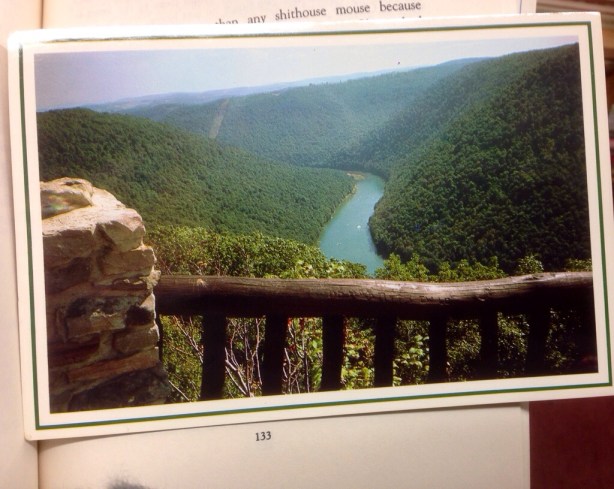
I leave stuff in books all the time. In fact, I almost always leave something (a movie stub, a photo, a note, a picture my son or daughter drew, something) in each book I finished.  (I even wrote about it a bit last year). So I guess Miss Moss, the old librarian in Gass’s Middle C, would be royally pissed with my habits. I read this passage a day or two after a visit to my favorite used bookstore, where, looking for books by Grace Paley, I came across an uncracked copy of Breece D’J. Pancake’s super sad super terrific collected stories. I own the book, but in a different edition (fox on the cover), so I grabbed it out. Lo and behold, a postcard!–and of a scene straight out of Pancake’s own semi-beloved West Virginia, no less! The note, a token of friendship, accompanied an inscription in the book itself—is there anything sadder than an inscribed book abandoned to a used bookstore?

I left the book, postcard in it, easily resisting the initial temptation to slide it into one of the Paley volumes. Destined for another reader.

20140311-143234.jpg

Library Rules (William H. Gass)

We can’t frisk our customers—I wouldn’t want to put my hands on some—but in the reading room or anywhere—if you see someone taking notes with a pen, you must caution them. Highli—? Indeed. Highlighters—highlighters are evil, they must be immediately confiscated and their users given a talking-to, even if they are marking up their own books or some harmless paper copies. Oh … Marjorie raised her hands to heaven. How I hate highlighters—you don’t use them, do you? Joseph wagged his head. Good, she said, good sign. The dog-ear people do it, stupid students do it, and they will grow dog-ears in due time. You don’t do dogs, do you, Joseph? We never could afford a pet, Joseph said. Good sign. Good sign. Dogs are bad for books. Don’t ever do dogs. They chew. Cats are bad, too. They claw. They love to rub their chins on the corners of covers, leave sneezers of fur. Rub their chins and grin at you. Before they fade from view, Joseph said. Oh, you are a darling, I kiss the nearby air, Marjorie exclaimed.

But it would not be for the last time. The neighboring air got many a smooch. Marjorie’s approval made Joey happy. He was a success.

Do not lean with heavy hands or rest your elbows on a book, even closed, even at apparent peace. You know why, I suppose?

Ah—

It compresses the covers against the spine and may crack the adhesive.

Oh.

Do not use a book as a writing board. Points can make indentations, especially—you’d be surprised—on jackets, many of which are waxy, slick, easily marked, for example, with a fingernail. And never put your notepaper on an open book, even to write a word—a dozen crimes in one action there.

I wouldn’t do that. Open books are so uneven.

Never mark in a book not your own, but even then, unless you think you’re Aristotle, never make a marginal note or a clever remark you will surely regret, and always assume the author is smarter than you are—have you written a book on his subject? … well?—so put down your differences on a piece of paper made for the purpose, or keep the quarrel quietly in your head where it will bother only you and never fluster another, not even your future self who will have forgotten the dispute, you can be sure, and will not wish to be reminded.

Yes, ma’am.

Marjorie. Not Miss, Mizz, or Ma’am. Marjorie. Marjorie.

It was a nice name, he thought, well syllabled.

Don’t put your palms down on illustrations, reproductions, any page at all, really, because even the most fastidious sweat—men sweat the most, women have more discipline over their bodies—did you know that? except for their hands, their hands are public advertisements, they encounter a porcupine, a precipice, a proposal, and their palms get runny; oh yes, and in the old days, when men kissed a milady’s hand, it was the top of it they put their lips to, not the palm, you never know where the palm has been or what it’s been wrapped around. Well. Where was … Ah … Be wary. Inks may smear. Pigments flake. Thumb oils may seep into the paper, leave prints, and sweat attracts insects, did you know? also there may be a fungus in the neighborhood. Sweat is a magnet.

Gee, I didn’t know that.

Joseph. That is your last “gee.” Never even feel—“gee.” You are a grown-up.

Okay …“Okay” is also out? Gee … Okay.

Marjorie laughed like a wind chime. Good man, she said. Good man.

From William H. Gass’s novel Middle C.