A Philosophy of Walking by Frederic Gros is new in English translation from Verso Books. Their blurb:
In A Philosophy of Walking, Frédéric Gros charts the many different ways we get from A to B—the pilgrimage, the promenade, the protest march, the nature ramble—and shows what it tells us about ourselves.
He draws attention to other thinkers who also saw walking as a central part of their practice, and ponders over things like why Henry David Thoreau entered Walden Woods in pursuit of the wilderness; the reason Rimbaud walked in a fury while Nerval rambled to cure his melancholy. We learn how Rousseau had to walk to think, Nietzsche in order to write, while Kant walked to distract himself from contemplation. Brilliant, erudite and always entertaining, Gros is certain to make you reconsider this everyday activity.
I had hoped to crack into this a bit more over the holidays, but got wrapped up in another Verso book, Balestrini’s Tristano—and also like four other books. More to come.
“The Assassination of John Fitzgerald Kennedy Considered as a Downhill Motor Race” (1966)
1. “The Beach Murders” (1966)
Up until the mid-sixties, Ballard wasn’t able to find a rhetoric to match his ideas. Perhaps this makes sense if we consider that Ballard’s fiction has always been more interested in art, music, film, and biology than literature itself. He still relied on the tropes of magazine pulp fiction and hard-boiled detective stories to frame his tales, and while even the weakest of these tales was better than an episode of The Twilight Zone, they still occupied the same territory. Although Ballard’s earliest stories are distinctly Ballardian–obsessed with time, saturated in surrealism and psychology, shot through with a Cold War era paranoia and its attendant nihilism—it’s not until 1964, in the fragmentary “The Terminal Beach,” and the wry fabulism of “The Drowned Giant,” that Ballard finally merges form and content.
With “The Beach Murders,” Ballard manages to overstuff all of his tropes into a strange burlesque game. Paranoid, breast-obsessed, violent and funny, “The Beach Murders” comprises 26 sections, one for each letter in the English alphabet. And like the alphabet, Ballard’s story can be combined in any number of possibilities. In his introduction to the story, the narrator hints at a solution to the puzzle, before pointing out that any “final answer” will forever remain unclear:
Readers hoping to solve the mystery of the Beach Murders – involving a Romanoff Princess, a CIA agent, two of his Russian counterparts and an American limbo dancer – may care to approach it in the form of the card game with which Quimby, the absconding State Department cipher chief, amused himself in his hideaway on the Costa Blanca. The principal clues have therefore been alphabetized. The correct key might well be a familiar phrase, e. g. PLAYMATE OF THE MONTH, or meaningless, e. g. qwertyuiop… etc. Obviously any number of solutions is possible, and a final answer to the mystery, like the motives and character of Quimby himself, lies forever hidden.
“The Beach Murders” reads like a postmodern update of one of Edgar Allan Poe’s detective stories. Its gestures recall the fragmentation of his hero William Burroughs, as well as the techniques of his American contemporary Donald Barthelme–not to mention the emerging wave of continental deconstruction. It’s also very, very fun. Part of my ideal collection, The Essential Short Stories of J.G. Ballard.
2. “The Day of Forever” (1966)
It’s tempting to give in to biographical criticism when considering the subtle but significant shift in Ballard’s work after the shocking death of his wife Helen in 1964. While themes of loss, sleeplessness, and despair reverberate through many (if not most) of his early stories, they become sharper, more defined after 1964.
“The Day of Forever” is not exactly a great story, especially if you do what I’m doing—that is, read all of his stories chronologically. The story, about a world that has ceased to rotate, feels like a series of sketches that Ballard is using for something bigger (or has left out of something bigger). Taken in the context of his wife’s death, however, the story seems richer, sadder, more personal in its evocations of dreamlessness and loss.
When the story’s protagonist Halliday raids an abandoned gallery for its surrealist images, it’s hard not to intuit Ballard’s own desire to recover the unrecoverable:
In the students’ gallery hung the fading reproductions of a dozen schools of painting, for the most part images of worlds without meaning. However, grouped together in a small alcove Halliday found the surrealists Delvaux, Chirico and Ernst. These strange landscapes, inspired by dreams that his own could no longer echo, filled Halliday with a profound sense of nostalgia. One above all, Delvaux’s The Echo’, which depicted a naked Junoesque woman walking among immaculate ruins under a midnight sky, reminded him of his own recurrent fantasy. The infinite longing contained in the picture, the synthetic time created by the receding images of the woman, belonged to the landscape of his unseen night.
Delvaux’s The Echo
3. “The Impossible Man” (1966)
The theme of recovery surfaces again in “The Impossible Man,” where a young man named Conrad (insert observation here that so many of Ballard’s protagonist’s are nakedly named for writers) is given the chance to walk again after a terrible accident—he’ll receive the limbs of a man who died causing the accident. With its fetishizing of scars, auto accidents, and surgery, “The Impossible Man” points directly toward Ballard’s weirdest works, The Atrocity Exhibition and Crash.
4. “Storm–Bird, Storm–Dreamer” (1966)
“Storm-Bird, Storm-Dreamer” evokes a rich, Gothic world, a swampland where humans battle mutant birds. Here, a strange woman in mourning awaits the return of her lost child (there’s that theme again!) through some avian agency. There are skiffs and pergolas and feathers and shotguns. There is a dwarf. Dark and romantic, the tale’s themes—and the delivery of those themes—recall Ballard’s earlier forays into magical realism, “The Drowned Giant” and 1962’s “The Garden of Time.”
5. “Tomorrow is a Million Years” (1966)
Ballard’s narrator in “Tomorrow is a Million Years” directly invokes Robinson Crusoe and Moby-Dick and alludes to the myth of the Flying Dutchman. Allusion is a fundamental trope of literature—indeed, most literature seems to take literature as its own subject—but Ballard’s allusions, beyond his character names (he christens a character in 1967’s “Cry Hope, Cry Fury!” Melville) tend to skew toward art and music. The allusions to doomed voyages and shipwreck are appropriate here, and Ballard synthesizes them into a tale of madness and hallucination. And, at the risk of spoiling the tale’s shocking ending, I’ll suggest again that Ballard is writing through/to/around/beneath the death of his wife.
6. “The Assassination of John Fitzgerald Kennedy Considered as a Downhill Motor Race” (1966)
Ballard begins “Assassination” with an author’s note:
The assassination of President Kennedy on November 22nd, 1963, raised many questions, not all of which were answered by the Report of the Warren Commission. It is suggested that a less conventional view of the events of that grim day may provide a more satisfactory explanation. In particular Alfred Jarry’s “The Crucifixion Considered as an Uphill Bicycle Race” gives us a useful lead.
Author of the infamous proto-surrealist play Ubu Roi, Alfred Jarry’s pataphysical conceits undoubtedly influenced and engaged Ballard, offering him new ways of writing beyond the constraints of his earlier pulp fiction. Published almost 60 years after Jarry’s death, “Assassination” is just as shocking as the text it’s modeled on, suggesting that the disruptive powers of language that Ballard was beginning to experiment with retain vitality outside of history. It’s worth sharing the opening paragraphs of “Assassination”:
Oswald was the starter.
From his window above the track he opened the race by firing the starting gun. It is believed that the first shot was not properly heard by all the drivers. In the following confusion Oswald fired the gun two more times, but the race was already under way.
Kennedy got off to a bad start.
There was a governor in his car and its speed remained constant at about fifteen miles an hour. However, shortly afterwards, when the governor had been put out of action, the car accelerated rapidly, and continued at high speed along the remainder of the course.
The visiting teams. As befitting the inauguration of the first production car race through the streets of Dallas, both the President and the Vice–President participated. The Vice–President, Johnson, took up his position behind Kennedy on the starting line. The concealed rivalry between the two men was of keen interest to the crowd. Most of them supported the home driver, Johnson.
If “Kennedy got off to a bad start” doesn’t crack you up then it’s likely this story isn’t for you. Ballard’s humor often rests entirely on a kind of moral irony in his earlier stories (you know, like something from the Twilight Zoneseries), but “Assassination” shows a wry constraint, a trust in the reader that probably originated in Ballard’s growing comfort in his own powers. (Later stories like “The Greatest Television Show on Earth” and “The Life and Death of God” advance Ballard’s control of dark humor).
“The Assassination of John Fitzgerald Kennedy Considered as a Downhill Motor Race” was published in The Atrocity Exhibition; for whatever reason, The Complete Short Stories only includes two other stories from that collection (“Why I Want to Fuck Ronald Reagan” and “The Secret History of World War 3,” which wasn’t actually part of the original AE pressing). So maybe Complete is not so complete.
I’m actually almost finished with the book (my Kindle tells me I’m at 72%). I should probably slow down and try to take more notes for these riffs—or just write faster and looser. But the reading becomes far more compelling at this point, as Ballard transcends the limitations of sci-fi pulp and begins to contend with his surrealist forbears. Next time: “Why I Want to Fuck Ronald Reagan”! Another Vermilion Sands story—this one not so bad! Ballard takes on Vietnam! Etc.
All society necessarily involves, as the first condition of its existence, mutual accommodation and restraint upon the part of its members. This means that the larger it is, the more insipid will be its tone. A man can be himself only so long as he is alone; and if he does not love solitude, he will not love freedom; for it is only when he is alone that he is really free. Constraint is always present in society, like a companion of whom there is no riddance; and in proportion to the greatness of a man’s individuality, it will be hard for him to bear the sacrifices which all intercourse with others demands, Solitude will be welcomed or endured or avoided, according as a man’s personal value is large or small,—the wretch feeling, when he is alone, the whole burden of his misery; the great intellect delighting in its greatness; and everyone, in short, being just what he is.
From Schopenhauer’s Counsels and Maxims, translated by T. Bailey Saunders.
I’m just two chapters shy of finishing Nanni Balestrini’s Tristano—I’ve kind of lax about these “book acquired” posts lately—so full review forthcoming. But here’s the blurb:
This book is unique as no other novel can claim to be: one of 109,027,350,432,000 possible variations of the same work of fiction.
Inspired by the legend of Tristan and Isolde, Tristano was first published in 1966 in Italian. But only recently has digital technology made it possible to realise the author’s original vision. The novel comprises ten chapters, and the fifteen pairs of paragraphs in each of these are shuffled anew for each published copy. No two versions are the same. The random variations between copies enact the variegations of the human heart, as exemplified by the lovers at the centre of the story.
The copies of the English translation of Tristano are individually numbered, starting from 10,000 (running sequentially from the Italian and German editions). Included is a foreword by Umberto Eco explaining how Balestrini’s experiment with the physical medium of the novel demonstrates ‘that originality and creativity are nothing more than the chance handling of a combination’.
I’ll write a proper review in the next week or two, but the quick version is that This Is Not for Everyone, but you can probably already tell that from the blurb, right? The prose is also Not for Everyone, which is what I suspect most people who come to Tristano, interested in the concept, will be most disappointed in. Balestrini isn’t delivering a plot driven story that “recombines” into new versions for the reader. This is something closer to Donald Barthelme’s disruptions and displacements—poetic, strange, occasionally funny, moving.
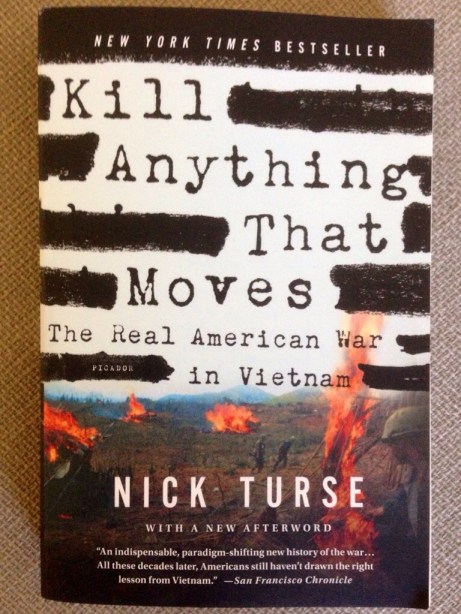
Blurb for Nick Turse’s Kill Anything That Moves, new in paperback:
Americans have long been taught that events such as the notorious My Lai massacre were isolated incidents in the Vietnam War, carried out by just a few “bad apples.” But as award-winning journalist and historian Nick Turse demonstrates in this groundbreaking investigation, violence against Vietnamese noncombatants was not at all exceptional during the conflict. Rather, it was pervasive and systematic, the predictable consequence of official orders to “kill anything that moves.”
Drawing on more than a decade of research into secret Pentagon archives and extensive interviews with American veterans and Vietnamese survivors, Turse reveals for the first time the workings of a military machine that resulted in millions of innocent civilians killed and wounded—what one soldier called “a My Lai a month.” Devastating and definitive, Kill Anything That Moves finally brings us face-to-face with the truth of a war that haunts America to this day.