
Tag: Books
An Interview with Evan Lavender-Smith
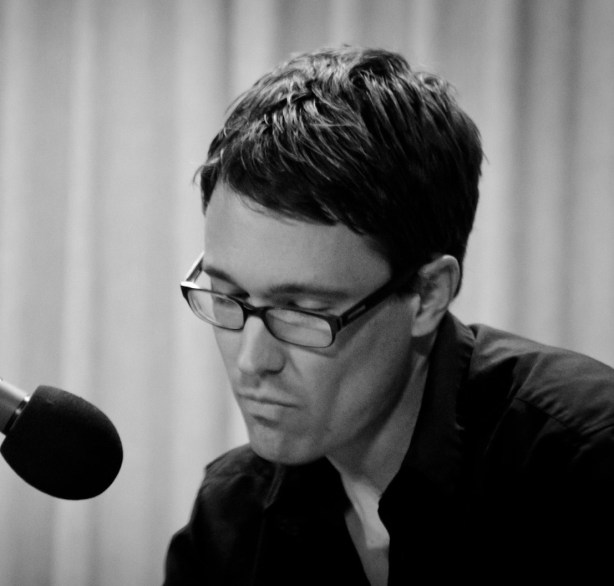
Evan Lavender-Smith is an American writer who has published two books, Avatar and From Old Notebooks.
I really really really like his anti-novel (or whatever you want to call it) From Old Notebooks, which has recently been reissued by the good people at Dzanc Books.
(Here is my review of FON). I still haven’t read Avatar.
Evan talked with me about his writing, his reading, and other stuff over a series of emails. He was generous in his answers and I very much enjoyed talking with him.
Evan lives in New Mexico with his wife, son, and daughter. He has a website. Read his books.
Biblioklept: Do you know that first editions of From Old Notebooks are going for like three hundred dollars on Amazon right now?
ELS: Here at the house I have a whole drawer full of them. That’s how I’m planning to pay for the kids’ college.
Biblioklept: I read that Cormac McCarthy won’t sign his books anymore because he has this reserve of signed editions that are for his son to sell and corner the market on. Or I think I read that.
Speaking of your kids: the parts in From Old Notebooks about them are some of my favorites, perhaps because the moments you describe seem so real to me, or that I relate so strongly to the feelings that you express. (My own kids, a daughter and son, are about the same age as your kids are in the book). Is it weird if I ask how your kids are?
ELS: Glad to hear some of that stuff resonates with you. No, I don’t think it’s weird. I believe the book even sort of self-consciously anticipates a certain reader’s empathetic engagement with it. There’s that passage somewhere, for example, in which we get something like an interview answer, something like “The real Evan Lavender-Smith has never made it past the first section of Ulysses, the real Evan Lavender-Smith has no children,” which I think maybe winks at the possibility of that type of readerly engagement. So no, it’s encouraging to hear that parts of the book seemed to work for you. My kids are great, by the way. Sofia’s at her violin lesson, Jackson’s doing an art project with his mom.
Biblioklept: The faux-interview answers crack me up. I think we’ve all done that in some way—that we go through these little experiments of interviewing ourselves, performing ourselves, imagining how others perceive us. You write your own obituary; at one point we get: ” ‘With my first book I hope to get all the cult of personality stuff out of the way’.” You remark that you don’t put dates on anything as “an act of defiance” against your “literary executors.” Moments like these seem simultaneously ironic and sincere.
I’m curious as to how closely you attended to these disjunctions—From Old Notebooks seems incredibly, I don’t know, organic.
ELS: At a certain point I became very aware that I was performing some version or versions of myself in the book, and I think the book tries to find ways of grappling with problems I perceived as bound up with that performance. One way was to insist on a narrative tone or mode somewhere in between irony and sincerity, or to regularly oscillate between or conflate these competing modes. Something like “I am the greatest writer in the history of the world!” might later be countered by “Gosh, my writing really blows, doesn’t it?”; or “My kids are so beautiful, I love them so much,” might be followed by “I wish those little fuckers were never born.” While the function of this variability is, in From Old Notebooks, probably mostly an apology or a mask for a kind of subjectivity I worry might come off as cliche and naive, that particular representation of the thinking subject — cleaved, inconsistent, heterogeneous — does strike me as truer of human experience and perception than the more streamlined consistency of expression and behavior we tend to associate with the conventional narratological device called “character.” When I try to look deep down inside myself, to really get a handle on my thinking, for example, or on my understanding of truth, I end up facing a real mess of disjunctive, contradictory forces competing for my attention. For me — and likely for the book, as well — the most immediate figure for this condition might be the confluence of sincerity and irony, the compossibility of taking a genuine life-affirming pleasure in, and exhibiting a kind of cynical hostility toward, the fact of my own existence.
Biblioklept: That contest between sincerity and irony seems present in many works of post-postmodern fiction. It’s clearly a conflict that marks a lot of David Foster Wallace’s stuff. You invoke Wallace a number of times in From Old Notebooks, but the style of the book seems in no way beholden to his books. Can you talk about his influence on you as a reader? A writer?
ELS: Wallace hugely influenced the way I think about any number of things. I think his most immediate influence on my writing is this blending of hieratic and demotic modes of language when I’m dealing with pretty much anything that requires the serious application of my writing mind; the hip nerdiness of his language was and still is very empowering to me. He made it seem super cool to geek out on books — “The library, and step on it,” says Hal in Infinite Jest — and back in high school and college that example was so vital for me, as someone entirely too obsessed with being both cool and well read. He served to guide my reading of other writers in a way that only John Barth and Brian Evenson have come close to matching; I poured over his essays for names, then went to the library and checked out and read all the books he mentioned, then reread his essays. His fiction’s most common subject matter — addiction, depression, the yearning for transcendence, the incommensurability of language and lived experience, problems of logic vis-a-vis emotion, metafiction’s values and inadequacies — all of this stuff hit very close to home. To my mind there’s little doubt that Infinite Jest is the best English-language novel published in the last 25 years. His advocacy for David Markson has got to be up there among the greatest literary rescue missions of the 20th century. In “Good Old Neon” he wrote what may be the most haunting long short story since “The Death of Ivan Ilych.” He galvanized young writers everywhere right when the internet was taking off and unwittingly served as a touchstone for emerging online literary communities that thrive today. I think for a lot of young writers, myself included, he was, maybe next to the emergence of the internet, the most important force in the language’s recent history. The list goes on and on. And also he helped me out personally, providing encouragement and advice that was so generous and inspiring. I was extremely troubled by his suicide and wasn’t able to write much or think about much else for quite a while.
With all that said, there are some things he says that bother me a bit. The synthesis of art and entertainment he espouses as it pertains to the role of the writer in the age of television — which I think in many ways corresponds to his striving for a new aesthetic in which the cerebral effects associated with 60s and 70s postmodernist fiction are complemented by or synthesized with the more visceral effects associated with 70s and 80s realist fiction — strikes me now as existing very much in opposition to what I believe in most passionately about writing: that it can and in the most important cases should exist in a state of absolute opposition to our entertainments. I’ve come to better appreciate, years after reading Wallace, the writing of people like Woolf and Beckett and Gaddis, those writers who are uncompromising in their vision of narrative art’s most radical and affecting possibilities and who necessarily, I believe, pay very little attention to any sort of entertainment imperative. The books I love most make me feel things strongly, and think things strongly, but rarely do they entertain me. If I want to be entertained, I know exactly where to go: a room without books. I’ve come to think of certain books as my life’s only source of intellectual solace; when I’m not despairing over the futility of everything under the sun, that unflagging commitment to a truly rigorous and uncompromising art that I perceive in a writer like Beckett seems to me a matter of life and death, just as serious as life can ever get. When Wallace talks that shit about art and entertainment, or about the need to add more heart or greater complexity of character to Pynchon or whatever, it makes me feel like I want to throw up. I heard him say once in an interview that he felt he couldn’t write the unfiltered stuff in his head, that it would be too radical or something, and the admission really upset me; it felt like in some serious way he had allowed his projection of an imaginary target audience’s desire to determine the form of his writing. I often feel something similar in the essays; I find many of them to be merely entertaining. I suppose I often judge the essays in relation to the fictions, which I find far superior in their attempt to overcome the strictures and conventions of language and form. Wallace was always at his best, to my reading, when he was really bearing down — when he was at his most difficult.
But no doubt he’s been monumentally important to me, more so than any other recent fiction writer, and in more ways than I can name. There’s something in From Old Notebooks where the methodical awkwardness and wordiness of so many of his sentences is likened to the affectation of bumping up against the limits of language. That’s probably what I take away from him more than anything: when I sit down at the laptop to face the language, I often feel myself struggling with the words as well as struggling to demonstrate that I’m struggling with the words. That’s pure Wallace: word-by-word, letter-by-letter self-consciousness. (There’s another thing in From Old Notebooks about how I’m always talking shit because I care for him so deeply … which is why the paragraph before this one). Continue reading “An Interview with Evan Lavender-Smith”
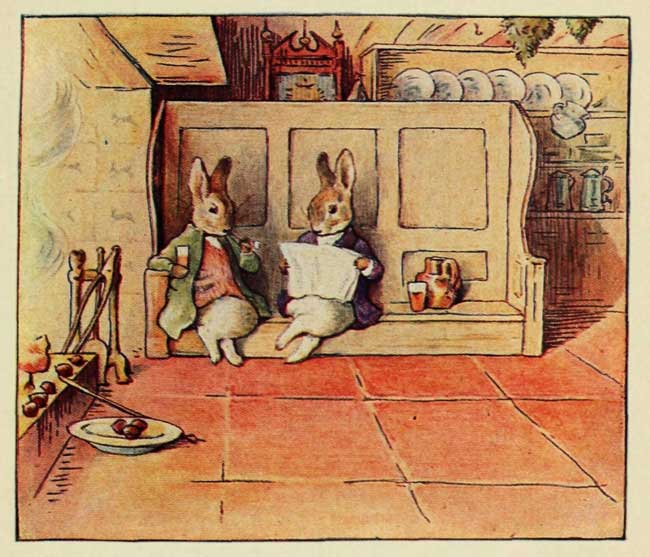
Two Rabbits, One Reading, One Smoking and Drinking — Beatrix Potter
Errors on Walt Whitman // Jorge Luis Borges

The Reading Girl — Theodore Roussel

A Riff on Lars Iyer’s Novel Exodus
I. Trilogy
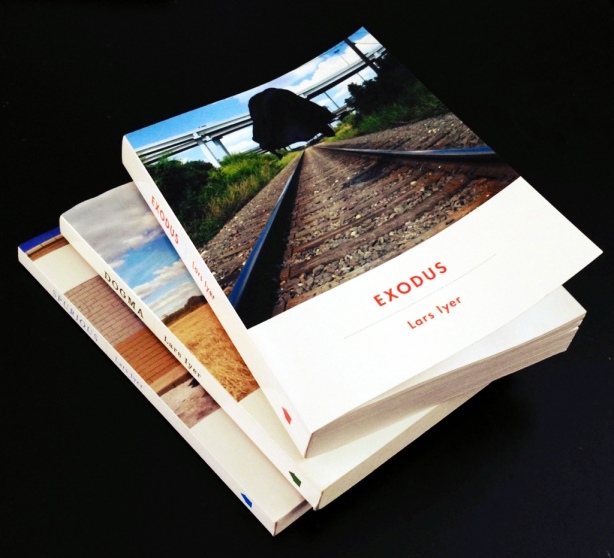
Exodus is the third entry in a trilogy that Lars Iyer began with Spurious and Dogma.
What happens in Exodus?
Not much (but also maybe everything—like all sorts of philosophical investigations and intellectual adventure and despair and potential revolution and symbolic death, etc.).
If you’ve read Spurious and Dogma you’d expect this.
There is a quest though in Exodus, a quest that feels more visceral, more real, cuts closer to the bone than in the first two entries.
What is this quest?
Do our heroes W. and Lars vanquish despair? Figure out Kafka?
Do they save humanity (or at least the humanities department)?
Do they finally cast the One Ring into Mount Doom?
(They go on a lecture tour).
II. Quest
What is the connection between Kierkegaard and capitalism?: that’s our question, W. says. What does Kierkegaard tell us about the despair of capitalism?
And
‘The true and only virtue is to hate ourselves’, W. says, reading from his notebook.
And, perhaps more specifically
Of course, they’re going to close all humanities courses in British universities, W. says . . . They’re simply going to marketise education, W. says. They’re simply going to turn the university over to the free market. They’re going to submit philosophy to the forces of capitalism . . .
And
Imagine it! Two plastic cups of Plymouth Gin might usher in the reign of peace, W. says.
And
There are no jobs in philosophy — everyone knows that. No jobs in academia!
And etc.
III. The Call to Adventure
This is our last tour, W. says. He feels that strongly. Something’s going to happen. Something’s about to happen. . . Why does he feel such a sense of dread?
IV. The Road of Trials
Gin, Deleuze, Kafka, Kierkegaard, gin, Blade Runner, Guy Debord, postgraduate students, linguistic stupidity, anxiety over what Alan Badiou is doing right this very minute, gin, Gandhi, Marx, the blogosphere (so-called), Bartleby, Moses, God, logical-mathematical stupidity, the Talmud, gin, bodily-kinesthetic stupidity, cheap food, the Thames, Oxford, Rosenzweig, interpersonal stupidity, gin, Bela Tarr, Manchester, Wikipedia, gin, intrapersonal stupidity, Beckett, Gombrowicz, Middlesex, Weil, naturalistic stupidity, Abraham and Isaac, Old Europe, sports science students, moral stupidity, Solomon Maimon, gin, Plato (turning in his grave), public houses, existential stupidity, Kant, a friend from Taiwan, a plenary speaker, sartorial stupidity, gin, Krasznahorkai, blowing a great horn to have the horde come running (like that guy in Anchorman), a Dostoevskian innocence or a Grossmanian selflessness, religious stupidity, Master/Blaster as a metaphor for the mind-brain problem, Canadian laughter in the glittering light (etc.), Essex Postgraduates, gin, gin, gin, job security, painting-and-decorating stupidity, hangovers, posh people eating lunch in the sun, settling for cans of Stella from the trolley, philosophy of walking, gin, romantic stupidity, gin, culinary stupidity, gin, stupidity stupidity.
Revolution!
V. The Magic Flight
Alcohol makes people speak, that’s its greatness, W. says. It makes them religious, political, even as it shows them the impossibility of religion and the impossibility of politics. Drinking carries you through despair, W. says. Through it, and out beyond it, if you are prepared to keep drinking right all through the night.
VI. Apotheosis
W. dreams of the profound slumber from which we would rise reborn, ready for the morning, ready for work. He dreams of the great day that would follow our night of rest, and of the great ideas that would flash above us like diurnal stars.
How is it still alive in him, the belief that he might wake into genius?, W says. How is it that he still believes, despite everything, that he is a man of thought?
VII. Freedom to Live
Thought is the hangman, our hangman, W. says. Thought has its nooses ready just for us.
VIII. Cult Fiction
Judgment, evaluation, criticism: Exodus—the Spurious Trilogy, if that’s what we’ll call it—has reserved its own special place in the world of cult fiction. These novels (if they are in fact novels) perform their own deconstruction. They delineate metacognition. They frustrate. They are simultaneously sad and funny, and even a little bit scary, at least if you earn your bread by academicizin’.
They frustrate. Wait, do I repeat myself? Very well then, I repeat myself.
These novels dissect the problems of philosophy against the backdrop of late capitalism, but part of this dissection is also the covering up of the dissection: the fear, the failure, the despair, the doom. (Hence the anesthesia, the gin). So that the novels seem to be a series of references, contours, quirks, loops of dialog, declamations, insults . . . That the novels take their own central subject as the failure to mean, to communicate—and then perform these failures: deferral, delay, intellectual suspense. And that these suspensions replace the furniture and sets of the traditional novel, etc. Maybe I’m failing to mean. I’ve anesthetized myself a bit, I do admit.
I get it. I mean, that’s maybe what I mean, or hope to mean to say about these novels: That meaning is hard, that saying meaning doing thinking is hard; that thinking after, against, beyond other thinkers is hard, painful, produces despair, dread, etc. Maybe that’s why I like these novels. Because I think that maybe I get them even as I doubt that I do get them.
IX. An Idea
Publisher Melville House might consider putting all three of these books into one epic volume.
X. A Question
Do the eagles ever show up to fly W. and Lars out of Mordor?
A Pupil of Green Girl’s School, Reading — Annie Margaret Bradley

The Wild Beasts of Wuhan (Book Acquired, 3.21.2013)
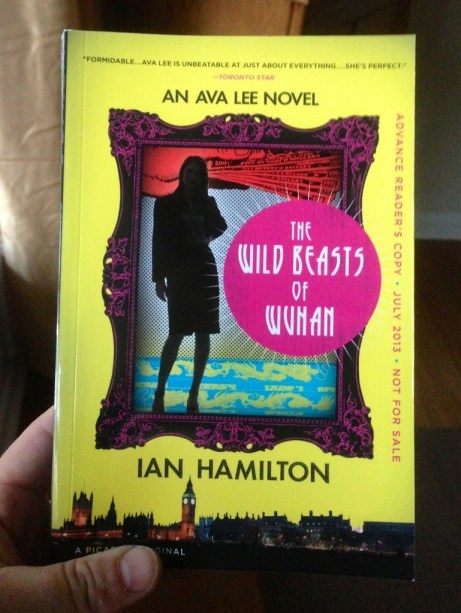
It took me a few minutes to figure out the title of Ian Hamilton’s latest Ava Lee novel, The Wild Beasts of Wuhan—something about the font I guess. The book is out this June from Picador. Blurb from Hamilton’s site:
In The Wild Beasts of Wuhan, Uncle and Ava are summoned by Wong Changxing, “The Emperor of Hubei” and one of the most powerful men in China, when he discovers that the Fauvist paintings he recently acquired are in fact forgeries.
Ava uncovers a ring of fraudulent art dealers and follows their twisted trail to Denmark, the Faroe Islands, Dublin, London, and New York. But the job is further complicated by Wong’s second wife, the cunning and seductive May Ling, who threatens to interfere in Ava’s investigation.
Will Ava find the perpetrators and get the Wongs’ money back? Or will May Ling get to them first…
Misshelved

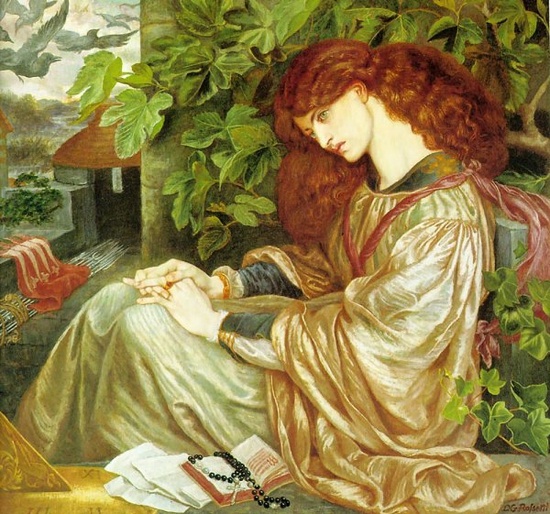
La Pia de’ Tolomei — Dante Gabriel Rossetti
Marusia in the Library — David Burliuk

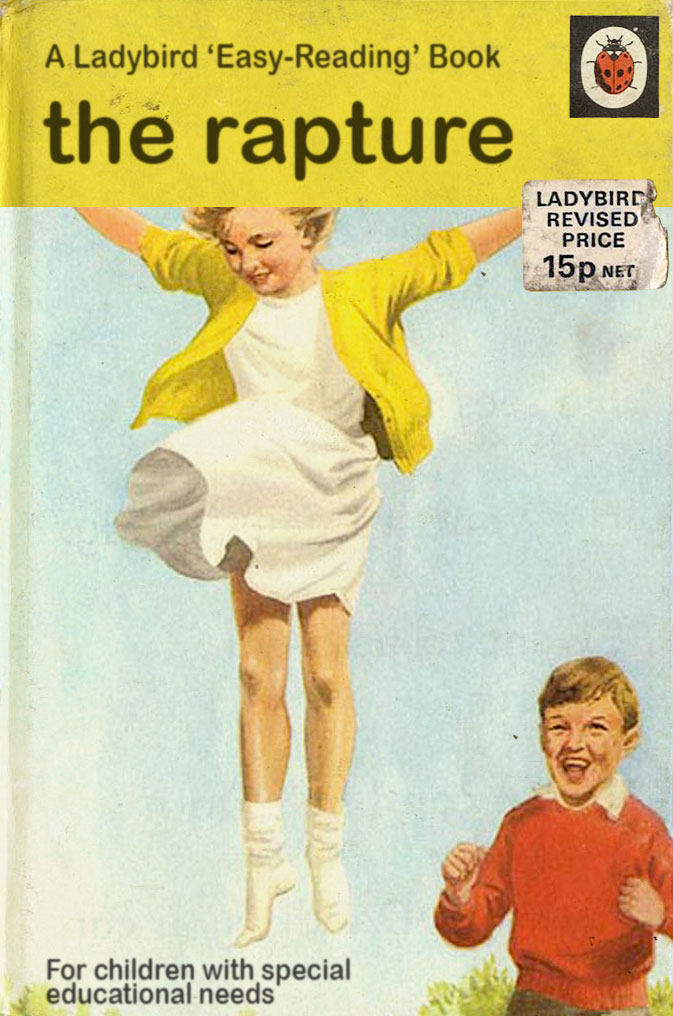
The Rapture — A Ladybird Easy-Reading Book for Children with Special Educational Needs
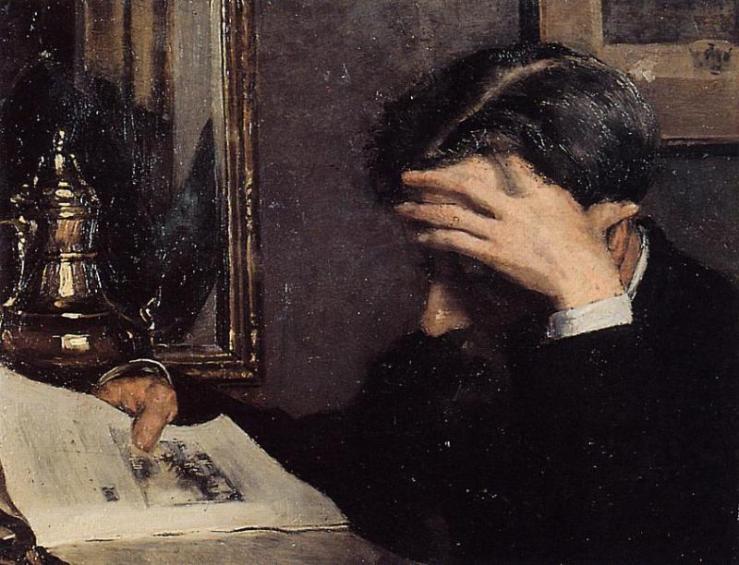
Man Reading — Georges Lemmen
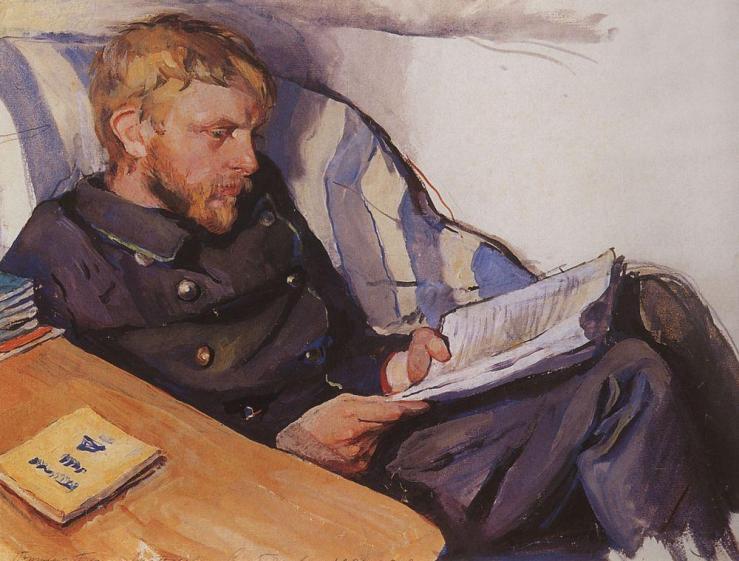
Portrait of Boris Serebryakov — Zinaida Serebriakova
Peanuts/Borges/mbv (Books and an LP Acquired, 3.19.2013)

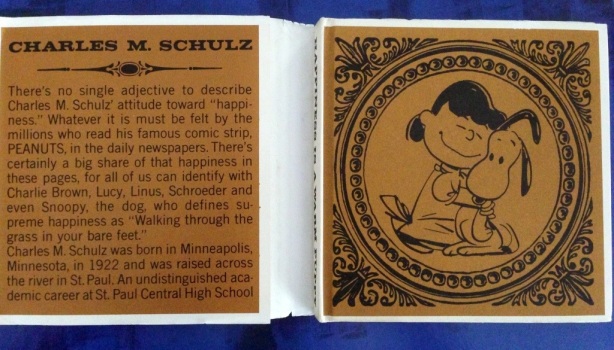
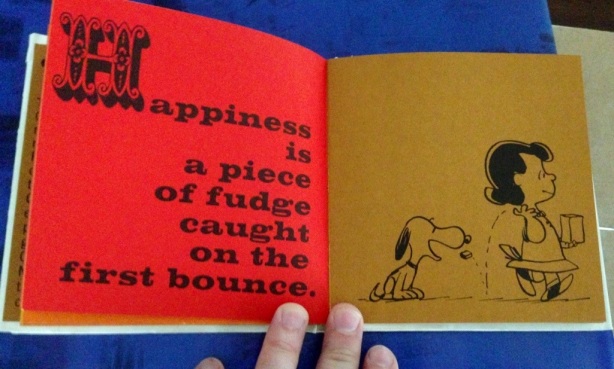
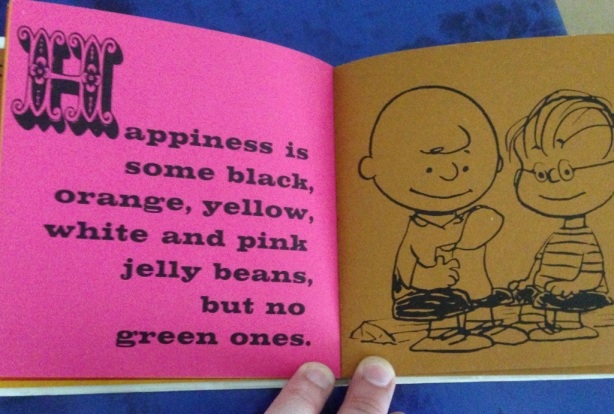
Found this hardback first edition of Charles M. Schulz’s Happiness Is a Warm Puppy, a kids book printed on heavy stock colored paper with bold litho images and letters. The cover is a bit rough but the book itself seems untouched. It’s a first edition from 1962.
Also picked up this collection of short essays by Jorge Luis Borges:

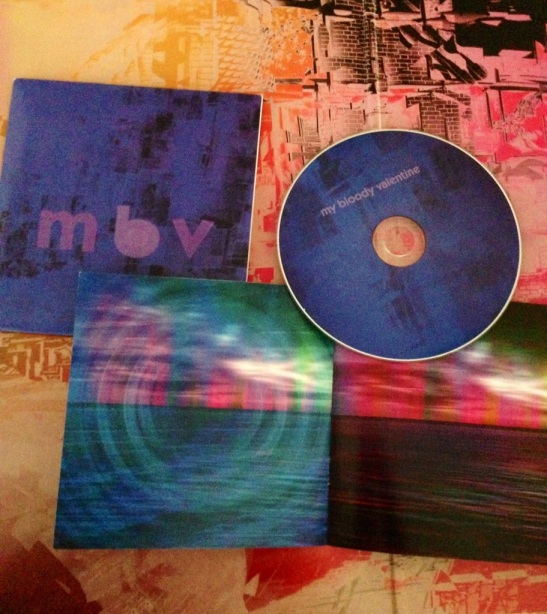
And came home to find the new My Bloody Valentine Record I bought six weeks ago (and likely paid too much for, including overseas shipping, but hey, I’ll shop smarter next time they put out an LP):
“Bread and Butter Letter from a Chicago Gentleman” — F. Scott Fitgerald
Dear Marion,
I certainly enjoyed myself. The chow was all good, mostly, but the butter was rancid. The bed was hard but uncomfortable. The talk was over my head but there was some made sense—that part about my being a great guy for instance.
I got home sick at the stummuck but I do not blame you at all.
Will you tell the servents next time I like my soup hot and more of a sharp edge when they press my pants.
You said I only had to pay one buck for board but even that is too much when the service is not good. That black bean soup was rancid too, and mine had a beetle in it. Besides there wasn’t enough blankets and the only good one was stale like it had been used for a baby or something.
I liked all the people I met except that woman I had to slug at dinner. Tell her I hope she found her teeth in the tomato soup when they emptied it out. No gentleman should have done a thing like that but I cannot stand a warm stocking on my ankle under the table.
I’m sorry I shot the horse and dog but they kep me awake 1/2 the night and I come there for a rest. You will find a lot of cigar stubs in the refrigidaire as I did not know where to put them. I do not want them however so give them to one of the negro servants, you know the colored ones, not your uncle or aunt or anybody like that. The black ones.
I’ll tell you when I can come down again and we will have more of that fun in the dumb waiter—hey kid, you know? Only I’m sorry I left you between floors when I went to bed. I thot it would give you more time to cool off so you could get some sleep too.
All right kid and goodby and I know now you are not such a dumb cluck as you look like.“Tick”
P.S. If you called that thing a cocktail then listerine is the Holy Grail.
From F. Scott Fitzgerald’s Notebooks.
Portrait of the Artist’s Daughter, Julie Manet, at Gorey — Berthe Morisot

 Biblioklept