Towards mid-day the three pursuers came abruptly round a bend in the torrent bed upon the sight of a very broad and spacious valley. The difficult and winding trench of pebbles along which they had tracked the fugitives for so long, expanded to a broad slope, and with a common impulse the three men left the trail, and rode to a little eminence set with olive-dun trees, and there halted, the two others, as became them, a little behind the man with the silver-studded bridle.
For a space they scanned the great expanse below them with eager eyes. It spread remoter and remoter, with only a few clusters of sere thorn bushes here and there, and the dim suggestions of some now waterless ravine, to break its desolation of yellow grass. Its purple distances melted at last into the bluish slopes of the further hills—hills it might be of a greener kind—and above them invisibly supported, and seeming indeed to hang in the blue, were the snowclad summits of mountains that grew larger and bolder to the north-westward as the sides of the valley drew together. And westward the valley opened until a distant darkness under the sky told where the forests began. But the three men looked neither east nor west, but only steadfastly across the valley.
The gaunt man with the scarred lip was the first to speak. “Nowhere,” he said, with a sigh of disappointment in his voice. “But after all, they had a full day’s start.”
“They don’t know we are after them,” said the little man on the white horse.
“SHE would know,” said the leader bitterly, as if speaking to himself.
“Even then they can’t go fast. They’ve got no beast but the mule, and all to-day the girl’s foot has been bleeding—-”
The man with the silver bridle flashed a quick intensity of rage on him. “Do you think I haven’t seen that?” he snarled.
“It helps, anyhow,” whispered the little man to himself.
The gaunt man with the scarred lip stared impassively. “They can’t be over the valley,” he said. “If we ride hard—”
He glanced at the white horse and paused.
“Curse all white horses!” said the man with the silver bridle, and turned to scan the beast his curse included.
The little man looked down between the melancholy ears of his steed.
2. Every time I read Moby-Dick it seems funnier and sadder. Richer. Thicker.
3. I cobbled together my reading over different media and spaces: I listened to William Hootkins‘ outstanding unabridged audiobook version, and then reread on my Kindle key passages I’d mentally underlined; I then checked those passages against the copy of Moby-Dick I annotated the hell out of in grad school.
4. I posted some of my favorite excerpts of Moby-Dick here on Biblioklept because I knew that I wouldn’t be able to write about the book—not really—that I wouldn’t be able to handle all of its language. (My riff on Olson’s book obsesses over Olson’s ability to write after Melville and Melville’s ability to write after Shakespeare).
5. Really, in posting so many fragments of Moby-Dick, I suppose that I’ve attempted to abrogate any kind of critical duty to describe the book under discussion in terms of its own language.
6. Point 5 is really a way of saying: Moby-Dick, like any sublime work of literature, is a self-defining, self-describing, and even self-deconstructing text.
7. Or, another way of making such a claim:
Let me (mis)appropriate Samuel Beckett’s description of Finnegans Wake and contend that the description fits Moby-Dick just as aptly:
Here form is content, content is form. You complain that this stuff is not written in English. It is not written at all. It is not to be read – or rather it is not only to be read. It is to be looked at and listened to. His writing is not about something, it is that something itself.
8. So here circumnavigate back to my own recent reading and auditing of the book:
Hootkins’ audio recording would make a great starting point for anyone (unnecessarily) daunted by Melville’s big book. He performs the book, commanding his audience’s attention. He unpacks the humor that might otherwise hide from untuned 21st century ears; he communicates the book’s deep, profound sorrow. His Ishmael is perceptive, clever, generous. His Stubb, hilarious. His Ahab a strange philosophical terror.
After listening to Hootkins on my commute, I’d return to key passages on my Kindle, and then finally review the notes I wrote in the cheap hardback Signet edition I read in grad school.
But why bring this up?
9. I don’t know.
Maybe: Unpacking Moby-Dick is too hard, too much—would require its own book, a book that would cite the entirety of Melville’s book.
But discussing the book this way seems a disservice to potential readers; it’s as if we would cloak the book in a mystic veil.
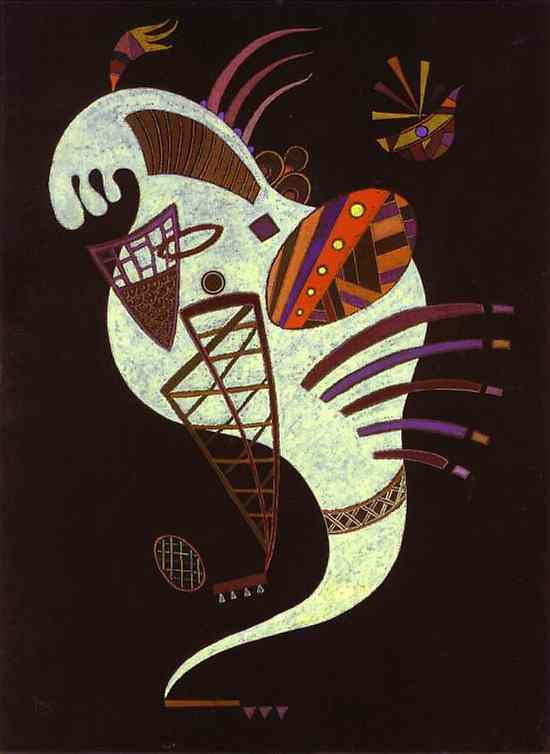
White Figure, Wassily Kandinsky
10. If I have a point to all of this: Moby-Dick is wonderful, funny, moving, engaging; a genre-bender that tackles philosophy, history, science; an adventure tale; a psychological novel brimming with ideas, allusions—but one delivered in sonorous, poetic language. It’s good, great, grand. Read it, if you haven’t. Reread it.
11. So I’ve failed to even try to begin to attempt to pretend to describe the plot.
Here: Ishmael, depressed, suicidal perhaps, decides to go to sea. To go whaling.
He tries to measure the whale, and by measuring the whale, maybe measure the world. But this is not really possible, certainly not in language. Certainly not in first-person perspective.
In Chapter 86, “The Tail,” Ishmael tells us:
The more I consider this mighty tail, the more do I deplore my inability to express it. At times there are gestures in it, which, though they would well grace the hand of man, remain wholly inexplicable. … Dissect him how I may, then, I but go skin deep. I know him not, and never will. But if I know not even the tail of this whale, how understand his head? much more, how comprehend his face, when face he has none? Thou shalt see my back parts, my tail, he seems to say, but my face shall not be seen. But I cannot completely make out his back parts; and hint what he will about his face, I say again he has no face.
(I don’t suppose I need to remark that Melville here lets one mighty tail stand in for another mighty tale—a tale he cannot face).
12. “Call me Ishmael”: our protagonist hails us.
But these famous opening lines aren’t really the beginning of the book. First we have the section titled “Extracts,” and before that “Etymology.” The first entry on the etymology of the whale, from Hackluyt, warns us not to leave out “the letter H, which almost alone maketh up the signification of the word.”
Whaling. Hailing. Wailing.
The whiteness of the whale.
The witness of the wail.
13. How, just how, does Ishmael witness? How does he manage to tell this story? Did I obsess over this in earlier readings? I don’t think so—I was too concerned with absorbing the what and the why of the story to closely attend the how of its telling.
14. The novel begins in standard first-person point-of-view territory, Ishmael guiding us through Manhattan, New Bedford, Nantucket—but by the time he’s boarded the Pequod and set out into the wide watery world, this first-person perspective transcends the limits of physics: Our narrator not only attends the private conversations of Ahab, his mates, his harpooners, his men—but also the very interior of those men, their minds, their dreams, their imaginations.
Is Ishmael a ghost?
Leviathan-Job 40-21, Salvador Dali
15. And to return to Ahab for a moment: My god, what a voice! His infecting, addicting insanity. His agon with Moby Dick, with the sun, with himself.
16. And Starbuck: Starbuck comes across weaker and weaker each time I read the book. We’re to believe he’s a man of convictions, but he moves in half-measures. In his final moments he tries to match or feign or approximate Ahab’s insanity: tragicomedy.
17. And Stubb: Despite his cruelties, he may be my favorite character in the book.
18. While I’m riffing: Is there a novel more phallic in the American canon than Moby-Dick? All that sperm: All that life-force.
19. This is maybe what Moby-Dick is about: Life-force. The attempt to to resurrect and die and resurrect again. The coffin that serves as life-buoy. The life-line that connects men that might also be their death. A counterpane to counter pain. A condensation of oppositions.
A yarn, a rope, a series of knots, layered, layering, self-contextualizing.
An attempt to put into language what cannot be put into language.
20. Twenty points: Maybe too long for the “short riff” promised in the title, but also surely too short to even begin to start to approach to pretend to say something adequate about the novel. So a parting thought: Moby-Dick is better—richer, fuller, deeper—each time I read it, and I look forward to reading it again.
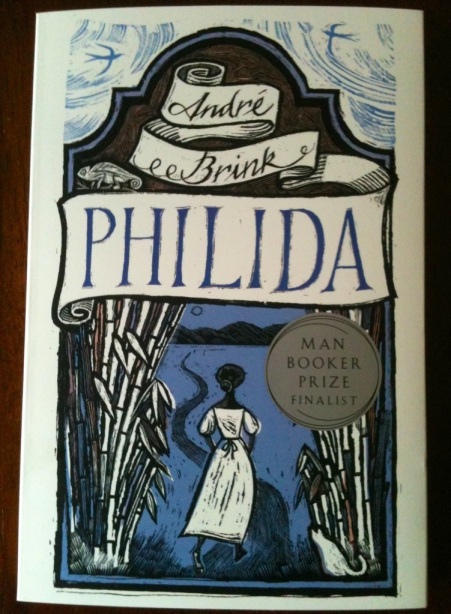
André Brink’s Philida is new in handsome trade paperback from Vintage. Love the cover on this one, and the story seems intriguing. From the Man Booker Prize site (the book was longlisted last year):
The year is 1832 and the Cape is rife with rumours about the liberation of the slaves. Philida made a pact for freedom with Francois Brink, the son of her master, but he has reneged on his promise to set her free. Deciding to take matters into her own hands, Philida risks her life by setting off on foot for distant Stellenbosch, in a journey that begins with the small act of saying no.
And from The Guardian’s favorable review:
In order to underline the multiplicity of experiences, Philida hops from one narrator to another, interspersed with third-person, quasi-historical material; each chapter begins with what is to follow in précis (“In which Philida and Ouma Petronella travel to the Caab where they encounter a woman who farms with slaves”), gesturing towards the conventions of both the picaresque novel and the folk-tales that [one of the characters] relates. Unsurprisingly, given the strength of her story, Philida’s voice dominates. If she can occasionally feel like a mouthpiece for a rather overworked metaphor (“What happen to me will always be what others want to happen. I am a piece of knitting that is knitted by somebody else.”), she can also be brilliantly irreverent and almost ribald. “That’s what the old goat make us listen to every night at prayers,” she reflects on Cornelis’s fondness for Bible stories of a sexual nature. “And almost every time it is a woman who get it in her sticky parts.”
The rain flashed across the midnight window with a myriad feet. There was a groan in outer darkness, the voice of all nameless dreads. The nervous candle-flame shuddered by my bedside. The groaning rose to a shriek, and the little flame jumped in a panic, and nearly left its white column. Out of the corners of the room swarmed the released shadows. Black specters danced in ecstasy over my bed. I love fresh air, but I cannot allow it to slay the shining and delicate body of my little friend the candle-flame, the comrade who ventures with me into the solitudes beyond midnight. I shut the window.
They talk of the candle-power of an electric bulb. What do they mean? It cannot have the faintest glimmer of the real power of my candle. It would be as right to express, in the same inverted and foolish comparison, the worth of “those delicate sisters, the Pleiades.” That pinch of star dust, the Pleiades, exquisitely remote in deepest night, in the profound where light all but fails, has not the power of a sulphur match; yet, still apprehensive to the mind though tremulous on the limit of vision, and sometimes even vanishing, it brings into distinction those distant and difficult hints—hidden far behind all our verified thoughts—which we rarely properly view. I should like to know of any great arc-lamp which could do that. So the star-like candle for me. No other light follows so intimately an author’s most ghostly suggestion. We sit, the candle and I, in the midst of the shades we are conquering, and sometimes look up from the lucent page to contemplate the dark hosts of the enemy with a smile before they overwhelm us; as they will, of course. Like me, the candle is mortal; it will burn out.
As the bed-book itself should be a sort of night-light, to assist its illumination, coarse lamps are useless. They would douse the book. The light for such a book must accord with it. It must be, like the book, a limited, personal, mellow, and companionable glow; the solitary taper beside the only worshiper in a sanctuary. That is why nothing can compare with the intimacy of candle-light for a bed-book. It is a living heart, bright and warm in central night, burning for us alone, holding the gaunt and towering shadows at bay. There the monstrous specters stand in our midnight room, the advance guard of the darkness of the world, held off by our valiant little glim, but ready to flood instantly and founder us in original gloom.
The wind moans without; ancient evils are at large and wandering in torment. The rain shrieks across the window. For a moment, for just a moment, the sentinel candle is shaken, and burns blue with terror. The shadows leap out instantly. The little flame recovers, and merely looks at its foe the darkness, and back to its own place goes the old enemy of light and man. The candle for me, tiny, mortal, warm, and brave, a golden lily on a silver stem!
“Almost any book does for a bed-book,” a woman once said to me. I nearly replied in a hurry that almost any woman would do for a wife; but that is not the way to bring people to conviction of sin. Her idea was that the bed-book is soporific, and for that reason she even advocated the reading of political speeches. That would be a dissolute act. Certainly you would go to sleep; but in what a frame of mind! You would enter into sleep with your eyes shut. It would be like dying, not only unshriven, but in the act of guilt. Continue reading ““Bed-Books and Night-Lights” — H.M. Tomlinson”→






 Biblioklept