It is a northern country; they have cold weather, they have cold hearts.Cold; tempest; wild beasts in the forest. It is a hard life. Their houses are built of logs, dark and smoky within. There will be a crude icon of the virgin behind a guttering candle, the leg of a pig hung up to cure, a string of drying mushrooms. A bed, a stool, a table. Harsh, brief, poor lives.To these upland woodsmen, the Devil is as reals as you or I. More so; they have not seen us nor even know that we exist, but the Devil they glimpse often in the graveyards, those bleak and touching townships of the dead where the graves are marked with portraits of the deceased in the naif style and there are no flowers to put in front of them, no flowers grow there, so they put out small votive offerings, little loaves, sometimes a cake that the bears come lumbering from the margins of the forests to snatch away. At midnight, especially on Walpurgisnacht, the Devil holds picnics in the graveyards and invites the witches; then they dig up fresh corpses, and eat them. Anyone will tell you that.Wreaths of garlic on the doors keep out the vampires. A blue-eyed child born feet first on the night of St. John’s Eve will have second sight. When they discover a witch – some old woman whose cheeses ripen when her neighbours’ do not, another old woman whose black cat, oh, sinister! follows her about all the time, they strip the crone, search for her marks, for the supernumerary nipple her familiar sucks. They soon find it. Then they stone her to death.
Winter and cold weather.
Go and visit grandmother, who has been sick. Take her the oatcakes I’ve baked for her on the hearthstone and a little pot of butter.
The good child does as her mother bids – five miles’ trudge through the forest; do not leave the path because of the bears, the wild boar, the starving wolves. Here, take your father’s hunting knife; you know how to use it.
The child had a scabbby coat of sheepskin to keep out the cold, she knew the forest too well to fear it but she must always be on her guard. When she heard that freezing howl of a wolf, she dropped her gifts, seized her knife, and turned on the beast.
It was a huge one, with red eyes and running, grizzled chops; any but a mountaineer’s child would have died of fright at the sight of it. It went for her throat, as wolves do, but she made a great swipe at it with her father’s knife and slashed off its right forepaw.
The wolf let out a gulp, almost a sob, when it saw what had happened to it; wolves are less brave than they seem. It went lolloping off disconsolately between the trees as well as it could on three legs, leaving a trail of blood behind it. The child wiped the blade of her knife clean on her apron, wrapped up the wolf’s paw in the cloth in which her mother had packed the oatcakes and went on towards her grandmother’s house. Soon it came on to snow so thickly that the path and any footsteps, track or spoor that might have been upon it were obscured.
She found her grandmother was so sick she had taken to her bed and fallen into a fretful sleep, moaning and shaking so that the child guessed she had a fever. She felt the forehead, it burned. She shook out the cloth from her basket, to use it to make the old woman a cold compress, and the wolf’s paw fell to the floor.
But it was no longer a wolf’s paw. It was a hand, chopped off at the wrist, a hand toughened with work and freckled with old age. There was a wedding ring on the third finger and a wart in the index finger. By the wart, she knew it for her grandmother’s hand.
She pulled back the sheet but the old woman woke up, at that, and began to struggle, squawking and shrieking like a thing possessed. But the child was strong, and armed with her father’s hunting knife; she managed to hold her grandmother down long enough to see the cause of her fever. There was a bloody stump where her right hand should have been, festering already.
The child crossed herself and cried out so loud the neighbours heard her and come rushing in. They know the wart on the hand at once for a witch’s nipple; they drove the old woman, in her shift as she was, out into the snow with sticks, beating her old carcass as far as the edge of the forest, and pelted her with stones until she fell dead.
Now the child lived in her grandmother’s house; she prospered.
Tag: Death
David Foster Wallace Defines The Word Despair
From David Foster Wallace’s essay “A Supposedly Fun Thing I’ll Never Do Again,” collected in the book of the same name:
The word’s overused and banalified now, despair, but it’s a serious word, and I’m using it seriously. For me it denotes a simple admixture—a weird yearning for death combined with a crushing sense of my own smallness and futility that presents as a fear of death. It’s maybe close to what people call dread or angst. But it’s not these things, quite. It’s more like wanting to die in order to escape the unbearable feeling of becoming aware that I’m small and weak and selfish and going without any doubt at all to die. It’s wanting to jump overboard.
Anne Sexton Reads “Wanting to Die”
Read “The School,” a short story by Donald Barthelme
“The School” by
Donald Barthelme
Well, we had all these children out planting trees, see, because we figured that … that was part of their education, to see how, you know, the root systems … and also the sense of responsibility, taking care of things, being individually responsible. You know what I mean. And the trees all died. They were orange trees. I don’t know why they died, they just died. Something wrong with the soil possibly or maybe the stuff we got from the nursery wasn’t the best. We complained about it. So we’ve got thirty kids there, each kid had his or her own little tree to plant and we’ve got these thirty dead trees. All these kids looking at these little brown sticks, it was depressing.
It wouldn’t have been so bad except that just a couple of weeks before the thing with the trees, the snakes all died. But I think that the snakes – well, the reason that the snakes kicked off was that … you remember, the boiler was shut off for four days because of the strike, and that was explicable. It was something you could explain to the kids because of the strike. I mean, none of their parents would let them cross the picket line and they knew there was a strike going on and what it meant. So when things got started up again and we found the snakes they weren’t too disturbed.
With the herb gardens it was probably a case of overwatering, and at least now they know not to overwater. The children were very conscientious with the herb gardens and some of them probably … you know, slipped them a little extra water when we weren’t looking. Or maybe … well, I don’t like to think about sabotage, although it did occur to us. I mean, it was something that crossed our minds. We were thinking that way probably because before that the gerbils had died, and the white mice had died, and the salamander … well, now they know not to carry them around in plastic bags.
Of course we expected the tropical fish to die, that was no surprise. Those numbers, you look at them crooked and they’re belly-up on the surface. But the lesson plan called for a tropical fish input at that point, there was nothing we could do, it happens every year, you just have to hurry past it.
We weren’t even supposed to have a puppy. Continue reading “Read “The School,” a short story by Donald Barthelme”
Buckminster Fuller Rambles Beautifully About Death
“A Toad, can die of Light” — Emily Dickinson
“A Toad, can die of Light,” a poem by Emily Dickinson:
A Toad, can die of Light —
Death is the Common Right
Of Toads and Men —
Of Earl and Midge
The privilege —
Why swagger, then?
The Gnat’s supremacy is large as Thine —Life — is a different Thing —
So measure Wine —
Naked of Flask — Naked of Cask —
Bare Rhine —
Which Ruby’s mine
“Being Dead While You’re Alive — That’s Real Death” — Henry Miller & Anaïs Nin on Death and Dreams
(An Incomplete) List of Writers Who Died in 2011
Vincent Cronin
Tony Geiss
MK Binodini
Kenneth Grant
Joe Gores
Maria Elena Walsh
Del Reisman
Christopher Trumbo
Loreen Rice Lucas
Diana Norman
Reynolds Price
John Ross
David Hart
B.H. Friedman
Dick King-Smith
Susana Chavez
Park Wun-suh
Wilfrid Sheed
Jean Dutord
Sun Axelsson
Ruth Cavin
Max Wilk
Hans Joachim Alpers
Donald S. Sanford
Peter J. Gomes
Ion Hobana
Rudi Bass
Anson Rainey
Perry Moore
Sean Boru
Bo Carpelan
Elaine Crowley
Martin Quigley Jr.
Charles E. Silberman
Andree Chedid
Iakovos Kambanelis
Sara Ruddick
Doris Burn
Steven Kroll
May Cutler
Thor Vilhjálmsson
H.R.F. Keating
Joe Bageant
Jean Liedloff
Bill Blackbeard
Alberto Granado
Hazel Rowley
Al Morgan
Raymond Garlick
John Haines
Ernesto Sabato
Abdul Hameed
Rafael Menjívar Ochoa
John Sullivan
Sidney Michaels
Madelyn Pugh
Sol Saks
Arthur Marx
Bill Brill
L.J. Davis
Ulli Beier
Kevin Jarre
Joanna Russ
David Wilkerson
Beverly Barton
Craig Thomas
Ira Cohen
W.J. Gruffydd
Anne Blonstein
Paul Violi
Johanna Fiedler
Dick Wimmer
Oniroku Dan
Hans Keilson
Martin Woodhouse
Newton Thornburg
Patrick Galvin
Wallace Clark
Carlos Trillo
Kate Swift
Arthur Laurents
Frans Sammut
William Kloefkorn
Thierry Martens
E.M. Broner
Tom Hungerford
Kathryn Tucker Windham
Harry Bernstein
Joel Rosenberg
Simon Heere Heeresma
David Rayfiel
Oscar Sambrano Urdaneta
Robert Kroetsch
Josephine Hart
Gloria Sawai
Anne LaBastille
Blaize Clement
Sissel Solbjørg Bjugn
Francis King
Agota Kristof
Henry Carlisle
Iain Blair
Hideo Tanaka
Michael Legat
Ruth Thomas
Colin Harvey
David Holbrook
Simona Monyová
William Sleator
Samuel Menashe
Selwyn Griffith
Sara Douglass
Ida Fink
Sergio Bonelli
Arthur Evans
Hella Haasse
David Croft
David Zelag Goodman
Emanuel Litvinoff
José Miguel Varas
Jo Carson
Cengiz Dağcı
Frank Parkin
Hugh Fox
Herbert Lomas
Florence Parry Heide
Stanley Mitchell
Uno Röndahl
Mildred Savage
Mick Anglo (LINK)
Alvin Schwartz
Sri Lal Sukla
Piri Thomas
Gerald Shapiro
Vittorio Curtoni
Morio Kita
Andrea Zonzotto
Taha Muhammad Ali
Georg Kreisler
Daniel Sada
H.G. Francis
Helen Forrester
Čestmír Vejdělek
Hal Kanter
Les Daniels
Leonid Borodin
Franz Josef Degenhardt
Morris Philipson
Ana Daniel
Ruth Stone
Peter Reading
Ruslan Akhtakhanov
Ivan Martin Jirous
Tomás Segovia
Kabir Chowdhury
Hans Heinz Holz
Ke Yan
Mario Miranda
Jean Baucus
Gilbert Adair
Jerry Robinson
Ambika Charan Choudhury
Matti Yrjänä Joensuu
Louky Bersianik
Christopher Logue
Christa Wolf
Elisabeth Young-Bruehl
“Death Is a Very Liberating Thought” — RIP Christopher Hitchens
“The Routine Things Around the House” — Stephen Dunn
“The Routine Things Around the House,” a poem by Stephen Dunn—
When Mother died
I thought: now I’ll have a death poem.
That was unforgivableyet I’ve since forgiven myself
as sons are able to do
who’ve been loved by their mothers.I stared into the coffin
knowing how long she’d live,
how many lifetimes there arein the sweet revisions of memory.
It’s hard to know exactly
how we ease ourselves back from sadness,but I remembered when I was twelve,
1951, before the world
unbuttoned its blouse.I had asked my mother (I was trembling)
if I could see her breasts
and she took me into her roomwithout embarrassment or coyness
and I stared at them,
afraid to ask for more.Now, years later, someone tells me
Cancers who’ve never had mother love
are doomed and I, a Cancer,feel blessed again. What luck
to have had a mother
who showed me her breastswhen girls my age were developing
their separate countries,
what luckshe didn’t doom me
with too much or too little.
Had I asked to touch,perhaps to suck them,
what would she have done?
Mother, dead womanwho I think permits me
to love women easily,
this poemis dedicated to where
we stopped, to the incompleteness
that was sufficientand to how you buttoned up,
began doing the routine things
around the house.
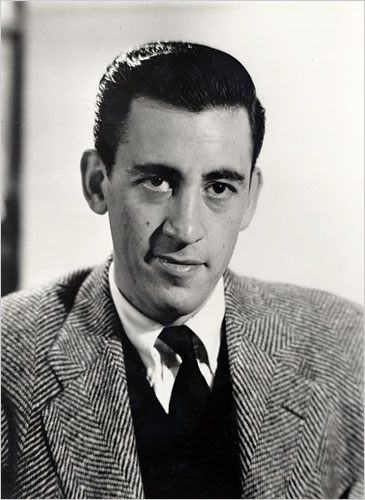
RIP J.D. Salinger

The Spare Room — Helen Garner
We’ve all had house guests who stay too long. But what happens when a house guest who overstays her welcome is dying? What if you invited her there hoping to prove in yourself some measure of humanity, humility, maybe even heroism, by taking good care of her? What if you found her irritating? Grating? Self-absorbed? What if she didn’t seem to even notice what a great caretaker you were? What if she didn’t seem to appreciate your prowess as a host? What if she outright ignored the disease that was killing her, just refused to even mention it, denying you any hope of closure? Worst of all would be the shame that compounded all of these feelings about the dying house guest, the sense that you are wrong, inhuman, cowardly, right? Helen Garner’s novella The Spare Room (new in trade paperback from Picador) tackles these questions and the emotional turmoil behind them in measured, spare prose making a compelling and rewarding read.

Little irks me more in journalism than a book review (or any media review, really) that seeks to intertwine the personal dramas of the reviewer. I am about to do just that right now, gentle reader, so you are forewarned. Stop reading now if you wish and know that Biblioklept recommends The Spare Room. It’s a marvelous piece of writing, one that gives proof to the cliché “brutally honest.”
Reading The Spare Room I could not help but identify with its narrator, an Australian woman in her 60s named Helen who takes care of her free-wheeling, slightly daffy, cancer-infested friend Nicola. I am not an Australian woman in my 60s, but, like Helen, I know what it is like to live with and care for a person whom you love who also happens to be dying. From the time I was 12 years old, my maternal grandmother Mama Dot lived with my family. The doctors, prognosticating wise men all, gave Mama Dot just a year or two to live and my folks wanted her to spend that time with us. She was very sick, and, as if to prove the verity of certain stereotypes about Southern women, she was also very stubborn–mulishly so (the woman could hold a grudge). She went on to live another 10 years with my parents, during which time both my brother and myself of course left the house (but always came back to visit). I loved her very, very much and, perhaps as a result of that love, fought with her constantly and fiercely about any little thing. Unlike the narrator Helen, who bottles up her irritation with Nicola (particularly her fury at her friend’s pursuit of quackish cures), I found it easier to confront my grandmother about her faults in illness–her lapses of memory and judgment, her lack of cooperation, her unbearable slowness. I could even be mean. But like Helen, I always felt bad about it too. What makes The Spare Room such an affecting, gripping read is Garner’s honesty, her ability to capture the negative, selfish feelings that we all must feel when comforting the sick.
Narratives about the dying often disengage the emotional turmoil of the caretaker by applying a veneer of sentimentality, morality, or even whimsy. Garner handles her subject matter with a realism that denies sentimentality and faces the ugliness of death head on. Her narrator is compassionate toward her friend but it’s always clear that the book is not about Nicola–it’s about how Helen reacts to Nicola. It’s about what it means to be selfish at the very moment you are trying to be selfless. It’s about how hard it is to get past your flaws as a human being. Take the book’s humor, for instance: The Spare Room is frequently hilarious, yet the humor never seeks transcendence or escape. When Helen seems to mutter to her audience, “God bless morphine” at the beginning of a chapter, she isn’t drolly avoiding her friend’s pain–she’s thankful that the drug has given both of them a night’s sleep. Similarly, her observation that the “station was a seven-minute walk from my house, twenty if you had cancer,” reveals that Helen’s selfishness is wrapped in minute details, details that compound in the narrative and build tension toward its awful final sentence (a final sentence that I won’t spoil by revealing here, dear reader).
The Spare Room is a tightly-compressed novella that one might read in an afternoon or two, yet the book will undoubtedly stay with most readers for a long time to come. We might not all be like Helen (and, thankfully, not all of our patients are as trying as Nicola) but there is certainly bound to be some measure of her in even the best of us. Garner has captured here some of that rage against the dying of the light that Dylan Thomas encouraged of us, and she’s revealed that that rage, falling impotent against illimitable death, might end up aimed at those we love dearest–as well as ourselves. Highly recommended.
(An Incomplete List of) Writers Who Died in 2009
John Updike
Blair Lent
Hortense Calisher
John Mortimer
Philip José Farmer
James Purdy
Billy C. Clark
Horton Foote
Santha Rama Rau
J.G. Ballard
Eve Kosofsky Sedgwick
Bob Hamm
Tim Guest
Gordon Burn
Frank McCourt
Stanley Middleton
E. Lynn Harris
Jim Carroll
Keith Waterhouse
William Safire
William Hoffman
Lionel Davis
Norma Fox Mazer
Claude Lévi-Strauss
Raymond Federman
Christopher Anvil
Robert Holdstock
D0nald Harington
Stephen Toulmin
Milorad Pavić
J.G. Ballard Remembered

Author J.G. Ballard died of prostate cancer yesterday, at the age of 78. Ballard wrote over a dozen novels and hundreds of short stories. Ballard is probably most famous for his 1984 epic Empire of the Sun, which draws heavily on his childhood experiences during WWII Japanese-occupied Shanghai, but here at the Biblioklept we love his dystopian visions the most. Ballard’s early books like The Drowned World and short-story collection The Terminal Beach extend traditional adventure novels into strange dystopias and bizarre thought experiments. From the get-go, Ballard’s “sci-fi” (if you want to call it that) was less concerned with alien intelligences than it was with our internal and collective psychologies, and how we react to an increasingly mediated world. Hence novels like Crash, where human sexuality melds into technological fetishism, or The Atrocity Exhibition, a fragmented novel exploring the intersection of celebrity and Armageddon. Later novels like Cocaine Nights and Super-Cannes respond to an increasingly paranoid and disconnected world, with a sardonic humor that is ultimately more frightening than soothing. Ballard never sought to alleviate or mock or answer to an increasingly complex and increasingly absurd world–he just dissected it and extrapolated it beyond most of our dim imaginations.
Ballard belongs to a select counter-tradition of writers and artists, fitting neatly between William Burroughs and William Gibson. Like his strange brothers Philip K. Dick and Thomas Disch, Ballard will always have a place in the avant-garde sci-fi cannon, and it’s likely that that place will only grow. Ballard was still writing up to his death, and his last novel Kingdom Come, a book that detailed the descent of consumerism into a type of fascism was as relevant as ever. Indeed, Ballard was far ahead of his time; as our world catches up to his visions, we will surely find an increasing relevancy in his body of work. He will be missed.
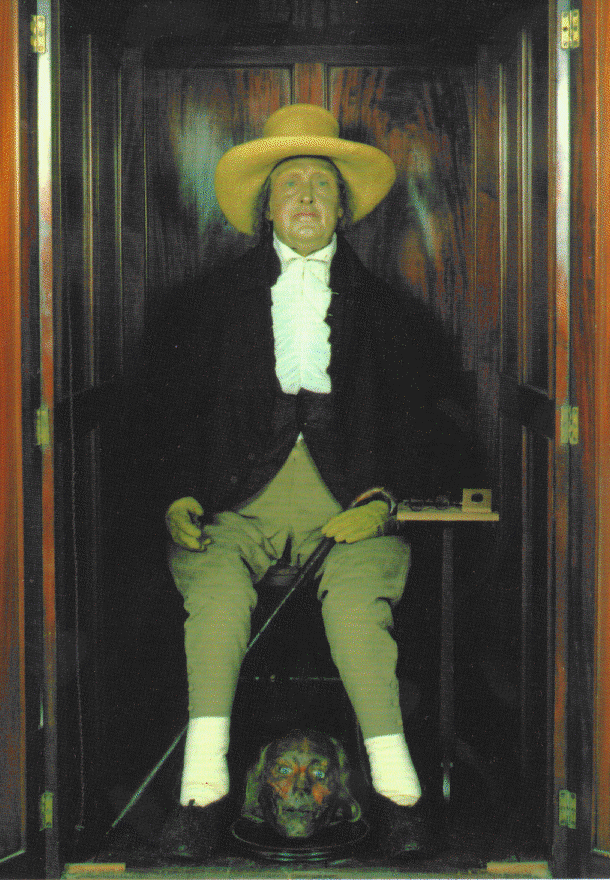
Jeremy Bentham’s “Auto-Icon”
![]()
From Simon Critchley’s The Book of Dead Philosophers:
In a text called Auto-Icon: or, Farther uses of the dead to the living, Bentham gave careful instructions for the treatment of his corpse and its presentation after his demise. If an icon is an object of devotion employed in religious ritual, then Bentham’s “Auto-Icon” was conceived in the spirit of irreligious jocularity. The “Auto-Icon” is a godless human being preserved in their own image for the small benefit of posterity. [. . .] As such, Bentham’s body is a posthumous protest against the religious taboos surrounding the dead [. . .] Bentham’s body was dissected and his skeleton picked clean and stuffed with straw. [. . .] Sadly, the mummification process went badly wrong and a wax head was used as a replacement. The original, rotting and blackened head used to be kept on the floor of the wooden box between Bentham’s feet . However, the head became a frequent target for student pranks, being used on one occasion for football practice in the front quadrangle.
An Intellectual Seed Crystal Dropped into the Supersaturated Solution of American Motorsports

Of all the David Foster Wallace obituaries and appreciations floating around the internet–many of them moving and insightful–today’s feature at The Onion, “NASCAR Cancels Remainder Of Season Following David Foster Wallace’s Death” strikes me as the strangest. The conceit of the piece, that NASCAR drivers are keenly attuned, even motivated by the literary world, is frankly some of the basest, dumbest, most obvious irony ever, and possibly the kind of contrived situation at which Wallace might’ve cringed. Yet there’s something sweet in The Onion elegy’s clumsiness. Consider this analysis of Infinite Jest they attribute to Greg Biffle:
I first read Infinite Jest in 1998 when my gas-can man gave me a copy when I was a rookie in the Craftsman Truck Series, and I was immediately struck dumb by the combination of effortlessness and earnestness of his prose. Here was a writer who loved great, sprawling, brilliantly punctuated sentences that spread in a kind of textual kudzu across the page, yet in every phrase you got a sense of his yearning to relate and convey the importance of every least little thing.
Well said. Or Jimmie Johnson‘s beautiful critique of DFW’s style:
David Foster Wallace could comprehend and articulate the sadness in a luxury cruise, a state fair, a presidential campaign, anything. But empathy, humanity, and compassion so strong as to be almost incoherent ran through that same sadness like connective tissue through muscle, affirming the value of the everyday, championing the banal yet true, acknowledging the ironic as it refused to give in to irony.
And so well here we are then–an ironic piece acknowledging Wallace’s ability to acknowledge and yet resist irony in his own work. The Onion simply can’t unpack the thoroughly Wallacian conundrum that results. But what I think they do is better–they eulogize a writer I think they love in the only way the mission of their site allows. And unlike their previous jibes at Wallace, “Girlfriend Stops Reading David Foster Wallace Breakup Letter at Page 20,” and the Weekender edition pictured above, it seems that The Onion staffers are too sad to make the piece funny–which, I think, is appropriate.
Death of the Author
“[O]nce I’m done with the thing, I’m basically dead, and probably the text’s dead: it becomes simply language, and language lives not just in but through the reader” — David Foster Wallace, quoted in Marshall Boswell’s Understanding David Foster Wallace

In the quote above, DFW illustrates why, when writing at his best, he was able to transcend the cold irony and post-modern goofiness of forbears (and, to some extent, contemporaries) like DeLillo and Pynchon. Wallace understood language as a game, and understood that the game was cooperative. He knew that it wasn’t enough to be clever–readers need to care about that cleverness. If the author is dead, and the text is dead, then the language has to live on through voices, through perspectives, through a series of interior identifications: this is where DFW excelled and dazzled. The myriad voices that lard Infinite Jest testify the power of walking in another’s shoes and seeing through another pair of eyes–in caring for the other. This is the power of literature, and this is why Wallace was such a powerful writer. And this is why we’ll miss him so much.
Wallace’s work went past the post-modern (counter)tradition of meta-textuality and self-referentiality, and commented–sometimes with a painful awareness and acuity–on the emotional deadening produced by contemporary irony and consumerist culture. His characters weren’t just placeholders to be pushed around in the hopes of proving a point, but real, achieved voices who lived through the reader. DFW’s project was not to simply repeat the postmodern realization of the indecidability of textuality, but to work through that realization into a new realm of connection and meaning and identification with his readers despite a cold, ironic, and sometimes meaningless world. In both his groundbreaking fiction and his brilliant essays, DFW delivered what matters the most in any piece of writing–subjects and characters you care about (often despite yourself). Postmodernist thought declares there’s nothing outside the text, a supposition many contemporary authors explore and expound upon in chilly irony or silly wordplay. Even when he was negotiating problems of meaning, signification, and communication in the face of alienation, fragmentation, and despair, David Foster Wallace gave us fully-realized worlds populated with characters we could care about.
There are any number of reports out there right now that mischaracterize DFW as an author who hid behind wordplay and irony. Consider Guy Adams ridiculous lead in The Independent: “For a writer who elevated irony to an art form, and whose infinite jesting co-existed with an all-too-apparent dark side, it felt grimly appropriate that David Foster Wallace should have chosen suicide as the means by which to end his own life story.” Did it feel “grimly appropriate”? Why? What was “grimly appropriate,” about David Foster Wallace’s suicide, Guy? Adams reinforces both his ignorance of his subject as well as his lack of literary understanding with this tidbit: “For all his natural ability, and occasional brilliance, Wallace never lived-up to the fullness of his talent, or the haunting reach of his possibilities.” Adams’s dismissive-yet-inflated rhetoric is exactly the kind of verbal posturing that needs to be shouted down right now by those who’ve actually read Wallace and can testify that his brilliance was anything but “occasional.” And that, I guess, is my only real goal here. Adams is wrong. It’s not true that “Wallace never lived-up to the fullness of his talent”–that phrase doesn’t even mean anything. Who measured the fullness of Wallace’s talent? When did that measurement take place, and in what units was said-talent measured? The measure of DFW’s talent can only be assessed by actually reading his work, and that’s what you should do–especially if you’ve been putting it off. Our author may be dead, but he lives on in a language game played with his readers via the act of reading, and this is a game where everyone stands to win.