Derrida Speaks About Animals

I Review Tom McCarthy’s Essay “Transmission and the Individual Remix”

Telephone Picture EM 3 — Laszlo Moholy-Nagy

In an interview published back in 2010 (coinciding roughly with the release of his excellent novel C), Tom McCarthy evaluated his work:

I see what I’m doing as simply plugging literature into other literature. For me, that’s what literature’s always done. If Shakespeare finds a good speech in an older version of Macbeth or Pliny, he just rips it and mixes it. It’s like DJing.

McCarthy’s new essay “Transmission and the Individual Remix” explores the idea of artist as DJ, as remixer, as synthesizer. It’s a brief, fun read—28 pages on paper the publicity materials claim, but it’s only available as an etext, so its length is hard to measure in terms of pages. It took me less than an hour to read it on my Kindle Fire. Then I read it again. Although publisher Vintage kindly sent me a copy, I’d argue that it’s well worth the two bucks they’re asking.

“Transmission” is playful and discursive, as befits its subject. The essay is not nearly as pretentious as its subtitle (“How Literature Works”) might suggest. McCarthy riffs on a few subjects to illustrate his thesis: Kraftwerk, the Orpheus myth (and its many, many retellings and interpretations), Rilke, Alexander Graham Bell, “Blanchot, Barthes, or any other dubious French character whose names starts with B,” Ulysses, Kafka, Beckett, etc. But what is his thesis? What does he want? He tells us:

My aim here, in this essay, is not to tell you something, but to make you listen: not to me, nor Beckett and Kafka, but to a set of signals that have been repeating, pulsing, modulating in the airspace of the novel, poem, play—in their lines, between them and around them—since each of these forms began. I want to make you listen to them, in the hope not that they’ll deliver up some hidden and decisive message, but rather that they’ll help attune your ear to the very pitch and frequency of its own activity—in other words, that they’ll help attune your ear to the very pitch and frequency of its own activity—in other words, that they’ll enable you to listen in on listening itself.

McCarthy’s concern here is to point out that nothing is original, that all creation is necessarily an act of synthesis. To read a novel is to read through the novel, to read the novelist’s sources (or, to use McCarthy’s metaphor, to listen through). McCarthy’s insights here are hardly new, of course—Ecclesiastes 1:19 gives us the idea over 2000 years ago, and surely it’s just another transmitter passing on a signal. What makes “Transmission” such a pleasure is its frankness, its clarity. Unlike so much postmodern criticism, McCarthy doesn’t trip over jargon or take flights of fancy into obscure metaphor. And even when he does get a bit flighty, he manages to clarify so many ideas of basic deconstructive theory:

This is it, in a nutshell: how writing works. The scattering, the loss; the charge coming from somewhere else, some point forever beyond reach or even designation, across a space of longing; the surge; coherence that’s only made possible by incoherence; the receiving which is replay, repetition—backward, forward, inside out or upside down, it doesn’t matter. The twentieth century’s best novelist understood this perfectly. That’s why Ulysses’s Stephen Dedalus—a writer in a gestational state of permanent becoming—paces the beach at Sandymount mutating, through their modulating repetition, air- and wave-borne phrases he’s picked up from elsewhere, his own cheeks and jaw transformed into a rubbery receiver . . .

Amazingly, the name Derrida doesn’t show up in “Transmission,” even as McCarthy gives us such a clear outline of that philosopher’s major ideas, as in the above riff’s explication of différance and iterability (with twist of Lacanian lack to boot). Or here, where McCarthy deconstructs the notion of a stable self:

All writing is conceptual; it’s just that it’s usually founded on bad concepts. When an author tells you that they’re not beholden to any theory, what they usually mean is that their thinking and their work defaults, without even realizing it, to a narrow liberal humanism and its underlying—and always reactionary—notions of the (always “natural” and preexisting, rather than constructed self, that self’s command of language, language as vehicle for “expression,” and a whole host of fallacies so admirably debunked almost fifty years ago by the novelist Alain Robbe-Grillet.

So I read Derrida through McCarthy’s reading of Robbe-Grillet. This is all transmission, writing as remix, but also reading as remix.

I could go on, but I fear that I’ll simply start citing big chunks of McCarthy’s essay, which is supremely citable, wonderfully iterable. Recommended.

Derrida (2002 Documentary)

Derrida Talks About Biography, Authority, and Stability


Derrida Talks About Stupidity

“Could You Elaborate on These Things?” — Derrida Talks About “American” Attitudes; Sports an Orange Tan

“One of the Gestures of Deconstruction Is to Not Naturalize What Isn’t Natural” — Derrida Kinda Sorta Almost Defines Deconstruction

Derrida Speaks of Love (Or Not)

Biblioklept Interviews Camelia Elias, Editor-in-Chief of EyeCorner Press

Camelia Elias is the founder and editor-in-chief of EyeCorner Press, an independent publisher devoted to printing a host of difficult-to-classify writings, including creative academic writing, and poetic fragments and aphorisms. EyeCorner publishes works in English, Danish, and Romanian, as well as bilingual editions. This multilingual approach gels with the publishing house’s fragmentary philosophy, as well as its origins as a collaborative venture between universities in three nations. In addition to her editorial duties, Elias is also one of EyeCorner’s authors; her latest work Pulverizing Portraits is a monograph on the poetry of Lynn Emanuel. Elias is Associate Professor of American Studies at Roskilde University in Denmark and she blogs at FRAG/MENTS. Elias was kind enough to talk with me over a series of emails; in our discussion she defines creative criticism, discusses the value in being open to error, accounts for hostility against deconstruction and post-structuralism in academia, and explains why it doesn’t hurt to throw the word “fuck” into a textbook now and then.

Camelia Elias

Biblioklept: EyeCorner Press is somewhat unusual, even for an indie publisher — a joint venture between universities in Denmark, Finland, and the US that focuses on creative criticism. How did the press come into being?

Camelia Elias: The press came into being as an act of anarchism, if you like, a form of resistance against the idea that academic work must be measured not only against its own standard, but also against the standard that idiotic governments sets for measuring, and hence controlling, intelligence, creativity, and freedom. In 2007 I was editing new research papers written by colleagues and associates of the Institute of Language and Culture at Aalborg University with view to publication by the Faculty of Humanities at AU. A new change in leadership also brought about a new set of ideas. These were rigidly formulated along the newly established injunction passed down by the Danish government, which dictated that all Danish academics must now prioritize publishing with Oxford and Harvard. Without getting into the silly and imbecilic arguments produced for the sustainability of such a demand in reality, the fact remains that many heads of department throughout our Danish universities tried to implement the new regulations literally. The good publishing folks at Aalborg were told that Research News (the publishing venue) was going to close, and no, as the justification for it ran, this was not because the papers were not good enough, but 1) because publishing new research under the aegis of the department was likely to have the undesirable effect of preventing the researchers from expanding their range of publishing possibilities – and hence not consider Oxford and Harvard – and 2) there will be no money for it anymore. Few of us tried to make obvious the stupidity pertaining to the first argument – bad idea, as bosses generally don’t want to be told that they have limited visions – and as to the second argument, pertaining to the precarious, or rather by then non-existent financial support, a few of us also tried to suggest that we could go ‘on demand’ and even work ‘con amore’ for it, which would involve no expenses. The answer was still no. So, there we were, with a few manuscripts in the pipeline and no possibility of getting them out. As the editor of these papers, I felt a responsibility not only towards the writers but also towards the readers who had bothered to peer-review the works. I decided to start EyeCorner Press in my own name, but retain the ties we had in terms of publishing jointly with a few other partner universities. With Brenau University in Gainesville, Georgia, we had just finalized a volume on transatlantic relations (aesthetics and politics) within Cultural Text Studies Series published by Aalborg University Press. We are happy to call them our close allies. University of Georgia, Gwinnett, and Oulu University in Finland followed suit and so did Roskilde University, which became my new working place not long after the Aalborg ‘situation’.

Continue reading “Biblioklept Interviews Camelia Elias, Editor-in-Chief of EyeCorner Press”

David Foster Wallace Describes Poststructuralism

Thumbed through my copy of A Supposedly Fun Thing I’ll Never Do Again yesterday and ended up re-reading David Foster Wallace’s essay “Greatly Exaggerated,” ostensibly a review of H.L. Hix’s book Morte d’Author: An Autopsy, considers the literary fall-out after Roland Barthes declared the “death of the author.” Anyway, I thought Wallace’s description of poststructuralism was worth sharing–

The deconstructionists (“deconstructionist” and “poststructuralist” mean the same thing, by the way: “poststructuralist” is what you call a deconstructionist who doesn’t want to be called a deconstructionist) . . . see the debate over the ownership of meaning as a skirmish in a larger war in Western philosophy over the idea that presence and unity are ontologically prior to expression. There’s been this longstanding deluded presumption, they think, that if there is an utterance then there must exist a unified, efficacious presence that causes and owns that utterance. The poststructuralists attack what they see as a post-Platonic prejudice in favor of presence over absence and speech over writing. We tend to trust speech over writing because of the immediacy of the speaker: he’s right there, and we can grab him by the lapels and look into his face and figure out just exactly what one single thing he means. But the reason why poststructuralists are in the literary theory business at all is that they see writing, not speech, as more faithful to the metaphysics of true expression. For Barthes, Derrida, and Foucault, writing is a better animal than speech because it is iterable; it is iterable because it is abstract; and it is abstract because it is a function not of presence but of absence: the reader’s absent when the writer’s writing, and the writer’s absent when the reader’s reading.

For a deconstructionist, then, a writer’s circumstances and intentions are indeed a part of the “context” of a text, but context imposes no real cinctures on the text’s meaning, because meaning in language requires a cultivation of absence rather than presence, involves not the imposition but the erasure of consciousness. This is so because these guys–Derrida following Heidegger and Barthes Mallarme and Foucault God knows who–see literary language as a not a tool but an environment. A writer does not wield language; he is subsumed in it. Language speaks us; writing writes; etc.

J.M. Coetzee and Ethics — Anton Lesit & Peter Singer

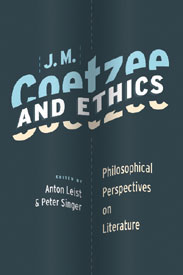
In their introduction to J.M. Coetzee and Ethics, editors Anton Lesit and Peter Singer make the claim that the essays in the new collection “show the folly of Plato’s idea that literature has nothing to contribute to philosophical discussion. Instead they are an invitation to a dialogue that can sharpen the issues that literature raises while making philosophy more imaginative.” Lesit and Singer briefly review the philosophical tradition, from the time of Plato’s call to banish the poets to the current wars between pragmatists and postmodernists, specifically foregrounding the case for Coetzee’s literature as a legitimate source of philosophical inquiry. They identify three specific features of his works — reflectivity, truth seeking, and an exploration of social ethics — that merit critical attention. The essays in the volume address “the psychological and moral phenomenology of personal relationships; the consequences of human suffering, evildoing, and death for human rationality and reason; and the literary methods invoked to open areas of experience beyond the abstract language of philosophers.” The editors also point out that “Unsurprisingly, the ethics of animals looms large in this collection,” a concern that might attract animal ethicists and others interested in animal-human relationships who might not immediately turn to literature for answers (or questions). On the whole, J.M. Coetzee and Ethics, while obviously a specialty volume, strives to appeal to a wider audience, eschewing much of the acadamese that plagues (and obfuscates the arguments of) so many critical volumes. Fans of Coetzee will wish to take note. J.M. Coetzee and Ethics is new in hardback from Columbia University Press.

Jacques Derrida vs. John Searle (Book Shelf Showdown)

Photographer Andrew Bush’s instillation Speech Acts combines two photographs of book shelves–one of Jacques Derrida’s and one of John Searle’s. Derrida and Searle rumbled over the primacy of speech vs. writing in the 1970s (read Derrida’s seminal essay “Signature Event Context” for more).

Jacques Derrida's room of his published books in his home in Ris Orange, France, 2001
John Searle's room of his published books in his home in Berkeley, CA, 2000

James Wood on Harold Bloom

In his essay “Shakespeare in Bloom,” critic James Wood performs one of the strangest, most backhanded (and yet earnest) defenses I’ve ever read of Harold Bloom‘s aesthetic reaction to (what Bloom has called) “The School of Resentment” — deconstruction, Marxism, gender and queer theory, postcolonial theory, all that good stuff. Wood comes out strong, arguing, that in his prolific output, Bloom “has kidnapped the whole of the English literature and has been releasing his hostages, one by one, over a lifetime, on his own spirited terms.” Wood suggests that “this ceaselessness has produced some hurried, fantastical, and repetitive work,” before going on to throw around words like “garrulous” and “shallow.” Wood then takes Bloom to task over his famous (and improbable) claim that “Shakespeare invented us,” situating the claim against Bloom’s own most famous theory, the anxiety of influence. Wood says–

In truth, Bloom’s word invention is an enthusiastic Wildean necessary exaggeration. It is Bloom’s way of registering our almost religious sense that we live in Shakespeare’s shadow and that he does not simply represent human beings but brings new life, more life, into the world. . . . Bloom’s determination to honor Shakespeare’s godly primacy is a kind of secular theology.

The second section of Wood’s essay should be required reading for all English majors (or anyone serious about literary criticism). Here, Wood provides a wonderfully succinct overview of the history of literary criticism, connecting Freudian analysis and the New Critics to the various theories that Bloom would come to call the “The School of Resentment.” As we bring up the term again, we should note that we consider it a bit pejorative and utterly reactionary, and, to borrow from (and perhaps misapply) Wood, shallow. Wood points out that “Deconstruction brings a generalized suspicion to bear on language and in particular on metaphor (or ‘rhetoric’), which it suspects of hiding something–namely, its own metaphoricity.” In short, literature always metaphorizes, and thus hides, some other impulse, one always politicized. Wood continues: “Political criticism, including cultural materialism, converts Freud’s analytical suspicions into political ones. . . . The poem is read as if it were covering something up, as if it were an alibi that is rather too fluent to be entirely trusted.” It must be interrogated to reveal its secret, the secret prejudices of its age. Wood continues, after a page or two–

This is a long way around to Bloom, but it may explain the venom and desperation of his attacks. For although deconstruction did not intend to, it has produced mutant modes of reading that, when combined with leftish political guilt or ressentiment, seem to threaten the existence of literature as a discipline.

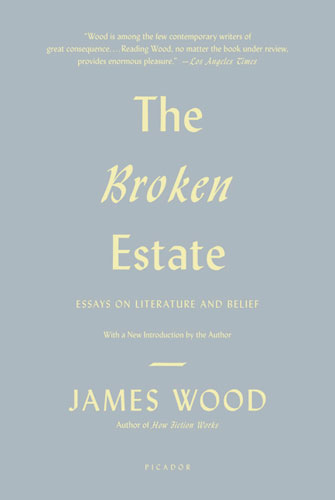
Wood espouses some common sense here uncommon in literary criticism, taking a long view that recognizes–and attempts to step outside of–the fact that it’s not all academic when it comes to how we read our books. History and politics matter, but so does our passion, our love for our books (as silly as that may sound). He defends Bloom’s work even as he calls it an overreaction. He credits deconstruction as having “produced some brilliance and many distinguished readings (no one could deny the acuities of Derrida, of Paul de Man, of Barbara Johnson).” Wood’s essay “Shakespeare in Bloom” is the kind of thing that students and aspiring critics alike should read before they feel the need to draw arms. You can read it in the second printing (the first in a decade) of Wood’s essay collection The Broken Estate, which debuts in June, 2010 from Picador.

Death of the Author

“[O]nce I’m done with the thing, I’m basically dead, and probably the text’s dead: it becomes simply language, and language lives not just in but through the reader” — David Foster Wallace, quoted in Marshall Boswell’s Understanding David Foster Wallace

In the quote above, DFW illustrates why, when writing at his best, he was able to transcend the cold irony and post-modern goofiness of forbears (and, to some extent, contemporaries) like DeLillo and Pynchon. Wallace understood language as a game, and understood that the game was cooperative. He knew that it wasn’t enough to be clever–readers need to care about that cleverness. If the author is dead, and the text is dead, then the language has to live on through voices, through perspectives, through a series of interior identifications: this is where DFW excelled and dazzled. The myriad voices that lard Infinite Jest testify the power of walking in another’s shoes and seeing through another pair of eyes–in caring for the other. This is the power of literature, and this is why Wallace was such a powerful writer. And this is why we’ll miss him so much.

Wallace’s work went past the post-modern (counter)tradition of meta-textuality and self-referentiality, and commented–sometimes with a painful awareness and acuity–on the emotional deadening produced by contemporary irony and consumerist culture. His characters weren’t just placeholders to be pushed around in the hopes of proving a point, but real, achieved voices who lived through the reader. DFW’s project was not to simply repeat the postmodern realization of the indecidability of textuality, but to work through that realization into a new realm of connection and meaning and identification with his readers despite a cold, ironic, and sometimes meaningless world. In both his groundbreaking fiction and his brilliant essays, DFW delivered what matters the most in any piece of writing–subjects and characters you care about (often despite yourself). Postmodernist thought declares there’s nothing outside the text, a supposition many contemporary authors explore and expound upon in chilly irony or silly wordplay. Even when he was negotiating problems of meaning, signification, and communication in the face of alienation, fragmentation, and despair, David Foster Wallace gave us fully-realized worlds populated with characters we could care about.

There are any number of reports out there right now that mischaracterize DFW as an author who hid behind wordplay and irony. Consider Guy Adams ridiculous lead in The Independent: “For a writer who elevated irony to an art form, and whose infinite jesting co-existed with an all-too-apparent dark side, it felt grimly appropriate that David Foster Wallace should have chosen suicide as the means by which to end his own life story.” Did it feel “grimly appropriate”? Why? What was “grimly appropriate,” about David Foster Wallace’s suicide, Guy? Adams reinforces both his ignorance of his subject as well as his lack of literary understanding with this tidbit: “For all his natural ability, and occasional brilliance, Wallace never lived-up to the fullness of his talent, or the haunting reach of his possibilities.” Adams’s dismissive-yet-inflated rhetoric is exactly the kind of verbal posturing that needs to be shouted down right now by those who’ve actually read Wallace and can testify that his brilliance was anything but “occasional.” And that, I guess, is my only real goal here. Adams is wrong. It’s not true that “Wallace never lived-up to the fullness of his talent”–that phrase doesn’t even mean anything. Who measured the fullness of Wallace’s talent? When did that measurement take place, and in what units was said-talent measured? The measure of DFW’s talent can only be assessed by actually reading his work, and that’s what you should do–especially if you’ve been putting it off. Our author may be dead, but he lives on in a language game played with his readers via the act of reading, and this is a game where everyone stands to win.

“Some Principles of Democracy and Deconstruction—American or Otherwise” by A. S. Kimball

“Some Principles of Democracy and Deconstruction—American or Otherwise” by Sam Kimball.

1. Democracy and deconstruction name the namelessness of a we, the people in relation to this people’s unimaginable possibilities of collective self-identification to come.

2. For this reason democracy and deconstruction locate the we in a future that transcends any possible transcendence of time, and therefore that remains utterly contingent and extinguishable, able to be obliterated in an apocalypse of the name.

3. Democracy and deconstruction attempt to respond to a demand—untraceable to any face or mind, to any consciousness—for absolute justice.

4. To this end, and because “we are all heir, at least, to persons or events marked, in an essential, interior, ineffaceable fashion, by crimes against humanity” (Derrida, Of Cosmopolitanism and Forgiveness, 29), democracy and deconstruction demand of the citizen to come an attitude of radical forgiveness and hospitality.

5. To this same end, and for similar reasons, democracy and deconstruction also entail a radical affirmation—that is, they are ways of saying “Yes?” or “Who’s there?” in the absence of any determinate voicing.

6. This means that democracy and deconstruction respond to a call that comes from an unimaginable and indeterminate future.

7. For all these reasons as well as the fact that “all nation-states are born and found themselves in violence” (Of Cosmopolitanism and Forgiveness, 57), democracy and deconstruction are provisional names for an historically unrealized ideal.

8. Thus, democracy and deconstruction require an incessant work of critique.

9. Democracy and deconstruction are ways of working toward forms of community that must necessarily exceed, transgress, transcend, and therefore remark all political borders, most especially those that define the sovereignty of the nation-state.

10. The spirit of the spirit of democracy and deconstruction has no single emotional marker, cannot be contained within or encompassed by any single emotional apprehension, is not identifiable as an affective state.

11. Democracy and deconstruction are inseparable from the fictionalizing, virtualizing power of literature.

Noam Chomsky, Intellectual Elitism, Po-Mo Gibberish, More Attacks on Deconstruction, and Bad Writing Revisited

While doing some background research for an upcoming Graduate Symposium I’ll be participating in later this month (more on that in the future), I somehow stumbled upon this post from Noam Chomsky in which the famous linguist/activist attacks post-modernism and its heroes. In this email/posting Chomsky criticizes what he views as “a huge explosion of self- and mutual-admiration among those who propound what they call “theory” and “philosophy,”” as little beyond “pseudo-scientific posturing.” Immediately, my thoughts jumped to the discussion of the Sokal Hoax I posted a few weeks back. Chomsky continues his affront to post-structuralism, arguing, much like Sokal, that the major figures of this movement–Derrida, Lacan, Foucault, Kristeva, etc.–obfuscate their arguments with an incoherent vocabulary rife with misused and misapplied scientific terminology. Chomsky on Derrida:

“So take Derrida, one of the grand old men. I thought I ought to at least be able to understand his Grammatology, so tried to read it. I could make out some of it, for example, the critical analysis of classical texts that I knew very well and had written about years before. I found the scholarship appalling, based on pathetic misreading; and the argument, such as it was, failed to come close to the kinds of standards I’ve been familiar with since virtually childhood. Well, maybe I missed something: could be, but suspicions remain […]”

Ouch!

But Chomsky’s not done yet:

“Some of the people in these cults (which is what they look like to me) I’ve met: Foucault (we even have a several-hour discussion, which is in print, and spent quite a few hours in very pleasant conversation, on real issues, and using language that was perfectly comprehensible — he speaking French, me English); Lacan (who I met several times and considered an amusing and perfectly self-conscious charlatan, though his earlier work, pre-cult, was sensible and I’ve discussed it in print); Kristeva (who I met only briefly during the period when she was a fervent Maoist); and others. Many of them I haven’t met, because I am very remote from from these circles, by choice, preferring quite different and far broader ones […] I’ve dipped into what they write out of curiosity, but not very far, for reasons already mentioned: what I find is extremely pretentious, but on examination, a lot of it is simply illiterate, based on extraordinary misreading of texts that I know well (sometimes, that I have written), argument that is appalling in its casual lack of elementary self-criticism, lots of statements that are trivial (though dressed up in complicated verbiage) or false; and a good deal of plain gibberish.”

Illiterate gibberish? Charlatan? Cults ? (This is a really common charge leveled at psychoanalysis in particular, and when one considers that both the work of Freud and Lacan was carried on by their respective daughters, there may be some validity to the claim. Still…)

Double-ouch!

Two things:

First, as a linguist, Chomsky is searching for an underlying, “universal grammar” or deep structure, a core pattern that underpins/organizes/generates all human languages. In this sense, Chomsky is searching for an ideal, a foundation. This method is in direct opposition to deconstruction, which as I understand it, seeks to decenter and disrupt all metaphysical anchors. I will never forget the class in transformational syntax I took at the University of Florida with Mohammed Mohammed (or MoMo, as we affectionately were permitted to call him). The class was a split grad/undergrad section, and MoMo scared away all of the undergrads in the first session, with the exception of myself and another student. After that point, he was always very kind to us (the undergrads) and cruel to the grads. MoMo was a Palestinian; he identified as a Jordanian refugee. He was a devout Chomskyian (cultishly so, perhaps). Derrida spoke at UF while I was in this class. I didn’t really understand what Derrida’s lecture was about, but it was very long and his English accent wasn’t so great. The next day in class, MoMo savaged Derrida for the entirety of the period on points both specific and general, most of it over our heads. It was a true rant, one of the best I’ve ever witnessed, culminating in (and I quote): “He’s full of shit!”

So Derrida certainly provoked MoMo, a strict Chomskyian–and why not? If you spend your academic career and your adult life searching for something that another person says you could never find, wouldn’t you be upset? (I believe that more than anything MoMo was upset over Derrida’s reception at UF, which was rock-starish to say the least). For MoMo, Derrida was a phony, a pied-piper misleading the children from the real issues.

Which brings me to point two–Chomsky is primarily a political figure, and really a pragmatist at heart. The core of his argument is not so much that po-mo writing is high-falutin’ nonsense, but rather that it ultimately serves no practical purpose. Here is where I would strongly disagree. The people that Chomsky attacks and their followers are re-evaluating the canon and the very notion of received wisdom. Chomsky attacks them for “misreading the classics”–but just what are the classics, and whose value systems created the notion that the classics were indeed “classic”? If Derrida & co. appear to “misread,” it is because they seek to recover the marginalized knowledge that has been buried under a sediment of givens as “truth.” Yes, the post-modern movement might have elitist tendencies, and yes, the subjects and themes of their work might not have much to do on the surface with the plight of a refugee (cf. MoMo in Jordan in 1948)…but the goal is actually in line with Chomsky’s goal–to make people question the powers that structure their lives.

I do agree, as I’ve said before, that post-modern writing often comes off as so-much sophistry and hogwash (I admit to plenty of this myself), that in some sense it relies too heavily on a coded vocabulary that seems unaccessible to the untrained eye, and that all too often an air of self-congratulation, an atmosphere of winks and nods replaces an environment of real thinking and debate. But my real take is this: any philosophy that could shake MoMo into discomposure is good. MoMo is a brilliant man and his class was fascinating, but to have seen him that day–his feathers so ruffled, his foundations tested–so infuriated over ideas–that was a beautiful thing. Right then, I knew there must be something to Derrida, something I wanted to figure out. And that’s what the best of these writers do–they infuriate us by provoking the truths that we are so sure that we hold in ourselves. They destabilize our safe spaces. They don’t allow for easy answers; they rebuke tradition. And if this approach falls into the norm in academia, becomes lazy and sedimentary, undoubtedly someone will come along and call “bullshit” on it, thus reigniting debate, questions, language. Nietzsche speaks of language as a series of hardened metaphors, language as petrified lava, sedimentary givens. This is the goal of deconstruction: to get that lava flowing again.

 

The Sokal Hoax, Friedrich Nietzsche, Attacks on Deconstruction, and More Bad Writing

NYU physics professor Alan Sokal wrote a paper entitled “Transgressing the Boundaries: Towards a Transformative Hermeneutics of Quantum Gravity” which was published in 1996 in Duke University’s Social Text, a cultural studies journal. The same day the article was published–with no peer review, incidentally–Sokal announced in Lingua Franca that the whole thing was a hoax, a collection of nonsense, buzzwords, and jargon, making liberal use of recontextualized quotes. Sokal’s intention was to provoke the postmodern tendencies of humanities professors, whom he viewed as having a poor understanding of the science they critiqued.

Now, anyone who has spent any time in any university’s cultural studies department or English department (they tend to be the same thing nowadays) knows that postmodernism is all the rage: the dominant thinkers tend to be of the deconstructionist/post-structuralist school of thought–Derrida, Kristeva, Deleuze, Foucault, Butler, and so on. The major goal of deconstructive analysis is to disrupt the traditional, metaphysical groundings that have been accepted as “natural” to philosophy–to free up marginalized and subjugated areas of thought and break through the layers of sedimentary “givens.” In this sense, deconstruction takes a major queue from the philosophy of Friedrich Nietzsche. In many ways Nietzsche provided not only some of the major questions that initiate a deconstructive philosophy, but also a model for how those ideas would be presented in writing.

Nietzsche’s writing is poetic and often ironically self-reflexive. In his essay “On Truth and Lie in an Extra-Moral Sense,” he makes the claim that all language is an anthropomorphic jumble of metaphors, that concepts are only constructed upon other concepts, all understood through an anthropocentric viewpoint that is impossible to abandon. Nietzsche’s writing contains this awareness; he frames his argument in a series of illustrative metaphors and similes, arguing that language does not permit people to reach the true essence of “the thing in itself”; rather, concepts are the “fractured echo[es]” of the ego seeking recognition—deceptions and illusions. In Nietzsche’s view, science can only build on these empty metaphors and therefore all scientific, empirical knowledge is a house of cards waiting to collapse. Nietzsche prefers an irrational, intuitive, liquid approach to life—a “playing with seriousness”: by abandoning stoic, static reasoning, one will gain “illumination, cheer, and redemption.” This joyful disruption is one starting point for the deconstructionists who Sokal attacked in his hoax.

Sokal obviously disagrees with Nietzsche: as a physicist, Sokal clearly values empirical, rational thought. But his real disagreement is with his perception of an abusive misuse of scientific and mathematic terminology by humanities professors. Sokal views the majority of post-modern theorists as perpetrators of hogwash, arrogant elitists who obfuscate their hollow ideas in jargon.

Okay. Now. So. Is Sokal right? Is there a tendency in humanities departments toward obscurantism with elitist undertones? Absolutely. However, I see this as the academic byproduct of the writers under attack, the detritus of myriad misunderstandings and misreadings. Nobody’s perfect, obviously. I disagree that certain of the writers Sokal attacks–Julia Kristeva in particular (a hero of mine, whose writing I find to be both wonderfully lucid and poetically profound)–are purposefully difficult. Most of the deconstructionists mentioned above take their lead from Nietzsche, and thus employ a strange, elliptical, roundabout and often poetic strategy to their writing. The deconstructionist methodology itself is an affront to easy readings–simply put, it’s meant to make you think. Furthermore, philosophy, for most of us, is not beach reading.

Interestingly, and perhaps ironically, Sokal’s gesture is an essentially postmodern move, a deconstructive move–a challenge to the new establishment of academic humanities and cultural studies. Even his use of recontextualized quotes is an affirmation of Derrida’s concept of iterability. The greatest value of the hoax is that it reinforces the tenets of deconstruction: to upset the places we feel are comfortable and safe, prompting constant re-examination of our aims and goals. Sokal’s hoax initiates a dynamic rethinking of the way we write and the way we read. Who are we writing for? How are we presenting our ideas? Do we understand what we are saying? More than anything, Sokal’s hoax calls attention to the constant need for peer review, for academia to question itself, its products, its institutions.