Denis Johnson’s Train Dreams Is a Perfect Audiobook

Going West (Express Train) — Thomas Hart Benton

A few weeks ago on this blog, I declared Denis Johnson’s Train Dreams a perfect novella, a claim that I feel even more certain about after listening to Macmillan audio’s new production of the book, read by Will Patton.

Precise, funny, and moving, Train Dreams tells the story of Robert Grainier, a laborer (and eventual hermit of sorts) who makes a life in (and against) the strange wilderness of the Idaho panhandle. The book somehow measures the first half of the twentieth century in the US without overreaching; instead, through Grainier’s human (but anti-social) presence, Johnson traces the end of Manifest Destiny, the last strands of the wild frontier. Train Dreams, poised tautly on a line that divides the mythic and metaphysical from the concrete and real, shows us a world where we might catch a glimpse of wolf-children and angels—the real thing, not just the sham show, not just a pale suggestion.

Moving through the book again via Patton’s expert narration, I was struck by how constructed yet seamless Johnson’s narrative is. Johnson gets so much credit for the precision of his syntax, but a rereading of Train Dreams reveals how tight and layered, yet never obvious, his plot is—how he lays out his themes repeatedly without brazenly calling attention to them. (One of the joys of reading is rereading; one of the joys of a novella is that its brevity allows us to easily reread). The book is a gem.

Will Patton’s reading perfectly matches the tone, pacing, and depth of Train Dreams. He understands the restraint of Johnson’s prose, never tripping over into bombast or ghastly over-emoting. Patton’s wry, not-quite-dusty, not-quite-dulcet tone brings Johnson’s small cast to vivid life. In particular, he breathes energy into the humorous dialogues. I found myself laughing aloud over a discourse between Grainier and a man who’s been shot by his own dog. Patton understands the material and brings the same sensitivity, pathos, and wit to it that he brought to his reading of Johnson’s 2007 opus, Tree of Smoke.

A good reader makes all the difference of course. In the wrong hands—excuse me, wrong voice—a book we thought we knew can come across stifled, squashed; the reader can actually hurt the book, impose the wrong tone: misread. A reader like Patton (and I should credit his director and production team too, of course) can enlarge a book for its audience, shining light on the subtle nuances we might overlook, or even clouding phrases we thought we fully understood, empowering the language with a new ambiguity that enriches the overall reading experience. Highly recommended.

Here’s Patton reading the first part of Train Dreams:
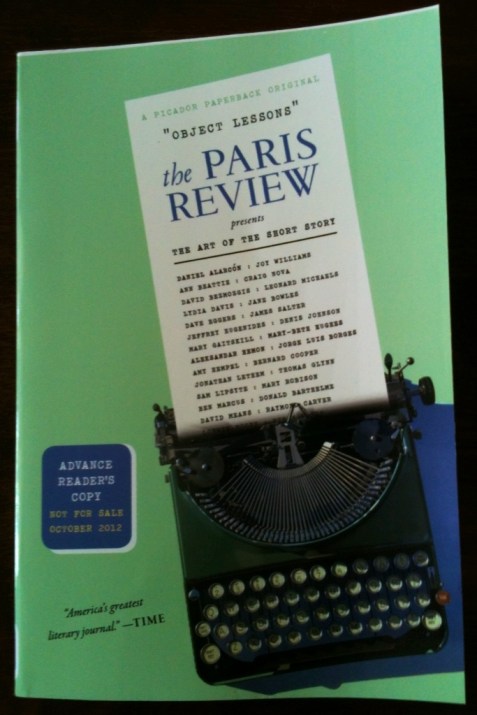
Object Lessons from The Paris Review, Where Writers Present Some of Their Favorite Short Stories from Other Writers (Book Acquired, 6.11.2012)

20120611-150824.jpg

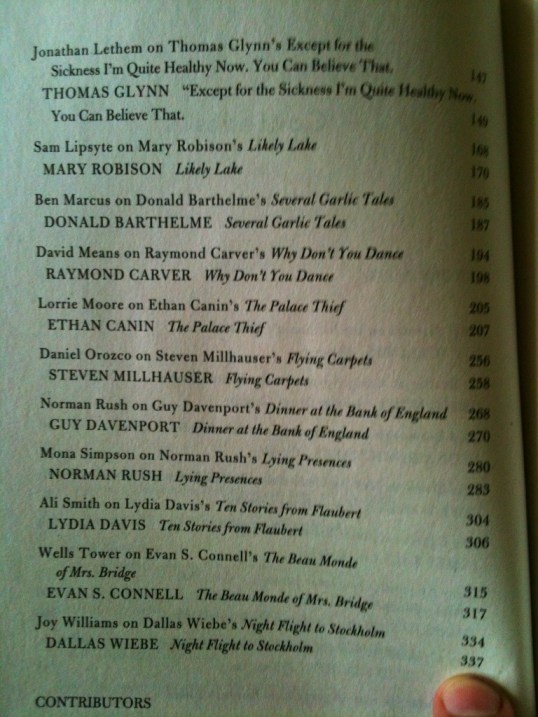
Okay: This one is really cool: Object Lessons features a bunch of short stories, some you may have read, each with a short lead-in (two-five pages) by another writer. So, we get Jeffrey Eugenides on Denis Johnson, or Ben Marcus on Donald Barthelme, or Lydia Davis on Jane Bowles, or Ali Smith on Lydia Davis. You know what, let me just share the table of contents (review down the line):

20120611-150831.jpg

20120611-150837.jpg

Denis Johnson’s Train Dreams Is a Perfect Novella

With blunt grace, Denis Johnson navigates the line between realism and the American frontier myth in his perfect novella Train Dreams. In a slim 116 pages, Johnson communicates one man’s life story with a depth and breadth that actually lives up to the book’s blurb’s claim to be an “epic in miniature.”  I read it in one sitting on a Sunday afternoon, occasionally laughing aloud at Johnson’s wry humor, several times moved by the pathos of the narrative, and more than once stunned at the subtle, balanced perfection of Johnson’s prose, which inheres from sentence to paragraph to resonate throughout the structure of the book.

The opening lines hooked me:

In the summer of 1917 Robert Grainier took part in an attempt on the life of a Chinese laborer caught, or anyway accused of, stealing from the company stores of the Spokane International Railway in the Idaho Panhandle.

Three of the railroad gang put the thief under restraint and dragged him up the long bank toward the bridge under construction fifty feet above the Moyea River. A rapid singsong streamed from the Chinaman voluminously. He shipped and twisted like a weasel in a sack, lashing backward with his one free fist at the man lugging him by the neck.

The matter-of-fact violence here complicates everything that follows in many ways, because Grainier it turns out is pretty much that rare thing, a good man, a simple man who tries to make a life in the Idaho Panhandle at the beginning of the 20th century. The rest of the book sees him trying—perhaps not consciously—to somehow amend for the strange near-lynching he abetted.

Grainier works as a day laborer, felling the great forests of the American northwest so that a network of trains can connect the country. Johnson resists the urge to overstate the obvious motifs of expansion and modernity here, instead expressing depictions of America’s industrial growth at a more personal, even psychological level:

Grainier’s experience on the Eleven-Mile Cutoff made him hungry to be around other such massive undertakings, where swarms of men did away with portions of the forest and assembled structures as big as anything going, knitting massive wooden trestles in the air of impassable chasms, always bigger, longer, deeper.

Grainier’s hard work keeps him from his wife and infant daughter, and the separation eventually becomes more severe after a natural calamity, but I won’t dwell on that in this review, because I think the less you know about Train Dreams going in the better. Still, it can’t hurt to share a lovely passage that describes Grainier’s courtship with the woman who would become his wife:

The first kiss plummeted him down a hole and popped him out into a world he thought he could get along in—as if he’d been pulling hard the wrong way and was now turned around headed downstream. They spent the whole afternoon among the daisies kissing. He felt glorious and full of more blood than he was supposed to have in him.

The passage highlights Johnson’s power to move from realism into the metaphysical and back, and it’s this precise navigation of naturalism and the ways that naturalism can tip the human spirit into supernatural experiences that makes Train Dreams such a strong little book. In the strange trajectory of his life, Grainier will be visited by a ghost and a wolf-child, will take flight in a biplane and transport a man shot by a dog, will be tempted by a pageant of pulchritude and discover, most unwittingly, that he is a hermit in the woods. In Johnson’s careful crafting, these events are not material for a grotesque picaresque or a litany of bizarre absurdities, but rather a beautiful, resonant poem-story, a miniature history of America.

Train Dreams is an excellent starting place for those unfamiliar with Johnson’s work, and the book will rest at home on a shelf with Steinbeck’s naturalist evocations or Cormac McCarthy’s Border Trilogy. I have no idea why the folks at FS&G waited almost a decade to publish it (Train Dreams was originally published in a 2002 issue of The Paris Review), but I’m glad they did, and I’m glad the book is out now in trade paperback from Picador, where it should gain a wider audience. Very highly recommended.

Typed Notes for Train Dreams — Denis Johnson

(Via).

Books Acquired, 5.17.2012—Or, Here’s What’s New from Picador This June

20120521-122547.jpg

Nice little batch from the good folks at Picador, including Bill Loehfelm’s thriller The Devil She Knows, Mohamed ElBarardei’s The Age of Deception, an analysis of nuclear politics, and Michael Cunningham’s Land’s End, which I assume is a novelization of the clothing catalog.

Also in the batch: Denis Johnson’s novella Train Dreams, which I read in one sitting this Sunday. It’s a perfect novella, its pathos balanced with humor, its realism tempered in something of the mythic spirit of the American frontier. Full review forthcoming.

20120521-122553.jpg

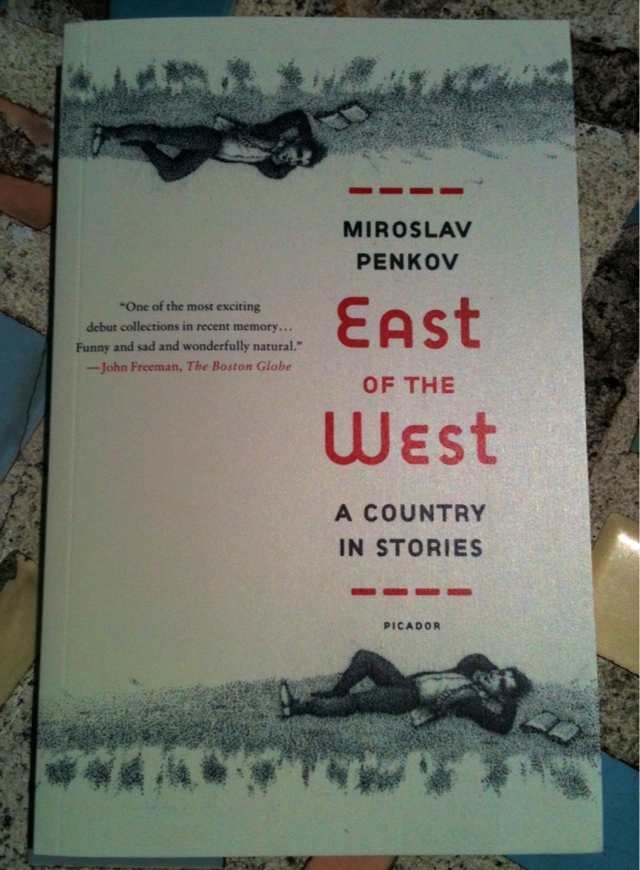
Miroslav Penkov’s collection East of the West looks pretty cool.

20120521-122559.jpg

Here’s a description from his website:

A grandson tries to buy the corpse of Lenin on eBay for his Communist grandfather. A failed wunderkind steals a golden cross from an Orthodox church. A boy meets his cousin (the love of his life) once every five years in the river that divides their village into east and west. These are Miroslav Penkov’s strange, unexpectedly moving visions of his home country, Bulgaria, and they are the stories that make up his charming, deeply felt debut collection.

20120521-122605.jpg

Donald Antrim’s debut Elect Mr. Robinson for a Better World has also been reissued with a new intro by Jeffrey Eugenides. Here’s an excerpt of the novel:

It was Friday, the day of the big theriomorphism workshop Rotary luncheon out at the Holiday Inn. My wife, Meredith, and I and a crowd of red-faced Rotarians and their well-dressed wives (Rotary Anns) sat around hotel banquet tables and listened to a visiting anthropology professor at the junior college say, “Pick an animal, any animal, fish, fowl, beast. Concentrate on aspects of the animal. Is it big? Small? Cute? Does it eat other animals? What color fur? If the animal is a bird, what color are its feathers? What song does it sing?”

“This is stupid,” I whispered to Meredith.

“It’s your fault we’re here, Pete. Why don’t you give it a chance?”

The anthropologist said, “Why don’t we all think about it for a minute? Okay, everybody got one?”

“Yes,” “No,” “Wait,” people said. Meredith whispered, “What’s yours?”

“I don’t know, what’s yours?”

“Coelacanth.”

“The prehistoric fish?”

“I need a volunteer,” declared the professor. Meredith raised her hand, and the man at the podium said, “Yes, back there. Tell us your name and the name of the animal you’ve chosen to become today.”

“Meredith Robinson. Coelacanth. It’s a kind of fish that scientists believed extinct until one was caught off the coast of Africa.”

“Excellent. Come forward. Sit here. Would someone please dim the lights?” I watched Rotary guys watch my wife. Bill Nixon, Tom Thompson, Abraham de Leon, Dick Morton, Terry Heinemann, Robert Isaac—all the usuals, plus others. Jerry and his wife, Rita, sat up front. The professor soothingly said, “Close your eyes, breathe deeply, and tell us about the coelacanth. Everybody else, let’s all breathe deeply too, and be thinking about our own animals. Go ahead, Meredith.”

“Well, it’s four feet long, deep slate blue, with bony, protruding fins and big jaws with scary teeth. It goes back seventy million years. It moves slowly, it dwells in dark water.” The professor nodded. Audience members inched forward in their seats. Meredith said, “At night it swims upside down with its head pointed to the sea bottom, bobbing along.”

“A feeding technique?”

“Maybe.”

“How’s the water?” I could see Meredith’s head settle forward as she softly answered, “Cold.”

“Feel the cold. Breathe that cold. Inhale that water. What do you feel?”

“Colors.”

“Colors?”

“Blue, black, indigo.”

Denis Johnson, Malcolm Lowry, Ben Marcus (Books Acquired, 4.18.2012)

20120418-144738.jpg

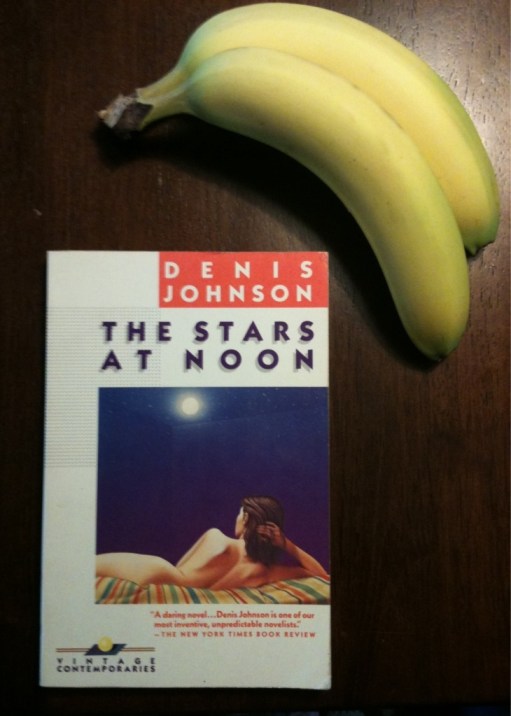
I went to the bookstore to pick up a graduation present and then spent too much time wandering the stacks. While looking for Mat Johnson’s Pym, I found a first printing paperback of Denis Johnson’s The Stars at Noon and had to have it—haven’t read it yet, and it makes a nice sister for my copy of Angels—but honestly, I’m just in love with these 1980s Vintage Contemporary editions with awful, awful covers.

20120418-144806.jpg

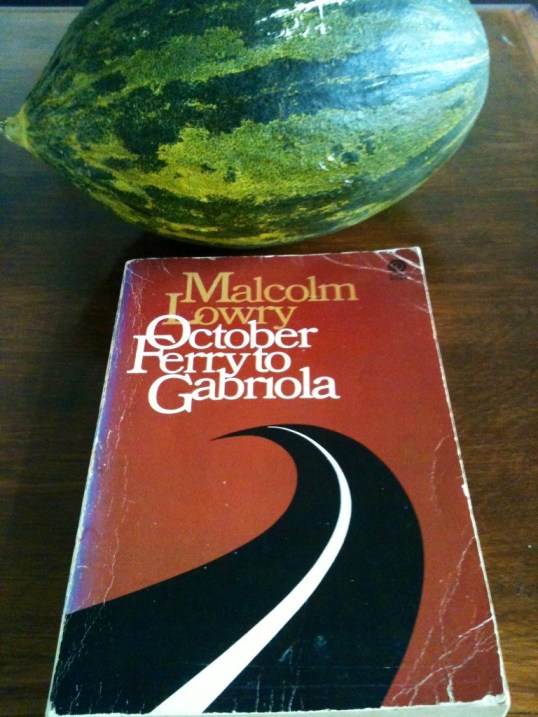
Malcolm Lowry’s last novel, the posthumously published October Ferry to Gabriola. Kind of a hideous cover.

20120418-144816.jpg

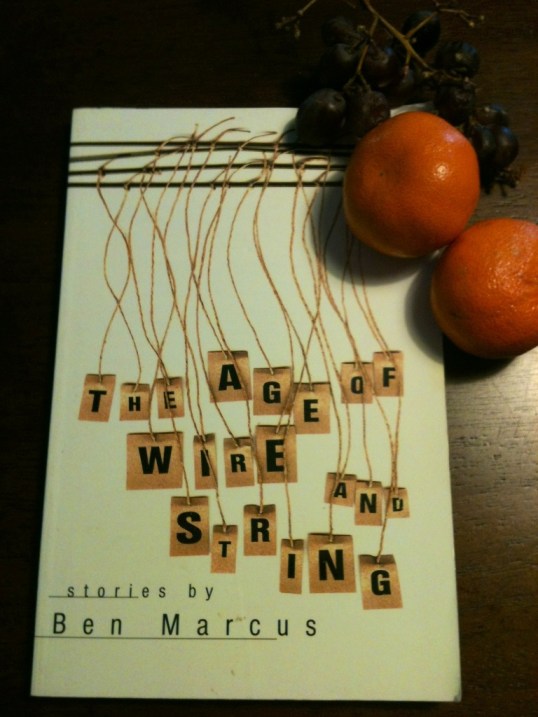
 I was looking for something by David Markson (no dice) when I came across The Age of Wire and String by Ben Marcus; I’ve been meaning to check out Marcus’s stuff, and a few minutes with the volume sold me—short vignettes, sort of like Lydia Davis or DFW or Dennis Cooper or William Burroughs (but probably not; I’m just using these as a short hand reference).

Book Shelves #11, 3.11.2012

20120310-192648.jpg

Book shelves series #11, eleventh Sunday of 2012. DeLillo, Denis Johnson, Pynchon (no, I have not read Against the Day nor finished Mason & Dixon). There’s also a hardback copy of Bolaño’s Between Parentheses; I have an ARC of the same shelved with the other Bolaños, which are on the shelf under—but the finished copy won’t fit on the shelf and it fits here. For now.

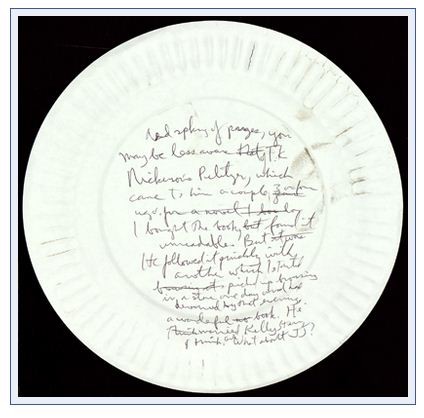
Denis Johnson’s Notes for The Name of the World, as Recorded on a Paper Plate

“Quickly Aging Here” — A Poem by Denis Johnson

“Quickly Aging Here,” a poem by Denis Johnson—

1


nothing to drink in
the refrigerator but juice from
the pickles come back
long dead, or thin
catsup. i feel i am old


now, though surely i
am young enough? i feel that i have had
winters, too many heaped cold


and dry as reptiles into my slack skin.
i am not the kind to win
and win.
no i am not that kind, i can hear


my wife yelling, “goddamnit, quit
running over,” talking to
the stove, yelling, “i
mean it, just stop,” and i am old and
2


i wonder about everything: birds
clamber south, your car
kaputs in a blazing, dusty
nowhere, things happen, and constantly you


wish for your slight home, for
your wife’s rusted
voice slamming around the kitchen. so few


of us wonder why
we crowded, as strange,
monstrous bodies, blindly into one
another till the bed


choked, and our range
of impossible maneuvers was gone,
but isn’t it because by dissolving like so
much dust into the sheets we are crowding


south, into the kitchen, into
nowhere?

Read the Opening Paragraphs of Denis Johnson’s Forthcoming Novella Train Dreams

The opening paragraphs of Denis Johnson’s forthcoming novella Train Dreams (via)—

In the summer of 1917 Robert Grainier took part in an attempt on the life of a Chinese laborer caught, or anyway accused of, stealing from the company stores of the Spokane International Railway in the Idaho Panhandle.

Three of the railroad gang put the thief under restraint and dragged him up the long bank toward the bridge under construction fifty feet above the MoyeaRiver. A rapid singsong streamed from the Chinaman voluminously. He shipped and twisted like a weasel in a sack, lashing backward with his one free fist at the man lugging him by the neck. As this group passed him, Grainier, seeing them in some distress, lent assistance and found himself holding one of the culprit’s bare feet. The man facing him, Mr. Sears, of Spokane International’smanagement, held the prisoner almost uselessly by the armpit and was the only one of them, besides the incomprehensible Chinaman, to talk during the hardest part of their labors: “Boys, I’m damned if we ever see the top of this heap!” Then we’re hauling him all the way? was the question Grainier wished to ask, but he thought it better to save his breath for the struggle. Sears laughed once, his face pale with fatigue and horror. They all went down in the dust and got righted, went down again, the Chinaman speaking in tongues and terrifying the four of them to the point that whatever they may have had in mind at the outset, he was a deader now. Nothing would do but to toss him off the trestle.

They came abreast of the others, a gang of a dozen men pausing in the sun to lean on their tools and wipe at sweat and watch this thing. Grainier held on convulsively to the Chinaman’s horny foot, wondering at himself, and the man with the other foot let loose and sat down gasping in the dirt and got himself kicked in the eye before Grainier took charge of the free-flailing limb. “It was just for fun. For fun,” the man sitting in the dirt said, and to his confederate there he said, “Come on, Jel Toomis, let’s give it up.” “I can’t let loose,” this Mr. Toomis said, “I’m the one’s got him by the neck!” and laughed with a gust of confusion passing across his features. “Well, I’ve got him!” Grainier said, catching both the little demon’s feet tighter in his embrace. “I’ve got the bastard, and I’m your man!”

The party of executioners got to the midst of the last completed span, sixty feet above the rapids, and made every effort to toss the Chinaman over. But he bested them by clinging to their arms and legs, weeping his gibberish, until suddenly he let go and grabbed the beam beneath him with one hand. He kicked free of his captors easily, as they were trying to shed themselves of him anyway, and went over the side, dangling over the gorge and making hand-over-hand out over the river on the skeleton form of the next span. Mr. Toomis’s companion rushed over now, balancing on a beam, kicking at the fellow’s fingers. The Chinaman dropped from beam to beam like a circus artist downward along the crosshatch structure. A couple of the work gang cheered his escape, while others, though not quite certain why he was being chased, shouted that the villain ought to be stopped. Mr. Sears removed from the holster on his belt a large old four-shot black-powder revolver and took his four, to no effect. By then the Chinaman had vanished.

“Surreptitious Kissing” — Denis Johnson

“Surreptitious Kissing,” a poem by Denis Johnson

I want to say that
forgiveness keeps on

dividing, that hope
gives issue to hope,

and more, but of course I
am saying what is

said when in this dark
hallway one encounters

you, and paws and
assaults you—love

affairs, fast lies—and you
say it back and we

blunder deeper, as would
any pair of loosed

marionettes, any couple
of cadavers cut lately

from the scaffold,
in the secluded hallways

of whatever is
holding us up now.

Venus Drive — Sam Lipsyte

[Editorial note: Biblioklept ran a version of this review last year; we run it again in the spirit of Sam Lipsyte Week].

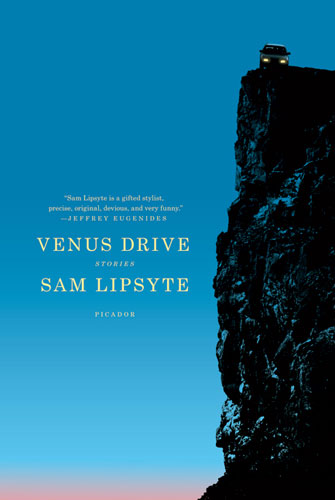
The thirteen stories in Venus Drive compose a sort of novel-in-stories. The title of the collection takes its name from a banal suburban street mentioned in a few of the stories, and many of the characters seem like iterations of the same type or voice. There are washed up would-be indie rock stars, small-time coke peddlers, and underemployed and overeducated addicts. There are deviants and perverts and outsiders. There are bullies. There are dead or dying mothers, dead or dying sisters. In short, Venus Drive is its own tightly-drawn, tightly-coiled, and highly-compressed world.

As the plot points double and re-double in these stories, so do the themes. “Our culture is afraid of death, and considers it something we must wage battle against,” says Tessa, a pain specialist, a peripheral character in “Cremains.” She continues: “I say, surrender, submit. Go gentle. Terminal means terminal.” Death informs almost all of these stories in some way, and Tessa’s commentary presents the problem with death, or at least the problem these characters have with dealing with death: it’s not easy to go gentle. It goes against our culture and our nature to surrender. If she’s presented as a voice of wisdom, she’s also an ironic character, one of the many would-be authorities Lipsyte’s weirdos and outsiders can’t help but mock. “The Drury Girl,” part-suburban satire and pure pathos, posits a pre-pubescent narrator obsessed with his teenage babysitter; his dad’s cancer plays second fiddle to his lust. Thus the story neatly ties together the overarching themes of Venus Drive, sex and death. Admittedly, these are probably the only real themes of proper literature, but Lipsyte does it so damn well and lays it all out so bare and does so in such humor and grace that it really sticks. It’s good stuff.

That humor is desert-dry, of course, and succeeds so well because his characters are so endearing in their pathetic pathologies. The antiheroes of “Beautiful Game” and “My Life, for Promotional Use Only,” are also-rans in the sordid history of underground rock, addicts approaching washed-up (Are they the same person? Maybe. They have different names, of course. Doesn’t matter). A scene from “Beautiful Game” shows the ambivalence at the core of many of these characters: “At the bank machine, Gary doesn’t check the balance. Better to leave it to the gods. Someday the bank machine will shun him. Why know when?” Gene, the ex-rocker in “My Life, for Promotional Use Only” now suffers the indignities of working for his ex-girlfriend. Everyone in the story is an ex-something, everyone is growing up and leaving art (or is it “Art”?) behind. In a poignant and funny and cruel scene, familiar to many of us, Gene sees some of himself in a waitress:

Rosalie calls over the waitress and they talk for a while about somebody’s new art gallery. The waitress is famous for a piece where she served the Bloody Marys mixed with her menstrual blood. Word had it she overdid the tabasco.

I wait for the moment when our waitress stops being a notorious transgressor of social mores and becomes a waitress again, look for it in her eyes, that sad blink, and order a beer.

Gene, a former “notorious transgressor of social mores” himself feels both sorrow and hate for the waitress. He sees her job as menial and pathetic — just like his own. He doesn’t seem to think much of her art, either. Lipsyte telegraphs so much there with so few words, his sentences clean, spare, precise, and rarely of the compound variety. There’s a truncated, clipped rhythm that Lipsyte builds over the thirteen-story run that helps propel the immediacy of his tales. The stories are short, too; the longest is sixteen pages and most run to eight or ten. Lipsyte’s rhetorical gift is to shine the grubby and, at times, his sentences can feel almost too perfect, too-fussed over–but this (minor) complaint, it must be noted, comes from someone who admires occasional ambiguity or incoherence. Lipsyte removes his own authorial voice and thus achieves lucidity in his characters’ voices; somehow, though — and paradoxically — these voices bear the ghostly trace of his absence. But that seems like a silly conversation, and certainly not one for this post.

Venus Drive reminds me very much of one of my favorite books, Denis Johnson’s Jesus’ Son, which I would also call a novel-in-stories, also a spare and precise collection, also a study of weirdos and addicts and outsiders. Jesus’ Son is something of a standard in creative writing workshops (or at least it used to be) and a sensible teacher would add Venus Drive to her syllabus as well. Finally, like Jesus’ Son, Lipsyte’s book is seething, funny, and poignant, with characters tipped toward some redemption, awful or otherwise, for all their myriad sins. The book might take its name from a geographic location, but the “Venus drive” is also a spiritual inclination toward love and hope. Highly recommended.

Venus Drive is available in trade paperback from Picador.

“The White Fires of Venus” — Denis Johnson

“The White Fires of Venus” by Denis Johnson

We mourn this senseless planet of regret,
droughts, rust, rain, cadavers
that can’t tell us, but I promise
you one day the white fires
of Venus shall rage: the dead,
feeling that power, shall be lifted, and each
of us will have his resurrected one to tell him,
“Greetings. You will recover
or die. The simple cure
for everything is to destroy
all the stethoscopes that will transmit
silence occasionally. The remedy for loneliness
is in learning to admit
solitude as one admits
the bayonet: gracefully,
now that already
it pierces the heart.
Living one: you move among many
dancers and don’t know which
you are the shadow of;
you want to kiss your own face in the mirror
but do not approach,
knowing you must not touch one
like that. Living
one, while Venus flares
O set the cereal afire,
O the refrigerator harboring things
that live on into death unchanged.”

They know all about us on Andromeda,
they peek at us, they see us
in this world illumined and pasteled
phonily like a bus station,
they are with us when the streets fall down fraught
with laundromats and each of us
closes himself in his small
San Francisco without recourse.
They see you with your face of fingerprints
carrying your instructions in gloved hands
trying to touch things, and know you
for one despairing, trying to touch the curtains,
trying to get your reflection mired in alarm tape
past the window of this then that dark
closed business establishment.
The Andromedans hear your voice like distant amusement park music
converged on by ambulance sirens
and they understand everything.
They’re on your side. They forgive you.

I want to turn for a moment to those my heart loves,
who are as diamonds to the Andromedans,
who shimmer for them, lovely and useless, like diamonds:
namely, those who take their meals at soda fountains,
their expressions lodged among the drugs
and sunglasses, each gazing down too long
into the coffee as though from a ruined balcony.
O Andromedans they don’t know what to do
with themselves and so they sit there
until they go home where they lie down
until they get up, and you beyond the light years know
that if sleeping is dying, then waking
is birth, and a life
is many lives. I love them because they know how
to manipulate change
in the pockets musically, these whose faces the seasons
never give a kiss, these
who are always courteous to the faces
of presumptions, the presuming streets,
the hotels, the presumption of rain in the streets.
I’m telling you it’s cold inside the body that is not the body,
lonesome behind the face
that is certainly not the face
of the person one meant to become.

“A Poem About Baseballs” — Denis Johnson

“A Poem About Baseballs” by Denis Johnson–

for years the scenes bustled
through him as he dreamed he was
alive. then he felt real, and slammed
awake in the wet sheets screaming
too fast, everything moves

too fast, and the edges of things

are gone. four blocks away
a baseball was a dot against
the sky, and he thought, my
glove is too big, i will
drop the ball and it will be
a home run. the snow falls

too fast from the clouds,
and night is dropped and
snatched back like a huge

joke. is that the ball, or is
it just a bird, and the ball is
somewhere else, and i will
miss it? and the edges are gone, my

hands melt into the walls, my
hands do not end where the wall

begins. should i move
forward, or back, or will the ball
come right to me? i know i will
miss, because i always miss when it
takes so long. the wall has no

surface, no edge, the wall
fades into the air and the air is
my hand, and i am the wall. my
arm is the syringe and thus i
become the nurse, i am you,

nurse. if he gets
around the bases before the
ball comes down, is it a home
run, even if i catch it? if we could

slow down, and stop, we
would be one fused mass careening
at too great a speed through

the emptiness. if i catch
the ball, our side will
be up, and i will have to bat,
and i might strike out.


“The Starlight on Idaho” — Denis Johnson

“The Boarding” — Denis Johnson

“The Boarding” by Denis Johnson–

One of these days under the white
clouds onto the white
lines of the goddamn PED
X-ING I shall be flattened,
and I shall spill my bag of discount
medicines upon the avenue,
and an abruptly materializing bouquet
of bums, retirees, and Mexican
street-gangers will see all what
kinds of diseases are enjoying me
and what kind of underwear and my little
old lady’s legs spidery with veins.
So Mr. Young and Lovely Negro Bus
Driver I care exactly this: zero,
that you see these things
now as I fling my shopping
up by your seat, putting
this left-hand foot way up
on the step so this dress rides up,
grabbing this metal pole like
a beam of silver falling down
from Heaven to my aid, thank-you,
hollering, “Watch det my medicine
one second for me will you dolling,
I’m four feet and det’s a tall bus
you got and it’s hot and I got
every disease they are making
these days, my God, Jesus Christ,
I’m telling you out of my soul.”


The Best Books We Read in 2010 That Were Published Before 2010

The best books that we read in 2010 that were published before 2010:

Nazi Literature in the Americas by Roberto Bolaño (2008, English translation) — Bolaño’s fake encyclopedia of right-wing writers is a tragicomic crash course in misanthropy, failure, and fated violence. Francisco Goldman’s blurb on the back of the book is spot on–the book is a “key cosmology to Bolaño’s literary universe.” Nazi Literature is like an index for the Bolañoverse–creepy, steeped in dread, deeply, caustically funny, and bitterly poignant.

Butterfly Stories by William T. Vollmann (1993) Adventures in the Southeast Asian sex trade. Bleakly funny, often depressing, and filled with erudite asides on Nobel prizewinners, transvestites, and the benefits of whiskey and benadryl. Plenty of grotesque sex. Not for everyone. In fact, not for most people.

The Friends of Eddie Coyle by George V. Higgins (1970) — Higgins throws his audience into the deep end of gritty urban Boston on the wrong side of the sixties in this crime noir classic. There’s little exposition to spell out Coyle’s intricate and fast-paced plot, but there is plenty of machine-gun dialogue, rendered very true and very raw. Higgins trusts the reader to sort out the complex relationships between hustlers and dupes, cops and finks from their conversations alone. The imagery is straight out of a Scorcese film, and like that director, Higgins has a wonderful gift for showing his audience action without getting in the way.

Home Land (2004) and Venus Drive (2000) by Sam Lipsyte — Is there a better stylist working today than Lipsyte? Does anyone write better sentences? Of course, sentences alone don’t matter much if you don’t have a story worth telling, and both Homeland and Venus Drive deliver. They are seething, funny, poignant books, with characters tipped toward some redemption, awful or otherwise, despite their myriad sins.

Steps by Jerzy Kosinski (1968) — One of the many small vignettes that comprise Steps begins with the narrator going to a zoo to see an octopus that is slowly killing itself by consuming its own tentacles. The piece ends with the same narrator discovering that a woman he’s picked up off the street is actually a man. In between, he experiences sexual frustration with a rich married woman. The piece is less than three pages long. You will either hate or love this book.

Cloud Atlas (2004) and Black Swan Green (2006) by David MitchellCloud Atlas is a postmodern puzzle piece of six nested narratives (each a smart take on some kind of genre fiction), informed by Nietzsche’s idea of eternal recurrence; Black Swan Green (which for some reason we forgot to review here) is a funny and heartwarming coming-of-age story of a boy who copes with his terrible stutter and his parents’ crumbling marriage in early 1980’s England. The books have little in common save their brilliance–which seems kinda sorta unfair. It also seems unfair that Mitchell put them out so quickly. Damn him.

Angels by Denis Johnson (1983) — Angels begins as a small book about not very much and ends as a small book about pretty much everything. Johnson has a keen eye and keener ear for the kinds of marginal characters many of us would rather overlook all together, people who live and sweat and suffer in the most wretched, unglamorous, and anti-heroic vistas of a decayed America. The great achievement of the novel (beyond Johnson’s artful sentences) is in staging redemption for a few–not all, but a few–of its hopeless anti-heroes.

Suttree by Cormac McCarthy (1979) — A beautiful, rambling riff on American literature — Suttree picks up on Emerson and Twain, Faulkner and Whitman, and flows into a new, wild territory that is pure McCarthy. Is it his best novel? Could be. Read it.