“I don’t know why Against the Day hasn’t been banned” | Ishmael Reed on Thomas Pynchon

I don’t know why Against the Day hasn’t been banned. In one of the most remarkable scenes penned by an American writer, Pynchon cites events that the anti-woke crowd would want deleted. Referring to the Blacks and Filipinos, Mexicans and hillbillies who are present in that scene, the character Lew Basnight “gradually understood that what everybody here had in common was having survived some cataclysm none of them spoke about directly — a bombing, a massacre perhaps at the behest of the U.S. government.” Those with prominent media megaphones today are denying that such cataclysms took place.

Ishmael Reed on one of his favorite Thomas Pynchon novels. The extract is from a piece in The New York Times on different writers and artists sharing their “favorite pinch of Pynchon.” William Gibson’s riff is especially nice too–he singles out Father Rapier’s sermon on They/we systems in Gravity’s Rainbow. Don DeLillo contributes a loose haiku. I didn’t read the remarks of Homer and Lisa Simpson.

The spectator, at this point, is certain to wonder whether he must now endure a football game in print | Don DeLillo

(The spectator, at this point, is certain to wonder whether he must now endure a football game in print — the author’s way of adding his own neat quarter-notch to the scarred bluesteel of combat writing. The game, after all, is known for its assault-technology motif, and numerous commentators have been willing to risk death by analogy in their public discussions of the resemblance between football and war. But this sort of thing is of little interest to the exemplary spectator. As Alan Zapalac says later on: “I reject the notion of football as warfare. Warfare is warfare. We don’t need substitutes because we’ve got the real thing.” The exemplary spectator is the person who understands that sport is a benign illusion, the illusion that order is possible. It’s a form of society that is rat free and without harm to the unborn; that is organized so that everyone follows precisely the same rules; that is electronically controlled, thus reducing human error and benefiting industry; that roots out the inefficient and penalizes the guilty; that tends always to move toward perfection. The exemplary spectator has his occasional lusts, but not for warfare, hardly at all for that. No, it’s details he needs — impressions, colors, statistics, patterns, mysteries, numbers, idioms, symbols. Football, more than other sports, fulfills this need. It is the one sport guided by language, by the word signal, the snap number, the color code, the play name. The spectator’s pleasure, when not derived from the action itself, evolves from a notion of the game’s unique organic nature. Here is not just order but civilization. And part of the spectator’s need is to sort the many levels of material: to allot, to compress, to catalogue. This need leaps from season to season, devouring much of what is passionate and serene in the spectator. He tries not to panic at the final game’s final gun. He knows he must retain something, squirrel some food for summer’s winter. He feels the tender need to survive the termination of the replay. So maybe what follows is a form of sustenance, a game on paper to be scanned when there are stale days between events; to be propped up and looked at — the book as television set — for whatever is in here of terminology, pattern, numbering. But maybe not. It’s possible there are deeper reasons to attempt a play-by-play. The best course is for the spectator to continue forward, reading himself into the very middle of that benign illusion. The author, always somewhat corrupt in his inventions and vanities, has tried to reduce the contest to basic units of language and action. Every beginning, it is assumed, must have a neon twinkle of danger about it, and so grandmothers, sissies, lepidopterists and others are warned that the nomenclature that follows is often indecipherable. This is not the pity it may seem. Much of the appeal of sport derives from its dependence on elegant gibberish. And of course it remains the author’s permanent duty to unbox the lexicon for all eyes to see — a cryptic ticking mechanism in search of a revolution.)

From Don DeLillo’s 1972 novel End Zone.

Books acquired, 26 Jan. 2024

Last Friday, I drove across a bridge to a library on the other side of the city for a Friends of the Library sale. I was hoping for a nice leisurely afternoon browse, figured I’d find a few titles worth my efforts, and I’d fill out the 10 dollar brown paper grocery bag with books I could trade for store credit elsewhere. I ended up filling the bag almost immediately, mostly with heavy hardbacks, resulting in my weak arm quickly settling into a painful fatigue that killed my browsing vibe.

Here are the books I picked up:

–A paperback copy of Thomas S. Klise’s cult classic The Last Western. It was in the “nonfiction” section, which I didn’t really browse that studiously, but its cover nevertheless stood out to me. I bought a copy of it from an online used bookseller online six years ago (and was very disappointed that the seller had appended a retail barcode sticker to its cover).

–A paperback omnibus of Salem Kirban’s early seventies “prophecy” apocalypse novels 666 and its sequel 1000. I’d thumbed through a worn copy of 666 sometime last year—the title of and its cracked spine calling to me from the shelf of the sci-fi section. Kirban’s “novel” is a millennialist screed conveyed in a tawdry postmodern manner, and it didn’t seem worth the eight bucks the used bookstore was asking at the time—but I didn’t mind snuggling it into the paper bag last Friday, oddity that it is.

–A hardback copy of Don DeLillo’s novel Zero K. I skipped it when it came out, and I don’t think DeLillo’s done anything good since Point Omega.

–A hardback copy of John Barth’s novel Every Third Thought. I think that Barth’s best work is decades behind him, but every now and then I try something newer, and this 2011 novel is one of his shorter recentish efforts.

–A hardback copy of Leni Zumas’ novel Red Clocks. I had never heard of this book, but the spine enticed me enough to pick it up when I was browsing the “sci fi” section at the booksale, and the premise–America has outlawed and criminalized abortion–seemed depressingly dystopian enough to take it with me.

–A hardback copy of Sven Birkert’s collection of literary criticism, An Artificial Wilderness. Includes chapters on Thomas Bernhard, Umberto Eco, Borges, and “The School of Gordon Lish” among many, many others.

–A Vintage Contemporaries Edition of Raymond Carver’s Where I’m Calling From, a collection I have not read in over two decades.

–A hardback copy of Jesse Ball’s novel How to Set a Fire and Why. I liked his 2011 novel The Curfew, so maybe I’ll like this?

–A hardback copy of Jeanette Winterson’s novel Frankisstein; reviews of this 2019 novel intrigued me at the time it was published (and I do like a good Frankenstein riff).

–A hardback copy of Robert Coover’s novel Huck Out West. An amazing sequel to Twain’s novel; I reviewed it on this site years ago. This handsome edition shall replace the ugly advance copy I got years ago. I might need to revisit it in anticipation of Percival Everett’s take on Twain’s Huck’s Jim—James.

–A hardback copy of Lawrence Ferlinghetti’s late novel Little Boy, which The Guardian described as a “novel-cum-memoir-cum-grand finale.” (Too much cum, The Guardian.)

–A Library of America edition of The Complete Novels of Eudora Welty. I hate to admit what I will now admit: I love love love Welty’s short stories, but have never read one of her novels.

–A hardback copy of Walker Percy’s Thanatos Syndrome. Again, a late-period work by old master, likely not his finest stuff, but hey. I burned through his first four novels a few years ago—Lancelot was my favorite.

Don DeLillo’s chicken parts and brownies

  No one wanted to cook that night. We all got in the car and went out to the commercial strip in the no man’s land beyond the town boundary. The never-ending neon. I pulled in at a place that specialized in chicken parts and brownies. We decided to eat in the car. The car was sufficient for our needs. We wanted to eat, not look around at other people. We wanted to fill our stomachs and get it over with. We didn’t need light and space. We certainly didn’t need to face each other across a table as we ate, building a subtle and complex cross-network of signals and codes. We were content to eat facing in the same direction, looking only inches past our hands. There was a kind of rigor in this. Denise brought the food out to the car and distributed paper napkins. We settled in to eat. We ate fully dressed, in hats and heavy coats, without speaking, ripping into chicken parts with our hands and teeth. There was a mood of intense concentration, minds converging on a single compelling idea. I was surprised to find I was enormously hungry. I chewed and ate, looking only inches past my hands. This is how hunger shrinks the world. This is the edge of the observable universe of food. Steffie tore off the crisp skin of a breast and gave it to Heinrich. She never ate the skin. Babette sucked a bone. Heinrich traded wings with Denise, a large for a small. He thought small wings were tastier. People gave Babette their bones to clean and suck. … We sent Denise to get more food, waiting for her in silence. Then we started in again, half stunned by the dimensions of our pleasure.

From Don DeLillo’s novel White Noise.

RECENT HISTORY OF THE WORKERS OF THE WORLD | Don DeLillo

The day after that he experienced what at first he thought might be some variation of déjà vu. He’d finished lunch and stood at the door of a corner restaurant, able to see, at a severe angle, the lean elderly man who frequently appeared outside Federal Hall holding a hand-lettered political placard over his head for the benefit of those gathered on the steps. He, Lyle, was cleaning his fingernails, surreptitiously, using a toothpick he’d taken from a bowl near the cash register inside the restaurant. The paradox of material flowing backward toward itself. In this case there was no illusion involved. He had stood on this spot, not long ago, at this hour of the day, doing precisely what he was doing now, his eyes on the old man, whose body was aligned identically with the edge of a shadow on the façade of the building he faced, his sign held at the same angle, it seemed, the event converted into a dead replica by means of structural impregnation, the mineral replacement of earlier matter. Lyle decided to scatter the ingredients by heading directly toward the man instead of back to the Exchange, as he was certain he’d done the previous time. First he read the back of the sign, the part facing the street, recalling the general tenor. Then he sat on the steps, with roughly a dozen other people, and reached for his cigarettes. Burks was across the street, near the entrance to the Morgan Bank. People were drifting back to work. Lyle smoked a moment, then got up and approached the sign-holder. The strips of wood that steadied the edges of the sign extended six inches below it, giving the man a natural grip. Burks looked unhappy, arms folded across his chest.
“How long have you been doing this?” Lyle said. “Holding this sign?”

The man turned to see who was addressing him.

“Eighteen years.”

Sweat ran down his temples, trailing pale outlines on his flushed skin. He wore a suit but no tie. The life inside his eyes had dissolved. He’d made his own space, a world where people were carvings on rock. His right hand jerked briefly. He needed a haircut.

“Where, right here?”

“I moved to here.”

“Where were you before?”

“The White House.”

“You were in Washington.”

“They moved me out of there.”

“Who moved you out?”

“Haldeman and Ehrlichman.”

“They wouldn’t let you stand outside the gate.”

“The banks sent word.”

Lyle wasn’t sure why he’d paused here, talking to this man. Dimly he perceived a strategy. Perhaps he wanted to annoy Burks, who obviously was waiting to talk to him. Putting Burks off to converse with a theoretical enemy of the state pleased him. Another man moved into his line of sight, middle-aged and heavy, a drooping suit, incongruous pair of glasses—modish and overdesigned. Lyle turned, noting Burks had disappeared.

“Why do you hold the sign over your head?”

“People today.”

“They want to be dazzled.”

“There you are.”

Lyle wasn’t sure what to do next. Best wait for one of the others to move first. He took a step back in order to study the front of the man’s sign, which he’d never actually read until now.

RECENT HISTORY

OF THE WORKERS OF THE WORLD

CIRCA 1850–1920 Workers hands cut off on Congo rubber plantations, not meeting work quotas. Photos in vault Bank of England. Rise of capitalism.

THE INDUSTRIAL AGE Child labor, accidents, death. Cruelty = profits. Workers slums Glasgow, New York, London. Poverty, disease, separation of family. Strikes, boycotts, etc. = troops, police, injunctions. Bitter harvest of Ind. Revolution.

MAY 1886 Haymarket Riot, Chicago, protest police killings of workers, 10 dead, 50 injured, bomb blast, firing into crowd.

SEPT 1920 Wall St. blast, person or persons unknown, 40 dead, 300 injured, marks remain on wall of J. P. Morgan Bldg. Grim reminder.

FEB 1934 Artillery fire, Vienna, shelling of workers homes, 1,000 dead inc. 9 Socialist leaders by hanging/strangulation. Rise of Nazis. Eve of World War, etc.

There was more in smaller print fitted onto the bottom of the sign. The overweight man, wilted, handkerchief in hand, was standing five feet away. Lyle, stepping off the sidewalk, touched the old man, the sign-holder, as he walked behind him, putting a hand on the worn cloth that covered his shoulder, briefly, a gesture he didn’t understand. Then he accompanied the other man down to Bowling Green, where they sat on a bench near a woman feeding pigeons.

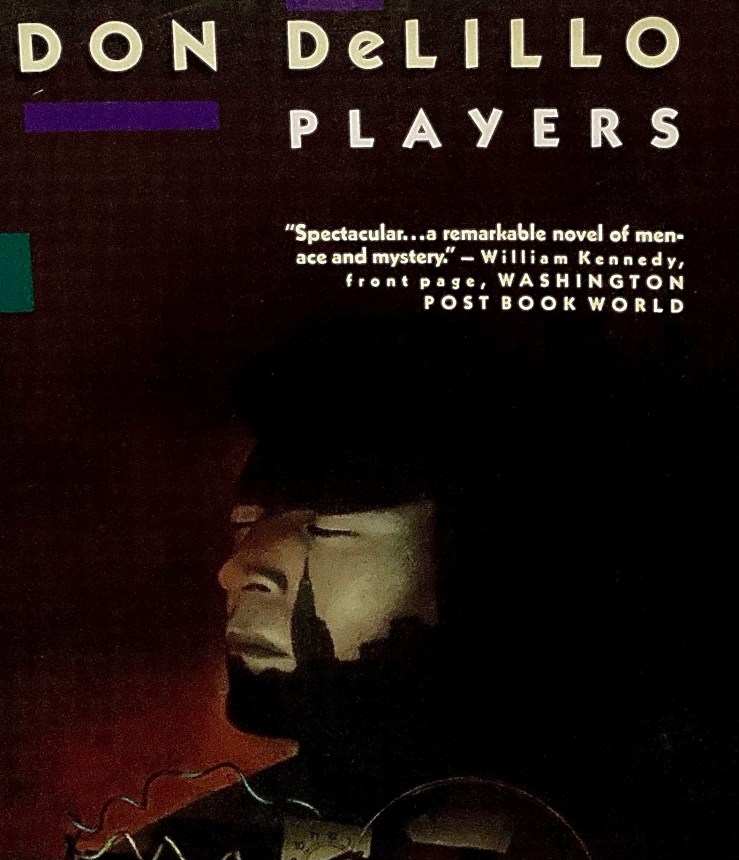
From Don DeLillo’s novel Players.

RECENT HISTORY OF THE WORKERS OF THE WORLD | Don DeLillo

The day after that he experienced what at first he thought might be some variation of déjà vu. He’d finished lunch and stood at the door of a corner restaurant, able to see, at a severe angle, the lean elderly man who frequently appeared outside Federal Hall holding a hand-lettered political placard over his head for the benefit of those gathered on the steps. He, Lyle, was cleaning his fingernails, surreptitiously, using a toothpick he’d taken from a bowl near the cash register inside the restaurant. The paradox of material flowing backward toward itself. In this case there was no illusion involved. He had stood on this spot, not long ago, at this hour of the day, doing precisely what he was doing now, his eyes on the old man, whose body was aligned identically with the edge of a shadow on the façade of the building he faced, his sign held at the same angle, it seemed, the event converted into a dead replica by means of structural impregnation, the mineral replacement of earlier matter. Lyle decided to scatter the ingredients by heading directly toward the man instead of back to the Exchange, as he was certain he’d done the previous time. First he read the back of the sign, the part facing the street, recalling the general tenor. Then he sat on the steps, with roughly a dozen other people, and reached for his cigarettes. Burks was across the street, near the entrance to the Morgan Bank. People were drifting back to work. Lyle smoked a moment, then got up and approached the sign-holder. The strips of wood that steadied the edges of the sign extended six inches below it, giving the man a natural grip. Burks looked unhappy, arms folded across his chest.
“How long have you been doing this?” Lyle said. “Holding this sign?”

The man turned to see who was addressing him.

“Eighteen years.”

Sweat ran down his temples, trailing pale outlines on his flushed skin. He wore a suit but no tie. The life inside his eyes had dissolved. He’d made his own space, a world where people were carvings on rock. His right hand jerked briefly. He needed a haircut.

“Where, right here?”

“I moved to here.”

“Where were you before?”

“The White House.”

“You were in Washington.”

“They moved me out of there.”

“Who moved you out?”

“Haldeman and Ehrlichman.”

“They wouldn’t let you stand outside the gate.”

“The banks sent word.”

Lyle wasn’t sure why he’d paused here, talking to this man. Dimly he perceived a strategy. Perhaps he wanted to annoy Burks, who obviously was waiting to talk to him. Putting Burks off to converse with a theoretical enemy of the state pleased him. Another man moved into his line of sight, middle-aged and heavy, a drooping suit, incongruous pair of glasses—modish and overdesigned. Lyle turned, noting Burks had disappeared.

“Why do you hold the sign over your head?”

“People today.”

“They want to be dazzled.”

“There you are.”

Lyle wasn’t sure what to do next. Best wait for one of the others to move first. He took a step back in order to study the front of the man’s sign, which he’d never actually read until now.

RECENT HISTORY

OF THE WORKERS OF THE WORLD

CIRCA 1850–1920 Workers hands cut off on Congo rubber plantations, not meeting work quotas. Photos in vault Bank of England. Rise of capitalism.

THE INDUSTRIAL AGE Child labor, accidents, death. Cruelty = profits. Workers slums Glasgow, New York, London. Poverty, disease, separation of family. Strikes, boycotts, etc. = troops, police, injunctions. Bitter harvest of Ind. Revolution.

MAY 1886 Haymarket Riot, Chicago, protest police killings of workers, 10 dead, 50 injured, bomb blast, firing into crowd.

SEPT 1920 Wall St. blast, person or persons unknown, 40 dead, 300 injured, marks remain on wall of J. P. Morgan Bldg. Grim reminder.

FEB 1934 Artillery fire, Vienna, shelling of workers homes, 1,000 dead inc. 9 Socialist leaders by hanging/strangulation. Rise of Nazis. Eve of World War, etc.

There was more in smaller print fitted onto the bottom of the sign. The overweight man, wilted, handkerchief in hand, was standing five feet away. Lyle, stepping off the sidewalk, touched the old man, the sign-holder, as he walked behind him, putting a hand on the worn cloth that covered his shoulder, briefly, a gesture he didn’t understand. Then he accompanied the other man down to Bowling Green, where they sat on a bench near a woman feeding pigeons.

From Don DeLillo’s novel Players.

More evil than we’d imagined | From Don DeLillo’s novel Players

Our big problem in the past, as a nation, was that we didn’t give our government credit for being the totally entangling force that it was. They were even more evil than we’d imagined. More evil and much more interesting. Assassination, blackmail, torture, enormous improbable intrigues. All these convolutions and relationships. Assorted sexual episodes. Terribly, terribly interesting, all of it. Cameras, microphones, so forth. We thought they bombed villages, killed children, for the sake of technology, so it could shake itself out, and for certain abstractions. We didn’t give them credit for the rest of it. Behind every stark fact we encounter layers of ambiguity. This is all so alien to the liberal spirit. It’s a wonder they’re bearing up at all. This haze of conspiracies and multiple interpretations. So much for the great instructing vision of the federal government.

From Don DeLillo’s novel Players.

“The Movie” — Don DeLillo

“The Movie”

the overture for the novel Players

by Don DeLillo


Someone says: “Motels. I like motels. I wish I owned a chain, worldwide. I’d like to go from one to another to another. There’s something self-realizing about that.”

The lights inside the aircraft go dim. In the piano bar everyone is momentarily still. It’s as though they’re realizing for the first time how many systems of mechanical and electric components, what exact management of stresses, power units, consolidated thrust and energy it has taken to reduce their sensation of flight to this rudimentary tremble. Beyond the windows not a nuance of sunset remains. Four men, three women inhabit this particular frame of arrested motion. The only sound is drone. One second of darkness, all we’ve had thus far, has been enough to intensify the implied bond which, more than distance, speed or destination, makes each journey something of a mystery to be worked out by the combined talents of the travelers, all gradually aware of each other’s code of recognition. In the cabin just ahead, the meal is over, the movie is about to begin.

As light returns, the man seated at the piano begins to play a tune. Standing nearby is a woman, shy of thirty, light-haired and unhappy about flying. There’s a man to her left, holding the rim of his drinking glass against his lower lip. They’re clearly together, a couple, wearing each other.

The stewardess moves past with pillows and magazines, glancing into the cabin at the movie screen, credits super-imposed on a still image of a deserted golf course, early light. Near the entrance to the piano bar, about a dozen feet from the piano itself, are two chairs separated by an ashtray stand. Another obvious couple sits here, men in this case. Both look at the piano player, anticipating their own delight at whatever pointed comment his choice of tunes is meant to suggest.

The third woman sits near the rear of the compartment. She pops cashew nuts into her mouth and washes them down with ginger ale. She’s in her early forties, indifferently dressed. We know nothing else about her. Continue reading ““The Movie” — Don DeLillo”

DeLillo has since stayed small

Michael Gorra has a thoughtful essay on Don DeLillo’s late style in the latest issue of The New York Review of Books. Ostensibly a review of DeLillo’s latest, The Silence, Gorra’s essay considers DeLillo’s body of work against some of his peers and literary forebears, arguing that DeLillo’s finest novels were composed and published in his “full middle age”:

The core of DeLillo’s oeuvre is the series of five novels that began with The Names (1982) and ended with Underworld; the intervening volumes are White NoiseLibra, and Mao II (1991). Those books look permanent, with the last of them a summa; his early books in contrast seem preparatory, though they each have their admirers. To put it another way, DeLillo was born in 1936, and what matters are the novels he wrote in full middle age, with Underworld appearing when he was sixty. Dickens was dead by that age, Balzac too, but DeLillo has had a third act in the six short books he has written in the new century. These novels rarely take age itself as their topic, as both Saul Bellow and Philip Roth did in their own late work; yet still they are the product of age.

Gorra then points out that “DeLillo’s recent books are significantly different from the great novels of his middle age, and that difference is worth thinking about.” Gorra continues:

…after Underworld his sense of novelistic form, of what he needs to make a narrative, did change. Probably there was no good way to follow that novel, with its distorting size and scope, a book that began with Frank Sinatra and ended with the disposal of nuclear waste. How could one compete with that—compete with oneself? DeLillo wisely didn’t try. There would be no new plateaus, no arc of increasing achievement. Underworld’s successor, The Body Artist (2001), was deliberately slight, a novella-length exploration of the uncanny that makes me think of “Bartleby, the Scrivener.” It was as if a composer who’d only written symphonies had suddenly switched to a tinny atonal song, and DeLillo has since stayed small. His late books have been at most a quarter of Underworld’s length, with The Silence the shortest of them, and always with fewer characters and a more sharply limited focus.

There’s a thorough and very generous review of The Silence embedded in Gorra’s essay—he’s far, far more generous than I was toward the book (at one point Gorra attests that he “can’t tell the difference between a few randomly chosen sentences from his recent work and a passage from Libra. Reader, there’s a difference). And while his phrase “DeLillo has since stayed small” is not overtly pejorative, I think it nevertheless captures the general sense that DeLillo’s late works—or late style—simply does not meet the quality of his work in the eighties and nineties. (Gorra admits that “Cosmopolis seems to me almost unreadable” — I concur.)

Others have found crystalline beauty in DeLillo’s late work, and in The Silence in particular. I found it a depressing read, not for its content necessarily—okay, maybe for its content, but also for its form, its prose. I concur with the first sentence of Gorra’s conclusion, but not with the second:

Some pages in this book verge on self-parody, and I doubt it will draw any readers who haven’t already invested themselves in DeLillo’s work, in the half-century of risks his voice has taken. But those of us who have will find something poignant and terrible in this strange unbroken silence.

Read Michael Gorra’s essay on DeLillo, “The Sense of an Ending,” here.

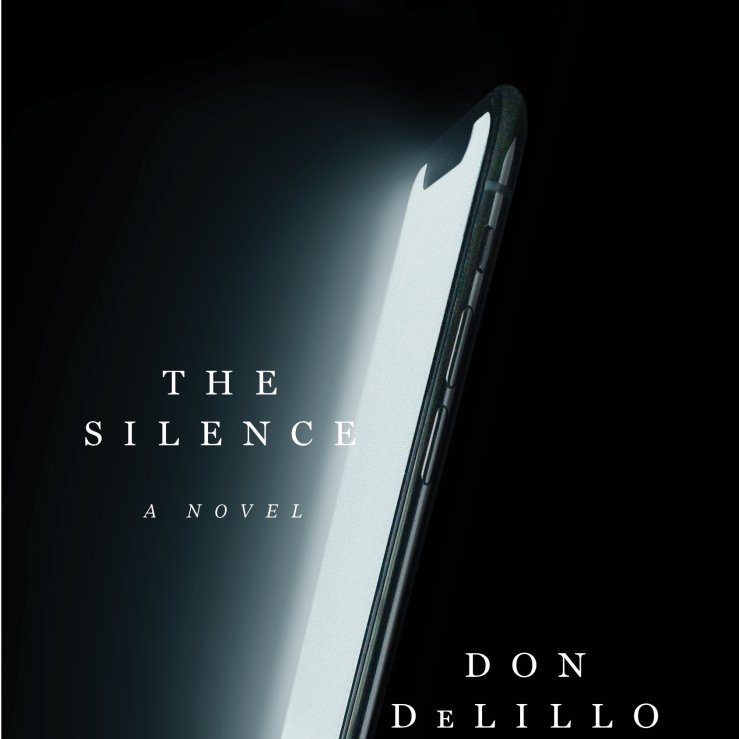
Don DeLillo’s new book The Silence is a slim disappointment

Don DeLillo’s latest fiction The Silence is set on Super Bowl Sunday in the year 2022. The story, such as it is, takes place over the course of a few hours, focusing primarily on five characters who gather in a New York apartment to watch the big game. The quintet is unable to see the game though because, for reasons unknown and never really explored, contemporary communication systems and technologies fail worldwide. No email, no internet, no teevee.

“Seemingly all screens have emptied out, everywhere. What remains for us to see, hear, feel?” the narrator—or maybe one of the characters—wonders. Other characters insist that what’s happening is the beginning of World War III (The Silence opens with Einstein’s famous quote about World War IV being fought with sticks and stones). “The drone wars,” another quips blankly, worrying—is he worrying?—that the “drones have become autonomous.”

We’re told of chaos, panic, and “small riots” in response to this unexplained failure of technology, but DeLillo doesn’t show us any of the pandemonium, let alone evoke much of a sense of anxiety about the titular silence. Instead, the book plods along a course of droll ennui and flat utterances that I suppose are meant to sound profound. “What if we are not what we think we are?” asks a character, and if DeLillo is pulling our leg with such banal dialogue, there’s little in The Silence to signal that the book is open to an ironic reading.

Instead we get blank references to Einstein, deep time, mass surveillance, and Jesus of Nazareth, as if these would-be motifs can signal meaning (or, like, lack of meaning, man!?) on their own. Characters repeat buzzwords; a dude riffs on microplastics; another treats his auditor to a pre-coital definition of capitalism. “The woman realizes she is still in the thrall of cryptocurrencies” is a real sentence in this book.

The rhetorical moves here have long been staples of DeLillo’s toolkit, but the verbal obliquity of The Silence feels anemic. The sentences are thin, the book is thin. The ideas don’t stick. Or rather, the insights that DeLillo offers here seem, well, obvious.

I used the verb plods a few paragraphs above, which doesn’t seem like the obvious choice for such a skinny book. I checked out an ebook of The Silence from my library and read it in about 75 minutes. (I am not a fast reader.) DeLillo’s publisher Scribner lists the hardback at 128 pages. I imagine the font must be huge and the margins pretty wide. What I read could’ve fit neatly into 40 or 50 pages of a mass-market paperback. (The hardback retails for twenty US dollars.) The American cover insists that The Silence is a novel, but it sure doesn’t read like one.

Despite its brevity, The Silence plods. For a book with a plane crash, a football game, casual sex, planet-wide panic, and the maybe-advent of WW III, The Silence is notably listless. Perhaps that’s by design, but if so it’s a design I didn’t care for.

Reviews and descriptions of DeLillo’s last novel Zero K (2016) deterred me from reading it, even though I liked its predecessor Point Omega (2010) more than many reviewers. I was intrigued by The Silence’s brevity, hopeful that DeLillo might pack the narrative with rich sentences and deep thoughts. I was hoping that he might bring some of the magic that we got in Pafko at the Wall (1992), a wonderful novella that DeLillo repurposed as the prologue for Underworld (1997).

But no. The Silence is a slim disappointment, a scant morality play whose thinly-sketched characters speak at (and not to) each other liked stoned undergrads. At least it’s short.

Read “Human Moments in World War III,” a sci-fi story by Don DeLillo

“Human Moments in World War III”

by

Don DeLillo


note about Vollmer. He no longer describes the earth as a library globe or a map that has come alive, as a cosmic eye staring into deep space. This last was his most ambitious fling at imagery. The war has changed the way he sees the earth. The earth is land and water, the dwelling place of mortal men, in elevated dictionary terms. He doesn’t see it any more (storm-spiralled, sea-bright, breathing heat and haze and colour) as an occasion for picturesque language, for easeful play or speculation.

At two hundred and twenty kilometres we see ship wakes and the larger airports. Icebergs, lightning bolts, sand-dunes. I point out lava flows and cold-core eddies. That silver ribbon off the Irish coast, I tell him, is an oil slick.

This is my third orbital mission, Vollmer’s first. He is an engineering genius, a communications and weapons genius, and maybe other kinds of genius as well. As mission specialist, I’m content to be in charge. (The word specialist, in the standard usage of Colorado Command, refers here to someone who does not specialize.) Our spacecraft is designed primarily to gather intelligence. The refinement of the quantum-burn technique enables us to make frequent adjustments of orbit without firing rockets every time. We swing out into high, wide trajectories, the whole earth as our psychic light, to inspect unmanned and possibly hostile satellites. We orbit tightly, snugly, take intimate looks at surface activities in untravelled places. The banning of nuclear weapons has made the world safe for war.

I try not to think big thoughts or submit to rambling abstractions. But the urge sometimes comes over me. Earth orbit puts men into philosophical temper. How can we help it? We see the planet complete, we have a privileged vista. In our attempts to be equal to the experience, we tend to meditate importantly on subjects like the human condition. It makes a man feel universal, floating over the continents, seeing the rim of the world, a line as clear as a compass arc, knowing it is just a turning of the bend to Atlantic twilight, to sediment plumes and kelp beds, an island chain glowing in the dusky sea.

I tell myself it is only scenery. I want to think of our life here as ordinary, as a housekeeping arrangement, an unlikely but workable setup caused by a housing shortage or spring floods in the valley.

Continue reading “Read “Human Moments in World War III,” a sci-fi story by Don DeLillo”

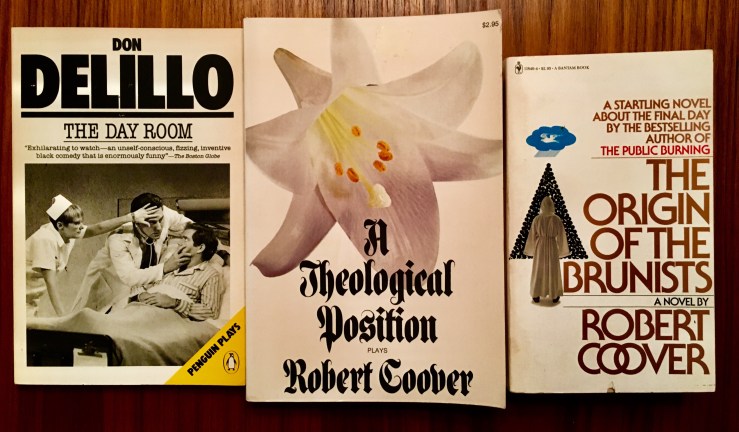
Two by Robert Coover and one by Don DeLillo (Books acquired—a few plays, unexpectedly—26 Jan. 2019)

img_2140

On Friday night we watched the first Hunger Games film with our daughter, who had finished the book this week. The movie isn’t that great, as I argued when I saw it seven years ago in the theater, but she seemed to like it, although she said she would have “done a lot of things differently.” She asked me to pick up the second book for her when I got a chance, and Not at the library, I want to own it, etc. So I figured that I’d use that as an excuse to browse my favorite used bookstore, so conveniently located 1.1 miles away (I swear I didn’t move into this neighborhood because of its proximity).

I went for a walk, got bitten rather viciously by a medium-sized dog, cleaned and dressed the wound, and went to browse books.

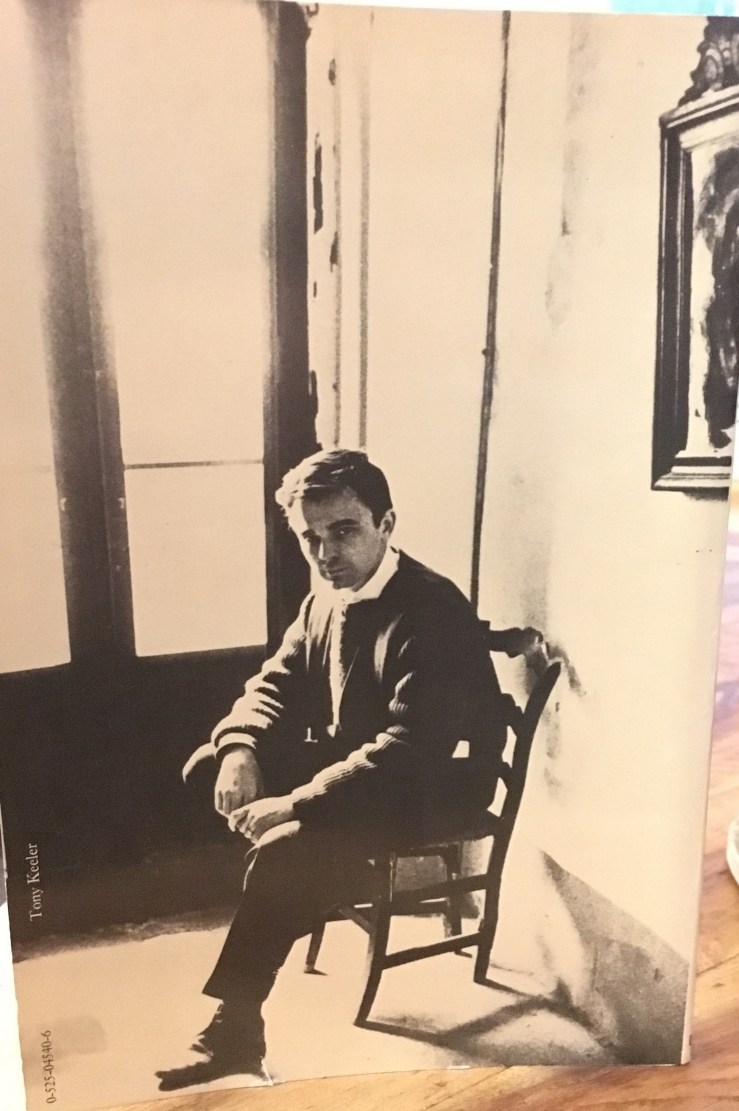
There are over two million books in this bookstore, a lot of them not really organized. While I usual mull around general fiction, literary criticism, art and art history, sci-fi, fantasy, and a section called “literary fiction,” I like to mix it up by going into areas I don’t know as well. Strolling through stack after stack in the drama section, an outward-turned collection of plays by Robert Coover caught my eye. I’d never heard of A Theological Position, but the cover and a few minutes browsing the four plays collected here—including one called Rip Awake, about Rip Van Winkle, which especially interested me—sealed the deal. That was before I turned the book over and saw this magnificent author photo, where a young Coover looks a bit like Jacques Derrida, in lieu of a tired blurb—

img_2142

A column over I spied a copy of Don DeLillo’s play The Day Room, 1986 joint I’d never heard of. The Penguin Plays edition with a black and white cover of a production recalled to me the four years of theater and drama I took in high school—we had plenty of these in the drama room, plays by Eugene O’Neil, Arthur Miller, Sam Shepard, etc. I was like the only one interested in these; it took me until the end of my sophomore year to realize that most of the drama kids were interested in fucking musicals and not literary drama. I probably belonged with the art kids but whatever.

I went and picked up the second Hunger Games book, and then browsed sci-fi a bit, hoping to find some more by the Strugatsky brothers or David Ohle’s Motorman, but not that day, friends! I also wanted to get a copy of Octavia Butler’s Parable of the Sower—and there were several—but they were all in these ridiculously well-kempt respectable and utterly literary cover editions that I can’t get down with. I’m sure I’ll find something I can live with sometime this year, but in the meantime, turning a corner, I found a massmarket paperback copy of Robert Coover’s novel The Origin of the Brunists, a novel I’ve been meaning to read for almost twenty years now. So.


Blog about Don DeLillo’s novel The Names, which I read a few weeks ago and now only half remember

img_2722

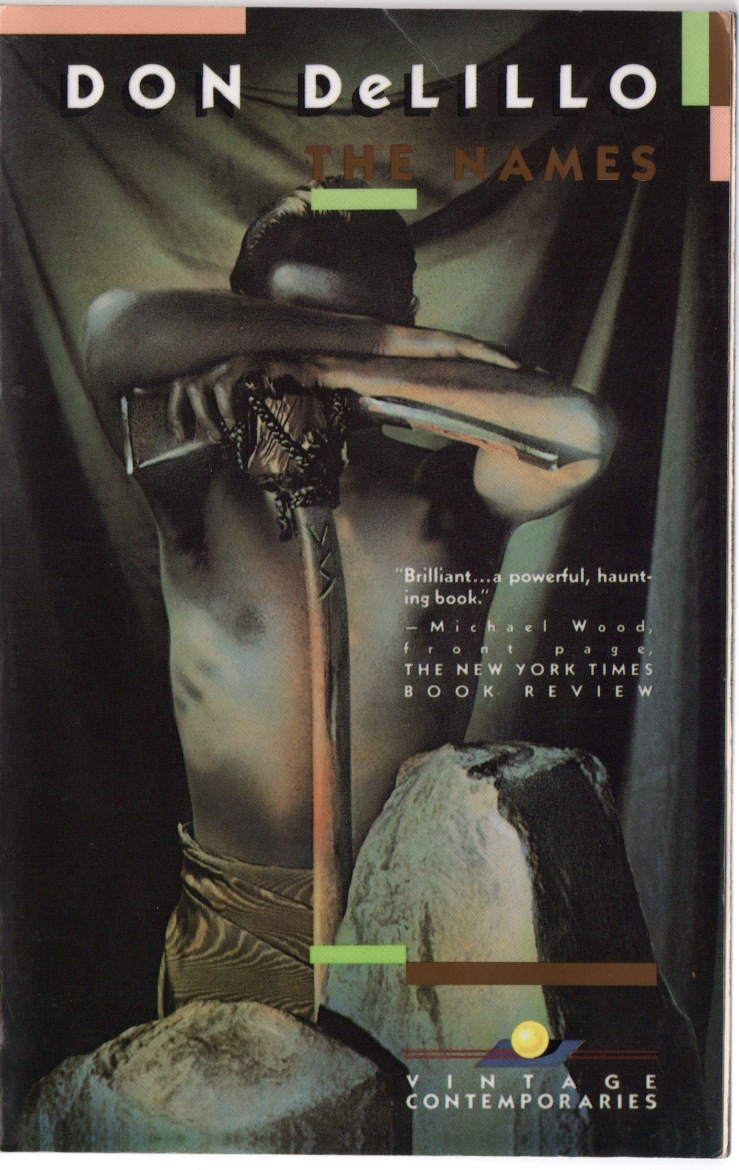
A physical copy of Don DeLillo’s 1982 novel The Names is on a shelf a few steps away from me. Normally I’d pick it up and thumb through it before writing about it—or better yet, reread it before writing about it—or even better, simply not write about it at all. But none of that would be in the spirit of these Blog about posts.

The plot of The Names, such as I remember it, is something like this: the novel’s protagonist and narrator (whose name may or may not be named Nick—I don’t really remember) is an American operative of some kind who basically works for the CIA. This specific job description is never really clear to the American protagonist or anyone else in the novel. He moves to Greece to be closer to his wife, who has left him, and his son, a budding novelist of sorts (despite being like nine or ten), whom DeLillo based on Atticus Lish (son of Gordon Lish and now a superb novelist in his own right)  The protagonist’s estranged wife works an archaeological dig headed by an older dude named Owen (the protagonist’s son’s novel is Owen’s fictional biography). Owen, and later (or is it before—I can’t remember?!) the protagonist, encounter a weird language cult that performs ritualistic linguistic murders.

The Names’ great appeal is DeLillo’s riffs on language and meaning in a postmodern era. The language cult isn’t some socioculturally-realistic entity that draws the reader in, but rather an occasion for monologue. The novel is very much a monologue, no matter who is speaking. This may sound like a criticism as I now type it out (it does to me, anyway), but DeLillo’s monologue has a fun force to it. It’s sort of like a Derridean teledrama in novelistic form, all its pollyglossic intentions subsumed into a low dry clipped clever voice: DeLillo waxes on film; DeLillo waxes on pleasure; DeLillo waxes on Americanism; DeLillo waxes on expatriation; DeLillo waxes on globalism; DeLillo waxes on airports; DeLillo waxes on terrorism. A big takeaway from the novel for me was that DeLillo wrote his 9/11 novel two decades before the fact. No wonder he wrote Falling Man so quickly; he’d already thought through the problems.

I can’t really remember the linguistic system or philosophy or language critique in The Names, but I do remember the repetitions—the word name threads throughout, usually pointing toward a symbol, a referent, a landing strip. DeLillo also repeats the word recognition—which I take to simply be the power of name(s) (why would I use the adverb “simply” there?!). But the keyword isn’t name—I think the keyword of The Names is the world, a term that seems to refer to the absolute set of possibility (linguistic or otherwise) that Exist—a shifting, unstable, but nevertheless complete set that everyone must play within.

While its expatriation visions ring true, DeLillo doesn’t fully conjure the world in The Names, although that’s never his intention, I think. The whole affair is more oblique. Clipped is the word I used before—the novel is dry, witty, but resists being pegged as glib through its strangeness and humor.  I laughed a lot in The Names. What I think I like most though is the ending, which I still remember—I haven’t read everything by DeLillo, but I’ve read a lot, and I can’t think of another of his that sticks the ending so well. And he does it by borrowing. DeLillo cribs from the protagonist’s son’s novel—which is to say from a child’s novel—which is to say from a real child’s work, Atticus Lish’s stuff—and that cribbing is somehow the magic ingredient that makes the rest of his novel rise up. It’s a second voice (or hey, the idea of a second voice) in a monologue, and it makes a huge difference.

Hell is the place we don’t know we’re in (Don DeLillo)

“Singh remarked to me once, his conspiratorial aspect, fixing those flat heavy eyes on me, ‘Hell is the place we don’t know we’re in.’ I wasn’t sure how to take the remark. Was he saying that he and I were in hell or that everyone else was? Everyone in rooms, houses, chairs with armrests. Is hell a lack of awareness? Once you know you’re there, is this your escape? Or is hell the one place in the world we don’t see for what it is, the one place we can never know? Is that what he meant? Is hell what we say to each other or what we can’t say, what is beyond our reach? The sentence defeated me. I was afraid of the desert but drawn to it, drawn to the contradiction. Men will come to fill this empty place. This place is empty in order that men may rush in to fill it.”

From Don DeLillo’s novel The Names.

“In other words, I stole from a kid” | Don DeLillo and Atticus Lish

Like ”Ratner’s Star,” a book in which Mr. DeLillo says he tried to ”produce a piece of mathematics,” ”The Names” is complexly structured and layered. It concludes with an excerpt from a novel in progress by Axton’s 9-year-old son, Tap. Inspiration for the ending came from Atticus Lish, the young son of Mr. DeLillo’s friend Gordon Lish, an editor.

”At first,” Mr. DeLillo says, ”I had no intention of using excerpts from Tap’s novel. But as the novel drew to a close I simply could not resist. It seemed to insist on being used. Rather than totally invent a piece of writing that a 9-year-old boy might do, I looked at some of the work that Atticus had done when he was 9. And I used it. I used half a dozen sentences from Atticus’s work. More important, the simple exuberance of his work helped me to do the last pages of the novel. In other words, I stole from a kid.”

Young Atticus is given ample credit in the book’s acknowledgments, but creative borrowing from life is not a new technique for Mr. DeLillo, who has been praised for his ear for dialogue. ”The interesting thing about trying to set down dialogue realistically,” he says, ”is that if you get it right it sounds stylized. Why is it so difficult to see clearly and to hear clearly? I don’t know. But it is, and in ‘Players’ I listened very carefully to people around me. People in buses. People in the street. And in many parts of the book I used sentences that I heard literally, word for word. Yet it didn’t sound as realistic as one might expect. It sounded over-refined even.”

From a 1982 profile of Don DeLillo in The New York Times

Atticus Lish’s 2014 novel Preparation for the Next Life was one of the best novels I read last year, and one of the best contemporary American novels I’ve read in ages.

Air travel reminds us who we are. It’s the means by which we recognize ourselves as modern (Don DeLillo)

In this vast space, which seems like nothing so much as a container for emptiness, we sit with our documents always ready, wondering if someone will appear and demand to know who we are, someone in authority, and to be unprepared is to risk serious things.

The terminal at each end is full of categories of inspection to which we must submit, impelling us toward a sense of inwardness, a sense of smallness, a self-exposure we are never prepared for no matter how often we take this journey, the buried journey through categories and definitions and foreign languages, not the other, the sunlit trip to the east which we thought we’d decided to make. The decision we’d unwittingly arrived at is the one that brings us through passport control, through the security check and customs, the one that presents to us the magnetic metal detector, the baggage x-ray machine, the currency declaration, the customs declaration, the cards for embarkation and disembarkation, the flight number, the seat number, the times of departure and arrival.

It does no good to say, as I’ve done a hundred times, it’s just another plane trip, I’ve made a hundred. It’s just another terminal, another country, the same floating seats, the documents of admission, the proofs and identifications.

Air travel reminds us who we are. It’s the means by which we recognize ourselves as modern. The process removes us from the world and sets us apart from each other. We wander in the ambient noise, checking one more time for the flight coupon, the boarding pass, the visa. The process convinces us that at any moment we may have to submit to the force that is implied in all this, the unknown authority behind it, behind the categories, the languages we don’t understand. This vast terminal has been erected to examine souls.

It is not surprising, therefore, to see men with submachine guns, to see vultures squatting on the baggage vehicles set at the end of the tarmac in the airport in Bombay when one arrives after a night flight from Athens.

All of this we choose to forget. We devise a counter-system of elaborate forgetfulness. We agree on this together. And out in the street we see how easy it is, once we’re immersed in the thick crowded paint of things, the bright clothes and massed brown faces. But the experience is no less deep because we’ve agreed to forget it.

From Don DeLillo’s novel The Names.

If a thing can be filmed, film is implied in the thing itself (Don DeLillo)

“Film is more than the twentieth century art. It’s another part of the twentieth-century mind. It’s the world seen from inside. We’ve come to a certain point in the history of film. If a thing can be filmed, film is implied in the thing itself. This is where we are. The twentieth century is on film. It’s the filmed century. You have to ask yourself if there’s anything about us more important than the fact that we’re constantly on film, constantly watching ourselves. The whole world is on film, all the time. Spy satellites, microscopic scanners, pictures of the uterus, embryos, sex, war, assassinations, everything.”

From Don DeLillo’s novel The Names.