Angels — Denis Johnson

Angels, Denis Johnson’s 1983 début novel, begins as a small book about not very much and ends as a small book about pretty much everything. Johnson has a keen eye and keener ear for the kinds of marginal characters many of us would rather overlook all together, people who live and sweat and suffer in the most wretched, unglamorous, and anti-heroic vistas of a decayed America. The great achievement of the novel (beyond Johnson’s artful sentences) is in staging redemption for a few–not all, but a few–of its hopeless anti-heroes.

Take Jamie, for instance. Angels opens on this unfortunate young woman as she’s hauling her two young children onto a Greyhound bus. She’s leaving her cheating husband for relatively unknown prospects, lugging her children around like literal and symbolic baggage. Jamie should be sympathetic, but somehow she’s not. She’s someone we’d probably rather not look at, yelling at her kids while she drags on a Kool. Even she knows it. Of two nuns on the bus: “But Jamie could sense that they found her make-up too thick, her pants too tight. They knew she was leaving her husband, and figured she’d turn for a living to whoring. She wanted to tell them what was what, but you can’t talk to a Catholic.” Jamie finds a closer companion, or at least someone equally bored and equally prone to drinking and substance abuse, in Bill Houston. The ex-con, ex-navy man is soon sharing discreet boilermakers with her on the back of the bus, and she makes the first of many bad decisions in deciding to shack up with him over the next few weeks in a series of grim motels.

The bus, the bus stations, the motels, the bars–Johnson details ugly, urgent gritty second-tier cities and crumbling metropolises at the end of the seventies. The effect is simply horrifying. This is a world that you don’t want to be in. Johnson’s evocation never veers into the grotesque, however; he never risks tipping into humor, hyperbole, or distance. The poetic realism of his Pittsburgh or his Chicago is virulent and awful, and as Jamie drunkenly and druggily lurches toward an early trauma, one finds oneself hoping that even if she has to fall, dear God, just let those kids be okay. It’s tempting to accuse Johnson of using the kids to manipulate his audience’s sympathy, but that’s not really the case. Sure, there’ s a manipulation, but it veers toward horror, not sympathy. (And anyway, all good writing manipulates its audience). Johnson’s milieu here is utterly infanticidal and Jamie is part and parcel of the environment: “Jamie could feel the muscles in her leg jerk, she wanted so badly to kick Miranda’s rear end and send her scooting under the wheels, of, for instance, a truck.”

Jamie is of course hardly cognizant of the fact that her treatment of her children is the psychological equivalent of kicking them under a truck. She’s a bad mother, but all of the people in this novel are bad; only some are worse–much worse–than others. Foolishly looking for Bill Houston on the streets of Chicago, she notices that “None of these people they were among now looked at all legitimate.” Jamie is soon conned, drugged, and gang-raped by a brother and his brother-in-law; the sister/wife part of that equation serves as babysitter during the horrific scene.

And oh, that scene. I put the book down. I put the book away. For two weeks. The scene is a red nightmare, the tipping point of Jamie’s sanity, and the founding trauma that the rest of the novel must answer to–a trauma that Bill Houston, specifically, must somehow pay for, redress, or otherwise atone. The rape and its immediate aftermath are hard to stomach, yet for Johnson it’s no mere prop or tasteless gimmick. Rather, the novel’s narrative thrust works to somehow answer to the rape’s existential cruelty, its base meanness, its utter inhumanity. Not that getting there is easy.

Angels shifts direction after the rape, retreating to sun-blazed Arizona, Bill Houston’s boyhood home and home to his mother and two brothers. There’s a shambling reunion, the book’s closest moment of levity, but it’s punctuated and punctured by Jamie’s creeping insanity, alcoholism, and drug addiction. Johnson’s signature humor is desert-dry and rarely shows up to relieve the narrative tension. Jamie hazily evaporates into the background of the book as the Houston brothers, along with a dude named Dwight Snow, plan a bank robbery. Another name for Angels might be Poor People Making Bad Decisions out of Sheer Desperation. Burris, the youngest Houston, has a heroin habit to feed. James Houston is just bored and nihilistic and seems unable to enjoy his wife and child and home. On hearing about the bank robbery plan, Jamie achieves a rare moment of insight: “Rather unexpectedly it occurred to her that her husband Curt, about whom she scarcely ever thought, had been a nice person. These people were not. She knew that she was in a lot of trouble: that whatever she did would be wrong.” And of course, Jamie’s right.

The bank robbery goes wrong–how could it not?–but to write more would risk spoiling much of the tension and pain at the end of Angels. Those who’ve read Jesus’ Son or Tree of Smoke will see the same concern here for redemption, the same struggle, the same suffering. While Jesusian narratives abound in our culture, Johnson is the rare writer who can make his characters’ sacrifices count. These are people. These are humans. And their ugly little misbegotten world is hardly the sort of thing you want to stumble into, let alone engage in, let alone be affected by, let alone be moved by. But Johnson’s characters earn these myriad affections, just as they earn their redemptions. Angels is clearly not for everyone, but fans of Raymond Carver and Russell Banks should make a spot for it on their reading lists (as well as Johnson fans like myself who haven’t gotten there yet). Highly recommended.

Three by Lydia Davis

The massive new volume The Collected Stories of Lydia Davis doesn’t come out until later this month, but you can read the first three stories in the book now at Picador’s website. Read “Story,” “The Fears of Mrs. Orlando,” and “Liminal: The Little Man,” all originally published in Break It Down.
“The book educates you about the book” — NPR Profiles Philip Roth

In case you missed it: NPR’s All Things Considered spoke with Philip Roth about his new book Nemesis earlier this week. From the profile–

Nemesis is Roth’s 31st work, and at age 77, he still continues to take risks with his narrative style. In Nemesis, he doesn’t reveal the identity of the narrator until well into the novel.

“It just dawned on me as I was writing along,” Roth explains. “The book educates you about the book.”

Though Roth developed the novel’s narrative structure unexpectedly, he was motivated to do so by a novel that continues to inspire him: Gustave Flaubert’s Madame Bovary. In the novel’s first scene, the reader is introduced to Charles Bovary, Madame Bovary’s husband-to-be, as a schoolboy. The scene is narrated by the collective voice of his mocking classmates — a voice that then disappears.

“Well, I don’t have the guts for that,” Roth says, laughing. “That’s what made Flaubert Flaubert, you know. But indeed, it is from the charm of that opening of Madame Bovary that I took my lead.”


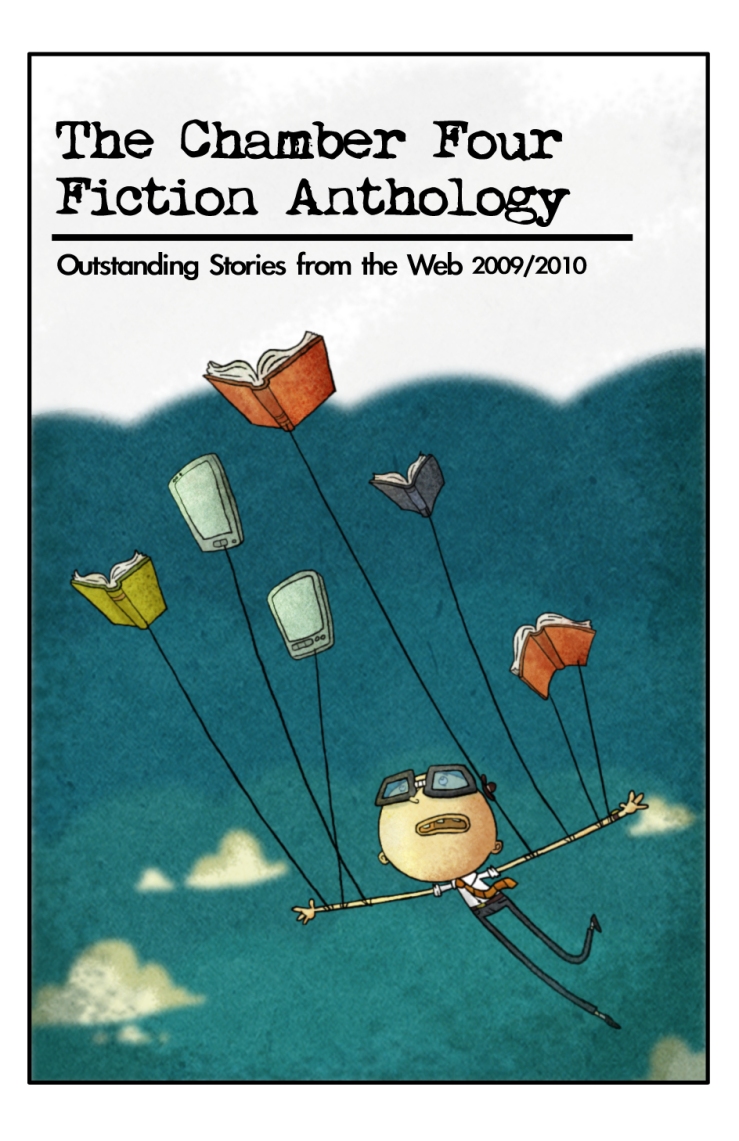
Download The Chamber Four Fiction Anthology

Download The Chamber Four Fiction Anthology. From their website–

This anthology contains 25 of the best short stories published on the web in 2009 and 2010 as chosen by the editors of ChamberFour.com, a website dedicated to making reading more enjoyable and more rewarding.

In this collection, you’ll find traditional, Carver-esque stories alongside magical realist tales of teleportation, long pieces that slowly pull you in, and single-page punches to the solar plexus. Some of these authors you’ve heard of, others you’ll be discovering for the first time, and you can be sure you’ll see them all again.

There is no factor that unifies the pieces collected here beyond their availability online and that hard-to-define but unmistakable hallmark of quality. These stories are as diverse and as wide in scope as the Internet, but each is true to their shared subject: the attempt to reconcile our world to the struggles of the human soul.

This anthology is DRM-free and free to download. Anybody charging for it is ripping you off.

Biblioklept’s 777th Post Spectacular

Welcome to Biblioklept’s 777th Post Spectacular*

*Not guaranteed to be spectacular.

777 seems like a beautiful enough number to celebrate, and because we’re terribly lazy, let’s celebrate by sharing reviews of seven of our favorite novels that have been published since this blog started back in the hoary yesteryear of 2006. In (more or less) chronological order–

The Children’s Hospital–Chris Adrian — A post-apocalyptic love boat with metaphysical overtones, Adrian’s end of the world novel remains underrated and under-read.

The Road — Cormac McCarthy That ending gets me every time. The first ending, I mean, the real one, the one between the father and son, not the tacked on wish-fulfillment fantasy after it. Avoid the movie.

A Mercy — Toni Morrison –Slender and profound, A Mercy should be required reading for all students of American history. Or maybe just all Americans.

Tree of Smoke — Denis Johnson — Nobody knew we needed another novel about the Vietnam War and then Johnson went and showed us that we did. But it’s fair to say his book is about more than that; it’s an espionage thriller about the human soul.

2666 — Roberto Bolaño — How did he do it? Maybe it was because he was dying, his life-force transferred to the page. Words as viscera. God, the blood of the thing. 2666 is both the labyrinth and the minotaur.

Asterios Polyp — David Mazzucchelli — We laughed, we cried, and oh god that ending, right? Wait, you haven’t read Asterios Polyp yet? Is that because it’s a graphic novel, a, gasp, comic book? Go get it. Read it. Come back. We’ll wait.

C — Tom McCarthy — Too much has been made over whether McCarthy’s newest novel (out in the States next week) is modernist or Modernist or post-modernist or avant-garde or whatever–these are dreadfully boring arguments when stacked against the book itself, which is complex, rich, enriching, maddening.

The Rumpus Interviews David Mitchell

The Rumpus interviews David Mitchell. Topics include his brilliant new novel The Thousand Autumns of Jacob de Zoet, diction, syntax, and other writerly concerns. And stammering. I’m currently finishing up Mitchell’s novel Black Swan Green, which is hilarious and sad and beautiful. I will review it here shortly.

The New York Observer Profiles Tao Lin (in the Style of Tao Lin)

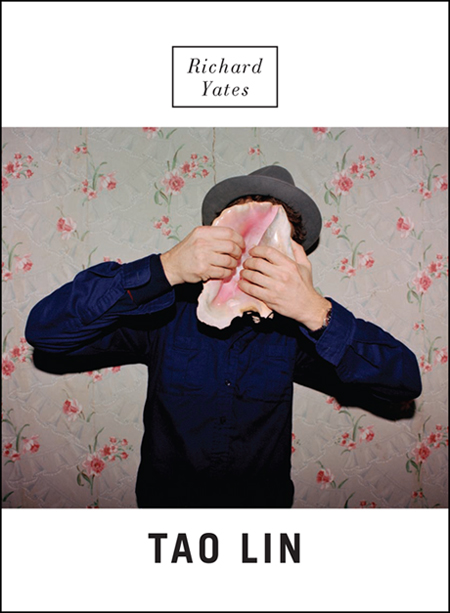
“Tao Lin Will Have the Scallops” by Christian Lorentzen. I’m about halfway through Lin’s forthcoming novel, Richard Yates, which is somehow both far out and totally banal at the same time. Its cover is pretty awesome–

“Extreme Solitude” — New Fiction from Jeffrey Eugenides

“Extreme Solitude” — a new story from Jeffrey Eugenides at The New Yorker. Read the whole story here. Here’s an excerpt that might ring true to many an English major:

Madeleine had met Leonard in an upper-level semiotics seminar taught by a renegade from the English department. Michael Zipperstein had arrived at Brown thirty-two years earlier filled with zeal for the New Criticism. He’d inculcated the habits of close reading and biography-free interpretation into three generations of students before taking a Road to Damascus sabbatical, in Paris, in 1975, where he’d met Roland Barthes at a dinner party and been converted, over duck cassoulet, to the new faith. Now Zipperstein taught two courses in the newly created Program in Semiotic Studies: Introduction to Semiotic Theory, in the fall, and, in the spring, Semiotics 211. Hygienically bald, with a seaman’s mustacheless white beard, Zipperstein favored French fisherman’s sweaters and wide-wale corduroys. He buried people with his reading lists: in addition to all the semiotic big hitters––Derrida, Eco, Barthes––the students in Semiotics 211 had to contend with a magpie nest of reserve reading that included everything from Balzac’s “Sarrasine” to issues of Semiotext(e) to xeroxed selections from E. M. Cioran, Robert Walser, Claude Lévi-Strauss, Peter Handke, and Carl Van Vechten. To get into the seminar, you had to submit to a one-on-one interview with Zipperstein during which he asked bland personal questions, such as what your favorite food or dog breed was, and made enigmatic Warholian remarks in response. This esoteric probing, along with Zipperstein’s guru’s dome and beard, gave his students a sense that they’d been spiritually vetted and were now—for two hours Wednesday afternoons, at least––part of a campus lit-crit élite.

Almost overnight it became laughable to read writers like Cheever or Updike, who wrote about the suburbia Madeleine and most of her friends had grown up in, in favor of reading the Marquis de Sade, who wrote about anally deflowering virgins in eighteenth-century France. Madeleine had become an English major for the purest and dullest of reasons: because she loved to read. The university’s “British and American Literature Course Catalogue” was, for Madeleine, what its Bergdorf equivalent was for her roommates. A course listing like “English 274: Lyly’s Euphues” excited Madeleine the way a pair of Fiorucci cowboy boots did Abby. “English 450A: Hawthorne and James” filled Madeleine with an expectation of sinful hours in bed that was not unlike the sensation Olivia got from wearing a Lycra skirt and leather blazer to Danceteria. Right up through her third year of college, Madeleine had kept wholesomely taking courses like “Victorian Fantasy: From ‘Phantastes’ to ‘The Water-Babies,’ ” but by senior year she could no longer ignore the contrast between the blinky people in her Beowulf seminar and the hipsters down the hall reading Maurice Blanchot. Going to college in the moneymaking eighties lacked a certain radicalism. Semiotics was the first thing that smacked of revolution. It drew a line; it created an elect; it was sophisticated and Continental; it dealt with provocative subjects, with torture, sadism, hermaphroditism––with sex and power.

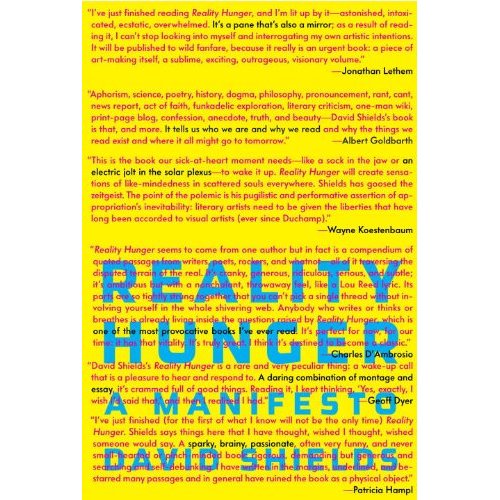
Reality Hunger — David Shields

Just what, exactly, is David Shields’s Reality Hunger supposed to be about? He’s brazen enough to slap the subtitle “A Manifesto” right there under the title, suggesting a work of sustained principles calling for something to change or happen for some reason, but after reading the damn thing, I still have no real idea what he really wants or why I should care. If I had to venture a guess, it seems that Shields is suggesting that we quit reading, writing, and publishing “standard novels” and that “realism” in letters can only be located in lyric essays and other works free from genre constraint (even the memoir is too artificial for Shields, and autobiography ultimately represents facts without truth).

I think what he really wants is authenticity, which repeatedly gets called “reality,” a term he (repeatedly) fails to satisfactorily define. Reality Hunger seems to argue that authenticity in the 21st century must take the form of synthesis, must chop up and recombine disparate elements, genres, cultural artifacts. To that end, Shields’s book is a tour-de-force of citation and appropriation. Aspiring toward an aphoristic tone, Shields organizes the book into 618 short sections over 200 or so pages; most of the sections are not his work, but come rather from myriad sources across different cultures and eras. I have no problem with this (c’mon, this is Biblioklept!) and Shields clearly demonstrates that the practice is hardly new in the history of story-telling, rhetoric, or philosophy.

My real problem is the self-seriousness of it all. Shields aspires to “break” reality into his text by reapportioning and recombining varied citations, but this bid for authenticity is, of course, utterly artificial, often stolid, and not nearly as fun as such a playful medium would suggest. Even worse, it’s not really a proper synthesis; that is, in stacking bits of other people’s work together with some of his own thin connective tissue, Shields hasn’t achieved an authentic blend or, to use a term he’d hate, anything novel, anything new. The jarring stylistic shifts between sections will lead serious readers repeatedly to the book’s appendix to find out who originated the words Shields is copping.

If Reality Hunger approaches having a point, it comes in the book’s penultimate chapter, “Manifesto.” Here, he attacks “standard novels.” The term is appropriated from W.G. Sebald, a writer of marvelous and strange novels that Shields would love to be essays. In one of the few original lines in the book, Shields dismissively writes that “Novel qua novel is a form of nostalgia.” He goes on to argue that the personal/lyric essay is more closely aligned with philosophy, history, and science than novels, and that novels no longer have any legitimate response to these more “real” concerns. Which is utter bullshit, really, and seems more than anything to prove that Shields is probably not that well-read, despite his massive cut and paste catalog. Not that I think that he’s not that well-read. He just picks and chooses, according to his taste, what novels get to escape being “standard.” How can one read contemporary masterpieces like The Rings of Saturn or Infinite Jest or 2666 or Underworld and honestly say that they don’t hold value? Shields, of course, does/would presumably find room for these in his “manifesto.”

The most embarrassing chapter of Reality Hunger, “Hip-hop,” also reveals the most about Shields’s program. It’s also one of the few chapters to feature long sections of Shields’s own original prose. In a turgid, humorless, overly-analytical “defense” of hip-hop and “sampling culture,” Shields describes how hip-hop works, riffing on the function of “realness” in hip-hop, and grasping at the larger implications of a normalized recombinant art form within modern culture. And though I agree with pretty much everything that Shields has to say about piracy and copyright laws, the drastic artificiality of his style and tone is really too much here. It’s like someone trying to explain why a joke is funny.

The worst though is Shields’s assertion that “Our culture is obsessed with real events because we experience hardly any.” The sentence itself is a clever bit of sophistry that falls apart under any real scrutiny. I can name a dozen “real events” that I experienced in the last few hours alone, including eating dinner with my family, talking with my wife, and putting my daughter to bed. Complaining that we are denied “real events,” like the mopes Shields cites from Douglas Coupland’s Generation X who lament their “McLives,” is a way of excusing ourselves from the intensity of being present–at all times–in our own lives. The vapid philosophy of the spoiled whiners in Reality Bites wasn’t attractive back in the early nineties and it’s downright repellent now.

So what does it all add up to? I think that Reality Hunger works well as a description of post-postmodernity. And as much as I’ve ranted against it here it’s actually quite enjoyable as a compendium of clever quotations. As a manifesto though, it’s an utter failure. To be fair, he had no shot of convincing me that the novel is or should be dead. There’s just too much evidence to the contrary.

Reality Hunger is now available in hardback from Knopf.

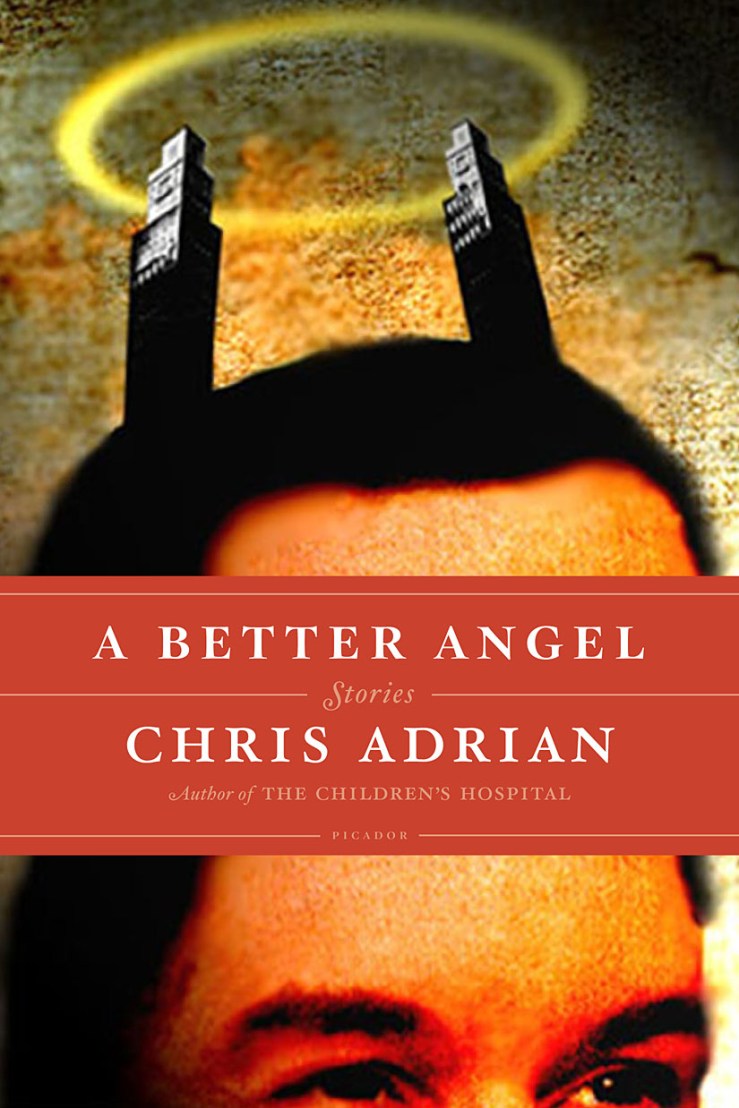
A Better Angel — Chris Adrian

Better Angel

How does one grieve? This central question runs through the nine stories that comprise Chris Adrian’s A Better Angel (available now in trade paperback from Picador). For Adrian’s protagonists, mostly adolescents and children, the past is inescapable and insurmountable, and the future promises only depression at best and eternal suffering at worst. These are stories about hauntings. In Adrian’s world (and it is a fully-realized world in the same way that Tolkien’s Middle Earth is its own discrete place), ghosts, angels, and even wayward friends are all likely to to demonically possess some sad, troubled weird kid. Again and again, these stories force their protagonists–and their readers–to question how one might witness to death, disease, and disaster–and still keep a modicum of sanity.

Those who’ve read Adrian’s novels The Children’s Hospital and Gob’s Grief will find that the stories in A Better Angel work to flesh out a distinctly Adrianesque milieu. There are hospitals and doctors and nurses, dead brothers and absent parents, events of epic destruction and personal crises of illness, drugs and alcohol, ouija boards, and plenty of angels and demons. Adrian’s narratives explore a fine line between metaphysics and pure biology that each protagonist has to navigate. In “The Sum of Our Parts,” nurses and doctors wonder how our body parts make us individuals as a ghost tries to escape her coma-bound body. The fraudulent doctor of “A Better Angel” uses drugs as a way of subduing the angel who haunts him. “I make my living praising the beauty of well children,” he says. “I love babies and I love ketamine, and that’s really why I became a pediatrician, not because I hate illnesses, or really ever wanted to make anybody better.” Indeed, Adrian’s characters seem doubtful that anyone can make anyone else better, but it doesn’t stop them from trying. There’s the father of “The Changeling,” whose son is possessed by the ghosts of those murdered in the 9/11 attacks on the World Trade Center, who parcels out his own body as a sacrifice to appease the dead. The story recognizes though that it’s not really the dead he is honoring–he’s really showing his love for his son–but this measure of love is not enough for the dead. “The Changeling” is one of three stories in A Better Angel addressing the 9/11 attacks (we’ll write more about this trio in an upcoming post, and we’ve already addressed one of the stories here), but the September 11th victims are hardly the only ghosts here. In “A Hero of Chickamauga,” Civil War re-enactors try to commune with the dead and somehow bring personal justice to something beyond comprehension. “A Child’s Book of Sickness and Death” posits disease as the ultimate affront to cosmic justice. Its protagonist Cindy, an ailing “short gut girl” who lives in semi-permanent residence at a children’s hospital, remarks to no one in particular after the death of a young child,

“It seems to me, who should really know better, that all the late, new sadness of the past twenty-four hours ought to count for something, out to do something, ought to change something, inside of me, or outside in the world. But I don’t know what it is that might change, and I expect that nothing will change–children have died here before, and hapless idiots have come and gone, and always the next day the sick still come to languish and be poked, and they will lie in bed hoping not for healing, a thing which the wise have all long given up on, but for something to make them feel better, just for a little while, and sometimes they get this thing, and often they don’t.”

Cindy’s is just one of many negative epiphanies here. It’s also worth noting that this Cindy is but one of several Cindys populating this book, and she also seems to be another version of a short gut syndrome Cindy who appears in The Children’s Hospital. In fact, most of the primary characters in “A Children’s Book of Sickness and Death” are also present in The Children’s Hospital, underscoring the sinew that connects Adrian’s milieu.

This holistic vision marks Adrian as an accomplished–and challenging–author. Adrian’s challenge is not so much an issue of readability; we found ourselves quickly devouring these stories. No, what we have here are tales that many will find hard to digest, the sort of stuff that some readers will find too bitter to ruminate and puzzle out. Adrian, through his protagonists’ bleak outlooks, doesn’t offer a cure or even much solace from the pain and sickness in the world, but he does offer some temporary, if mild, relief, a sort of reckoning with that pain and sickness. Although the angels and demons and ghosts of Adrian’s world cannot be ignored or dismissed, they can be confronted, even if that confrontation must repeat without solution. Instead of pandering to his readers with Panglossian platitudes or metaphysical escape hatches, Adrian dramatizes the realities of our mortality in a way that compels both sympathy and repulsion, and above all, some deep thinking. Highly recommended.

Three New Novels: Brothers, Amberville, and The Post-War Dream

The stack of promo copies and galleys at Biblioklept World Headquarters has built to an unmanageable and untenable tower of tasks that we are simply not up to of late. It’s not like we’re not reading, but we do have a day job! While we do request certain new books from publishers, most of what comes into our esteemed hallows is unsolicited, and a lot of it is honestly pretty dull stuff. However, we have a tidy little pile of new books that we’re going to read in full as soon as we can get to them, and it seems only right to share with our Esteemed Readers in a timely manner.

brothers

First up is Chinese author Yu Hua’s titanic Brothers, the engrossing and often ribald story of two step-brothers, Baldy Li and Song Gang. Brothers moves from the quiet village life of the brothers’ native Liu Town, through the Cultural Revolution, and into China’s contemporary economic and technological boom. At over 600 pages, the novel seemed a bit daunting, but we read the first 50 pages at a steady clip. Honestly, Yu Hua had us at the fourth page, when Baldy Li indulges in a bit of nasty voyeurism in a public restroom. Check the pithy wisdom:

Nowadays women’s bare butts aren’t worth much, since they can be found virtually everywhere. But back then things were different. It used to be that women’s bottoms were a considered a rare and precious commodity that you couldn’t trade for gold or silver or pearls. To see one, you had to go peeping in a public toilet . . .

We’re really enjoying Brothers so far, and the book seems destined to break Yu Hua’s funny and poignant voice to a Western audience. Here’s a pretty cool in-depth profile on Yu Hua by the New York Times. Full of weird vignettes, crude humor, and a frank look at a very different culture, we think this will be one of the highlights of 2009. Brothers is now available in hardback from Pantheon Books.

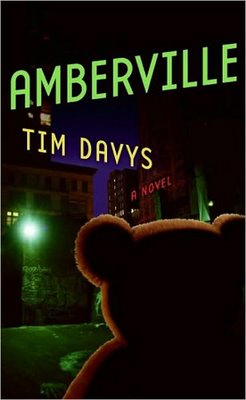
amberville

We’re not really big fans of detective noir, but Tim Davys’s Amberville seems to do the genre justice despite its big twist–the characters are all stuffed animals. In Davys’s debut novel, dark secrets from Eric Bear’s past come back to haunt him and challenge his legit prominence as a high-powered ad exec. The first two chapters were okay–Davys certainly has his noir tropes and rhythms down–but we had a hard time getting over the stuffed animal conceit. Still, readers who like their noir twisted–or fans of fantasy may get a kick out of Amberville, available now in hardback from HarperCollins.

postwardreampreview

New in paperback next month from Anchor Books, Mitch Cullin’s novel The Post-War Dream tells the story of two retirees in Arizona. After his wife Debra becomes gravely ill, Hollis finally confronts the trauma of his past, rooted in his experiences as a soldier in the Korean War. We have to admit that the plot description sounded a bit…hmmmm… “not our speed” would be a polite way to put it, we suppose (honestly, the idea of reading about an old married retired couple didn’t sound that interesting), but the first three chapters were very good, a bit strange, and intriguing enough to keep us going. Plus the book is dedicated to Howe Gelb–how weird is that? Those unfamiliar with Cullins might know his novel Tideland from its film adaptation a few years ago by Terry Gilliam. Those unfamiliar with Terry Gilliam have our permission to give up.

Underworld — Don DeLillo

Don DeLillo’s Underworld explores American culture and psyche throughout–and immediately after–the Cold War era. The book centers loosely on waste management exec Nick Shay, but diverges in constant achronological loops, employing dozens of different voices and viewpoints in order to handle a variety of themes and subjects that are, frankly, too massive to get a grip on. At all times though, Underworld seems aware of this inability to document its subject’s vastness, but, like Ishmael in Moby-Dick who attempts to systemize the unknowable whales, the characters in Underworld nevertheless try and try again to find order and meaning in a paranoid and increasingly disconnected world. The real center of the book is a baseball, the ball pitched by Brooklyn Dodger Ralph Branca to New York Giant Bobby Thomson, who won the game in a hit known as “The Shot Heard ‘Round the World.” However, this ball, this center, is repeatedly transferred, deferred, shifted, and even characters who claim to own the “real” ball understand that the validity or “realness” of the home run ball is always under question. DeLillo seems to suggest that finding fixed, stable meaning is an illusion; the best that people can hope for is to find solace in their family and friends in open, honest relationships.

By the time DeLillo had published Underworld in 1997, he had already established himself as a canonized saint of the American postmodern literary tradition, yet Underworld, in its massive size and scope (it weighs in at over 800 pages) seems primed to be the author’s “big book,” destined to fit neatly in the new canon of large and long American postmodern novels next to John Barth’s The Sot-Weed Factor, Robert Coover’s The Public Burning, Thomas Pynchon’s Gravity’s Rainbow, and David Foster Wallace’s Infinite Jest. Underworld utilizes nearly every postmodernist trope, including a nonlinear plot, myriad, discursive voices, and a willingness to engage historical figures. The novel also manages to contain a bulk of themes and devices DeLillo has employed throughout his body of work: find here the paranoid alienation of The Names, the shadow of assassination-as-spectacle from Libra, the intersection of art, violence, economics, and politics of Mao II, and the exploration of the new American religion, consumerism, that underpinned White Noise.

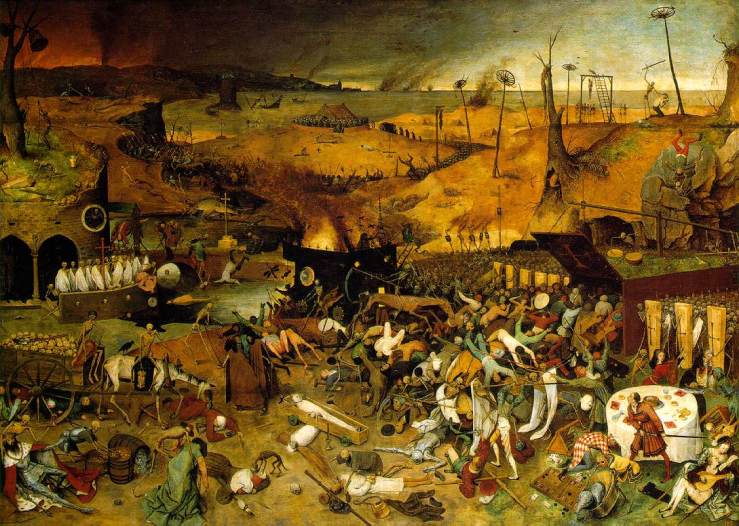
Ultimately, all of Underworld‘s themes–garbage, art, war, insulation, paranoia, drugs, death, secrets, baseball, identity, etc.–threaten to crush the narrative under their sheer weight. Unlike Pynchon, Barth, Coover, and DFW, DeLillo is rarely playful or even fun; most of the humor here serves to alienate rather than connect the reader to the characters. The book is masterfully written, and any number of the little vignettes, like the sad life of the Texas Highway Killer, or the Space-Age compartmentalization of a 1950s suburban family, expertly delineate DeLillo’s handling of concepts and motifs. However, the book’s prologue, “The Triumph of Death” (the title alludes to Bruegel’s painting), an account of the 1951 Dodgers-Giants pennant game is easily the most passionate, intense, and engaging moment of the novel. This assessment isn’t meant to suggest that the remaining 700 pages or so of Underworld aren’t as rewarding, they just aren’t as fun. Underworld is probably a work of genius, and the sum of its many, many parts do add up to more than the corpus, only that sum will probably leave a lot of readers feeling cold.

The Biblioklept Interview: Mathias Freese

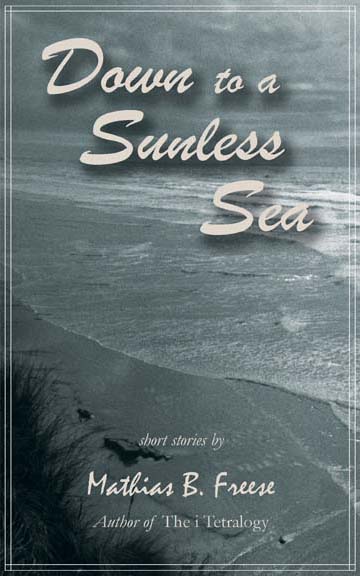
Mathias Freese, author of Down to a Sunless Sea and The i Tetralogy, was kind enough to answer a few questions for us. This interview took place over the course of several emails.

Biblioklept: Have you ever stolen a book? If so, could you tell us a little bit about that?

Mathias Freese: No, I’ve never stolen a book.

B: Have you ever borrowed a book without returning it–purposefully or not?

MF: The amount of guilt for both of these questions, as a young boy, would be too much to bear; and then obsessing about it enters the picture and I’d end up in central casting auditioning for a role in The Possessed.

B: What are you currently reading?

MF: Dan Wakefield’s, New York in the Fifties. Living in Arizona, a geriatric Disneyland, I remember well Brooklyn – Brighton Beach, Manhattan Beach, and Coney Island. I grew up in the Fifties and Wakefield evokes the literary times very well – Ginsburg, Kerouac, Mailer – as well as the cultural sensibilities of the time. I was too young for all this but reading about it evokes Greenwich Village, egg creams, and a great bialy.

B: What are you writing right now?

MF: I am editing a novel, my first, written more than two decades ago. Sojourner is a philosophical tale dealing with the emigration of a young Chinese farmer to the Mountain of Gold (California) as it was called.

B: Sojourner sounds interesting. Is it research-based historical fiction? (Perhaps you hate to classify what you write into a specific genre, of course). Tell us more.

MF: Sojourner began as a 30 page short story in the years 1969 to 1972; I was working on a federal project dealing with racial-ethnic relations in the town of Freeport, on Long Island, NY. I had met a Chinese-American librarian who had written on the emigration to Gum Shan, Mountain of Gold. I researched only details that would be useful for verisimilitude, such as Gum Shan, and began a short story about the subject. The book ultimately reflects my own philosophical needs and emotional cravings for meaning. When submitted to publishers as a novel for young adults almost all of them wrote that I had made an error, and that this fiction was serious and for adults. Who knew? I do believe that the writer is the last to truly appreciate his work. The i Tetralogy which began in 1996, is a more thoroughly researched book , and it is a historical fiction on the Holocaust based on my experiences as an American Jew. I had read a significant amount of the literature on the Holocaust with no intent of being a writer. If you read my “On the Holocaust” in the Pages section of my website, you will get a rather complete statement of my point of view.

B: The Marxist critic Theodor Adorno famously declared: “To write poetry after Auschwitz is barbaric.” How do you interpret this remark?

MF: Adorno’s comment was of its time. I feel what he means, how can we allow beauty in the presence of such unspeakable evil! However, it does not make sense. When you write you metabolize feelings – all kinds – thoughts, experiences and all the rest. When the ancients passed down Homer’s Odysseus orally, the words saturated the listener with meaning and continuity. We must write about the Holocaust until the end of time, although we face psychological resistance every step of the way. I have faced this with The i Tetralogy. One of the most significant gifts of Judaism to civilization is memory. We do not forget – and most assuredly, we do not “put it behind us,” one of the more inane “truisms” in this culture – re: Mel Gibson and Jesse Jackson. Adorno is dead wrong.

B: The back of your book, Down to a Sunless Sea, mentions that you worked for over twenty-five years as a social worker and psychotherapist. Several of the stories in the book seem to explore explicitly psychoanalytical themes, yet these themes are never overstated. Is this purposeful?

MF: I have been accused of being too clinical; I think that is unfair. I use my therapeutic insights when I can while integrating them with my psychological and emotional wisdoms (if that) and try to make a story. I recall covering for a teacher in an eleventh grade class. He was teaching Oedipus Rex. I asked him if I could treat it the way I wanted to. He agreed. In class, in a small review, the students told me that they were up to where Oedipus scratches out his eyeballs, consequently the interpretation was stressed that he chose not to see – and how very symbolic that was. I asked them if they were opened to another way of looking at it. I shared that to me it was a case of displacement. Duh! In effect, he was castrating himself. Titters and titters. I went on to say that they touch their eyes now and make an observation. Finally, one student said that they felt like balls. And away we go! The next day the teacher was bent out of shape because he had heard that I said that Oedipus ripped out his eyes, in effect, his balls. I am sure some students came away believing that balls evolve from eye sockets. Why should I give up insight (no pun intended) no matter where it comes from?

B: I teach eleventh-graders, actually. You never know what weird mutation of what you discussed that they will commit to memory forever. Do you enjoy being in a classroom? Have you ever taught fiction writing? What do you think of MFA programs?

MF: I was terribly misplaced in that career. The consensus was that I was a terrific teacher but I detested the rules, the administration and the deadness. You read “Nicholas.” He has it right. So I studied to become a therapist and it worked very well for me, my craft and my self. I have taught seminars on fiction writing and if you go to the site you will see a course description and in the Pages section there are short essays all dealing with writing. Go nosh. As to MFA programs I have a simple premise: if it is organized, go elsewhere. Same feelings I have about religion, et al. I cannot think of any world class writer who has a MFA. What about good old suffering and pain as a motivator?

B: Many of the stories in Down to a Sunless Sea utilize a very tight, condensed prose style. How much do you edit out of your work?

MF: I like this question in that it touches upon something I truly believe in. Some writers secrete out paragraphs per day. I can’t handle that anality. I write, let us say, 10 pages knowing full well I cut back to maybe 4. The art of writing is revise, revise and revise. I like pruning the story tree so that new growth is inaugurated. Like poetry, which I find, of course, the most condensed of writing, I believe stories should be very tight – let the reader infer rather than I tell. Indeed, one reviewer complained she couldn’t understand the stories, at least in her first reading. Good. Get back to it and reread it. I am not fooling around here and I deserve a better reading if you feel there is more to my stories than Oprahesque fluff.

B: When you re-read “Arnold Schwarzenegger’s Father Was a Nazi” now, do you consider it prescient? How do you think Arnie turned out?

MF: I had a sense about Arnie, of that tom tom in his character, that immigrant feeling that America can be tamed and domesticated to one’s own ends. I associate to Daniel Day-Lewis [in] There Will Be Blood, that tornadic energy to succeed, ambition on speed. In many ways Arnie is an athletic Algeresque character. I was not conscious of making any predictions, but it did feel to me, on a gut level, that he had other measures and goals to achieve and one of them is to marry into a famous family and all the rest. He is a delightful social climber who has denied, at least in the media, his background. I can write about Arnie because I don’t know him and that is the freedom of the writer. Give a writer one telling detail and the rest is extrapolation; think Kafka.

B: You maintain a website, www.mathiasbfreese.com. Do you write certain pieces specifically for the site? Corollary–How does your writing change when you write specifically for hypertext publishing?

MF: Blogging is new to me and I find it frustrating that so few people respond, given that I have had over 8400 hits; something is awry. Nevertheless, I enjoy writing every few days to keep my skills sharp. I am presently sharing a memoir about a fire on Mt. Lemmon in Tucson; it is filled with reflections, moods, sadnesses, and philosophy. Who cares if the reader is bored? I like it. I think the blog is excellent for short pieces, mini essays, faction. The reader gets bored with long pieces, but who knows in this new century of the Borg.

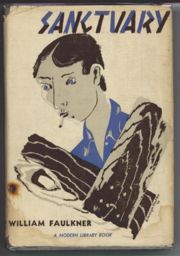
Sanctuary–William Faulkner

sanctuary.jpg

So I’ve been reading William Faulkner’s Sanctuary over the past few days. This was Faulkner’s breakthrough novel, the one that made him famous when it was published in 1931. He claimed that it was pot-boiler pulp fiction, written purely to make money, but who knows. I mean, we’re talking about a guy who chose to start spelling his name with a ‘u’ for some obscure reason–an author who worked from day one at creating the myth of himself as author. So who knows–maybe he actually thought he was writing a great piece of literature when he produced this lurid drivel.

Sanctuary is most famous for the rape of Southern debutante Temple Drake. She is raped with a corn cob. There you go. That’s pretty much all you need to know about this book. However, if you’re into elliptical and confusing depictions of violence, drunken debauchery, creepy voyeurism, and post-lynching sodomy, Sanctuary just might be the book for you.

There are two film adaptations of Sanctuary–1933’s The Story of Temple Drake, and 1961’s Sanctuary. Neither are readily available on VHS or DVD, and for good reason. They’re both pretty terrible. Still, the early sixties take on Sanctuary manages to capture the backwoods grotesque that saturates the novel. Actually, David Lynch could make a pretty decent film out of this.

My final analysis: I’m very very happy that I only have one more novel of Faulkner’s to read–Intruder in the Dust. Sanctuary did nothing but help consolidate my prejudice against Faulkner and my belief that the notion of Faulkner as an American Great is nothing but a scam.