the kid rakes an object from under the paper into his helmet and puts down the paper and stands and puts the helmet under his arm and crosses the plaza to his bike and puts his foot over the bike and starts it and pulls his gloves from the helmet and lays them on the tank in front of him and pulls on the helmet and fastens the strap and then pulls on the gloves and kicks back the stand and pulls away into the traffic.
night. two-lane blacktop road through the high desert. A car passes and the lights recede down the long straight and fade out. A man walks out from the scrub cedars that line the road and stands in the middle of the road and lights a cigarette. He is carrying a roll of thin braided wire over one shoulder. He continues across the road to the fence. A tall metal pipe is mounted to one of the fence posts and at the top—some twenty feet off the ground—is a floodlight. The man pushes the button on a small plastic sending unit and the light comes on, flooding the road and the man’s face. He turns it off and walks down the fence line a good hundred yards to the corner of the fence and here he drops the coil of wire to the ground and takes a flashlight from his back pocket and puts it in his teeth and takes a pair of leather gloves from his belt and puts them on. Then he loops the wire around the corner post and pulls the end of the wire through the loop and wraps it about six times around the wire itself and tucks the end several times inside the loop and then takes the wire in both hands and hauls it as tight as he can get it. Then he takes the coil of wire and crosses the road, letting out the wire behind him. In the cedars on the far side, a flatbed truck is parked with the bed of the truck facing the road. There is an iron pipe at the right rear of the truck bed mounted vertically in a pair of collars so that it can slide up and down and the man threads the wire through a hole in the pipe and pulls it taut and stops it from sliding back by clamping the wire with a pair of vise grips. Then he walks back out to the road and takes a tape measure from his belt and measures the height of the wire from the road surface. He goes back to the truck and lowers the iron pipe in its collars and clamps it in place again with a threaded lever that he turns by hand against the vertical rod. He goes out to the road and measures the wire again and comes back and wraps the end of the wire through a heavy three-inch iron ring and walks to the front of the truck, where he pulls the wire taut and wraps it around itself to secure the ring at the end of the wire and then pulls the ring over a hook mounted in the side rail of the truck bed. He stands looking at it. He strums the wire with his fingers. It gives off a deep resonant note. He unhooks the ring and walks the wire to the rear of the truck until it lies slack on the ground and in the road. He lays the ring on the truck bed and goes around and takes a walkie-talkie from a work bag in the cab of the truck and stands in the open door of the truck, listening. He checks his watch by the dome light in the cab.
“Casablanca, or, the Clichés Are Having a Ball” by Umberto Eco
When people in their fifties sit down before their television sets for a rerun of Casablanca, it is an ordinary matter of nostalgia. However, when the film is shown in American universities, the boys and girls greet each scene and canonical line of dialogue (“Round up the usual suspects,” “Was that cannon fire, or is it my heart pounding?”–or even every time that Bogey says “kid”) with ovations usually reserved for football games. And I have seen the youthful audience in an Italian art cinema react in the same way. What then is the fascination of Casablanca?
The question is a legitimate one, for aesthetically speaking (or by any strict critical standards) Casablanca is a very mediocre film. It is a comic strip, a hotch-potch, low on psychological credibility, and with little continuity in its dramatic effects. And we know the reason for this: The film was made up as the shooting went along, and it was not until the last moment that the director and script writer knew whether Ilse would leave with Victor or with Rick. So all those moments of inspired direction that wring bursts of applause for their unexpected boldness actually represent decisions taken out of desperation. What then accounts for the success of this chain of accidents, a film that even today, seen for a second, third, or fourth time, draws forth the applause reserved for the operatic aria we love to hear repeated, or the enthusiasm we accord to an exciting discovery? There is a cast of formidable hams. But that is not enough.
Here are the romantic lovers–he bitter, she tender–but both have been seen to better advantage. And Casablanca is not Stagecoach, another film periodically revived. Stagecoach is a masterpiece in every respect. Every element is in its proper place, the characters are consistent from one moment to the next, and the plot (this too is important) comes from Maupassant–at least the first part of it. And so? So one is tempted to read Casablanca the way T. S. Eliot reread Hamlet. He attributed its fascination not to its being a successful work (actually he considered it one of Shakespeare’s less fortunate plays) but to something quite the opposite: Hamlet was the result of an unsuccessful fusion of several earlier Hamlets, one in which the theme was revenge (with madness as only a stratagem), and another whose theme was the crisis brought on by the mother’s sin, with the consequent discrepancy between Hamlet’s nervous excitation and the vagueness and implausibility of Gertrude’s crime. So critics and public alike find Hamlet beautiful because it is interesting, and believe it to be interesting because it is beautiful.
On a smaller scale, the same thing happened to Casablanca. Forced to improvise a plot, the authors mixed in a little of everything, and everything they chose came from a repertoire of the tried and true. When the choice of the tried and true is limited, the result is a trite or mass-produced film, or simply kitsch. But when the tried and true repertoire is used wholesale, the result is an architecture like Gaudi’s Sagrada Familia in Barcelona. There is a sense of dizziness, a stroke of brilliance. Continue reading ““Casablanca, or, the Clichés Are Having a Ball” — Umberto Eco”→
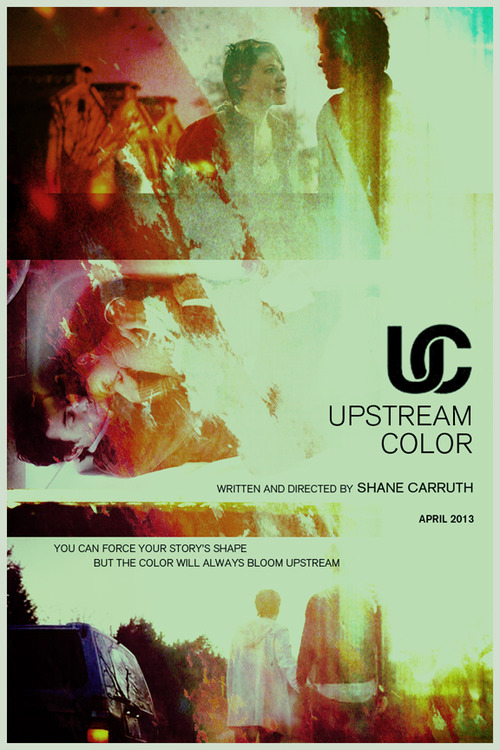
1. I managed to avoid reading anything about Shane Carruth’s new film Upstream Color before I saw it.
I just knew that this was the guy who did Primer, this was his new film, and I wanted to see it because Primer was so strange and engaging.
2. Two immediate responses after viewing Upstream Color:
i). The desire to see Upstream Color again and
ii). The desire to read what other people thought about Upstream Color.
3. (My wife and I, reading the credits, pausing the credits, reassessing the film against the backdrop of the credits, arguing about the film, discussing the film, etc.).
4. I think it’s better that if you have any interest at all in Upstream Color that you just see it cold [update/warning: the comments section of this post is full of spoilers]. But I know that 100 minutes is an investment of time, so maybe you’d like some kind of précis or at least description. So, a loose attempt, which surely will devolve into fragments and references:
Upstream Color is a sci-film, sort of.
Or maybe its a mystery film about ethics and biology.
Maybe a nature film, sort of.
Henry David Thoreau’s Walden.
Worms—parasites.
Theft.
Pigs.
Shades of Philip K. Dick, David Cronenberg, Terence Malick, but also something utterly original.
Mind control.
Trauma.
Ambient music.
Orchids.
Sampling nature.
Memory.
Swimming.
Drowning.
Creation: knitting, paper chains, music, seeds, life, children, etc.
A film that can and should be described as poetic.
It’s a love story, too.
5. It occurs to me that there’s a trailer for the film. I haven’t seen it yet. Should we watch it?
6. Does that do it for you? I don’t know how to do this anymore. Recommend things. I don’t know, the trailer makes the film perhaps look more pretentious than it is. It isn’t pretentious. It isn’t even confusing—just perplexing, haunting, troubling.
7. (Wanted: Quinoa Valley Record Co., complete discography).
8. My take on Upstream Color, spoiler-free, supporting-detail-free:
The film is about agency, about drive, about how the characters (and, implicitly, us, we, the audience, who identify with the characters on the screen) may be driven by something beyond us, something controlling us like a parasite (internal) or from afar like a ventriloquist (external). That even when we do assert agency the effect, the fallout, the shape lays beyond us, upstream.
9. (This morning, my wife telling me about her dream, a nightmare that our young daughter had ingested hallucinogenic mushrooms, clearly a response to the film).
10. I haven’t done a good job of really saying anything about the film. So, lazily:
I think Caleb Crain provides a perceptive and persuasive reading of the film in his essay “The Thoreau Poison.” He reads the film through the American transcendentalists, particularly Thoreau, of course, but also Emerson and Hawthorne.
There’s also a piece at Slate by Forrest Wickman that perhaps over-explicates but nonetheless offers perspective, including elements of Carruth’s own take.
11. (I will avoid Carruth’s explanation of the film until I’ve seen it a second time. Maybe I’ll avoid his explanation forever).
12. A take on Upstream Color that I don’t quite buy into (the take is my own): The film perhaps invites us to find metaphysical entities in two of its secondary characters, both of whom exert influence (creative and destructive) over the primary characters. Something something godlike, something something devillike.
I like that the film offers this simple duality and then crushes it, shows something far more complicated, suggests a cycle far more strange.
13. (White orchid. Blue orchid. Yellow orchid).
14. Upstream Color features minimal dialogue and nothing approaching traditional exposition, but we still learn about its characters, come to feel for them, feel their desires and traumas. The film is cerebral and philosophical, but it’s also emotional, offering an aesthetic that sublimely overwhelms the viewer.
15. Carruth wrote, produced, directed, scored, photographed, cast and starred in Upstream Color. (I’m sure he did a lot of other stuff too). He also distributed the film himself. The entire filmmaking process was untouched by the Hollywood system. There’s so much hope for film as an art form in this knowledge.
16. Parting thoughts: See Upstream Color. Resist imposing whatever film grammar you usually bring with you to the movies. Resist the temptation to see the film as a puzzle to figure out. See Upstream Color.
All of this seems so terribly ill-advised. The book is great—not Faulkner’s greatest, but it has a linear trajectory that I do think is filmable—but this trailer seems to portray a pale imitation of someone else’s vision of what a Faulkner film might look like (no, I don’t know what that sentence means exactly, other than this film looks like a bad riff on Faulkner).



 Biblioklept