Some Books I Plan to Read in 2013

20121228-105736.jpg

There are only a handful of forthcoming titles that I know about right now that I’m looking forward to reading next year: story collections from Sam Lipsyte (The Fun Parts) and George Saunders (Tenth of December), and a new novel from William Gass called Middle C. I’m also hoping Keith Ridgway’s Hawthorn and Child will finally get a US release, because I’d like to read it too.

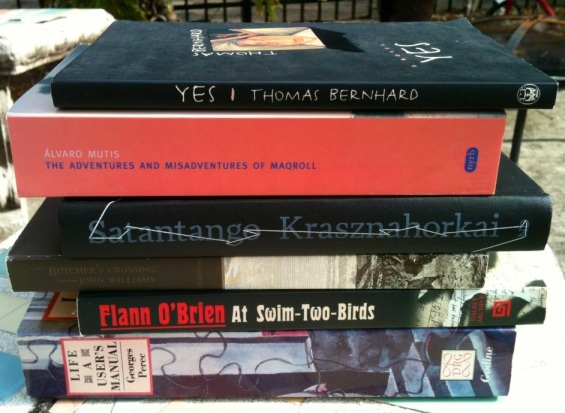
There are a few newish books that I didn’t read in 2012 that I’ll try to catch up to this year—Ben Marcus’s The Flame Alphabet, László Krasznahorkai’s Satantango, and Laurent Binet’s HHhH.

I do not currently possess any of these books.

I also look forward to reading Evan Lavender-Smith’s From Old Notebooks, back in print again from Dzanc (who I am sure will get the copy I ordered to me any day now).

At the top of my list though are the books I’m currently reading: Alvaro Mutis’s Maqroll novellas and Flann O’Brien’s At Swim-Two-Birds.

Stuff I’ve been saying I’ll read for a few years now that I hope to get to:

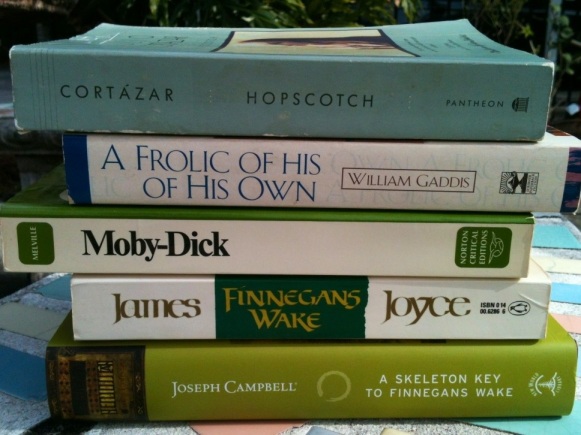
Cortazar’s Hopscotch, John Williams’s Butcher’s Crossing, Gombrowicz’s Ferdydurke, and, at the top of the heap, Georges Perec’s Life A User’s Manual.

20121228-111213.jpg

I have a few books by Thomas Bernhard that I’ll probably get into this year (when I feel called to a misanthropic monologue), and I’ll gobble up anything else by Barry Hannah that I can get my mitts on. I read William Gaddis’s “big books” last year, but I still haven’t read A Frolic of His Own, which I’ve heard is superior to Carpenter’s Gothic.

I’ll reread Moby-Dick this year (or at least listen to William Hootkins’s brilliant audio version) and I’ll probably end up rereading some book that I hadn’t planned to at all (this happened with 2666 and The Savage Detectives this year—who knows? I haven’t read Gravity’s Rainbow since college, and I haven’t reread Infinite Jest in full, and I’d love to go through Suttree again . . . ).

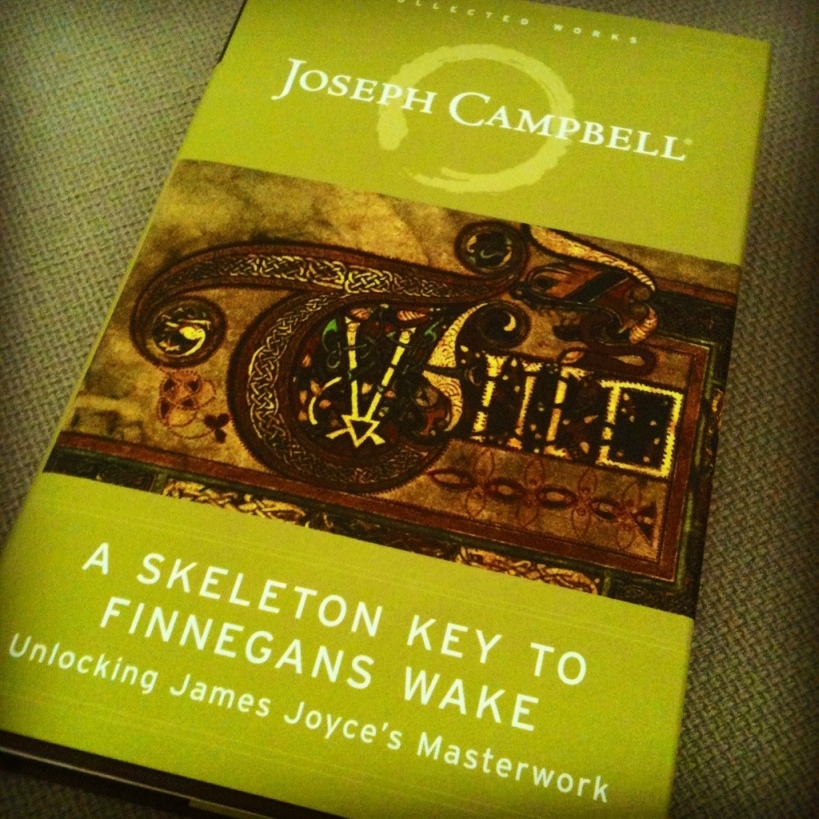
I dipped my toe into Finnegans Wake this year—I’ve found reading it on the Kindle late at night and then going through Joseph Campbell’s Skeleton Key the next morning is rewarding—and I’ll probably keep at it in 2013. Maybe I’ll make it to chapter 3.

But enough of my rambling—What books do you, dear reader, look forward to in 2013?

A Very Finnegans Wake Christmas

20121223-161734.jpg

20121223-161742.jpg

20121223-161754.jpg

20121223-161806.jpg

20121223-161817.jpg

20121223-161827.jpg

20121223-161840.jpg

Book Shelves #43, 10.21.2012

20121021-104711.jpg

Book shelves series #43, forty-third Sunday of 2012

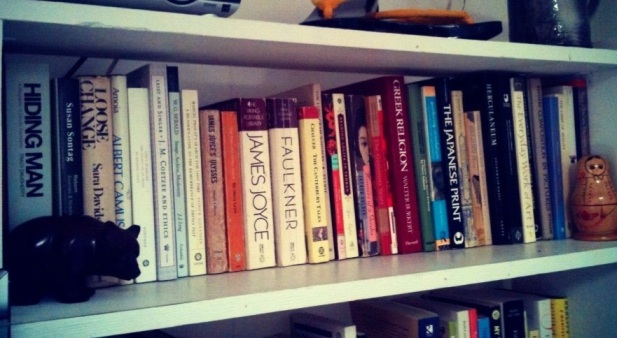
Kind of a hodgepodge shelf—some literary biography, a few now-redundant collections, some literary criticism, art books, etc.

Tracy Daugherty’s Donald Barthelme biography Hiding Man is on the far left; I reviewed it a few years ago, taking note of my favorite part, the so-called postmodernists’ dinner.

Next to it is Susan Sontag’s Reborn, a collection of early journals that I also reviewed.

Next to these two is Sara Davidson’s Loose Change. My aunt gave me a box of books years ago (lots of Asimov and Octavia Butler) and this was in here.

I knew about it because of a long essay in a 2007 issue of The Believer.

20121021-104718.jpg

I picked up Penguin’s The Essential James Joyce in Jimbocho, an area in Tokyo known for used bookstores.

I recall paying maybe ¥100 for it. It comprises a few selections from Ulysses and Finnegans Wake, some of  Joyce’s (totally unessential) poetry, and the entirety of Dubliners, Exiles, and Portrait. I’ve kept it because of sentiment (and  I like the cover).

20121021-104725.jpg

A Skeleton Key to Finnegans Wake (Book Acquired, 8.18.2012)


20120818-174214.jpg

A few weeks ago, for some reason beyond my ken, I stumbled into Finnegans Wake, read on the gentle glow of my Kindle Fire. I’ve been poking into the book for years now, but that particular night I read it with an ease—not an ease of understanding, but an ease of spirit, or of mind. Or ear, really. I had fun with it. I went back each night since then, sometimes only going through a page or two before slipping into slumbers.

Anyway, I’ve been searched for a used copy of Joseph Campbell’s Skeleton Key to the Wake for years, but I finally just broke down and ordered a new copy through my bookstore.  My plan is to read Finnegans Wake next year. It’s not a plan, so much as something I’ve just typed.


Finnegans Wake (With Bear)

20120527-204833.jpg

20120527-204844.jpg

20120527-204859.jpg

20120527-204905.jpg

20120527-204916.jpg

20120527-204937.jpg

20120527-204947.jpg

Finnegans Wake (With Bunny)

20120502-201713.jpg

20120502-201724.jpg

20120502-201732.jpg

20120502-201741.jpg

20120502-201752.jpg

20120502-201807.jpg

20120502-201817.jpg

20120502-201836.jpg

20120502-201846.jpg

20120502-201854.jpg

Book Shelves #19, 5.06.2012

20120502-173818.jpg

Book shelves series #19, nineteenth Sunday of 2012.

When I started this project, this shelf was all Tolkien and Joyce; now it’s mostly Gaddis and Joyce.

I have dupes of most of the Joyce books here; there’s also Joyce criticism/guides on the shelf.

Another angle. Glare is horrible. iPhone is not a good camera; lots of glare; shelf is much taller than me, etc.:

20120502-173845.jpg

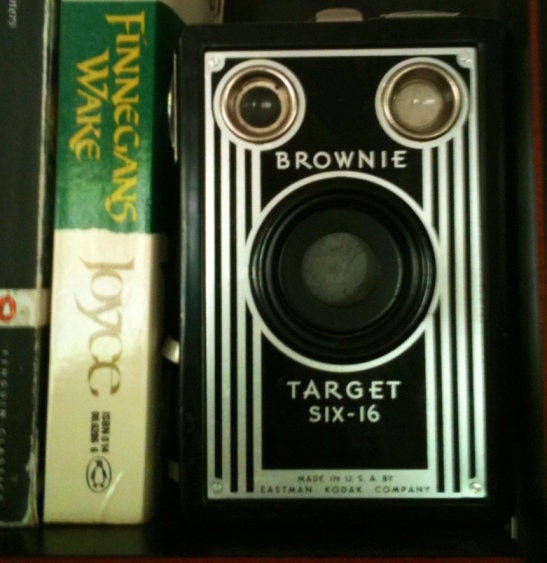
Here’s a tight shot of the Brownie Six-16 that serves as bookend:

20120502-173907.jpg

Something from Finnegans Wake :

20120502-174223.jpg

“Rhetoric” — A Page from James Joyce’s Notebooks

This page is from a notebook that contains some of Joyce’s preparatory notes for Ulysses—there are notes for characters (“Stephen,” “Simon,” “Leopold,” etc.) as well as lists (“Books,” “Recipes”) and general ideas (“Theosophy”). This particular page, “Rhetoric,” seems to be part of the material that went into the “Aeolus” chapter of Ulysses, which plays with the windiness of rhetorical figures. From the National Library of Ireland, via UbuWeb.

William Gaddis on James Joyce

William Gaddis on James Joyce (via/more):

I recall a most ingenious piece in a Wisconsin quarterly some years ago in which The Recognitions’ debt to Ulysses was established in such minute detail I was doubtful of my own firm recollection of never having read Ulysses.

(March 1972 letter to Jean [?] Howes)

I’ve about reached the end of the line on questions about what I did or didn’t read of Joyce’s 30 years ago. All I read of Ulysses was Molly Bloom at the end which was being circulated for salacious rather than literary merits; No I did not read Finnegans Wake though I think a phrase about “psychoanaloosing” one’s self from it is in The Recognitions; Yes I read some of Dubliners but don’t recall how many & remember only a story called “Counterparts”; Yes I read a play called Exiles which at the time I found highly unsuccessful; Yes I believe I read Portrait of an Artist but also think I may not have finished it; No I did not read commentary on Joyce’s work & absorb details without reading the original. I also read, & believe with a good deal more absorbtion [sic], Eliot, Dostoevski, Forster, Rolfe, Waugh, why bother to go on, anyone seeking Joyce finds Joyce even if both Joyce & the victim found the item in Shakespear, read right past whole lines lifted bodily from Eliot &c, all of which will probably go on so long as Joyce remains an academic cottage industry.

(June 1975 letter to Grace Eckley)

Books Removed from Stack, 10.07.2011

20111006-144432.jpg

Summer wanes into fall; time to clean out the stack of books in my nightstand. Most volumes were permitted to stay, but I’m going to go ahead and find shelf space for these fellows.

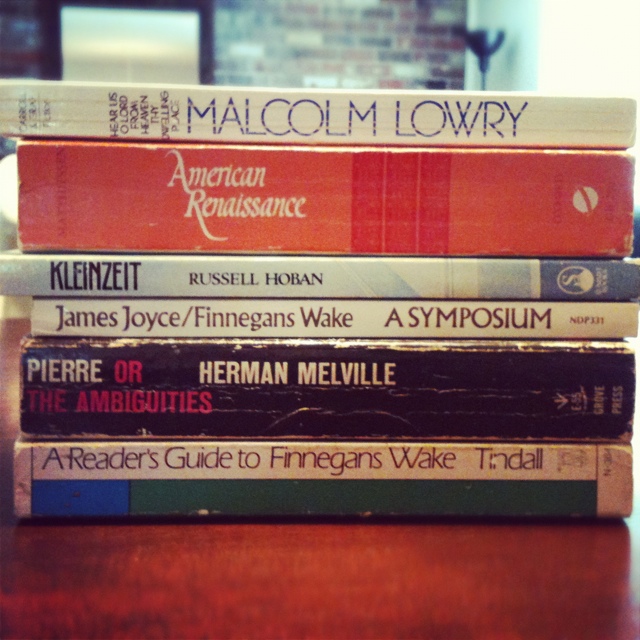
The Lowry book, Hear Us O Lord from Heaven Thy Dwelling Place collects short stories and other writings. It’s a muddled, unfinished affair, and I muddled through not very much of it, leaving it unfinished.

F.O. Matthiessen’s American Renaissance: Art and Expression in the Age of Emerson and Whitman is full of insight and keen writing, but its voluminous scope and long essays kept making me wonder why I wasn’t just reading Hawthorne and Melville themselves. No knock on lit crit, but it seems wiser to spend reading time on the originals.

Speaking of Melville—I gave his incest novel Pierre another (third?) serious shot this summer, influenced by the Matthiessen, I guess. No go. Got distracted. It’s long.

I did finish Kleinzeit by Russell Hoban, a baffling schizophrenic novel that has thwarted every attempt of mine to review it. Here’s a review: it’s a strange, funny novel, a cult novel without a big enough cult.

I read several of the essays in A Symposium (ones by Beckett and William Carlos Williams), as well as the letters it includes (attacking Finnegans Wake) and Sylvia Beach’s reluctant intro. An interesting book but sometimes dry. Its inclusion, along with Tindall’s A Reader’s Guide to Finnegans Wake remind me of the brave week I spent trying to get a handle on Joyce’s language vortex. For whatever reason, I left the Wake in the stack. A dare? A dare.

“Finnegans Wake: What It’s All About” — Anthony Burgess

Read Anthony Burgess’s essay on James Joyce’s Finnegans Wake. From said essay—

In his dream HCE, as we shall now call him, tries to make the whole of history swallow up his guilt for him. His initials are made to stand for the generality of sinful man, and they are expanded into slogans like “Here Comes Everybody” and “Haveth Childers Everywhere”. After all, sexual guilt presupposes a certain creative, or procreative, vitality, and a fall only comes to those who are capable of an erection. The unquenchable vitality appears in “our Human Conger Eel” (despite the “down, wantons, down” of the eel-pie-maker in King Lear); the erector of great structures is seen in “Howth Castle and Environs”. From the point of view of the ultimate dreamer of the dream, though (the author himself), “HCE” has a structural task to perform. As a chemical formula (H2CE3) or as a genuine vocable (“hec” or “ech” or even “Hecech”) it holds the dream down to its hero, is sewn to it like a mono­gram-HCE: his dream. But HCE has, so deep is his sleep, sunk to a level of dreaming in which he has become a collective being rehearsing the collective guilt of man. Man falls, man rises so that he can fall again; the sequence of falling and rising goes on till doomsday. The record of this, expressed in the lives of great men, in the systems they make and unmake and remake, is what we call history.

“Joyce Maims Words” — William Carlos Williams on James Joyce

William Carlos Williams on James Joyce (from Our Exagmination Round His Factification for Incamination of Work in Progress, a symposium on Finnegans Wake)—

Joyce maims words. Why? Because meanings have been dulled, then lost, then perverted by their connotations (which have grown over them) until their effect on teh mind is no longer what it was when they were fresh, but grows rotten as poi — though we may get to like poi.

Meanings are perverted by time and chance — but kept perverted by academic observance and intention. At worst they are inactive and get only the static value of anything, which retains its shape but is dead. All words, all sense of being is gone out of them. Or trained into them by the drill of the deadly minded. Joyce is restoring them.

Books I Am Always (Re-)Reading

Trudging through a very long book the other night–never mind the title, at least now anyway–it occurred to me that I’d rather be reading from 2666; that, at that particular moment, I’d rather re-read from “The Part About the Crimes.” I don’t know if it was the effete dullness of the first volume that made me want to pick up Bolaño’s epic, perhaps trying to zap some life into my waning eyeballs; perhaps it was just the sense that I was wasting my time with the merely good, which, after all, is mediocrity when set against genius (yes, these are subjective terms).

Anyway, I didn’t have to go looking for 2666 — I have a copy (yes, I have two) right there jammed into my nightstand, along with a few other books that I realize that I’m always reading. Furthermore, I’m always reading these books in the most discontinuous, stochastic fashion, often picking them up at random and thumbing through them. I think I use these books to clear my literary palate, to get a bad (or worse, boring) taste out of my brain, to inspire me, to suggest another book. Some of these books, like 2666 are big, fat volumes, volumes that I set close at hand in the hopes of rereading in full. Sometimes I’ve met this goal; in the case of Moby-Dick, I’ve read the book through at least three times now, and yet never tire of it. I’m always picking it up again and again, sometimes to find Elijah’s rant or to dip into Ahab’s mad monologue or perhaps just to hear Stubb comment on the proper preparation of shark steaks. Of a piece with those big novels is David Foster Wallace’s Infinite Jest, which I turn to repeatedly, reading over a riff or two at a time, perhaps still trying to figure out the ending, or some clue of the ending, perhaps trying to figure out why Hal can’t speak (you know, beyond like, a a metaphorical level).

There’s also Blood Meridian.

A book I always keep proximal is D.H. Lawrence’s Studies in Classic American Literature, which, if this were a dictatorship under Biblioklept might replace the Constitution (jaykay, Tea Partiers!). Tellingly, I’ve never managed to finish one of Lawrence’s novels (I even struggle through his much-anthologized piece, “The Rocking Horse Winner”), but I consider his dissertations on Hawthorne, Poe, and Melville indispensable (and creative in their own right). I guess I just like lit crit; Harold Bloom’s too-huge volume The Western Canon is a book I return to again and again. Sometimes I find myself throwing it to the ground, quite literally (if I’ve enjoyed a drink or two, that is), in disgust. Bloom’s battle with “The School of Resentment” can be maddening, especially when he’s so up front about essentially making Shakespeare God. Still, Shakespeare doesn’t seem like a bad God to have.

I should point out that I’ve made no attempt to read The Western Canon the whole way through; in fact, I’ve never made a single attempt to read it systematically. I just sort of pick it up, thumb through it, occasionally plumb the index. There are several books that I am always rereading in this category: Books That I Am Always Reading and Yet Have Never Finished. Foremost among these is Nietzsche’s Human, All Too Human, a book that I probably, at this point, have read in full, but never fully through. Its aphorisms beg to be read discontinuously; I think Nietzsche wet-dreamed about his fragmentary works being literally fragmented and then later found, read piecemeal against some newer, more garish culture. Or perhaps that’s just my metaphorical wet dream.

Other Books That I Am Always Reading and Yet Have Never Finished — The Life and Opinions of Tristram Shandy, Gentleman stands out, as does Finnegans Wake. Sterne’s book is such an oddity: I remember picking it up in a stack of books to be shelved at my college library, thumbing through it, bewildered, thinking that it must be contemporary with John Barth. A bit of research left me even more perplexed. Like Tristram, who can’t seem to finish his story, I can’t seem to actually finish it, but I’m okay with picking it up again and again. Similarly, Finnegans Wake strikes me as an unfinished-unfinishable volume (I do not mean this literally; I know that Joyce “finished” the book as an infinite strange loop, just as I know that the book can be read). I have an audio recording of Finnegans Wake that I like to listen to occasionally (especially while driving), as well as William York Tindall’s  guide (which is fun), but I’d rather just sort of grab the thing at random and read a page or two. I know, in an intellectual sense, that is, that I could easily read the book in a calendar year by committing to three pages a day (plus a few pages of Tindall), but I don’t think that I can read books in an intellectual sense. I think, at the risk of sounding unbearably corny, that books have to call to their readers in an emotional and perhaps even spiritual sense. Otherwise, what’s the point?

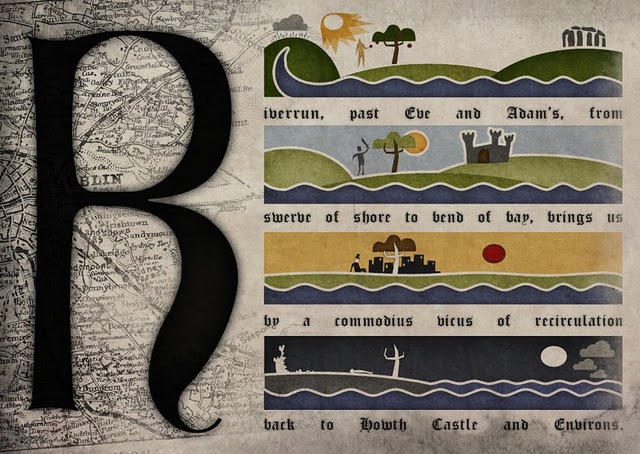
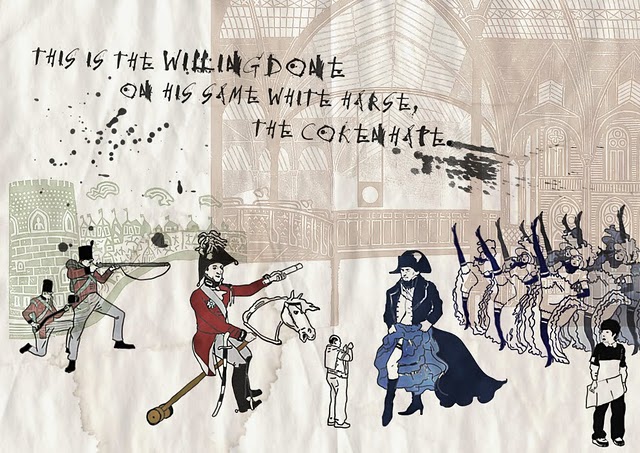
“Riverrun, past Eve and Adam’s” — Stephen Crowe Illustrates Finnegans Wake

First Line - Stephen Crowe

At Wake In Progress, Stephen Crowe has given himself the daunting task of illustrating James Joyce’s novel/linguistic black hole Finnegans Wake. It’s pretty cool stuff, and we love projects like these (see also: Six Versions of Blood Meridian and One Drawing for Every Page of Moby-Dick). Crowe’s site makes an interesting if different companion for the ongoing project at Ulysses “Seen.” Good luck to Stephen–keep them coming! (and thanks to @RhysTranter for sharing). More images–

Page 8 - Stephen Crowe
Page 19 - Stephen Crowe
Page 16 - Stephen Crowe

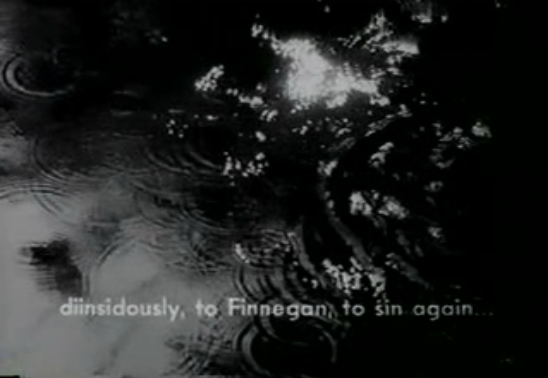
Passages From James Joyce’s Finnegans Wake — Mary Ellen Bute

finnegan

In the mid-sixties, Mary Ellen Bute made a surreal little film that kinda sorta illustrates James Joyce’s most inscrutable novel, Finnegans Wake. Watch the whole thing at UbuWeb Film. And you were going to celebrate St. Patrick’s Day by simply getting stinking drunk…for shame…for shame!

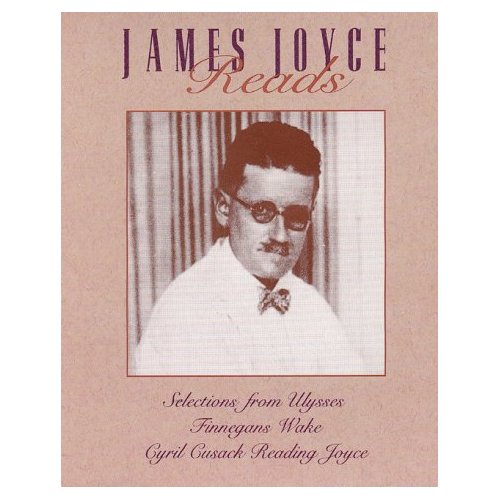
James Joyce Reads, You Listen!

Check out these mp3s of James Joyce reading selections from his novels (that word, “novel,” it doesn’t seem right…) Ulysses and Finnegans Wake. Lovely lilting rhythm. Mostly, it’s just cool to hear his voice. From the original liner notes by Sylvia Beach to the 1924 album (courtesy The Modern World):

In 1924 I went to the office of His Master’s Voice in Paris to ask them if they would record a reading by James Joyce from ULYSSES. But they would agree only if it were done at my expense. The record would not have their label on it, nor would it be listed in their catalogue. I accepted the terms: thirty copies of the recording to be paid for on delivery.

Joyce himself was anxious to have this recording made. He had made up his mind, he told me, that this would be his only reading from ULYSSES. Recording was done in a rather primitive manner in those days. All the same, I think the ULYSSES recording is a wonderful performance. I never hear it without being deeply moved.

James Joyce reads from Finnegans Wake (part I)

James Joyce reads from Finnegans Wake (part II)

Jams Joyce reads from Ulysses (from the “Aeolus” episode)

Or, if you prefer, check out Jim Norton reading the first few pages of Finnegans Wake (from the audio book version, which who knows if listening to counts as reading the thing–but it’s pretty cool to hear an adult man make these noises and think that such a thing might be Great Literature).

Ineluctable Modality of the Funny Papers


finnegan1.gif

The first line of Joyce’s Finnegans Wake in comics form. Part II here (but, um, there’s like more to the book, of course), and check out the rest of Galumph’s comic book poetry (“Tales of Adventure & Girls–Stories to Make You Sad”).