Book Shelves #20, 5.13.2012

1.4.  Things which aren’t books but are often met with in libraries

Photographs in gilded brass frames, small engravings, pen and ink drawings, dried flowers in stemmed glasses, matchbox-holders containing, or not, chemical matches (dangerous), lead soldiers, a photograph of Ernest Renan in his study at the College de France, postcards, dolls’ eyes, tins, packets of salt, pepper and mustard from Lufthansa, letter-scales, picture hooks, marbles, pipe-cleaners, scale models of vintage cars, multicoloured pebbles and gravel, ex-votos, springs.

 —From Georges Perec’s essay “The Art and Manner of Arranging One’s Books”

20120512-173054.jpg

Book shelves series #20, twentieth Sunday of 2012: In Which I Try to Prove I Am Not Just Phoning It In

Last week I was accused of “going through the motions” with this project, which accusation may or may not be true. I was out of town on vacation, and last week’s post was composed a few days ahead of time in a harried rush of end-of-the-semester grading + summer semester planning + packing + bad bad writer’s block.

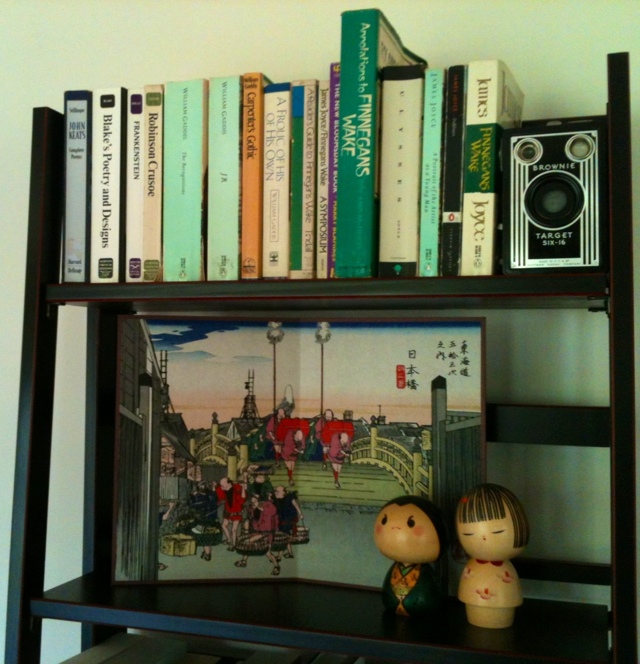
The shelf featured last week is the top shelf in the shot above.

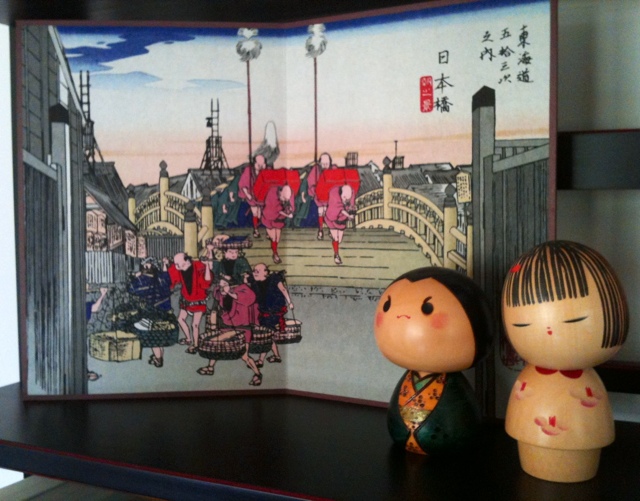
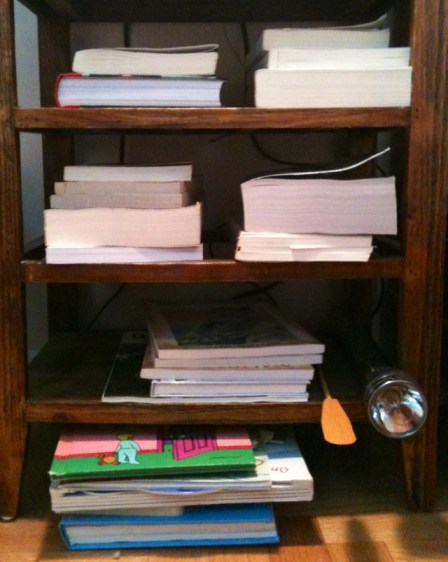
Here is a detail of the shelf below, which clearly features things which are not books:

20120512-173112.jpg

My wife and I—not actually married at the time, kids really—bought these kokeshi dolls when we were living in Japan. We lived in Tokyo, but I’m almost positive we bought these on a vacation in Kyoto. (Or maybe it was in Kamakura. Or I suppose it could have been in Tokyo).

20120512-173123.jpg

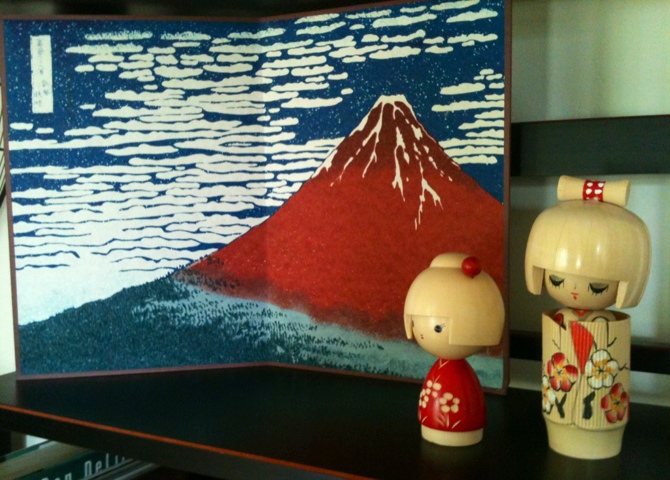
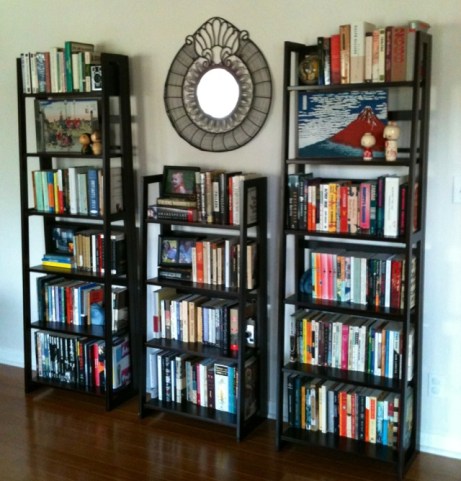
The screen in the background was a gift from a student, as was the screen in the shot below, a shelf that twins this one (if anyone cares at all, the shelf would be sequenced between shelves 10 and 11).

20120512-173142.jpg

20120512-173202.jpg

Book Shelves #11, 3.11.2012

20120310-192648.jpg

Book shelves series #11, eleventh Sunday of 2012. DeLillo, Denis Johnson, Pynchon (no, I have not read Against the Day nor finished Mason & Dixon). There’s also a hardback copy of Bolaño’s Between Parentheses; I have an ARC of the same shelved with the other Bolaños, which are on the shelf under—but the finished copy won’t fit on the shelf and it fits here. For now.

Book Shelves #9, 2.26.2012

We should first of all distinguish stable classifications from provisional ones. Stable classifications are those which, in principle, you continue to respect; provisional classifications are those supposed to last only a few days, the time it takes for a book to discover, or rediscover, its definitive place. This may be a book recently acquired and not read yet, or else a book recently read that you don’t quite know where to place and which you have promised to yourself you will put away on the occasion of a forthcoming ‘great arranging’, or else a book whose reading has been interrupted and that you don’t to classify before taking it up again and finishing it, or else a book you have used constantly over a given period, or else a book you have taken down to look up a piece of information or a reference and which you haven’t yet put back in its place, or else a book that you can’t put back in its place, or else a book that you can’t put back in its rightful place because it doesn’t belong to you and you’ve several times promised to give it back, etc.

—Georges Perec, from “The Art and Manner of Arranging One’s Books”

Book shelves series #9, ninth Sunday of 2012: In which I photograph three book shelves that I will examine more closely over the next several weeks.

Georges Perec goes on to admit that over three-quarters of his own books are provisionally categorized (at best). Libraries, like governments and tectonic plates and personalities, are not stable entities. Still, most of us try to impose some sense of order on our book collection, even if it’s an order apparent and relevant to ourselves alone. The three book shelves photographed below are probably the most “stable” in the house:

20120226-105205.jpg

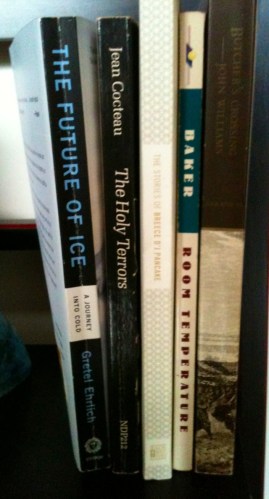
Despite an ongoing process of accretion, relocation, and removal, these shelves tend to remain fairly constant, with minor rearrangements happening maybe monthly instead of weekly or daily. As of today, there’s only one slim piece of a shelf “free”—that is, holding unsorted books waiting to be read, shelved, or, in one case, reviewed (I swear I’ll make another stab at writing up Breece D’J Pancake one day . . .). These books will be elsewhere by the time I get to photographing the shelf they rest on now:

20120226-105217.jpg

Book Shelves #2, 1.08.2012

. . . it’s not too difficult, very obviously, to keep ten or twenty or let’s say even a hundred books; but once you start to have 361, or a thousand, or three thousand, and especially when the total starts to increase every day or thereabouts, the problem arises, first of all of arranging all these books somewhere and then of being able to lay your hand on them one day when, for whatever reason, you either  want or need to read them at last or even to reread them.

Thus the problem of a library is twofold: a problem of space, first of all, then a problem of order.

—Georges Perec, from “Brief Notes on the Art and Manner of Arranging One’s Books” (1978)

Book shelves series #2, second Sunday of 2012. Master bedroom: Corner piece bookshelf in the southwest corner; two tiers + top shelf.

I didn’t take a picture of the entire bookshelf, a humble little two-tier piece that abuts the corner of any room with corners. Actually, I did take a picture—a few—but they just looked awful. Like I said in the first installment of this series, it’s not my goal to present aesthetically pleasing portraits of bookshelves.

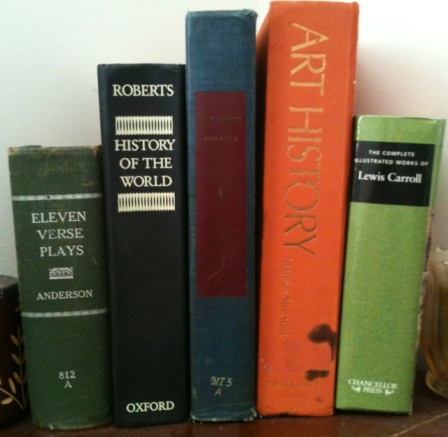
This corner bookshelf was my grandmother’s and I’ve had it for at least 10 years. The top shelf holds five books that rest there for entirely aesthetic purposes; looking at them now I realize that, with the exception of the Audubon volume in the middle and the Lewis Carroll on the end, I’ve never even bothered to flick through them. They look strange photographed here without the framed photographs, plants, and tchotchkes that attend most shelves in the house:

20120107-141429.jpg

At one point, this entire piece of furniture was double shelved (is this a term? Do you know what I mean here?) with cheap mass market paperbacks, the kind of books that I bought and received for years. I rarely buy mass markets anymore; nor do I like hardbacks. I’m a trade paperback man. Still, some of the sci-fi/dystopian lit here was fundamental to my early reading habits, to the point where I even pick up newer volumes (like Philip Pullman’s books) in mass market paperback.

We also see here the first of many cameras scattered throughout the books in this house. This particular Polaroid is likely the least antiquated; I think it’s from 1999 or 2000. I took all these photos with an iPhone:

20120107-141441.jpg

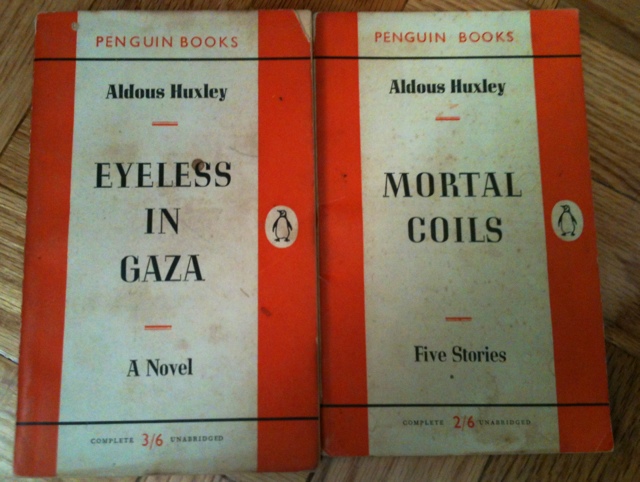
The shot is blurry, so you might not make out the cracked spines, but there are many Huxley books there (although it occurs to me now how odd it is that only one Vonnegut volume is there, when I know that I have so many more somewhere). Two noteworthy Huxleys:

20120107-141453.jpg

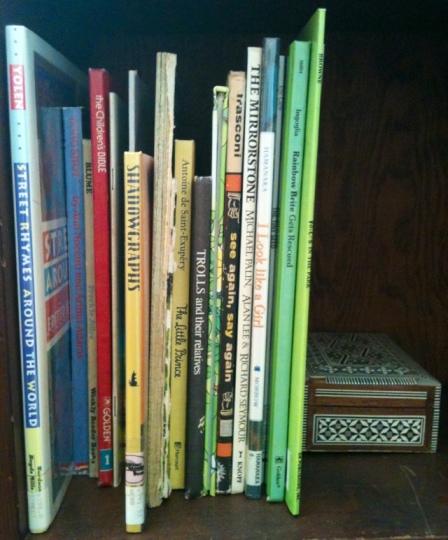
We have children. There are children’s books everywhere in the house, organized in no particular fashion. The drawing and painting books belonged to my grandmother, who was an amateur painter. I am fairly familiar with these books.

20120107-141500.jpg

More kids books. They were probably stuffed here after piling up on the floor one night. The box is full of homemade dice and preserved insects:

20120107-141508.jpg

And more mass markets—sci-fi and fantasy. Many of these were, uh, “borrowed” and never returned, either from a school that I used to work for (The Left Hand of Darkness; Alas Babylon, the aforementioned Pullman volumes), or from dear friends (I’m looking at you, William Gibson books). There are probably 50 more books like this in a secret stash in the back of the house, out of sight:

20120107-141519.jpg

The Lord of the Rings trilogy is an early paperback edition, sporting Tolkien’s original illustrations. My aunt gave me these. I’ve probably read The Lord of the Rings more than any other book, and I’m almost certain that I’ve owned it in more editions than any other book:

20120107-141526.jpg

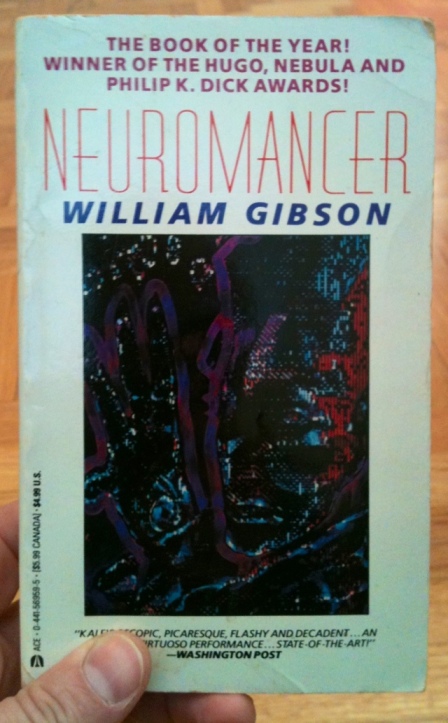
 A dear friend lent me Gibson’s Neuromancer years ago; I know Gibson’s other early books (the first two trilogies) must be somewhere around the house, unless I passed them on, but I’ve always been fond of this book, which taught me how to read in some ways:

20120107-141534.jpg

So we’ve made it out of my bedroom—I chose not to take a picture of my wife’s night stand, for her privacy, I suppose, although she might not have cared. (She doesn’t read this blog and is likely unaware of this weird project). There was a Hayao Miyazaki adaptation she was reading to our daughter there, and Hemingway’s novel The Garden of Eden, which I think she finished just the other night.

Book Shelves #1, 1.01.2012

Every library answers a twofold need, which is often also a twofold obsession: that of conserving certain objects (books) and that of organizing them in certain ways.

—Georges Perec, from “Brief Notes on the Art and Manner of Arranging One’s Books” (1978)

For all of 2011 and half of 2010, I ran a death mask on this blog every Sunday. I liked the idea of having a regular, uniform post on the blog, and I enjoyed searching for death masks (and life masks) and learning about them. However, my interest is waning; it’s time to move on.

Still wanting to run a regular post each Sunday, I’ve elected to photograph the bookshelves, or the surfaces that hold books in my house. These will not be beautiful, arranged pictures, but rather simple pics from my iPhone documenting the spaces that books occupy. I will photograph each space “as is” and then remove a book or two, photograph it, and then comment on it.

I didn’t know where to start, so I started with what may be the most plain book shelves in my home, the nightstand next to my bed. (Right now it is unusually tidy, having been cleaned out and partially restocked for the new year; in a week or two it will be crammed to its wooden gills). Here is what it looks like:

20111231-112128.jpg

Not very exciting, I know! This is perhaps the only photo in this book shelf series that will not feature shots of spines. Like I said, I don’t plan to arrange any of the shots in this series. I talked about a lot of what’s in here in yesterday’s riff on recent reading and a post last week on stuff I plan to read in 2012.

Stuff on the top tier tends to be stuff I’m currently reading; the second shelf is filled with books I’m always rereading, or picking at slowly. The third shelf is where stuff goes to marinate or get dusty or cry to be shelved.

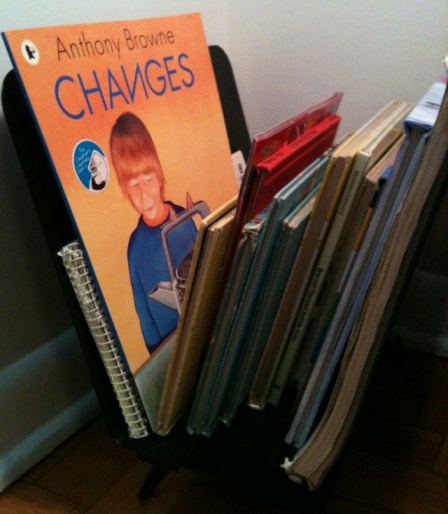
There’s also a bunch of kids book on the floor. More kids books are in this giant magazine stand, along with some notebooks, art pads, and probably an actual magazine or two (Anthony Browne’s book Changes is a surrealist masterpiece for kids, by the way):

20111231-112135.jpg

The Perec quote above comes from an essay collected in Species of Spaces and Other Pieces. “Brief Notes on the Art and Manner of Arranging One’s Books” will be in some ways the guiding inspiration for the Biblioklept book shelf series; my aim is not so much to present beautiful pictures that show off my books (I’m not equipped to do that, and other people do it very well already), but to comment on how my books are arranged and how they move and flow throughout the house; it will also give me a good opportunity to pick up books that might have been lingering (do books linger?) on a shelf for sometime.

I pulled these three books, not quite at random, from the shelves. The Perec book is one of those volumes I like to read scattershot-style. The latest issue of Paris Review still has a few pieces I haven’t read. Nausicaa: I meant to start it the other night. It will migrate to another room, a day-reading room, not a night-reading room:

20111231-112151.jpg

I don’t anticipate future book shelf posts being quite this long; my intention here is to kind of set the ground rules (for myself) or delineate both spirit and letter to this project. As such, a final note on movement: I will move “outward” from this nightstand, photographing any place where books are set. I will photograph every kind of book in this house in its natural habitat; this includes children’s books and cookbooks, but does not include personal photograph albums, instruction manuals, or anything else of that nature. I plan to do 53 total book shelf posts, including this one (there are 53 Sundays in 2012).

My hope is that readers will respond to these posts by sharing their own bookshelving habits.

Books I Didn’t Read in 2011 (And Books I Will Try to Read in 2012)

Okay. So obviously a list of the books I didn’t read in 2011 would be, y’know, long.

This post is about the books I set out to read, tried to read, wanted to read, abandoned, neglected, acquired and thought looked interesting, etc. It’s also about what I want to—what I plan to—read in 2012.

20111228-115819.jpg

A reasonable starting place: I wrote a post in early January of this year detailing the books I would try to read in 2011. I actually read most of the books I named in that post. But:

I failed to read past page 366 of Adam Levin’s incredibly long novel The Instructions, although I think I was a bit too harsh in my semi-review. Chalk it up to exhaustion.

I failed to even begin to try to read William Gaddis’s incredibly long novel JR. (But I swear to read it one year. Not next year, but maybe the year after?).

I failed to read past the first chapter of Katherine Dunn’s Geek Love.

I read most of the Tintin collections I picked up last year, but I didn’t get to volumes 5 or 6.
20111228-115848.jpg

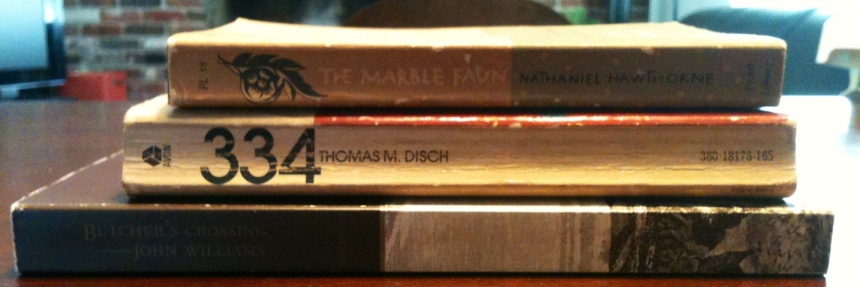
Moving beyond that early post, books that I recall abandoning (although I’m sure there must be more):

I abandoned Nathaniel Hawthorne’s Italian romance The Marble Faun after about 30 pages.

I abandoned 334 by Thomas Disch after about 50 pages. Somehow simultaneously dense and loose, it struck me as intensely imagined and sloppily composed.

I abandoned John Williams’s Butcher’s Crossing after the first chapter; it was a great opening chapter, but I thought it was going to be, I don’t know, more like Blood Meridian.

I also abandoned Chad Harbach’s big book The Art of Fielding (after 100 pages) because it was lame (notice it’s not pictured above because I traded in that sucker), but I had a nice dialog with some readers who responded to a post I wrote about abandoning it, so that was a plus.
20111228-115828.jpg

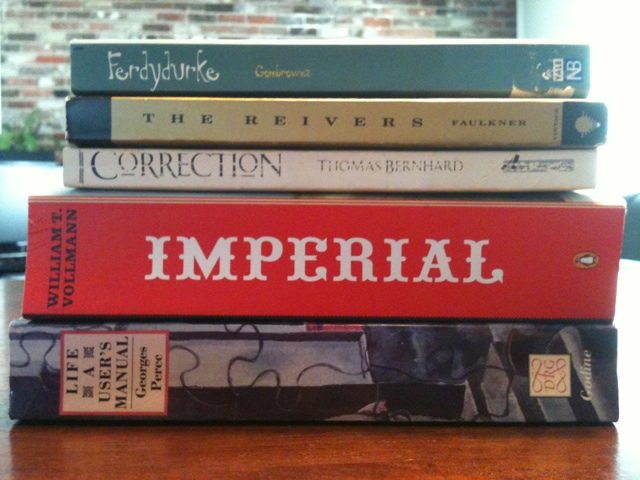
Books I bought in 2011 that I aim to read in 2012:

Correction by Thomas Bernhard. Bernhard was a repeated suggestion from readers in the aforementioned Harbach post/rant, and he was apparently a huge influence on W.G. Sebald, so, yes, looking forward to this.

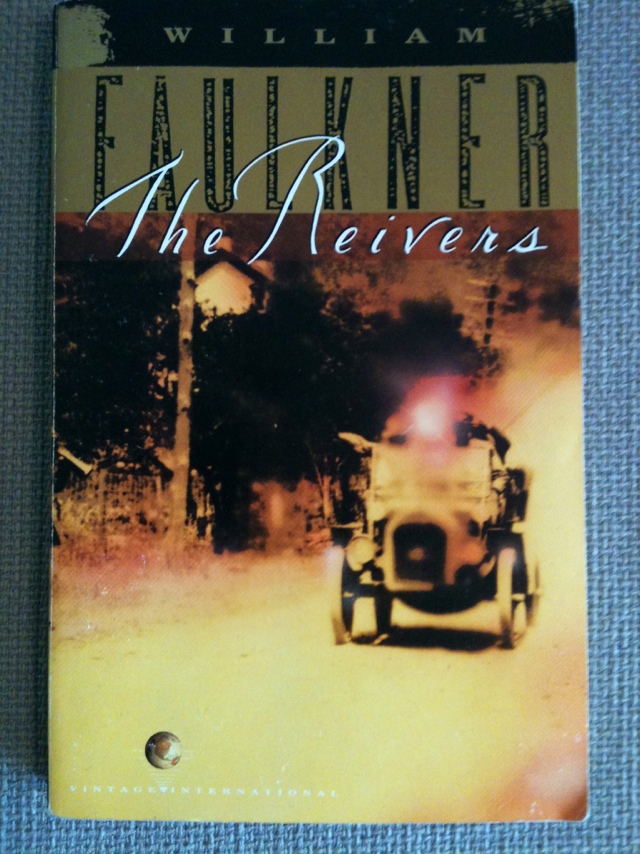
The Reivers by William Faulkner. I read A Light in August this year and reread most of Go Down, Moses. My plan is to read one Faulkner a year for the next ten years.

Ferdydurke by Witold Gambrowicz. I struggled to make it through Gombrowicz’s bizarre jaunt Trans-Atlantyk, but once the novel taught me how to read it, I was enchanted by its strange humor and frenetic syntax. Over some beer and wine, I had a conversation about Ferdydurke with my father-in-law’s priest who is Polish. His pronunciation of Ferdydurke should win an award for charm.

I will read Georges Perec’s big book Life: A User’s Manual.

I have already promised to read William Vollmann’s Imperial.

There are many, many more, of course (too many, really).
20111228-115835.jpg

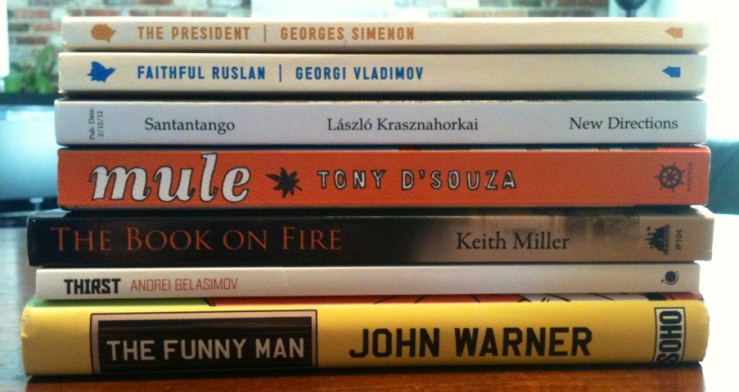
Books people sent me to read and review that look really cool that I will be reading and reviewing at some point in the very near future:

Satantango by László Krasznahorkai: I will read this and review this in the very near future.

The Funny Man by John Warner: Comedy, drugs, celebrity culture.

The Book on Fire by Keith Miller: This one is about a biblioklept. It’s been at the top of my stack for a few months now, but I keep letting myself get distracted.

Thirst by Andrei Gelasimov: Apparently this novella about a maimed alcoholic war vet is funny. (I hate the cover).

Mule by Tony D’Souza: Middle class man sells marijuana cross country. (I love the cover).

Various titles from Melville House’s Neversink line: I’ve got a few in the stack.

Also: I got a Kindle Fire for Christmas. I actually stayed up really late last night reading free public domain books from Hawthorne, Melville, Whitman, and Dickinson; I’ll read a contemporary novel on it this year—Neal Stephenson’s Snow Crash, perhaps? Suggestions welcome!—and try to review both novel and the process of reading the novel on a warm glowing machine.

And: I’m sure there are a ton of novels that will come out in 2012 that I’ll want to read; I’m already primed for Dogma, Lars Iyer’s sequel to Spurious.

So: What are you guys looking forward to reading in 2012? What did you fail to read in 2011?

Books Acquired, 12.21.2011

20111227-194728.jpg

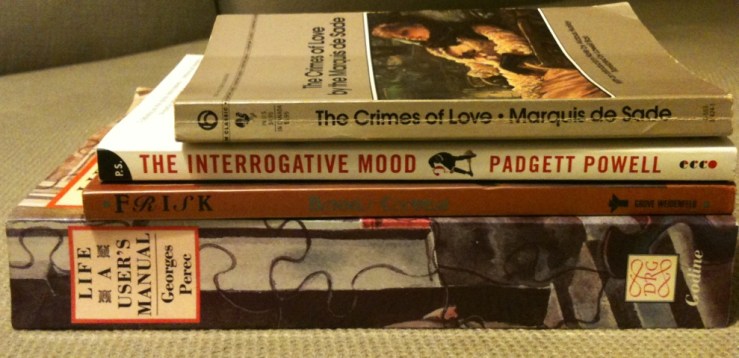
So, obviously I can’t manage to do these “Books Acquired” posts in a timely fashion, let alone chronologically. Anyway, I’m certain of the date I picked up these four because I ended up writing this post about why novels make lousy gifts later that day. As always, the iPhone pic is a bit blurry. It’s tough work lighting books, believe it or not, and they’re usually different dimensions, etc., gripe, whine. Jeez. So these books are: The Crimes of Love by Marky de Sade, which I dunno, I’ve been compelled to read him lately; The Interrogative Mood by Padgett Powell, which did you know is written entirely in questions? And did you know that Powell was (is) the big-time writer in res at my alma mater? And do you care? And why? The Dennis Cooper novel is Frisk. I always scour this particular bookshop for Cooper, but have never had any luck. So on this particular trip, of course someone has let go of his entire collection of Cooper, like six or seven novels (not God Jr. or the short story collection though, which seemed like good starting places). I picked Frisk sort of at random. I’ve been looking for Georges Perec’s Life: A User’s Manual for a while too, so I was happy to pick it up. I consider it assigned reading in 2012.

I also picked up books as gifts that day, including some children’s books for my kids, and a first edition hardback copy of Brugo Partridge’s A History of Orgies. 

Eleven Encyclopedic Books, Overstuffed with References, That Compel Compulsive Reading

Eleven Encyclopedic Books, Overstuffed with References, That Compel Compulsive Reading

1. Moby-Dick, Herman Melville

2. Finnegans Wake, James Joyce

3. Expelled from Eden, A WilliamVollmann Reader

4. Species of Spaces and Other Pieces, Georges Perec

5. Wittgenstein’s Mistress, David Markson

6. The Silmarillion, J.R.R. Tolkien

7. Foucault’s Pendulum, Umberto Eco

8. The Rings of Saturn, W.G. Sebald

9. The Recognitions, William Gaddis

10. Between Parentheses, Roberto Bolaño

11.  The Architecture of the Arkansas Ozarks, Donald Harrington


“On the Difficulty of Imagining an Ideal City” — Georges Perec

“On the Difficulty of Imagining an Ideal City,” a poem or essay or something—a text—by Georges Perec. The piece is one of the selections in Perec’s collection of miscellany, Species of Spaces and Other Pieces:

I wouldn’t like to live in America but sometimes I would

I’d love to live on the Boulevard St Germain but sometimes I wouldn’t

I wouldn’t like to live on a coral reef but sometimes I would

I wouldn’t like to live in a dungeon but sometimes I would

I wouldn’t like to live in the East but sometimes I would

I love living in France but sometimes I don’t

I’d love to live in Greenland but not for too long

I’d like to live to a hundred but sometimes I wouldn’t

I wouldn’t like to live in Issoudun but sometimes I would

I wouldn’t like to live on a junk but sometimes I would

I wouldn’t like to live in a ksar but sometimes I would

I’d have loved to go in a lunar module but it’s a bit late

I wouldn’t like to live in a monastery but sometimes I would

I wouldn’t like to live at the Hotel Negresco but sometimes I would

I wouldn’t like to live in the open air but sometimes I would

I love living in Paris but sometimes I don’t

I wouldn’t like to live in Quebec but sometimes I would

I wouldn’t like to live by my own resources but sometimes I would

I wouldn’t like to live in a submarine but sometimes I would

I wouldn’t like to live in a tower but sometimes I would

I wouldn’t like to live with Ursula Andress but sometimes I would

I wouldn’t like to live in a village but sometimes I would

I wouldn’t like to live in a wigwam but sometimes I would

I’d love to live in Xanadu but not for ever

I wouldn’t like to live in the Yonne but sometimes I would

I wouldn’t like us all to live in Zanzibar but sometimes I would

Books Acquired, Sometime Last Week (I Don’t Know, Maybe on Thursday or Friday)

I picked up a bevy of books at my favorite bookstore sometime last week ; can’t remember the day, exactly. Anyway, some of these selections come from reader recommendations re: nonconventional lit.

20111103-155310.jpg

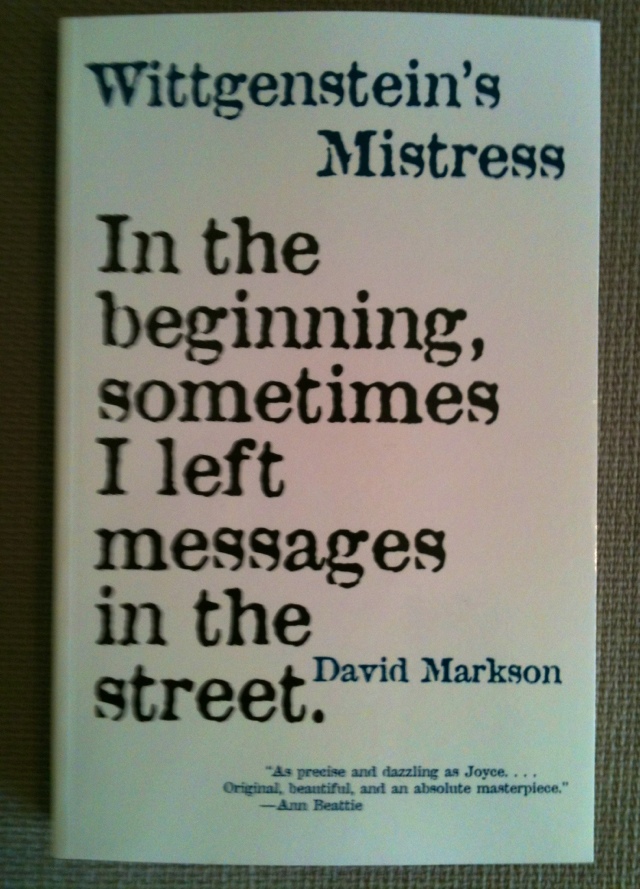
I ordered David Markson’s novel Wittgenstein’s Mistress, which I’ve been meaning to read for yonks but had never found used. Horrible, horrible cover

20111103-155319.jpg

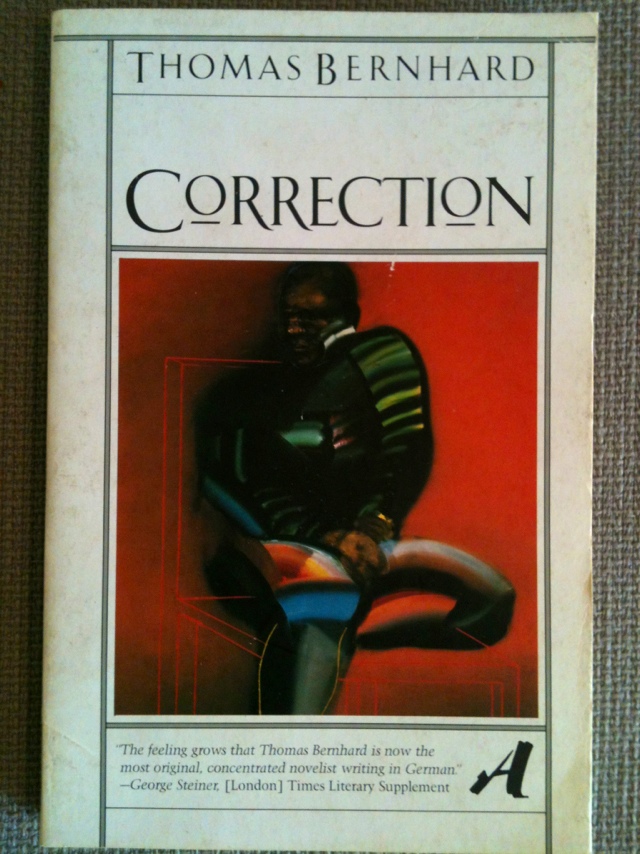
Bernhard’s Correction: Thomas Bernhard came recommended by a number of readers in the aforelinkedto post; dipping into Correction immediately recalled Sebald’s The Rings of Saturn for some reason.

20111103-155327.jpg

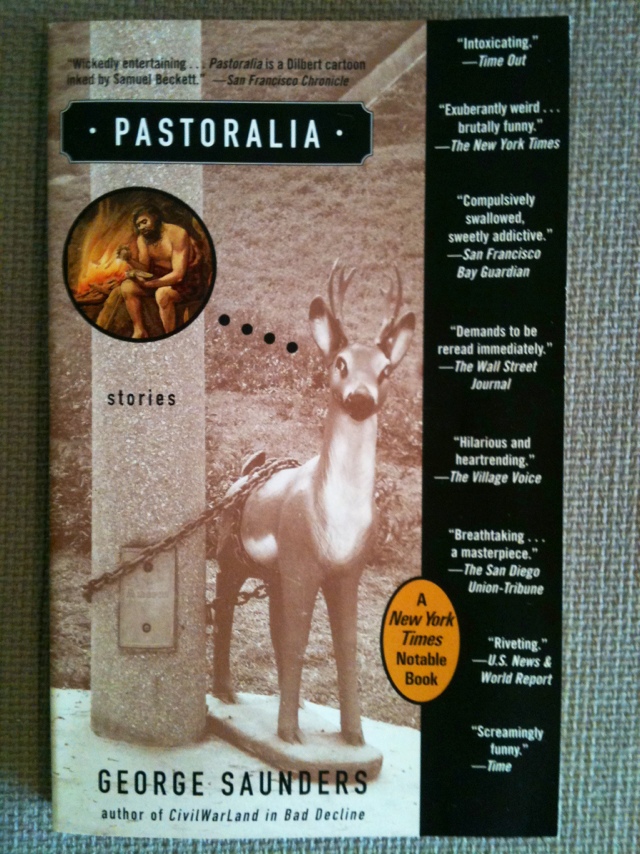
George Saunders: another reader recommendation. I actually read Pastoralia this week. I love short stories. Anyway, full review forthcoming. Short version: good stuff, but DFW casts a pretty big shadow.

20111103-155351.jpg

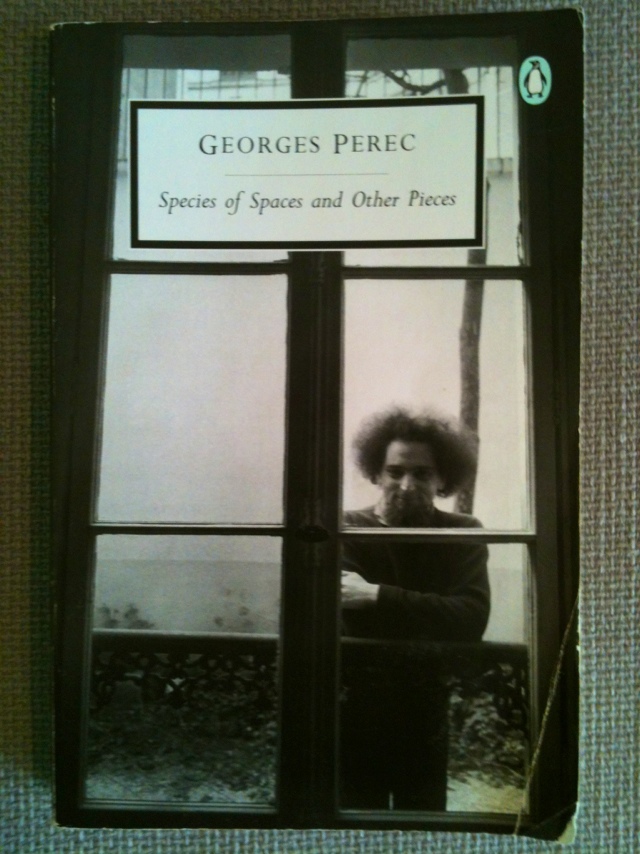
Georges Perec was another reader rec, but it was his novel Life: A User’s Manual that kept popping up. I found Species of Spaces and Other Pieces, his collection of essays and other stray bits, by sheer chance. I think I was looking for something by De Sade, actually. Anyway, I love, love, love this book—it kinda reminds me of Bolaño’s Between the Parentheses or even the Vollmann reader Expelled from Eden—the kind of book I see myself dipping into again and again, a little mini-labyrinth of ideas.

20111103-155359.jpg

I also picked up Faulkner’s last novel, The Reivers; been wanting to read it for a long time now. I’ll try to get it in over the Christmas break.