The dead ride fast | Notes on Thomas Pynchon’s Shadow Ticket, Ch. 33-34

Notes on Chapters 1-7 | Glows in the dark.

Notes on Chapters 8-14 | Halloween all the time.

Notes on Chapters 15-18 | Ghostly crawl.

Notes on Chapters 19-20 | The needs of cold capitalist reality and those of adjoining ghost worlds come into rude contact.

Notes on Chapters 21-23 | Phantom gearbox.

Notes on Chapters 24-26 | Idiots get respect out here, they’re believed to be in touch with invisible forces.

Notes on Chapters 27-29 | We’re in for some dark ages, kid.

Notes on Chapters 30-32 | Some occult switchwork


Chapter 33 is the big-budget action sequence of Shadow Ticket, in which the “pocket-size golem Zdeněk” and musician/secret agent Hop Wingdale rescue Ace Lomax from the clutches of the fascist Vladboys in their “Hungaro-Croatian terrorist training camp, located right on the borderline.” (Notably–significantly–Hicks is missing from the rescue team.)

The narrator informs us that the camp is “flexibly all-purpose Fascist, quivering in readiness to be deployed anywhere…briefly innocent as Fascism in its ‘springtime of beauty,’ as the old anthem goes, before it descended into paperwork and brutality…” We tend to think, rightly, that fascism is a rejection of progressive values, but it’s worth remembering that much of what we now think of as Modernism was wrapped up in proto-fascist idealizations of energy and action — consider Filippo Tommaso Marinetti’s Manifesto of Futurism f’r’instance…

The camp where Ace is being held prisoner is a hotbed of action:

“Fascist adventurers have journeyed here from all over, Austrians sporting blue cornflowers and black grouse feathers, secret police, anti-Red goon squads, revolutionary cells, convicts escaped from internal exile and not sure where they are right now or what language they’re supposed to be speaking, colonial stooges in civvies in from as far afield as Indo-China and South America, irredentist aristos from the old Hungarian kingdom adrift in nostalgia, Polish freelancers working on spec for all of the above.” 

I love the force of the sentence. For such a breezy novel, Shadow Ticket is dense. We might take it as a sketch of a much larger, thicker, denser novel.

Well so and anyway–

The deal is that Hop’s band shows up to play this fascist gig; he’s informed that they, the fascist paramilitary Vladboys, “are pretending to invade Fiume, which any number of potential clients want back.” The garrulous entertainment liaison who meets with the band opines that such an invasion would be “all over in a day or two. Anasa supo.”

That last phrase, anasa supo, is Esperanto for duck soup, an American idiom referring to a task easily accomplished. Duck Soup is also of course the title of the 1933 Marx Brothers that centers (oh-so-anarchically) around the tiny nation of Freedonia–a bilocation of Fiume? Here’s a bit of bilocation from Duck Soup:

Hop and his band will play their swing tunes in “ruined limestone amphitheater, once dedicated to bloodletting presented as amusement, back when the Fifth Macedonian Legion were busy here invading and occupying.

The entertainment menu is “A Gay Evening with Vlad Ţepeş,” with riffs including “Vlad’s Vegetarian Chef”…(“Turnip loaf again, remind me to have the chef impaled”) and “Vlad at the Office” (the Count laments that they never call him “Vlad the Spending Reducer.”)
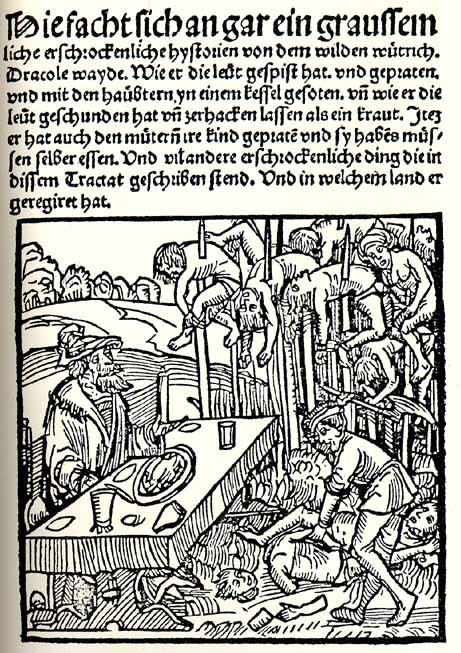
1499 German woodcut depicting Vlad the Impaler dining among his victims: “Here begins a gruesome and terrible history of the wild tyrant, Dracole Wayde. How he had people impaled, roasted, and boiled in a kettle with their heads. How he had people flayed and their skin salted like cabbage. He also had mothers’ children roasted, and they had to eat them themselves.”

Is this “Vlad Ţepeş” just a performer playing a character in the evening’s festivities, vamping on a riff–or is it, like, the Vlad Ţepeş, son of Vlad Dracul, Voivode of Wallachia, born half a century before the events of Shadow Ticket — like, Dracula man Vlad? A few paragraphs later, we are briefly introduced to the thug guarding Ace, “Csongor…a sort common in these parts, an apprentice vampire doomed never to develop past journeyman.” On one hand, the language here, and the general supernatural bent of Shadow Ticket suggests that these are like real (as in mythological) vampires — but the novel’s themes of bilocation also hedge the bet: vampire here could be a metaphor; the Vlad Ţepeş could be merely an actor playing a part.

Pynchon renders the scene in the kind of sexualized language we’d expect from vampire stories: “Vladboys have been building up, sending them out after prey each time in a more dangerous state of arousal. Trivial disputes are apt at any moment to erupt into violence. Local women go more and more in fear of their safety, cover their hair, stay in groups. The weirdly erotic charge accumulates, until vrrrooom! here’s the Vladboys out on another massive prowl…”

The prowl, as we’ve already learned, scores “Ace…an understandably welcome catch, with the Flathead an unexpected bonus, which the boys keep insisting is a Jewish motorcycle.” (The idiot vladboys reasoning? “Harley. David…Son, this is son of David, no?”)

Standing guard over their “welcome catch,” journeyman vampire Csongor takes interest in Ace’s tattoo: “’Die Todten reiten schnell,’ the Vladboy reads from the Gothic lettering there. ‘Something about the dead ride fast.'”

The phrase “Denn die Todten reiten schnell” appears in the opening chapter of Bram Stoker’s Dracula, a phrase recorded in Harker’s journal, which he identifies as the “line from [Gottfried August] Bürger’s ‘Lenore.'”
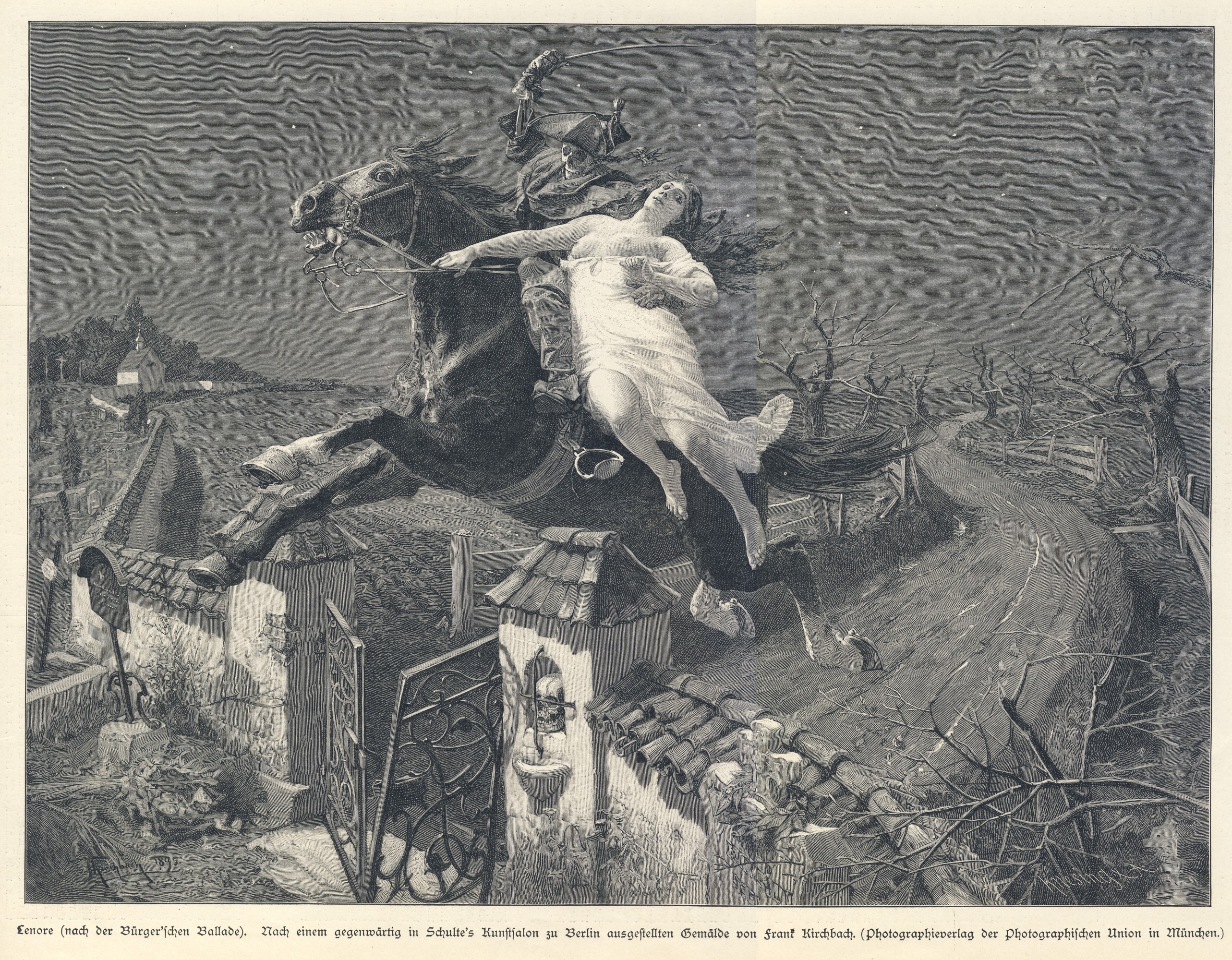
Illustration for Lenore, 1896 by Frank Kirchbach (1859-1912); engraving by Theodore Knesing (1840-1925).

Csongor wants to know if the dead actually do ride fast. Ace’s answer is philosophical: “Over there, among the dead, time has no meaning anymore, so to get distance per hour you’d have to divide by zero, which even if it was legal would still give you infinite speed.”

But before he can really explain his riff on death-speed paradox though, Ace’s rescuers arrive: “the pocket-size golem Zdeněk [and] Hop Wingdale.” Our mini-golem is a cyborg: “Zdeněk’s left arm turns out to be a modified ZB-26 Czech light machine gun, with the magazine built into his shoulder.” He likens it to “one of many earthly variants of Azrael, the Angel of Death” — yet still spares Csongor.

The chapter ends with our heroic trio escaping the fascist camp, fleeing their captors with the aid of a “pocket-size model” of a “a Bangalore torpedo” that Zdeněk has improvised from “a few sticks of dynamite thoughtfully borrowed last week in Transylvania off of a freelance firefighting crew passing through en route to a Romanian oil-well fire everybody could see from fifty miles away.”

The massive fire Pynchon’s narrator refers to here is, with most everything in Shadow Ticket, an historical event. The “torch of Moreni” burned for almost two and a half years, from September 1929 to November 1932.
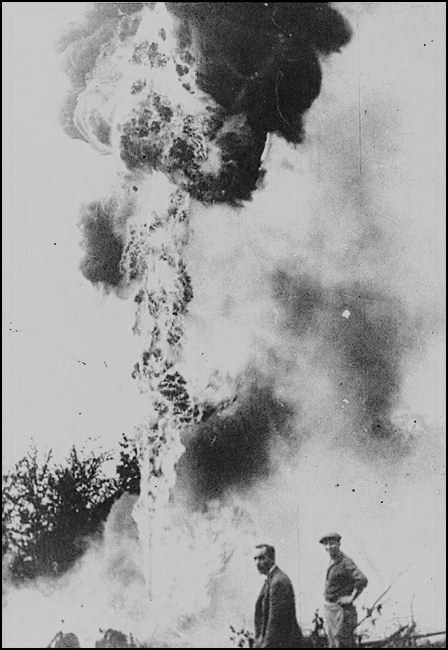
The Moreni oil-well fire.

Chapter 34 opens with a sentence that lays out the situation for us: “Daphne looking for Hop has blundered out into a territory she thought she knew, which in fact the political situation has changed to something unrecognizable and poisonous.”

The Weimar days are over; “Hamburg, once the Swing Kid metropol” is now a Nazi hotbed, where “Blues licks have largely given way to major triads.” Conformity reigns; difference is punished. Daphne finds this out the hard way when she “wanders into a beer garden [Hop’s band] the Klezmopolitans once played at, formerly named the Midnight Mouse after a poem by Christian Morgenstern, now converted to a Sturmlokal” — she’s stumbled into a Nazi bar, and immediately finds herself imperiled by the not-so-subtle sexual predations of fascist goons (“Looking for me, Schätzchen?”)

But before our “Cheez Princess…become[s] fondue” she’s by Glow Tripforth del Vasto in her autogyro-cum-deus-ex-machina. They alight to a tavern; on the way Glow complains that because gyros “are forgiving ships…there’s the danger [of] The idiot appealromance on the cheap.” Modern convenience will puncture Gothic adventures of flight. Any idiot can fly.

Glow, headed to “some kind of anarchist sainthood” in Spain, drops Daphne in Fiume, but first delivers another one of several hey-we’re-about-to-be-in-some-bigger-mess-than-we-thought-we-were-going-to-be-in proclamations: “Whatever it is that’s just about to happen, once it’s over we’ll say, oh well, it’s history, should have seen it coming, and right now it’s all I can do to get on with my life.”

Glow adds, “I don’t care to know more than I need to about the mysteries of time…You’re expecting spiritual wisdom from little G. T. del V.? you’ll be waiting a long time, sucker.” 

The dead might ride fast–but they’re still dead.

Ghostly crawl | Notes on Thomas Pynchon’s Shadow Ticket, Ch. 15-18

Notes on Chapters 1-7 | Glows in the dark.

Notes on Chapters 8-14 | Halloween all the time.


Chapter 15 opens proximal to Xmas time, presumably 1931, still–although it’d take a reread for me to pin down the timeline better. Hicks is in the grip of mild paranoia, feeling like he’s the target of some unknown They. The feeling is a haunting: “light as delusional bugs, the ghostly crawl of professional finger-eye coordination, somewhere above and in the distance, tightening in on whatever is centered in its crosshairs, which at the moment happens to be Hicks’s head.” 

Christmas bugs?!

Hicks’s paranoia is well-placed. He’s “handed a parcel wrapped in festive red-and-green paper whose design features Xmas trees, reindeer, candy canes, so forth. Ribbon tied in a big bow. Something to do with Christmas” by miscreants claiming to be “Santa’s elves.”

Skeptical Hicks denies the supernatural, natch, despite the “ghostly crawl” that’s come over his aspect this haunted season. The so-called elves protest that they are cousins of Billie the Brownie, an historical mainstay of Milawaukee’s Schuster’s Department Store Christmas spectacles.

(I’ve tried not to overload these riffs with too many of Pynchon’s Milwaukee/Milwaukee-proximal references–like, I couldn’t leave Les Paul out when I riffed on Ch. 8, but I didn’t include his reference in the same chapter to Árpád Élő, the Hungarian-American physicist who taught at Marquette in Milwaukee for four decades, during which time he developed the Elo chess rating. Anyway, the point is — for a breezy novel, Shadow Ticket is still pretty dense. Pynchon enjoys fat in the right proportion.)

Anyway, addressing Hicks as “Schultz,” the elves deliver an Xmas package and evaporate into thin air. Then who appears? “Damn if it ain’t the same sawed-off Bolshevik striker Hicks didn’t manage to kill that fateful night not so long ago,” who we learned of back in Ch. 4 (recall Hicks felt some kind of metaphysical interjection prevented his striking down the protester). He warns Hicks to dispose of the package posthaste, insinuating it’s a time bomb.

Hicks steps into Wisebroad’s Shoes in order to use their, yes, X-ray machine. The narrator informs us that, “One of many interesting facts about Milwaukee is that along with the Harley-Davidson motorcycle and the QWERTY typewriter keyboard layout, it’s also the birthplace of the shoe-store X-ray machine.” I have to admit I thought at first that the ridiculousness of such an apparatus struck me as a goofy Pynchonian invention. But shoe-fitting fluoroscopes were like a totally real twentieth-century thing.  (One of the shoe clerks attests that he prefers Brannock devices as X-rays “don’t pick up fat, and fat’s the key, see.”)

The X-ray riff here ties into Shadow Ticket’s themes of mad science, glow-in-the-dark wonders, and strange rays, like those Dr. Swampscott Vobe was said to experiment on his psychiatric patients (Ch. 14) or the irradiated “Radio-Cheez” that helped establish the Airmont cheese fortune (Ch. 13).

Instead of a bomb in the package, Hicks and the shoe clerks see something closer to a face when they peer into the fluoroscope’s lens. The scene is another moment of anxious dread, horror even, woven into the comic zaniness:

“Despite a certain blurriness, Hicks realizes it is inescapably a face, not unchanging and lifeless, like you’d get from a severed head for example, but instead gazing back with its eyes wide open and holding a gleam of recognition, a face he’s supposed to know but doesn’t, or at least can’t name. Mouth about to open and tell him something he should’ve known before this. The window he never wanted to have to look through, the bar he used to know enough not to set foot inside of.”

Hicks disposes of the package in Lake Michigan, where it explodes.

Later, Hicks, haunted and depressed, finds some solace in April. But they both know he won’t keep the girl, even as he dreams of them as partners on the move, “teamed up against each day and its troubles.”

The chapter ends with Hicks trying to pick up the thread of why those elves delivered the bomb to him, and why they called him Schulz. Uncle Lefty isn’t really much help. Hick checks in with the anarchist bombsmith Michele “Kelly” Stecchino, a character who could fit in neatly in Against the Day. Kelly suggests that “an explosion, not always but sometimes, is actually somebody with something to say. Like, a voice, with a message we aren’t receiving so much as overhearing.” He then advises Hicks to get out of town, suggesting a trip to Italy. Hicks protests that Italy’s, “Fascist dictatorship, Professore,” and anarchist Kelly needles him back, asking “What makes you private dicks any different?…Study your history, gabadost, you started off, mosta yiz, breakin up strikes, didn’t ya, same as Mussolini’s boys.” Again, one of the major conflicts in Shadow Ticket is Hicks realizing which side of history he wishes to be on. Hicks then checks in at the Nazi bolwing alley, New Nuremberg Lanes with his old associate Ooly, who thinks that the bomb “don’t feel local. Somethin’s on the way around here, bigger than a gang war.” That would be a World War. Finally, Hicks checks in with Lew Basnight (who was in Against the Day); Lew tells him that what he’s “after is an Overlooked Negative.” Is that something an X-ray could catch? Hicks tells Lew that he was “always what I was hoping to be someday” — and I don’t think he meant it as mere flattery.


Chapter 16 sees the action move out from Milwaukee (much to Hicks’s chagrin). His employer seems to agree with everyone else that he should get out of town for his own health and safety, and the agency sends him to New York (Hicks picks up on the fact that his travel stipend is decidedly a one way sum).

April’s gangster beau Don Peppino sends one of his enforcers along too to suggest he hits the bricks. (The goon tries to hip Hicks to how one might take a “grape so harsh and bitter you’d never make wine from it alone—but when you blend it with other grapes, sometimes only a couple percent, suddenly a miracle” — but Hicks protests that he’s “Only a beer drinker.” The scene is a sweet repetition of sorts of Mason and Dixon’s discussion of grape people and grain people in Mason & Dixon.)

Hicks then goes through some goodbyes with April. I realized that one of my favorite bits in Shadow Ticket is that April always addresses Hicks with a different, sweet-but-pejorative nickname — “Chuckles,” “damned ox,” “Fathead,” “Einsteins” (plural), and my favorite, “ten-minute egg.” They depart in a sweet noir phantasia at Union Station.


Chapter 17 is a relatively short chapter (especially given the sprawl of Chapter 15, which, let me say, I’m sorry that I went on so long about it — part of what I’m trying to do is reread the book by writing about it and tie some themes, motifs, etc. together — I know it went on long. But it was a long chapter, chock full of Important Stuff) — sorry, Chapter 17 is a relatively short ditty, with Hicks’s train moving east through “Depression Pittsburgh, a ghost city” and then entering deeper into the night run, having left behind and below what neon still shone, the Hoovervilles, the ghost-city light, hobo gatherings around trackside trash fires, stray auto headlights gliding briefly alongside the tracks, some fractional moonlight through the windows plus a few dim electric lamps in the observation car, deserted at this hour except for Hicks.” Reviewers and critics will rightly point out that Shadow Ticket is a detective noir; it’s possible to overlook the Gothic horror underpinnings of that genre though. Pynchon often foregrounds this Gothicism, as in the lovely description above. 

Solitary in the observation car, Hicks is approached by “a Pullman porter, whose name, as he’s quick to point out, isn’t George but McKinley.” The reference here is to George Gibbs, a nineteenth century naturalist who, in the parlance of Twain, lit out for the Territory to study, among other things, indigenous languages in the Pacific Northwest.

Our Pullman porter “McKinley Gibbs turns out to be running a sideline in race records; after riffing on politics with Hicks, he slips a few records out for our PI to peruse, including “Blind Blake, ‘Police Dog Blues.’”

We are then told that “McKinley brings it over to the club-car Victrola, puts it on. Before bar three Hicks is about to topple into a romantic nostalgia episode. ‘I’ve heard this. Not on a record, not in a club, but…'”

Presumably the referent for the “it” McKinley possesses is “Police Dog Blues” — but the “romantic nostalgia episode” reveals a different song. The vocalist? “It’s April. Natch.” We get another of Pynchon’s songs, including another of April’s nicknames for Hicks — “dimwit of my dreams” (rhymes with “strange as it seems”). But Hicks’s “romantic nostalgia episode” (American Gothic, I say) is pure reverie. He awakes — no record, no McKinley. Did either ever exist?


Chapter 18: Hicks makes it to New York and does a “courtesy drop-by at the New York branch of U-Ops, which he finds slightly west of Broadway beneath a neon sign featuring a pair of eyeballs electrically switching back and forth between bloodshot vein-crazed and lens-blank pop-bottle green.” The lurid eyeball image mixes nineteenth-century Gothicism with twentieth-century pop. Connie McSpool, on the U-Ops desk, ribs Hicks: “You just missed Judge Crater, he was in here looking for you.” Joseph Force Crater was a New York Supreme Court justice who infamously disappeared and, for a decade or two, was known as America’s “missingest” person. (Maybe surpassed, at the end of the twentieth century, by Jimmy Hoffa.) Shadow Ticket–and Pynchon’s oeuvre in general–features many characters “pulling a Crater.”

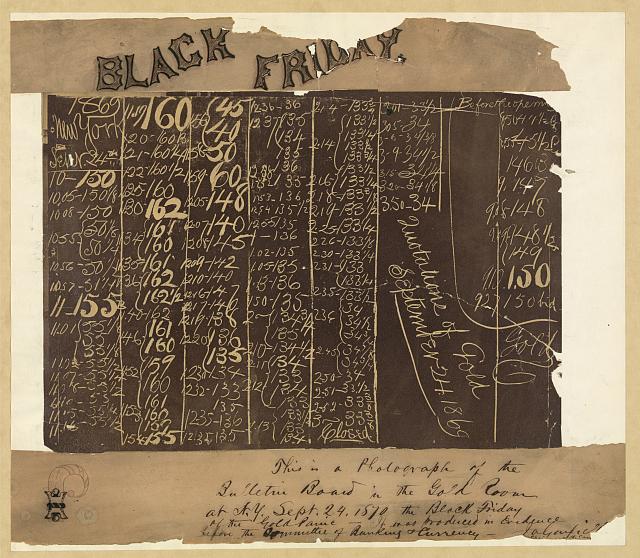
Chapter 18 concludes with Hicks overwhelmed, in true Pynchonian fashion, by a shadowy (tickety?) They. There’s “something weirdly off about Gould Fisk Fidelity and Trust,” the “bank” he finds himself at, getting an unexpected ticket to Europe and two-weeks pay. The reference here is to Black Friday, 1869, where big money boys Jay Gould and Jim Fisk tried to hijack the gold market in a Gilded Age financial thriller. Another fragment, maybe, from Against the Day.

The chapter ends with Hicks at “Club Afterbeat up in Harlem,” complaining to Connie McSpool that someone “wants me 86’d clear out of the U.S.A.” 

We’ll get to that ejection soon.


The incest thing | More scattered thoughts on Cormac McCarthy’s novel The Passenger

He’s in love with his sister and she’s dead.

The Passenger, Cormac McCarthy


The theme of brother-sister incest haunts the early American novel on its lower levels of literacy as well as on the higher—a nightmare from which our writers do not choose to awake too soon, since it is one their readers are willing to pay to share.

Love and Death in the American Novel, Leslie Fiedler


When he woke she was leaning against his shoulder. He thought she was asleep but she was looking out the plane window. We can do whatever we want, she said.

No, he said. We cant.

The Passenger, Cormac McCarthy


She turned to the Kid. What does it say on the trunk?

What does what say? 

There’s a sticker on the trunk.

Yeah. It says progeny of Western Union.

Progeny?

The Passenger, Cormac McCarthy


The last in the series of quotes above is an exchange between Alicia Western and her hort/figment/projection the Thalidomide Kid. The Kid has caused to be brought to Alicia a wiseassed—cruel, even—ventriloquist dummy. The dummy is another fitting prop in the Alicia-Kid episodes that punctuate The Passenger. It again underlines the vaudevillian aspect of these interstitial pieces, while also highlighting the novel’s themes of ventriloquism—of how memory of the dead might speak through the living, as the living grapple with death.

The quips above feature another of the Kid’s malapropisms — in this case his substitution of “progeny of Western Union” for property of Western Union. The Freudian slip (never really a slip on our imp’s tongue) points to The Passenger’s incest motif. It turns out that the dummy’s name is Crandall (perhaps named for the typewriter?). It’s likely Alicia herself named Crandall, and her grandmother tailored his clothes. I think the strong implication is that handy Bobby Western built (fathered) Crandall. In this sense, Crandall is the dreamchild born of a Western union. “I was only six,” Alicia cries as he disappears back into his case.


The incest motif perforates the literary tradition. We find it in Oedipus, in Lot seduced by his daughters, in David’s children Tamar and Amnon–a tale recapitulated in Faulkner’s southern Gothic Absalom! Absalom! We find it coded in Poe’s tale “The Fall of the House of Usher” or made strange but more clear in Melville’s baffling Pierre. We find it in the tawdry attic of V.C. Andrew’s lurid Dollanganger novels (likely read by many more Americans than the other novels I’ve named).

The incest thing in literature is, of course, an exploration of taboo, and is such the rightful property (or progeny) of literature. In his seminal (and often bombastic) study Love and Death in the American Novel, Leslie Fiedler suggests that “brother-sister incest in particular comes to stand in Romantic symbology for the rebellion against paternal authority, for the spirit of revolution itself.” He continues, declaring that the “Oedipal significance” of this revolutionary spirit “projects not only the desire to revolt, but also to die; that is to say, beneath the yearning for rebellion lies hidden the wish to be punished for it.”


Le’ts follow Fiedler’s reading (ahem, rehashing of Freud) and stick it on to the Western children: What is the paternal authority they rebel against—that is, beyond the actual literal father (a marginal memory)? Père Western was one of the lead authors of the atomic bomb. He changed the American relationship to death, permanently.


I have a little under a hundred pages left to go in The Passenger, but if either Bobby or Alicia has expressed overt familiar guilt over their father’s work in engineering mass death, I’ve missed it. What does linger is a deep-seated, unspoken anxiety about their father’s deeds.


At the end of his own surreal and improbable conversation with the Thalidomide Kid, Bobby expresses the only loss of his life, the only ashes in his world:

There is no other loss. Do you understand? The world is ashes. Ashes. For her to be in pain? The least insult? The least humiliation? Do you understand? For her to die alone? Her? There is no other loss. Do you understand? No other loss. None.

The emotional outburst, with its plaintive tone and cycle of repetitions, is rare for Bobby Western: for the most part, when The Passenger juts its free indirect speech into Bobby’s skull, we get simple, direct (if increasingly paranoid) language.


It’s when he thinks of his sister Alicia that Bobby’s voice gives over to passion, to a kind of Gothic romantic language that recalls Poe more than Hemingway. Consider how Gothic frills in the following passage soon give way to an archaic and obscure (yet still ornate) style that recalls the Cormac McCarthy of Blood Meridian:

In his dreams of her she wore at times a smile he tried to remember and she would say to him almost in a chant words he could scarcely follow. He knew that her lovely face would soon exist nowhere save in his memories and in his dreams and soon after that nowhere at all. She came in half nude trailing sarsenet or perhaps just her Grecian sheeting crossing a stone stage in the smoking footlamps or she would push back the cowl of her robe and her blonde hair would fall about her face as she bent to him where he lay in the damp and clammy sheets and whisper to him I’d have been your shadowlane, the keeper of that house alone wherein your soul is safe. And all the while a clangor like the labor of a foundry and dark figures in silhouette about the alchemic fires, the ash and the smoke. The floor lay littered with the stillborn forms of their efforts and still they labored on, the raw half-sentient mud quivering red on the autoclave. In that dusky penetralium they press about the crucible shoving and gibbering while the deep heresiarch dark in his folded cloak urges them on in their efforts. And then what thing unspeakable is this raised dripping up through crust and calyx from what hellish marinade. He woke sweating and switched on the bedlamp and swung his feet to the floor and sat with his face in his hands. Dont be afraid for me, she had written. When has death ever harmed anyone?


(I had not intended to type out the entire passage above, but once I got going I couldn’t stop.)


Bobby’s dream begins as an erotic manifestation of his sister, a Gothic evocation in silk ribbon or Grecian garb. She takes to a “stone stage,” again underscoring the shift into high drama. “I’d have been your shadowlane, the keeper of that house alone wherein your soul is safe,” she declares. The word shadowlane here seems like a symbolic substitution for the near homphone chatelaine, an archaic word for a woman who keeps a castle or great house (readers of Wolfe’s Book of the New Sun series will be familiar with the word).

A chatelaine also refers to a chain belt used for holding keys, an image that carries over into the second half of Bobby’s dream, which shifts from eroticism to terror. Shadowy figures inhabit a “dusky penetralium,” an innermost chamber, a locked place. Here, the figures labor with red “half-sentient mud” (Adamic atoms) in an “autoclave” (self-key). Amidst a litter of stillbirths, the figures toil to bring a new creature into being.

Bobby’s dream moves from brother-sister incest to the Gothic terror of a laboratory creation coming to life—an evocation of the father’s sins. Bobby’s subconscious mind transmutes the Manhattan Project into a satanic ritual presided over by a clandestine “heresiarch” — the damning father figure whose strange experiment impede Bobby’s incestuous consummation. Instead, we get another Western union. And the promise of death.


(More thoughts to come.)

On Walker Percy’s postmodern Gothic novel Lancelot

Walker Percy’s 1977 novel Lancelot opens with an invitation: “Come into my cell. Make yourself at home.”

The invitation is to both the reader and to the titular Lancelot’s audience of one, a friend from his college days he calls Percival. Percival listens to Lancelot’s increasingly-insane, unceasing monologue without interruption.

Lancelot Lamar—Lance, to friends—tells his story from his cell in the Center for Aberrant Behavior. It’s New Orleans, sometime in the mid-seventies. The dream of the sixties has curdled and soured, its failed would-be revolution of love turned to rot.

Lance’s (electrically-sexual) love for his wife Margot begins to sour, fester, and rot. He discovers by chance that he is not the father of their daughter Siobhan, and quickly comes to suspect that Siobhan is the product of Margot’s infidelity with Merlin, a filmmaker whom Margot, an always-aspiring actress, has known for years.

Merlin and his crew are filming at Lance’s ancestral manse, Bell Isle. Belle Isle was once a Great House in its parish, but modernity (and postmodernity) have a way of rotting out traditions. Margot, heiress to a new-money Texas fortune, restores the ancestral home to something-close-to its former glory. Belle Isle and the Lamar name might rub some good old fashioned Southern Aristocracy off on her. Despite those oil dollars, the Lamars still need to allow tour groups to visit Belle Isle—gawking Michiganders and Yankees and the like—in order to keep in the black.

Lancelot Lamar himself has long since stopped working. A one-time liberal who helped the NAACP, he trained as a lawyer, but latterly has taken to lust and drink. At the outset of his tale, our debauched wastrel spends his days in the pigeonnier of Belle Isle slurping bourbon and smoking cigs. His discovery that his daughter is not his own revitalizes him—it’s the revelation—nay, the apocalypse—that splits his life in two: “my life is divided into two parts, Before and After,” he tells Percival in cell.

Percival says all of thirteen words in the novel. Or, really, two words: twelve yeses and one no. It’s never quite clear if Percival is a failed psychiatrist or a failed priest or some hybrid of both, but we do know that Lancelot has long admired Percival since their school days, when the austere intellectual literally jumped ship to swim to a deserted island for a Thoreau-inspired think. Percival, or Lancelot’s ideation of Percival, serves not only as a confessor’s ear, but also as Lancelot’s avatar of intellectual spirituality. In contrast, visceral once-virile Lance (with his oh-so-phallic mantle) rests on his most vibrant college laurels: he once ran 110 yards against the Alabama Crimson Tide.

But back to Lancelot of the Before and After. Specifically, the After. After discovering his wife’s apparent infidelity (infidelities?), Lance enlists the help of his retainer Elgin, the son of Belle Isle’s Black housekeepers. Elgin is an MIT student and a technical genius, a figure whose ascendancy Lancelot can understand but perhaps not fully appreciate. A scion of the South and a one-time “liberal,” Lancelot is unable to fully understand his own racism, even as he understands Elgin’s intellectual and technocratic superiority.

Still, Lancelot comprehends the failure of the 1960’s liberalism to fully follow through on its utopian promise. He relies on Elgin’s gratitude to him, but admits,

…in truth I had done very little for him, the kind of easy favors native liberals do and which are almost irresistible to the doer, if not to the done to, yielding as they do a return of benefit to one and a good feeling to the other all out of proportion to the effort expended. That was one of the pleasures of the sixties: it was so easy to do a little which seemed a lot. We basked in our sense of virtue and what we took to be their gratitude. Maybe that was why it didn’t last very long. Who can stand gratitude?

Driven by his own motives, tech-whiz Elgin sets up secret cameras all around Belle Isle as part of Lancelot’s movie-making scheme: our monologist plans to catch his wife in the act, either with Merlin or another lover. Percy’s postmodernism is subtle but effective here. We see Belle Isle through layers, a Gothic playground of both real and imaginary depravities, some staged, some extemporaneous, all set against the backdrop of the sins of the Gothic South.

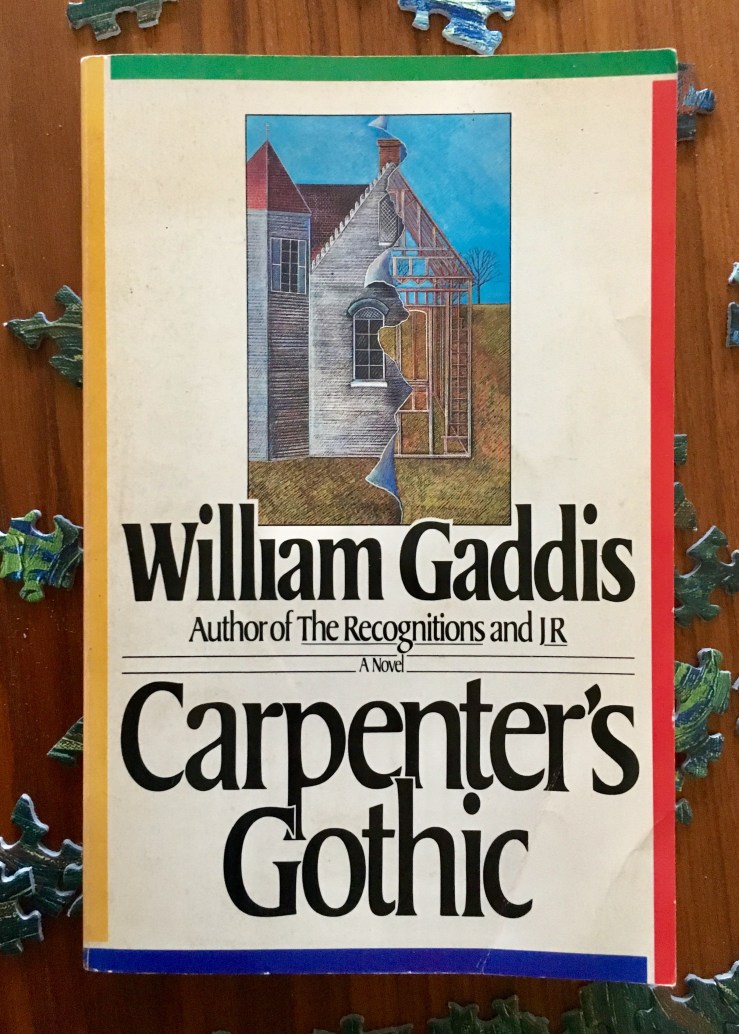
Like William Gaddis’s 1985 novel Carpenter’s Gothic, Percy’s Lancelot is a work of Gothic postmodernism. Belle Isle has been converted to a theme park version of its aristocratic past, glossed up for tourists and film crews. It’s certainly not the scene of domestic bliss.

Lancelot’s monologue starts to boil over into crazed horror, taking the reader (and his auditor Percival) into strange new spaces. Belle Isle becomes a haunted house, scene of repeated debaucheries on the cusp of disaster. The film crew prepares a massive weather machine to simulate a hurricane for their fantasy even as a massive hurricane approaches to destroy the real world. But maybe Lance, in his perverted quest, will destroy that world first.

Lancelot’s Gothic quest is for the anti-Grail, the Unholy Grail. As the novel unravels towards its crazed ending, Lancelot’s consciousness ping-pongs about in philosophical ranting. Our hero stands against postmodernity, against the nascent eighties, against the collapse of the Romantic sixties and its failed revolution. He plans a third Revolution, the final part in the trilogy initiated by the American Revolution and the Civil War. Lancelot’s increasingly unhinged screeds disturb both Percival and the reader. His apocalyptic urge for a great cleansing veers into strange, misogynistic territory.

A failed knight who cannot see his own failure, he becomes obsessed with the woman celled next to him, Anna, victim of a gang rape whom he both fetishizes and idealizes. Lancelot reads like a Southern companion to Martin Scorsese’s 1976 film Taxi Driver. Lance reminds one of Travis Bickle: both are strange, nihilistic, optimistic idealists, would-be knights seeking to save damsels in a fallen world, praying for some great rain to come and cleanse the filth of sin away. 

And like Taxi Driver, Percy’s novel—released around the same time, of course—seems like an early analysis of the failure of the sixties. It’s the burn out, the hangover, the realization that the dream was just a dream, and that the business of reality is cruel and cold and dirty. Perhaps insanity is the proper response.

There’s so much in Lancelot I’ve failed to unpack: Its analysis of America–North, South, and West–its treatment of Hollywood, its strange gnostic tinges, its weird tangled and often colliding philosophies. Lancelot Lamar is an enthralling monologist, witty, severe, pathetic and sympathetic, simultaneously cartoonish and ferociously real. I’ve also failed to convey how funny this novel is—Percy’s prose crackles and zaps, zips and dips, turns into weird little unexpected nooks. I ate it up.

Lancelot was the first Walker Percy novel I’ve read, but it won’t be the last. Great stuff.

On the Halloween chapter of William Gaddis’s novel Carpenter’s Gothic

Mischief Night, Jamie Wyeth

The fourth of seven unnumbered chapters in William Gaddis’s Carpenter’s Gothic is set over the course of Halloween, moving from morning, into afternoon, and then night. Halloween is an appropriately Gothic setting for the midpoint of Gaddis’s postmodern Gothic novel, and there are some fascinating turns in this central chapter.

A summary with spoilers is not necessary here. Suffice to say that our heroine Elizabeth Booth is left alone on Halloween in the dilapidated Rural Gothic style house she and her awful husband Paul rent from mysterious Mr. McCandless. As Paul exits the house to go on one his many fruitless business trips, he notices that some neighborhood kids have already played their Halloween tricks:

He had the front door open but he stood there, looking out, looking up, —little bastards look at that, not even Halloween till tonight but they couldn’t wait… Toilet paper hung in disconsolate streamers from the telephone lines, arched and drooped in the bared maple branches reaching over the windows of the frame garage beyond the fence palings where shaving cream spelled fuck. —Look keep the doors locked, did this last night Christ knows what you’re in for tonight… and the weight of his hand fell away from her shoulder, —Liz? just try and be patient? and he pulled the door hard enough for the snap of the lock to startle her less with threats locked out than herself locked in, to leave her steadying a hand on the newel…

The kids’ Halloween antics take on a particularly sinister aspect here, set against the stark New England background Gaddis conjures. We get gloomy streamers, desolate trees, and the bald, ugly signification of one lone word: fuck. (Fuck and its iterations, along with Gaddis’s old favorite God damn, are bywords in Carpenter’s Gothic). Paul’s reading of this scene is also sinister; he underscores the Gothic motif in telling Elizabeth to “keep the doors locked” because she doesn’t know what she’s “in for tonight.” Tellingly, the aural snap of Paul’s exit shows us that Elizabeth is ultimately more paranoid about being locked in. Indeed, by the middle of the novel, we see her increasingly trapped in her (haunted) house. The staircase newel, an image that Gaddis uses repeatedly in the novel, becomes her literal support. Elizabeth spends the rest of the morning avoiding chores before eventually vomiting and taking a nap.

Then, Gaddis propels us forward a few hours with two remarkable paragraphs (or, I should say, two paragraphs upon which I wish to remark). Here is the first post-nap paragraph:

She woke abruptly to a black rage of crows in the heights of those limbs rising over the road below and lay still, the rise and fall of her breath a bare echo of the light and shadow stirred through the bedroom by winds flurrying the limbs out there till she turned sharply for the phone and dialed slowly for the time, up handling herself with the same fragile care to search the mirror, search the world outside from the commotion in the trees on down the road to the straggle of boys faces streaked with blacking and this one, that one in an oversize hat, sharing kicks and punches up the hill where in one anxious glimpse the mailman turned the corner and was gone.

What a fantastic sentence. Gaddis’s prose here reverberates with sinister force, capturing (and to an extent, replicating) Elizabeth’s disorientation. Dreadful crows and flittering shadows shake Elizabeth, and searching for stability she telephones for the time. (If you are a young person perhaps bewildered by this detail: This is something we used to do. We used to call a number for the time. Like, the time of day. You can actually still do this. Call the US Naval Observatory at 202-762-1069 if you’re curious what this aesthetic experience is like). The house’s only clock is broken, further alienating Elizabeth from any sense of normalcy. In a mode of “fragile care,” anxious Elizabeth glances in the mirror, another Gothic symbol that repeats throughout this chapter. She then spies the “straggle of boys” (a neat parallel to the “black rage of crows” at the sentence’s beginning) already dressed up in horrorshow gear for mischief night and rumbling with violence. The mailman—another connection to the outside world, to some kind of external and steadying authority—simply disappears.

Here is the next paragraph:

Through the festoons drifting gently from the wires and branches a crow dropped like shot, and another, stabbing at a squirrel crushed on the road there, vaunting black wings and taking to them as a car bore down, as a boy rushed the road right down to the mailbox in the whirl of yellowed rust spotted leaves, shouts and laughter behind the fence palings, pieces of pumpkin flung through the air and the crows came back all fierce alarm, stabbing and tearing, bridling at movement anywhere till finally, when she came out to the mailbox, stillness enveloped her reaching it at arm’s length and pulling it open. It looked empty; but then there came sounds of hoarded laughter behind the fence palings and she was standing there holding the page, staring at the picture of a blonde bared to the margin, a full tumid penis squeezed stiff in her hand and pink as the tip of her tongue drawing the beading at its engorged head off in a fine thread. For that moment the blonde’s eyes, turned to her in forthright complicity, held her in their steady stare; then her tremble was lost in a turn to be plainly seen crumpling it, going back in and dropping it crumpled on the kitchen table.

The paragraph begins with the Gothic violence of the crows “stabbing and tearing” at a squirrel. Gaddis fills Carpenter’s Gothic with birds—in fact, the first words of the novel are “The bird”—a motif that underscores the possibility of flight, of escape (and entails its opposite–confinement, imprisonment). These crows are pure Halloween, shredding small mammals as the wild boys smash pumpkins. Elizabeth exits the house (a rare vignette in Carpenter’s Gothic, which keeps her primarily confined inside it) to check the mail. The only message that has been delivered to her though is from the Halloween tricksters, who cruelly laugh at their prank. The pornographic image, ripped from a magazine, is described in such a way that the blonde woman trapped within it comes to life, “in forthright complicity,” making eye contact with Elizabeth. There’s an intimation of aggressive sexual violence underlying the prank, whether the boys understand this or not. The scrap of paper doubles their earlier signal, the shaving creamed fuck written on the garage door.

Elizabeth recovers herself to signify steadiness in return, demonstratively crumpling the pornographic scrap—but she takes it with her, back into the house, where it joins the other heaps of papers, scraps, detritus of media and writing that make so much of the content of the novel. Here, the pornographic scrap takes on its own sinister force. Initially, Elizabeth sets out to compose herself anew; the next paragraph finds her descending the stairs, “differently dressed now, eyeliner streaked on her lids and the
colour unevenly matched on her paled cheeks,” where she answers the ringing phone with “a quaver in her hand.” The scene that follows is an extraordinary displacement in which the phone takes on a phallic dimension, and Elizabeth imaginatively correlates herself with the blonde woman in the pornographic picture. She stares at this image the whole time she is on the phone while a disembodied male voice demands answers she cannot provide:

The voice burst at her from the phone and she held it away, staring down close at the picture as though something, some detail, might have changed in her absence, as though what was promised there in minutes, or moments, might have come in a sudden burst on the wet lips as the voice broke from the phone in a pitch of invective, in a harried staccato, broke off in a wail and she held it close enough to say —I’m sorry Mister Mullins, I don’t know what to… and she held it away again bursting with spleen, her own fingertip smoothing the still fingers hoarding the roothairs of the inflexible surge before her with polished nails, tracing the delicate vein engorged up the curve of its glistening rise to the crown cleft fierce with colour where that glint of beading led off in its fine thread to the still tongue, mouth opened without appetite and the mascaraed eyes unwavering on hers without a gleam of hope or even expectation, —I don’t know I can’t tell you!

Gaddis’s triple repetition of the verb burst links the phone to the phallus and links Elizabeth to the blonde woman. This link is reinforced by the notation of the woman’s “mascaraed eyes,” a detail echoing the paragraph’s initial image of Elizabeth descending the stairs with streaked eyeliner. The final identification between the two is the most horrific—Elizabeth reads those eyes, that image, that scrap of paper, as a work “without a gleam of hope or even expectation.” Doom.

Elizabeth is “saved,” if only temporarily, by the unexpected arrival of the mysterious Mr. McCandless, who quickly stabilizes the poor woman. Gaddis notes that McCandless “caught the newel with her hand…He had her arm, had her hand in fact firm in one of his.” When he asks why she is so upset, she replies, “It’s the, just the mess out there, Halloween out there…” McCandless chalks the mess up to “kids with nothing to do,” but Elizabeth reads in it something more sinister: “there’s a meanness.” McCandless counters that “it’s plain stupidity…There’s much more stupidity than there is malice in the world.” This phrase “Halloween out there” repeats three times in the chapter, suggesting a larger signification—it isn’t just Halloween tonight, but rather, as McCandless puts it, the night is “Like the whole damned world isn’t it.” It’s always Halloween out there in Carpenter’s Gothic, and this adds up to mostly malice of mostly stupidity in this world—depending on how you read it.

The second half of the chapter gives over to McCandless, who comes to unexpectedly inhabit the novel’s center. Elizabeth departs, if only for a few hours, leaving McCandless alone, if only momentarily. A shifty interlocutor soon arrives on the thresh hold of his Carpenter Gothic home, and we learn some of his fascinating background. It’s a strange moment in a novel that has focused so intently on the consciousness of Elizabeth, but coming in the novel’s center, it acts as a stabilizing force. I won’t go into great detail here—I think much of what happens when McCandless is the center of the narrative is best experienced without any kind of spoiler—but we get at times from him a sustained howl against the meanness and stupidity of the world. He finally ushers his surprise interlocutor out of his home with the following admonition: “It’s Halloween out there too.”

[Ed. note–Biblioklept first published this post in October of 2018.]

A patchwork of conceits, a hodgepodge of good intentions, another blog about William Gaddis’s novel Carpenter’s Gothic

img_1155

In its sixth (and penultimate chapter), William Gaddis’s 1985 novel Carpenter’s Gothic includes a rare scene. Our heroine Elizabeth Booth exits the house she spends most of the book confined in and actually looks at it from the outside. With her is the house’s owner, the mysterious Mr. McCandless:

—I’ve never really looked at it.

—At what… looking where she was looking.

—At the house. From outside I mean.

Carpenter’s Gothic is a novel of utter interiority—the reader never makes it but a few feet out of the house, and only then on rare occasions. This postmodern Gothic novel tingles with a smothering claustrophobia, its insularity underscored by continual references to other spaces outside the house. The possibility of an outside world waiting for Elizabeth is realized through dialogue with her husband Paul, her brother Billy, and mysterious Mr. McCandless, as well as the non-stop (and, from the reader’s perspective, one-sided) telephone conversations that make up so much of the novel’s material. And yet with all its references to traveling away to California, Africa, New York City, Acapulco, etc., Carpenter’s Gothic keeps Elizabeth locked away in the old house, tethered to the umbilical phone cord at the novel’s center.

McCandless is off in his own interior space—the shifting tortured howl of his own consciousness—when Elizabeth remarks that she has never really seen the house from the outside. Her observation raises him “to the surface” of concrete reality:

—Oh the house yes, the house. It was built that way yes, it was built to be seen from outside it was, that was the style, he came on, abruptly rescued from uncertainty, raised to the surface —yes, they had style books, these country architects and the carpenters it was all derivative wasn’t it, those grand Victorian mansions with their rooms and rooms and towering heights and cupolas and the marvelous intricate ironwork.

The house is built in the Carpenter Gothic style (sometimes called Rural Gothic style), which essentially amounts to an American imitation of European Gothic’s forceful elegance. McCandless continues:

That whole inspiration of medieval Gothic but these poor fellows didn’t have it, the stonework and the wrought iron. All they had were the simple dependable old materials, the wood and their hammers and saws and their own clumsy ingenuity bringing those grandiose visions the masters had left behind down to a human scale with their own little inventions, those vertical darts coming down from the eaves? and that row of bull’s eyes underneath?

McCandless, stand-in for Gaddis, performs a metatextual interpretation for the reader. The Carpenter Gothic is Carpenter’s Gothic, the American postGothic reinterpreation of the European form—namely, the Gothic novel. The materials Gaddis uses to build his book are the materials of mass media and mass textuality. He condenses high literature, lurid newspaper clippings, mail, textbook pages, scraps of illegible notes, pornographic centerfolds, and every other manner of paper into a postGothic synthesis. And not just paper, but also the telephone (always ringing) and the radio (always on, always tuned to inhuman human voices). And the television too, tuned to Orson Welles as Mr. Rochester in Jane Eyre (dir. Robert Stevenson, 1943),  a film which weaves its way in and out of Elizabeth’s consciousness in the beginning of the novel, planting seeds of romance and locked rooms and secrets and fire.

But I’ve cut off McCandless, who was just about to give us another neat description of the Carpenter Gothic, which is to say another neat description of Carpenter’s Gothic:

He was up kicking leaves aside, gesturing, both arms raised embracing —a patchwork of conceits, borrowings, deceptions, the inside’s a hodgepodge of good intentions like one last ridiculous effort at something worth doing even on this small a scale, because it’s stood here, hasn’t it, foolish inventions and all it’s stood here for ninety years…

 Carpenter’s Gothic is more than just a hodgepodge or patchwork; it is more than a ridiculous effort; it is more than the sum of its foolish inventions. Gaddis gives us something new, a postmodern Gothic analysis of the end of the American century.

McCandless, Gaddis’s stand-in, wants to put all the pieces together. He echoes Jack Gibbs, the (anti-)hero (and fellow Gaddis stand-in) of J R, and he prefigures the narrator of Gaddis’s last novel, Agapē Agape, who, like Gibbs, strives to stitch together something from the atomized scraps and remnants of the 20th century.  Gaddis’s protagonists contend with entropy and attempt to get the detritus of the modern world “sorted and organized.” The push-pull of hope and despair drives these protagonists, but often drives them too far.

And McCandless’s reverie takes him too far, again into the interiority of his skull:

…breaking off, staring up where her gaze had fled back with those towering heights and cupolas, as though for some echo: It’s like the inside of your head McCandless, if that was what brought him to add —why when somebody breaks in, it’s like being assaulted, it’s the…

In a moment of self-speech, McCandless realizes that the Carpenter Gothic is “like the inside of [his] head,” underscoring his connection to his creator, Gaddis, as well as the connection between the house and the novel.

The (always) ringing phone punctures the scene:

—Listen! The phone had rung inside and she started up at the second ring, sank back with the third. —All I meant was, it’s a hard house to hide in…

Elizabeth’s lines here emphasize Carpenter’s Gothic’s central Gothicism—the Carpenter Gothic and Carpenter’s Gothic is a hard place to hide in. Secrets will out.

And so well where does our hodgepodge of good intentions lead?

Blog about Blog about 4

img_1220

On 1 Oct. 2018 on this foolish blog I foolishly wrote about my foolishgood intent to blog about something—books, film, art—every day or nearly every day.” I added, ” I’m not sure how it will go,” although I was a little bit sure about how it would go, which was, not great. Like, I knew that I would stumble in writing every day this month, which I have. October has snuck up (or sneaked up) on me like a thief or a serpent or a hobbit or a pick-your-simile—I even somehow missed taking my kid to her dentist appointment yesterday, and will almost surely get a bill from them over that. October sneaked/snuck up on me, and here we are 16 of 31 days in, and I have only managed 10 of these posts (including this one), which is like, 10 of 16, or 62.5%. (10/16 is also today’s date though, so like, uh, so like nothing).

Anyway.

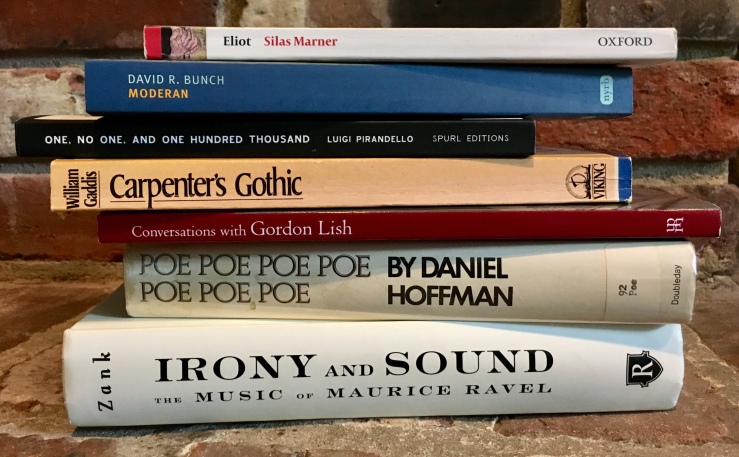
have been reading, and the initial blog I wrote about even included some specific goals, along with this picture, which semi-summarized those goals:

From bottom to top—

did, as I promised I would, return (and not steal) the Ravel book, Irony and Sound, which was frankly over my head.

I have not returned to Hoffman’s Poe book, but I haven’t shelved it.

I’ve been reading the Gordon Lish interviews. Like, the book is good—it’s sort of almost like a book of Lish stories. I blogged about it a bit even.

I’ve absolutely loved reading William Gaddis’s third novel Carpenter’s Gothic. It’s turned out to be a perfect Halloween novel, too. I’ll finish the last of its seven chapters tonight—I would’ve finished last night, but I got sidetracked by some lines that reminded me of Leslie Fiedler’s 1960 analysis of American literature, Love and Death in the American Novel. Gaddis’s book in many ways performs a similar analysis to Fiedler’s—they both trace the weight of American guilt. As if anticipating Gaddis’s postmodern postGothic Gothic novel, Fiedler writes, a quarter century before Carpenter’s Gothic’s publication,

…in the United States, certain special guilts awaited projection in the gothic form. A dream of innocence had sent Europeans across the ocean to build a new society immune to the compounded evil of the past from which no one else in Europe could ever feel himself free. But the slaughter of the Indians, who would not yield their lands to the carriers of utopia, and the abominations of the slave trade, in which the black man, rum, and money were inextricably entwined in a knot of guilt, provided new evidence that evil did not remain with the world that had been left behind—but stayed alive in the human heart, which had come the long way to America only to confront the horrifying image of itself.

(I have stalled out on writing a stupid “Blog about” blog post these past few days because I have been cobbling together notes on something about Fiedler and Gaddis. But, like, really—I need to finish Gaddis’s book first).

No dent in the Pirandello.

I’ll return to David Bunch’s Moderan after finishing Carpenter’s Gothic. Bunch’s work is, so far, a perfectly-pitched pitch black satire of toxic (like nuclearly-toxic) masculinity. Horror-as-comedy, weird and undelightful.

I finished George Eliot’s Silas Marner pretty quickly in October, and enjoyed it. I’m glad I read Middlemarch first though. What Eliot next, reader?

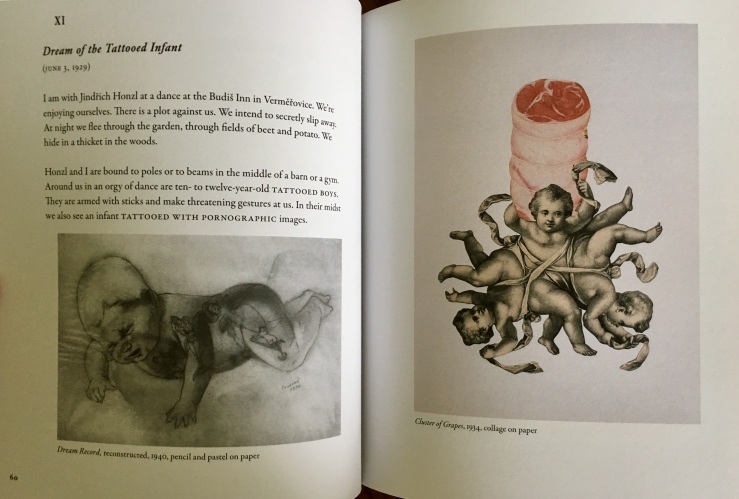
So—what next? The picture at the top is the stack I’ve been stacking and unstacking and restacking. Gaddis and Fiedler feel like the thing I really want to write about—gender roles, Gothic promises, domesticity vs. adventure, the house vs. the frontier, the collapse of self into fragments of language, etc. I’m also loving Dreamverse, a collection of poems, art, and prose by Jindřich Štyrský’ that Twisted Spoon Press has put together.  Its insides look like this, at least in one place—

img_1162

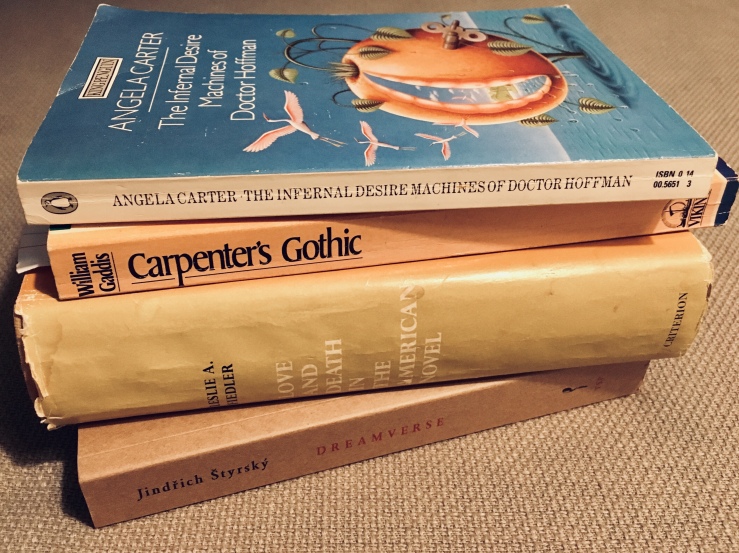
I think the next novel I will read will be Angela Carter’s The Infernal Machines of Doctor Hoffman.

Blog about about the Halloween chapter of William Gaddis’s novel Carpenter’s Gothic

Mischief Night, Jamie Wyeth

The fourth of seven unnumbered chapters in William Gaddis’s Carpenter’s Gothic is set over the course of Halloween, moving from morning, into afternoon, and then night. Halloween is an appropriately Gothic setting for the midpoint of Gaddis’s postmodern Gothic novel, and there are some fascinating turns in this central chapter.

A summary with spoilers is not necessary here. Suffice to say that our heroine Elizabeth Booth is left alone on Halloween in the dilapidated Rural Gothic style house she and her awful husband Paul rent from mysterious Mr. McCandless. As Paul exits the house to go on one his many fruitless business trips, he notices that some neighborhood kids have already played their Halloween tricks:

He had the front door open but he stood there, looking out, looking up, —little bastards look at that, not even Halloween till tonight but they couldn’t wait… Toilet paper hung in disconsolate streamers from the telephone lines, arched and drooped in the bared maple branches reaching over the windows of the frame garage beyond the fence palings where shaving cream spelled fuck. —Look keep the doors locked, did this last night Christ knows what you’re in for tonight… and the weight of his hand fell away from her shoulder, —Liz? just try and be patient? and he pulled the door hard enough for the snap of the lock to startle her less with threats locked out than herself locked in, to leave her steadying a hand on the newel…

The kids’ Halloween antics take on a particularly sinister aspect here, set against the stark New England background Gaddis conjures. We get gloomy streamers, desolate trees, and the bald, ugly signification of one lone word: fuck. (Fuck and its iterations, along with Gaddis’s old favorite God damn, are bywords in Carpenter’s Gothic). Paul’s reading of this scene is also sinister; he underscores the Gothic motif in telling Elizabeth to “keep the doors locked” because she doesn’t know what she’s “in for tonight.” Tellingly, the aural snap of Paul’s exit shows us that Elizabeth is ultimately more paranoid about being locked in. Indeed, by the middle of the novel, we see her increasingly trapped in her (haunted) house. The staircase newel, an image that Gaddis uses repeatedly in the novel, becomes her literal support. Elizabeth spends the rest of the morning avoiding chores before eventually vomiting and taking a nap.

Then, Gaddis propels us forward a few hours with two remarkable paragraphs (or, I should say, two paragraphs upon which I wish to remark). Here is the first post-nap paragraph:

She woke abruptly to a black rage of crows in the heights of those limbs rising over the road below and lay still, the rise and fall of her breath a bare echo of the light and shadow stirred through the bedroom by winds flurrying the limbs out there till she turned sharply for the phone and dialed slowly for the time, up handling herself with the same fragile care to search the mirror, search the world outside from the commotion in the trees on down the road to the straggle of boys faces streaked with blacking and this one, that one in an oversize hat, sharing kicks and punches up the hill where in one anxious glimpse the mailman turned the corner and was gone.

What a fantastic sentence. Gaddis’s prose here reverberates with sinister force, capturing (and to an extent, replicating) Elizabeth’s disorientation. Dreadful crows and flittering shadows shake Elizabeth, and searching for stability she telephones for the time. (If you are a young person perhaps bewildered by this detail: This is something we used to do. We used to call a number for the time. Like, the time of day. You can actually still do this. Call the US Naval Observatory at 202-762-1069 if you’re curious what this aesthetic experience is like). The house’s only clock is broken, further alienating Elizabeth from any sense of normalcy. In a mode of “fragile care,” anxious Elizabeth glances in the mirror, another Gothic symbol that repeats throughout this chapter. She then spies the “straggle of boys” (a neat parallel to the “black rage of crows” at the sentence’s beginning) already dressed up in horrorshow gear for mischief night and rumbling with violence. The mailman—another connection to the outside world, to some kind of external and steadying authority—simply disappears.

Here is the next paragraph:

Through the festoons drifting gently from the wires and branches a crow dropped like shot, and another, stabbing at a squirrel crushed on the road there, vaunting black wings and taking to them as a car bore down, as a boy rushed the road right down to the mailbox in the whirl of yellowed rust spotted leaves, shouts and laughter behind the fence palings, pieces of pumpkin flung through the air and the crows came back all fierce alarm, stabbing and tearing, bridling at movement anywhere till finally, when she came out to the mailbox, stillness enveloped her reaching it at arm’s length and pulling it open. It looked empty; but then there came sounds of hoarded laughter behind the fence palings and she was standing there holding the page, staring at the picture of a blonde bared to the margin, a full tumid penis squeezed stiff in her hand and pink as the tip of her tongue drawing the beading at its engorged head off in a fine thread. For that moment the blonde’s eyes, turned to her in forthright complicity, held her in their steady stare; then her tremble was lost in a turn to be plainly seen crumpling it, going back in and dropping it crumpled on the kitchen table.

The paragraph begins with the Gothic violence of the crows “stabbing and tearing” at a squirrel. Gaddis fills Carpenter’s Gothic with birds—in fact, the first words of the novel are “The bird”—a motif that underscores the possibility of flight, of escape (and entails its opposite–confinement, imprisonment). These crows are pure Halloween, shredding small mammals as the wild boys smash pumpkins. Elizabeth exits the house (a rare vignette in Carpenter’s Gothic, which keeps her primarily confined inside it) to check the mail. The only message that has been delivered to her though is from the Halloween tricksters, who cruelly laugh at their prank. The pornographic image, ripped from a magazine, is described in such a way that the blonde woman trapped within it comes to life, “in forthright complicity,” making eye contact with Elizabeth. There’s an intimation of aggressive sexual violence underlying the prank, whether the boys understand this or not. The scrap of paper doubles their earlier signal, the shaving creamed fuck written on the garage door.

Elizabeth recovers herself to signify steadiness in return, demonstratively crumpling the pornographic scrap—but she takes it with her, back into the house, where it joins the other heaps of papers, scraps, detritus of media and writing that make so much of the content of the novel. Here, the pornographic scrap takes on its own sinister force. Initially, Elizabeth sets out to compose herself anew; the next paragraph finds her descending the stairs, “differently dressed now, eyeliner streaked on her lids and the
colour unevenly matched on her paled cheeks,” where she answers the ringing phone with “a quaver in her hand.” The scene that follows is an extraordinary displacement in which the phone takes on a phallic dimension, and Elizabeth imaginatively correlates herself with the blonde woman in the pornographic picture. She stares at this image the whole time she is on the phone while a disembodied male voice demands answers she cannot provide:

The voice burst at her from the phone and she held it away, staring down close at the picture as though something, some detail, might have changed in her absence, as though what was promised there in minutes, or moments, might have come in a sudden burst on the wet lips as the voice broke from the phone in a pitch of invective, in a harried staccato, broke off in a wail and she held it close enough to say —I’m sorry Mister Mullins, I don’t know what to… and she held it away again bursting with spleen, her own fingertip smoothing the still fingers hoarding the roothairs of the inflexible surge before her with polished nails, tracing the delicate vein engorged up the curve of its glistening rise to the crown cleft fierce with colour where that glint of beading led off in its fine thread to the still tongue, mouth opened without appetite and the mascaraed eyes unwavering on hers without a gleam of hope or even expectation, —I don’t know I can’t tell you!

Gaddis’s triple repetition of the verb burst links the phone to the phallus and links Elizabeth to the blonde woman. This link is reinforced by the notation of the woman’s “mascaraed eyes,” a detail echoing the paragraph’s initial image of Elizabeth descending the stairs with streaked eyeliner. The final identification between the two is the most horrific—Elizabeth reads those eyes, that image, that scrap of paper, as a work “without a gleam of hope or even expectation.” Doom.

Elizabeth is “saved,” if only temporarily, by the unexpected arrival of the mysterious Mr. McCandless, who quickly stabilizes the poor woman. Gaddis notes that McCandless “caught the newel with her hand…He had her arm, had her hand in fact firm in one of his.” When he asks why she is so upset, she replies, “It’s the, just the mess out there, Halloween out there…” McCandless chalks the mess up to “kids with nothing to do,” but Elizabeth reads in it something more sinister: “there’s a meanness.” McCandless counters that “it’s plain stupidity…There’s much more stupidity than there is malice in the world.” This phrase “Halloween out there” repeats three times in the chapter, suggesting a larger signification—it isn’t just Halloween tonight, but rather, as McCandless puts it, the night is “Like the whole damned world isn’t it.” It’s always Halloween out there in Carpenter’s Gothic, and this adds up to mostly malice of mostly stupidity in this world—depending on how you read it.

The second half of the chapter gives over to McCandless, who comes to unexpectedly inhabit the novel’s center. Elizabeth departs, if only for a few hours, leaving McCandless alone, if only momentarily. A shifty interlocutor soon arrives on the thresh hold of his Carpenter Gothic home, and we learn some of his fascinating background. It’s a strange moment in a novel that has focused so intently on the consciousness of Elizabeth, but coming in the novel’s center, it acts as a stabilizing force. I won’t go into great detail here—I think much of what happens when McCandless is the center of the narrative is best experienced without any kind of spoiler—but we get at times from him a sustained howl against the meanness and stupidity of the world. He finally ushers his surprise interlocutor out of his home with the following admonition: “It’s Halloween out there too.”


How could one tell where the American dream ended and the Faustian nightmare began

But why, one is driven to ask, why has the tale of terror so special an appeal to Americans? Surely its success must be derived in part from the failure of love in our fiction; the death of love left a vacuum at the affective heart of the American novel into which there rushed the love of death. The triumph of the genteel sentimental incapacitated even our most talented writers, left them incapable of dealing with the relations of men and women as subtly and convincingly as the prose writers in the great novelistic tradition of France. Our novelists, deprived of the subject that sustained Stendhal or Constant, Flaubert or Proust, that seemed indeed to them the subject of the novel, turned to fables of loneliness and terror.

Moreover, in the United States, certain special guilts awaited projection in the gothic form. A dream of innocence had sent Europeans across the ocean to build a new society immune to the compounded evil of the past from which no one else in Europe could ever feel himself free. But the slaughter of the Indians, who would not yield their lands to the carriers of utopia, and the abominations of the slave trade, in which the black man, rum, and money were inextricably entwined in a knot of guilt, provided new evidence that evil did not remain with the world that had been left behind—but stayed alive in the human heart, which had come the long way to America only to confront the horrifying image of itself. Finally, there was the myth of Faust and of the diabolic bargain, which, though not yet isolated from gothic themes of lesser importance (that isolation was to be the word of American writers!), came quite soon to seem identical with the American myth itself.

How could one tell where the American dream ended and the Faustian nightmare began; they held in common the hope of breaking through all limits and restraints, of reaching a place of total freedom where one could with impunity deny the Fall, live as if innocence rather than guilt were the birthright of all men. In Huck’s blithe assertion, “All right, I’ll go to Hell,” is betrayed a significant undermeaning of the Faustian amor fati, at least in its “boyish” American form: the secret belief that damnation is not all it is cracked up to be.

From Leslie Fiedler’s Love and Death in the American Novel (1960).

The gothic is an avant-garde genre

…the gothic is an avant-garde genre, perhaps the first avant-garde art in the modern sense of the term. A pursuit, half serious enterprise, half fashionable vice, of the intellectuals of the end of the 18th century, it remained highbrow enough to tempt the Shelleys and Byron, for instance, to try their hands at it. The popular success of Frankenstein, perpetuated still in movies, and known in its essence to children in the street, obscured the fact that it was launched as an advanced book; and that it belongs to a kind, one of whose functions was to shock the bourgeoisie into an awareness of what a chamber of horrors its own smugly regarded world really was. If some examples of the early gothic strike us now is comical, this is only in part the result of changing taste; such books were from the beginning intended to be, in part at least, a joke on the middle class reader who would inevitably find them too funny or not funny enough!

From Leslie Fiedler’s Love and Death in the American Novel (1960).

The primary meaning of the gothic romance, then, lies in its substitution of terror for love as a central theme of fiction

The primary meaning of the gothic romance, then, lies in its substitution of terror for love as a central theme of fiction. The titillation of sex denied, it offers its readers a vicarious participation in a flirtation with death—approach and retreat, approach and retreat, the fatal orgasm eternally mounting and eternally checked. More than that, however, the gothic is the product of an implicit aesthetic that replaces the classic concept of nothing-in-excess with the revolutionary doctrine that nothing succeeds like excess. Aristotle’s guides for achieving the tragic without falling into “the abominable” are stood on their heads, “the abominable” itself being made the touchstone of effective art. Dedicated to producing nausea, to transcending the limits of taste and endurance, the gothic novelist is driven to seek more and more atrocious crimes to satisfy the hunger for “too-much” on which he trades.

It is not enough that his protagonist commit rape; he must commit it upon his mother or sister; and if he himself is a cleric, pledged to celibacy, his victim a nun, dedicated to God, all the better! Similarly, if he commits murder, it must be his father who is his victim; and the crime must take place in darkness, among the decaying bodies of his ancestors, on hallowed ground. It is as if such romancers were pursuing some ideal of absolute atrocity which they cannot quite flog their reluctant imaginations into conceiving…

Some would say, indeed, that the whole tradition of the gothic is a pathological symptom rather than a proper literary movement, a reversion to the childish game of scaring oneself in the dark, or a plunge into sadist fantasy, masturbatory horror. For Wordsworth, for instance, heir of the genteel sentimentality of the eighteenth century, gothic sensationalism seemed merely a response (compounding the ill to which it responded) to the decay of sensibility in an industrialized and brutalized world—in which men had grown so callous that only shock treatments of increasing intensity could move them to react.

From Leslie Fiedler’s Love and Death in the American Novel.

Hark! A Vagrant Does Wuthering Heights

At Hark! A Vagrant, satirist supreme Kate Beaton sends up Wuthering Heights. Beaton’s book is now available for preorder.